
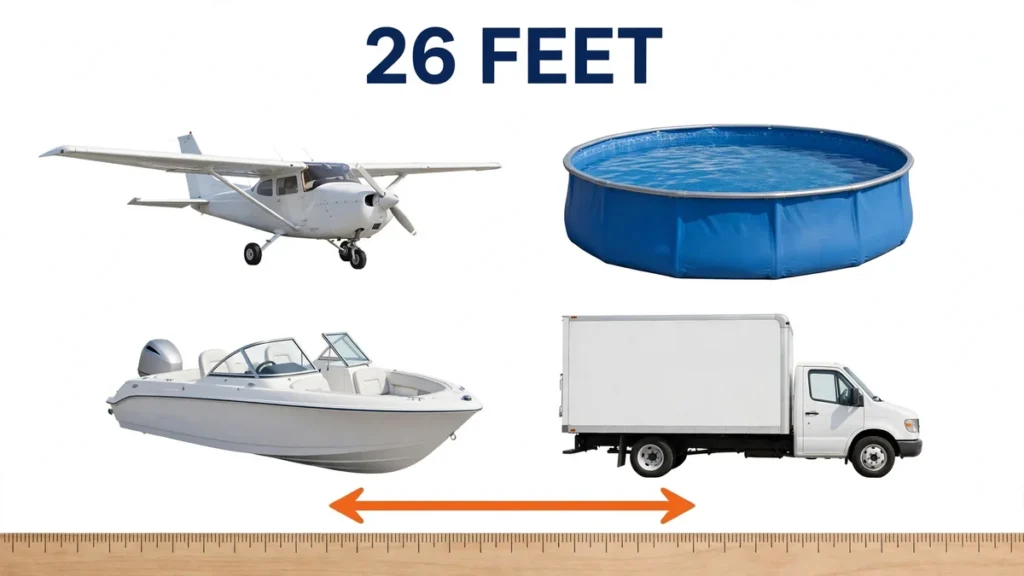
Twenty-six feet is the length of the best-selling aeroplane of the 21st century, and it is also the length of the biggest truck you can drive without a commercial licence — and those two facts are the same fact, because both machines were drawn to 7.92 metres. The Cirrus SR22, the four-seat single-engine aeroplane that has outsold every other general-aviation aeroplane built this century, prints its length as 26 feet, 7.92 metres, on the manufacturer's own specification sheet. The Grady-White Freedom 265, a brand-new dual-console boat shown at the Fort Lauderdale boat show in October 2026, prints its centreline length as 26 feet, 7.92 metres, on its own specification page. Two factories, two continents, two machines that will never meet — and the same number, to the centimetre. That is what how long is 26 feet actually looks like — not a round number, but a real machine you can stand next to.
That coincidence is the story of this article, because 26 feet is the rare length in this series that is exact in the metric system without being round in either one. Twenty-six feet is 7.9248 metres exactly, and 7.92 metres is what both spec sheets round it to — which means the number you picture in feet and the number you picture in metres are the same tape, not two different tapes. The eight things below are the closest honest answers: two of them are 26 feet to the inch, one of them is 26 feet on the reading that matters and a foot and seven inches over on the reading that does not, and the rest carry a named model and a printed miss, from two inches to three feet. None of them is a stack, a multiple, a fraction, a sum, a range, or a category guess. By the end you will know 26 feet as an aeroplane, a pool, a boat, a truck, a sailboat, a lift, a snake, and a ladder — and you will know which of those you can trust to the inch and which one is three feet shorter than its own name.
Why 26 Feet Is 7.92 Metres — and Why 8 Metres Is Wrong
Every guide that answers this question tells you to call 26 feet "about 8 metres", and every one of them is wrong by three inches. Eight metres is 26 feet 3 inches — 7.92 metres is 26 feet, and the three inches between them is the difference between a truck that fits in the bay and a truck that does not, a pool that fits in the garden and a pool that does not, a boat that fits in the berth and a boat that does not. The honest shortcut is 7.92 metres, or 312 inches, or 8 yards and 2 feet — and the only one of those that is round is none of them, which is exactly why 26 feet has real objects behind it instead of round numbers. A length that is 8 yards and 2 feet is nobody's round number, so nobody built a rulebook around it; instead, manufacturers built machines to it, and the machines are the evidence.
The trap works the other way too. A 26-foot truck is not 26 feet long — its cargo box is 26 feet 2 inches, and the whole vehicle with the cab is longer still. A ladder sold as 26 feet is not 26 feet of ladder — it is about 23 feet of ladder and 26 feet of reach. A boat with 26 in its name is not 26 feet long — the best-known 26-footers measure 27 to 28 feet bumper to bumper, or bow to swim platform. The name on the box is a size class, a floorplan code, or a reach height, and the tape is something else entirely. This article prints both readings wherever they differ, because the difference is the whole point: trust the spec sheet, print the deviation, and let the name stay on the box where it belongs.
Quick Answer
26 feet is 7.9248 metres exactly — 792.48 centimetres, 7,924.8 millimetres, 312 inches, and 8 yards and 2 feet. But do NOT call it 8 metres: 8 metres is 26 feet 3 inches, which is 3 inches longer than 26 feet, and do NOT call it 7 metres either: 7 metres is 22 feet 11 inches, which is more than 3 feet shorter. The honest shortcut is 7.92 metres — and the honest objects are the Cirrus SR22, 26 feet long by its manufacturer's specification sheet, and the Intex Ultra XTR 26-foot pool, 26 feet across by its maker's own manual.
The 8 Objects at a Glance
| Object | Figure | Miss vs 26 ft | Grade |
|---|---|---|---|
| Cirrus SR22 | 26 ft 0 in long | 0 | LISTED |
| Intex Ultra XTR 26-ft pool | 26 ft diameter | 0 | LISTED |
| Grady-White Freedom 265 | 26 ft centreline; 27 ft 7 in overall | 0 / 1 ft 7 in over | LISTED |
| U-Haul 26-ft moving truck | 26 ft 2 in interior | 2 in over | LISTED |
| Hunter 26 sailboat | 25.75 ft LOA | 3 in short | LISTED |
| JLG T26E mast lift | 26 ft 6 in platform height | 6 in over | LISTED |
| Medusa, reticulated python | 25 ft 2 in | 10 in short | REPORTED |
| Werner MT-26 multi-ladder | 26 ft reach; ~23 ft of ladder | ~3 ft short | LISTED |
Two of the eight land on 26 feet to the inch, and every object with a fixed figure sits inside a ten-inch band except the ladder, which is the article's lesson about what a name means. Step across the table and the numbers barely move — and then they jump, once, by three feet, which is why the ladder is last.
The 8 Objects
The eight objects below are ordered by how close they land, and each one carries its evidence grade in the heading. LISTED means the figure is the manufacturer's or operator's published specification for the named model. REPORTED means the figure is the largest verified measurement an expert source reports for the named thing. There is no EXACT in this article, because no rulebook writes 26 feet the way the Laws of the Game write 24 — but two spec sheets print 26 feet 0 inches, and that is as close to exact as a manufactured thing gets. No object here is a stack, a multiple, a fraction, a sum, or a category guess.
1. A Cirrus SR22 — 26 Ft 0 In Long (LISTED)

The Cirrus SR22 is the article's cleanest exact, because its 26 feet is printed on the specification sheet of the best-selling general-aviation aeroplane of the 21st century. Cirrus Aircraft lists the SR22 at 26 feet long, 7.9 metres, with a wingspan of 38 feet 4 inches and a height of 8 feet 11 inches — a four- or five-seat, single-engine, fixed-gear aeroplane powered by a 310-horsepower Continental IO-550-N, with a maximum gross weight of 3,600 pounds and a whole-airframe parachute, the Cirrus Airframe Parachute System, fitted as standard. Walk from the propeller spinner to the tail and you have walked 26 feet — the same on every SR22 ever built, because the type certificate is the product.
The fitting check is the propeller, because the aeroplane's 26 feet is its overall length and its wingspan is 38 feet 4 inches — twelve feet wider than it is long — and the thing people misjudge is which dimension a hangar is sold against. A hangar bought against "26 feet" for this aeroplane fits on the length, because the length is the smaller number, and the wingspan is the number that decides whether the doors close. The guides that call a 26-foot aeroplane "about 26 feet" never say whether they mean the fuselage, the wingspan, or the trailer, because they never read the specification — and the AOPA spec sheet prints all three numbers in one row, which is why it is the source here and not a listicle. The grade is listed because the figure is the maker's own specification for the named model, with the deviation printed in full: 26 feet 0 inches, zero inches of miss. Measure the spinner before you measure the hangar, because the Cirrus is the object in this article you fly.
2. An Intex Ultra XTR 26-Foot Round Pool — 26 Ft Across (LISTED)
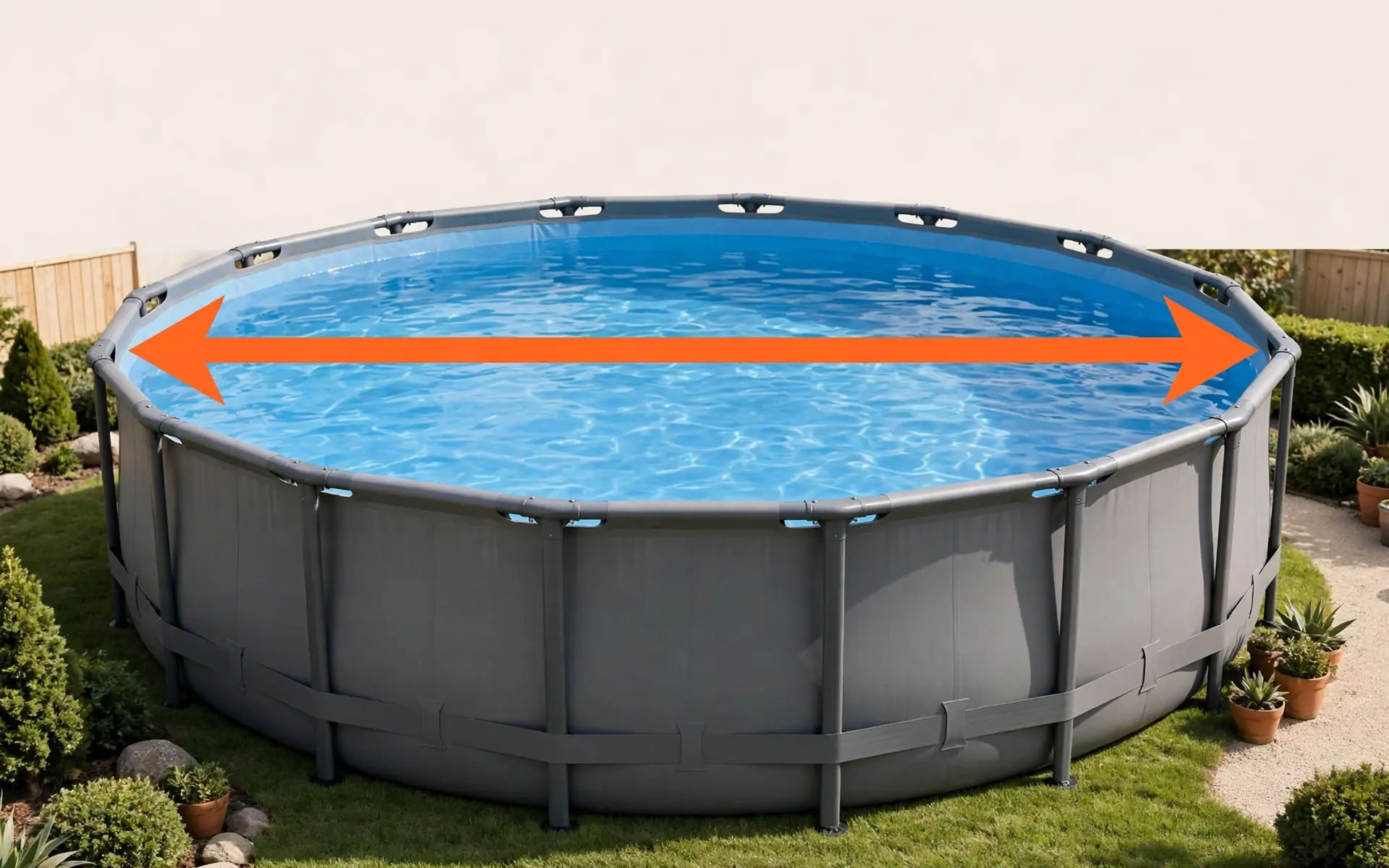
The pool is the article's most domestic exact, because it is the 26 feet you are most likely to already own, or to have swum in. Intex's Ultra XTR above-ground pool, model 26345VM, is sold as 26 feet by 52 inches: a round steel-frame pool, 312 inches across and 52 inches high, holding 14,667 gallons, with a 2,800-gallon-per-hour sand filter pump, a ladder, a ground cloth, and a cover in the box. The Intex manual lists the size as 26 feet by 52 inches, 792 centimetres, and the 26 feet is its diameter — the distance straight across the middle, through the centre — which works out to about 531 square feet of swimming surface. Swim from one side to the other and you have crossed 26 feet — the same on every 26345VM ever sold, because the frame is the product.
The fitting check is the middle, because the pool's 26 feet is a diameter and the thing people misjudge is the rim: measure around the edge and you get the circumference, about 81.7 feet, which is more than three times the number in this article's title, and measure the wall height and you get 52 inches, which is the depth, not the width. A level base bought against "26 feet" for this pool also needs more than 26 feet of ground, because the frame legs splay out past the wall and the ladder and the pump need their own space — and the guides that call a 26-foot pool "the most popular size" are right about the popularity and silent about the base, because they never set one up. The grade is listed because the figure is the maker's own listing for this named model, with the deviation printed in full: 26 feet across, 0 inches of miss, 52 inches high. Measure across the middle before you measure the base, because the pool is the object in this article you swim in.
3. A Grady-White Freedom 265 — 26 Ft Centreline, 27 Ft 7 In Overall (LISTED)
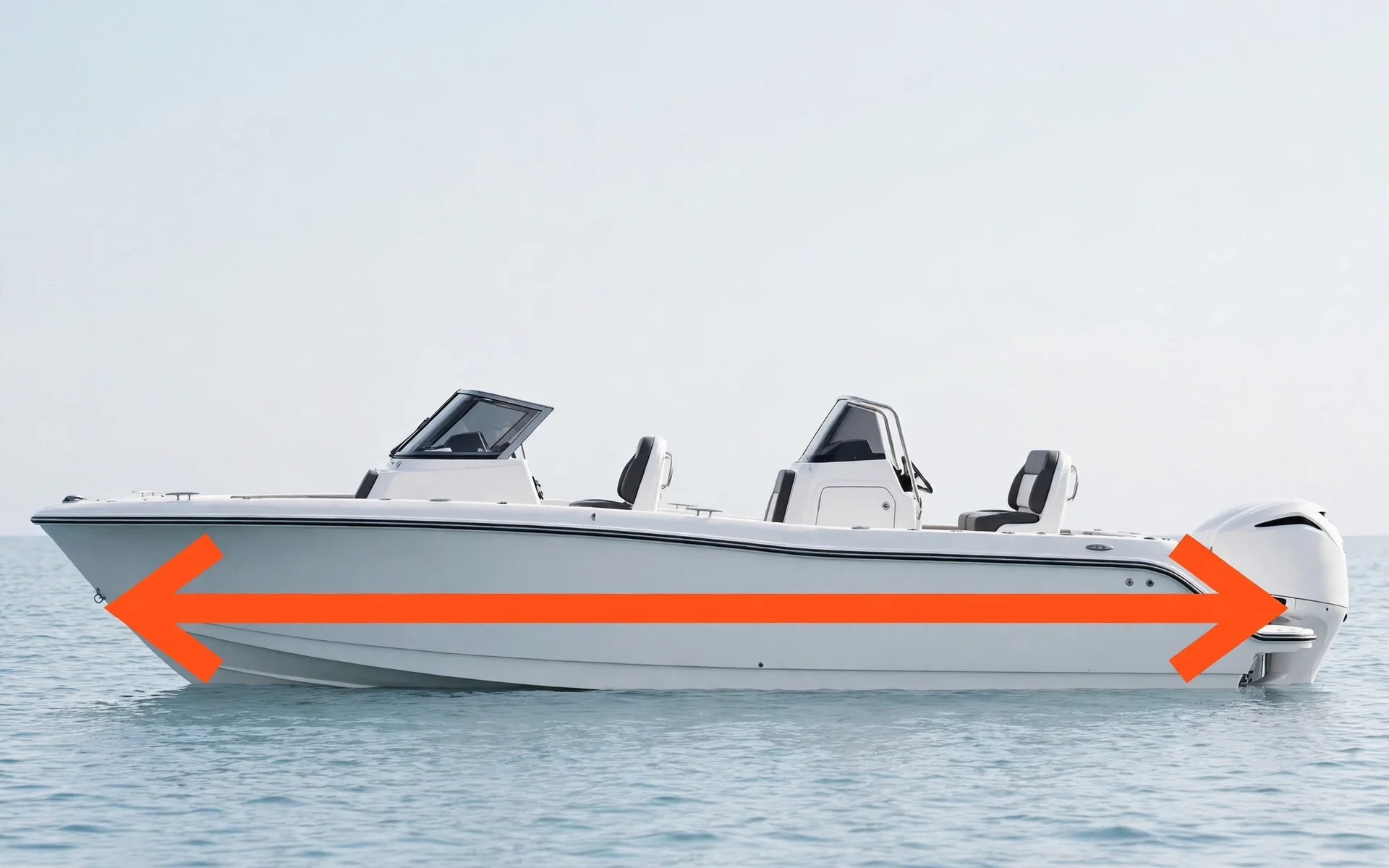
The Grady-White is the article's most instructive exact, because it is 26 feet on the reading that matters and a foot and seven inches over on the reading that does not — and both readings are printed on the same page. Grady-White's own specification page lists the Freedom 265, a dual-console boat introduced for 2026 and shown at the Fort Lauderdale International Boat Show in October 2026, at a centreline length of 26 feet, 7.92 metres, without swim platforms and engines — and at a length overall of 27 feet 7 inches, 8.41 metres, with the swim platforms. The rest of the specification is just as fixed: a beam of 9 feet, a maximum of 600 horsepower, a 150-gallon fuel tank, and a cockpit 26 inches deep. Walk the centreline from bow to stern and you have walked 26 feet — and walk it again with the swim platforms and you have walked 27 feet 7 inches, because the platforms are the product's extra.
The fitting check is the platform, because the boat's 26 feet is its centreline and its overall length is 27 feet 7 inches — and the thing people misjudge is which length a berth or a trailer is sold against. A berth bought against "26 feet" for this boat fails by a foot and seven inches if you measure the hull and forget the platforms, and a trailer bought against the overall length wastes a foot and seven inches if you measure the platforms and forget the hull. The guides that call a 26-foot Grady-White "26 feet long" never say whether they mean the centreline or the overall, because they never read the specification — and the Grady-White specification page prints both numbers side by side, which is why it is the source here and not a listicle. The grade is listed because the figure is the maker's own specification for the named model, with the deviation printed in full: 26 feet on the centreline, 1 foot 7 inches over overall. Measure the centreline before you measure the berth, because the Grady-White is the object in this article you fish from.
4. A U-Haul 26-Foot Moving Truck — 26 Ft 2 In of Cargo Box (LISTED)

The truck is the article's most rented exact, because it is the 26 feet more Americans have driven than any other 26 feet in this article. U-Haul's size chart lists its 26-foot truck — the largest truck in the fleet, and the largest truck you can typically drive without a Commercial Driver's License — with an interior cargo area of 26 feet 2 inches long, 8 feet 2 inches wide, and 8 feet 3 inches high: 1,682 cubic feet of space, a gross vehicle weight rating of 25,999 pounds, a payload of up to 12,859 pounds, a 60-gallon fuel tank, and room for a three- to four-bedroom home. The 26 feet is the cargo box, not the vehicle — the cab sits in front of it, and the whole truck is longer than its name. Walk the inside of the box from the cab wall to the roll-up door and you have walked 26 feet 2 inches — two inches past the number in this article's title, and the same on every 26-foot U-Haul, because the box is the product.
The fitting check is the cab, because the truck's 26 feet is the box and the thing people misjudge is the vehicle: the "26-foot truck" is longer than 26 feet bumper to bumper, and the 25,999-pound gross weight is one pound under the 26,001-pound line where a commercial licence starts, which is the whole reason the size exists. A driveway bought against "26 feet" for this truck needs the cab's length on top of the box, and a load planned against "26 feet" needs the two extra inches the box actually gives you. The guides that call the 26-foot truck "the undisputed king of DIY moves" are right about the popularity and silent about the two inches, because they never read the size chart — and the U-Haul size chart prints the interior length, the width, the height, and the volume in one row, which is why it is the source here and not a listicle. The grade is listed because the figure is the maker's own listing for the named size, with the deviation printed in full: 26 feet 2 inches inside, two inches over. Measure the box before you measure the driveway, because the truck is the object in this article you move house in.
5. A Hunter 26 Sailboat — LOA 25.75 Ft (LISTED)
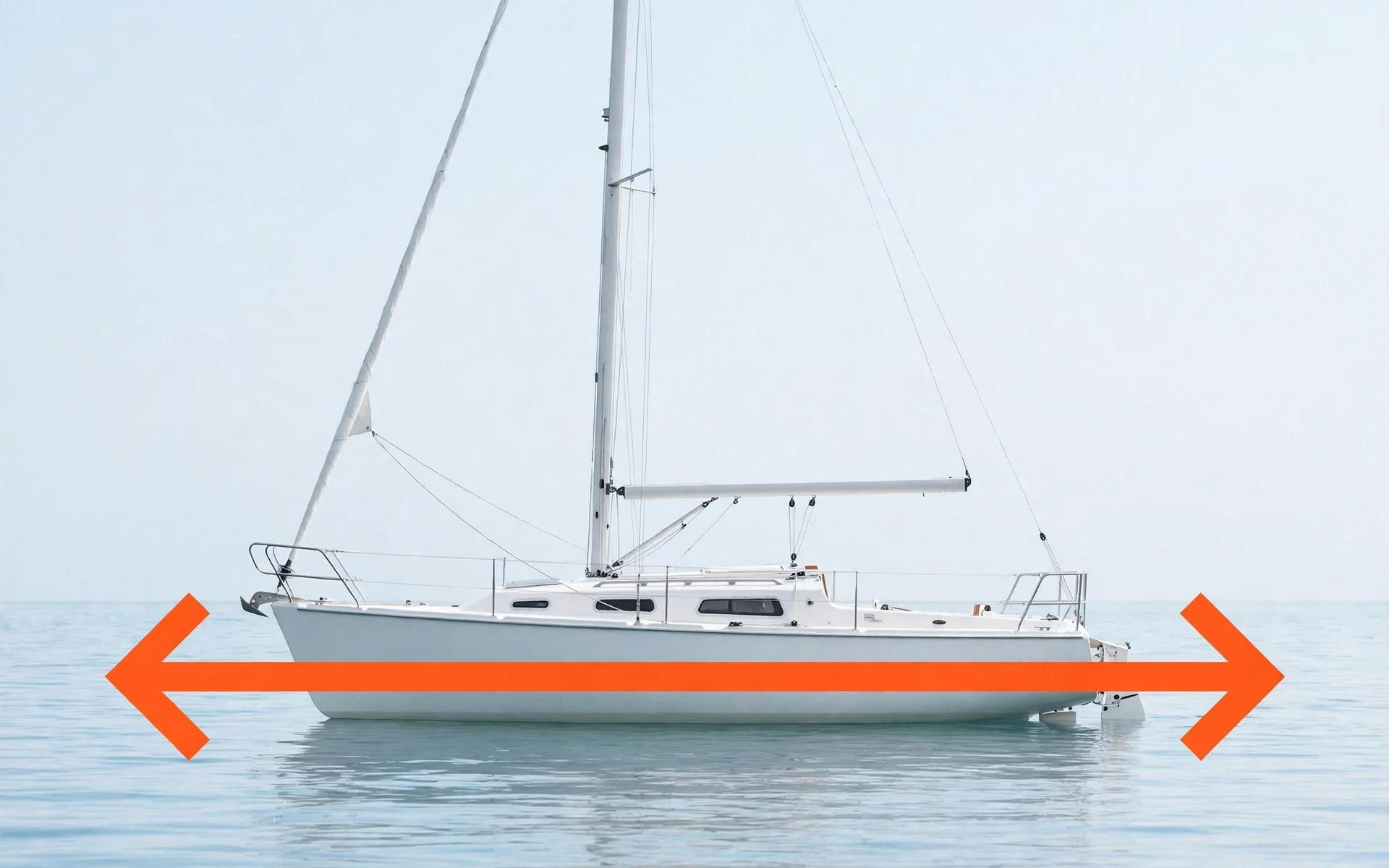
The Hunter is the article's first miss, and the one that closes the exacts by three inches. The Hunter 26 is an American trailerable sailboat designed by Rob Mazza and built by Hunter Marine from 1994 to 1997: a fibreglass monohull with a length overall of 25.75 feet, 7.85 metres, a waterline length of 23.16 feet, a beam of 9.00 feet, a draft of 6.00 feet with the centreboard down and 1.75 feet with it up, a displacement of 4,600 pounds, and a hull speed of 6.44 knots. Walk from the bow to the stern and you have walked 25 feet 9 inches — three inches short of the number in this article's title, and the same on every Hunter 26 ever built, because the mould is the product.
The fitting check is the name, because the boat's 26 is a model name and its 25.75 feet is a measurement — and the thing people misjudge is the gap between the two. A berth bought against "26 feet" for this boat fits with three inches to spare, which is the forgiving direction to miss in, and the guides that call the Hunter "26 feet long" round three inches away and never say so, because three inches sounds like nothing — and three inches is the difference between this article's second miss and its third exact, which is why the three inches are printed here instead of rounded away. The grade is listed because the figure is the class's own dimension for the named model, with the deviation printed in full: 25.75 feet, three inches short. Measure the bow before you measure the berth, because the Hunter is the object in this article you sail.
6. A JLG T26E Mast Lift — 26 Ft 6 In of Platform Height (LISTED)

The lift is the article's most vertical exact, because its 26 feet is measured upward, not along the ground. The JLG T26E — a vertical mast lift, relaunched by JLG Industries in 2010 under the name T26E after its earlier life as the E26MJ — lifts its platform to 26 feet 6 inches, 8.10 metres, on the JLG specification sheet, with a working height of 32 feet, a platform capacity of 500 pounds, an overall width of 39 inches, and a horizontal outreach of 8 feet 8 inches. The "26" in its name is the nominal size; the platform itself goes six inches past it. Stand on the platform at full height and you are standing 26 feet 6 inches above the ground — six inches past the number in this article's title, and the same on every T26E, because the mast is the product.
The fitting check is the platform, because the lift's 26 feet 6 inches is where a worker stands and the thing people misjudge is the working height: 32 feet is what a worker's hands can reach, 26 feet 6 inches is where their feet are, and the 5 feet 6 inches between them is the worker. A job planned against "26 feet" for this lift needs the platform height for the feet and the working height for the hands, and the rental listings that call it a "26-foot mast lift" are right about the name and six inches short of the platform, because they print the nominal size and not the sheet. The grade is listed because the figure is the maker's own specification for the named model, with the deviation printed in full: 26 feet 6 inches, six inches over. Measure the platform before you measure the job, because the lift is the object in this article you stand on.
7. Medusa, the Reticulated Python — 25 Ft 2 In (REPORTED)
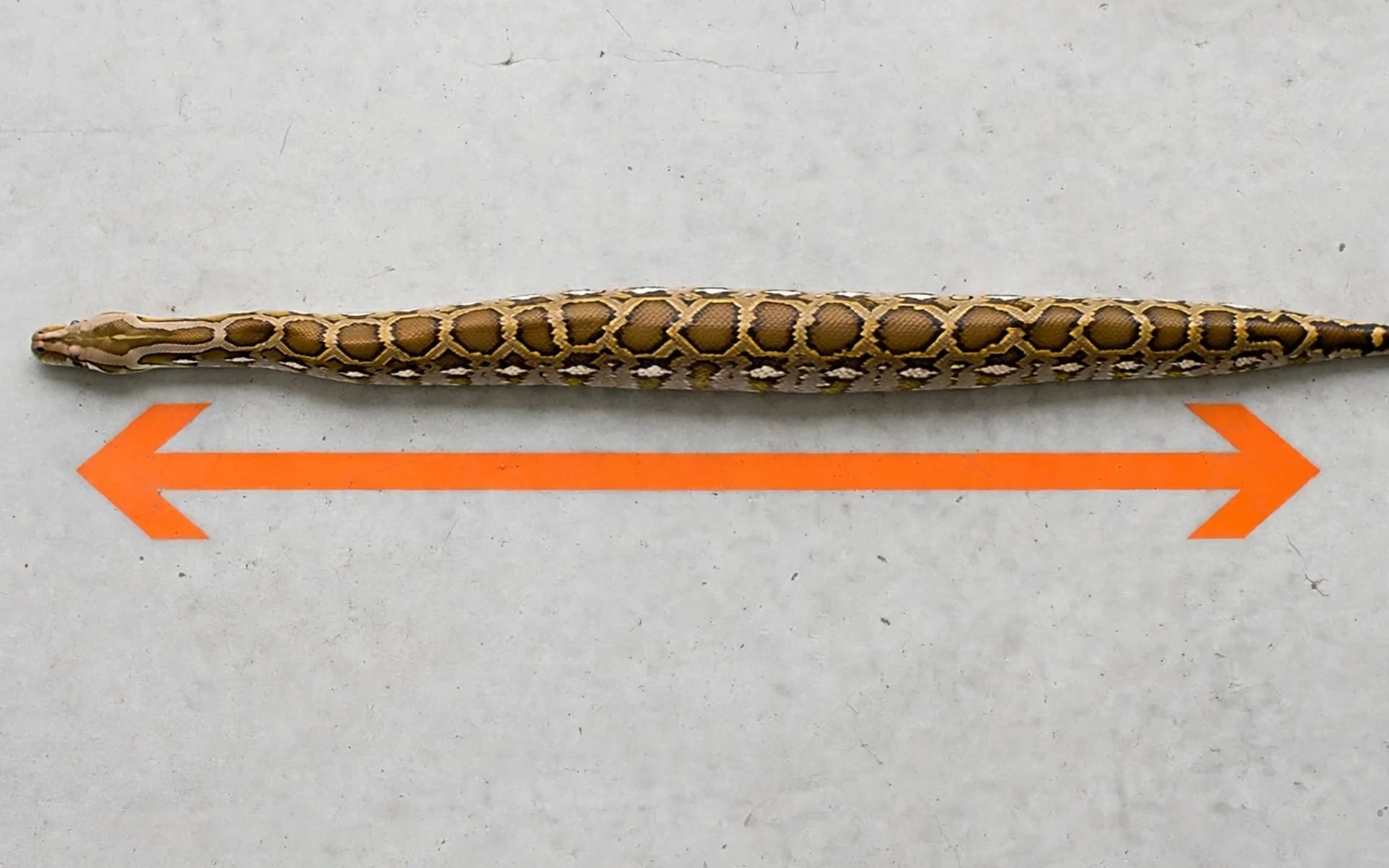
The python is the article's living miss, and the one that proves a record is a measurement and a story is not. Medusa, a female reticulated python kept by Full Moon Productions at the Edge of Hell haunted house in Kansas City, Missouri, was measured by Guinness World Records on 12 October 2011 at 7.67 metres — 25 feet 2 inches — long, weighing 158.8 kilograms, 350 pounds, making her the longest snake ever held in captivity. It took fifteen people to hold her at full stretch for the measurement. Stretch her out nose to tail and you have 25 feet 2 inches — ten inches short of the number in this article's title, and the longest any snake has ever been verified at in captivity, because the tape is the product.
The fitting check is the captivity, because Medusa's 25 feet 2 inches is the longest verified measurement of a living snake and the thing people misjudge is the wild: reticulated pythons normally grow to between 10 and 20 feet, and the stories of 26-foot and 30-foot wild pythons are stories, not measurements — a python reported at 8 metres in Penang in 2018 died three days after capture and was never measured to Guinness standards. The guides that call an Indonesian python "approximately 26 feet long" are repeating a villager's video, not a measurement, because no tape was ever put to that snake. The grade is reported because the figure is the largest verified measurement an expert source reports for the named thing, with the deviation printed in full: 25 feet 2 inches, ten inches short. Measure the snake before you measure the story, because Medusa is the object in this article you do not want to meet in the wild.
8. A Werner MT-26 Multi-Ladder — 26 Ft of Reach, About 23 Ft of Ladder (LISTED)
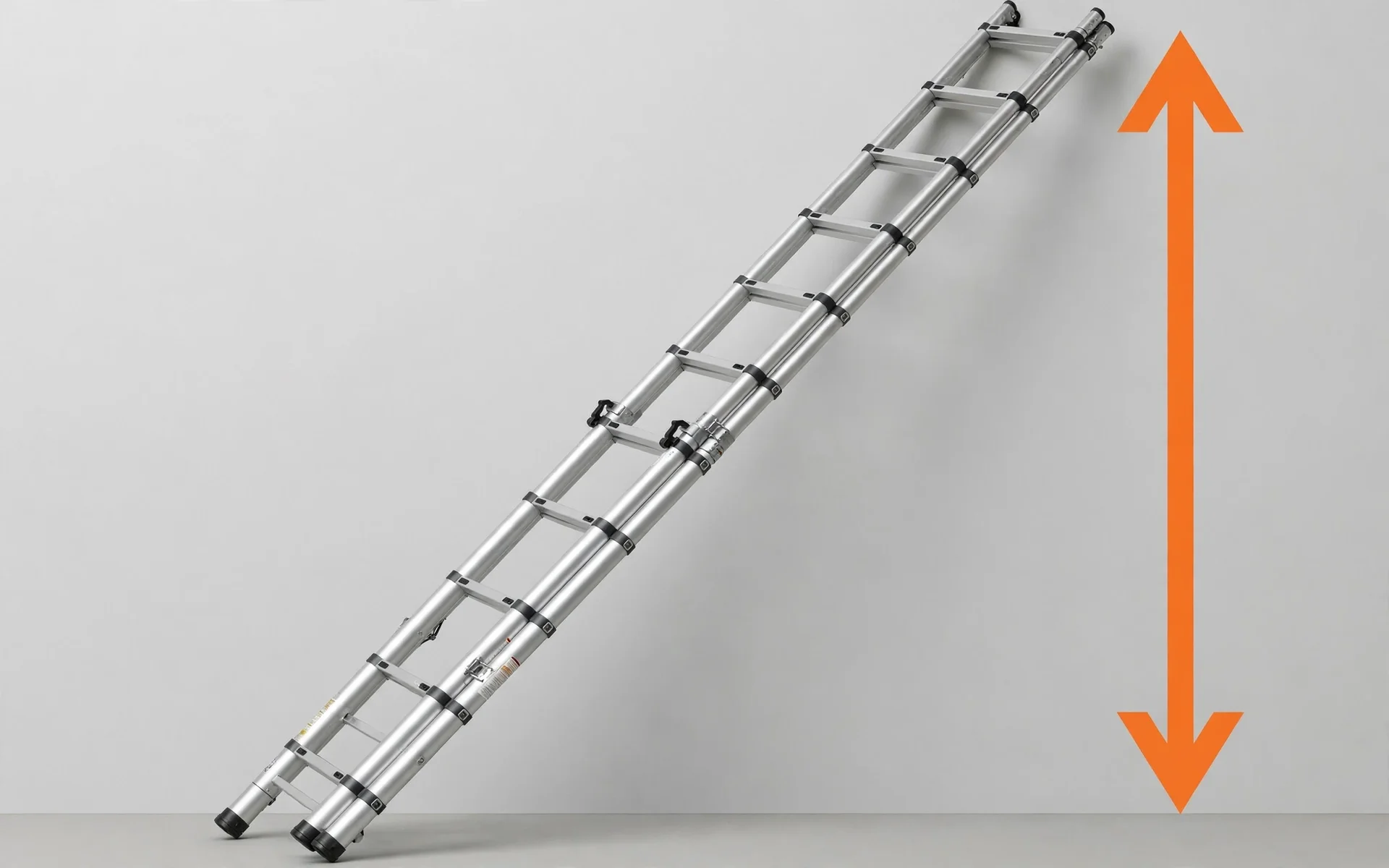
The ladder is the article's lesson, and the one that closes the list three feet short of its own name. The Werner MT-26 is a telescoping multi-ladder sold as a 26-foot ladder: aluminium, Type IA duty rating, 300-pound load capacity, 59.3 pounds, folding down to about six and a half feet for transport. Its manual lists a maximum height of 26 feet — but the 26 feet is the maximum reach height, the height a person of average height can reach while standing on the ladder, and the ladder itself, fully extended as an extension ladder, is about 23 feet of aluminium. Werner's ladder-height guide says the same thing in general: an extension ladder's reach is about a foot less than its height, and the highest safe standing level is four rungs down from the top. Lean it against a wall and climb to the top and you have climbed about 23 feet of ladder to reach 26 feet — three feet short of the number in this article's title, and the same on every MT-26, because the reach is the product and the ladder is not.
The fitting check is the reach, because the ladder's 26 feet is what a person can touch and the thing people misjudge is the ladder: a 26-foot ladder does not give you 26 feet of ladder, and a roofline bought against "26 feet" needs the ladder's open length, not its reach. The guides that list a "26-foot ladder" among things that are 26 feet long never say whether they mean the ladder, the reach, or a custom build, because they never read the manual — and the manual prints the maximum height and the guide prints the reach, which is why both are the sources here and not a listicle. The grade is listed because the figure is the maker's own listing for the named model, with the deviation printed in full: 26 feet of reach, about 23 feet of ladder, three feet short. Measure the ladder before you measure the roofline, because the Werner is the object in this article you climb.
Eight Numbers the Other Lists Get Wrong
Eight wrong numbers about 26 feet circulate so widely that they deserve their own section, because each one is stated confidently on a page that ranks for this exact question. First, the Komodo dragon: one popular guide says Komodo dragons "can grow to a length of 26 feet", and the same page says in an earlier paragraph that they are "at least ten feet" — and ten feet is the truth, because the largest Komodo dragons ever measured are about 10 feet long, which is sixteen feet short of 26. Second, the Indonesian python: another guide says a python in Indonesia was "approximately 26 feet long", and no tape was ever put to that snake — the verified record is Medusa at 25 feet 2 inches, and the 8-metre python reported in Penang in 2018 died three days after capture and was never Guinness-measured. Third, the Bennington "26" pontoon: the model number is not the length, because the maker's own site lists the M 26 at 28 feet 3 inches overall and the 26 MSB at 26 feet 11 inches — a "26-foot Bennington" is eleven inches to two feet three inches longer than 26 feet. Fourth, the blue whale calf: another guide says a calf is "typically about 23 to 25 feet long", and NOAA's own figures put calves at 20 to 23 feet at birth — about 23 feet at the top, three feet short of 26. Fifth, the "call it 8 metres" rounding: 8 metres is 26 feet 3 inches, three inches over, and the guides that recommend it never print the three inches. Sixth, the fifth-wheel trailer: another guide says fifth-wheel trailers are "usually around 23 to 26 feet long", and a range is not a measurement — no named fifth-wheel model is 26 feet on its specification sheet. Seventh, the paper bridge: one guide lists a 26-foot bridge over the Buffalo River as a thing that is 26 feet long, and the bridge is a student art installation made of paper, a cantilever you cannot walk on or verify — a curiosity, not an object. Eighth, the custom ladder and the garden: one guide says a ladder "can be custom-made to a length of 26 feet" and a garden is "usually around 26 feet long", and a thing that can be made to any length proves nothing, while "usually around" is not a measurement at all. None of these eight numbers belongs in a 26-foot article as an object, and all eight are here so you never have to learn that from a purchase.
Checking 26 Feet Without a Tape Measure
Twenty-six feet is a number you can check without a second tool, because the objects in this article are the tools — but only if you use the objects themselves, not your body. First, take the steps: the University of Iowa puts the average adult's walking step at 2.5 feet, so take 10 steps and you have walked 25 feet — a foot short — and take 11 steps and you have walked 27 feet 6 inches, a foot and a half over, so the honest count is 10 steps and a shuffle, and anyone who tells you 10 paces is rounding away a foot. Second, take the trailer: a standard semi-trailer is 53 feet long, so cut one in half in your head and you have 26 feet 6 inches — six inches over, and the closest big thing on any highway to the number in this article's title. Third, take the truck: a 26-foot U-Haul is the article's own object, so stand beside one at a rental lot and you are standing beside 26 feet 2 inches of cargo box — but check the cab first, because the truck is longer than its name. Fourth, take the three-point line: an NBA three-point line is 23 feet 9 inches at the top of the arc, two feet three inches short of 26 feet, so a very deep three-pointer is not 26 feet, however far it looks from the stands. None of these replaces a calibrated tool for anything that must fit, but all four will tell you whether 26 feet is the size you think it is before the pool is filled or the truck is loaded — and the aeroplane is the one to trust, because its zero inches is the smallest miss you can walk.
How 26 Feet Compares With Other Lengths
Readers comparing nearby sizes may also want the site’s guides to 25 feet, 27 feet, 24 feet, 23 feet, 22 feet, and 30 feet for the foot series, 10 meters and 8 meters for the metre series, and the inches hub and feet hub for the full directories. Each of those guides follows the same rule as this one: the spec sheet, the grade, and the miss printed in full.
Frequently Asked Questions
How many meters is 26 feet?
26 feet is exactly 7.9248 meters, usually rounded to 7.92 meters. Multiply 26 by 0.3048 and you get 7.9248 — and the trap is rounding that to 8 meters, which overstates the length by 3 inches, or to 7 meters, which understates it by more than 3 feet. For anything that must fit, use 7.9248 meters; for a quick estimate in your head, 7.92 meters is close enough to picture it and only 4.8 millimetres short.
How many inches is 26 feet?
312 inches exactly. Multiply 26 by 12 and you get 312, with no rounding at all. In centimetres that is 792.48 cm, in millimetres it is 7,924.8 mm, and in yards it is 8 yards and 2 feet — the only one of the conversions in this article that does not come out whole, which is why "8 yards and 2 feet" is the honest shortcut.
How many yards is 26 feet?
8.67 yards, or 8 yards and 2 feet. There are 3 feet in a yard, and 26 divided by 3 is 8 with 2 left over — which is the reason 26 feet has exact objects where round numbers do not: 8 yards and 2 feet is nobody's round number, so manufacturers built machines to it instead of rulebooks. In metres, 8 yards and 2 feet is 7.92 metres, which is the same figure as the Cirrus SR22's length and the Grady-White Freedom 265's centreline.
What is the largest truck you can drive without a CDL?
A 26-foot box truck, like the U-Haul 26-footer in this article. A Commercial Driver's License is required at a gross vehicle weight rating of 26,001 pounds, and the 26-foot rental trucks are rated at 25,999 pounds — one pound under the line, which is the whole reason the size exists. The cargo box is 26 feet 2 inches long inside, with 1,682 cubic feet of space and a payload of up to 12,859 pounds, and it will hold a three- to four-bedroom home.
Is a 26-foot pool really 26 feet across?
Yes — 26 feet is the diameter, measured straight across the middle through the centre. The Intex Ultra XTR 26-foot pool is 26 feet across and 52 inches high, holding 14,667 gallons, and its circumference is about 81.7 feet, which is more than three times the diameter. A level base bought for it needs more than 26 feet of ground, because the frame legs splay out past the wall and the ladder and the pump need their own space.
How long is a Cirrus SR22?
26 feet exactly — 7.92 metres — from the propeller spinner to the tail, on the manufacturer's own specification sheet. Its wingspan is 38 feet 4 inches, which is twelve feet wider than it is long, and its height is 8 feet 11 inches. It is the best-selling general-aviation aeroplane of the 21st century, and the only object in this article that lands on 26 feet 0 inches alongside the pool.
How many steps does it take to walk 26 feet?
Ten steps and a shuffle, at the average adult's step length. The University of Iowa puts the average walking step at 2.5 feet, so 10 steps cover 25 feet — a foot short of 26 feet — and 11 steps cover 27 feet 6 inches, which is a foot and a half over. The honest count is 10.4 steps, and anyone who tells you 10 paces is rounding away a foot.
Is 26 feet the same as 8 meters?
No, and the difference is three inches. Eight meters is 26 feet 3 inches, which is 3 inches longer than 26 feet — the length of a hand's width. For picturing the length in your head, 8 meters will mislead you by that much; for anything that must fit — a pool base, a truck bay, a berth — use 7.92 meters, which is 26 feet to within 4.8 millimetres.
Final Thoughts
Twenty-six feet is the rare measurement that is exact in the metric system without being round in either one, because 7.92 metres can be an aeroplane, a pool, a boat, a truck, a sailboat, a lift, a snake, and a ladder — and the number alone never says which. Now you know it as an aeroplane's length fixed by its manufacturer, a pool's diameter fixed by its frame, a boat's centreline fixed by its builder, a truck's cargo box fixed by its rental fleet, a sailboat's length fixed by its mould, a lift's platform fixed by its mast, a snake's length fixed by a world record, and a ladder's reach fixed by its manual — and you know which of those you can trust to the inch and which one is three feet shorter than its own name. The rule that runs through all eight is the same one this site always uses: trust the spec sheet, print the deviation, and let the name stay on the box where it belongs. Measure twice, in the direction the object actually travels, and 26 feet will fit the first time.
