

If you are asking how long is 27 inches, start with the one fact about this number that nobody can argue with: 27 inches is exactly three-quarters of a yard. Not approximately — exactly. It is 68.58 centimetres exactly, 685.8 millimetres exactly, 2.25 feet exactly, and 0.75 yards exactly, one of the rare sizes in this series whose conversions land clean in every unit at once. So picture a yardstick, the old 36-inch wooden kind, and put your thumb on the three-quarter mark. That is where this article lives. In the series, take a step down to 26 inches or a step up to 28 inches. For the full range, see the complete inches size guide. Eight objects that carry the number 27 are brought to that mark, one at a time, and graded against it — a tennis racket, a child’s baseball bat, a computer monitor, a baby, a hockey stick, a bicycle wheel, a wall oven and a pair of jeans. Two of them measure 27 inches in the plain, tape-on-the-object sense. The rest measure it diagonally, statistically, historically, or not at all — and in each case the maker’s own paperwork says so, if you read it closely enough.
That is the real subject here: not the inch, which never changes, but the directions and definitions hiding behind it. A 27-inch monitor is 27 inches only corner to corner. A 27-inch bicycle wheel has no part that measures 27 inches. A size-27 pair of jeans is not 27 inches long, wide, or — despite what the label implies — even 27 inches around. Each object below gets the same treatment this series always applies: the primary source first (the manufacturer’s specification sheet, the standards table, the official size chart), the verified figure in plain sight, and a grade on a line we are calling the Yard line. By the end you will know exactly how long 27 inches is, and exactly which of the eight things wearing the number deserve to.
QUICK ANSWER
27 inches = 68.58 cm exactly (685.8 mm • 2.25 ft • 0.75 yd) — exactly three-quarters of a yard. But the things that carry the number split three ways. On the line: an adult tennis racket (27.00 in end to end, per Wilson’s spec table) and Easton’s 27-inch youth bat. On the line, extent named: a 27-inch monitor is 27 only on the diagonal — Dell lists the cabinet at 24.10 in wide; a baby of about seven months (27 in is the WHO median length at ≈6.6 months for boys, ≈7.9 for girls); a junior hockey stick sized for a small child. The name only: a classic 27-inch bicycle wheel (rim bead seat 630 mm = 24.80 in, per Schwalbe), a GE 27-inch wall oven (the oven is 26-3/4 in wide; the 27 is the cabinet), and size-27 jeans (Levi’s chart fits them to a 28.25-in waist). Eight objects, graded against the yardstick below.
The Yardstick: Why 27 Inches Is the Three-Quarter Mark
The conversions first, because 27 is unusually well behaved. One inch is exactly 2.54 centimetres by international definition, so 27 inches is exactly 68.58 centimetres and exactly 685.8 millimetres — no rounding anywhere. In feet it is 2.25 exactly. In yards it is 0.75 exactly: three-quarters of a yard, or three-quarters of the distance from a yardstick’s end to its middle and half again. Most sizes in this series convert to something untidy (21 inches is 0.5833 of a yard, a number that has to be rounded to be printed). Twenty-seven converts like it was designed. If you sew, you already own this measurement: three-quarters of a yard of fabric is a standard cut, measured off the bolt every day. What is true and checkable is simpler: 27 inches is the length of three standard 9-inch spans laid end to end, two and a quarter foot-long rulers, and a little under sixty-nine of the units in how big is 10 mm.
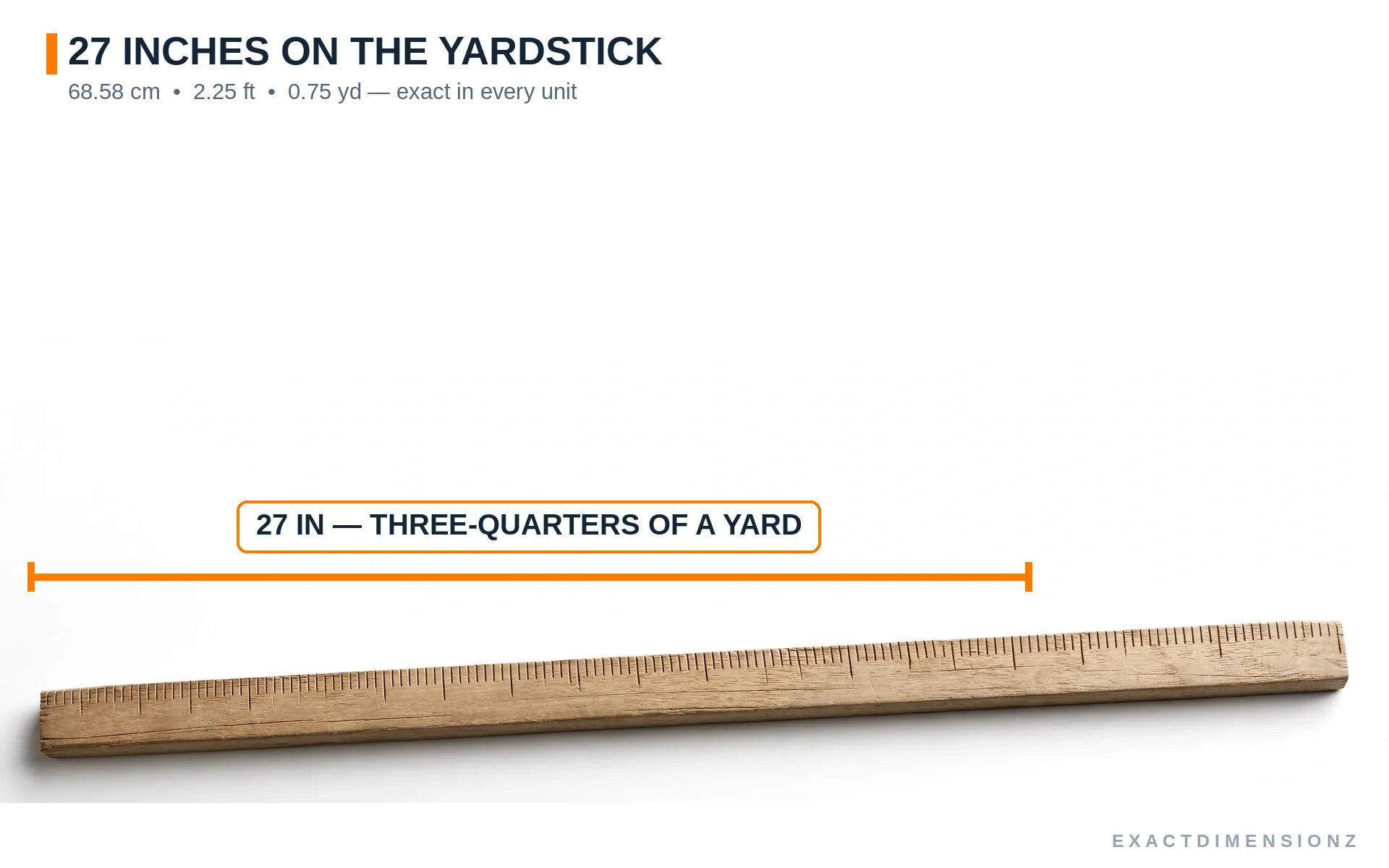
Against the sizes already published in this series, 27 inches sits eleven inches past how long is 16 inches — beyond laptops and into the territory of sports equipment, babies and kitchen appliances. It is two and a quarter times how long is 12 inches, the foot that anchors the whole imperial system, and 2.7 times how long is 10 inches. Three spans of how long is 9 inches make it exactly. Every one of those comparisons is a straight line laid along a ruler. The objects below are where the straight line starts to bend — onto diagonals, around waists, and into names that were never measurements at all.
How the Yard Line Grades Work
Three rules govern every grade in this article. First, the evidence must be a primary source: a specification published by the company that makes the object, an official standard or chart, quoted with its link so you can check it yourself. Retail roundups and rival articles are never evidence — they are, in the Corrections Desk below, occasionally the accused. Second, the measurement must be named. “27 inches” is not a measurement until somebody says 27 inches of what: end to end, corner to corner, around, or on average. Half the grades below turn entirely on that question. Third, no nominal, toleranced or class figure is ever called exact. Where a number is a class name, the article says so on the grade line itself.
The grades. ON THE LINE means a tape laid on the object, in the direction the name promises, reads 27 inches. ON THE LINE, WITH THE EXTENT NAMED means the 27 is real but survives only with its direction or definition attached — a diagonal, a median, a child’s size run. THE NAME ONLY means the 27 is a label, a class or a rounded inheritance, while the object in front of you measures something else in every direction you would actually use. Eight objects, three grades, one yardstick. First stop.
Stop 1: The Adult Tennis Racket, a True 27 End to End
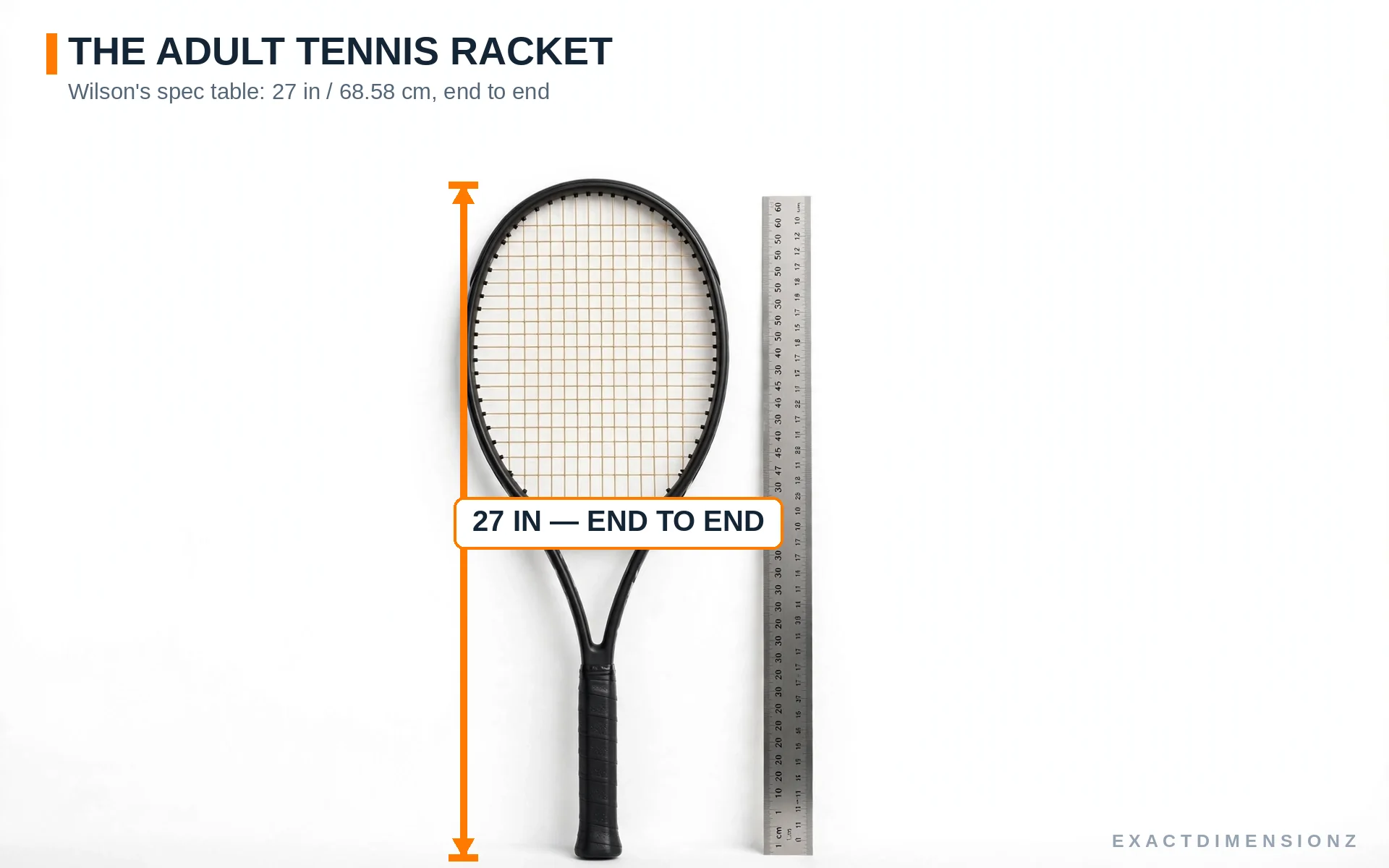
The cleanest claim on the list belongs to the adult tennis racket. A standard adult racket is specified by its length, and its length is its whole self: butt cap to head tip, one straight line, the longest dimension the object has. Wilson’s specification tables — reproduced in full by retailers such as the Ultra Power RXT 105 listing — state it without decoration: “Length: 27 in / 68.58 cm.” Note the metric column. Wilson does not print 68.6 and move on; the figure is 68.58, the exact conversion of 27 inches, because the racket is manufactured to the inch figure and converted honestly. Measured-spec retailers agree: Tennis Warehouse’s measured specifications for the Wilson Ultra Pro list “Length: 27in / 68.58cm” from samples they handled themselves.
Why is 27 the standard at all? Because the rules of tennis cap racket length, and the industry settled at 27 inches as the adult norm generations ago — long enough for leverage on the serve, short enough to control at the net. Junior rackets climb toward it in steps (19, 21, 23, 25 inches) and stop being junior when they arrive. There is no diagonal convention to hide behind, no case-versus-whole split, no nominal bore. The name is the measurement, the measurement is the name, and the tape agrees with both.
Yard line: ON THE LINE. Wilson’s own table: 27 in / 68.58 cm, end to end. Check it yourself: lay any standard adult racket beside a tape, butt cap at zero; the head tip lands on 27.
Stop 2: The Youth Baseball Bat, Manufactured at 27

The second clean claim is also sporting goods, one size down in every sense. The Easton ADV1 USA youth bat — a one-piece composite built for USA Baseball leagues — is sold in a run of lengths, and 27 inches is one of them: the Dick’s Sporting Goods listing for the ADV1 (-12) offers the bat in sizes stepping through 27, 28, 29 and 30 inches, and the buyer reviews on that same listing name the size directly — one parent describes buying “the 27in (-12)” for a seven-and-a-half-year-old moving up to 8U machine pitch. The -12 is the drop: length minus weight, so the 27-inch version weighs 15 ounces. A bat’s length is measured the way a racket’s is, knob to end cap along the barrel’s axis, and like the racket there is no second direction competing for the name.
Bat sizing is where parents meet this number in the wild, usually via a height chart at a sporting-goods store: a 27-inch bat is the standard recommendation for a child around 3 feet 7 to 4 feet tall and 61 to 80 pounds, give or take a brand’s chart. The number is a manufactured length, not a class and not a rounded diagonal — Easton moulds the composite to it. If the racket showed what a grown-up’s 27 looks like, the bat shows a child’s: same line on the yardstick, smaller hands wrapped around it.
Yard line: ON THE LINE. A manufactured 27 inches, knob to end cap, in a size run you can order today. Check it yourself: the size is stamped in the product’s size selector, and the drop arithmetic (27 − 12 = 15 oz) is printed beside it.
Stop 3: The 27-Inch Monitor, True Only Across the Corner
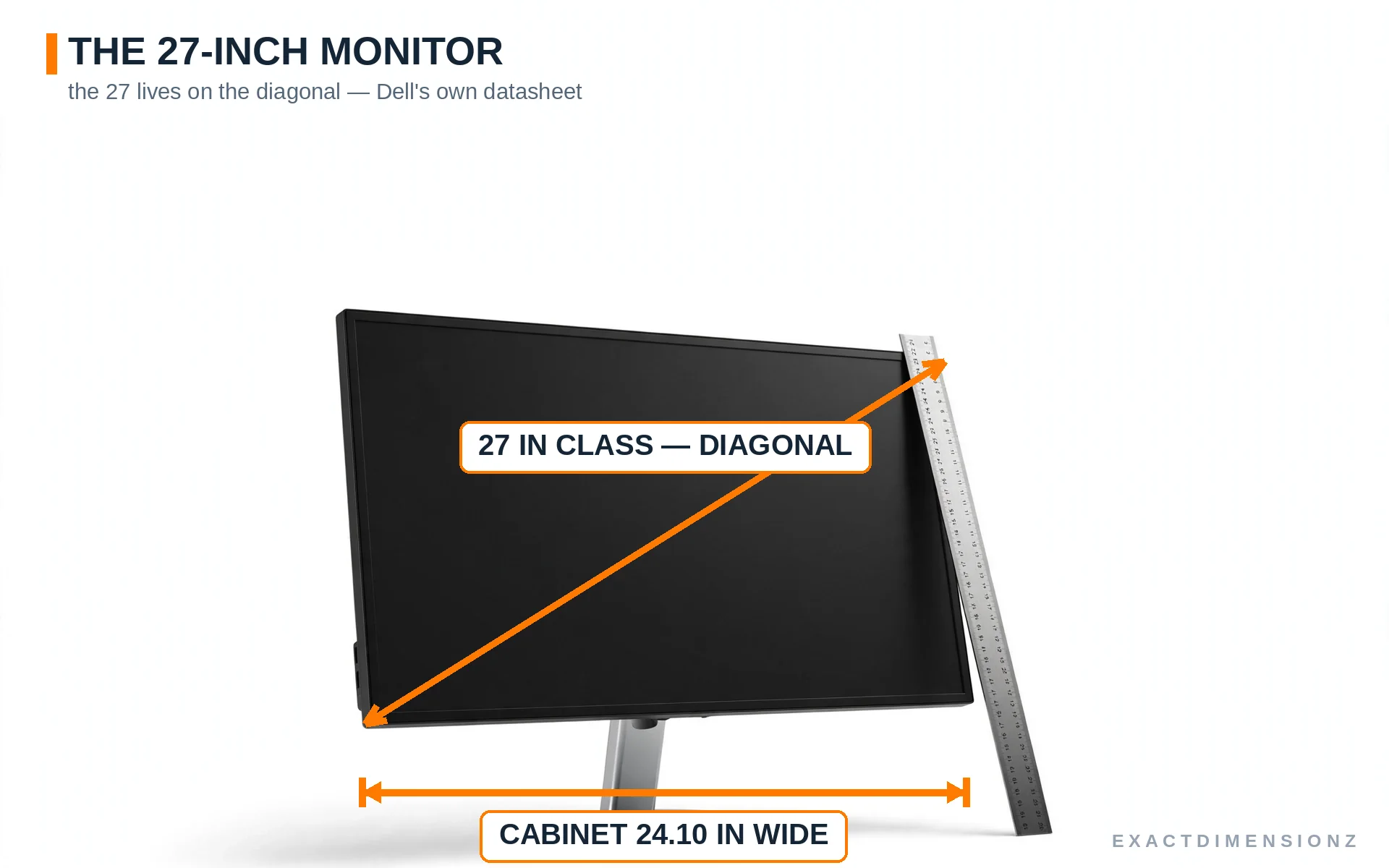
Now the yardstick meets its first diagonal. A “27-inch monitor” is 27 inches in exactly one direction: corner to corner of the screen. Dell’s own datasheet for the UltraSharp 27 U2724D — Dell’s published specifications — gives the diagonal viewing size as 684.70 mm (27.00 inches), measured diagonally. That is the whole claim, and Dell states it honestly. What the same datasheet states next is what the name leaves out: the preset display area is 596.74 × 335.66 mm (23.49 × 13.22 inches), and the cabinet, stand included, is 612.24 mm — 24.10 inches — wide. No straight edge on this monitor measures 27 inches. The widest line on the object is 24.10.
One computation is worth doing in the open, because nobody in the rival coverage does it. The lit area Dell publishes — 596.74 mm by 335.66 mm — has a diagonal of √(596.74² + 335.66²) = 684.67 mm, which is 26.96 inches. So even the diagonal, the friendliest possible direction, lands a hair under 27.00 when you compute it from the panel’s own active dimensions; the 27.00 figure is the class diagonal, rounded at the second decimal. This is not a scandal — it is how every screen on earth is sold, by a class named for a rounded diagonal — but it is exactly the kind of fine print a size guide exists to print. (The leading rival list, to its credit, half-admits this in its comparison table, listing a 27-inch-class monitor’s width as “about 24–27 inches.” The exact figure is 24.10, and it was in Dell’s datasheet all along.)
Yard line: ON THE LINE, WITH THE EXTENT NAMED. The extent is the diagonal; the class figure is 27.00 in (684.7 mm); the lit diagonal computes to ≈26.96 in; the box on your desk is 24.10 in wide and 13.88 in tall without its stand. Check it yourself: measure any 27-inch monitor across, then corner to corner. The tape will find the 27 only on the diagonal — and even there, a whisper under.
Stop 4: The Baby of About Seven Months, 27 Inches on Average
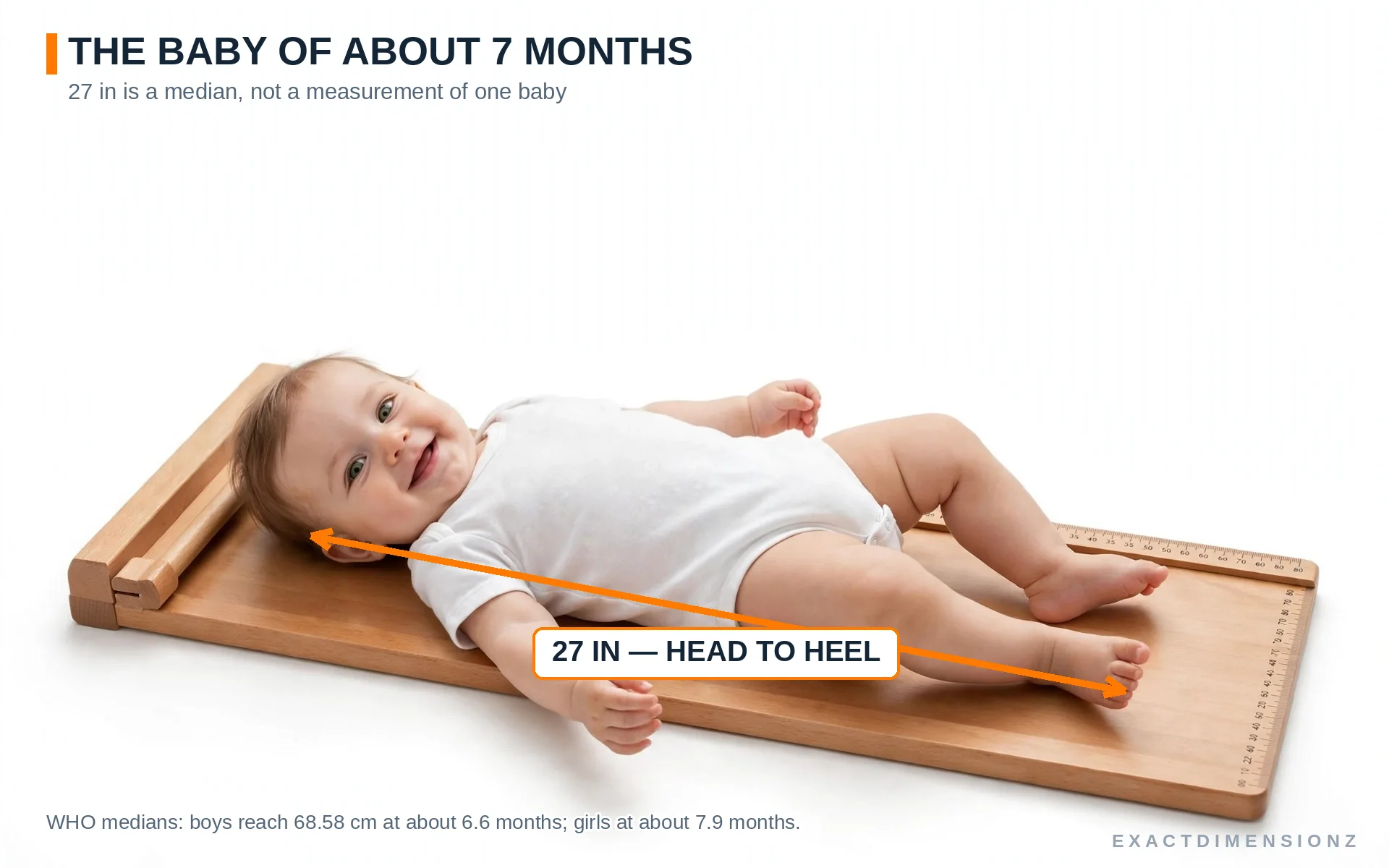
The fourth stop is not an object at all, and its 27 is a different species of number: a median. Baby length is measured lying down, head to heel on a length board, and the reference for what is normal is the World Health Organization’s Child Growth Standards — the LMS tables behind every growth chart, tabulated in full in MSD Manual’s WHO length-for-age reference. Read the medians off the table. Boys: 67.62 cm at 6 months, 69.16 cm at 7 months. Girls: 65.73 cm at 6 months, 67.29 at 7, 68.75 at 8. Our line on the yardstick is 68.58 cm. A boy’s median length crosses it at about 6.6 months; a girl’s median crosses it at about 7.9 months. So “a 27-inch baby” is a true statement about the middle of the distribution — at roughly seven months, depending on the baby.
The same table disciplines the claim in the other direction. At exactly 6 months, a 27-inch baby is not the average baby the rival articles describe: 68.58 cm sits about +0.45 standard deviations above the boys’ median (roughly the 67th percentile) and about +1.26 above the girls’ (roughly the 90th percentile) — a long baby, not a typical one. And individual babies scatter widely around any median, which is why this stop’s grade carries its definition with it. A racket is 27 inches. A seven-month-old averages 27 inches, in the specific sense that half of healthy babies that age measure more and half measure less.
Yard line: ON THE LINE, WITH THE EXTENT NAMED. The extent is a population median of recumbent length: boys reach it at ≈6.6 months, girls at ≈7.9 months (WHO). Check it yourself: plot any baby’s length on the WHO chart — 27 inches crosses the median line between the 6- and 8-month marks, never on the 6-month line itself.
Stop 5: The Junior Field Hockey Stick, 27 Inches for a Small Child
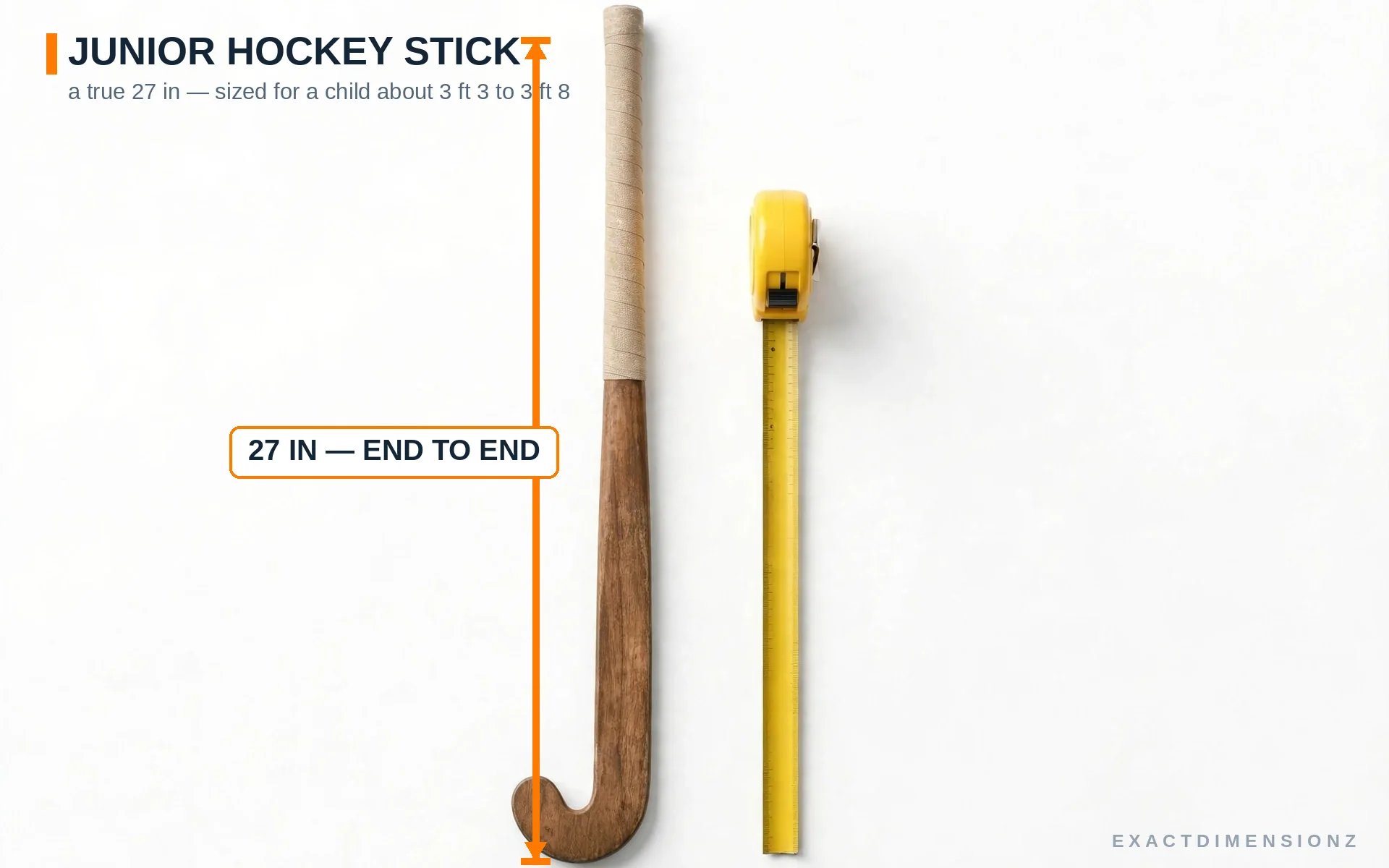
Field hockey sizes its sticks the way baseball sizes its bats — by the player’s height — and the authority here is the sport’s specialist retailer: Longstreth’s guide to choosing a field hockey stick, whose height chart runs 24 inches for a player 3 feet and under, 26 inches for 3 feet to 3 feet 5, 28 inches for 3 feet 5 to 3 feet 10, and on up through 34, 35.5, and the adult standard of 36.5 inches for players 5 feet 4 to 6 feet. Hockey sticks are stocked mostly in even and half sizes, so a 27-inch stick — sold in junior ranges — falls between Longstreth’s 26 and 28 rungs: it is the fit for a child roughly 3 feet 3 to 3 feet 8 tall. The stick itself is honestly manufactured at its stated length, top of the grip to the bottom of the head, measured along the shaft.
Hold that against the adult game for scale. The midfielder or forward of the rival articles plays with 35 to 37.5 inches of stick — nine or ten inches more than this stop’s 27. A 27-inch stick in an adult’s hands would reach barely past the knee. None of which makes the number wrong; it makes it addressed. Like the bat at Stop 2, this is a true 27 with a named owner: a child in the first years of the sport.
Yard line: ON THE LINE, WITH THE EXTENT NAMED. Manufactured length 27 in, end to end — sized, per Longstreth’s chart, for a player about 3 feet 3 to 3 feet 8. Check it yourself: stand the stick beside its player; the top of the grip should reach about the hip bone. On a 27-inch stick, that hip belongs to a small child.
Stop 6: The Classic 27-Inch Bicycle Wheel, a Name From the Brake Era

With the bicycle wheel, the yardstick stops measuring objects and starts measuring history. “27 inch” for a wheel is a class name from the era of rim brakes, and the cleanest explanation in print is the tire industry’s own: Schwalbe’s tire-size guide states plainly that “inch sizes are not precise,” and that “oddly enough, tires with an inner diameter of 630 mm are classified as 27 inch.” The inner diameter — the bead seat diameter, the circle the tire actually mounts on — is 630 mm, which is 24.80 inches. The rim of a “27-inch wheel” measures 24.80 inches across. Schwalbe’s own size charts list the classic fitments as ETRTO numbers ending in -630, such as 32-630, the old 27 × 1¼.
Where did the 27 come from, then? From the whole wheel, once upon a time. The inch marking, Schwalbe explains, states the approximate outer diameter — wheel and tire together. Add a period tire of 28 to 32 mm section to the 630 mm bead seat and the assembled wheel stands roughly 686 to 694 mm tall: about 27.0 to 27.3 inches. The name was a fair description of the finished wheel in the sizes of its day. What it never described is the rim you would measure in a shop — and the trap still catches people, because the modern “27.5-inch” mountain-bike wheel (a 584 mm bead seat) is a smaller rim than the classic 27 despite the bigger-sounding name, and its tires do not fit a 630 rim. The 27 survived as a label long after the tires that justified it thinned out of production.
Yard line: THE NAME ONLY. The rim’s bead seat is 630 mm = 24.80 in; the ≈27 belonged to the whole wheel wearing period tires, and Schwalbe itself warns the inch marking is not precise. Check it yourself: read the ETRTO number on any “27-inch” tire’s sidewall — it ends in -630, and 630 mm is not 27 inches in any unit.
Stop 7: The 27-Inch Wall Oven, Sized by the Cabinet It Fits

Kitchen appliances speak the same dialect as bicycle wheels. A “27-inch wall oven” is an oven built for a 27-inch cabinet — and GE’s own installation document for the JKS5000 shows exactly what that does and does not mean. (The document is GE’s; it is read here via its mirror at manuals.plus, and the figures below are GE’s own.) The dimension table lists, in order: Cabinet: 27″. Then the oven itself: overall width 26-3/4″, overall height with trim 28-7/8″, install depth 23-1/2″. And the hole you actually cut for it, from GE’s installation dimensions for the same model: cutout width 25″ minimum to 25-1/4″ maximum. Three different numbers wear the one name: the cabinet is 27, the appliance is 26¾, and the opening is 25 to 25¼ — that minimum cutout is exactly how long is 2 inches narrower than the class name on the box.
None of this is deception; it is how fitted appliances have to work. The oven must be narrower than its cabinet so it can slide in, its face frame wider than the cutout so it covers the cut edge, and its name must match the cabinet line it joins — a kitchen is planned in cabinet widths, and 27 is one of the two standard single-oven widths (the other is 30). But it means the number answers a question about your cabinetry, not about the oven. Anyone who “measures for a 27-inch oven” by cutting a 27-inch hole has misunderstood the name in the most expensive direction available.
Yard line: THE NAME ONLY. The 27 belongs to the cabinet; the oven measures 26-3/4 in wide and fits a 25 to 25-1/4 in cutout (GE’s installation document, via manuals.plus). The first link for the dimension table is GE’s JKS5000 dimensions and installation information. Check it yourself: on any built-in oven’s spec sheet, compare the headline size with “overall width” and “cutout width” — three numbers, one name, every brand.
Stop 8: Size-27 Jeans, Where the 27 Goes Around — and Isn’t
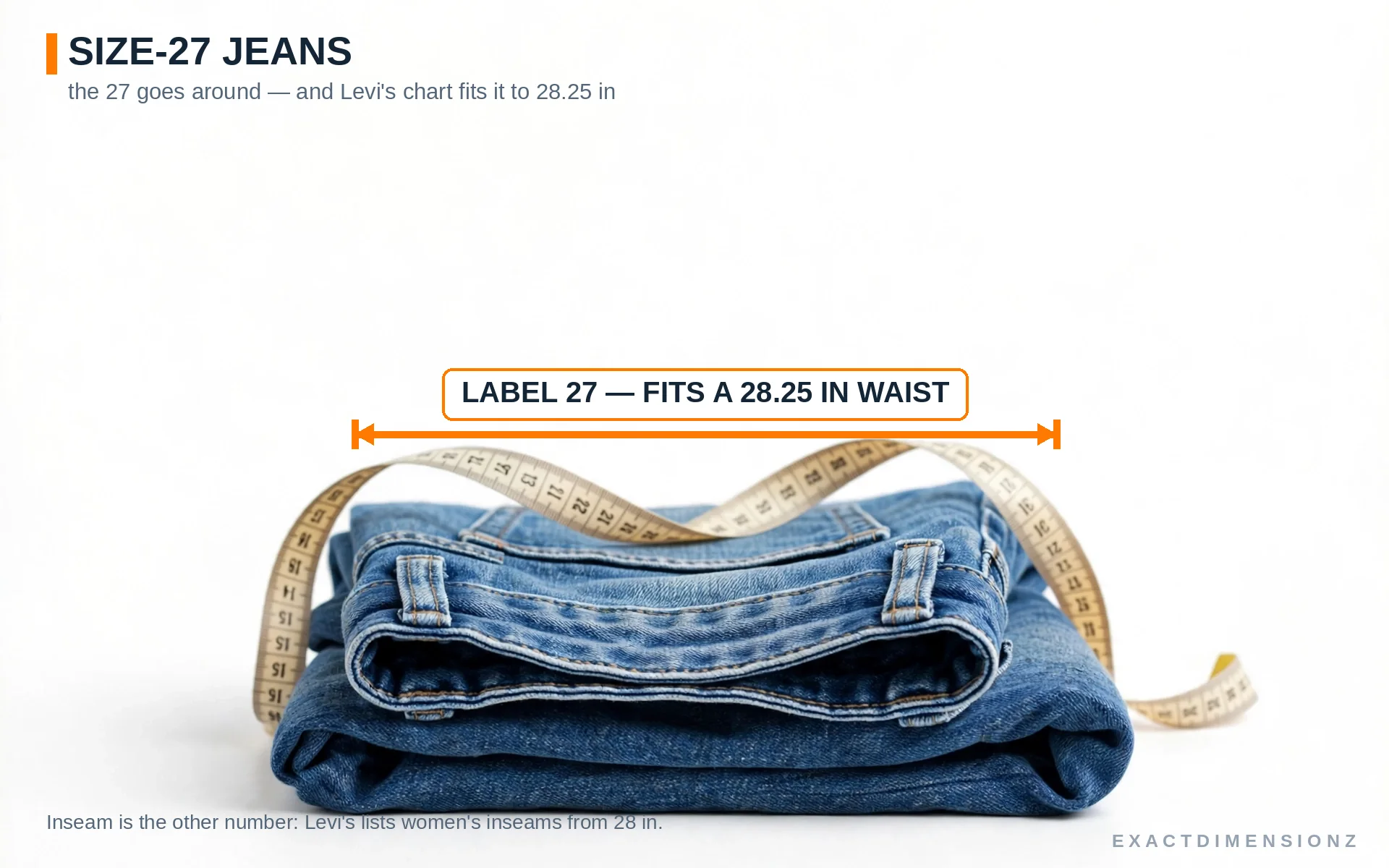
The last stop turns the yardstick into a tailor’s tape, because this 27 is not measured along anything. Women’s jeans are sized by waist, and the size number is the waist in inches — in theory. In practice, read Levi’s official size chart: jean size 27 corresponds to a waist of 28.25 inches and a hip of 37 inches (the metric chart gives the same size-27 waist as 72 cm). The gap is vanity sizing, applied so consistently that it is printed in the maker’s own chart: the label says 27, the body the jeans are cut for measures 28¼ around the waist. So the most famous “27 inches” in clothing is not a length at all, and is not 27 even as a circumference.
The chart teaches the second lesson too. A jean’s full size is two numbers — waist × inseam, W27 L32 and so on — and the inseam is a genuinely along measurement, crotch seam to hem. On Levi’s chart the women’s numeric inseams run 28, 30, 32, 34 by height band: there is no 27 among them. The number 27 exists in denim only as the waist label. Which makes Stop 8 the mirror image of Stop 3: the monitor’s 27 is a real measurement taken in an unnamed direction; the jeans’ 27 is a named direction — around the waist — with a number that has drifted an inch and a quarter off the tape.
Yard line: THE NAME ONLY. A label for a 28.25-inch waist, measured around; the same brand’s inseams start at 28 in (Levi’s size chart). Check it yourself: wrap a tape around the waistband of any size-27 jean, buttoned flat — then read the size chart of the brand that made it. The two 27s will not meet.
The Scoreboard at the Three-Quarter Mark
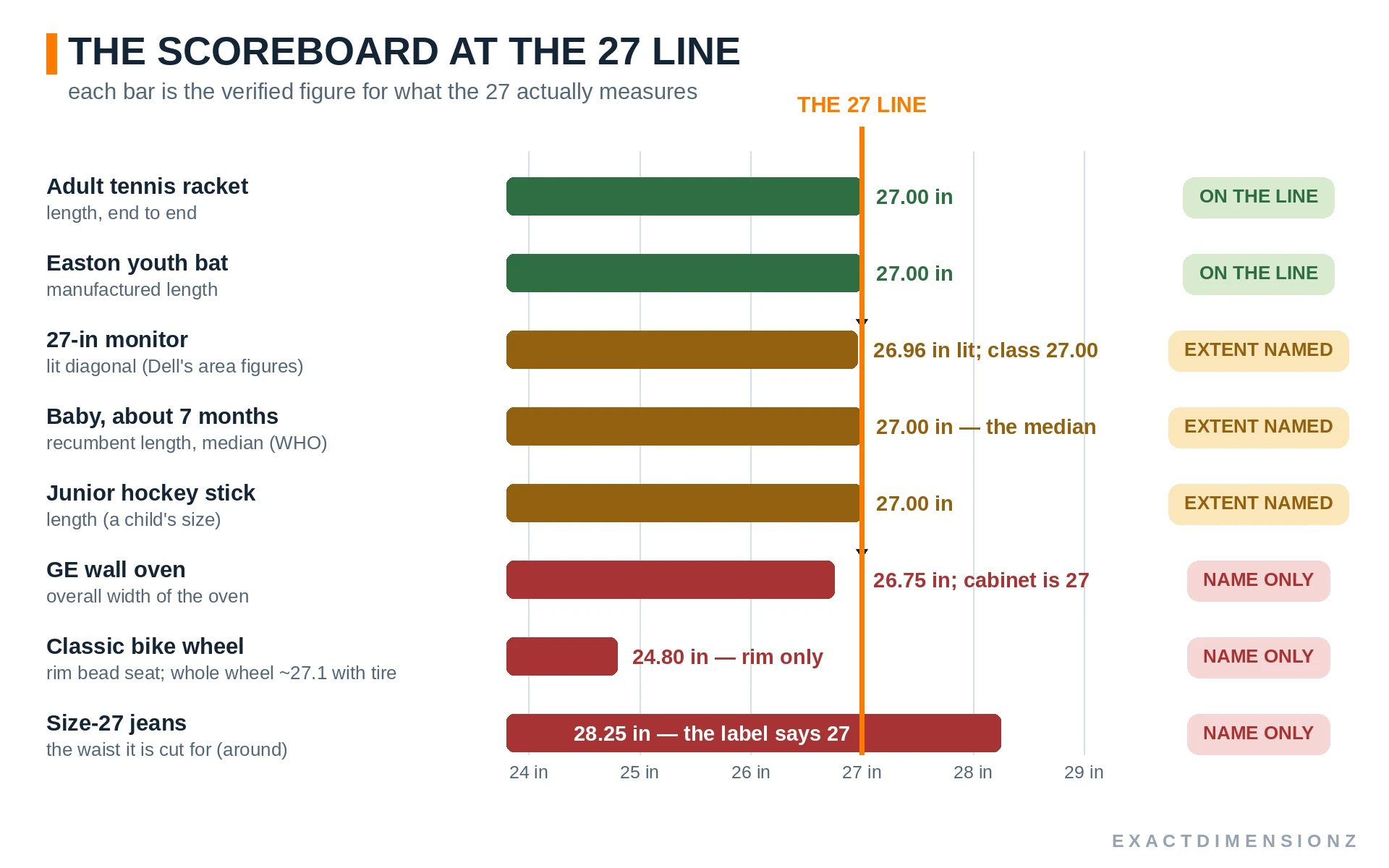
Eight stops, three grades. Two objects measure 27 inches the way a reader pictures it — a tape along the thing, landing on the mark. Three more hold their 27 honestly once the extent is named: a diagonal, a median, a child’s size. And three carry the number as a name only — a rim class from the brake era, a cabinet width, and a waist label that has drifted off its own tape. The pattern is the point of this series: the number is never the lie. The missing extent is.
| Object | What the 27 measures | Verified figure | Yard line |
|---|---|---|---|
| Adult tennis racket | End-to-end length | 27 in / 68.58 cm (Wilson’s spec table) | ON THE LINE |
| Easton ADV1 youth bat (-12) | Manufactured length | 27 in size run; 15 oz at that length | ON THE LINE |
| Dell UltraSharp 27 monitor | Screen diagonal (class) | 684.7 mm class diagonal; lit area computes to ≈26.96 in; cabinet 24.10 in wide | ON THE LINE, EXTENT NAMED |
| Baby of about 7 months | Recumbent length (median) | 68.58 cm = boys’ median at ≈6.6 mo, girls’ at ≈7.9 mo (WHO) | ON THE LINE, EXTENT NAMED |
| Junior field hockey stick | Manufactured length | 27 in, for a player ≈3 ft 3 to 3 ft 8 (Longstreth) | ON THE LINE, EXTENT NAMED |
| Classic 27-in bicycle wheel | Class name | Bead seat 630 mm = 24.80 in; whole wheel ≈27.0–27.3 in with period tires | THE NAME ONLY |
| GE 27-in wall oven (JKS5000) | Cabinet class | Cabinet 27 in; oven 26-3/4 in wide; cutout 25 to 25-1/4 in | THE NAME ONLY |
| Levi’s size-27 jeans | Waist label | Fitted waist 28.25 in (Levi’s chart); inseams listed 28–34 in | THE NAME ONLY |
Along, Across the Corner, Around: The Three Ways to Point at 27

Lay the eight stops out by direction and a small taxonomy appears — the real souvenir of this article. Along is the honest default: the racket, the bat and the hockey stick are 27 inches along their length, the way a yardstick measures. Across the corner is the screen convention: the monitor’s 27 lives on its diagonal, and its width — the direction your desk cares about — is 24.10 inches. Around is clothing: the jeans’ 27 was always a circumference, and even read that way it has drifted to 28.25. And standing outside the three directions are the names that point nowhere: the wheel’s 630 mm rim, the oven’s 27-inch cabinet, and the baby’s median — a direction through a population rather than through an object. When any product tells you its size from now on, the first question is not “how big” but “which way”: along, across the corner, or around — or is it a name?
Build 27 Inches Yourself
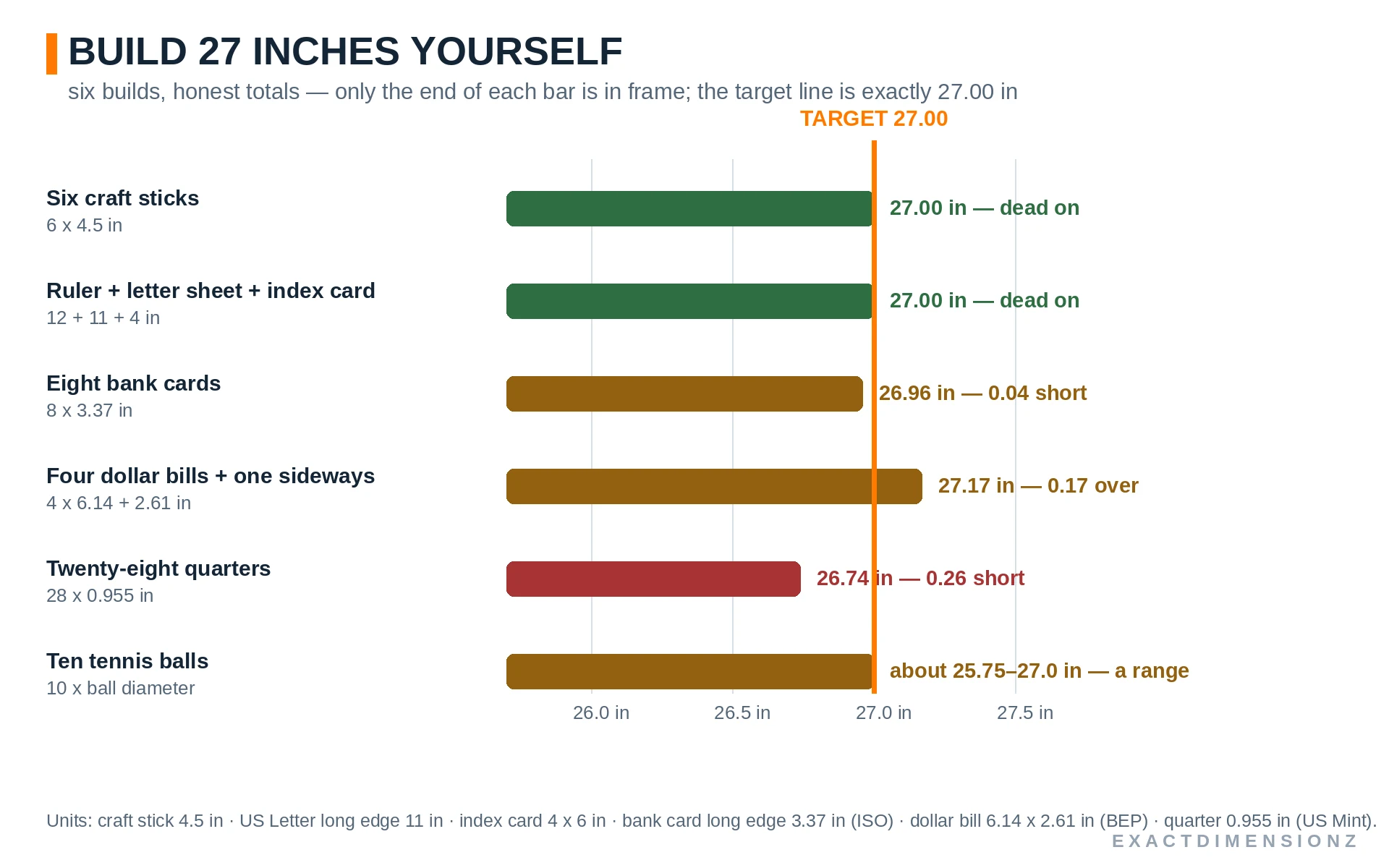
No yardstick in the house? Twenty-seven inches can be assembled from objects whose sizes are themselves standards — and two of this series’ own guides hold the pieces: a 13-inch object laid against a 14-inch object makes 27 on the nose. The builds below use only verified unit sizes (a standard craft stick is 4.5 inches; a US dollar bill is 6.14 × 2.61 inches per the Bureau of Engraving and Printing; a quarter is 0.955 inches across per the US Mint; a bank card’s long edge is 3.37 inches). Totals are printed to the hundredth, including the builds that miss — missing honestly is the house rule.
| Build | Parts | Total | Verdict |
|---|---|---|---|
| Six craft sticks | 6 × 4.5 in | 27.00 in | Dead on |
| Ruler, letter sheet, index card | 12 + 11 + 4 in | 27.00 in | Dead on |
| Eight bank cards | 8 × 3.37 in | 26.96 in | 0.04 in short |
| Four dollar bills, plus one sideways | 4 × 6.14 + 2.61 in | 27.17 in | 0.17 in over |
| Twenty-eight quarters | 28 × 0.955 in | 26.74 in | 0.26 in short |
| Ten tennis balls | 10 × ≈2.575–2.70 in diameter | ≈25.75–27.0 in | A range, not a total — it depends on the ball |
The second build is the one to keep in a drawer: a 12-inch ruler, the long edge of a US Letter sheet (11 inches), and the short edge of a 4 × 6 index card sum to exactly 27.00 — three office supplies, zero rounding. The tennis balls close the table with the opposite lesson: a ball’s diameter is a range set by the rules of tennis, not a single figure, so ten of them give you an interval. Any build, chart or product that reports a range as a point is doing the thing this article grades down.
The Corrections Desk: Seven Rival Claims, Corrected
Every figure above was checked against a primary source. The claims below were not — they come from the top-ranking rival pages for this keyword, and each is corrected against the same standard of evidence, with the source linked so the correction can be checked too.
1. The guitar body that is not “close to 27 inches” (flagship). The top rival list for this keyword opens with the claim that “many acoustic guitars have a body measuring close to 27 inches.” Measure the archetype instead. A Martin D-28’s body length is 20 inches, its scale length is 25.4 inches, and its overall length is 40.5 inches — figures set out in the D-18/D-28 specification comparison, with the 25.4-inch scale confirmed on American Musical’s Martin D-28 listing. No dimension of the guitar is 27; the body, the part named in the claim, misses by about seven inches.
2. The counter stool that belongs to no class. The same rival list gives a kitchen counter stool a seat height of about 27 inches. Stool heights are standardized by the surface they serve: counter stools run 24 to 26 inches for 36-inch counters, and bar stools 28 to 30 inches for 40- to 42-inch bars — see Kouboo’s stool height guide, whose ranges match every furniture guide we checked. Twenty-seven sits in the gap between the two classes: a stool built there would be wrong at both surfaces.
3. The electric guitar’s “27-inch fretboard.” One rival page says an electric guitar’s 27 inches “usually refers to the length of the fretboard.” Standard electric guitars have scale lengths of 24.75 to 25.5 inches; a 27-inch scale exists only on baritone guitars, built for lower tunings — and scale length (nut to bridge) is not the fretboard’s length in the first place. Guitar.com’s baritone guide states the ranges plainly: standard scale 24.75 to 25.5 inches, baritones “typically 27 inches or higher.”
4. The 27-inch hockey stick “preferred by midfielders and forwards.” The same page presents a 27-inch field hockey stick as a size for adult positional players. Longstreth’s height chart (linked at Stop 5) brackets 27 inches between its 26-inch size for players 3 feet to 3 feet 5 and its 28-inch size for 3 feet 5 to 3 feet 10. Adult midfielders and forwards play with 35- to 37.5-inch sticks. The claim misplaces the stick by roughly a decade of the player’s life.
5. “At six months, the average baby is 27 inches long.” Another rival page offers the six-month baby as a 27-inch reference. The WHO medians (tabulated at Stop 4) are 67.6 cm for boys and 65.7 cm for girls at six months — 26.6 and 25.9 inches. A 27-inch length is the median at about 6.6 months for boys and 7.9 months for girls. Two months of a baby’s first year is not a rounding error.
6. “The average cat is usually 27 inches long.” The same page gives the average cat a 27-inch length. The average domestic cat’s head-to-body length is about 46 cm — 18 inches — with a tail of about 30 cm (12 inches) on top of that, per standard domestic-cat measurement references. Twenty-seven inches matches neither the body (18) nor the whole animal (about 30). It is simply a number with a whisker drawn on it.
7. The “27-inch inseam” that maps to a waist. A third rival page builds a section on a “27-inch inseam” and maps it to waist sizes — two different measurements fused into one. On Levi’s own chart (linked at Stop 8), a size 27 is a waist label fitted to 28.25 inches, and the women’s inseams Levi’s lists begin at 28 inches. The page’s central example is a measurement its own subject does not offer.
Past the Three-Quarter Mark
So: how long is 27 inches? Exactly 68.58 centimetres, exactly 2.25 feet, exactly three-quarters of a yard — and, in the world of objects, a racket and a child’s bat that truly span it, a screen that spans it only across the corner, a baby who spans it on average at about seven months, a small child’s hockey stick, and three names — a wheel class, a cabinet class, a waist label — that span nothing at all. The grades differ; the standard never did.
Keep the yardstick habit and the number stays honest anywhere: ask which direction the size runs (along, across the corner, around), ask whose document the figure comes from, and ask whether it is a measurement or a name. Eight objects were brought to the three-quarter mark for this article. Two stood on the line. That ratio — not any single figure — is what “27 inches” means in the wild.
