
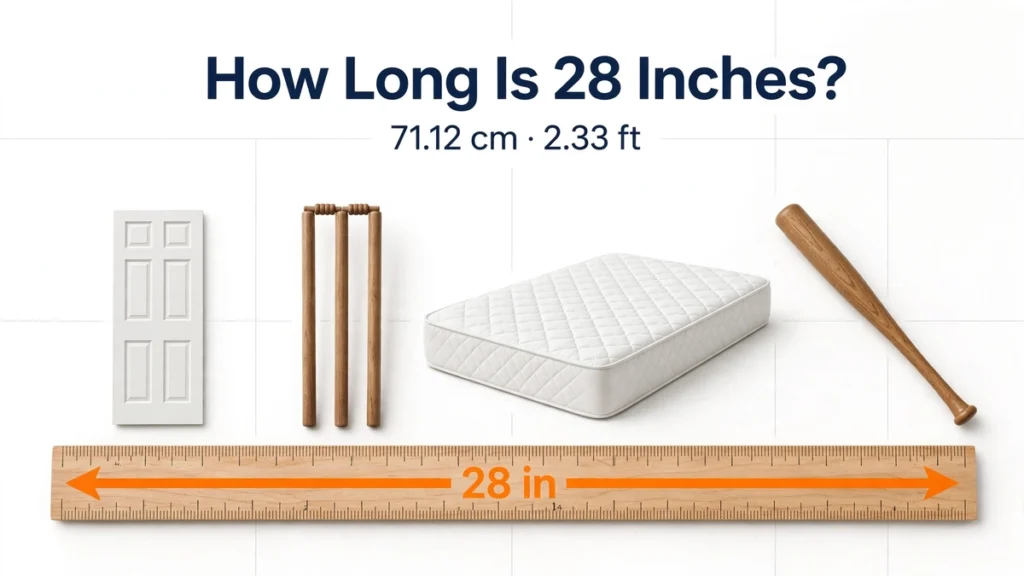
If you are asking how long is 28 inches, you are probably not holding a tape measure — you are holding a question about fit. Will it go through the doorway? Will it fit the crib, the player, the jeans, the airline’s checked-bag limit? Twenty-eight inches is exactly 71.12 centimetres, exactly 711.2 millimetres, 2.3333 feet, 0.7778 of a yard — and, for a first picture, exactly two 14-inch spans laid end to end. But the number’s working life is as a size that other things are built to fit, and that is where it gets slippery: some of the things sold as “28 inches” measure it dead on, some are held to it by a rulebook, and some never measure 28 in any direction at all. For the wider scale, see the complete inches size guide.
So this article is a fitting room. Eleven claimants step in: a door slab, a set of cricket stumps, a crib mattress, a Great Dane, a baseball bat, a jeans inseam, a necklace, a monitor, a suitcase, a bicycle wheel and an off-road tire. Each one is checked against a primary source — the law book, the breed standard, the maker’s own specification sheet — and each leaves with a fit grade that says exactly how its 28 is earned. Two are dead fits. Two are fixed by rule. Three are label fits, where the honest physical measurement is something else entirely, and we print that measurement too.
QUICK ANSWER
28 inches = 71.12 cm exactly (711.2 mm • 2.3333 ft • 0.7778 yd). It is the width of a standard interior door slab, the height of cricket stumps under Law 8, the width of every full-size crib mattress, the minimum shoulder height of a female Great Dane, and the full length of a youth baseball bat — all verified below. But a “28-inch” monitor is 26 inches wide (the 28 is its diagonal), a “28-inch” suitcase stands 31.75 inches tall at the airport, and a “28-inch” bicycle wheel has a rim of 622 mm. Eleven fits, graded one by one.
Welcome to the Fitting Room: How the Fit Checks Work
Every object below gets one line — its Fit check — graded on a six-point scale built for this article. DEAD FIT means the object itself physically measures 28 inches in the direction named. RULE FIT means a rulebook or regulation fixes the dimension at 28 inches, so the fit is enforced rather than approximate. MINIMUM FIT means 28 inches is a floor the thing must reach, not a size it happens to be. SIZE FIT means 28 is the maker’s size code for that dimension — the number you order by. RANGE FIT means 28 falls inside a named band. And LABEL FIT means the 28 is a class name or a legacy name: the object is genuinely sold as a 28, but its tape-measure truth is a different number, which we always state. No object is called “exactly 28 inches” unless the evidence earns the word.
Why a fitting room, and not another ruler? Because 28 inches is rarely asked about in the abstract. It is the width of the doorway the sofa has to pass, the footprint the nursery furniture must match, the length a young player’s arms can swing. A pure length question — “how long is 28 inches” — is almost always a fit question in disguise, and fit questions have a property pure lengths never do: they can fail. A bat that measures 27 inches is not approximately a 28 for the child whose league chart assumes the longer bat. A mattress an inch too narrow is not approximately safe. Grading the fits, rather than merely listing the objects, is what turns a number into an answer — and it is why every section below names the document the fit was checked against, so you can re-run the check yourself.
The Fit Chart: All Eleven, at a Glance
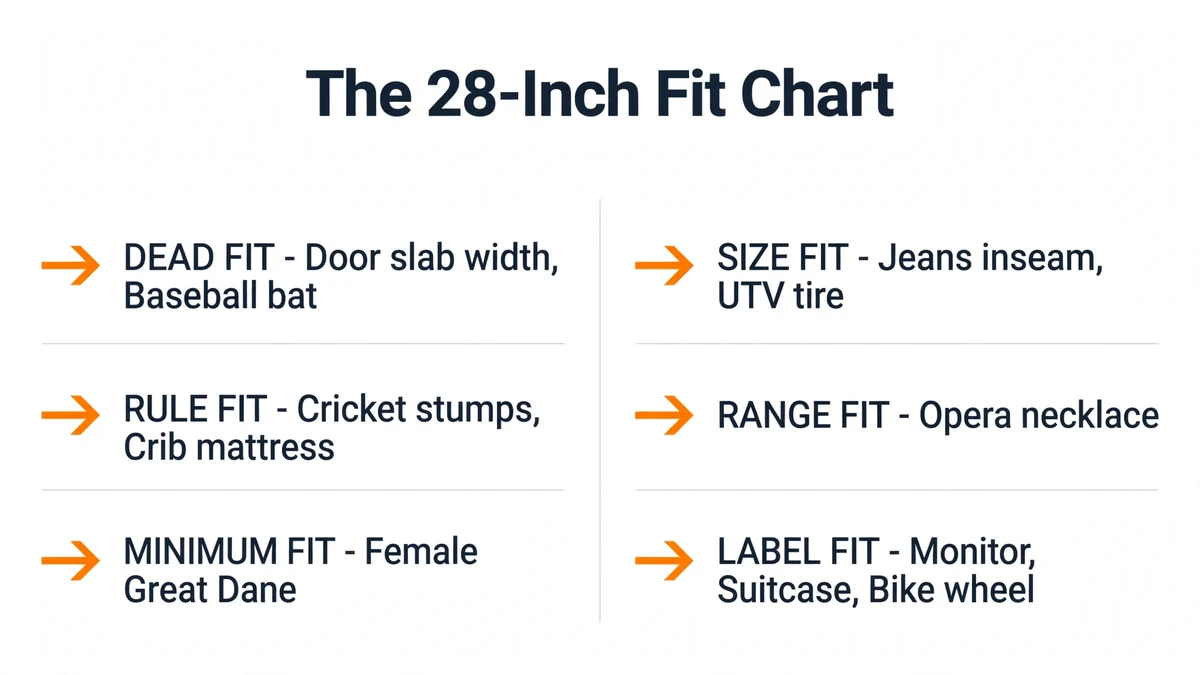
| Object | Where the 28 lands | Fit check |
|---|---|---|
| Interior door slab | The slab’s width | DEAD FIT |
| Cricket stumps | Ground to top of the stumps | RULE FIT |
| Full-size crib mattress | The mattress’s width (52 × 28 in) | RULE FIT |
| Female Great Dane | Minimum shoulder height | MINIMUM FIT |
| Youth baseball bat | Knob to barrel end | DEAD FIT |
| Jeans inseam | Crotch seam to hem (the “short” length) | SIZE FIT |
| Opera necklace | Inside the 24–30 in opera band | RANGE FIT |
| 28-inch-class monitor | The screen’s diagonal class (26.0 in wide) | LABEL FIT |
| “28-inch” checked suitcase | Interior class; stands 31.75 in overall | LABEL FIT |
| 700C bicycle wheel | The traditional name; rim bead seat 622 mm | LABEL FIT |
| UTV tire, 28x10R14 | Overall-diameter size code | SIZE FIT |
The 28-Inch Door Slab: A Dead Fit You Walk Through

The first fit is the one you pass through every day. Interior doors are sold by the size of the slab — the leaf itself — and 28 inches, written 2/4 in trade shorthand (two feet, four inches), is one of the standard widths on every maker’s list. Masonite’s interior range, for example, lists a 28 in. x 80 in. common size across its prehung and slab lines, typically used for bathrooms, closets and secondary bedrooms where a full 30- or 32-inch leaf will not swing.
The honest fine print is about what the 28 does not include. The slab is 28 inches wide; the frame it hangs in adds jamb material on both sides, and the rough opening a builder frames for it is wider still, conventionally around 30 inches. So if you are checking whether a 28-inch door fits a hole in your wall, the answer runs the other way: the hole must be bigger than the door. But measured the way doors are named, bought and stamped, the leaf itself is a true 28 inches wide — the first dead fit of the day, eighty inches tall and hiding in plain sight.
Fit check: DEAD FIT — the slab itself is manufactured and sold at 28 inches wide; frame and rough opening are wider and are not what the size names.
Cricket Stumps: The Law Books It at Exactly 28

Cricket is a game run by a law book, and the law book is unusually fond of this number. Law 8 of the MCC Laws of Cricket governs the wickets: two sets of three stumps, and in the words of Law 8.2 as set out in the MCC Laws, “the tops of the stumps shall be 28 in/71.12 cm above the playing surface.” Note the conversion the law itself prints — 71.12 cm is exactly this article’s number, because the law was written in both units and 28 inches converts exactly.
The same law fixes the supporting dimensions: each stump between 1.38 and 1.50 inches in diameter, the three together spanning 9 inches, with bails resting in grooves on top. A wicket keeper, a bowler and 28 inches of ash wood: when a bail flies, it falls from a legally specified height. This is not a manufacturer’s claim that can drift between production runs — a stump that is not 28 inches tall is not a legal stump, and matches from Lord’s to a school field are played in front of the same 28-inch target.
Fit check: RULE FIT — the Laws of Cricket fix stump height at 28 in/71.12 cm; the fit is enforced by the rulebook, not estimated.
The Crib Mattress: A Regulation Fit, 52 by 28

Every full-size crib mattress in the United States is built around 28 inches, because the crib it must fit is. The federal definitions behind the standard put a full-size crib’s interior at 28 inches wide, with a tolerance of ±⅝ inch, and require the mattress to measure at least 27¼ inches wide so it cannot shift and trap a baby against the side. Makers build to the nominal: Graco’s Premium Crib & Toddler Mattress, to take a mainstream example, is specified in the manufacturer’s manual (mirror-hosted copy) at 52″L × 28″W × 5″H and sold as fitting “any standard full-size crib.”
That 52 × 28 footprint is why this object earns its place: the 28 is the short side of the most safety-regulated rectangle in the nursery. A mattress meaningfully narrower than 28 inches in a standard crib is not a bargain, it is a hazard — which is what makes one rival’s claim, corrected in the Corrections Desk below, more than a typo. When a dimension is written into safety rules, “about” stops being good enough.
Fit check: RULE FIT — the 28-inch width is set by the federal crib standard the mattress must fit; retail mattresses are manufactured to 52 × 28 in.
The Female Great Dane: 28 Inches Is the Floor, Not the Height

The fourth fit is alive. The Great Dane breed standard — the document judges measure the dog against — sets minimum heights at the shoulder: 30 inches for males, and for females, in the standard’s words as reproduced in the Great Dane Club of America’s illustrated standard, “the female shall not be less than 28 inches at the shoulders,” adding that “Danes under minimum height must be disqualified.” A female Dane standing 27 inches at the withers is a lovely dog and, by the standard, not a show Dane at all.
So here 28 inches is neither a size nor an average — plenty of female Danes stand 30 inches or more — it is a threshold. Below it, the breed’s defining trait, its giant scale, is judged absent. If you want to feel how tall a minimum that is, stand a tape at 28 inches against your own leg: on most adults it lands around mid-thigh, which is the height of the shoulder of the smallest Great Dane the standard allows.
Fit check: MINIMUM FIT — 28 inches is the disqualification floor for a female Great Dane’s shoulder height under the AKC standard, not a typical measurement.
The 28-Inch Baseball Bat: A Dead Fit for Young Players
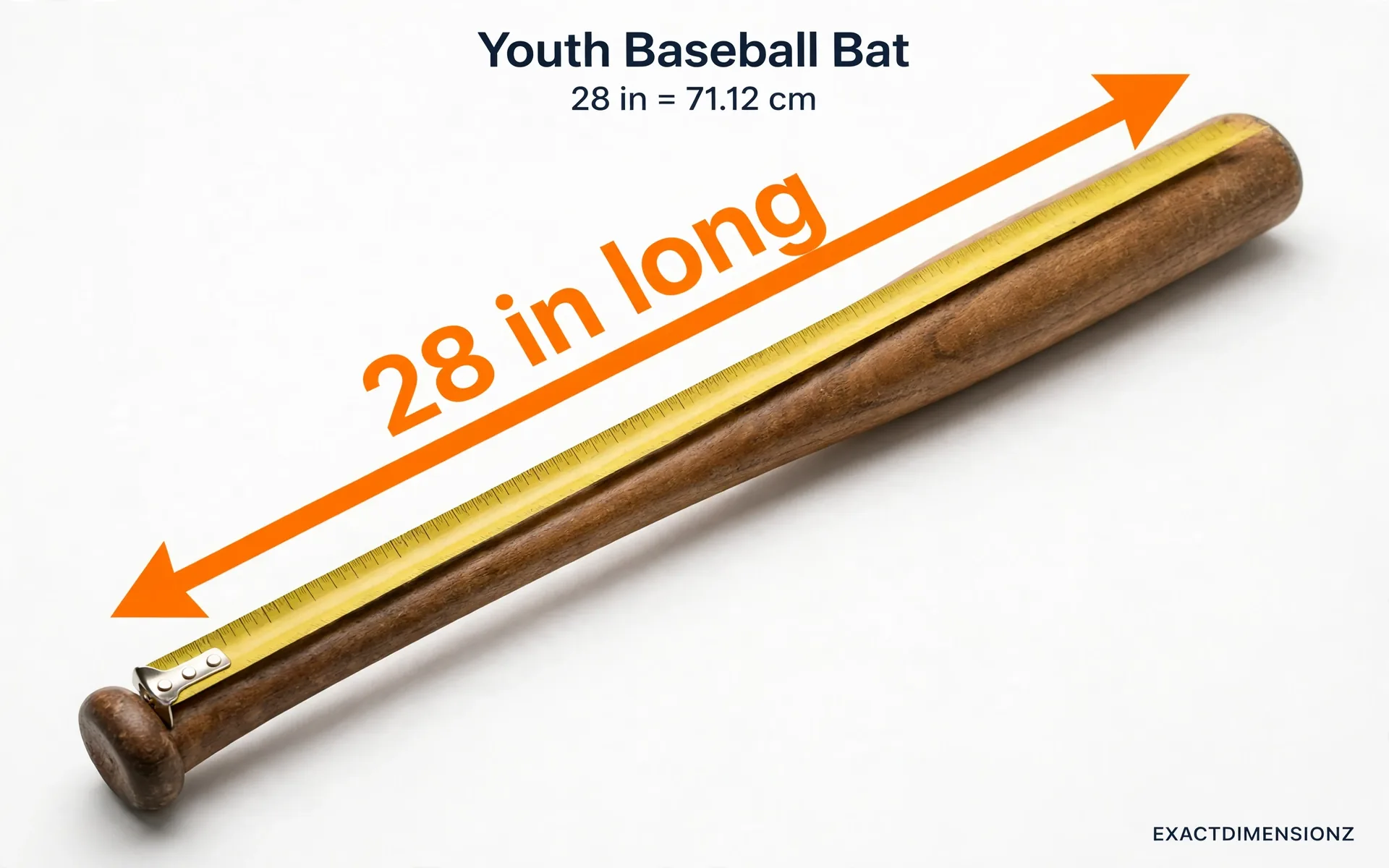
Baseball bats are sized by a single honest number: overall length, knob to barrel end. The 28-inch size is a standard youth length, and makers publish it plainly — Rawlings’ MACH AI line, for instance, includes a 28-inch model (part RUS4MC10-28) whose manufacturer specifications list the size as 28 inch with product dimensions of 28″L × 2.63″W. There is no diagonal, no class, no fine print: lay the bat beside a tape and it reads 28.
Context makes the fit more useful. Adult bats run 31 to 34 inches, and the smallest youth sizes start around 24 — so 28 inches sits in the heart of the kid-pitch range, typically matched to players roughly eight to ten years old by the bat charts. When a coach says “a 28,” every parent in the dugout knows the length being discussed. Compare that with the AI-generated range table corrected below, which files the full length of a baseball bat under 12–16 inches — shorter than the barrel of the bat in this section.
Fit check: DEAD FIT — a 28-inch bat measures 28 inches end to end, per the maker’s own specification; the number is the object’s full length.
Check it yourself: the bat is the easiest fit in this article to verify at home. Any bat in the house can be laid along a tape or two rulers, knob against the zero, and read at the barrel end — and if a seller’s “28-inch” bat reads 27½, it is mislabelled — bats are manufactured to the size they are sold as, not rounded up from a smaller one. The same ten-second test, applied to the monitor and the suitcase below, is what separates a dead fit from a label — the bat passes it, they do not, and now you own the test.
The 28-Inch Jeans Inseam: The “Short” on Levi’s Chart

Jeans carry two numbers, and the second one is a length you wear. The inseam — measured from the crotch seam straight down the inside leg to the hem — is sold in named lengths, and 28 inches is the short end of the standard ladder. Levi’s own size guide maps its women’s inseams to heights: the 28 belongs to wearers 5’1″ or shorter, with 30, 32 and 34 climbing the chart from there. Order a 28 inseam and the leg of the jean is cut to put 28 inches of cloth between crotch and hem.
Notice what kind of fit this is. The 28 does not describe your leg; it describes the garment’s leg, and the matching of the two is the shopper’s job — the same pair measures identically on every wearer while fitting each one differently. It is also a genuinely useful way to feel the number in daily life: if you wear a 28 inseam, you have a calibrated 28-inch reference hanging in your closet.
Fit check: SIZE FIT — 28 is the manufacturer’s inseam size code, the “short” length on Levi’s published chart, measured crotch seam to hem on the garment.
The Opera Necklace: 28 Inches Inside the Band

Jewellery names its lengths like opera houses name their seats. Below the choker (14–16 in) and the princess (18 in) sits the matinee (20–24 in), and then the opera: on Blue Nile’s necklace length chart, the opera band runs 24 to 30 inches, worn falling below the bust, long or doubled into two strands. A 28-inch necklace is not an opera necklace by courtesy — it sits squarely inside the jeweller’s published band, four inches clear of either edge.
The strand itself is an honest 28 inches of chain or pearls, clasp included, which makes this a different animal from the monitor and the suitcase coming next: here the object measures 28, but the name it is sold under is the band, not the measurement. Ask a jeweller for “an opera” and you will be handed anything from 24 to 30 inches; ask for 28 inches and you get exactly this — the middle of the opera range, long enough to double into a two-strand look at 14 inches a side.
Fit check: RANGE FIT — the strand measures 28 inches, and 28 sits inside the 24–30 in opera band on Blue Nile’s published chart; the name names the range.
The 28-Inch Monitor: A Label Fit — the 28 Is the Diagonal

Now the fitting room turns honest about labels. A “28-inch monitor” has exactly one 28 anywhere near it: the diagonal of its viewable panel, corner to corner. Take ASUS’s VP28UQG, a typical 28-inch-class 4K monitor: ASUS’s published specifications list “Panel Size (inch): 28” and, a few lines later, the physical dimensions of the whole machine — 660.4 × 445.8 × 229.4 mm with its stand. Convert the width: 660.4 mm is 26.0 inches. The monitor you would carry through a doorway, or fit on a desk, is twenty-six inches wide and about seventeen and a half tall. Nothing on it measures 28 inches across or down.
This matters because at least one rival page for this very keyword tells readers a desktop monitor “can be about 28 inches wide” — the diagonal quietly promoted into a width, two full inches invented. Screen classes are a legitimate naming system with a century of convention behind them, but a class is not a measurement, and the moment you need the width — for a dual-monitor desk, a wall mount, a carry case — the class number is the wrong tool. Measure corner to corner for the class; measure across for the truth.
Fit check: LABEL FIT — 28 is the diagonal panel class; the physical monitor is 26.0 inches wide per the maker’s own dimensions.
The “28-Inch” Suitcase That Stands Nearly 32 Inches Tall
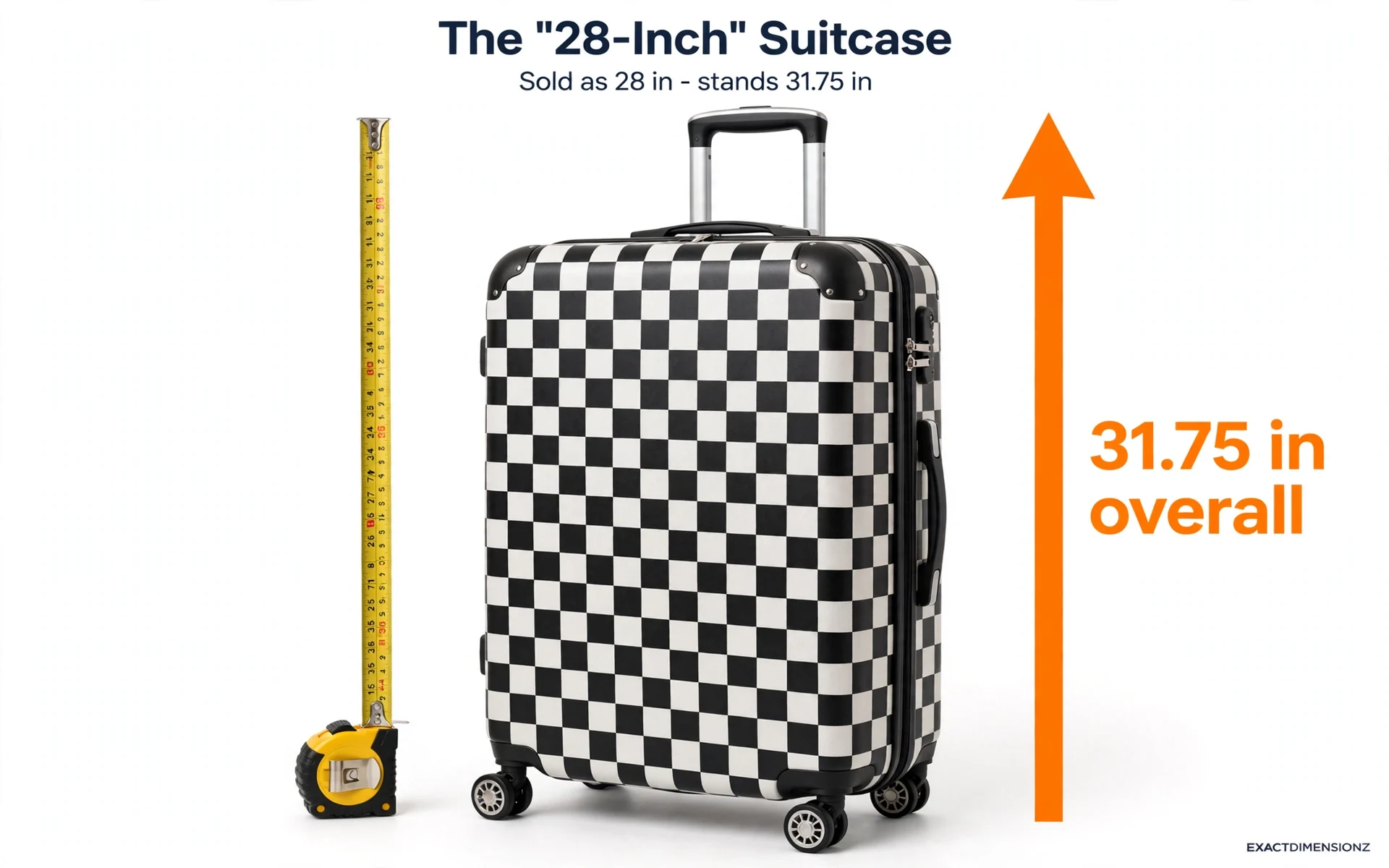
Luggage repeats the monitor’s trick with higher stakes, because airlines measure the outside. The Delsey Helium Aero in its “Checked-Large 28 Inch” size carries manufacturer-listed dimensions of 31.75 × 20.75 × 12.75 inches for the exterior, wheels and handles included, and 28.25 × 19.75 × 11.5 inches for the interior. Read those again: the 28 in the name belongs, roughly, to the inside of the case — the packing length — while the object that rolls up to the check-in desk stands 31.75 inches tall.
The arithmetic has a price tag. Add the three exterior numbers and the “28-inch” case totals 65.25 linear inches — over the 62-linear-inch threshold many airlines use before oversize fees apply. None of this makes the case dishonest; large checked bags from every major brand are named by their interior class the same way. But it does make the name useless at the one moment the traveller needs a measurement. The fitting room rule writes itself: for anything with wheels, a handle and a size in its name, measure the outside yourself.
Fit check: LABEL FIT — 28 names the interior size class (interior 28.25 in long); the physical case stands 31.75 in overall, per the manufacturer’s listed dimensions.
The 700C Wheel: The “28-Inch” Wheel That Isn’t — Until You Fit a Fat Tire
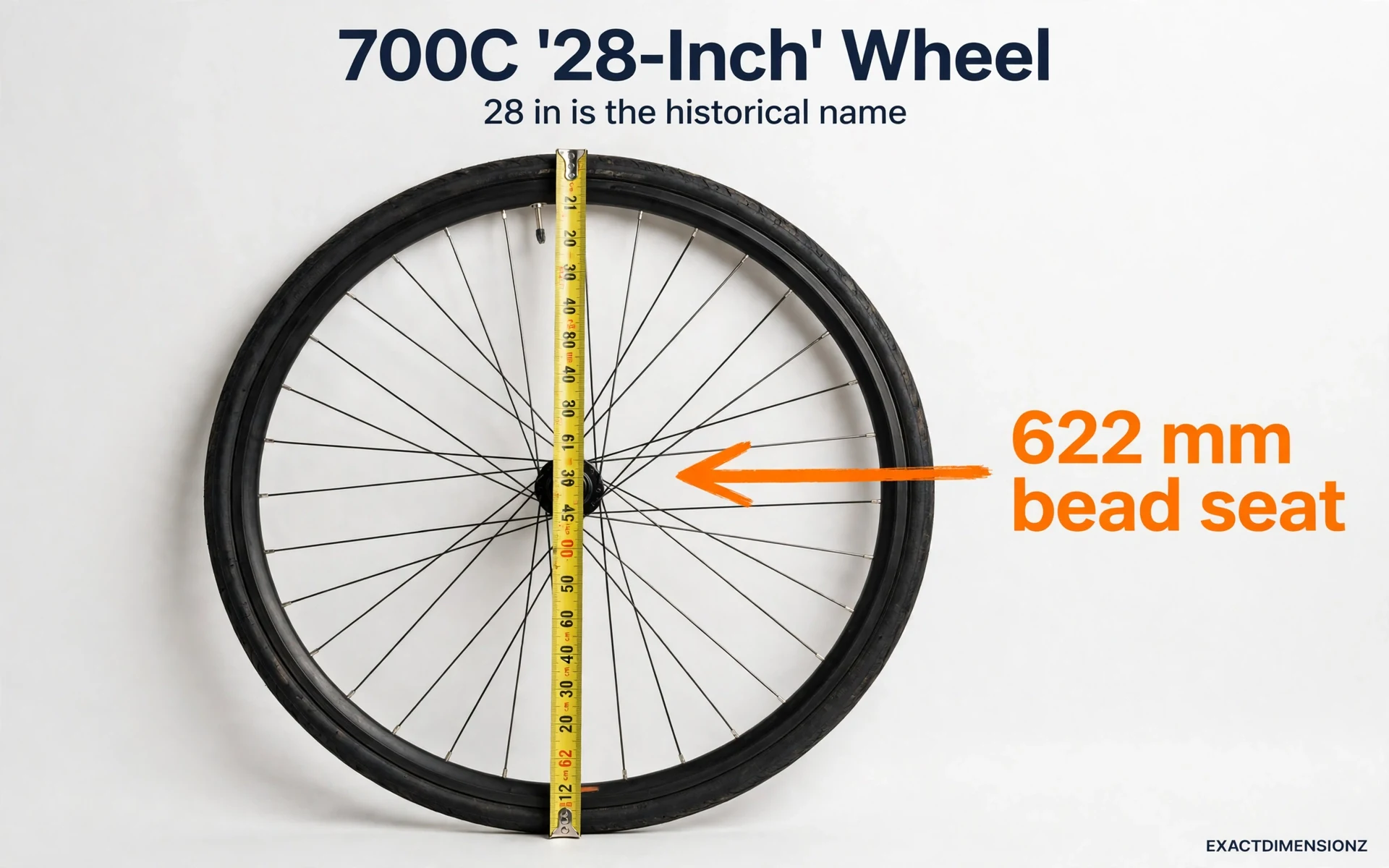
Ask a bike shop for a 28-inch wheel and you will be handed a 700C road wheel — the size most of Europe still calls 28 inch, a name inherited from the era when the tire’s outside diameter genuinely approached it. The modern truth is stamped in millimetres: the rim’s bead seat diameter, the circle the tire bead locks into, is 622 mm, or 24.5 inches, a figure standardized across makers in references such as Schwalbe’s technical reference. Everything above the rim is tire, and tire choice writes the final height.
Run the sum the way this series likes it run. A 700 × 28 mm road tire adds its width twice, once at the top and once at the bottom: 622 + 28 + 28 = 678 mm, about 26.7 inches — the “28-inch wheel” standing 1.3 inches short of its name. Fit a 45 mm gravel tire instead and the same wheel grows to 622 + 45 + 45 = 712 mm, or 28.0 inches: the legacy name finally, literally true. No object in this article better deserves its grade — the 28 is a century-old label that a fat tire can still earn and a skinny one cannot.
Fit check: LABEL FIT — 28 inch is the historical name for 700C; the rim is 622 mm, and the complete wheel measures about 26.7 in with a 28 mm tire, 28.0 in with a 45 mm tire.
The 28-Inch UTV Tire: A Size Code That Stands Its Height
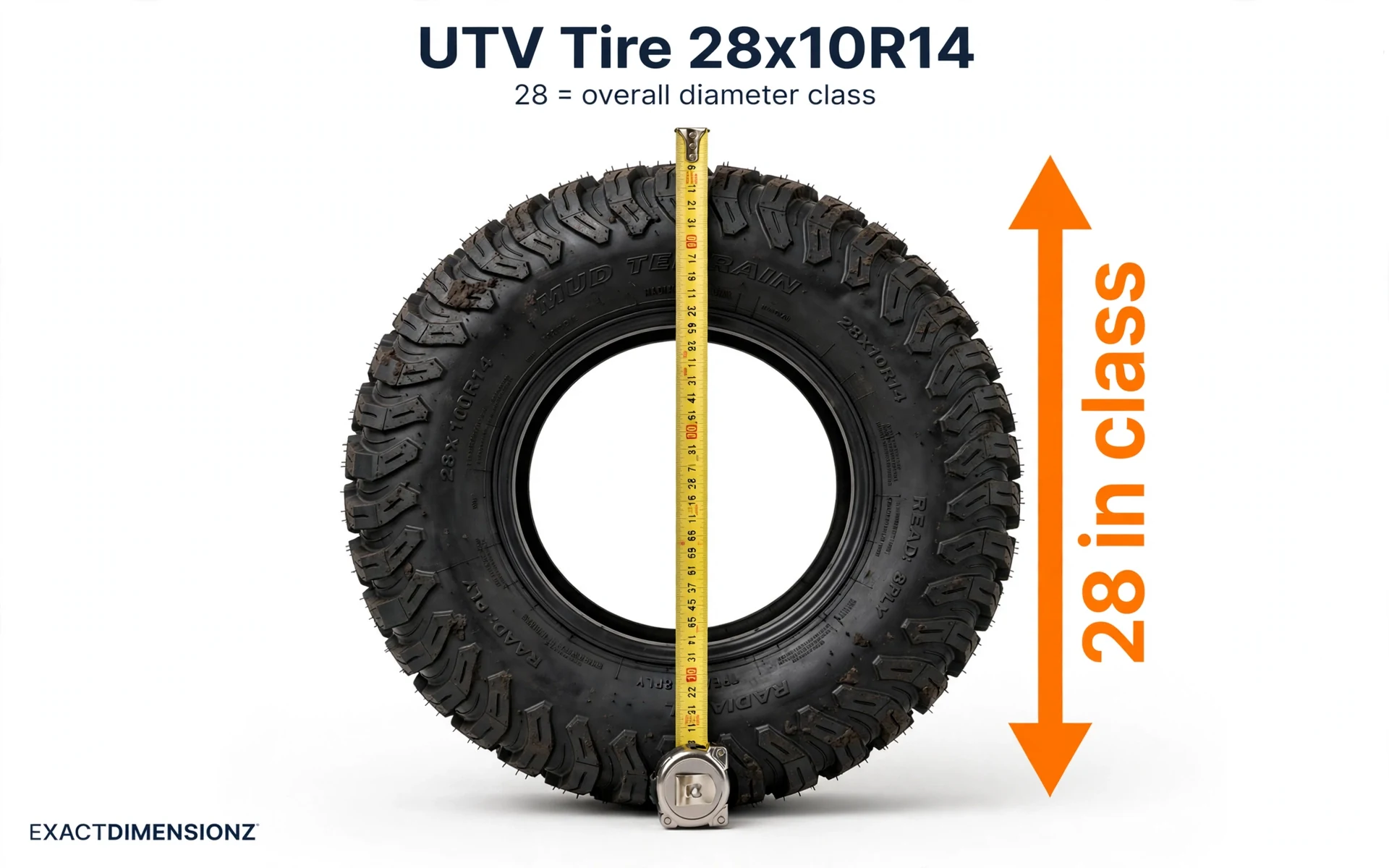
Off-road tires speak a different dialect of size. In the UTV fitment written 28×10.00R14, the first number is the tire’s overall diameter — the full height of the inflated tire standing on its rim — the middle number its width, and the last its rim size. When BFGoodrich launched UTV sizes of its Mud-Terrain T/A KM3, the launch release listed “28X10.00R14 NHS” among the first two UTV fitments: a tire built to stand 28 inches tall and run 10 inches wide on a 14-inch rim.
Grade it carefully, because a tire is not a machined part. The 28 is a design diameter: the same tire can measure a few tenths either side depending on rim width, pressure and load, which is why riders comparing true heights for gearing and clearance measure their own mounted tires. But unlike the monitor’s diagonal or the suitcase’s interior, this code names the very dimension a buyer cares about — how tall the tire stands — and the maker’s engineering target is 28 inches itself.
Fit check: SIZE FIT — 28 is the overall-diameter size code in the 28x10R14 fitment; mounted examples vary by tenths with rim, pressure and load.
28 Inches on One Strip
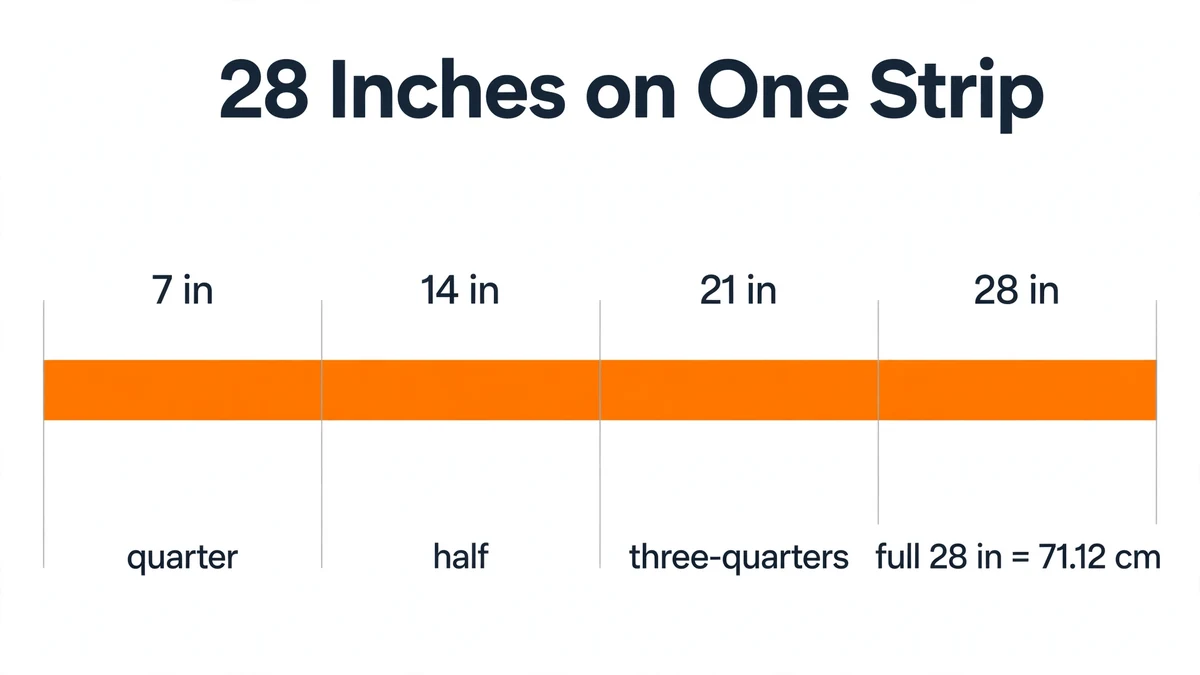
Before the builds, one clean mental picture. Lay a yardstick’s worth of imagination on the floor and mark the strip at quarters: 7 inches is the quarter mark, 14 the half, 21 the three-quarter point, and 28 the full fit — eight inches short of the yardstick’s own end, which is precisely the error corrected below. The strip’s other landmarks are covered elsewhere in this series: 9 inches and 10 inches sit just past the quarter mark, and 16 inches falls just beyond halfway. If you remember one anchor, remember the half: 28 is two fourteens, and 14 inches is a size most people can already picture from a laptop screen’s width. It sits just above 27 inches — one inch shorter — and just below 29 inches — one inch longer.
Build 28 Inches From Things on Your Desk

No tape measure? The fitting room still works with desk supplies, provided the arithmetic is run honestly — every build below shows its sum, including the beloved ones that miss. The units are verified: a standard ruler is a true 12 inches, US letter paper is a true 11 inches on its long edge, a 4 × 6 index card’s short edge is 4 inches, a US quarter is 0.955 inches in diameter, a bank card’s long edge is 3.37 inches, and a dollar bill runs 6.14 inches long — just past 6 inches, which is what makes the money build interesting.
| Build | The sum | True total | Verdict |
|---|---|---|---|
| Two rulers + an index card’s short edge | 12 + 12 + 4 | 28.00 in | Dead on — the desk build that works |
| Two letter sheets + a dollar bill | 11 + 11 + 6.14 | 28.14 in | 0.14 over — a hair past, invisible in practice |
| Twenty-eight quarters in a row | 28 × 0.955 | 26.74 in | 1.26 short — the count is not the length |
| Bank cards, long edges | 8 × 3.37 = 26.96; 9 × 3.37 = 30.33 | No whole count works | Eight fall short, nine overshoot — skip this build |
The quarter row deserves its sentence, because it is the fitting room’s lesson in miniature: twenty-eight quarters feel like they should make 28 inches, the way the count seems to promise the measure, but a quarter is 0.955 inches wide and the promise fails by an inch and a quarter. Counts are not lengths — the same sentence acquits the bat and convicts half the comparison tables on the internet.
The Corrections Desk: Eight Claims That Failed the Fit Check

The fitting room keeps a desk by the door for claims that arrived from other pages and could not be fitted to the facts. Eight were checked for this article; all eight failed. Each correction below rests on the primary source named.
1. “A standard guitar is close to 28 inches long”. A full-size guitar is nowhere near it: Taylor’s published specifications for its 814 give an overall length of 41 inches, with the body alone at 20 inches. The claim misses by roughly thirteen inches — nearly half the article’s subject.
2. “A large kitchen knife often measures 28 inches in total length”. Wüsthof’s own specification for its Classic 8-inch chef’s knife lists an 8.0-inch blade and a 4.5-inch handle on the maker’s product page — 12.5 inches in total. Even a 10-inch chef’s knife totals about 15. No kitchen knife in a home block approaches 28 inches.
3. “The width of a small desktop monitor can be about 28 inches”. Corrected in the monitor section above: the ASUS 28-inch-class VP28UQG is 26.0 inches wide per ASUS’s own dimensions; the 28 is its diagonal class. Width and diagonal are different lines on the same object.
4. A small TV with “height around 28 inches” — while the same page’s own text calls 28 the diagonal. The same page cannot have both, and the tape sides with the diagonal: a real 28-inch-class display stands about 17.6 inches tall including its stand (ASUS’s figures, above). Listing 28 as a height invents ten inches of television.
5. “28 inches is about the length of a yardstick. It is also about the length of a ruler. Finally, it is about the length of a pencil” . A yardstick is 36 inches, a ruler 12, a pencil about 7.5. Three comparisons, three misses — by 8, 16 and 20 inches respectively. This single sentence is the whole reason the Builds table above shows its sums.
6. “28 inches of hair is just below shoulder length” . Hang a tape from the crown and let it fall: on most adults 28 inches lands at the mid-back or waist. Shoulder length is roughly half that. The claim understates the length by an entire torso zone.
7. “Baby Crib Mattress Width — 21 inches” (from a rival 21-inches comparison table). The flagship correction. The US full-size crib standard — the one in the mattress section above — fixes the interior width at 28 inches and the mattress at 52 × 28 inches. A 21-inch-wide mattress in a standard crib would leave a seven-inch gap at the side, exactly the kind of gap crib standards exist to forbid. This is not a rounding error; it is a safety dimension understated by a quarter.
8. “Baseball bat (full length)” filed under 12–16 inches (in one AI-generated range chart). The bat in this article — a standard youth size — measures 28 inches by its maker’s specification, and adult bats run 31 to 34. A 12-to-16-inch “full-length bat” does not exist outside a keychain.
Questions People Ask About 28 Inches
How many centimetres is 28 inches?
Exactly 71.12 cm, because one inch is exactly 2.54 cm by international definition. In millimetres that is 711.2 mm; in feet, 2.3333; in yards, 0.7778 — a little over three-quarters of a yard, which is why 28 inches is not “about a yardstick.”
Is a 28-inch monitor actually 28 inches wide?
No. The 28 is the diagonal of the panel, corner to corner. A typical 28-inch-class monitor — ASUS’s VP28UQG — measures 26.0 inches wide and about 17.6 inches tall including its stand, per the maker’s specifications.
Will a “28-inch” suitcase fit airline checked-bag limits?
Measure the outside, not the name. The Delsey Helium Aero sold as a 28-inch case stands 31.75 inches tall overall and sums to 65.25 linear inches, over the 62-linear-inch threshold many airlines use before oversize fees. Individual airline rules vary; the exterior dimensions on your own case decide.
What common thing is exactly 28 inches?
The most everyday dead fits are the width of a standard 28 × 80 interior door slab and the full length of a 28-inch youth baseball bat. The most exacting fit is the height of cricket stumps — 28 in/71.12 cm, written into Law 8 of the Laws of Cricket.
The Fitting Room Verdict
Eleven fits, and the number behaved three different ways. Where people build to a standard — a doorway, a wicket, a crib — 28 inches is a promise the object keeps: two dead fits and two rule fits, each checkable against a document anyone can open. Where the number is worn as clothing — an inseam, a necklace band, a tire code — it fits as a size, honest as long as you know what it sizes. And where the number survives as a label — a screen’s diagonal, a suitcase’s interior, a wheel’s century-old nickname — the object itself quietly measures something else, and the label is only safe once you know the something else. That is the whole skill this series keeps teaching: never ask “is it 28 inches?” Ask which line, whose ruler, and what fits. The tape will do the rest.
Sources: MCC Laws of Cricket (Law 8) via Net World Sports’ guide; Great Dane Club of America illustrated standard (AKC); Graco/Storkcraft crib mattress manual (mirror-hosted copy) and US full-size crib definitions; Masonite door listings via Home Depot; Rawlings MACH AI specifications; Levi’s size guide; Blue Nile necklace length chart; ASUS VP28UQG specifications; Delsey Helium Aero manufacturer-listed dimensions; Schwalbe TechInfo; BFGoodrich KM3 UTV launch release via UTV Guide; Wüsthof and Taylor published specifications (Corrections Desk). All internal links verified live on exactdimensionz.com at the time of writing.
