
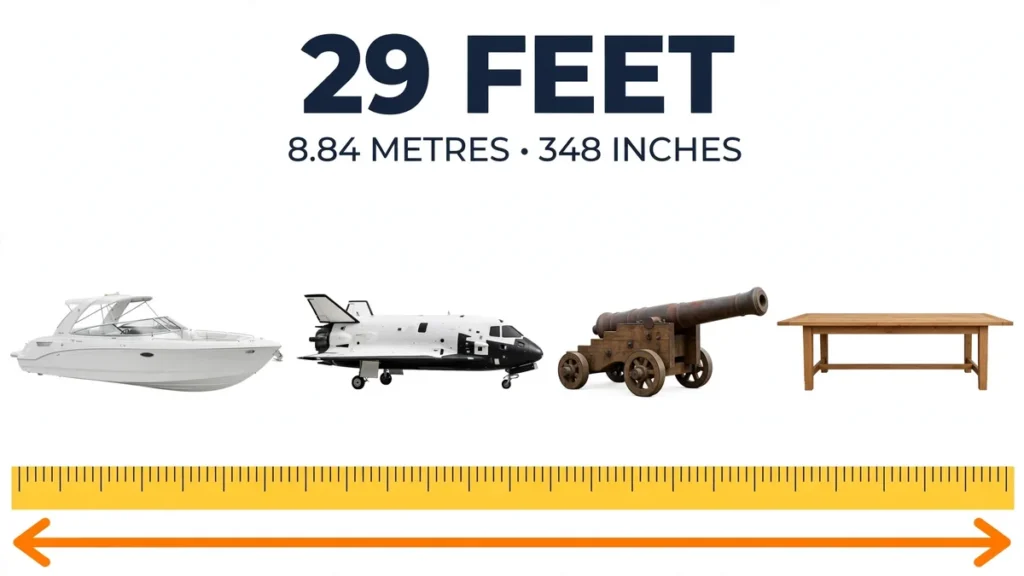
For 908 days, the most secretive aircraft in the American arsenal circled the Earth without a pilot, and nobody on the ground could tell you what it was doing up there. They could tell you how long it was, though: 29 feet 3 inches, nose to tail, with a wingspan of 14 feet 11 inches — a spaceplane one quarter the length of the shuttle it was copied from, landing on a runway in the dark after more than two years in orbit. That is the first thing to know about how long is 29 feet: it is a length that hides in plain sight, from a classified spaceplane to a table in a London hall, and the guides that answer this question keep reaching for the same wrong animals because they never look in either of those places.
Here is the second thing: the number itself is exact in every system that matters, and it is exactly one foot short of the round number everyone rounds it to. Twenty-nine feet is 8.8392 metres, 348 inches, 883.92 centimetres, and 9 yards 2 feet — and the eight things below are the closest honest answers to it: three of them land on 29 feet within an inch, five of them miss by one inch to six and a third inches with the miss printed in full, and not one of them is a multiple, a half, or a range. By the end you will know 29 feet as a bowrider, a cannon, a motorhome, a second bowrider, a spaceplane, a table, a sailboat, and the width of a volleyball court.
One Foot Short of a First Down: The Number Hiding Inside 29 Feet
Twenty-nine feet is a number that lives one foot away from roundness in every system, and that single foot is the whole story of this article. In yards it is 9 yards 2 feet — nine yards and a little bit, which is why the guides that call it "nine yards" are two feet generous and the guides that call it "ten yards" are one foot short, and neither of them is right. In metres it is 8.8392, which rounds honestly to 8.84 and dishonestly to 9: nine metres is 29 feet 6.33 inches, six and a third inches past the number, and eight metres is 26 feet 3 inches, three feet three inches short of it — so the only honest metric shortcut is 8.84 metres, and the only honest imperial shortcut is 9 yards 2 feet, and everything else is a rounding that costs you inches you will feel when the thing has to fit.
That is also why "call it 30 feet" is the one rounding in this article that fails by exactly a foot, and it fails in the direction that hurts. A first down is 10 yards, 30 feet, so 29 feet is one foot short of a first down — stand on the goal line and walk to the 10-yard line and you have walked one foot too far, and a trailer bay, a boat slip, or a campsite bought against "30 feet" for a 29-foot rig wastes a foot you paid for and a foot you did not need. The guides that answer this question with a conversion essay get that part right and then stop, as if the arithmetic were the answer — and the arithmetic is only the address. The answer is what sits at the address, and what sits there is a 29-foot boat with the number in its name, a cannon that may be the longest in the world, and a table made from a single oak tree.
Quick Answer
29 feet is 8.8392 metres exactly — 883.92 centimetres, 8,839.2 millimetres, 348 inches, and 9 yards 2 feet. But do NOT call it 9 metres: 9 metres is 29 feet 6.33 inches, which is 6.33 inches longer than 29 feet, and do NOT call it 8 metres either: 8 metres is 26 feet 3 inches, which is 3 feet 3 inches shorter. The honest shortcut is 8.84 metres — and the honest objects are the Formula 290 Bowrider, 29 feet 0 inches by the maker's own specification, the Bara Gazi cannon, about 29 feet on the researchers' tape, and a volleyball court, 29 feet 6 inches wide by the rulebook.
How to Read the Eight Objects Below
The eight objects below are ordered by how close they land, and each one carries its evidence grade in the heading. EXACT means the figure is a standard's or an authority's own dimension for the named thing. LISTED means the figure is the manufacturer's or operator's published specification for the named model. AVERAGE means the figure is an authority's published average or range for the named thing. REPORTED means the figure is the largest verified measurement an expert source reports for the named thing. Three of the eight land on 29 feet within an inch, and the five that do not carry their miss in the open, in inches, where you can see it — and the point of the ordering is that the miss grows as you read, so the last object is the one that stretches the number furthest.
1. A Formula 290 Bowrider — LOA 29 Ft 0 In (LISTED)
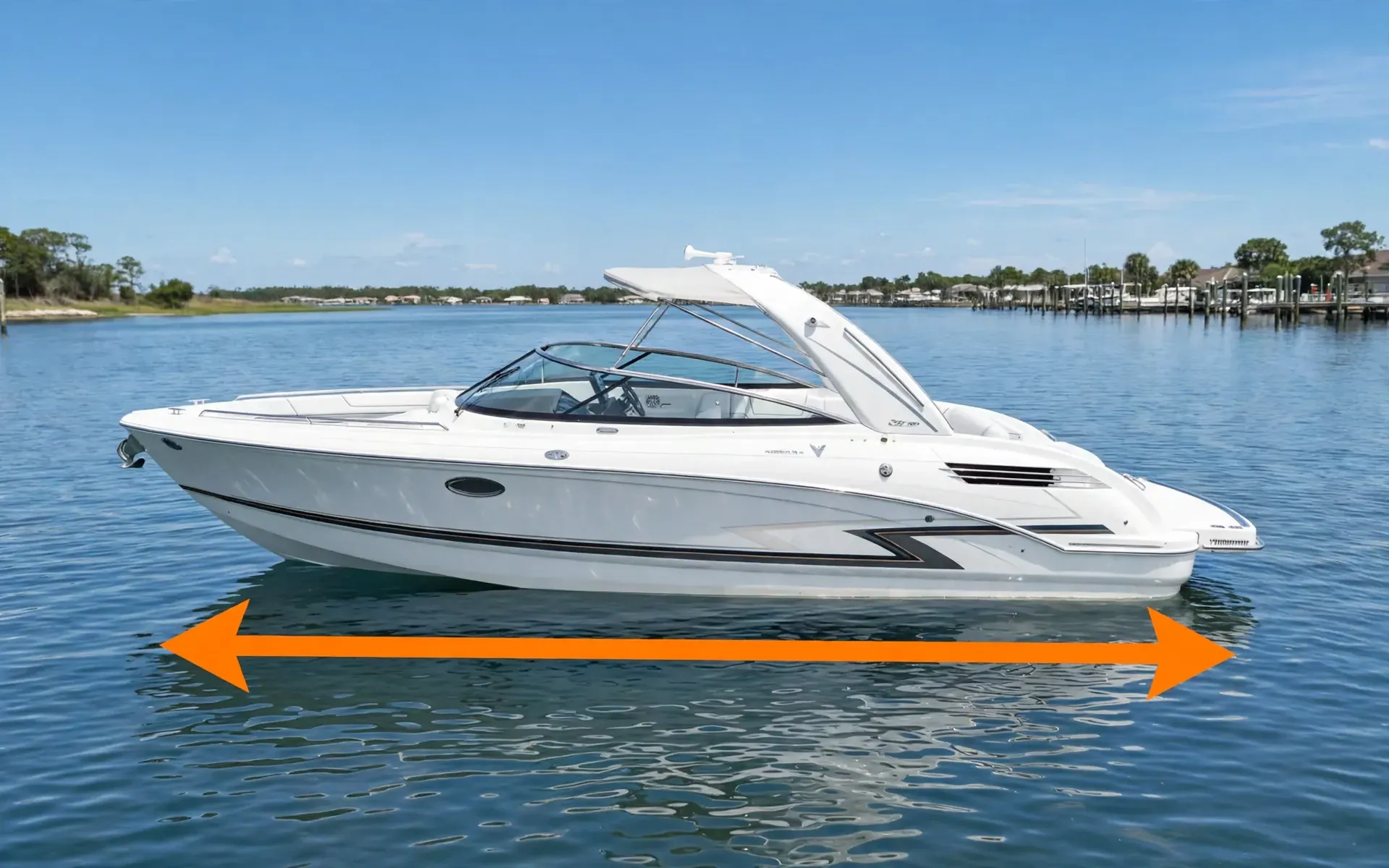
The Formula is the article's cleanest land-on, because its 29 feet is printed in the specification of a boat that has the number in its name and nowhere else to hide. The Formula 290 Bowrider is a 29-foot bowrider built by Formula Boats, and the comparison that tested all four boats in its class lists it at 29 feet 0 inches overall, 9 feet 0 inches in beam, 3 feet 4 inches in draft, displacing 8,950 pounds with 112 gallons of fuel and a single 380-horsepower MerCruiser or Volvo Penta as standard power. Walk from the bow to the stern and you have walked 29 feet — the same on every 290 ever sold, because the mould is the product, and the number in the model name is the length overall, not a floorplan code or a class name.
The fitting check is the swim platform, because the 290's 29 feet is the hull and the thing people misjudge is what hangs off it: the platform can be extended almost two feet, and the twin-engine option — a pair of 320-horsepower MerCruisers that pushed the test boat to 46.1 knots — adds sterndrives and a swim seat behind the transom, so a slip bought against "29 feet" for this boat fits the hull and not the hardware.
2. A Bara Gazi Toph Cannon — About 29 Ft Long (REPORTED)

The cannon is the article's oldest land-on, because it is 29 feet of 14th-century bronze that may be the longest cannon in the world and nobody has ever put it in the record book. The Bara Gazi Toph stands on the ramparts of Gulbarga Fort in Kalaburagi, Karnataka, cast in Panchdhatu — an alloy of five metals — during the reign of the Bahmani Sultanate, and the researchers who measured it in 2016 put it at about 29 feet long, 2 feet in diameter, 7.6 feet around, with walls 7 inches thick and a weight they estimated at 70 to 75 tonnes. Walk from the muzzle to the breech and you have walked about 29 feet — the same on every retelling, because the cannon has not moved in six hundred years, and the measurement is the researchers' own tape, not a guide's guess.
The fitting check is the word "longest", because the cannon's 29 feet is real and its title is not. The record book still lists the Tsar Cannon of Moscow at 17 feet 6 inches, because nobody has ever submitted the Bara Gazi for measurement — the researchers wrote to the record keepers, and the fort's own archaeology department has never measured it officially — so the claim that it is the longest cannon in the world is a claim, not a record, and this article prints it as one. The guides that list the cannon as "29 feet long, its barrel 7 inches long" are right about the length and wrong about the barrel: the barrel is 7 inches thick, not 7 inches long, and a barrel 7 inches long would be a toy, not a cannon. The grade is reported because the figure is the researchers' own measurement of the named thing, with the deviation printed in full: about 29 feet, unrecorded to the inch, and the title unrecorded with it.
3. A Thor Four Winds 27R Motorhome — 28 Ft 11.25 In Without the Ladder (LISTED)
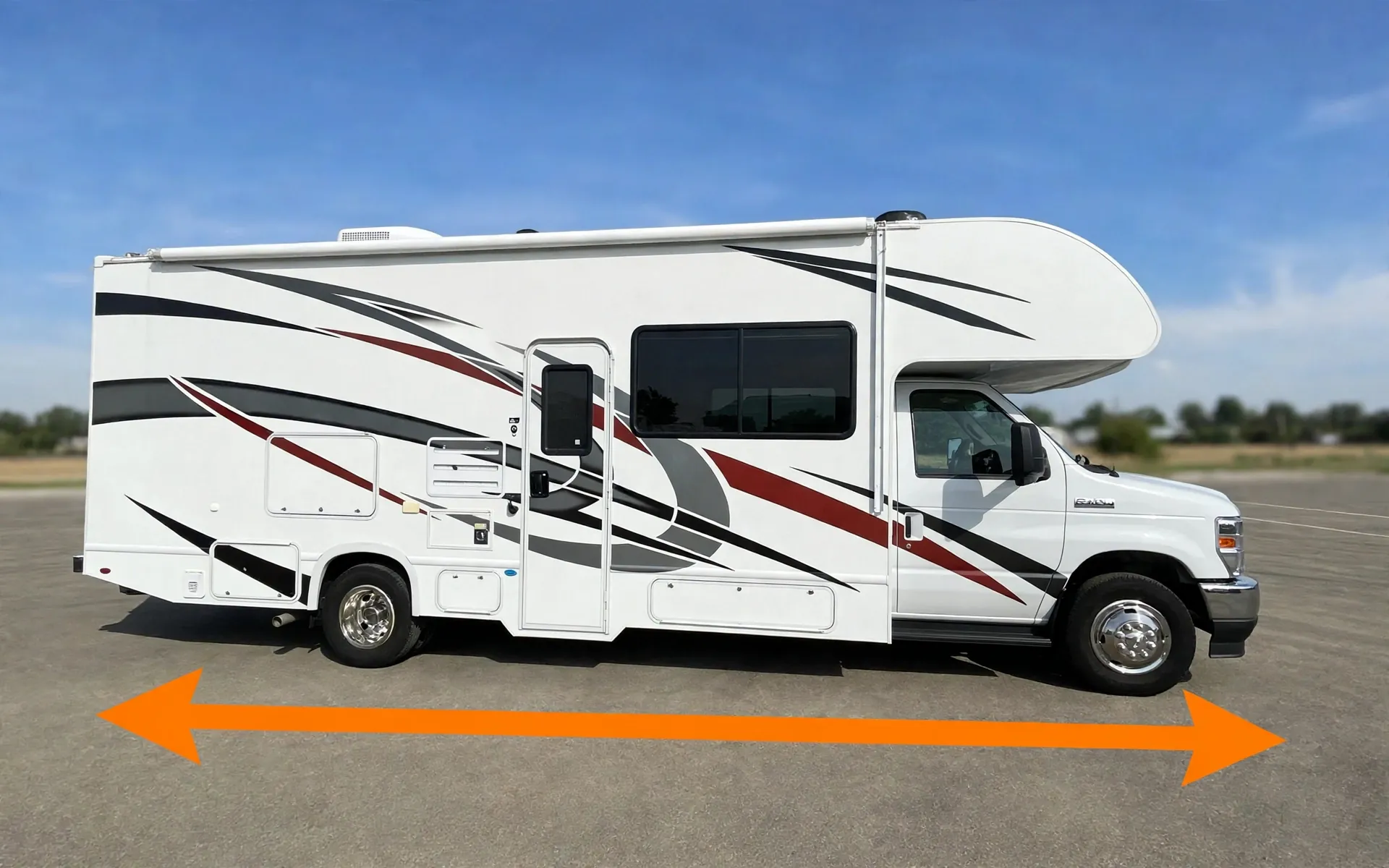
The Thor is the article's closest miss, and the one that proves a model name is not a measurement. The Thor Motor Coach Four Winds 27R is a Class C motorhome on a Ford E450 chassis with a 7.3-litre V8 making 325 horsepower, and the maker's own brochure table lists its exterior length at 28 feet 11.25 inches without the ladder — three quarters of an inch short of the number in this article's title — while RV Guide's specification listing gives 349 inches, 29.08 feet, with the ladder on. Drive one onto a site and walk from the front bumper to the rear wall and you have walked 28 feet 11.25 inches — three quarters of an inch short of 29 feet, and the same on every 27R ever sold, because the body is the product.
The fitting check is the ladder, because the Thor's missing three quarters of an inch live in one piece of hardware: bolt the ladder on and the rig is 29 feet 1 inch, take it off and it is 28 feet 11.25 inches, so a campsite bought against "29 feet" for this motorhome fits either way by less than an inch, and a national park with a 30-foot limit takes it with eleven inches to spare. The guides that call the 27R "a 29-foot RV" are right about the neighbourhood and wrong about the name — the "27" is the floorplan code, not the tape, and the same trap caught the Airstream 27FB in the earlier article in this series, which measures 28 feet 2 inches against a "27" name. The same trap also caught the Freeman 29, whose dealer page calls it 29 feet 6 inches while the builder's own spec sheet says 30 feet 5 inches — seventeen inches over, past the honesty band, which is why it is a warning here and not an object. The grade is listed because the figure is the brochure's own dimension for the named model, with the deviation printed in full: 28 feet 11.25 inches without the ladder, three quarters of an inch short.
4. A Regal 29 OBX Bowrider — LOA 29 Ft 1 In (LISTED)
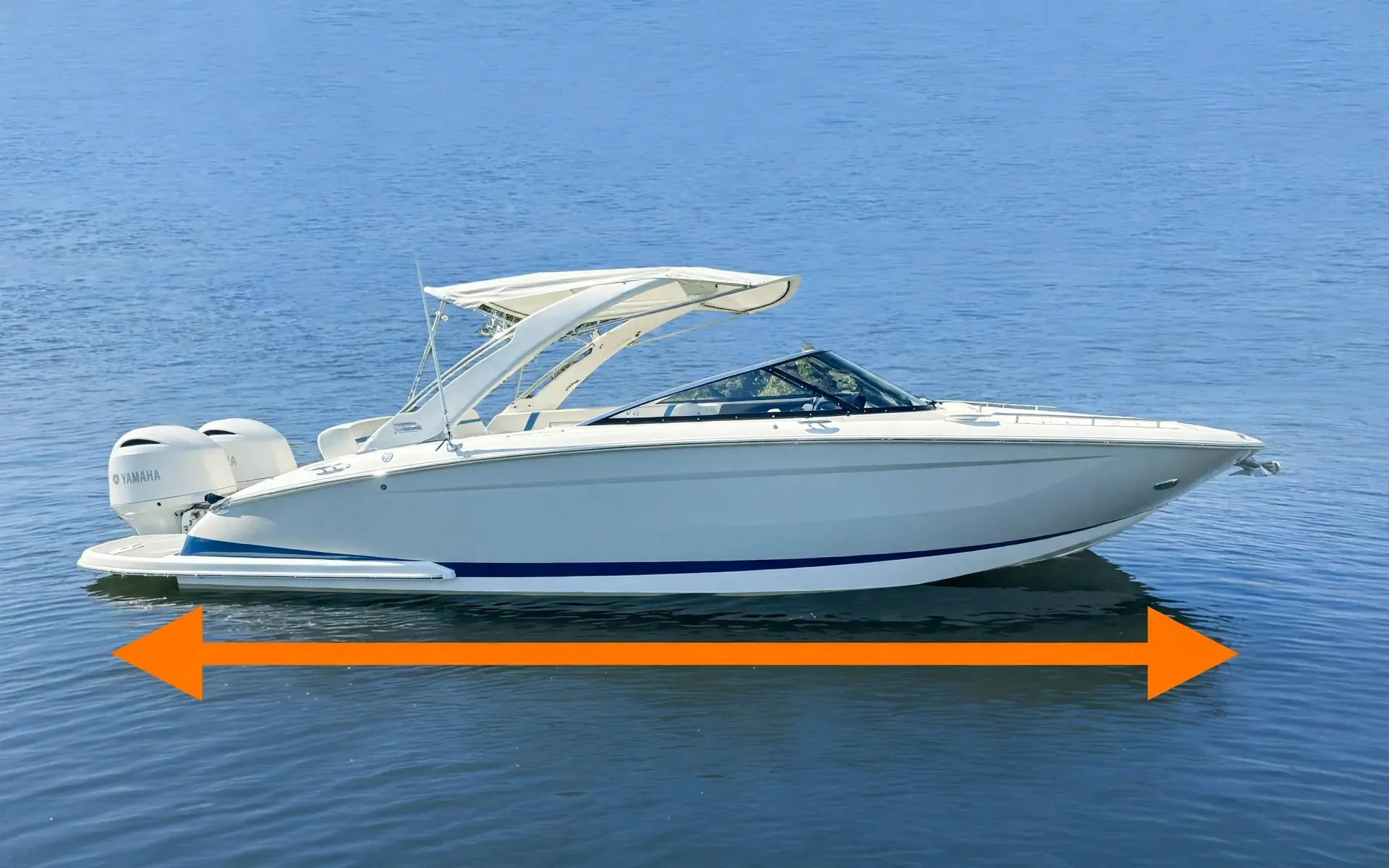
The Regal is the article's second bowrider, and the one that shows what a single inch of outboard buys you. The Regal 29 OBX is the outboard-powered sister to the Formula 290 in the same test, and the makers' specs list it at 29 feet 1 inch overall, 9 feet 0 inches in beam, 1 foot 7 inches in draft, displacing 6,550 pounds with 148 gallons of fuel and a pair of 200-horsepower Yamaha outboards as standard power. Walk from the bow to the transom and you have walked 29 feet 1 inch — one inch past the number in this article's title, and the same on every 29 OBX ever sold, because the mould is the product, and the extra inch is the outboard bracket, not the hull.
The fitting check is the swim platform, because the Regal's one extra inch lives next to a bigger difference: the outboards sit on the transom where the Formula's sterndrives sit inside the hull, so Regal builds mini-platforms to port and starboard of the motors instead of one platform across the stern, and the test captain pushed the boat to 45.7 knots on the standard twin 200s while cruising at 23.7 knots on better than 2 nautical miles per gallon. A slip bought against "29 feet" for this boat fits with an inch to spare if you measure the hull and fails by that inch if you measure the motors, which is the difference between a boat that fits its berth and one that hangs into the fairway. The grade is listed because the figure is the makers' own specification for the named model, with the deviation printed in full: 29 feet 1 inch, one inch over.
5. A Boeing X-37B Spaceplane — 29 Ft 3 In Long (EXACT)
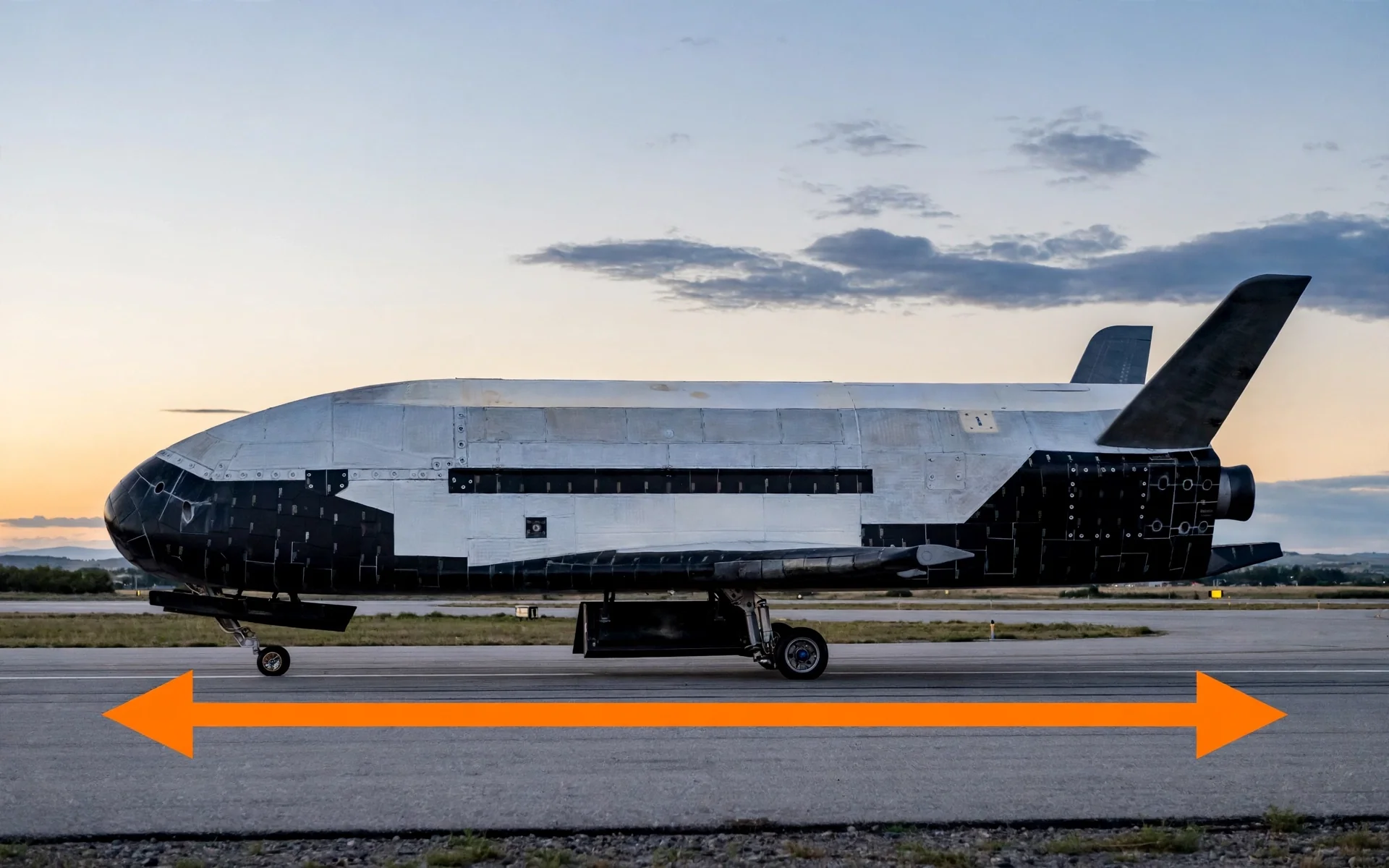
The X-37B is the article's most secretive overshoot, because it is a spacecraft that spent 908 days in orbit and came home in the dark. The Boeing X-37B Orbital Test Vehicle is an unmanned, reusable spaceplane operated by the Department of the Air Force, and the Air Force's own fact sheet lists it at 29 feet 3 inches long, 14 feet 11 inches in wingspan, and 9 feet 6 inches tall — a quarter-scale copy of the retired space shuttle, which was 122 feet long with a 78-foot wingspan, built by Boeing and launched vertically inside a rocket fairing before landing horizontally on a runway like an aeroplane. Walk from the nose to the tail and you have walked 29 feet 3 inches — three inches past the number in this article's title, and the same on both X-37Bs ever built, because the airframe is the product.
The fitting check is the mission, because the X-37B's three extra inches live next to a number that dwarfs them: its sixth mission stayed in orbit for 908 days — two and a half years — before landing at Kennedy Space Center in November 2022, and by the time the eighth mission launched in August 2025 the two spaceplanes had logged more than 1.3 billion miles between them. The guides that call the X-37B "around 29 feet long" are right about the neighbourhood and wrong about the address — it is 29 feet 3 inches, and three inches is the difference between this article's fourth land-on and its fifth miss, which is why the three inches are printed here instead of rounded away. The grade is exact because the figure is the operator's own dimension for the named vehicle, with the deviation printed in full: 29 feet 3 inches, three inches over.
6. The Middle Temple Bench Table — 29 Ft 4 In Long (REPORTED)

The table is the article's oldest overshoot, because it is 29 feet 4 inches of a single oak tree that has been in the same room since Elizabeth I was queen. The Bench Table stands on the dais at the west end of Middle Temple Hall in London, and the Inn's own 1928 history records it at 29 feet 4 inches long and 3 feet 2 inches wide, made from three planks, each running the whole length of the table, cut from one oak floated down the Thames from Windsor Great Park and manhandled in through a window before the building was finished — reputedly a gift from Elizabeth I herself. Walk from one end of the table to the other and you have walked 29 feet 4 inches — four inches past the number in this article's title, and the same on every retelling for four hundred and fifty years, because the tree is the product.
The fitting check is the hall, because the table's four extra inches live inside a room that is far bigger than the table: the hall itself is 101 feet 3 inches long and 40 feet 9 inches wide, with a double hammer-beam roof rising to 57 feet 6 inches at the apex, and the guides that call the hall "29 feet long" have measured the furniture instead of the room. The table is also the room's history in miniature — Francis Drake is said to have dined at it, and on 2 February 1602 the first performance of Twelfth Night was given in the hall, almost certainly with Shakespeare in the cast, in the Queen's presence. The grade is reported because the figure is the Inn's own history of the named thing, with the deviation printed in full: 29 feet 4 inches, four inches over.
7. A Leisure 29 Sailboat — LOA 29 Ft 4 In (LISTED)
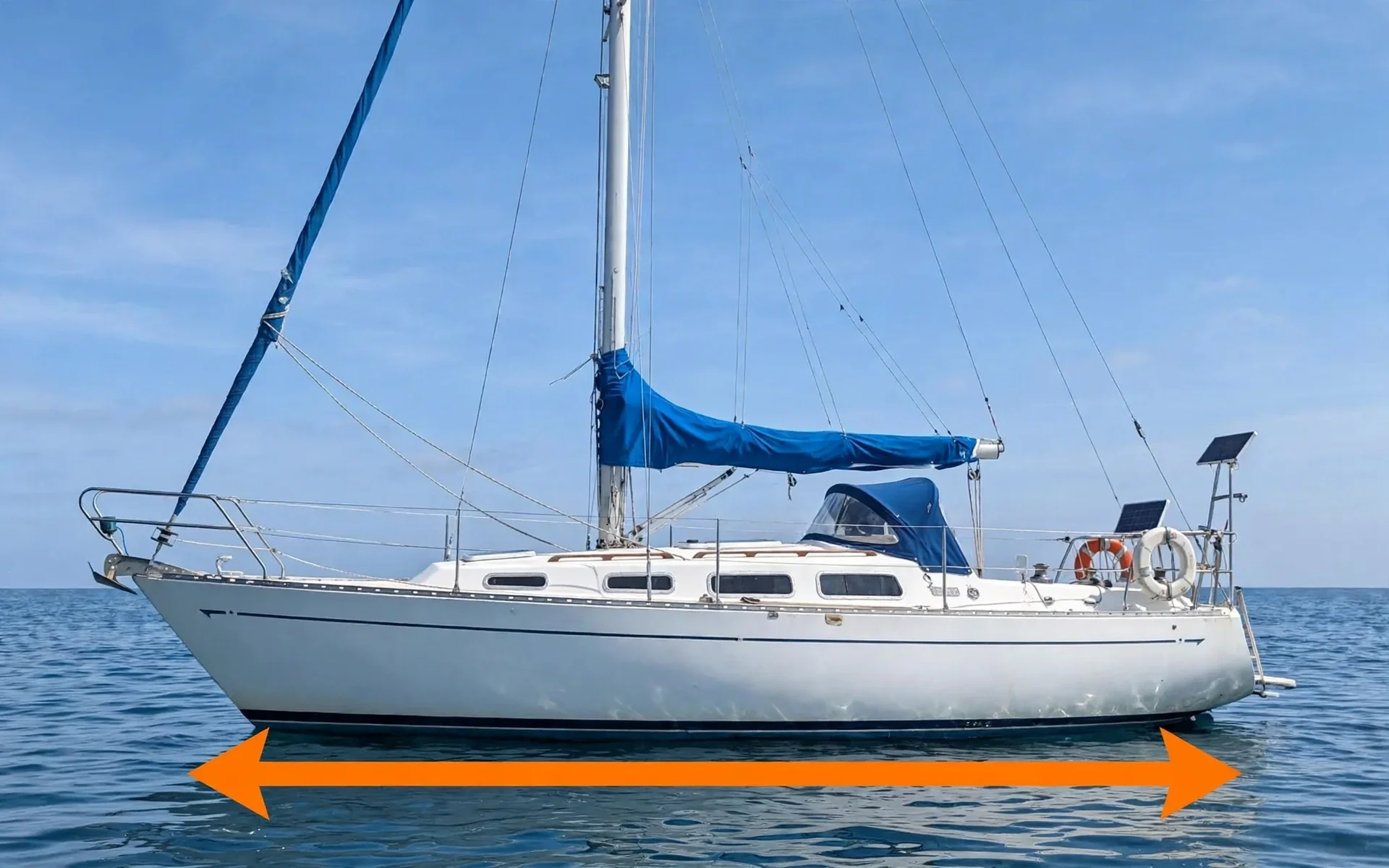
The Leisure is the article's second 29-foot-4-inch object, and the one that proves two boats can miss by the same four inches for completely different reasons. The Leisure 29 is a British cruising sailboat designed by Frank Pryor, and the owners' association lists it at 29 feet 4 inches overall, 25 feet 5 inches at the waterline — two feet longer than the Leisure 27 it was developed from, the extra length going into a larger cockpit with the skeg and rudder redesigned, and about thirty of them were built before the moulds passed to Jaguar Yachts for the Lynx 29. Walk from the bow to the stern and you have walked 29 feet 4 inches — four inches past the number in this article's title, and the same on every 29 ever built, because the mould is the product.
The fitting check is the name, because the Leisure's four extra inches live in the gap between what a boat is called and what it measures, and the thing people misjudge is which number a berth is sold against. A berth bought against "29 feet" for this boat fails by four inches if you trust the name instead of the specification, and the four feet between the waterline and the overall length is the bow overhang, the stern, and the sailing. The guides that call the Leisure 29 "a 29-foot sailboat" are right about the model and wrong about the measurement, because four inches is the difference between a boat that fits its berth and one that does not. The grade is listed because the figure is the owners' own specification for the named model, with the deviation printed in full: 29 feet 4 inches, four inches over.
8. A Volleyball Court — 29 Ft 6 In Wide (EXACT)
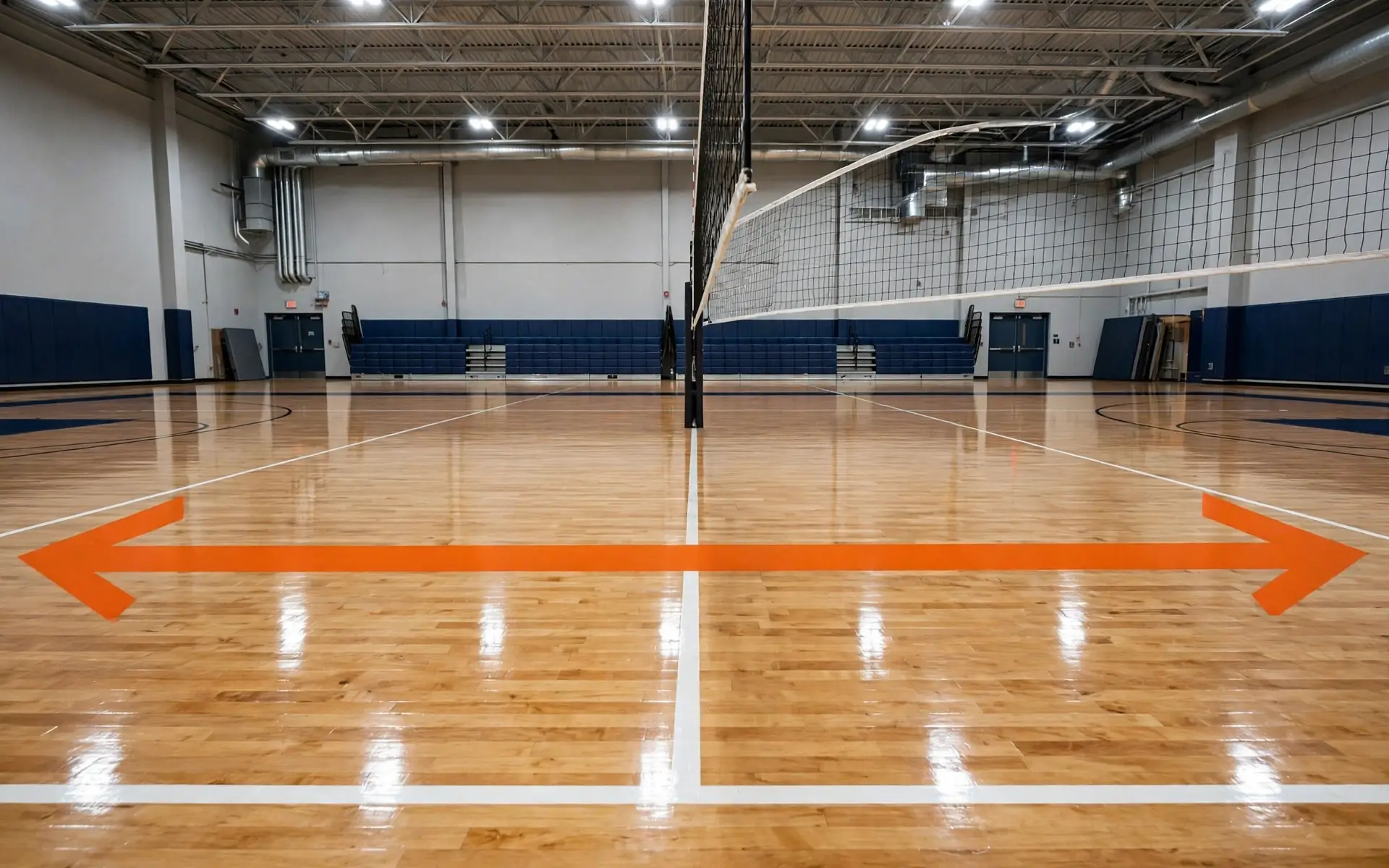
The court is the article's biggest honest miss, and the one that closes the list with a rulebook instead of a tape measure. A regulation indoor volleyball court is 18 metres long and 9 metres wide, and the rulebook's own words give the conversion as 59.06 feet by 29.53 feet — so the width of the court is 29 feet 6.33 inches, six and a third inches past the number in this article's title, and the same on every court in the world, because the rulebook is the product. Walk from one sideline to the other and you have walked 29 feet 6 inches — and each half of the court, split by the net, is 9 metres square, 29 feet 6 inches by 29 feet 6 inches, so the court is two 29-foot squares joined at the net.
The fitting check is the beach, because the court's six extra inches live next to a smaller court that is easy to confuse with it: a beach volleyball court is 16 metres by 8 metres — 52 feet 6 inches by 26 feet 3 inches — which is three feet shorter in every direction, and a gym bought against "a volleyball court" needs the indoor 18 by 9, not the beach 16 by 8, plus a free zone of at least 3 metres on all sides and a ceiling 7 metres high. The net is 2.43 metres high for men and 2.24 metres for women, and the attack line sits 3 metres from the centre line on each side — and none of those numbers is 29 feet, which is why the width is the number this article prints and the rest are the numbers it leaves in the rulebook. The grade is exact because the figure is the federation's own standard for the named thing, with the deviation printed in full: 29 feet 6.33 inches, six and a third inches over.
Eight 29-Foot Numbers That Do Not Survive a Tape Measure
Eight wrong numbers about 29 feet circulate so widely that they deserve their own section, because each one is stated confidently on a page that ranks for this exact question. First, the school bus: one popular guide says a typical school bus measures "around 29 feet", and a standard school bus is 35 to 45 feet long — 29 feet is roughly two-thirds of a bus, not a bus, and the guide's own comparison admits it in the next sentence. Second, the giraffe's neck: another guide says a giraffe's neck can measure "approximately 29 feet in length", and a giraffe's neck is about 6 feet long — the whole animal tops out at 18 feet, so the guide is eleven feet generous on the animal and twenty-three feet generous on the neck. Third, the bowling lane: another guide says a standard lane measures "approximately 29.5 feet from the foul line to the head pin", and the United States Bowling Congress sets that distance at exactly 60 feet — the guide has measured half a lane and called it a lane. Fourth, the whale shark: another guide says whale sharks reach "lengths of up to 29.9 feet", and typical adults are 18 to 33 feet, the largest verified specimen was 41.5 feet, and the largest measured was 61.7 feet — the guide understates the maximum by a third and calls it a maximum. Fifth, the green anaconda: one popular guide says green anacondas "can be as long as 29 feet", and Guinness's longest-snake entry gives a Brazilian female at 27 feet 9 inches as the largest reported, with the modern field record far shorter — the guide is a foot and three inches generous, and it is the same snake this series measured properly in the 28-foot article. Sixth, the sequoia: another guide says giant sequoia trunks reach "diameters of around 29 feet", and diameters are a range, not a number — the General Sherman is 36 feet 6 inches across at the base and 25 feet at breast height, so "around 29 feet" is true of some trees at some heights and false as a claim about the species. Seventh, Middle Temple Hall: one popular guide says "the middle temple hall is 29 feet long", and the hall is 101 feet 3 inches long — the 29 feet is its Bench Table, measured properly three sections above, and the guide has measured the furniture instead of the room. Eighth, half a giant squid: another guide says that since giant squids reach 59 feet, "the half of the giant squid will be around 29 feet" — and a half is not an object, it is arithmetic, and this article does not measure halves. None of these eight numbers belongs in a 29-foot article as an object, and all eight are here so you never have to learn that from a purchase.
Pacing Out 29 Feet With What You Already Own
Twenty-nine feet is a number you can check without a second tool, because the objects in this article are the tools — but only if you use the objects themselves, not your body. First, take the steps: the University of Iowa puts the average adult's walking step at 2.5 feet, so take 11 steps and you have walked 27.5 feet — a foot and a half short — and take 12 steps and you have walked 30 feet, a foot over, so the honest count is 11.6 steps, and anyone who tells you 11 paces is rounding away a foot and a half. Second, take the football field: a first down is 10 yards, 30 feet, so 29 feet is one foot short of a first down — stand on the goal line and walk to a foot short of the 10-yard line and you have walked 29 feet, and the one foot left to the marker is the gap between this article's number and the next one. Third, take the volleyball court: the court is 29 feet 6 inches wide, so walk from one sideline to the other and you have walked six inches too far, and the half-court you are standing on is a 29-foot square, which is the closest honest shape to this article's number you can stand inside. None of these replaces a calibrated tool for anything that must fit, but all three will tell you whether 29 feet is the size you think it is before the motorhome is parked or the boat is berthed — and the steps are the one to trust, because their 0.6 is the smallest miss you can walk.
The 8 Objects at a Glance
| Object | Figure | Miss vs 29 ft | Grade |
|---|---|---|---|
| Formula 290 Bowrider LOA | 29 ft 0 in | 0 | LISTED |
| Bara Gazi Toph cannon | about 29 ft | 0 | REPORTED |
| Thor Four Winds 27R | 28 ft 11.25 in | 0.75 in short | LISTED |
| Regal 29 OBX LOA | 29 ft 1 in | 1 in over | LISTED |
| Boeing X-37B length | 29 ft 3 in | 3 in over | EXACT |
| Middle Temple Bench Table | 29 ft 4 in | 4 in over | REPORTED |
| Leisure 29 LOA | 29 ft 4 in | 4 in over | LISTED |
| Volleyball court width | 29 ft 6.33 in | 6.33 in over | EXACT |
Twenty-nine feet sits one foot short of a round number in every system, and the table is the proof. Step across the list and the numbers barely move: the bowrider and the cannon at 29 feet, the motorhome three quarters of an inch short, the second bowrider an inch over, the spaceplane three inches over, the table and the sailboat four inches over, the court six and a third inches over — and the point of it is the middle: 29 feet has two land-ons behind it that you can drive and aim, a motorhome you can park, and five misses you can run, fly, eat at, sail, and play on, and every object with a fixed figure sits inside a six-and-a-third-inch band, which is why 29 feet is a size you can trust to the inch and still call it one number.
How 29 Feet Compares With Other Lengths
Readers comparing nearby sizes may also want the site’s guides to 28 feet, 27 feet, 26 feet, 25 feet, 24 feet, 23 feet, 22 feet, and 30 feet for the foot series, and the feet hub for the full directory. Each of those guides follows the same rule as this one: the spec sheet, the grade, and the miss printed in full.
Frequently Asked Questions
How many meters is 29 feet?
29 feet is exactly 8.8392 meters, usually rounded to 8.84 meters. Multiply 29 by 0.3048 and you get 8.8392 — and the trap is rounding that to 9 meters, which overstates the length by 6.33 inches, or to 8 meters, which understates it by 3 feet 3 inches. For anything that must fit, use 8.8392 meters; for a quick estimate in your head, 8.84 meters is close enough to picture it and only 0.8 millimetres short.
How many inches is 29 feet?
348 inches exactly. Multiply 29 by 12 and you get 348, with no rounding at all. In centimetres that is 883.92 cm, in millimetres it is 8,839.2 mm, and in yards it is 9 yards 2 feet — the only one of the conversions in this article that comes out as a whole number of yards plus a remainder, which is why "9 yards 2 feet" is the honest shortcut.
How many yards is 29 feet?
9.67 yards, or 9 yards 2 feet. There are 3 feet in a yard, and 29 divided by 3 is 9 with 2 left over — which is the reason 29 feet has exact objects where 10 metres had a gap: 9 yards 2 feet is a length the old rulebooks could build to, and the volleyball court is 9 metres wide because the rulebook was written in metres, not yards. In metres, 9 yards 2 feet is 8.84 metres, which is the same figure as the Formula 290's length.
How many steps does it take to walk 29 feet?
Eleven steps and most of a twelfth, at the average adult's step length. The University of Iowa puts the average walking step at 2.5 feet, so 11 steps cover 27.5 feet — a foot and a half short of 29 feet — and 12 steps cover 30 feet, which is a foot over. The honest count is 11.6 steps, and anyone who tells you 11 paces is rounding away a foot and a half.
Is 29 feet the same as 9 meters?
No, and the difference is six and a third inches. Nine meters is 29 feet 6.33 inches, which is 6.33 inches longer than 29 feet — the same overshoot as the width of a volleyball court, which is 9 metres wide for exactly that reason. For picturing the length in your head, 9 meters will mislead you by that much; for anything that must fit — a motorhome bay, a boat slip, a gym floor — use 8.84 meters, which is 29 feet to within 0.8 millimetres.
What common objects are 29 feet long?
The most exact everyday answers are a Formula 290 Bowrider (29 feet 0 inches overall, by the maker's specification), a Bara Gazi cannon (about 29 feet on the researchers' tape), and a Thor Four Winds 27R motorhome (28 feet 11.25 inches without the ladder, by the maker's brochure). The next closest are a Regal 29 OBX bowrider (29 feet 1 inch, one inch over), a Boeing X-37B spaceplane (29 feet 3 inches, three inches over), a Middle Temple Bench Table (29 feet 4 inches, four inches over), a Leisure 29 sailboat (29 feet 4 inches, four inches over), and a volleyball court (29 feet 6 inches wide, six inches over). A school bus is 35 to 45 feet and a bowling lane is 60 feet — neither is 29 feet, whatever the guides say.
How long is a bowling lane — is it 29 feet?
No. A regulation tenpin bowling lane is exactly 60 feet from the foul line to the centre of the head pin, set by the United States Bowling Congress — more than twice the 29.5 feet one popular guide claims. The guide has measured half a lane and called it a lane: 29.5 feet is roughly the distance from the foul line to the arrows, not to the pins, and a lane bought against "29.5 feet" would end halfway down the approach.
Is a school bus 29 feet long?
No. A standard school bus is 35 to 45 feet long, so 29 feet is roughly two-thirds of a yellow school bus — the length of the bus with its back third cut off. The guides that call a school bus "typically around 29 feet" are describing a short bus or a minibus, not the standard school bus, and the standard one is six to sixteen feet longer than the number in this article's title.
Final Thoughts
Twenty-nine feet is the rare measurement that is one foot short of round in every system and famous in none of them, because nine yards and two feet can be a bowrider, a cannon, a motorhome, a second bowrider, a spaceplane, a table, a sailboat, and the width of a court — and the number alone never says which. Now you know it as a boat's length fixed by its maker, a cannon's length fixed by its measurers, a motorhome's length fixed by its brochure, a second boat's length fixed by its test, a spaceplane's length fixed by its operator, a table's length fixed by its inn, a sailboat's length fixed by its owners, and a court's width fixed by its rulebook — and you know which of those you can trust to the inch, which ones miss by inches you can see, and which numbers about it are wrong and why. The rule that runs through all eight is the same one this site always uses: trust the spec sheet, print the deviation, and let the name stay on the box where it belongs. Measure twice, in the direction the object actually travels, and 29 feet will fit the first time.
