
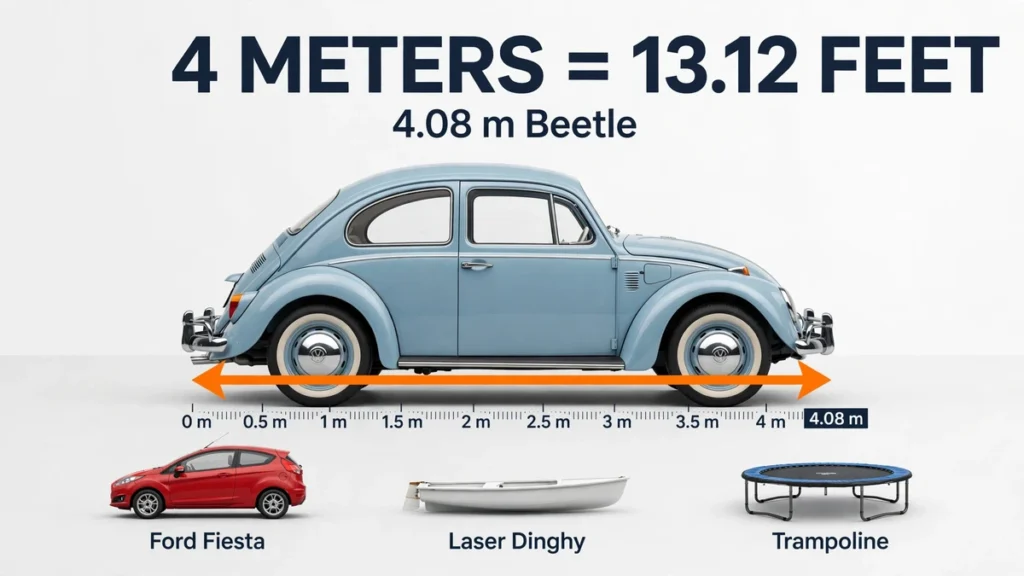
If you have ever wondered how long is 4 meters, the short answer is 13.12 feet — and the longer answer is that 4 meters is the length of a small car, which is why almost every guide about it reaches for a car and then gets the car wrong. A metre is a stride, 3 metres is a room, but 4 meters is a driveway: it is the length of the thing parked in the driveway, the width of the roll you lay on the floor, and the span of the boat you carry to the water. That is why it is so easy to picture badly. You cannot hold 4 meters in your hand, and you cannot pace it off in a hallway, because 4 meters is just past the length of your living room wall and just short of the length of the car outside it. It sits in the gap between the house and the street, and every guide about it tries to close that gap with something you already know — a car, a mattress, a trampoline — and almost every one of those comparisons is wrong by a margin that matters.
Below are five single, named things, each checked against its own specification, with the miss printed wherever a thing misses. One of them is exact at 4 meters for the dimension stated — a roll of sheet vinyl sold by that width — and the other four land 4 to 27 centimetres over it, all of them real products with real spec sheets. Every object’s image sits immediately after its heading, and no object is a stack, a multiple, a fraction, or a category guess. You will not find two doors stacked here, because two doors are two objects, and you will not find 70 percent of a giraffe, because 70 percent of an animal is arithmetic wearing a neck. By the end you will know 4 meters as a Beetle, a Fiesta, a Laser dinghy, a trampoline, and a roll of vinyl flooring — and you will know which of those you can trust to the centimetre and which you must measure yourself.
Quick Answer
4 meters is 13.12 feet exactly — 400 centimetres, 4,000 millimetres, 157.48 inches, and 4.37 yards. But do NOT call it 13 feet: 13 feet is 3.9624 metres, which is 3.76 centimetres shorter than 4 meters, and do NOT call it 4 yards either: 4 yards is 3.66 metres, which is 34 centimetres shorter. The honest shortcut is 13 feet 1 and a half inches — and the honest object is a roll of sheet vinyl 4 metres wide, sold by that width, or a Ford Fiesta at 4.04 metres, just 4 centimetres over.
Why 4 Metres Is a Car, Not a Room
Four metres is the first length in this series that you park. One metre is a stride, two metres is a doorway, three metres is a room — and all three of those are things your body already knows, because you have walked a metre, ducked under two, and stood inside three. Four metres is different, because it is longer than any room in a normal house is wide and shorter than any car on a normal street is long, and it lives in the driveway between the two. Stand at the front of your house and look at the car in the drive: if it is a small hatchback, you are looking at 4 metres, bumper to bumper, and if it is anything bigger, you are looking at 4 metres plus the extra the guides never mention. A compact SUV runs about 4.6 metres nose to tail, a family saloon runs about 4.7, and the average car across all classes runs about 4.4 metres — so the guides that tell you “a car is about 4 metres” are telling you about a car that most people do not own, and the ones that name a model usually name the wrong one, or no model at all.
The second reason 4 metres feels like a car is that the things sold by this number are the things you drive, carry, or lay on a floor. A roll of sheet vinyl is sold 4 metres wide because a room is usually less than 4 metres across, and the roll is made to cover it in one piece with no join. A Laser dinghy is 4.23 metres long because a racing boat has to fit on a car roof, and 4.23 metres is the longest hull a single sailor can still lift onto one. A 14-foot trampoline is 4.27 metres across because a garden is usually just wide enough to take it, and the frame is the thing that has to fit through the gate. The number shows up wherever a thing has to fit a space that is itself about the size of a car: a parking bay, a garage, a garden, a roof rack. It is not a coincidence that the two tightest objects in this article are both cars. Four metres is a measurement of driveways, and the only honest way to picture it is to stand beside one.
The 5 Objects
Each object below carries its evidence grade in the heading. EXACT means the figure is a standard’s or an authority’s own dimension for the named thing. LISTED means the figure is the manufacturer’s or retailer’s published specification for the named model. REPORTED means the figure is an authority’s published range, and the object sits at the top of it. The grade is the whole point: a list that never grades its numbers is asking you to trust it, and this article would rather show you the receipt.
1. A 1964 Volkswagen Beetle — 4.08 M Long (LISTED)
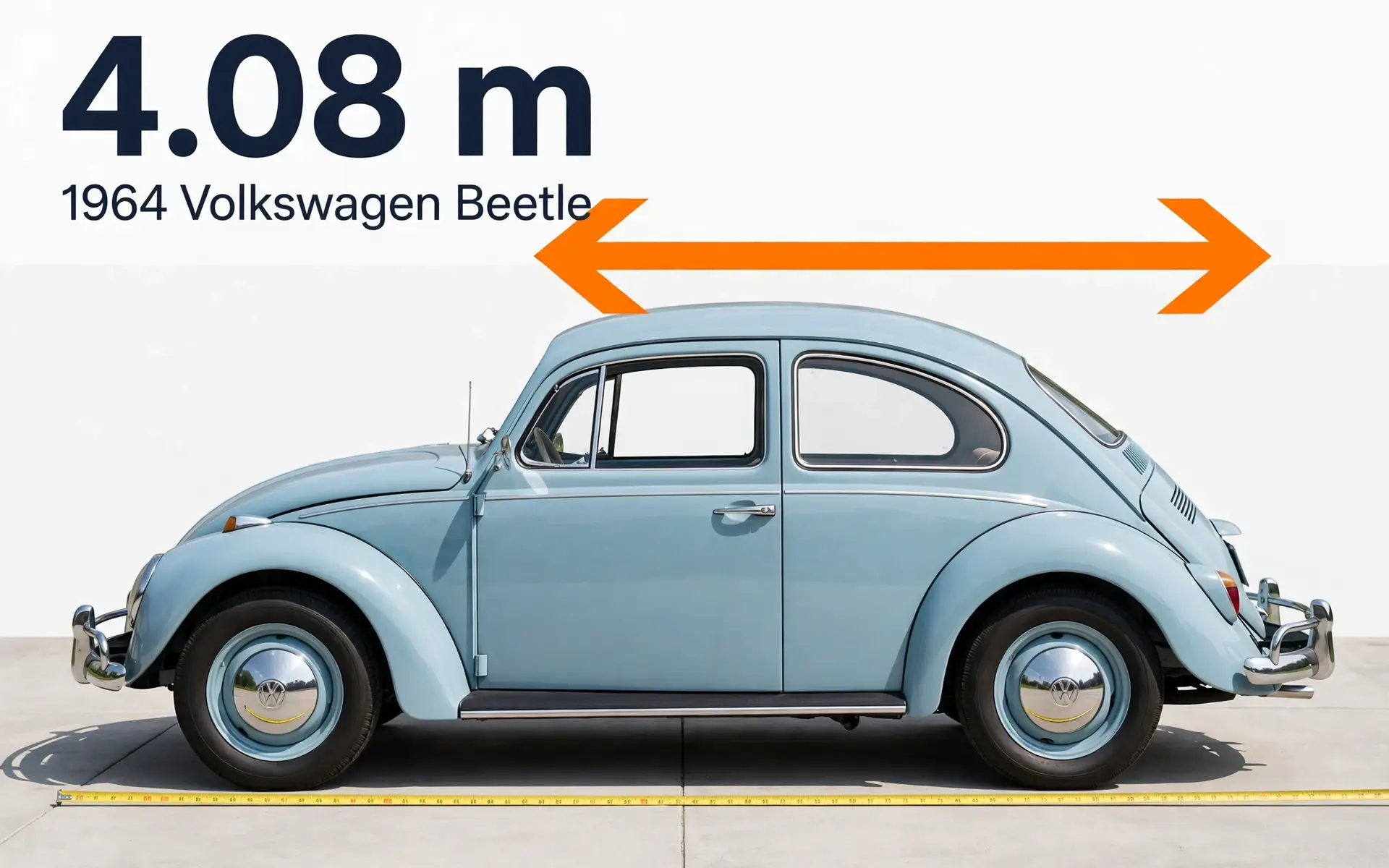
The Beetle is the article’s most famous near-miss, and the one every guide quotes without ever checking. The 1964 Volkswagen Beetle, the Type 1, is listed at 160.6 inches long — 4.079 metres — in the classic-car specification records, and the same figure is given as 4.08 metres by the guides that bother to print one at all. But the number has a honest range behind it that no guide prints: the factory general-arrangement drawing gives 4,030 millimetres for the body shell, and the extra 5 centimetres is the bumpers, so a Beetle measured without its bumpers is 4.03 metres and a Beetle measured with them is 4.08. This article uses the 4.08-metre overall figure, 8 centimetres over 4 metres, because the bumpers are part of the car you park, and the 5-centimetre spread is printed here so you know it exists. The Beetle stayed in production from 1938 to 2003, more than 21 million were built, and the 1964 car is the one the guides mean when they say “a Beetle”, because it is the Beetle at its most standard: a 1.2-litre air-cooled flat four, a 2.4-metre wheelbase, and a body that did not change shape for decades.
The fitting check is the parking bay, because a Beetle’s 4.08 metres is the number that decides whether it fits the space in front of your house. A standard parking bay in the UK is 4.8 metres long, so a Beetle leaves 72 centimetres of room to open the doors and walk around it, and a Fiesta leaves 76 — but a compact SUV at 4.6 metres leaves 20 centimetres, which is not enough to open a door properly, and that is the difference between a car that fits a bay and a car that only just fits in it. The guides that call a Beetle “almost an exact match for 4 meters” never say which Beetle they mean, because Beetles grew over 65 years of production — the 2013 Beetle is 4.28 metres long, 20 centimetres longer than the 1964 car — and a Beetle measured to the wrong year is a different number entirely. The grade is listed because the figure is the published specification for this named model and year, with the deviation printed in full: 4.08 metres, 8 centimetres over, and the 5-centimetre bumper spread is the whole story. Walk from its front bumper to its rear one and you have walked 4 metres plus a hand’s width.
2. A Ford Fiesta Mk8 — 4.04 M Long (LISTED)
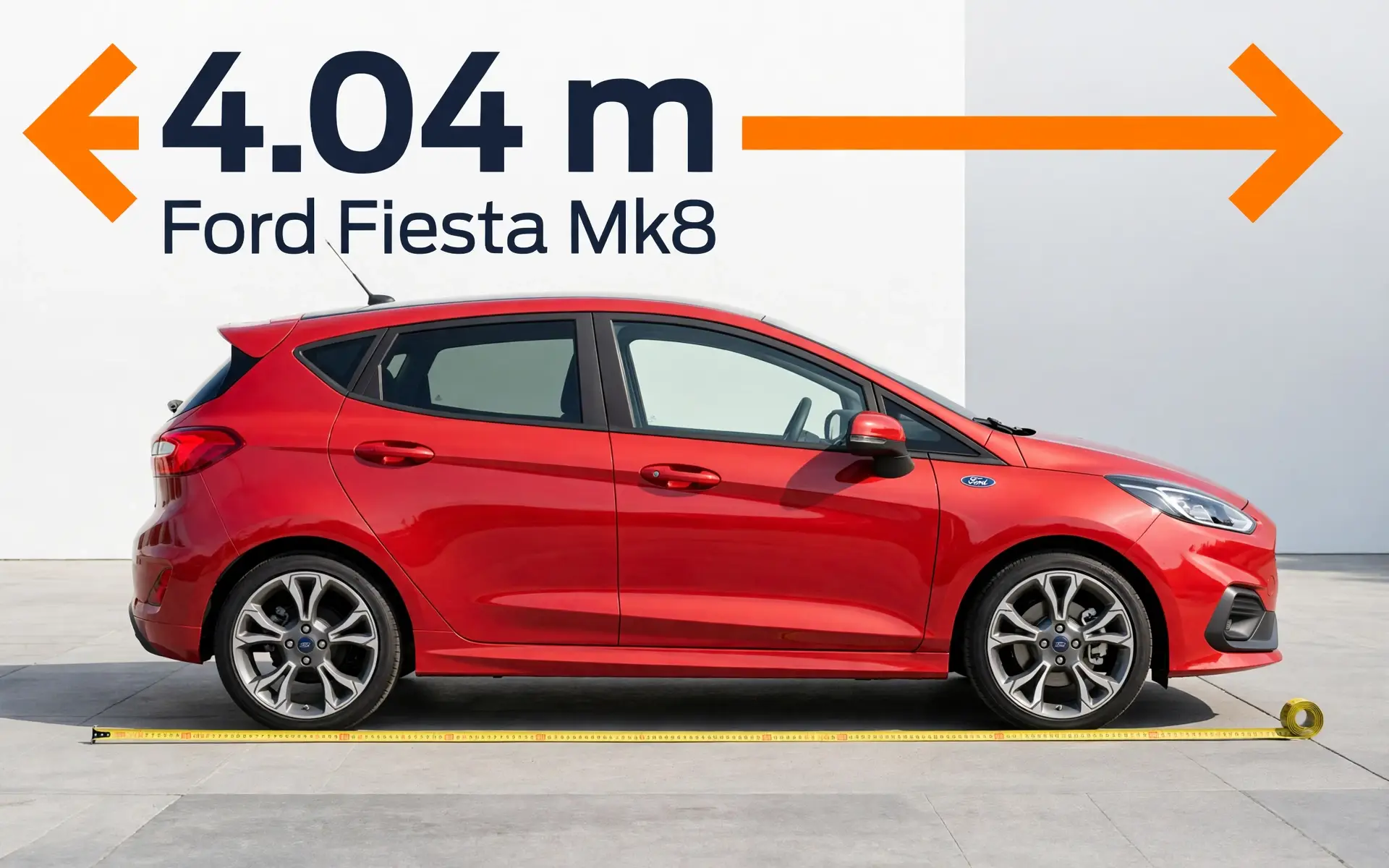
The Fiesta is the article’s tightest car, and the one that proves the guides’ favourite claim is only half true. Ford’s own dimension sheets list the Fiesta Mk8, built from 2017 to 2023, at 4,040 millimetres long — 4.04 metres — 1,735 millimetres wide without mirrors, 1,941 with them, on a 2,493-millimetre wheelbase, and the figure is the same across every trim, from the base Style to the Vignale, because the body shell never changed. That makes the Fiesta the closest modern car to 4 metres that you can still buy second-hand today: 4 centimetres over, the width of two fingers, and the same in every colour the car was sold in. It is the car in the supermarket car park, the car in the driveway, and the car in the used-car listing, and every one of them is the same length, because the length is the product. Stand at its front bumper and look to the rear one, and you are looking at 4 metres plus 4 centimetres.
The fitting check is the garage, because a Fiesta’s 4.04 metres is the number that decides whether it fits the building it sleeps in. A standard UK single garage is about 4.8 to 5 metres deep inside, so a Fiesta leaves 76 to 96 centimetres of room at the front — enough for a workbench, a bicycle, or a person to walk past — and a car 4.6 metres long leaves almost nothing, which is why so many garages hold bicycles and boxes instead of cars. A garage, a parking bay, or a driveway bought against “4 metres” fails if you measure the car and forget the mirrors, which stick out 10 centimetres on each side, and the guides that call the Fiesta “close to 4 metres” never say whether they mean the body or the body plus the mirrors. The grade is listed because the figure is the maker’s own dimension for this named model, with the deviation printed in full: 4,040 millimetres, not 4,000, and the 4 centimetres is the whole story. Measure the body before you measure the garage, because the Fiesta is the object in this article you have to park every day.
3. A Laser / ILCA Dinghy — 4.23 M Hull Length (EXACT)
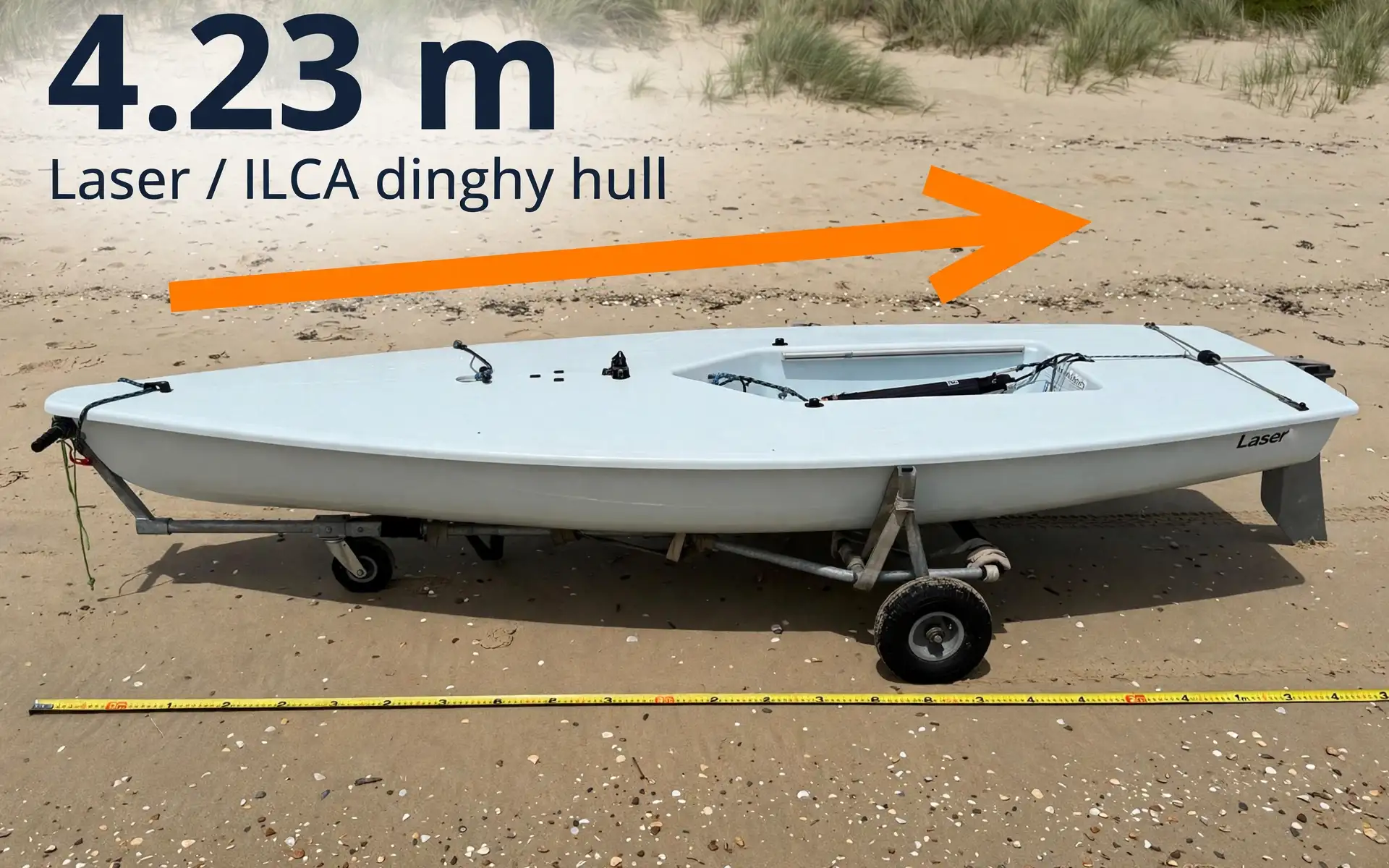
The Laser is the article’s only exact-grade object by rule, and the one that has to fit on a car roof. The Laser, raced today as the ILCA dinghy after a trademark dispute renamed the class in 2019, is a single-handed one-design racing boat, and the ILCA Handbook gives its hull as 4.23 metres long overall — 13 feet 10 and a half inches — with a 3.81-metre waterline, a 1.37-metre beam, and a 59-kilogram hull weight. Every hull in the class is built to the same measurement, because the class rules are the point: more than 223,000 boats have been built, the boat has been an Olympic class since 1996, and a Laser built in 1979 is the same length as a Laser built last year, because the rules forbid changing it. Lay one on the ground beside a tape measure and you are looking at 4.23 metres — 23 centimetres past the number in this article’s title, and the same in every rig the boat is sailed in, from the ILCA 4 to the ILCA 7.
The fitting check is the roof rack, because a 4.23-metre dinghy is longer than the car it travels on. A Ford Fiesta is 4.04 metres long, so a Laser on its roof overhangs the car by 19 centimetres, front and back combined, and the number that matters for the journey is not the hull length but the hull length plus the overhang the law allows — a dinghy that fits the car may not fit the garage, and a dinghy that fits the garage may not fit through the gate to the water. A roof rack, a wall mount, or a storage sling bought against “4 metres” fails by 23 centimetres if you measure the hull and forget the rudder and the daggerboard, which stick out past the stern and the slot by a few centimetres each, and the guides that never mention a dinghy at all never say whether they mean the hull, the waterline, or the boat with its mast strapped on — the waterline is 3.81 metres, 42 centimetres shorter than the hull, and a boat measured to the waterline is a different number entirely. The grade is exact because the figure is the class association’s own dimension for the named boat: 4.23 metres, by the rulebook, and the 23-centimetre miss is printed in the heading itself. Carry one to the water and you will feel the 23 centimetres — it is the distance the bow sticks out past the car.
4. A Skywalker Epic Series 14 Ft Round Trampoline — 4.27 M Across (LISTED)
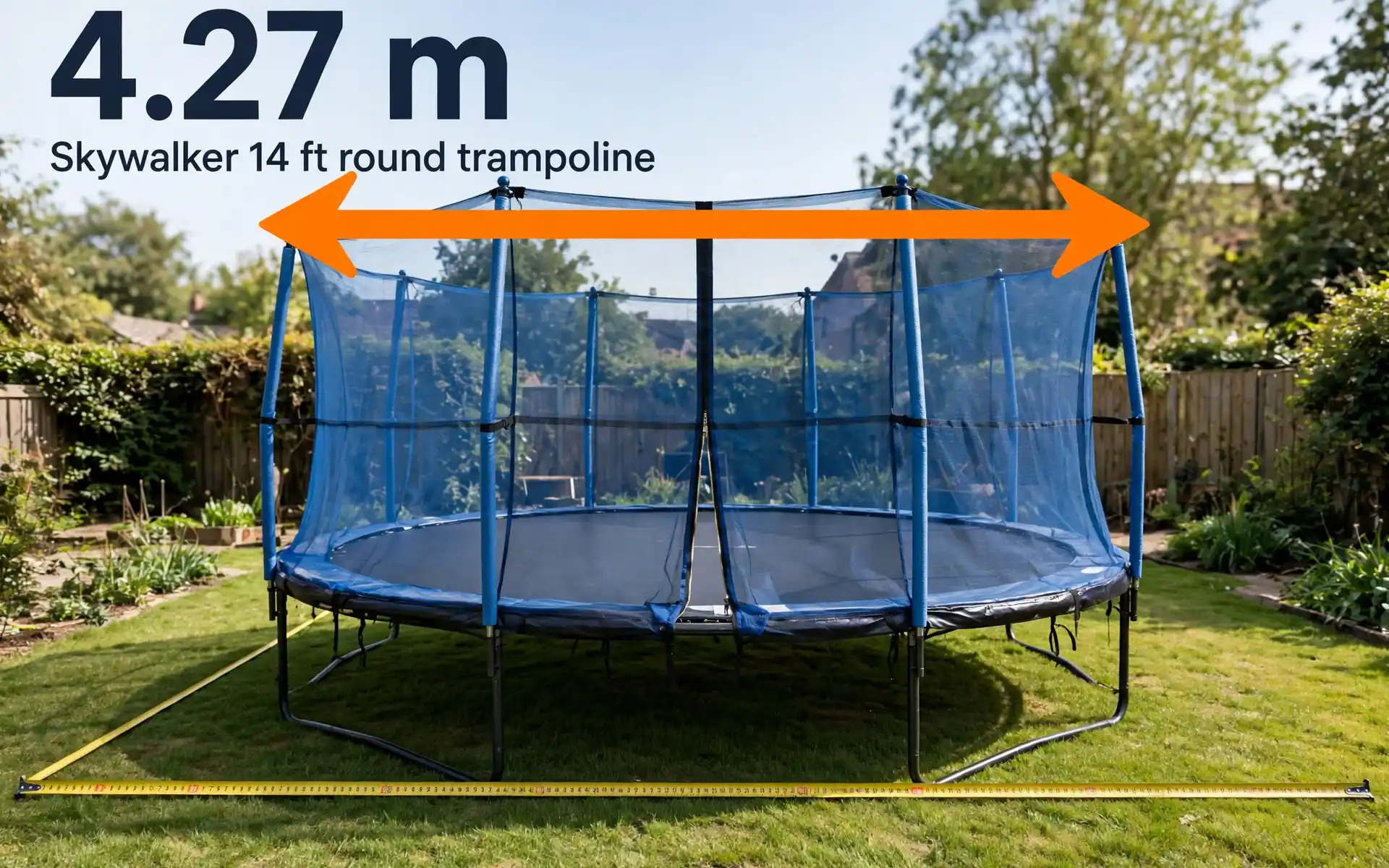
The trampoline is the article’s widest near-miss, and the one the guides most often call “visually interchangeable” with 4 metres. Skywalker’s Epic Series 14-foot round trampoline, model EPIC14D07, lists its footprint at 168 inches by 168 inches — 14 feet across, 4.267 metres — with 96 springs under the mat, 12 flexible enclosure rods instead of steel poles, a 400-pound single-user weight limit, and an overall height of about 9.1 feet with the enclosure up. It is the trampoline in the garden, the trampoline in the park, and the trampoline in the catalogue, and every one of them is the same width across the frame, because the frame is the product. Stand at one edge and look across to the other, and you are looking at 4.27 metres — 27 centimetres past the number in this article’s title, nearly 11 inches, and the same in every colour the trampoline is sold in.
The fitting check is the garden, because the trampoline’s 14 feet is its frame diameter and a garden bought against “4 metres” fails by more than a quarter of a metre if you measure the frame and forget the clearance — safety guidance calls for several feet of clear ground on every side, so a 14-foot trampoline needs a clear patch roughly 6 metres across, not 4, and a garden 4 metres wide cannot take one at all. A fence line, a cover, or a replacement mat bought against “4 metres” fails worse, because the jumping mat is only about 12 feet across — the springs and the padding over them take up the outer ring, so a child bouncing in the middle is jumping on a surface a full 60 centimetres narrower than the number on the box — and the guides that call a 14-foot trampoline “slightly wider than 4 meters” never say whether they mean the frame, the mat, or the enclosure, which stands about 2.8 metres tall, a different number in a different direction. The grade is listed because the figure is the maker’s own listing for this named model, with the deviation printed in full: 168 inches, not 157.48, and the 27 centimetres is the whole story. Measure across the frame before you measure the garden, because the trampoline is the object in this article you have to fit through a gate — and it is a different model from the 10-foot Skywalker in the 3-metre article, 79 centimetres wider, which is why it belongs here and not there.
5. Remland Natural Oak Sheet Vinyl, 4 M x 4 M — 4.00 M Wide (LISTED)
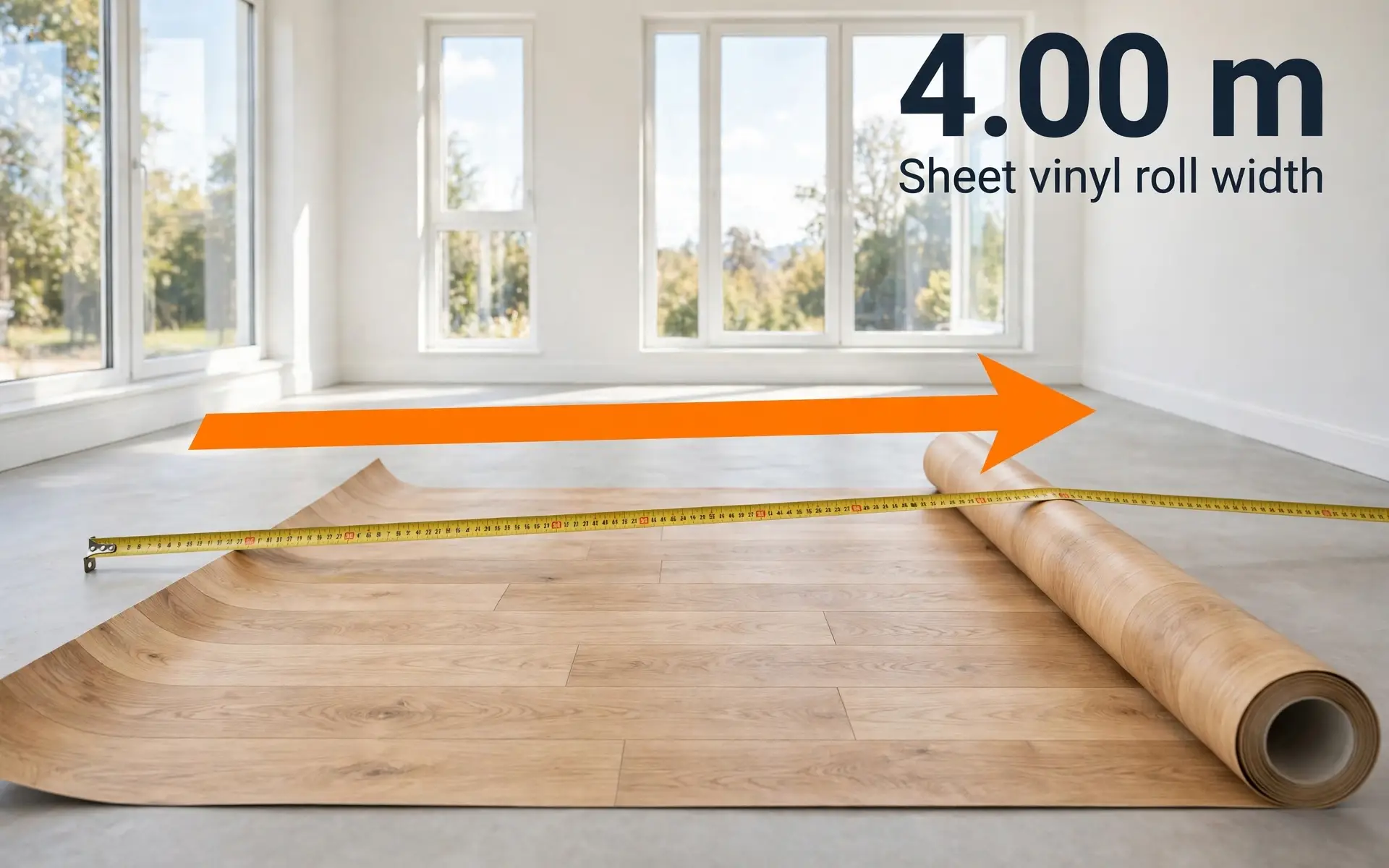
The vinyl is the article’s only exact object, and the one you buy by the number in its name. Remland’s Natural Oak sheet vinyl is sold as a 4-metre by 4-metre cut — 4 metres wide, 4 metres long, 1.9 millimetres thick — and the width is not a coincidence, because sheet vinyl is manufactured in standard roll widths of 2 metres, 3 metres, and 4 metres, and the 4-metre width is the widest roll a room can take in one piece with no join. The same width is listed across the trade: IVC sells its compact sheet vinyl in two-metre and four-metre widths, and the technical sheets for the ranges sold in Australia and New Zealand list a 4.0-metre width with a standard roll length of about 25 metres. Unroll one across your floor and you are looking at exactly 4 metres of flooring — no conversion required, and the same in every pattern the vinyl is sold in, from natural oak to springfield tile.
The fitting check is the room, because the vinyl’s 4 metres is its width and a room wider than 4 metres needs a join, and a join is where water gets in. Flooring guides say to measure the widest and longest points of the room and add 100 millimetres to both, so a room 3.9 metres wide takes a 4-metre roll with 10 centimetres to spare, and a room 4.1 metres wide takes two rolls and a seam — and the guides that call sheet vinyl “about 4 metres wide” never say which roll they mean, because the same product is sold in 2-metre and 3-metre widths too, and a 3-metre roll is a full metre short of the number in this article’s title. The grade is listed because the figure is the retailer’s own listing for this named product: 4 metres by 4 metres, by the listing’s own sheet, and the roll on your floor is the proof. Measure the room before you measure the roll, because the vinyl is the object in this article you walk on every day — and it is the only one in the article with nothing to shave off.
The Thirteen-Foot Trap: Where the Other Lists Get 4 Metres Wrong
Six wrong numbers about 4 metres circulate so widely that they deserve their own section, because each one is stated confidently on a page that ranks for this exact question. First, the king bed: one popular guide lists a king-sized bed as “roughly 4 meters”, and a king mattress is 80 inches long — 2.03 metres — so the guide is off by a factor of two, and the only way to reach 4 metres with king beds is to lay two of them end to end, which is two objects, not one. Second, the tennis court: another guide calls the width of a tennis court “approximately 4 meters”, and a doubles court is 10.97 metres wide and a singles court is 8.23 metres, so 4 metres is not a tennis court dimension at all — it is not even close to one. Third, the 14-foot trampoline: a same-age rival calls a 14-foot trampoline “visually interchangeable” with 4 metres, and 14 feet is 4.27 metres, which is 27 centimetres — nearly 11 inches — wider, and 11 inches at this size is the difference between a trampoline that fits a garden and one that does not. Fourth, the composites: guide after guide stacks two doors (4.06 metres), lays a queen mattress beside a twin (3.94 metres), or lines up two couches, two yoga mats, or two charging cables, and every one of those is two things, not one thing, and the guide never prints whether its sum lands over or under. Fifth, the fractions: another guide tells you 4 metres is 88 percent of a free-throw line and 70 percent of a giraffe, and a fraction is not an object — and the giraffe figure itself is the top of a range, because most giraffes stand 4.3 to 5 metres tall, not 5.7. Sixth, the 4-yard confusion: guide after guide treats 4 metres as 4 yards, and 4 yards is 3.66 metres — 34 centimetres short, more than a foot — which is the difference between a vinyl roll that covers the room and one that leaves a strip of bare floor. None of these six numbers belongs in a 4-metre article, and all six are here so you never have to learn that from a purchase.
Pacing 4 Metres Without a Tape
Four metres is a number you can check without a second tool, because the objects in this article are the tools — but only if you use the objects themselves, not your body. First, take the vinyl: a 4-metre roll of sheet vinyl is exactly 4 metres across its width, so unroll it across the floor and you are looking at 4 metres — but check the roll width first, because a 3-metre roll is a full metre short and will lie to you by exactly that much. Second, take the Beetle: a 1964 Beetle is 4.08 metres bumper to bumper, so walk from its front bumper to its rear one and shave off 8 centimetres in your head — a hand’s width — and you have 4 metres, but check the year first, because a 2013 Beetle is 4.28 metres and will lie to you by 20 centimetres. Third, take the trampoline: a 14-foot frame is 4.27 metres across, so walk from one edge of the frame to the other and shave off 27 centimetres — a little less than a 30-centimetre ruler — and you have 4 metres, but measure the frame, not the mat, because the mat is 60 centimetres narrower and will lie to you by more than half a metre. Fourth, take the floor tiles: standard floor tiles are 30 centimetres square, so count thirteen tiles in a straight line and you have 3.90 metres — then add 10 centimetres, four fingers’ width, and you have 4 metres — but check the tile size first, because large-format tiles are 60 centimetres, and thirteen of those is 7.8 metres, nearly double. None of these replaces a calibrated tool for anything that must fit, but all four will tell you whether 4 metres is the size you think it is before the vinyl is cut, the car is parked, or the trampoline is ordered — and the vinyl is the one to trust, because its zero centimetres is the smallest miss you can walk on.
4 Metres Against the Sizes Around It
Four metres sits one metre past the room in the last article — 3 metres is a springboard, a rim, an umbrella, a curtain, and a trampoline frame, and every one of those is a thing you stand inside or under — and a metre past that, the scale changes: the room becomes a car. Step up the ladder and the rungs crowd together: the 3-metre springboard, the 3.05-metre basketball rim, the 4.00-metre vinyl roll, the 4.04-metre Fiesta, the 4.08-metre Beetle, the 4.23-metre Laser dinghy, then the 4.27-metre trampoline frame — which is also the largest miss in this article, 27 centimetres over — then 13 feet at 3.96 metres, the round number people keep rounding 4 metres down to, and the reason the rounding is wrong by 3.76 centimetres. The ladder runs 3, 3.05, 4.00, 4.04, 4.08, 4.23, 4.27 — and the point of it is the middle: 4 metres is the only rung with an exact object that is also a product sold by the metre, a roll of vinyl on one side and a Fiesta on the other, and all five objects in this article sit inside a 27-centimetre band, which is wider than the 3-metre article’s 5-centimetre band, because 4 metres is a harder number to hit exactly — and the guides that pretend otherwise are the ones that never print a miss.
How 4 Metres Compares With Other Lengths
Readers comparing nearby sizes may also want the site’s guides to 1 meter, 2 meters, 3 meters, and 5 meters for the meters series, 13 feet and 14 feet for the foot series, and 4 feet for the short end of the foot series, plus the inches hub and feet hub for the full directories. Each of those guides follows the same rule as this one: the spec sheet, the grade, and the miss printed in full.
Frequently Asked Questions
How many feet is 4 meters?
4 meters is 13.12 feet, or 13 feet 1 and a half inches in feet and inches. Multiply 4 by 3.28084 and you get 13.12336 feet — and the trap is rounding that to 13 feet, which understates the length by 3.76 centimetres, or reading the 0.12 as 12 inches, which overstates it by nearly a foot. For anything that must fit, use 13.12 feet; for a quick estimate in your head, 13 feet 1 and a half inches is close enough to picture it and only a fraction of an inch short.
Is 4 meters the same as 13 feet?
No, and the difference matters. Thirteen feet is 3.9624 metres, which is 3.76 centimetres shorter than 4 metres — about an inch and a half. If you cut a 13-foot board for a 4-metre gap, you will have a gap of an inch and a half left over; if you buy a 13-foot trampoline for a 4-metre garden, it will fit, because 13 feet is 3.96 metres, but a 14-foot trampoline will not, because 14 feet is 4.27 metres. The honest shortcut is 13 feet 1 and a half inches, which is 4 metres to within a fraction of an inch.
How many inches is 4 meters?
157.48 inches exactly. Multiply 4 by 39.3701 and you get 157.4804 inches, with no rounding that matters for anything you will ever measure by hand. In centimetres that is 400 cm, in millimetres it is 4,000 mm, and in yards it is 4.37 yards rounded — exactly 4.3745 yards, which is the figure a tape measure will show if it is marked in yards.
How many yards is 4 meters?
4.37 yards. Four metres is 4 yards plus about 9 per cent more, because a metre is about 3 inches longer than a yard, and those 3 inches add up four times over. Do not confuse 4 metres with 4 yards: 4 yards is only 3.66 metres, which is 34 centimetres short — more than a foot — and that is how vinyl orders and fence panels end up wrong.
How long is 4 meters compared to a car?
About the length of a small hatchback, and shorter than the average car. The average car across all classes runs about 4.4 metres long, a compact SUV like the Honda CR-V runs about 4.6 metres, and only two named cars in this article sit at 4 metres: a Ford Fiesta at 4.04 metres and a 1964 Volkswagen Beetle at 4.08 metres. If someone tells you “a car is 4 metres long” without naming the car, ask which one — most cars are 40 centimetres longer than that.
What is 4 meters long in real life?
The most exact everyday answer is a roll of sheet vinyl 4 metres wide (4.00 m by its listing). The next closest are a Ford Fiesta (4.04 m long), a 1964 Volkswagen Beetle (4.08 m long), a Laser dinghy (4.23 m hull length), and a 14-foot trampoline (4.27 m across its frame). None of the four near-misses is exact, and each one’s miss is printed beside it in this article.
How do I measure 4 meters without a tape measure?
Use a 4-metre roll of sheet vinyl if you have one — it is 4 metres by its listing. Otherwise use a 1964 Beetle (4.08 m — shave off 8 centimetres), a 14-foot trampoline frame (4.27 m — shave off 27 centimetres), or thirteen 30-centimetre floor tiles in a straight line (3.90 m — add 10 centimetres). For anything that must fit — a car, a boat, a room — borrow or buy a real tape measure, because at 4 metres the misses in this article run from zero to 27 centimetres, and guessing throws every one of them away.
Will a 14-foot trampoline fit in a 4-metre garden?
No — not even close enough. A 14-foot trampoline is 4.27 metres across its frame, which is 27 centimetres wider than a 4-metre garden, and that is before the safety clearance, which calls for several feet of clear ground on every side. A 14-foot trampoline needs a clear patch roughly 6 metres across. A 13-foot trampoline is 3.96 metres across its frame and would fit a 4-metre garden — measure the frame before you order the trampoline, because the frame is the object in this article you cannot shorten.
Final Thoughts
Four metres is the rare measurement that is honest and still misunderstood, because 13.12 feet can be a Beetle, a Fiesta, a Laser dinghy, a trampoline, or a roll of vinyl — and the number alone never says which. Now you know it as a car’s length fixed by its maker, a hatchback’s length fixed by its maker, a hull’s length fixed by its class, a frame’s width fixed by its maker, and a roll’s width fixed by its listing — and you know which of those you can trust to the centimetre and which you must measure yourself. The rule that runs through all five is the same one this site always uses: trust the spec sheet, print the deviation, and let the name stay on the box where it belongs. Measure twice, in the direction the object actually travels, and 4 metres will fit the first time.
