
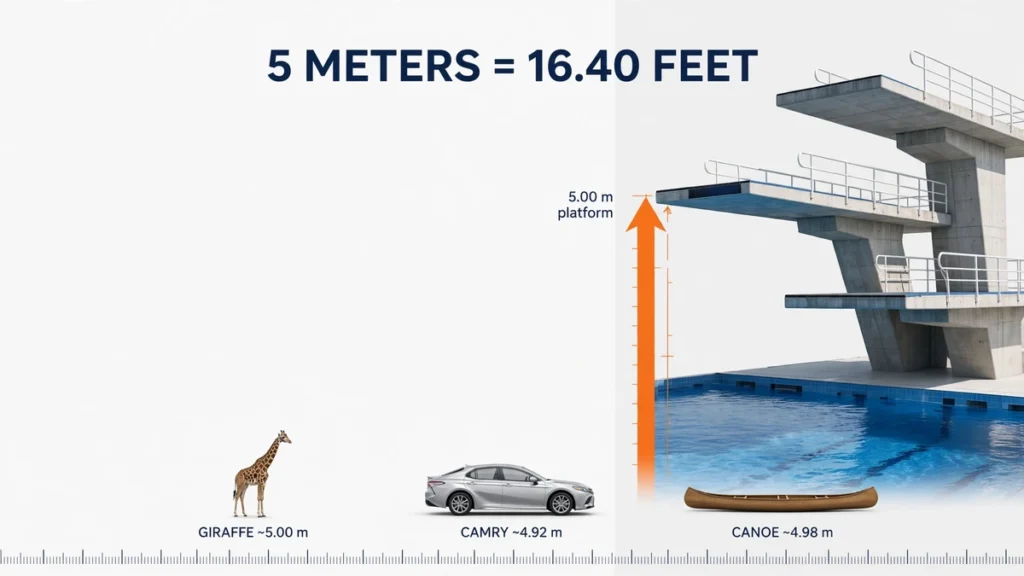
If you have ever wondered how long is 5 meters, the short answer is 16.40 feet — and the longer answer is that 5 meters is the length of things that have to fit somewhere. A centimetre is a blade, a metre is a stride, 3 metres is a room, but 5 metres is a driveway, a garage, a roof rack, a garden gate: it is the first length in this series that you cannot buy, carry, or park without checking the space it goes into first. That is why it is so hard to picture: you cannot hold it the way you hold a ruler, and you cannot stand inside it the way you stand inside a room, because 5 metres is just past the reach of your arms and just short of a distance worth driving. It sits in the gap between the body and the building, and every guide about it tries to close that gap with something you already know — a car, a kayak, a parking space — and almost every one of those comparisons is wrong by a margin that matters.
Below are eight single, named things, each checked against its own specification, with the miss printed wherever a thing misses. Two of them are exact at 5 metres for the dimension stated — a diving platform and a tape measure sold by that number — and the other six land 2.2 to 12.3 centimetres short of it, three of them 16-foot items that the guides call “5 metres” without ever printing the 12-centimetre gap. Every object’s image sits immediately after its heading, and no object is a stack, a multiple, a fraction, or a category guess. You will not find two sea lions here, because two animals is a pair and not an object, and you will not find one-third of a shipping container, because a third of a box is arithmetic wearing steel. By the end you will know 5 metres as a platform, a tape, a giraffe, a Camry, a canoe, a kayak, a garage door, and a trampoline — and you will know which of those you can trust to the centimetre and which you must measure yourself.
Quick Answer
5 meters is 16.40 feet exactly — 500 centimetres, 5,000 millimetres, 196.85 inches, and 5.47 yards. But do NOT call it 16 feet: 16 feet is 4.88 metres, which is 12.3 centimetres shorter than 5 metres, and 12.3 centimetres at this size is the difference between a kayak that fits on the roof rack and one that hangs past the tailgate. The honest shortcut is 16 feet 5 inches — and the honest object is a 5-metre diving platform, 5 metres above the water by its sport’s own rules.
Why 5 Metres Is a Driveway, Not a Room
Five metres is the first length in this series that is a fitting problem before it is a measurement. One metre is a stride you take without thinking, two metres is a doorway you walk through without ducking, and three metres is a room you stand inside without noticing the walls — but five metres is the length of the thing that has to go through the doorway, into the room, and onto the wall. A kayak is 5 metres long and the roof rack is 5 metres long and the garage is 5 metres deep, and the question is never “how long is it” in the abstract: the question is whether the kayak fits the rack, whether the rack fits the car, and whether the car fits the garage, and every one of those answers is decided by centimetres the guides never print. Stand in your driveway and look at the garage door: the standard double door is 16 feet wide, which is 4.88 metres, and the car parked in front of it is 4.92 metres long, and the gap between the two numbers is the gap between a car that fits and a car that scrapes. That is why the number feels slippery in a way that 17 centimetres never does. A santoku blade is a thing; 5 metres is a test.
The second reason 5 metres feels like a driveway is that the building trade already treats it as one. A standard parking bay is drawn 4.8 metres long in Britain and 5.5 metres long in America, and neither of those is 5 metres, which is why the guides that call a parking space “5 metres” are quoting a range and calling it a standard. A two-car garage door is 16 feet wide because two cars side by side need 4.88 metres and the builders rounded to feet, not because anyone measured 5 metres and chose it. A garden hose is sold in 5-metre lengths because a 5-metre hose reaches from the tap to the beds without coiling, and a 5-metre tape measure is sold in 5-metre lengths because a 5-metre tape reaches from one end of a room to the other without a second pull. The number shows up wherever a thing has to reach from one fixed point to another: from the tap to the bed, from the track to the floor, from the water to the platform, from the bumper to the tailgate. It is not a coincidence that the most exact object in this article is a diving platform. A platform is not a thing you hold; it is a height you fall from, over a pool dug to catch you, in a hall built around it. Five metres is a measurement of fits, and the only honest way to picture it is to try to fit something into it.
The 8 Objects
Each object below carries its evidence grade in the heading. EXACT means the figure is a standard’s or an authority’s own dimension for the named thing. LISTED means the figure is the manufacturer’s or operator’s published specification for the named model. AVERAGE means the figure is the midpoint of an authority’s published range for the named animal. The grade is the whole point: a list that never grades its numbers is asking you to trust it, and this article would rather show you the receipt.
1. A 5-Metre Diving Platform — 5.00 M Above the Water (EXACT)
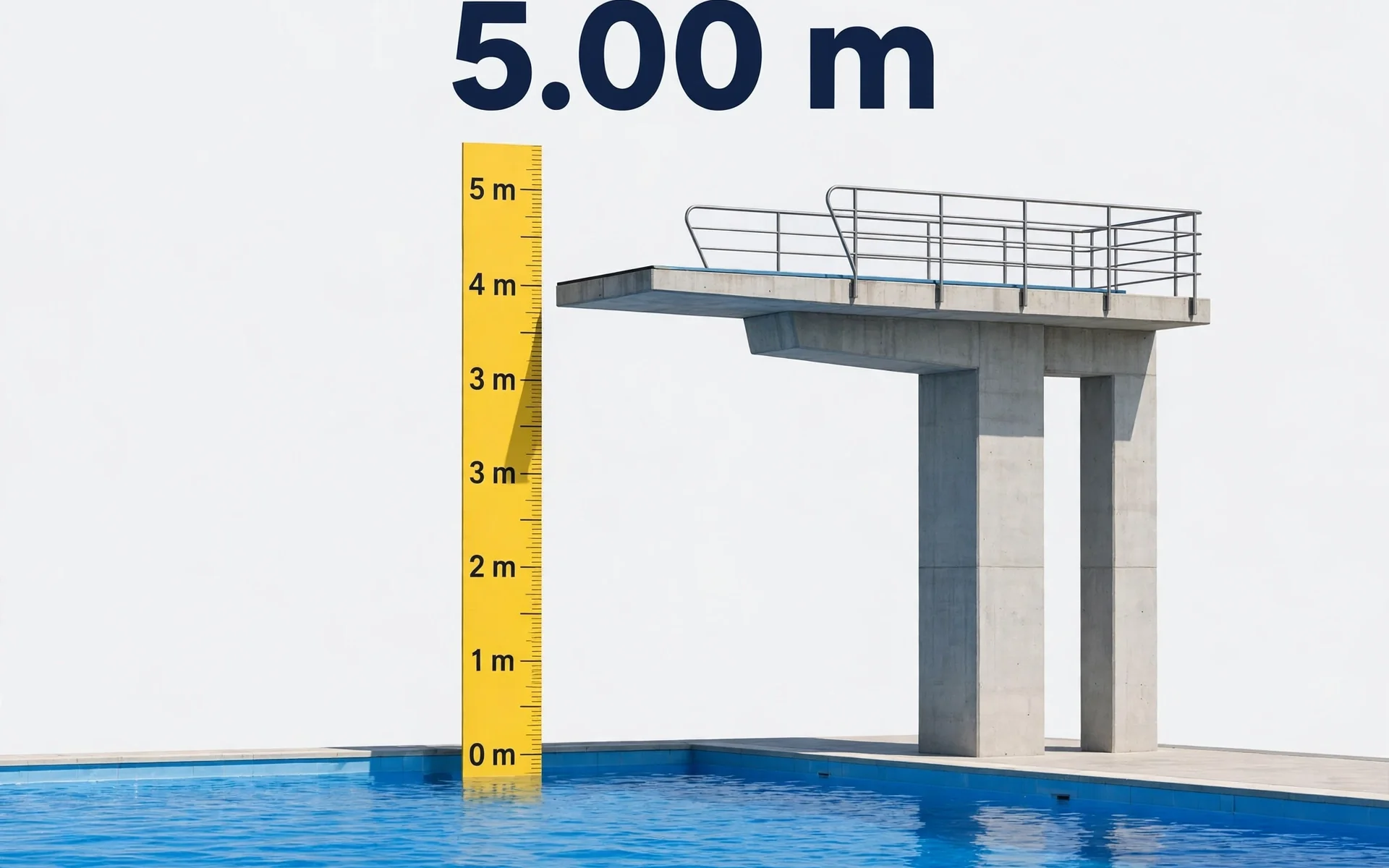
The diving platform is the article’s cleanest exact, because its 5 metres is written into the rules of the sport itself. The diving rules set platforms at 5 metres, 7.5 metres, and 10 metres above the water surface, and the 5-metre platform is the height used for training and for junior competition, on the same tower as the 10-metre platform the Olympics use. The platform is a rigid slab at least 6 metres long and 2 metres wide, fixed in place so it does not flex or rebound, and the height is measured from the water surface to the top of the platform — so a competition platform is 5 metres, by definition, and never a centimetre under. Stand on one and look down, and you are standing exactly 5 metres above the water — no conversion required, and no other object in this article can say that.
The fitting check is the water, because a 5-metre platform is only half the measurement — the pool below it has to be deep enough to catch a diver falling from 16 feet 5 inches, and the rules demand several metres of water under the platform before anyone is allowed to dive from it. A backyard pool with a 5-metre tower on a shallow end is not a diving pool, it is an accident waiting for a date, and the guides that call any raised platform “about 5 metres” never say whether they mean the platform, the drop, or the platform plus the tower it sits on. The grade is exact because the figure is the sport’s own dimension for the named thing: 5 metres above the water, by definition, and the platform in your pool is the proof. Climb one and you will feel the 5 metres in your stomach before you feel it in your feet — it is the height of a two-storey house, and it is the only object in this article that you fall from.
2. A Stanley PowerLock 5 M Tape Measure — 5.00 M Blade (EXACT)
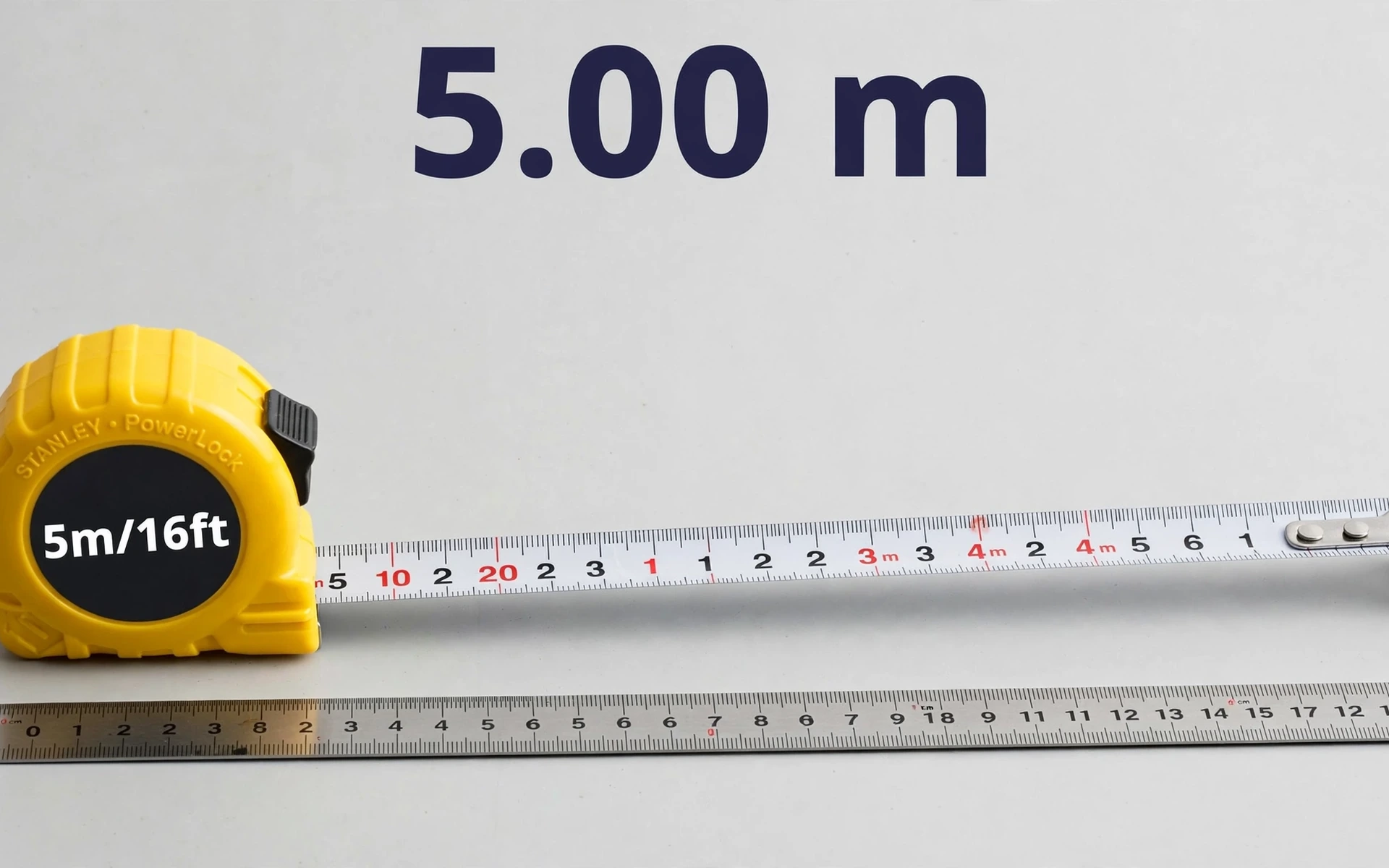
The tape measure is the article’s second exact, and the one that proves the trap. Stanley’s own listing sells the PowerLock tape rule as a 5-metre blade — model 33-215 is listed as “Powerlock 5 m (16-in) x 3/4-in Tape rule” — and the specification sheet for the 5-metre model gives a measuring length of 5 metres at Class II accuracy, which is the European standard for a tape you can trust to a millimetre over its whole length. Pull one out to its end and you are holding exactly 5 metres of steel blade — no conversion required, and the same in every hardware store the tape is sold in.
The fitting check is the label, because the tape is sold as “5 m / 16 ft” and those two numbers are not the same length. Sixteen feet is 4.88 metres, which is 12.3 centimetres short of 5 metres, so the imperial side of the blade runs out 12 centimetres before the metric side does — and the last 12 centimetres of the blade carry metric marks and no imperial marks at all. A measurement taken in feet off a “5 m / 16 ft” tape is 12 centimetres short of the measurement the same tape gives in metres, and the guides that call 16 feet “5 metres” are making exactly that mistake with a straight face. The grade is exact because the figure is the maker’s own listing for this named model: 5 metres of blade, by the maker’s own sheet, and the tape in your toolbox is the proof. Measure the room before you measure the furniture, because the tape is the object in this article that measures all the others.
3. An Adult Male Giraffe — About 5.00 M Tall (AVERAGE)
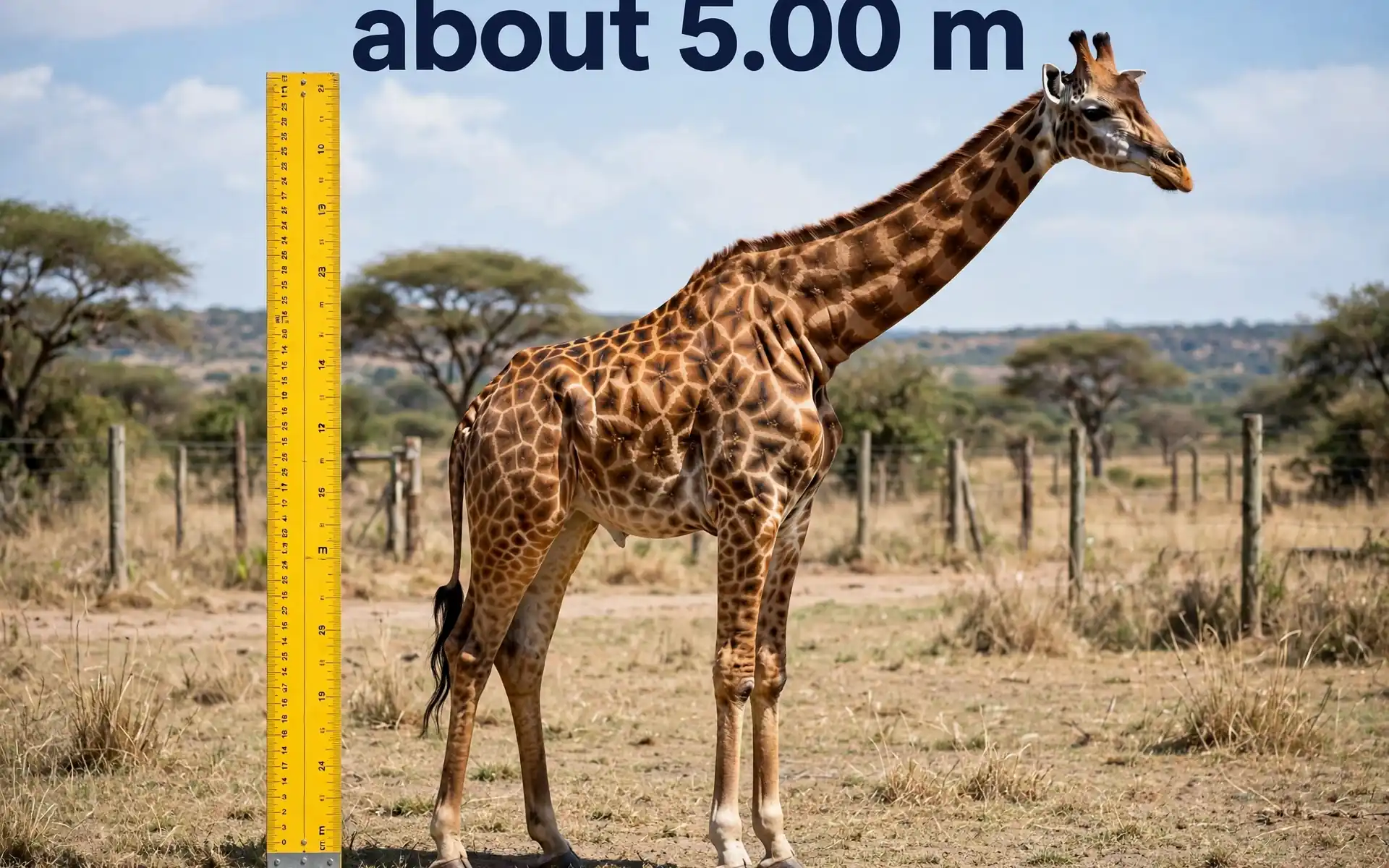
The giraffe is the article’s tallest living object, and the one whose number is an average rather than a specification. The conservation authorities put adult male giraffes at 16 to 18 feet tall — 4.8 to 5.5 metres — and adult females at 14 to 16 feet, 4.3 to 4.8 metres, so the average bull stands just over 5 metres from hoof to horn tip, and a typical male giraffe IS 5 metres tall in the only sense that matters for picturing it. It is the tallest land animal on Earth, and it reaches that height on legs alone: the legs are about 1.8 metres, the neck is about 1.8 metres, and the head and body make up the rest, so the animal is a 5-metre tower built out of three roughly equal parts. Stand beside one and you are standing beside 5 metres — no conversion required, and the same in every zoo the giraffe is kept in.
The fitting check is the neck, because the guides that call a giraffe’s neck and head “approximately five metres” are wrong about the anatomy by a factor of nearly three. The neck alone is about 1.8 metres long — long, but not 5 metres — and the head adds less than half a metre more, so a neck and a head together are barely 2 metres, and the guides that print 5 metres for them have confused the animal with its neck. A giraffe that fits under a 5-metre branch is a giraffe standing at its full height, and a giraffe that has to duck is a giraffe taller than 5 metres, which is to say a very large bull, because the record bull stood 5.87 metres and most bulls never reach it. The grade is average because the figure is the midpoint of the authority’s published range for the named animal, not a specification for a single giraffe: 4.8 to 5.5 metres, centred just over 5. Measure the animal before you measure the neck, because the giraffe is the object in this article that makes 5 metres feel alive.
4. A 2025 Toyota Camry — 4.92 M Long (LISTED)
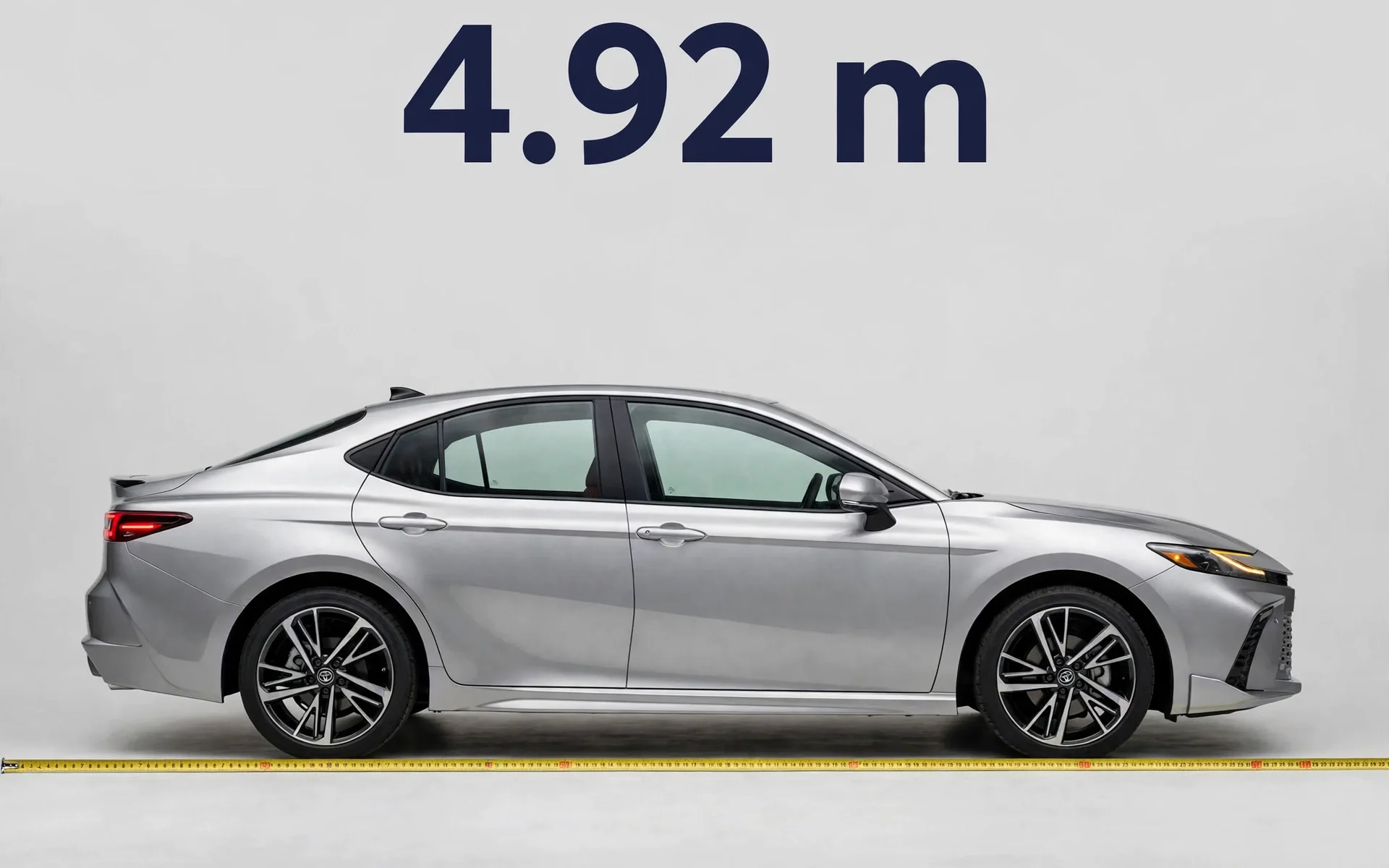
The Camry is the article’s closest car, and the proof that the rivals’ favourite comparison is wrong. Toyota’s own owner’s manual for the 2025 Camry Hybrid lists the length at 4,915 millimetres — 193.5 inches — with a width of 1,840 millimetres and a wheelbase of 2,825 millimetres, and the 4,915-millimetre figure is the same on every trim, because the body is the same body whatever engine sits in it. Park one beside a tape measure and you are looking at 4.92 metres — 8.5 centimetres short of the number in this article’s title, and the same in every colour the Camry is sold in.
The fitting check is the garage, because a 4.92-metre car is longer than most single garages are deep, and the number that matters for parking is not the length but the length plus the space to open the doors — a car that fits the garage may not fit the garage with its doors open, and a car that fits the driveway may not fit through the gate to the street. A parking bay, a garage, or a car cover bought against “5 metres” fails by 8.5 centimetres if you measure the car and forget the mirrors, which stick out past the body by a few centimetres each, and the guides that call a compact car “about 5 metres” never say which car they mean, because a Corolla is 4.63 metres and a Civic is 4.67 metres — 30 centimetres short — and only a mid-size sedan like the Camry comes within 10 centimetres. The grade is listed because the figure is the manufacturer’s own specification for this named model, with the deviation printed in full: 4,915 millimetres, not 5,000, and the 8.5 centimetres is the whole story. Measure the car before you measure the garage, because the Camry is the object in this article you have to park somewhere.
5. An Old Town Penobscot 164 Canoe — 4.98 M Long (LISTED)
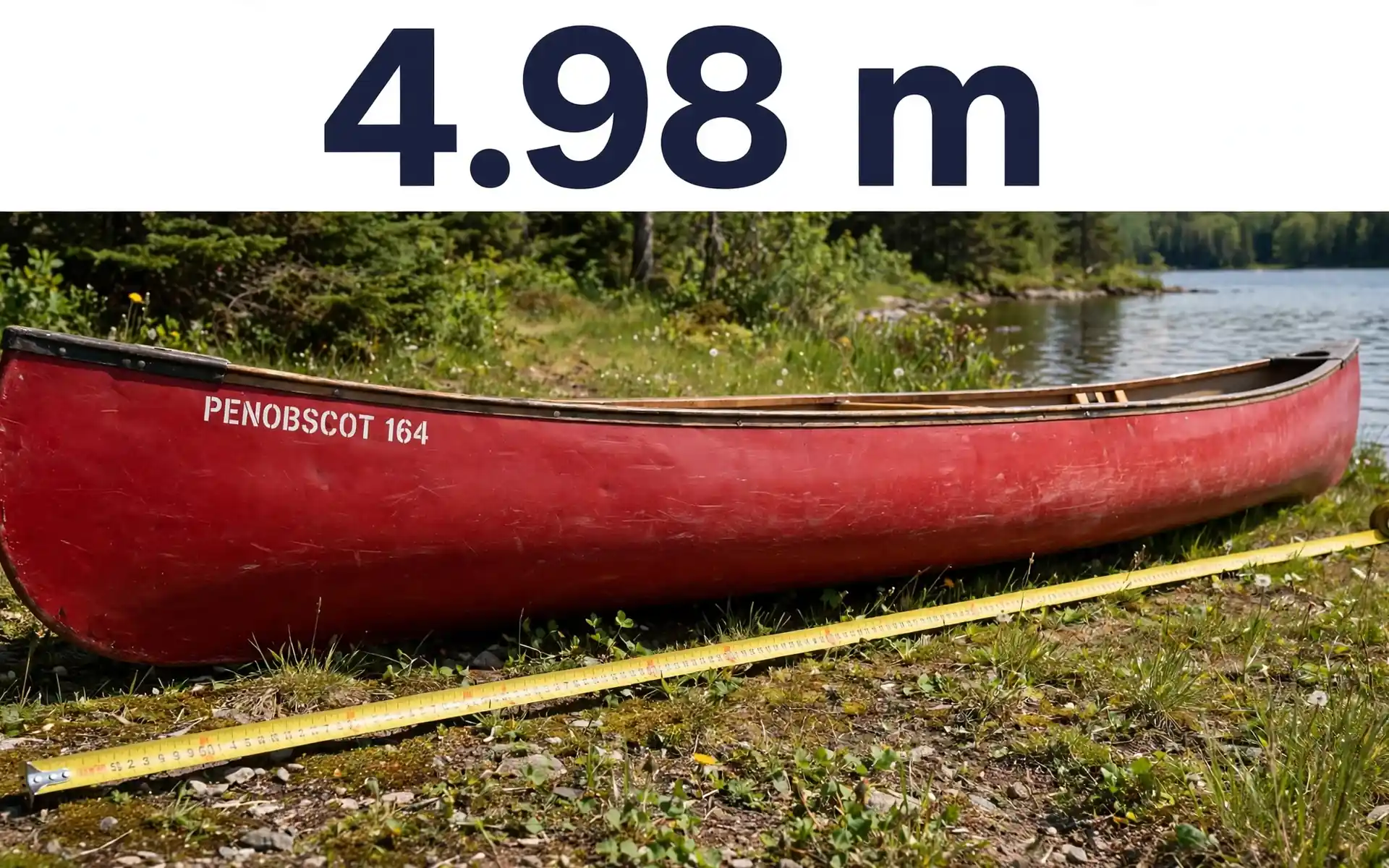
The canoe is the article’s closest object of all, and the one that has to fit through the most doors. Old Town’s Penobscot 164 lists its length at 16 feet 4 inches — 4.978 metres — with a width of 37.5 inches, a weight of 75 pounds, and a carrying capacity of 1,250 pounds, and the 16-foot-4-inch figure is the hull itself, measured from the tip of the bow to the tip of the stern. Lay one on the ground beside a tape measure and you are looking at 4.98 metres — 2.2 centimetres short of the number in this article’s title, closer than any other object here, and the same in every colour the canoe is sold in.
The fitting check is the roof rack, because a 4.98-metre canoe is longer than most car roofs and longer than most garage walls are deep, and the number that matters for transport is not the length but the length plus the overhang the law allows — a canoe that fits the car may not fit the garage, and a canoe that fits the garage may not fit through the gate to the water. A roof rack, a wall mount, or a storage sling bought against “5 metres” fails by 2.2 centimetres if you measure the hull and forget the carry handles, which stick out past the bow and stern by a couple of centimetres each, and the guides that call a canoe “about 5 metres” never say which canoe they mean, because canoes are sold from 10 feet to 18 feet, and a 16-foot canoe is 4.88 metres — 12 centimetres short — while only the 16-foot-4-inch Penobscot comes within a thumb’s width. The grade is listed because the figure is the manufacturer’s own specification for this named model, with the deviation printed in full: 16 feet 4 inches, not 16 feet 5 inches, and the 2.2 centimetres is the whole story. Measure the hull before you measure the car, because the canoe is the object in this article you have to carry somewhere.
6. A Wilderness Systems Tarpon 160 Kayak — 4.88 M Long (LISTED)
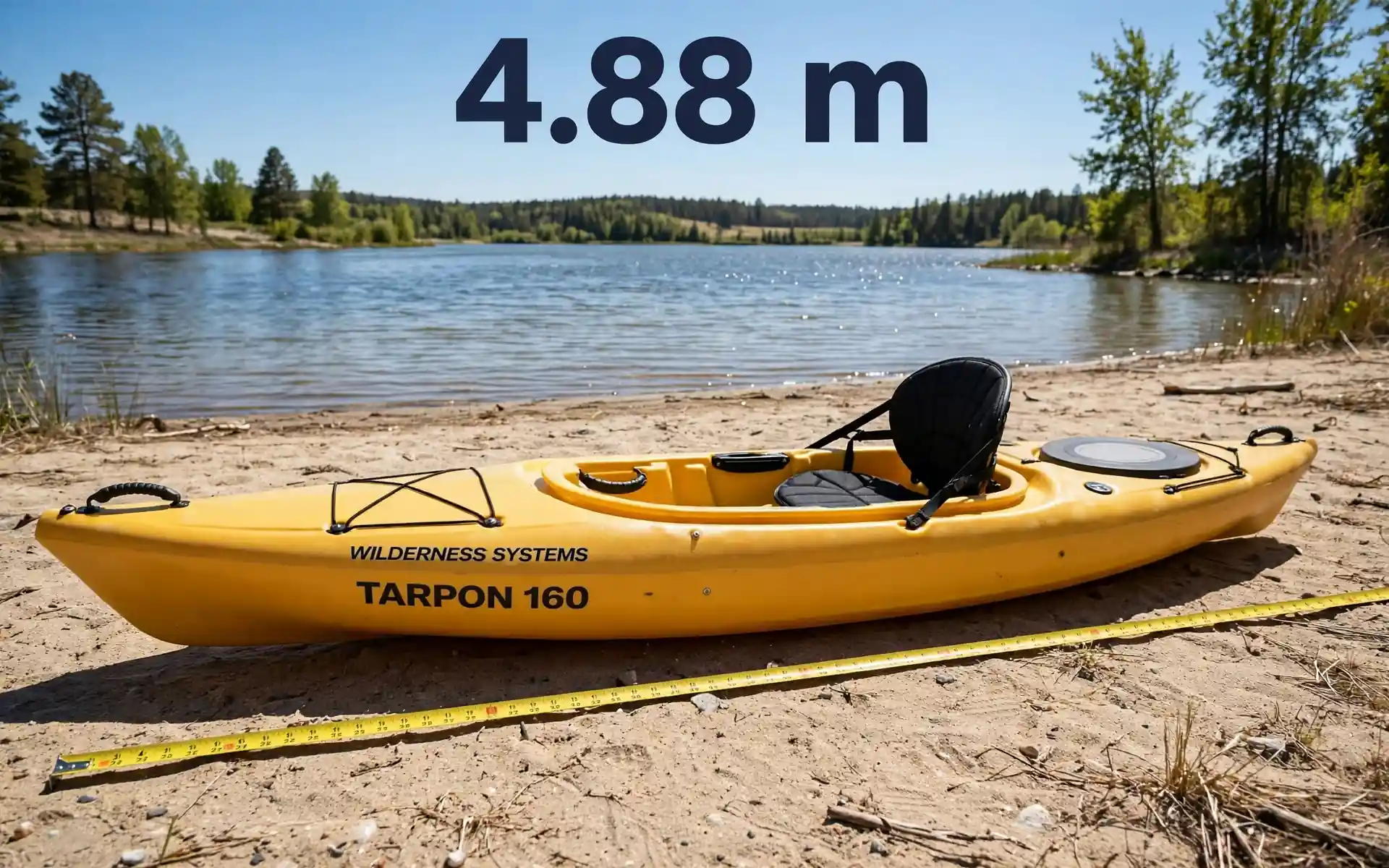
The kayak is the article’s first sixteen-foot trap, and the one the rivals get closest to right and still get wrong. Wilderness Systems’ own specification lists the Tarpon 160 sit-on-top kayak at 16 feet long — 488 centimetres — 28 inches wide, 76 pounds, with a 375-pound maximum capacity, and the 16-foot figure is the hull itself, measured from bow to stern. Lay one on the ground beside a tape measure and you are looking at 4.88 metres — 12.3 centimetres short of the number in this article’s title, and the same in every colour the kayak is sold in.
The fitting check is the roof rack, because a 4.88-metre kayak is longer than most car roofs, and the number that matters for transport is not the length but the length plus the overhang the law allows — a kayak that fits the car may not fit the garage, and a kayak that fits the garage may not fit through the gate to the water. A roof rack, a wall mount, or a storage sling bought against “5 metres” fails by 12.3 centimetres if you measure the hull and forget the rudder, which sticks out past the stern by several centimetres, and the guides that call a touring kayak “exactly 5 metres” never say which kayak they mean, because touring kayaks are sold from 14 feet to 18 feet, and a 16-foot kayak is 4.88 metres — 12 centimetres short — while a 17-foot kayak is 5.18 metres, 18 centimetres over. The grade is listed because the figure is the manufacturer’s own specification for this named model, with the deviation printed in full: 16 feet, 488 centimetres, and the 12.3 centimetres is the whole story. Measure the hull before you measure the car, because the kayak is the object in this article you have to strap to the roof.
7. A Clopay 16 Ft Two-Car Garage Door — 4.88 M Wide (LISTED)
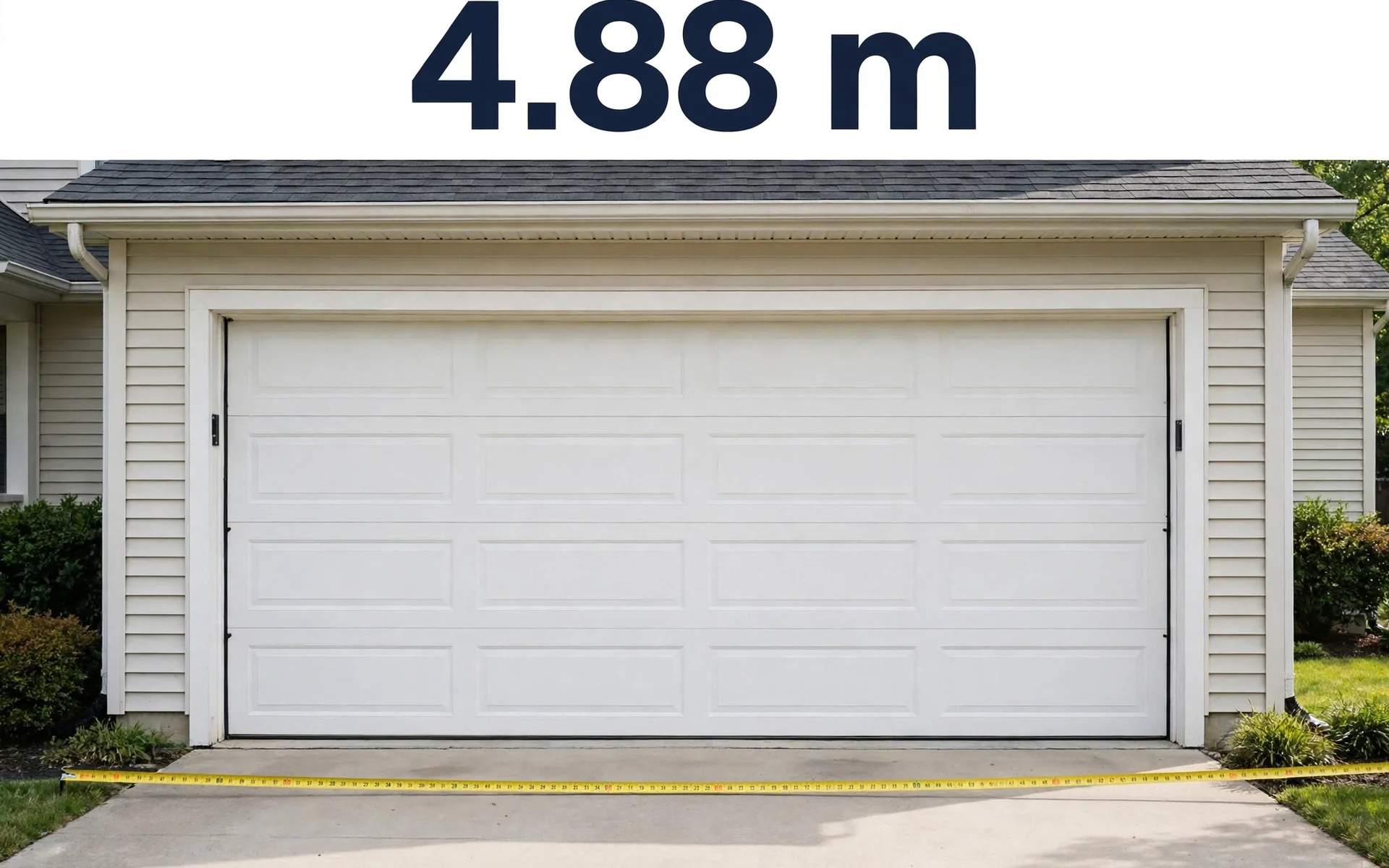
The garage door is the article’s widest object, and the one hanging on the most houses. Clopay lists 16 feet among its stock widths, and the 16-by-7-foot double door is the standard two-car size in America — the door sold for a garage that holds two cars side by side, 7 feet tall, in four 21-inch sections — and the 16-foot figure is the width of the door itself, measured from one jamb to the other. Stand in front of one with a tape measure and you are looking at 4.88 metres — 12.3 centimetres short of the number in this article’s title, and the same on every house the door is fitted to.
The fitting check is the opening, because the door’s 16 feet is the width of the door and the rough opening it fits into is 3 inches wider and an inch and a half taller — so a garage, a car, or a workbench bought against “5 metres” fails if you measure the door and forget the frame, which takes up the space around it. A 16-foot door on a 5-metre wall leaves 12 centimetres of wall on one side and nothing on the other, and the guides that call a garage door “5 metres wide” never say which door they mean, because garage doors are sold in 8, 9, 10, 12, 14, 16, and 18-foot widths, and an 18-foot door is 5.49 metres — 49 centimetres over — while only the 16-foot door comes within 13 centimetres. The grade is listed because the figure is the maker’s own listing for this named size: 16 feet, by the maker’s own catalogue, and the door on your house is the proof. Measure the opening before you measure the door, because the garage door is the object in this article you drive through every day.
8. A Skywalker 16 Ft Round Trampoline — 4.88 M Across (LISTED)
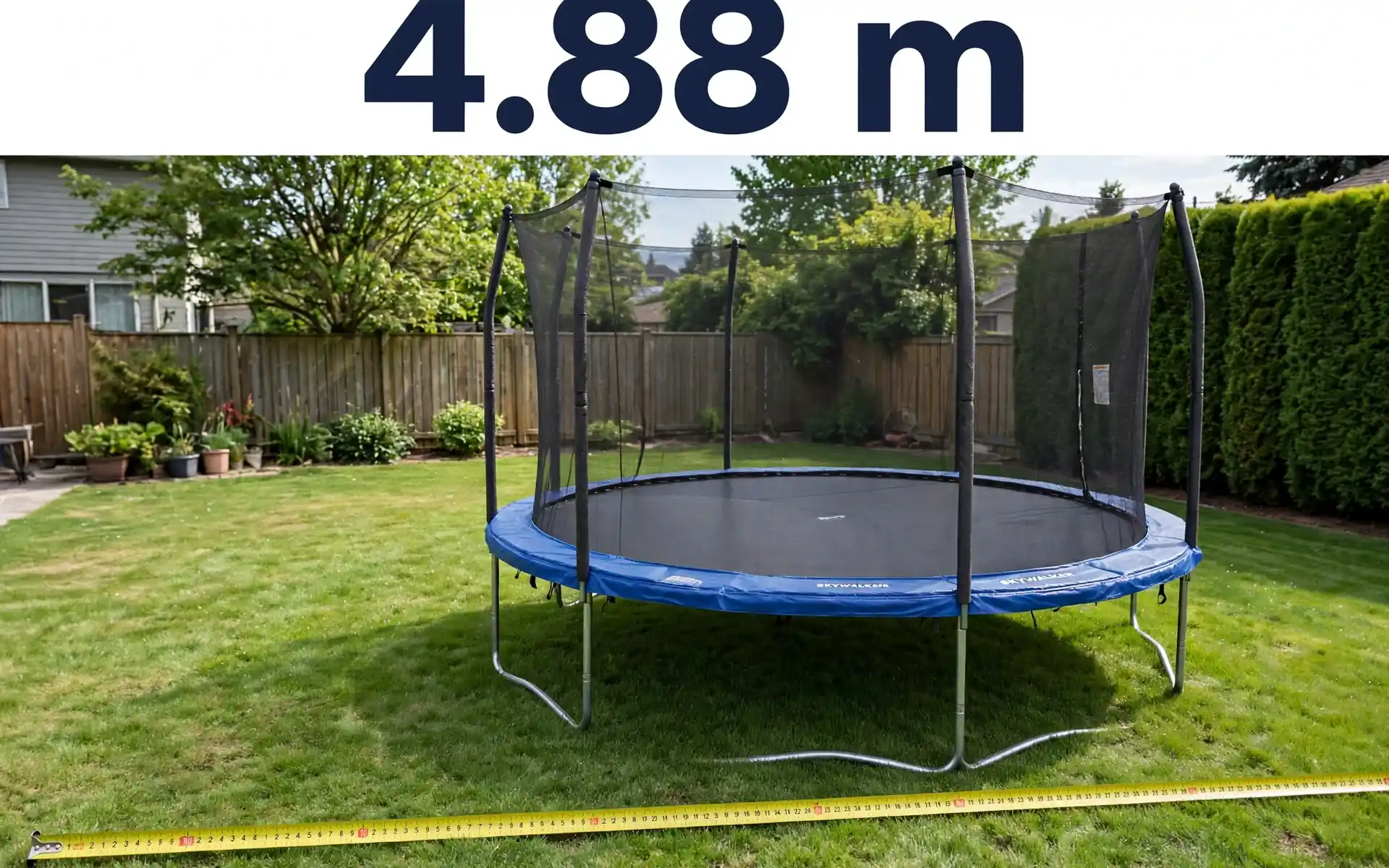
The trampoline is the article’s second sixteen-foot trap, and the one you can walk all the way around. Skywalker’s 16-foot round trampoline with enclosure lists its frame at 16 feet across — 192 inches, 4.88 metres — with 96 springs under the mat and a 200-pound maximum user weight, and the 16-foot size is the one sold for large backyards precisely because it is the biggest round frame that still fits a normal garden. Stand at one edge and look across to the other, and you are looking at 4.88 metres — 12.3 centimetres short of the number in this article’s title, and the same in every colour the trampoline is sold in.
The fitting check is the mat, because the trampoline’s 16 feet is its frame diameter and its jumping mat is only about 14 to 14.5 feet across — the springs and the padding over them take up the outer ring, so a child bouncing in the middle is jumping on a surface a full 45 to 60 centimetres narrower than the number on the box. A garden, a fence line, or a cover bought against “5 metres” fails by nearly half a metre if you measure the mat instead of the frame, and the guides that call a trampoline “almost exactly 5 metres” never say whether they mean the frame, the mat, or the enclosure — the enclosure stands about 2.7 metres tall, which is a different number in a different direction. The grade is listed because the figure is the maker’s own listing for this named model, with the deviation printed in full: 16 feet, not 16 feet 5 inches, and the 12.3 centimetres is the whole story. Measure across the frame before you measure the garden, because the trampoline is the object in this article you have to fit through a gate.
The Sixteen-Foot Trap: Where the Other Lists Get 5 Metres Wrong
Seven wrong numbers about 5 metres circulate so widely that they deserve their own section, because each one is stated confidently on a page that ranks for this exact question. First, the compact car: one popular guide calls 5 metres “slightly longer than a compact car” and lists the Civic, the Corolla, and the Golf as hovering around it, and a Corolla is 4.63 metres long — 37 centimetres short — which is more than a foot of missing car, and the guide’s own range of 4.6 to 5.1 metres proves it, because a range is not a figure. Second, the parking space: another guide calls 5 metres “the most common standard” for a parking space, and parking bays are drawn 4.8 metres long in Britain and 5.5 metres long in America — a range of 70 centimetres, not a standard — and the same guide’s own numbers prove it. Third, the shipping container: a third guide calls one-third of a 20-foot container “almost exactly five meters”, and a 20-foot container is 6.06 metres long, so one-third of it is 2.02 metres — a third of a box is arithmetic, not an object, and the guide’s own arithmetic proves it. Fourth, the giraffe’s neck and head: a fourth guide calls a giraffe’s neck and head “approximately five meters when fully stretched upward”, and a giraffe’s neck is about 1.8 metres and its head adds less than half a metre, so the neck and head together are barely 2 metres — the guide has confused the animal with its neck. Fifth, the school bus width: a fifth guide calls a school bus “approximately 5 meters across their width”, and a school bus is about 2.4 metres wide and about 12 metres long — 5 metres is neither dimension, and the guide’s own words prove it. Sixth, the basketball hoop plus backboard: a sixth guide calls the hoop plus the backboard “approaching 5 meters total”, and the rim is 3.05 metres high and the top of the backboard is about 3.95 metres — a full metre short of 5 — and the guide’s own numbers prove it. Seventh, the two swimming lanes: a seventh guide calls two pool lanes “about 5 meters”, and two lanes of 2.5 metres is addition, not an object — you cannot buy two lanes, carry two lanes, or park in two lanes, and the guide’s own arithmetic proves it. None of these seven numbers belongs in a 5-metre article, and all seven are here so you never have to learn that from a purchase.
Measuring 5 Metres With the Objects in This Article
Five metres is a number you can check without a second tool, because the objects in this article are the tools — but only if you use the objects themselves, not your body. First, take the tape measure: a 5-metre Stanley PowerLock blade is exactly 5 metres from the hook to the end, so pull one out to its full length and you are holding 5 metres — but check the label first, because the imperial side runs out at 16 feet and the last 12 centimetres carry metric marks only. Second, take the garage door: a 16-foot double door is 4.88 metres wide, so walk from one jamb to the other and add 12 centimetres in your head — the width of a hand — and you have 5 metres, but measure the door, not the opening, because the opening is 3 inches wider and will lie to you by 8 centimetres. Third, take the trampoline: a 16-foot frame is 4.88 metres across, so walk from one edge of the frame to the other and add 12 centimetres in your head, and you have 5 metres — but measure the frame, not the mat, because the mat is 45 to 60 centimetres narrower and will lie to you by nearly half a metre. Fourth, take the canoe: a 16-foot-4-inch Penobscot is 4.98 metres long, so lay one on the ground and you are looking at 5 metres to within a thumb’s width — but check the model first, because a 16-foot canoe is 12 centimetres short and will lie to you by a hand’s width. None of these replaces a calibrated tool for anything that must fit, but all four will tell you whether 5 metres is the size you think it is before the kayak is ordered, the car is bought, or the wall is built — and the tape measure is the one to trust, because its zero centimetres is the smallest miss you can hold in your hand.
5 Metres Against the Sizes Around It
Five metres sits two metres past the springboard in the last article — a 3-metre board is 9.84 feet, a distance your eyes already know — and three metres past the stride in the first, which is 3.28 feet and the length of a single step. Step up the ladder and the rungs crowd together: the 4.88-metre garage door, the 4.88-metre kayak, the 4.88-metre trampoline, the 4.92-metre Camry, the 4.98-metre canoe, then the 5-metre platform and the 5-metre tape, then the 5-metre giraffe standing just over the line, then 16 feet at 4.88 metres, the round number people keep rounding 5 metres down to, and the reason the rounding is wrong by 12.3 centimetres. The ladder runs 3, 4.88, 4.88, 4.88, 4.92, 4.98, 5, 5, 5 — and the point of it is the middle: 5 metres is the only rung with two exact objects behind it, a platform on one side and a tape on the other, and all eight objects in this article sit inside a 12-centimetre band, which is why 5 metres is the tightest size in the series to stand inside.
How 5 Metres Compares With Other Lengths
Readers comparing nearby sizes may also want the site’s guides to 16 feet, 10 feet, and 5 feet for the foot series, 1 meter, 2 meters, 3 meters, 4 meters, and 6 meters for the metre series, and the inches hub and feet hub for the full directories. Each of those guides follows the same rule as this one: the spec sheet, the grade, and the miss printed in full.
Frequently Asked Questions
How many feet is 5 meters?
5 meters is 16.40 feet, or 16 feet 4 and 7/8 inches in feet and inches. Multiply 5 by 3.28084 and you get 16.4042 feet — and the trap is rounding that to 16 feet, which understates the length by 12.3 centimetres, or reading the 0.40 as 4 inches, which understates it by nearly an inch. For anything that must fit, use 16.40 feet; for a quick estimate in your head, 16 feet 5 inches is close enough to picture it and only a fraction of an inch over.
Is 5 meters the same as 16 feet?
No, and the difference matters. Sixteen feet is 4.8768 metres, which is 12.3 centimetres shorter than 5 metres — nearly 5 inches. If you buy a 16-foot kayak for a 5-metre roof rack, the kayak will fit with room to spare; but if you cut a 16-foot board for a 5-metre gap, you will have 5 inches left over. The honest shortcut is 16 feet 5 inches, which is 5 metres to within a fraction of an inch.
How many inches is 5 meters?
196.85 inches exactly. Multiply 5 by 39.3701 and you get 196.8505 inches, with no rounding that matters for anything you will ever measure by hand. In centimetres that is 500 cm, in millimetres it is 5,000 mm, and in yards it is 5.47 yards rounded — exactly 5.4681 yards, which is the figure a tape measure will show if it is marked in yards.
How many yards is 5 meters?
5.47 yards. Five metres is 5 yards plus about half a yard more, because a metre is about 3 inches longer than a yard, and those 3 inches add up five times over. Do not confuse 5 metres with 5 yards: 5 yards is only 4.57 metres, which is 43 centimetres short — well over a foot — and that is how garden hoses and fence panels end up wrong.
How tall is 5 meters compared to a person?
About three times the height of an average adult. Most adults stand between 1.6 and 1.8 metres tall, so 5 metres is roughly three people standing on each other’s shoulders — taller than the tallest human in history, who reached 2.72 metres and still fell 2.28 metres short of 5. If you stand on your toes and reach up, you still will not touch a 5-metre mark unless you are standing on something tall.
What is 5 meters long in real life?
The most exact everyday answers are a 5-metre diving platform (5.00 m above the water) and a 5-metre tape measure (5.00 m of blade). The next closest are an Old Town Penobscot 164 canoe (4.98 m long), a 2025 Toyota Camry (4.92 m long), a Wilderness Systems Tarpon 160 kayak (4.88 m long), a Clopay 16-foot two-car garage door (4.88 m wide), and a Skywalker 16-foot round trampoline (4.88 m across) — plus an adult male giraffe, which stands about 5 metres tall on average. None of the six near-misses is exact, and each one’s miss is printed beside it in this article.
How do I measure 5 meters without a tape measure?
Use a 16-foot garage door if you have one — it is 4.88 metres wide, so add 12 centimetres in your head. Otherwise use a 16-foot trampoline frame (4.88 m — add 12 centimetres), a 16-foot kayak (4.88 m — add 12 centimetres), or a 16-foot-4-inch canoe (4.98 m — close enough to call it 5 metres). For anything that must fit — a kayak, a car, a wall — borrow or buy a real tape measure, because at 5 metres the misses in this article run from zero to 12 centimetres, and guessing throws every one of them away.
Will a 16-foot kayak fit on a 5-metre roof rack?
Yes — with room to spare. A 16-foot kayak is 4.88 metres long, which is 12.3 centimetres shorter than a 5-metre roof rack, so it fits with about a hand’s width to spare at each end. The trap runs the other way: a kayak sold as “5 metres” that is actually 17 feet long is 5.18 metres, which is 18 centimetres over a 5-metre rack and will hang past the tailgate. Measure the hull before you buy the rack, because the kayak is the object in this article you have to strap to the roof.
Final Thoughts
Five metres is the rare measurement that is honest and still misunderstood, because 16.40 feet can be a platform, a tape, a giraffe, a Camry, a canoe, a kayak, a garage door, or a trampoline — and the number alone never says which. Now you know it as a platform’s height fixed by its sport, a tape’s length fixed by its maker, a giraffe’s height fixed by its species, a car’s length fixed by its maker, a canoe’s length fixed by its maker, a kayak’s length fixed by its maker, a door’s width fixed by its maker, and a trampoline’s width fixed by its maker — and you know which of those you can trust to the centimetre and which you must measure yourself. The rule that runs through all eight is the same one this site always uses: trust the spec sheet, print the deviation, and let the name stay on the box where it belongs. Measure twice, in the direction the object actually travels, and 5 metres will fit the first time.
