
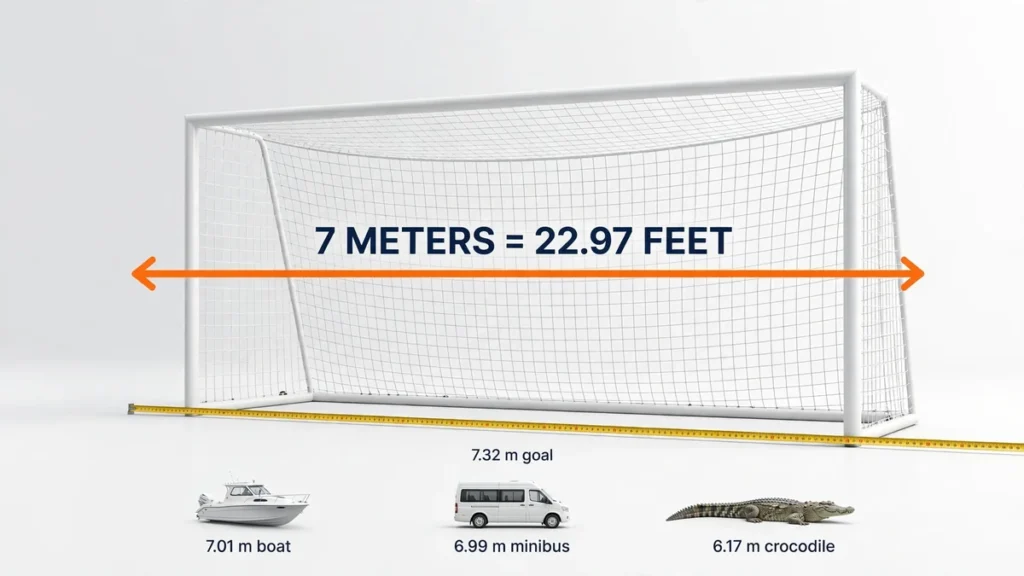
If you have ever wondered how long is 7 meters, the short answer is 22.97 feet — and the longer answer is that 7 meters is the first length in this series where the metric system and the imperial system finally agree with each other. Three meters is 9.84 feet, and everyone rounds it to 10 without much harm. Six meters is 19.69 feet, and everyone rounds it to 20, and that lie is 9.6 centimetres long, nearly four inches, the width of a hand — the whole story of the last article. Seven meters is 22.97 feet, and everyone rounds it to 23, and that lie is one centimetre long, the thickness of a fingernail. It is the difference between a rounding you must warn people about and a rounding you can simply use. Seven meters is the length where the two systems shake hands, because 23 feet is 7.01 meters, and a 23-foot boat is a 7-meter boat, and the number on the brochure and the number on the tape finally say the same thing.
Below are seven single, named things, each checked against its own specification, with the miss printed wherever a thing misses. Four of them land within 10 centimetres of the mark — a boat 1 centimetre over, a minibus 1 centimetre under, a limousine 3.2 centimetres over, a sailboat 6.6 centimetres under — and the other three land between 30 and 83 centimetres away. Two of them are fixed by the laws of the game and the laws of the sea: a soccer goal 7.32 metres wide by the Laws of the Game, and a lifeboat no shorter than 7.3 metres by the code that governs every ship on Earth. Every object’s image sits immediately after its heading, and no object is a stack, a multiple, a fraction, or a category guess. You will not find half a bus here, or three and a half mattresses, or seven guitars, because half a bus is a saw cut wearing a seatbelt, and you will not find a snooker table’s cue room, because a room is not a table. By the end you will know 7 metres as a goal, a lifeboat, a limousine, a powerboat, a minibus, a sailboat, and a crocodile — and you will know which of those you can trust to the centimetre and which you must measure yourself.
Quick Answer
7 meters is 22.97 feet exactly — 700 centimetres, 7,000 millimetres, 275.59 inches, and 7.66 yards. And unlike 6 metres, you CAN call it 23 feet: 23 feet is 7.01 metres, only 1 centimetre longer than 7 metres, and 1 centimetre at this size is the thickness of a fingernail. The honest shortcut is 22 feet 11 inches — and the honest object is a Boston Whaler 230 Outrage, a 23-foot boat that measures 7.01 metres by its maker’s own specification.
Why 7 Metres Is the 23-Foot Line
Seven metres is the first length in this series that you can buy under its own name in both systems at once. One metre is a stride, three metres is a room, six metres is a container that is not quite 20 feet — but seven metres is 23 feet, and 23 feet is a size the imperial world actually sells: 23-foot boats, 23-foot trailers, 23-foot garages. The Boston Whaler 230 Outrage is sold as a 23-foot boat, and its length overall is 7.01 metres. The Toyota Coaster is sold as a minibus, and its length is 6.99 metres. The Klassen Phantom is sold as a limousine, and its length is 7.032 metres. Three different makers, three different countries, three different machines — and all three land within 3.2 centimetres of the same number, because 7 metres and 23 feet are the same length wearing different clothes, and the clothes finally fit.
The second reason 7 metres feels like a line rather than a length is that it is the width of the game the whole world watches. A soccer goal is 7.32 metres wide by the Laws of the Game, which means the most famous rectangle on Earth is a 7-metre line drawn in white paint, and every goal ever scored was scored through a gap 32 centimetres wider than the number in this article’s title. A lifeboat is no shorter than 7.3 metres by the code that governs every ship on Earth, which means the smallest legal boat that can save your life is a 7-metre line drawn in orange fibreglass. A saltwater crocodile is 6.17 metres at its largest ever verified, which means the biggest reptile on Earth still falls 83 centimetres short of the goal it could never fit through. Seven metres is the scale of games and rescues and roads, not of furniture and tools — it is the first length in this series that belongs to the stadium and the sea rather than the room. Stand on the goal line and look at the posts, and you are looking at 7.32 metres. Stand beside a Coaster and you are looking at 6.99 metres. The guides that list “things that are 7 metres long” keep reaching for halves and multiples because no single object in a normal life is 7 metres long, and the objects that are — a goal, a lifeboat, a limousine, a boat, a bus, a sailboat, a crocodile — are the biggest single things in their own worlds.
The 7 Objects
Each object below carries its evidence grade in the heading. EXACT means the figure is a standard’s or an authority’s own dimension for the named thing. LISTED means the figure is the manufacturer’s or operator’s published specification for the named model. AVERAGE means the figure is an authority’s published average or range for the named thing. REPORTED means the figure is the largest verified measurement an expert source reports for the named thing. The grade is the whole point: a list that never grades its numbers is asking you to trust it, and this article would rather show you the receipt.
1. A Soccer Goal — 7.32 M Between the Posts (EXACT)
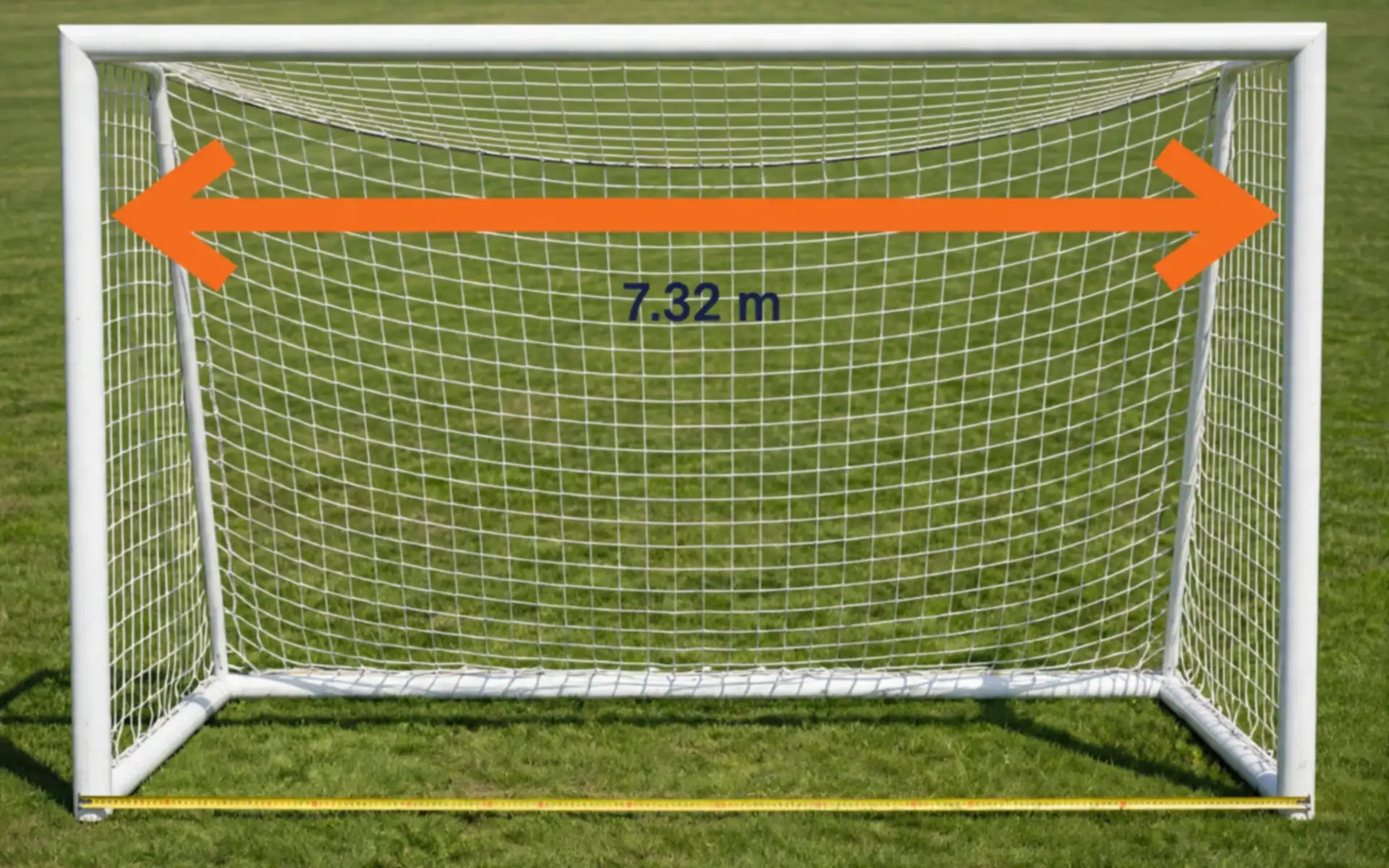
The goal is the article’s most familiar near-miss, because its 7 metres is written into the laws of the game rather than a catalogue. The Laws of the Game, Law 1, fix the distance between the inside of the posts at 7.32 metres — 8 yards — and the distance from the lower edge of the crossbar to the ground at 2.44 metres, 8 feet, and they do so for every full-size match on Earth, from a Sunday league pitch to a World Cup final. The posts and the crossbar must be white and no more than 12 centimetres thick, and the goal line must be the same width as the posts, so the white rectangle you see on television is a 7.32-metre gap with a 2.44-metre roof, and it is the same gap in every stadium on the planet, because the law is the product.
The fitting check is the 32 centimetres, because the goal’s 7.32 metres is 32 centimetres past the number in this article’s title, and a goal that looks “about 7 metres” from the stands is a third of a metre wider than the number you were picturing — which is the width of a football, and the difference between a shot that hits the post and a shot that hits the net. A training goal, a garden goal, or a five-a-side goal is smaller — a five-a-side goal is 3.66 metres wide, exactly half — and the guides that call a soccer goal “about 7 metres” never say whether they mean the full-size goal, the training goal, or the distance from the goalpost to the penalty spot, which is 11 metres and has nothing to do with the goal at all. The grade is exact because the figure is the law’s own dimension for the named thing: 7.32 metres, by the Laws of the Game, and the 32-centimetre miss is printed in the heading itself. Stand on the goal line and you will feel the 32 centimetres — it is the distance between the post and the edge of your outstretched arms.
2. A SOLAS Lifeboat — No Shorter Than 7.3 M (EXACT)
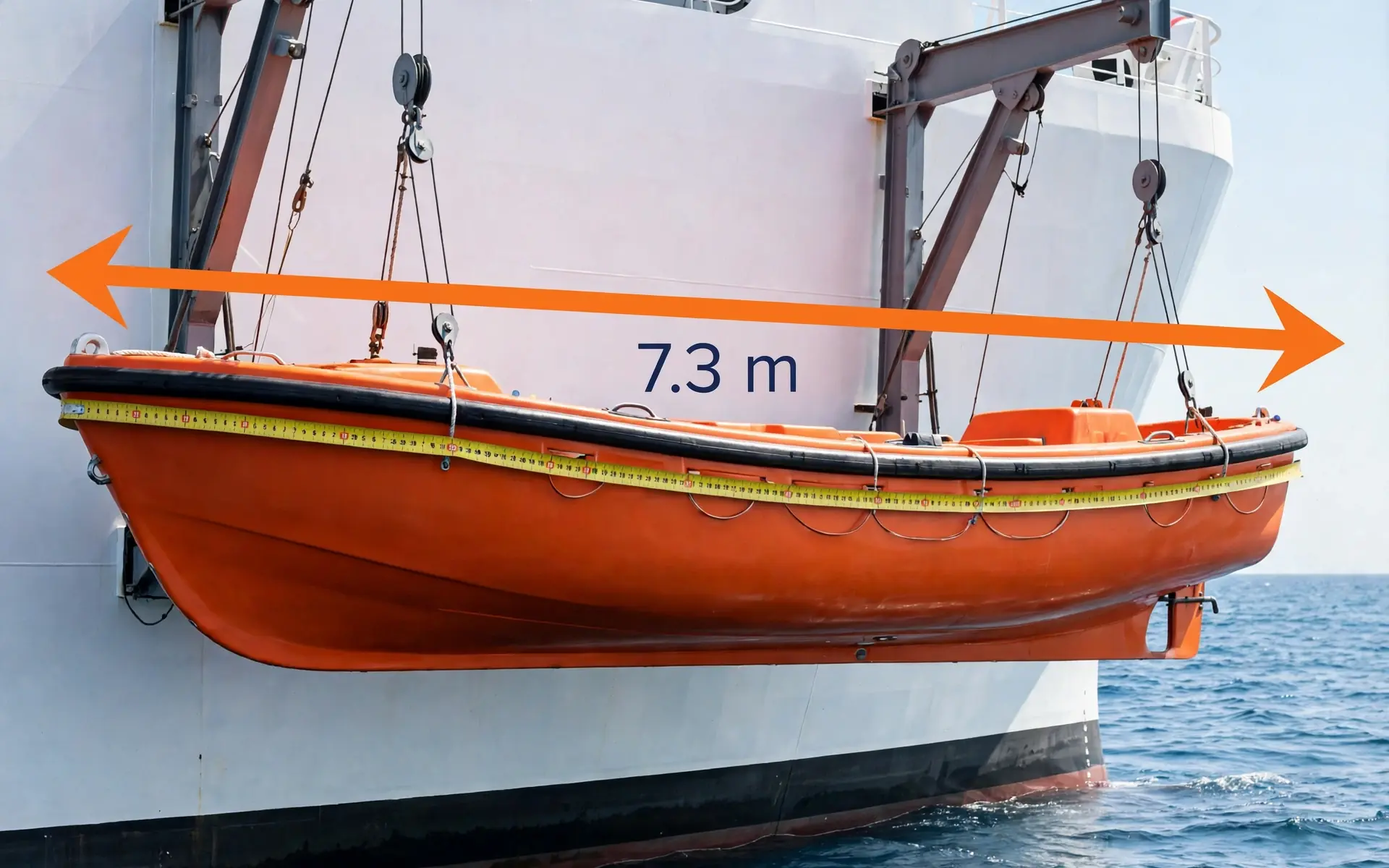
The lifeboat is the article’s most serious near-miss, because its 7 metres is written into the law of the sea rather than a brochure. The International Life-Saving Appliance Code, which governs every ship under the SOLAS convention, fixes the minimum length of a lifeboat at 7.3 metres — no lifeboat on a merchant ship may be shorter — and the national regulations that implement it print the same figure, 7.3 metres, for every class of ship that carries passengers or crew on unlimited voyages. The 7.3 metres is a floor, not a figure: real lifeboats run 7.3 metres and longer, and the smallest legal lifeboat on a ship is a 7.3-metre orange boat hanging in davits on either side, waiting for the day it is needed. Stand on the deck of a ferry and look at the lifeboats, and you are looking at 7.3 metres at the very least.
The fitting check is the floor, because the lifeboat’s 7.3 metres is a minimum and a real lifeboat is often 8 or 8.5 metres long, which is a metre or more past the number in this article’s title, and a boat bought or built against “7.3 metres” as if it were the length, rather than the shortest length allowed, will be too small for the davits it must hang in and too small for the people it must carry. A liferaft is not a lifeboat — a liferaft is a canister that inflates, and it has no fixed length at all — and the guides that call lifeboats “7.3 metres” never say whether they mean the minimum, the average, or the boat on the ship in the photograph, because they never read the code. The grade is exact because the figure is the code’s own dimension for the named thing: 7.3 metres, by the LSA Code, and the 30-centimetre miss is printed in the heading itself. Measure the davits before you measure the boat, because the lifeboat is the object in this article that has to work the one time it matters.
3. A Klassen Rolls-Royce Phantom VIII Limousine — 7.032 M Long (LISTED)
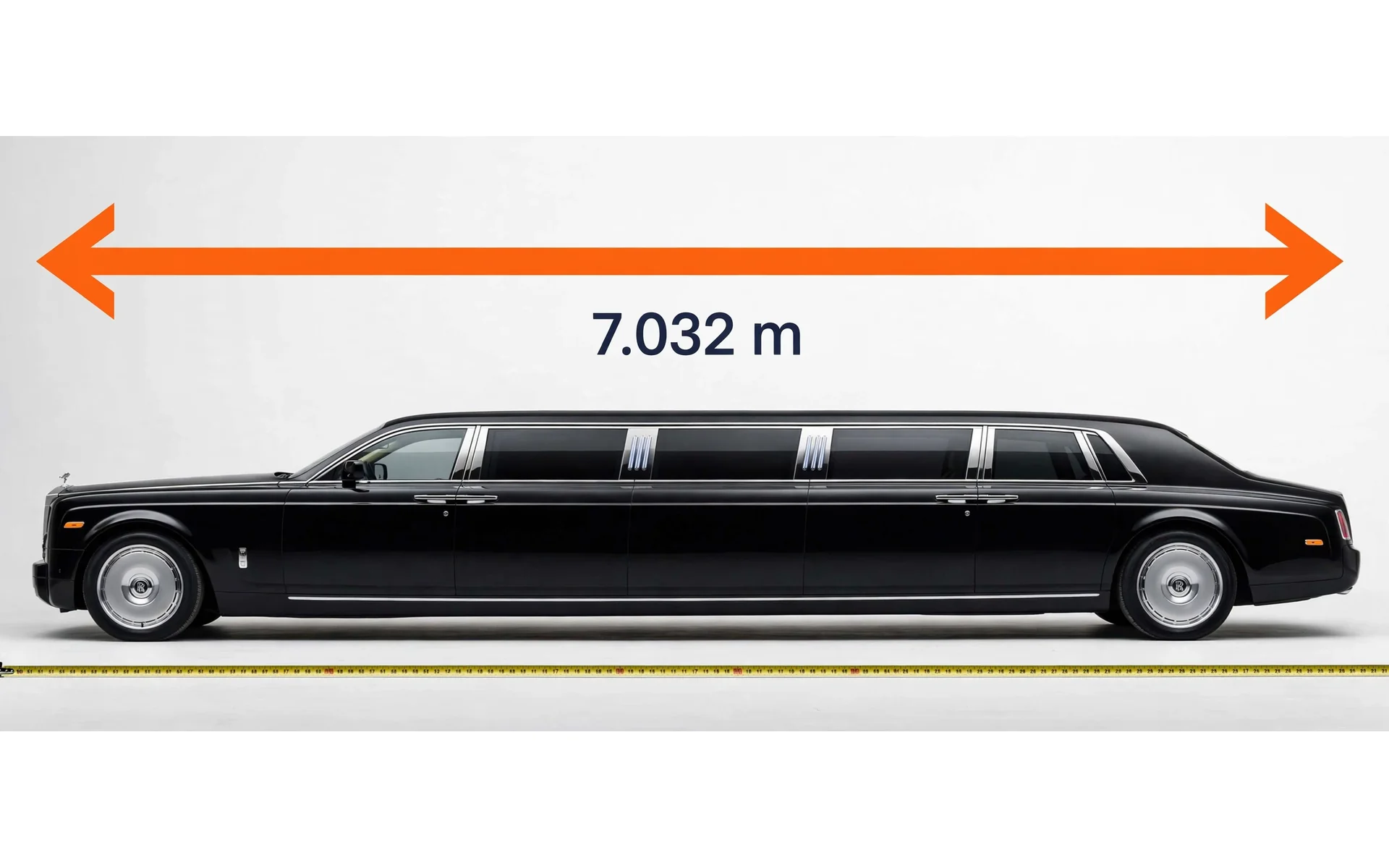
The Phantom is the article’s most expensive near-miss, because its 7 metres is a limousine built by stretching a car that was already the longest sedan on sale. Rolls-Royce’s own specification lists the Phantom Extended Wheelbase at 5,982 millimetres long, with a 3,772-millimetre wheelbase, and the German coachbuilder Klassen stretches that car by a further 1,050 millimetres — cutting the body and inserting a metre of steel, glass, and armour in the middle — to build a bulletproof limousine 7,032 millimetres long, with a 4,822-millimetre wheelbase and B7-level ballistic protection. The arithmetic is the receipt: 5,982 plus 1,050 is 7,032, and the wheelbase grows by the same 1,050, from 3,772 to 4,822, because the whole stretch goes into the cabin between the axles. Park one beside a tape measure and you are looking at 7.032 metres — 3.2 centimetres past the number in this article’s title — and the same in every colour the car is sold in, because the stretch is the product.
The fitting check is the garage, because the Phantom’s 7.032 metres is longer than a standard single garage is deep — most single garages are 5.5 to 6 metres — and a limousine bought against “about 7 metres” needs a double garage, a hotel forecourt, or a street long enough to hold it, and the guides that call stretch limousines “6.5 to 9 metres” never say which stretch they mean, because a stretch is whatever the coachbuilder cut. A factory Phantom Extended is 5,982 millimetres, which is a metre short of 7 metres, and a Klassen Phantom is 7,032 millimetres, which is 3.2 centimetres over — and the difference between the two is a metre of armour and a million dollars. The grade is listed because the figure is the coachbuilder’s published conversion figure for this named car, with the deviation printed in full: 5,982 millimetres from the factory, 1,050 added by Klassen, 7,032 in total. Measure the garage before you measure the car, because the Phantom is the object in this article you cannot fold.
4. A Boston Whaler 230 Outrage — 23 Ft 0 In, 7.01 M Long (LISTED)
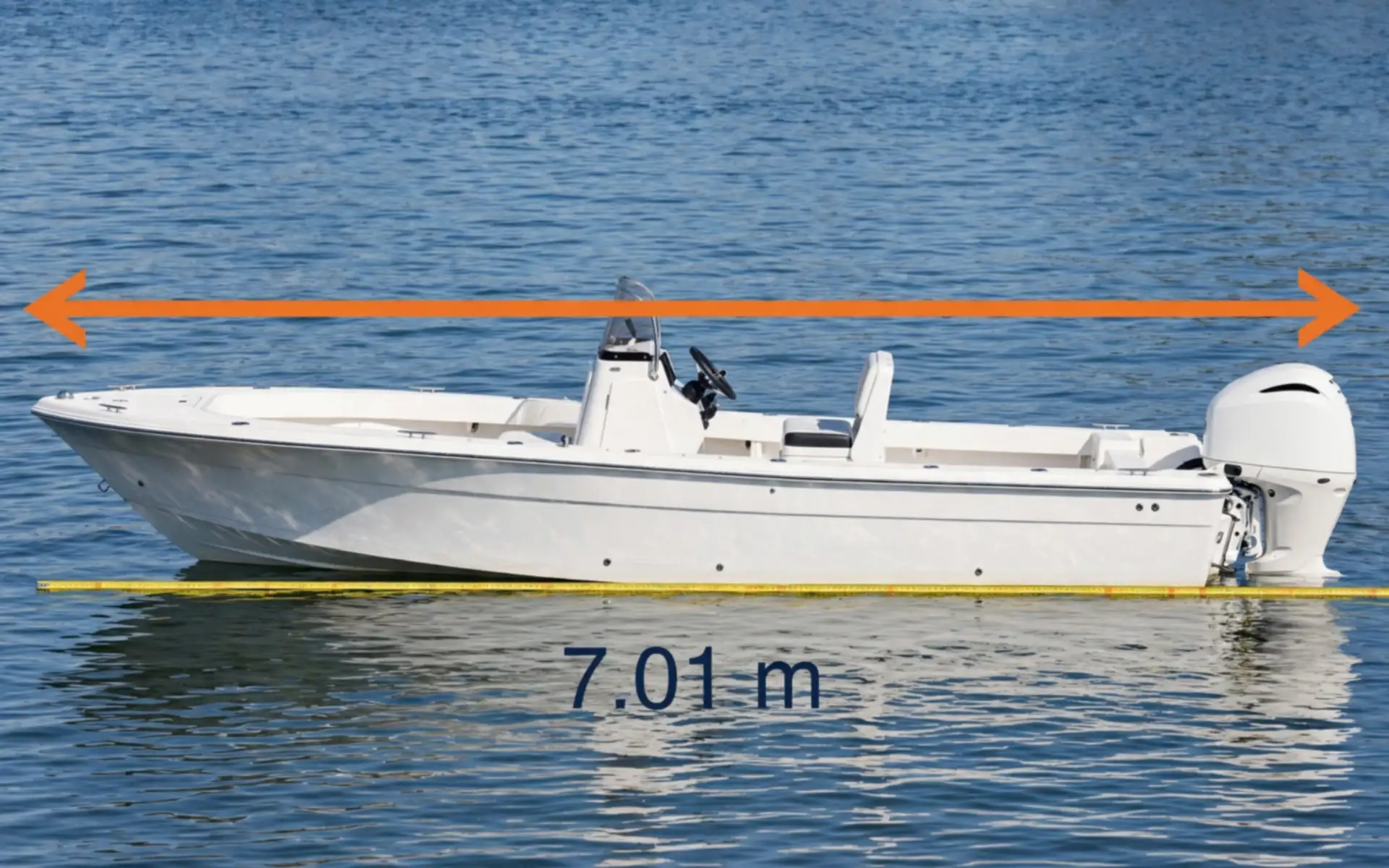
The Whaler is the article’s cleanest near-exact, because its 7 metres is printed on the same spec sheet in feet and in metres. Boston Whaler’s own specification lists the 230 Outrage at 23 feet 0 inches long overall — 7.01 metres — with an 8-foot 6-inch beam, 2.59 metres, an 18.5-inch draft, and a dry weight of 3,800 pounds, and the same sheet lists a 300-horsepower Mercury outboard and room for 10 people. The name is the measurement: the 230 is a 23-foot boat, and 23 feet is 7.0104 metres, so the boat is 1 centimetre past the number in this article’s title, and the same on every 230 Outrage on the water, because the hull is the product.
The fitting check is the outboard, because the Whaler’s 7.01 metres is the hull alone and the engine hangs off the transom behind it — a Mercury V8 on its bracket adds roughly half a metre to the length the boat actually occupies — so a berth, a trailer, or a garage bought against “23 feet” fits the hull and not the boat, and the guides that call small boats “around 7 metres” never say whether they mean the hull, the hull plus the engine, or the trailer underneath, because they never measured a boat. A 23-foot boat is 7.01 metres, and a 7-metre berth is 1 centimetre too short for it, which is the smallest miss in this article and the one that matters most, because a centimetre is the difference between a boat that fits its berth and a boat that scrapes the pontoon. The grade is listed because the figure is the maker’s own listing for this named model, with the deviation printed in full: 23 feet 0 inches, 7.01 metres, 1 centimetre over. Measure the berth before you measure the boat, because the Whaler is the object in this article that proves the 23-foot rounding.
5. A Toyota Coaster Minibus — 6,990 Mm Long (LISTED)
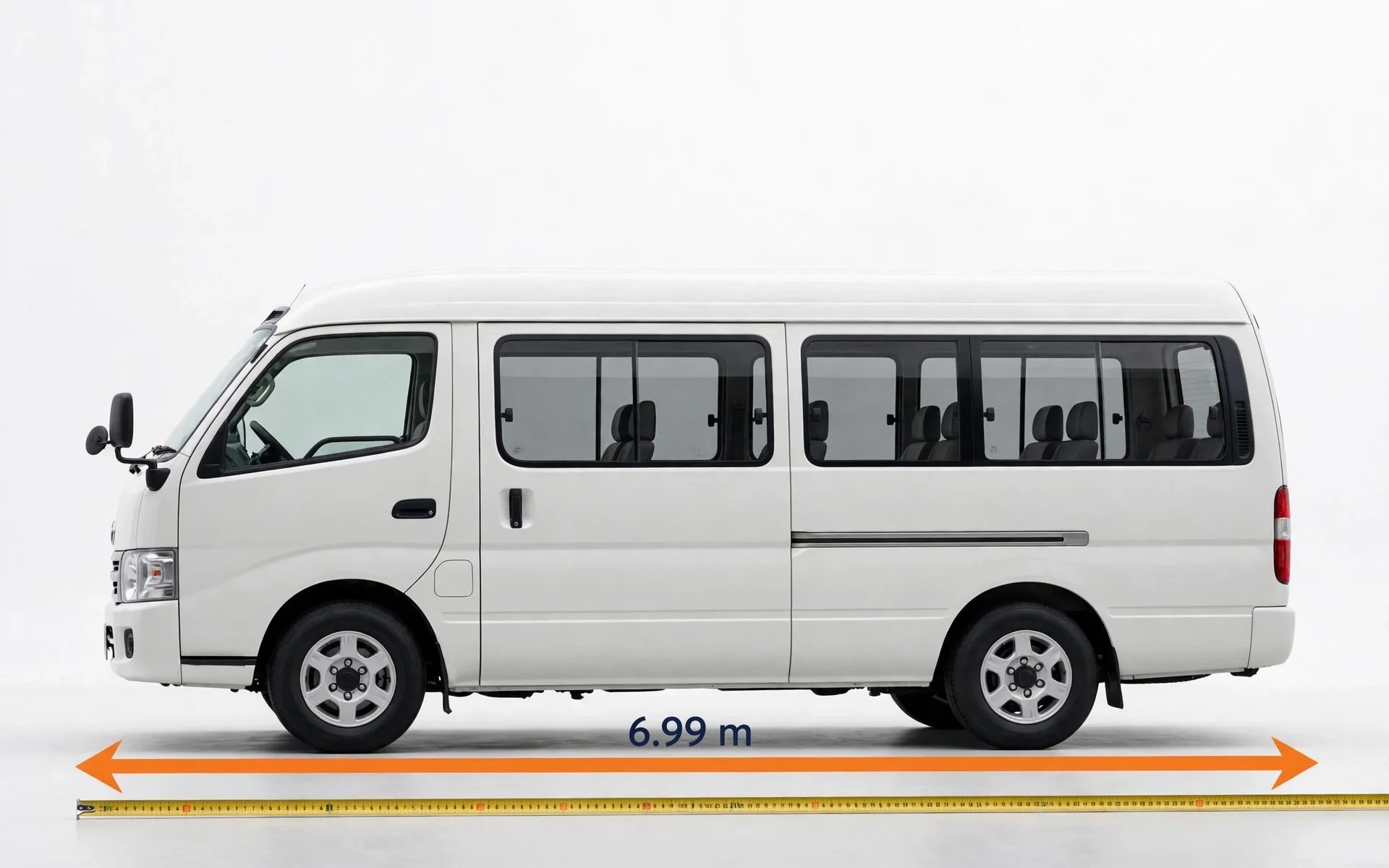
The Coaster is the article’s most useful near-miss, because it is the 7-metre object you can ride in every day. Toyota’s own specification lists the Coaster minibus at 6,990 millimetres long overall — 2,080 millimetres wide, 2,635 millimetres tall, on a 3,935-millimetre wheelbase — with room for up to 29 or 30 passengers, and the same sheet has listed the same 6,990 millimetres across model years, because the body is the product. Park one beside a tape measure and you are looking at 6.99 metres — 1 centimetre short of the number in this article’s title — and the same on every Coaster on the road, because the length is the specification.
The fitting check is the half, because the Coaster’s 6.99 metres is a whole bus, and the guides that tell you to picture “half a city bus” for 7 metres are picturing half of a 14-metre bus, which is 7 metres only if the bus is exactly 14 metres — and a standard city bus is 12 metres, so half of it is 6 metres, a metre short, and an articulated bus is 18 metres, so half of it is 9 metres, two metres over. A whole Coaster is 6.99 metres, and half a city bus is whatever the bus happens to be, and the guides that use halves never say which bus they halved, because they never measured one. The grade is listed because the figure is the maker’s own listing for this named model, with the deviation printed in full: 6,990 millimetres, 1 centimetre short. Measure the bus before you measure the half, because the Coaster is the object in this article you ride.
6. A J/70 Racing Sailboat — 6.934 M Long (LISTED)
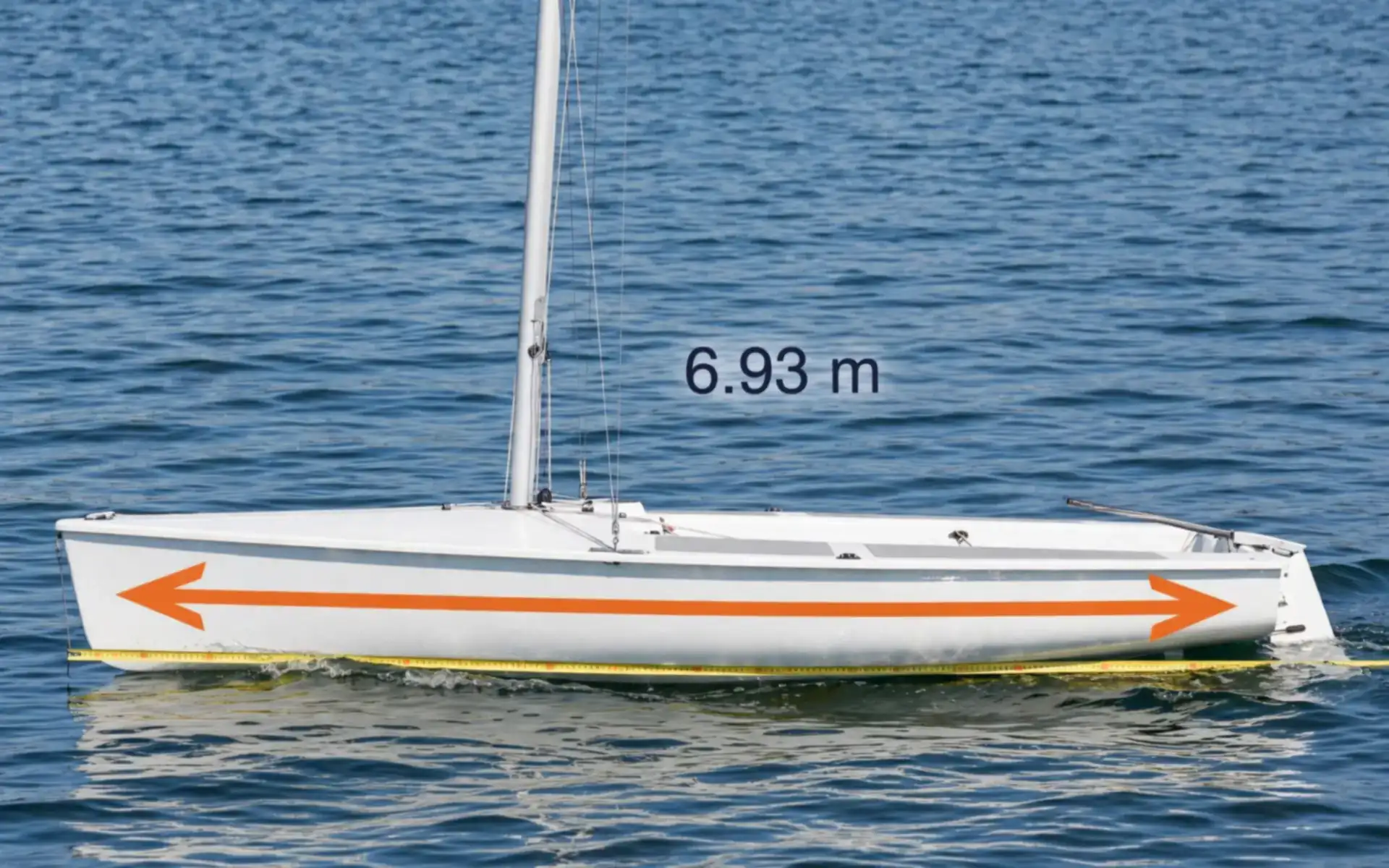
The J/70 is the article’s fastest near-miss, because its 7 metres is a racing rule rather than a brochure. J/Boats’ own class specification lists the J/70 at 6.934 metres long overall — 22.75 feet — with a 6.24-metre waterline, a 2.249-metre beam, and a displacement of 794 kilograms, and the same specification has governed every one of the 1,500-plus J/70s sailing in 25 countries since the class launched in 2012, because the class is the product. Lay one on its trailer and you are looking at 6.934 metres — 6.6 centimetres short of the number in this article’s title — and the same in every fleet on the planet, because one design means one length.
The fitting check is the bowsprit, because the J/70’s 6.934 metres is the hull alone and the retractable bowsprit, which carries the spinnaker, extends roughly a metre forward of the bow when it is out — so a slip, a trailer, or a garage bought against “6.93 metres” fits the hull and not the boat when it is racing, and the guides that call small boats “around 7 metres” never say whether they mean the hull, the waterline, or the bowsprit, because they never read the class rules. A racing sailboat is measured by its hull, and a hull of 6.934 metres is 6.6 centimetres short of 7 metres, which is the length of a hand, and the difference between a boat that fits its trailer and a boat that overhangs it. The grade is listed because the figure is the builder’s own specification for this named class, with the deviation printed in full: 6.934 metres, 6.6 centimetres short. Measure the hull before you measure the rig, because the J/70 is the object in this article you race.
7. A Saltwater Crocodile — Largest Verified 6.17 M Long (REPORTED)
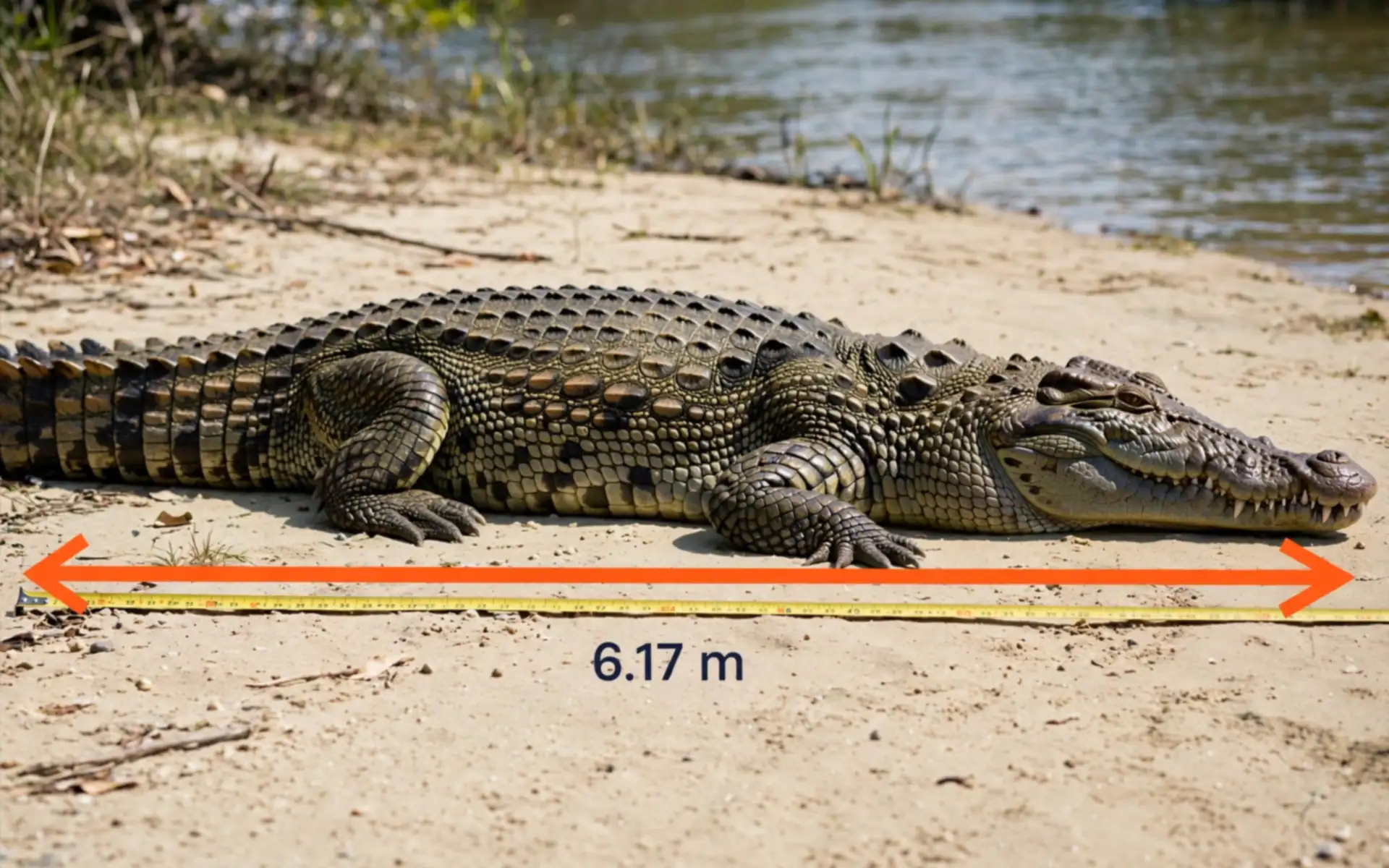
The crocodile is the article’s wildest near-miss, and the one every guide gets wrong by rounding it up. Guinness World Records measured Lolong, a male saltwater crocodile captured in Bunawan in the Philippines, at 6.17 metres from snout to tail — 20 feet 3 inches — and 1,075 kilograms, and certified him as the largest crocodile ever held in captivity, a record that still stands. The previous record holder, Cassius, measured 5.48 metres, and the famous “Krys” — the 8.6-metre crocodile supposedly shot in Queensland in 1957 — was never measured by anyone, and no photograph, skeleton, or witness has ever supported it. The saltwater crocodile is the largest living reptile on Earth, and the largest one ever reliably measured is still 83 centimetres short of the number in this article’s title — and the guides that call it “nearly 7 metres” are rounding up an 83-centimetre gap, which is the length of a man’s arm.
The fitting check is the tail, because a crocodile’s 6.17 metres is measured from the tip of its snout to the tip of its tail, and its tail alone is nearly half the animal — so a crocodile measured to its hips is only about 3.5 metres long, and a crocodile measured to its shoulders is shorter still. A cage, a boat, or a film built against “7 metres” for a saltwater crocodile is measuring a rumour, not an animal, and the guides that tell you to picture a crocodile never say whether they mean the measured record, the average, or the legend, because they never looked at the numbers. The grade is reported because the figure is the largest verified measurement an expert source reports for the named thing: 6.17 metres, by Guinness World Records, with the 83-centimetre miss printed in the heading itself. Stand beside one and you will feel the 83 centimetres — it is the distance between the tip of its tail and the end of your tape, and the distance you should keep in any case.
All Seven on One Ruler
Seven objects, seven spec sheets, and one ruler. Read the table top to bottom and you can see the whole article in a single glance: the two standards at the top, the two 7.0-metre machines in the middle, the two boats at the bottom of the band, and the crocodile underneath them all. Four of the seven land inside 10 centimetres of the mark, and the widest miss in the article is 83 centimetres — which is still smaller than the error in a single rival claim, because two sedans are 2.77 metres over and a shipping container is 94 centimetres under. The table is the article in miniature, and it is the reason the grades matter: the exacts are the law, the listed are the makers, and the reported is the record, and none of them is a guess.
| Object | Figure | Grade | Miss from 7 m |
|---|---|---|---|
| Soccer goal | 7.32 m between the posts | EXACT | 32 cm over |
| SOLAS lifeboat | 7.3 m minimum length | EXACT | 30 cm over |
| Klassen Rolls-Royce Phantom VIII | 7,032 mm long | LISTED | 3.2 cm over |
| Boston Whaler 230 Outrage | 7.01 m length overall | LISTED | 1 cm over |
| Toyota Coaster minibus | 6,990 mm long | LISTED | 1 cm short |
| J/70 racing sailboat | 6.934 m length overall | LISTED | 6.6 cm short |
| Saltwater crocodile (Lolong) | 6.17 m, largest verified | REPORTED | 83 cm short |
The ladder runs from 6.17 to 7.32, a band of 1.15 metres, and the middle of it is the point: 7 metres is the only rung with a machine on either side of it at one centimetre — a boat 1 centimetre over and a bus 1 centimetre under — and every object in this article sits inside a band narrower than the error in the rival lists. Six metres sat inside a 60-centimetre band, and its story was the rounding that fails. Seven metres sits inside a 1.15-metre band, and its story is the rounding that works — and the difference between the two articles is the difference between 9.6 centimetres and 1 centimetre, which is the difference between a container that scrapes the gate and a boat that slides into its berth.
Six Numbers the Other Lists Get Wrong
Six wrong numbers about 7 metres circulate so widely that they deserve their own section, because each one is stated confidently on a page that ranks for this exact question. First, the container: one popular guide calls a standard shipping container “7 metres”, and a 20-foot container is 6.058 metres by ISO 668 — 94 centimetres short, which is not a rounding error, it is a different container. Second, the crocodile: another guide calls the saltwater crocodile “nearly 7 metres”, and the largest ever reliably measured is Lolong at 6.17 metres — 83 centimetres short, which is the length of a man’s arm, and the 8.6-metre “Krys” it is usually confused with was never measured by anyone. Third, the anaconda: a third guide says the green anaconda “can reach a length of 7 metres”, and the largest scientifically measured wild female is 5.21 metres — 1.79 metres short, which is the height of a tall man — and even the verified captive record, 6.27 metres at Pittsburgh Zoo in 1960, is still 73 centimetres short. Fourth, the sedans: a fourth guide says two mid-sized sedans parked bumper to bumper are “approximately 7 metres”, and a 2024 Toyota Camry is 4.885 metres long, so two are 9.77 metres — 2.77 metres over, which is longer than a whole car — and the guide’s own maths, two times 4.5 metres, is 9 metres, which disproves its own claim in its own paragraph. Fifth, the tennis court: a fifth guide says a standard tennis court is “approximately 7 metres in width”, and a doubles court is 10.97 metres wide and a singles court is 8.23 metres — neither is 7 metres, and the doubles court is nearly 4 metres wider than the guide claims. Sixth, the rescue boat: a sixth guide says a surf lifesaving boat is “about 7 metres”, and the standard inflatable rescue boat is 3.8 metres long by the specification of Surf Life Saving Australia and New Zealand — 7 metres is nearly two of them, and the guide has doubled the boat. None of these six numbers belongs in a 7-metre article, and all six are here so you never have to learn that from a purchase, a berth, or a boat.
Measuring 7 Metres With the Objects in This Article
Seven metres is a number you can check without a second tool, because the objects in this article are the tools — but only if you use the objects themselves, not your body. First, take the goal: a full-size soccer goal is 7.32 metres wide by the Laws of the Game, so walk from one post to the other and shave off 32 centimetres in your head — the width of a football — and you have 7 metres, but check the goal first, because a five-a-side goal is 3.66 metres wide and will lie to you by more than half. Second, take the Whaler: a 23-foot Boston Whaler is 7.01 metres long by its maker’s own spec, so walk from bow to stern and shave off 1 centimetre — the thickness of a fingernail — and you have 7 metres, but measure the hull, not the engine, because the outboard hangs half a metre behind the transom and will lie to you by exactly that much. Third, take the Coaster: a Toyota Coaster is 6,990 millimetres long by Toyota’s own spec, so walk from bumper to bumper and add 1 centimetre in your head, and you have 7 metres — but check the bus first, because the long-wheelbase Coaster is 7,725 millimetres and will lie to you by 72 centimetres. Fourth, take the J/70: a J/70 is 6.934 metres long by its class rules, so walk from bow to stern and add 7 centimetres — the length of a hand — and you have 7 metres, but measure the hull, not the bowsprit, because the bowsprit extends a metre forward when it is out and will lie to you by a whole metre. None of these replaces a calibrated tool for anything that must fit, but all four will tell you whether 7 metres is the size you think it is before the boat is ordered, the bus is hired, or the goal is painted — and the Whaler is the one to trust, because its 1 centimetre is the smallest miss you can walk on your own street.
How 7 Metres Compares With Other Lengths
Readers comparing nearby sizes may also want the site’s guides to 7 feet, 10 feet, and 20 feet for the foot series, 1 meter, 2 meters, 4 meters, 5 meters, 6 meters, and 8 meters for the metre series, and the feet hub for the full directory. Each of those guides follows the same rule as this one: the spec sheet, the grade, and the miss printed in full.
Frequently Asked Questions
How many feet is 7 meters?
7 meters is 22.97 feet, or 22 feet 11.6 inches in feet and inches. Multiply 7 by 3.28084 and you get 22.96588 feet — and the trap this time is not rounding up, because rounding 22.97 to 23 feet overstates the length by only 1 centimetre, which is the thickness of a fingernail. For anything that must fit, use 22.97 feet; for a quick estimate in your head, 23 feet is close enough to picture it and only a centimetre long.
Is 7 meters the same as 23 feet?
No, but only by 1 centimetre — the smallest gap in the whole series. Twenty-three feet is 7.0104 metres, which is 1.04 centimetres longer than 7 metres, so a 23-foot boat needs a berth a centimetre longer than 7 metres, and a 7-metre garage will not quite hold it. Compare that with 6 metres, which is 9.6 centimetres short of 20 feet, and you can see why 7 metres is the first length in the series where the imperial rounding is honest. The honest shortcut is 22 feet 11 inches, which is 7 metres to within half a centimetre.
How many inches is 7 meters?
275.59 inches exactly. Multiply 7 by 39.3701 and you get 275.5907 inches, with no rounding that matters for anything you will ever measure by hand. In centimetres that is 700 cm, in millimetres it is 7,000 mm, and in yards it is 7.66 yards rounded — exactly 7.65529 yards, which is the figure a tape measure will show if it is marked in yards.
How many yards is 7 meters?
7.66 yards. Seven metres is 7 yards plus about 9 per cent more, because a metre is about 3 inches longer than a yard, and those 3 inches add up seven times over. Do not confuse 7 metres with 7 yards: 7 yards is only 6.40 metres, which is 60 centimetres short — two feet — and that is how berths and garages end up wrong.
How tall is 7 meters compared to a person?
About four times the height of an average adult. Most adults stand between 1.6 and 1.8 metres tall, so 7 metres is roughly four people stacked head to toe. The tallest man ever measured, Robert Wadlow, reached 2.72 metres, and two of him would still fall 1.56 metres short of 7 — you would need two Wadlows and a child on top to reach it. If you stand on your toes and reach up, you still will not touch a 7-metre mark unless you are standing on a ladder.
What is 7 meters long in real life?
The most exact everyday answers are a 23-foot boat and a minibus: a Boston Whaler 230 Outrage is 7.01 metres long and a Toyota Coaster is 6.99 metres long, one centimetre on either side of the mark. The next closest are a stretched Rolls-Royce Phantom at 7,032 millimetres and a J/70 sailboat at 6.934 metres. A soccer goal is 7.32 metres wide, a lifeboat is no shorter than 7.3 metres, and the largest saltwater crocodile ever verified measured 6.17 metres — 83 centimetres short, which is the largest miss in this article and the one the other guides round away.
How do I measure 7 meters without a tape measure?
Use a full-size soccer goal if you have one — it is 7.32 metres wide by the Laws of the Game, so shave off 32 centimetres. Otherwise use a 23-foot boat (7.01 m — shave off 1 centimetre), a Toyota Coaster (6.99 m — add 1 centimetre), or a J/70 sailboat (6.934 m — add 7 centimetres). For anything that must fit — a boat, a bus, a berth — borrow or buy a real tape measure, because at 7 metres the misses in this article run from 1 centimetre to 83 centimetres, and guessing throws every one of them away.
Will a 23-foot boat fit in a 7-metre berth?
No — not by a centimetre. A 23-foot boat is 7.01 metres long by its maker’s own specification, which is 1 centimetre longer than a 7-metre berth, and that is before the outboard engine, which hangs roughly half a metre behind the transom. A 23-foot boat needs a berth above 7.01 metres for the hull alone, and above 7.5 metres with the engine — measure the berth before you order the boat, because the boat is the one object in this article you cannot shorten, and the centimetre is the difference between a boat that slides in and a boat that scrapes the pontoon.
Final Thoughts
Seven metres is the rare measurement that is honest and still misunderstood, because 22.97 feet can be a goal, a lifeboat, a limousine, a powerboat, a minibus, a sailboat, or a crocodile — and the number alone never says which. Now you know it as a goal’s width fixed by the laws of the game, a lifeboat’s length fixed by the laws of the sea, a limousine’s length fixed by its coachbuilder, a powerboat’s length fixed by its maker, a minibus’s length fixed by its manufacturer, a sailboat’s length fixed by its class, and a crocodile’s length fixed by its record — and you know which of those you can trust to the centimetre and which you must measure yourself. The rule that runs through all seven is the same one this site always uses: trust the spec sheet, print the deviation, and let the name stay on the box where it belongs. Measure twice, in the direction the object actually travels, and 7 metres will fit the first time.
