
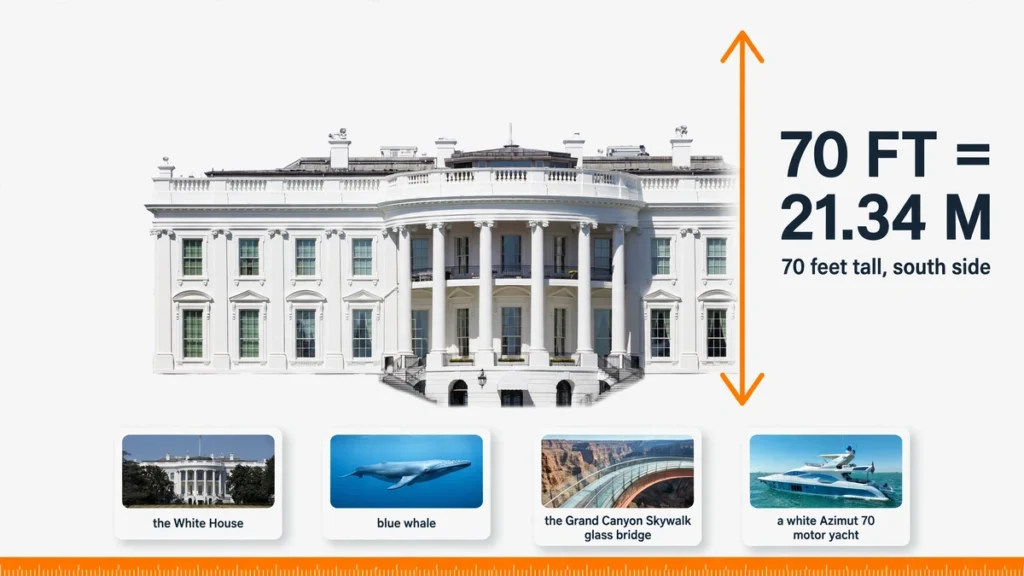
If you have ever wondered how long is 70 feet, the short answer is 21.34 metres — and the longer answer is that 70 feet is one of the few measurements that has real, named things sitting at exactly its size. The White House is 70 feet tall on its south side. The average adult blue whale is 70 feet long. A glass bridge in Arizona sticks 70 feet out over the Grand Canyon, and a yacht called the Azimut 70 is 70 feet from bow to stern because the number is its name. You do not need a stack of mattresses or a line of hockey sticks to picture 70 feet, because seven single things already are 70 feet, and each one has a specification to prove it.
Below are those seven things, each checked against its own specification, with the miss printed wherever a thing misses. Four of them are exact or listed at 70 feet for the dimension stated, and three are honest averages with their ranges printed beside them. Every object's image sits immediately after its heading, and no object is a stack, a multiple, or a category guess. You will not find seven alligators lined up or 105 bricks in a row here, because a chain of small things is not a thing that is 70 feet long — it is arithmetic wearing a trench coat. After the objects comes a section the other lists will not write: five claims about 70 feet that the internet states confidently and gets wrong, each corrected with the real number. By the end you will know 70 feet as a building, a whale, a bridge, a rock, a yacht, a tower block, and a home — and you will know which of those you can trust to the foot and which you must measure yourself.
Quick Answer
70 feet is 840 inches — 21.336 metres, 23.33 yards, and 2,133.6 centimetres. But do NOT trust a list that tells you a bowling lane is 70 feet long: the lane itself is exactly 60 feet, and the extra feet live in the approach and the pin deck. The seven things below are each checked against their own specification, with the miss printed wherever a thing misses.
70 Feet on a Scale Ladder
Seventy feet is easier to hold in your head when you climb it in steps, because every step on the ladder is a thing you have already seen. A basketball rim is 10 feet high, so seven rims stacked reach 70 feet. A standard school bus is about 35 feet long, so two buses parked bumper to bumper are 70 feet. An NBA basketball court is 94 feet long, so 70 feet is about three-quarters of the court — run from one baseline to the opposite three-point line and you have covered roughly 70 feet. The ladder below puts the whole range in one place, and the point of it is the middle row: 70 feet is not an exotic distance. It is two buses, seven rims, and three-quarters of a court, all at once.
| Length | What it is | 70 feet is… |
|---|---|---|
| 10 ft | A basketball rim above the court | 7 rims stacked |
| 35 ft | A standard school bus | 2 buses bumper to bumper |
| 60 ft | A bowling lane, foul line to head pin | 10 ft longer |
| 70 ft | — | 840 in, 21.336 m, 23.33 yd |
| 94 ft | An NBA basketball court | about three-quarters of the court |
| 140 ft | Two 70-foot lengths | a 14-story building |
The ladder also shows why 70 feet keeps appearing in building codes and trucking rules. It is the height of a seven-story building and the length of a full tractor-trailer combination in many American states, which means it is a threshold number: below it you are a house, above it you are a tower; below it you are a truck, above it you are an oversize load. That is why the objects below matter more than the stacks the other lists offer. A stack tells you what 70 feet adds up to. A single object tells you what 70 feet is.
The 7 Things That Are 70 Feet
Each object below carries its evidence grade in the heading. EXACT means the figure is a standard's or an authority's own dimension for the named thing. LISTED means the figure is the manufacturer's or operator's published specification for the named model. AVERAGE means the figure is a published average or a standard rule of thumb, with the honest range printed beside it. The grade is the whole point: a list that never grades its numbers is asking you to trust it, and this article would rather show you the receipt.
1. The White House — 70 Feet Tall on the South Side (EXACT)
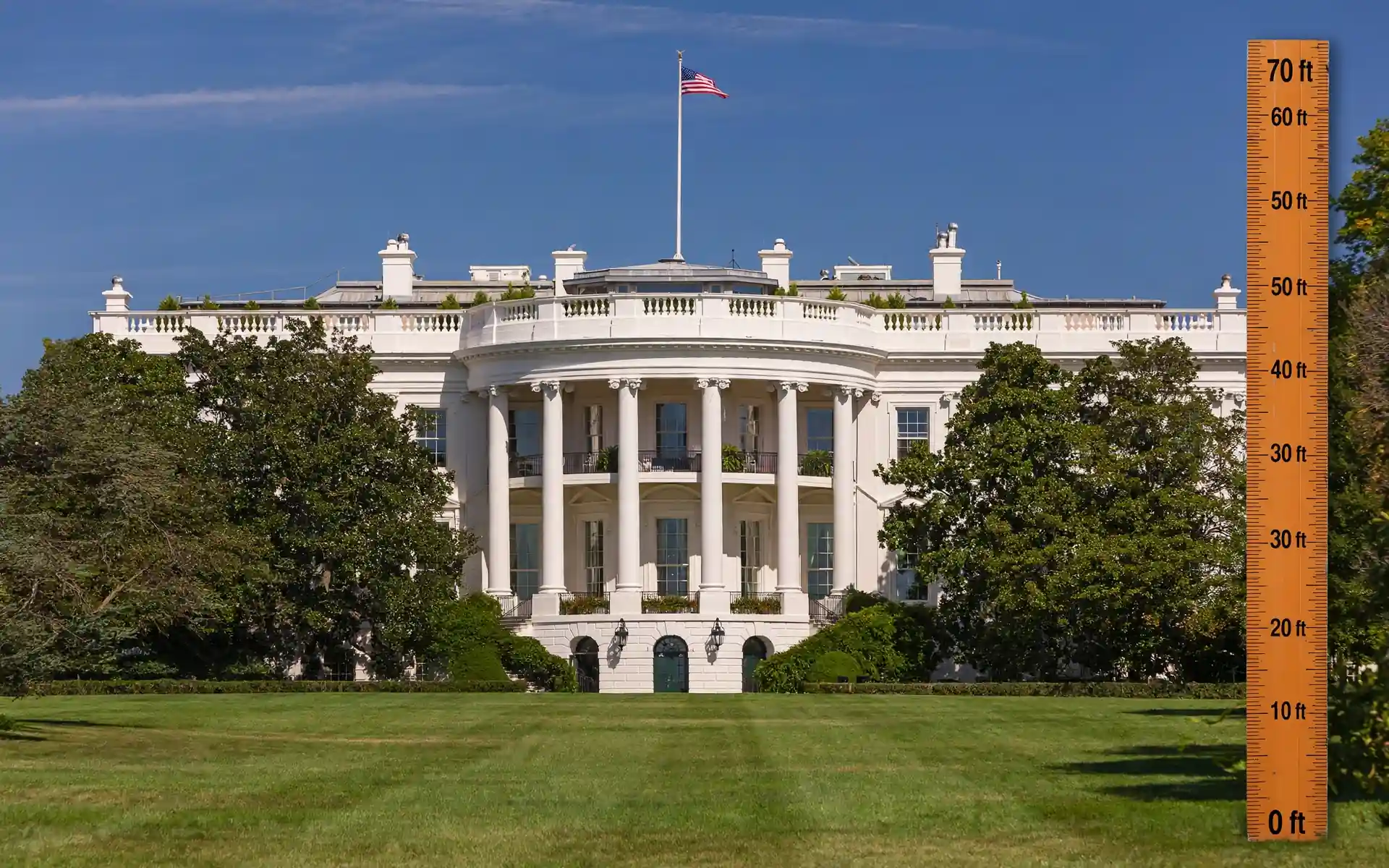
The White House is the article's cleanest exact, because its 70 feet is written down by the organisation that preserves the building. The White House Historical Association lists the overall height of the White House, to the top of the roof, as 70 feet on the south side and 60 feet 4 inches on the north side. The building is 168 feet long and 85 feet 6 inches wide without the porticoes, and 152 feet wide with them — but the height is the number that matters here, and it is 70 feet on the side you see from the South Lawn. Stand on that lawn and look up: the roofline above you is 70 feet from the ground, and the number is not an estimate. It is the Association's own dimension.
The fitting check is the side, not the building, because the White House has two heights and the famous one is the shorter. The front you know from photographs is the north side, facing Pennsylvania Avenue, and that side is 60 feet 4 inches to the top of the roof — nearly 10 feet shorter than the south side, because the ground slopes. The facade itself, from the grade of the lawn to the parapet, is 60 feet on the south and 50 feet 4 inches on the north, which is the figure an earlier guide in this series used for the north facade. So if someone tells you the White House is 70 feet tall, they are right — but only from the south. From the front, the building is a 60-foot building wearing a 70-foot roofline on its other side, and the grade is exact because the figure is the Association's own, with the side it applies to printed beside it.
2. A Blue Whale — 70 Feet for an Average Adult (AVERAGE)

The blue whale is the article's most honest average, because 70 feet is what a typical adult measures, not what the biggest one does. The New York State Department of Environmental Conservation's blue whale fact sheet states it plainly: an average individual is 70 feet long and weighs 100 tons. The American federal fisheries service gives the range behind that average: blue whales in the North Atlantic and North Pacific grow up to about 90 feet, and the Antarctic giants reach up to about 110 feet. The Alaska Department of Fish and Game puts the usual northern animal at 75 to 80 feet. So 70 feet is the middle of the species, not the record — and that is exactly why it belongs here. An average is the number you meet in the wild; a record is the number you meet in a book.
The fitting check is the sex, because female blue whales run larger than males. The University of Michigan's Animal Diversity Web gives average lengths of about 89 feet for females and 82 feet for males, which means a big female can be nearly 20 feet longer than the 70-foot average — and a pygmy blue whale, the smaller subspecies, tops out around 79 feet. None of that makes the 70-foot figure wrong. It makes it an average, and the grade says so: AVERAGE, with the range 70 to 90 feet in the north and up to 110 feet in the Antarctic printed beside it. If you ever see a blue whale from a boat, the boat is probably about 70 feet long too — and the whale beside it is the same length as the boat you are standing on.
3. The Grand Canyon Skywalk — 70 Feet Out Over the Rim (EXACT)
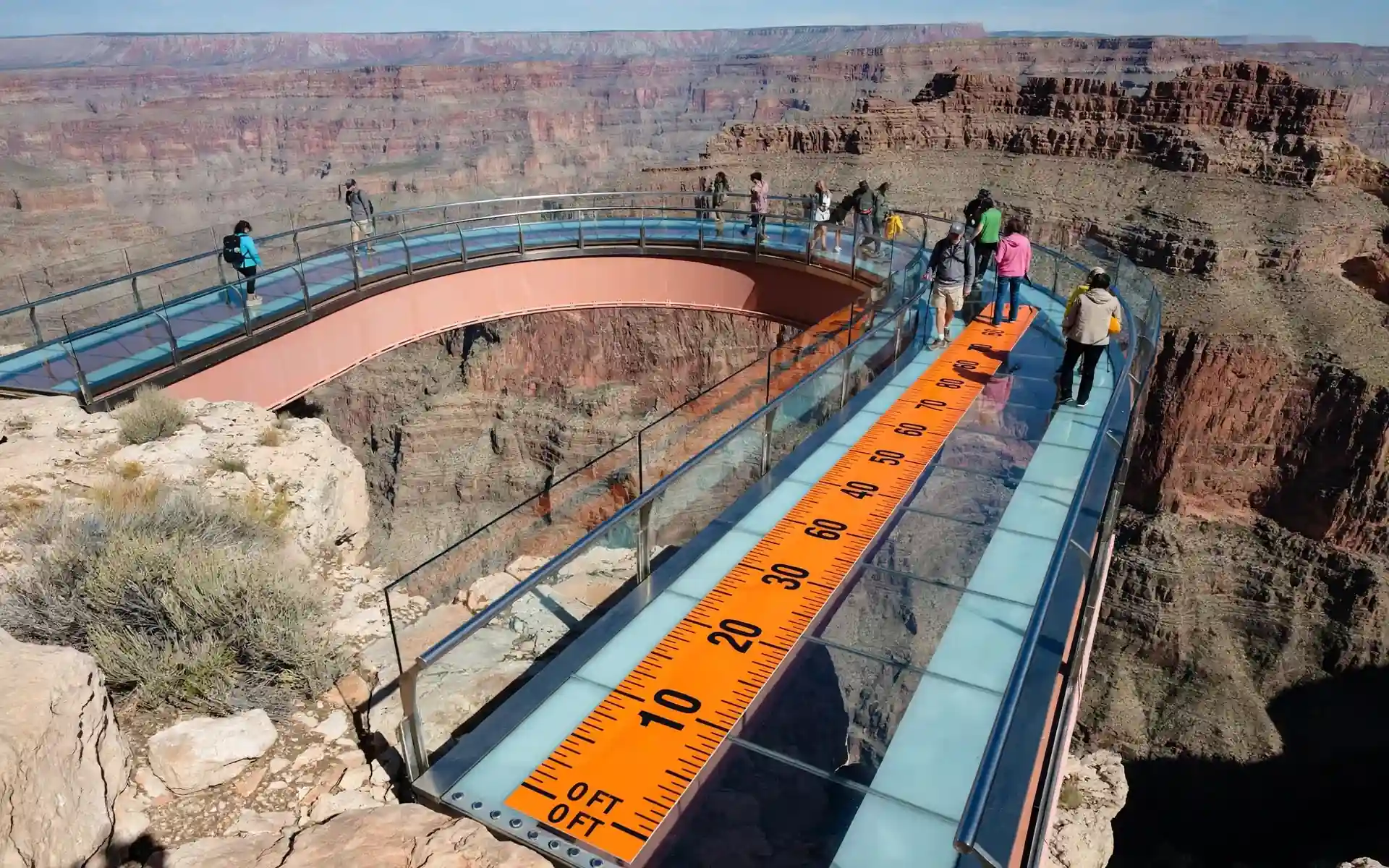
The Skywalk is the article's most dramatic exact, because its 70 feet is the whole point of the structure. The Grand Canyon Skywalk is a horseshoe-shaped glass bridge at Eagle Point on the West Rim of the Grand Canyon, operated by Grand Canyon West, and it extends 70 feet beyond the canyon rim. The bridge is 10 feet wide, it opened in March 2007, and the glass floor hangs 4,000 feet above the canyon floor — so the 70 feet is not a length you walk along, it is a length you walk out on, over nothing. The operator's own description puts the number first, because the number is the attraction: seventy feet of glass, past the edge, with the canyon dropping away underneath.
The fitting check is the strength, because a 70-foot glass bridge sounds like it should not exist. The Skywalk is built to hold the weight of 70 fully loaded 747 passenger jets, which is the figure the operator prints beside the 70-foot extension — and the coincidence of the two seventies is a coincidence, not a rounding. The grade is exact because the figure is the operator's own published dimension for this named bridge: 70 feet of extension, 10 feet of width, 4,000 feet of drop. If you want to feel 70 feet rather than read about it, walk to the far end of the horseshoe and look down through the glass. The distance from the rim to your feet is 70 feet, and the distance from your feet to the river is 4,000.
4. Monument Rocks — Chalk Towers Up to 70 Feet (LISTED)
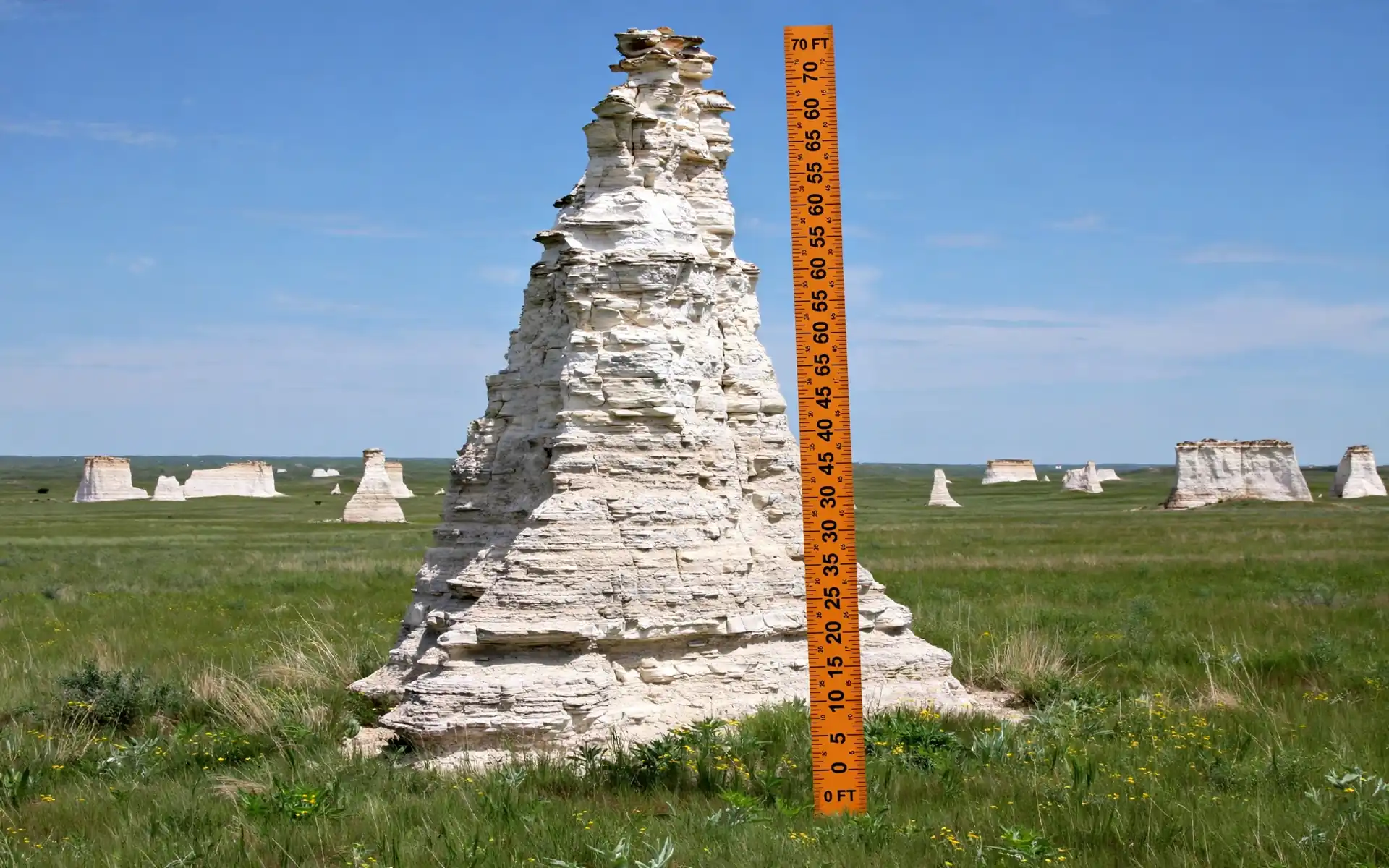
Monument Rocks is the article's oldest 70 feet, because the rocks are 80 million years older than the number. The formations are a series of large chalk towers in Gove County, Kansas, made of Niobrara chalk laid down on the floor of the Western Interior Seaway — the inland sea that covered the middle of North America during the Cretaceous Period — and they reach a height of up to 70 feet above the flat prairie. The site was designated a National Natural Landmark by the United States Department of the Interior in 1968, the first landmark in Kansas to receive that designation, and it was named one of the Eight Wonders of Kansas in 2008. The chalk is soft enough that wind and the Smoky Hill River are still carving it, which means the 70-foot towers are getting shorter, very slowly, while you read this.
The fitting check is the word "up to", because not every tower at Monument Rocks is 70 feet tall. The tallest formations reach about 70 feet; the shorter ones are 40 to 60 feet, and the site is a spread of buttes and arches rather than a single spire. The grade is listed, not exact, because the figure is the published height of the tallest formations, not a measurement of one named tower: up to 70 feet, in a place where the ground is otherwise flat enough to see the horizon in every direction. Stand at the base of the tallest tower and look up, and you are looking at 70 feet of 80-million-year-old seabed standing on dry land.
5. An Azimut 70 Flybridge Yacht — 70 Feet From Bow to Stern (LISTED)
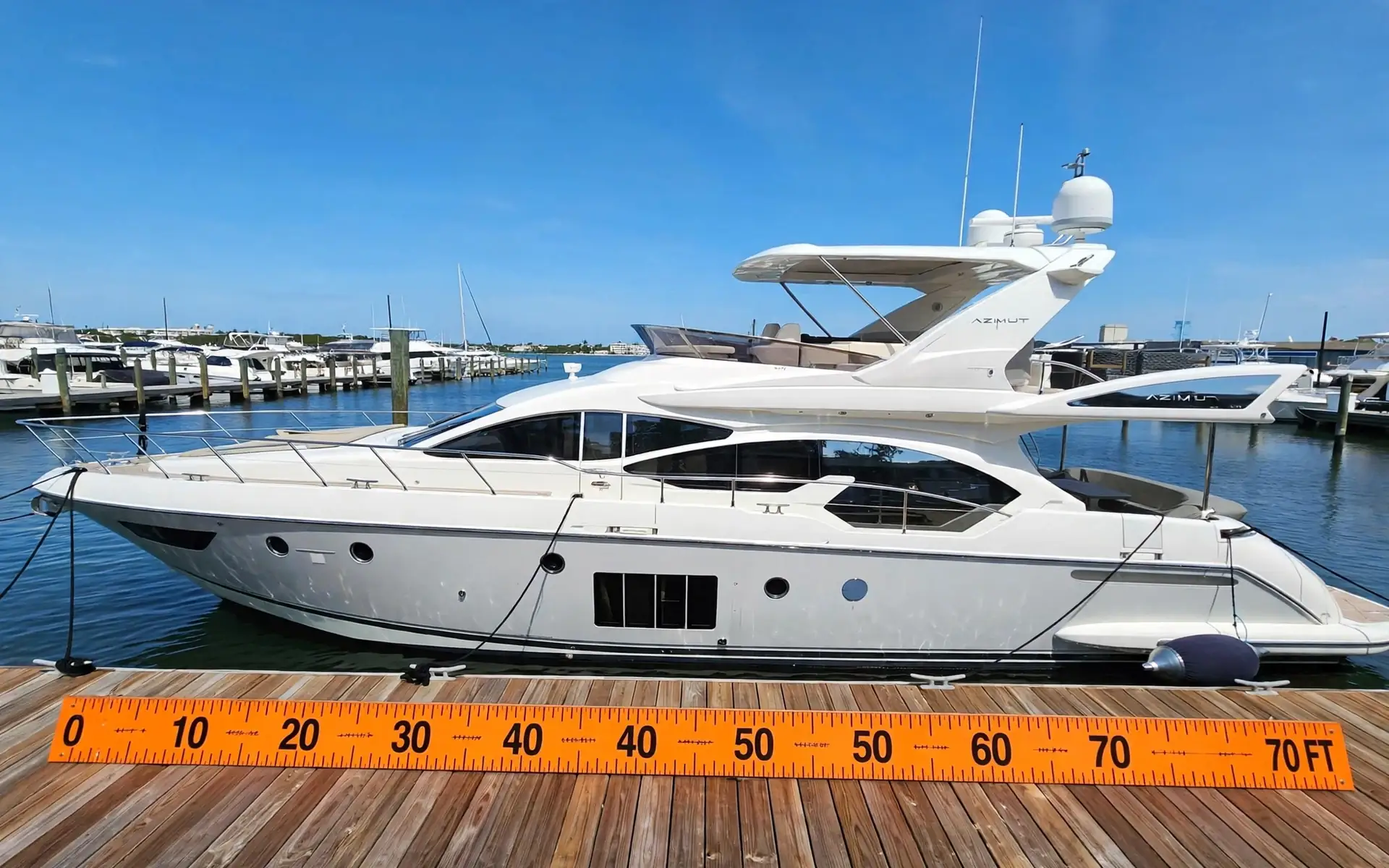
The Azimut 70 is the article's most literal 70 feet, because the number is the model's name. The classic Azimut 70 Flybridge, the Italian motor yacht built by Azimut Yachts, is listed at a length overall of 70 feet 0 inches — 21.34 metres — with a beam of 18 feet 3 inches and four guest staterooms. Broker specifications repeat the figure across every listing: LOA 70.00 feet, LWL 63.00 feet, beam 18.03 feet. The yacht is 70 feet because the builder built it 70 feet long and called it the 70, and the name is the measurement. It is the only object in this article whose length you can confirm by reading the badge on its hull.
The fitting check is the model year, because Azimut has since built a newer 70 that is not exactly 70 feet. The current Azimut Fly 70, unveiled for the 2026 Cannes Yachting Festival, is listed by the builder at 21.47 metres — 70 feet 5 inches — which is five inches longer than the classic. The grade is listed because the figure is the published specification for the named classic model, with the newer model's five extra inches printed beside it: the 70 Flybridge is 70 feet 0 inches, the Fly 70 is 70 feet 5 inches, and the difference is the width of a hand. If you are buying a berth for one, the slip must be 70 feet long — and if it is the newer model, it must be 70 feet 6 inches, because five inches at this size is the difference between fitting and not fitting.
6. A Seven-Story Building — About 70 Feet Tall (AVERAGE)
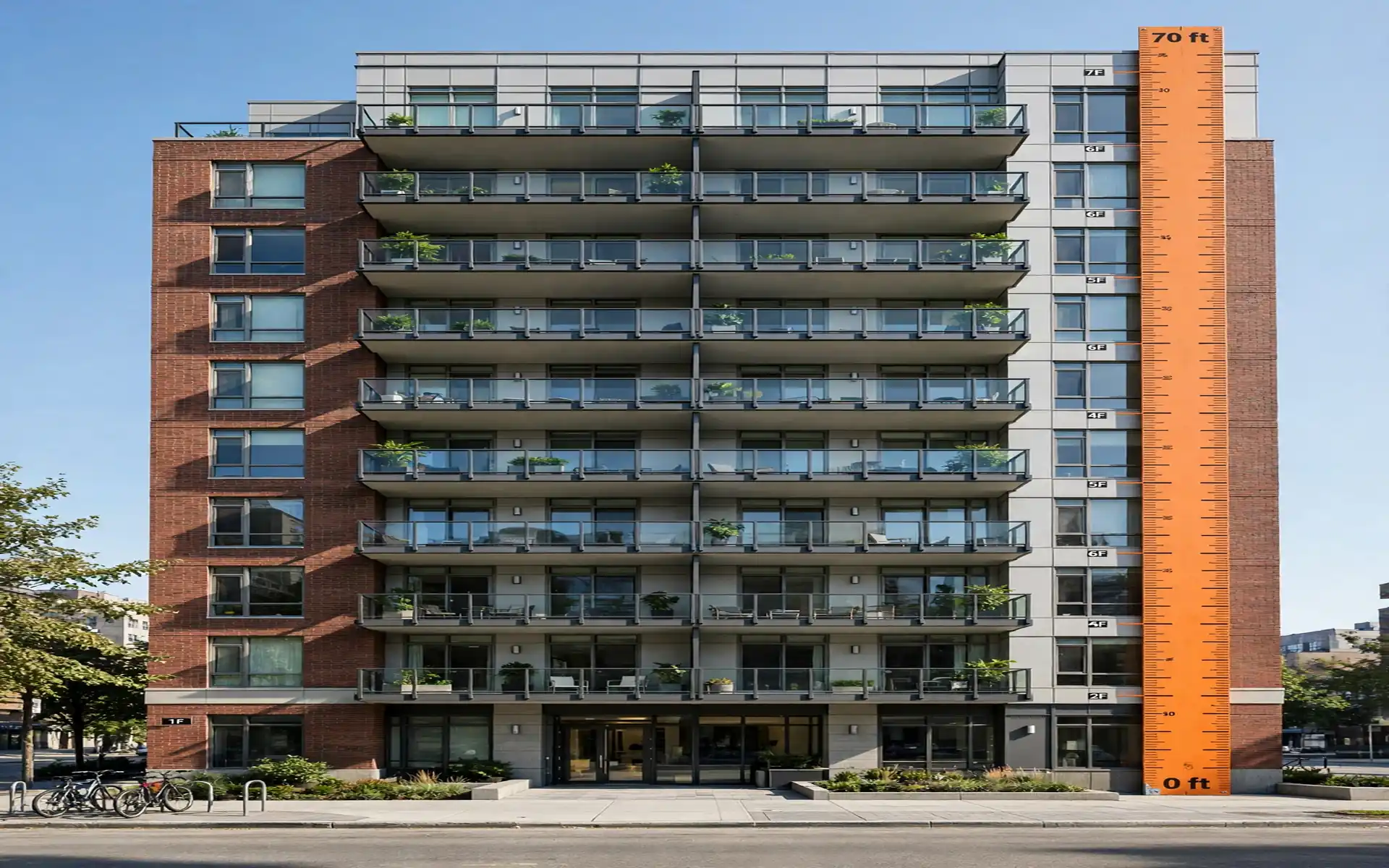
The seven-story building is the article's most useful average, because it is the one you can count from the street. The standard rule of thumb in construction is about 10 feet per story — residential buildings usually run 9 to 10 feet per floor, commercial buildings 10 to 14 feet — so seven stories at 10 feet each is 70 feet. That is the figure every rival list uses, and it is the figure this article uses too, with one difference: the range is printed beside it. A seven-story residential block is about 70 feet tall. A seven-story commercial building, with taller ceilings and deeper floor slabs, can run 70 to 100 feet or more. The 10-foot rule is a rule of thumb, not a building code, and the grade says so: AVERAGE, with the honest range 70 to 100 feet for commercial buildings printed beside the 70-foot residential figure.
The fitting check is the ground floor, because the first story is almost always taller than the rest. Lobbies, shopfronts, and entrances commonly add two to four feet to the ground floor, and the roof — parapet, plant room, lift housing — adds more on top. So a real seven-story building measured from the pavement to the top of the parapet is often 72 to 75 feet, not 70, and the 70-foot figure is the floor-to-floor sum rather than the building's full height. That does not make the object wrong. It makes it an average with a known bias, and the bias runs in one direction: real buildings are usually a little taller than the rule says, never a little shorter. Count seven floors on the block outside your window, and you are looking at about 70 feet — give or take a lobby.
7. A Large Single-Wide Manufactured Home — 14 by 70 Feet (LISTED)
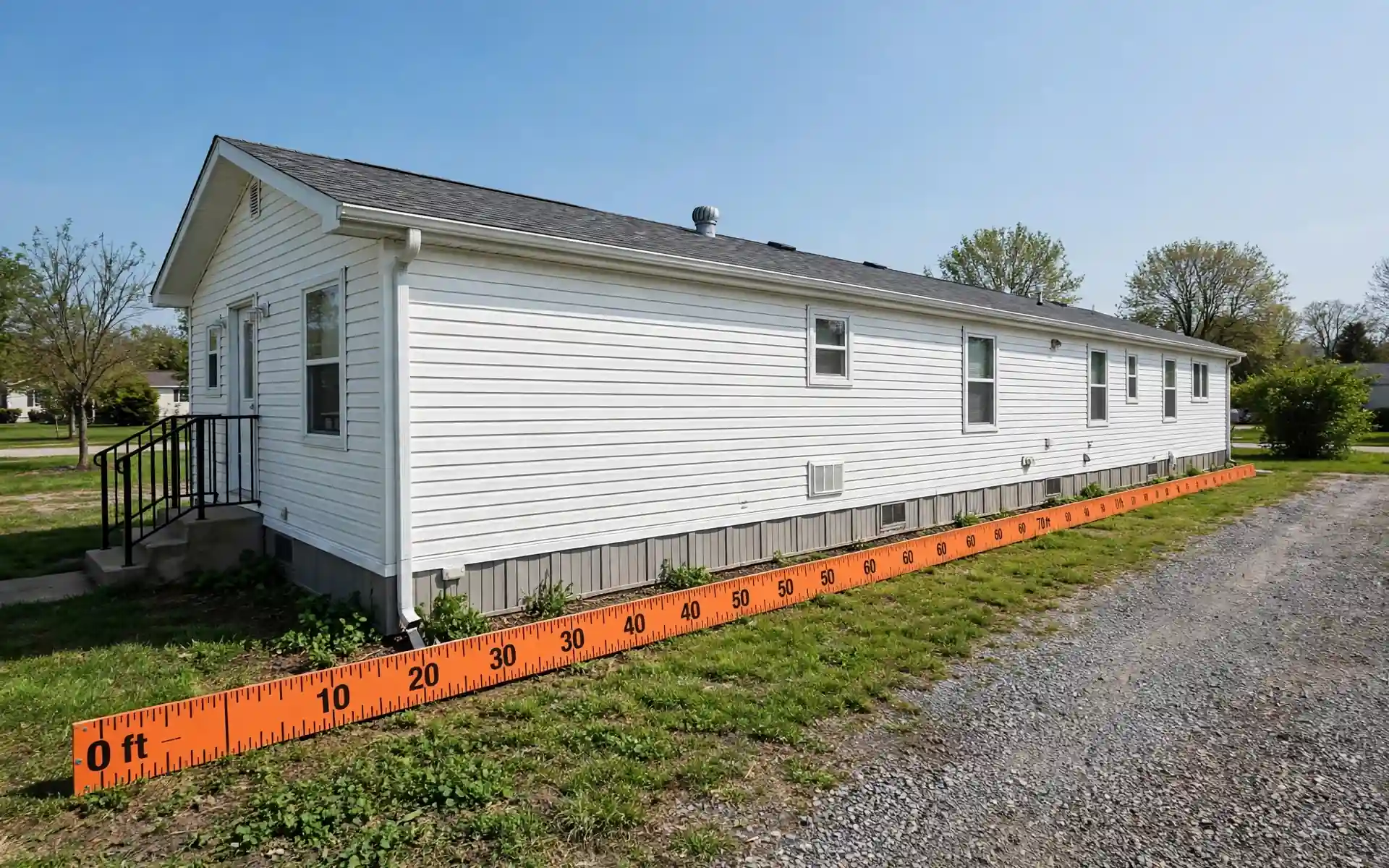
The single-wide home is the article's most surprising 70 feet, because it is a house that is 70 feet long and only 14 feet wide. Single-wide manufactured homes — the factory-built homes transported to site on a single chassis under the federal HUD Code — run 14 to 18 feet wide and 40 to 80 feet long, and the large tier is 70 to 80 feet long. A 14-by-70-foot home gives about 1,000 square feet of living space, typically three or four bedrooms and two bathrooms, in a single straight corridor with the kitchen at one end and the bedrooms at the other. It is a home shaped like a corridor, and its length is the reason: 70 feet of house, 14 feet wide, on one chassis.
The fitting check is the transport, because a single-wide is 70 feet long for a legal reason as well as a practical one. Under the HUD Code, a single-wide must be transportable on public roads without a special oversize-load permit, which caps the width at 18 feet — and the length is where the space goes instead. The grade is listed because the figure is the published size tier for the named home type, with the full range printed beside it: 40 to 80 feet long, with 70 feet at the top of the large tier. Walk the length of one in a sales lot and you have walked 70 feet indoors, past three bedrooms, without ever turning a corner.
Where the Other Lists Get 70 Feet Wrong
Five wrong numbers about 70 feet circulate so widely that they deserve their own section, because each one is stated confidently on a page that ranks for this exact question. First, the bowling lane: one popular list calls a regulation bowling lane "exactly 70 feet" long, and it is not — a lane is exactly 60 feet from the foul line to the head pin under the United States Bowling Congress standard, and the approach adds about 15 feet, which makes the approach-and-lane run about 75 feet, not 70. The 70-foot figure is a rounding error that became a fact, and it is wrong by 10 feet in one direction and 5 feet in the other. Second, the dinosaur: another list says the average Argentinosaurus "was 70 feet tall", and it was not — Argentinosaurus was roughly 100 to 130 feet long, and "tall" is the wrong dimension for an animal that walked on four legs. Third, the conversion: one list prints "70 feet = 21.366 meters", and the correct figure is 21.336 metres — 70 multiplied by 0.3048, not 0.3052 — a 3-centimetre error that matters when you are ordering material. Fourth, the aeroplane: a conversion guide offers the Boeing 737-100's wingspan as a 70-foot example, and the 737-100's wingspan is 93 feet — 23 feet longer than the number it is meant to illustrate. Fifth, the arithmetic: one list's canoe item says "four and a half" in the heading and "five and a half times" in the text, and another list's stack of nine 2-by-4 boards is 72 feet, not 70 — the list admits it, then keeps the item anyway. None of these five numbers belongs in a 70-foot article, and all five are here so you never have to learn that from a purchase, a building plan, or a bowling alley that does not fit its room.
70 Feet in the Wild: Where You Will Actually Meet It
Seventy feet is not a number you meet on a ruler. It is a number you meet in a permit office, a loading dock, and a marina, because it is a threshold. In many American suburbs, the height limit for mid-rise development is around 70 feet, which is why the seven-story building keeps appearing in this article: below 70 feet you are a neighbourhood building, above it you are a tower, and the planning meeting is about the difference. In trucking, many states cap a tractor-trailer combination at 70 to 75 feet, so a driver who knows the 70-foot limit knows whether the rig fits the loading dock before turning into it. In marinas, a 70-foot yacht needs a 70-foot slip, and the five inches between the classic Azimut 70 and the new Fly 70 is the difference between a slip that fits and one that does not. In bowling, a lane needs about 86 feet of building depth once you add the approach, the pin deck, and the pinsetter — so a room built to "70 feet" for a bowling lane is 16 feet too short, and the lane does not fit. And on the water, a 70-foot blue whale is the same length as the whale-watching boat you are standing on, which is the only comparison in this article that can look back at you. The number is a threshold everywhere it appears, and knowing it as a single object — a building, a whale, a bridge — is what lets you use it before you measure it.
How 70 Feet Compares With Other Lengths
Readers comparing nearby sizes may also want the site’s guides to 60 feet, 50 feet, 40 feet, 30 feet, 20 feet, 12 feet, and 11 feet for the feet series, and 11 cm for the centimetre series. Each of those guides follows the same rule as this one: the spec sheet, the grade, and the miss printed in full. The next size up is a step up to 80 feet, and the complete feet size guide covers every feet size from 1 to 100.
Frequently Asked Questions
How many meters is 70 feet?
70 feet is 21.336 metres exactly. Multiply 70 by 0.3048 — the international foot, fixed by the 1959 agreement — and you get 21.336, with no rounding involved. For everyday use, 21.34 metres is close enough to picture it and wrong enough to misbuy by if you are ordering material: the 0.336 metres is about 13 inches, and 13 inches at this size is a gap that shows.
How many inches is 70 feet?
840 inches exactly. Multiply 70 by 12 and you get 840 with no rounding, because the foot is defined as exactly 12 inches. In centimetres that is 2,133.6 cm, and in yards it is 23.33 yards rounded — exactly 23 and a third yards, which is the figure a tape measure will show if it is marked in yards.
How many yards is 70 feet?
23.33 yards, or 23 and a third yards exactly. Divide 70 by 3 and you get 23.333, so the honest figure is a repeating decimal — and the trap is rounding it to 23 yards, which understates the length by a full foot. For anything that must fit, use 23.33 yards; for a quick estimate in your head, 23 yards is close enough to picture it and wrong enough to misbuy by.
How many stories is 70 feet?
About seven stories in a residential building, at the standard 10 feet per story — and about five to six stories in a commercial building, where each story runs 10 to 14 feet. The number is not fixed, because story heights vary by building type, by country, and by whether the ground floor has a lobby. For a quick estimate, 70 feet is seven residential stories; for a real building, count the floors and multiply by 10, then add two to four feet for the lobby and the roof.
Is a bowling lane 70 feet long?
No. A regulation bowling lane is exactly 60 feet from the foul line to the head pin under the United States Bowling Congress standard. The approach in front of the foul line adds about 15 feet, which makes the approach-and-lane run about 75 feet, and the full system — approach, lane, pin deck, and pinsetter — runs about 86.5 feet. The "70-foot bowling lane" on some lists is a rounding error: 60 feet rounded up, or 75 feet rounded down, and wrong in both directions.
How long is a blue whale compared to 70 feet?
An average adult blue whale is about 70 feet long, so the whale and the measurement are the same size. Bigger animals run longer: northern blue whales grow up to about 90 feet, Antarctic giants up to about 110 feet, and females average larger than males. So 70 feet is the whale you are most likely to meet, not the biggest one that exists — and if you ever see one from a 70-foot boat, the whale beside you is the same length as the boat you are standing on.
How tall is the White House?
70 feet on the south side, to the top of the roof, and 60 feet 4 inches on the north side. The famous front, facing Pennsylvania Avenue, is the shorter side; the South Lawn side is the 70-foot side. The facade itself is 60 feet on the south and 50 feet 4 inches on the north, measured from the grade of the lawn to the parapet. So the answer depends on which side you are standing on — and the side in the photographs is not the 70-foot one.
What is 70 feet compared to a basketball court?
An NBA basketball court is 94 feet long, so 70 feet is about three-quarters of the court. Run from one baseline to the opposite three-point line and you have covered roughly 70 feet. Two standard school buses, at about 35 feet each, parked bumper to bumper, are also 70 feet — which is the comparison most people find easiest, because a bus is a thing you have stood next to and a court is a thing you have run across.
Final Thoughts
Seventy feet is the rare measurement that is honest and still misunderstood, because 21.34 metres can be a height, a length, an extension, or a span — and the number alone never says which. Now you know it as a building's south side fixed by its own historical association, a whale's average fixed by a government fact sheet, a glass bridge's extension fixed by its operator, a chalk tower's height fixed by a landmark designation, a yacht's length fixed by its builder, a tower block's height fixed by a rule of thumb, and a home's length fixed by a size tier — and you know which of those you can trust to the foot and which you must measure yourself. The rule that runs through all seven is the same one this site always uses: trust the spec sheet, print the deviation, and let the name stay on the box where it belongs. Measure twice, in the direction the object actually travels, and 70 feet will fit the first time.
