
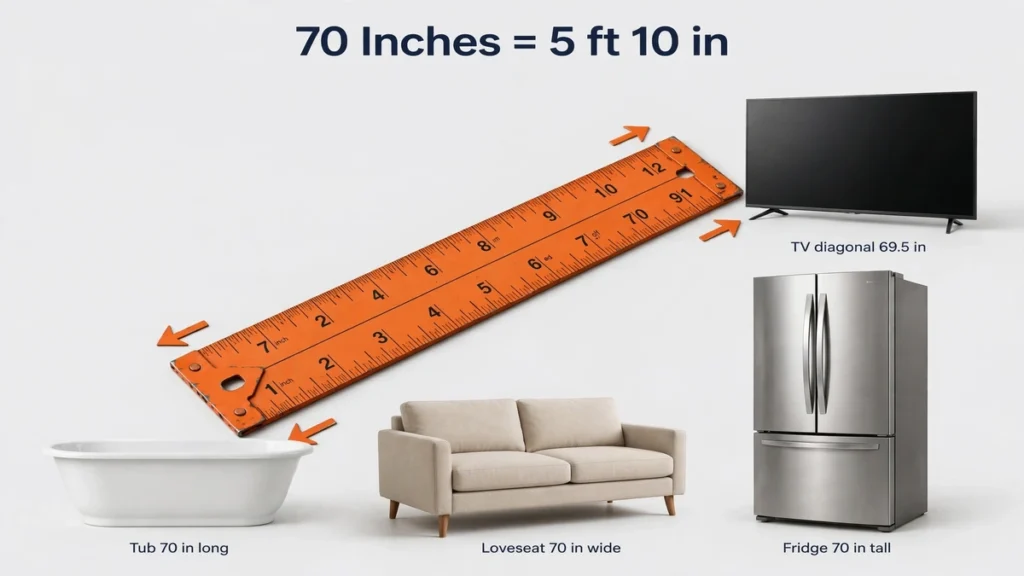
If you have ever asked how long is 70 inches, the answer is 5 feet 10 inches — and the first thing to get right is what that answer is not. It is not 5 feet 8 inches, even though a calculator shows 5.83 feet, and it is not 6 feet, even though 70 sits close enough to 72 to tempt a rough guess. Seventy inches is two inches short of six feet, ten inches short of a standard doorway, and ten inches longer than a queen bed is wide. It is also, inconveniently, a number that means a different thing on every product it appears on: a television’s diagonal, a bathtub’s length, a refrigerator’s height, a sofa’s width. This article names the dimension every time, checks every object against its own spec sheet, and prints the miss wherever an object misses — because a measurement you cannot fit is not a measurement at all.
Below are six single, named things. Two are exact at 70 inches for the dimension stated, one is exact with a hinge qualifier that matters, two are labelled near-misses, and one is a human average that 70 inches sits just above. Every object’s image sits immediately after its heading, and no object is a stack, a multiple, or a category guess. By the end you will know 70 inches as a screen, a tub, a fridge, a sofa, a table, and a height — and you will know which of those you can measure with a tape and which you must measure with a spec sheet. For the other sizes in the series, see the complete inches size guide.
Quick Answer
70 inches = 5 feet 10 inches exactly = 177.8 cm = 1.778 m = 1.94 yards (1 yard 34 inches). Do NOT read 5.83 feet as 5 feet 8 inches — the .83 of a foot is 10 inches, not 8. And do NOT buy a TV stand against the number 70: a 70-inch TV is about 61 inches wide, because the 70 is a diagonal.
The Two Traps, Before a Single Object
The first trap is arithmetic, and it catches people who are careful enough to use a calculator. Seventy divided by 12 is 5.833 feet, and the decimal part tempts a reader into writing 5 feet 8 inches, as if .83 meant 8. It does not: .833 of a foot times 12 inches is 10 inches, so 5.83 feet is 5 feet 10 inches, and any page printing 5 feet 8 inches for 70 inches has misread its own calculator. The second trap is direction. A television sold as 70 inches is measured corner to corner, a bathtub sold as 70 inches is measured end to end, and a refrigerator sold as 70 inches tall is measured floor to hinge. Same number, three directions — and the fitting question is different for each, which is why this article never prints “70 inches” without saying 70 inches of what.
A third, quieter trap is rounding by the seller. Model names round to the nearest friendly number, and spec sheets measure to the tenth of an inch. The dining table below is sold in the 70-inch family and measures 70.86 inches; the television below is sold as 70 inches and measures 69.5 inches diagonally. Neither is a lie, and both are useless if you quote the name instead of the sheet. The rule for the whole article is therefore simple: trust the spec sheet, print the deviation, and let the name stay on the box where it belongs.
Four Dimensions, One Number
Before the objects, the map. Length is the bathtub and the dining table, measured end to end along the floor. Width is the loveseat, measured arm to arm across the front. Height is the refrigerator and the person, measured floor to top. Diagonal is the television, measured corner to corner across the screen. A 70-inch length needs a 70-inch wall or alcove; a 70-inch width needs a 70-inch wall in the other direction; a 70-inch height needs 70 inches of vertical clearance, plus room to open doors or stand upright; a 70-inch diagonal needs only about 61 inches of wall, plus stand depth. If you remember nothing else from this section, remember that a diagonal is the only one of the four that is shorter across the front than its own name suggests.
The 6 Objects
1. Samsung QN70Q60C 70-Inch-Class TV — 69.5 Inches Diagonally, 61.4 Inches Wide (LISTED Near-Miss)
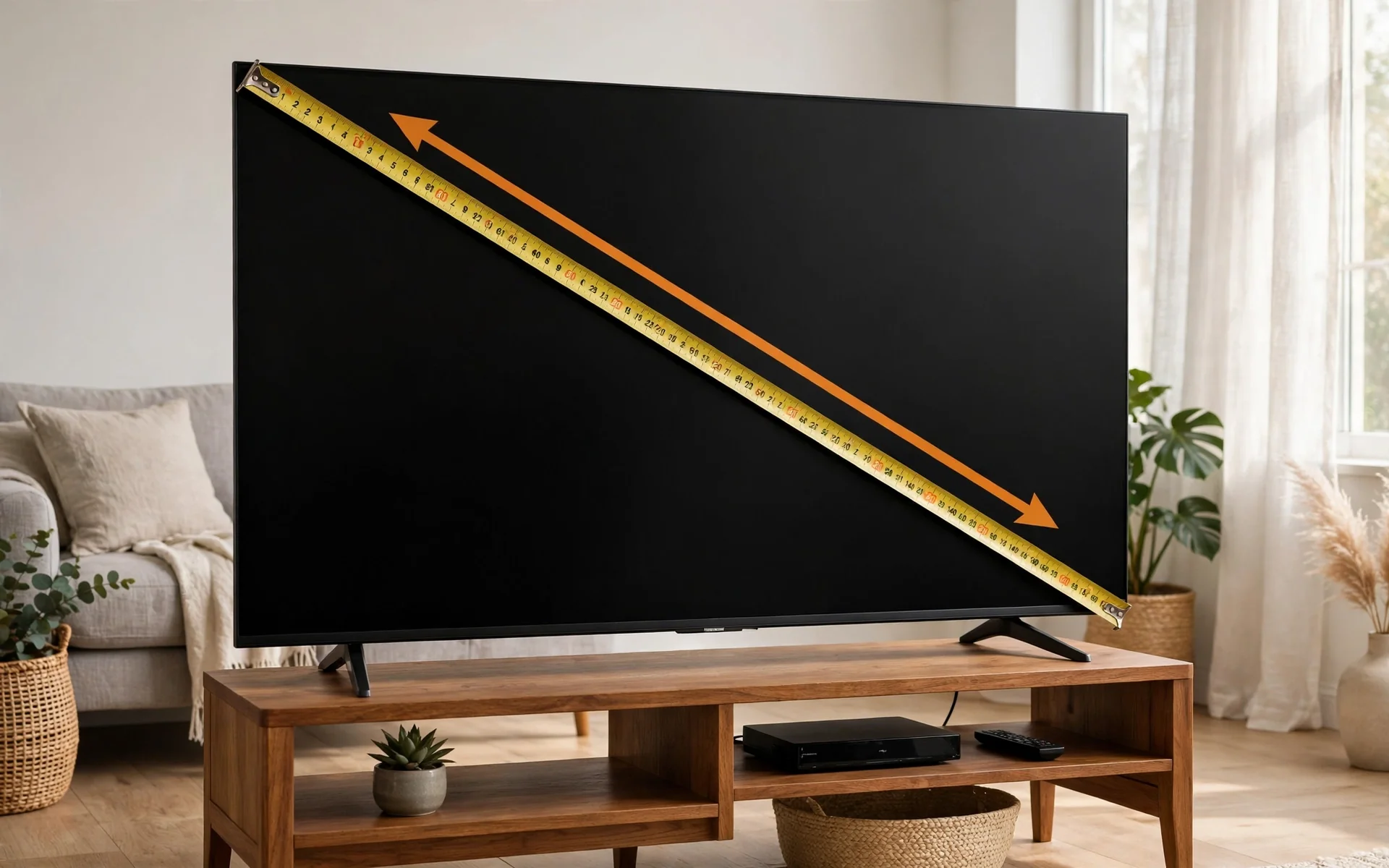
The television is the article’s most important near-miss, because it is the object most readers will actually buy against the wrong number. Samsung’s datasheet lists the screen diagonal at 69.5 inches for the QN70Q60C, a 70-inch-class set, and the same datasheet gives the overall width as 61.4 inches without the stand and 61.4 inches wide with it, at 37 inches tall on its stand. The diagonal therefore falls half an inch short of 70, and the width falls 8.6 inches short — so a buyer who orders a 70-inch-wide TV unit for this set has bought nearly nine inches of furniture they do not need, while a buyer who orders a 60-inch-wide unit has bought a stand the set overhangs by more than an inch on each side.
The geometry explains the gap, and it is worth one sentence because it generalises to every television size. A 16:9 screen’s width is about 87 percent of its diagonal, so a 69.5-inch diagonal gives a screen roughly 61 inches wide before the frame, and the frame adds only a fraction of an inch per side on a modern set. Measure the outer width on your exact model’s spec sheet, never the class name, and leave the stand at least an inch wider than the set on each side for ventilation and for hands. The diagonal tells you the screen size; the width tells you whether it fits your wall, and only one of those numbers is anywhere near 70.
2. Barclay Piper ATOVN70B Freestanding Bathtub — 70 Inches Long (EXACT, Nominal)
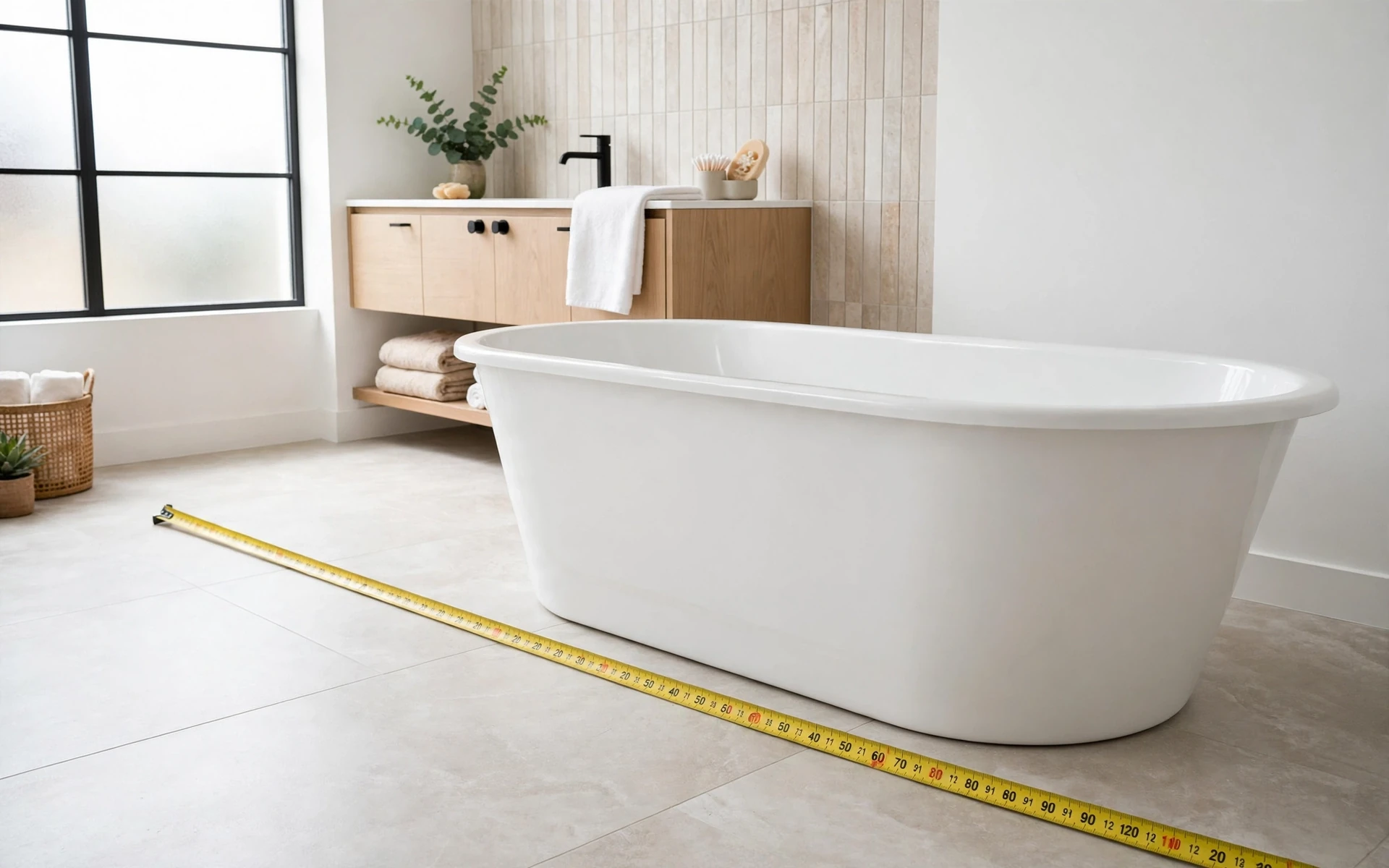
The bathtub is the article’s cleanest length, and the one that most changes a bathroom plan. The manufacturer’s specification sheet lists the Piper at 70 inches long, 29 inches wide, and 23 inches high, with a water depth of 17 and a half inches to the top of the tub. Seventy inches of tub is ten inches longer than the standard 60-inch alcove tub, which is exactly why freestanding tubs change the room around them: they need clear floor on all sides, not just a three-wall opening, and a bathroom built for a 60-inch alcove cannot swallow a 70-inch freestanding tub without giving up ten inches somewhere else.
The manufacturer’s own caveat belongs in the same paragraph. The specification sheet states that dimensions are nominal and subject to change, so measure the actual tub before roughing in plumbing or laying tile, and allow at least a few inches of clearance at each end for cleaning and for the floor-mounted filler most freestanding tubs require. Nominal 70 inches is the size class and the design target, and this model lands on it — but a rough-in built to exactly 70 inches with zero tolerance is a rough-in built to fail, and the ten extra inches over a standard tub are the first thing to check, not the last.
3. Samsung RF30BB6200 French Door Refrigerator — 70 Inches Tall to the Hinge (EXACT, With Qualifier)
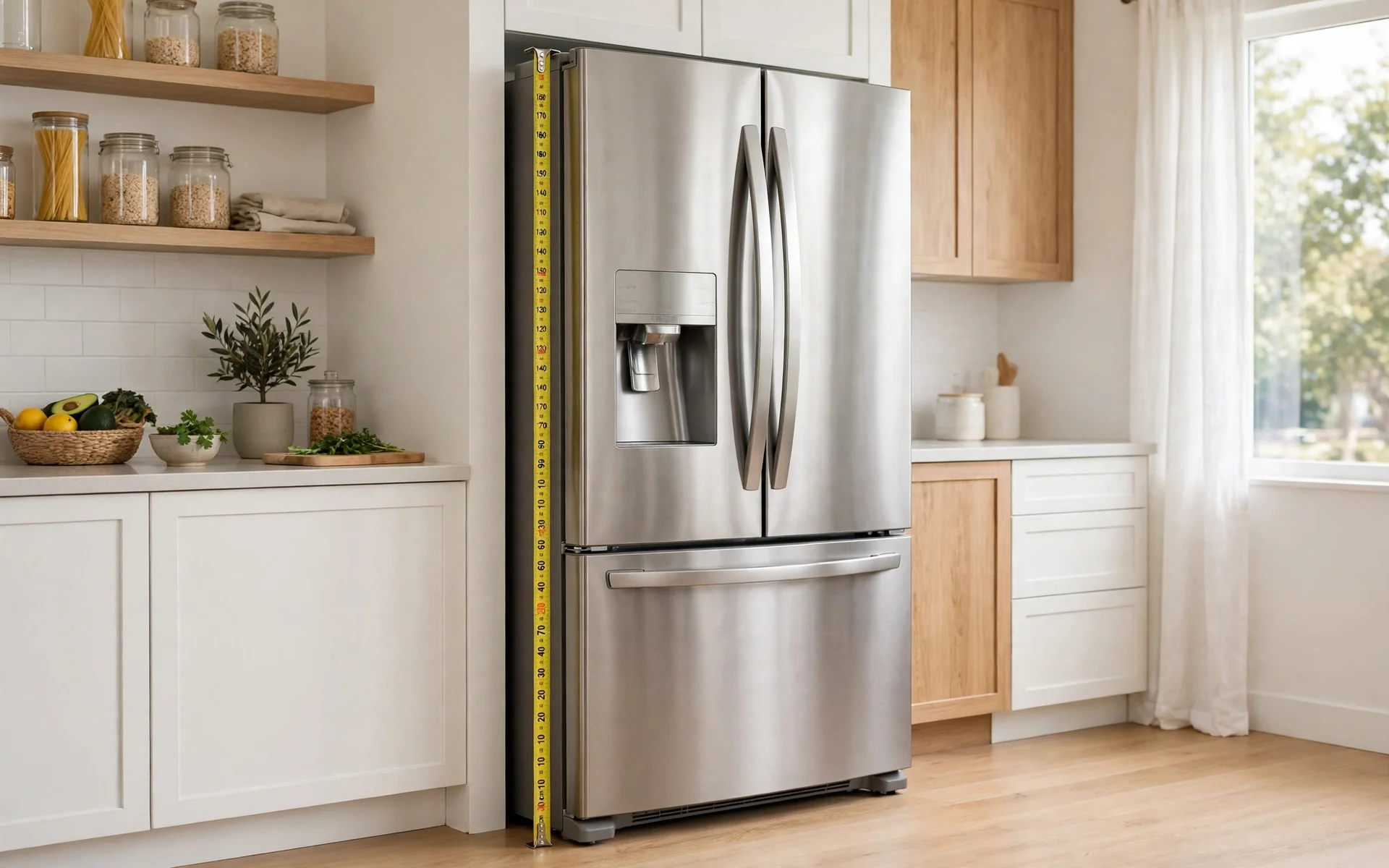
The refrigerator is the article’s tallest object and its most instructive qualifier. Samsung’s installation specifications list the height with hinges and doors at 70 inches, which is 177.8 centimetres, on a width of 35 and three-quarter inches — and the same specifications list the height without hinges and doors at 68 and seven-eighths inches. The 70-inch figure is therefore exact, but only for the hinge-inclusive height: the case alone is an inch and an eighth shorter, and the hinge is the part that hits the cabinet first.
That distinction decides real kitchens. Under-cabinet clearance must be planned against the 70-inch hinge height, not the 68-and-seven-eighths-inch case, because the doors swing on those hinges and the hinge caps are the highest fixed point once the fridge is levelled. Delivery is the second check: doorways, turns, and the final tilt into place all need more than 70 inches of diagonal room, since a 70-inch-tall box rotated through a doorway sweeps a longer diagonal. Measure the cabinet opening against 70 inches, measure the delivery path against something longer, and never let a retailer quote you the case height when your cabinets will meet the hinge.
4. Meridian Indulge Modular Loveseat — 70 Inches Wide (EXACT)
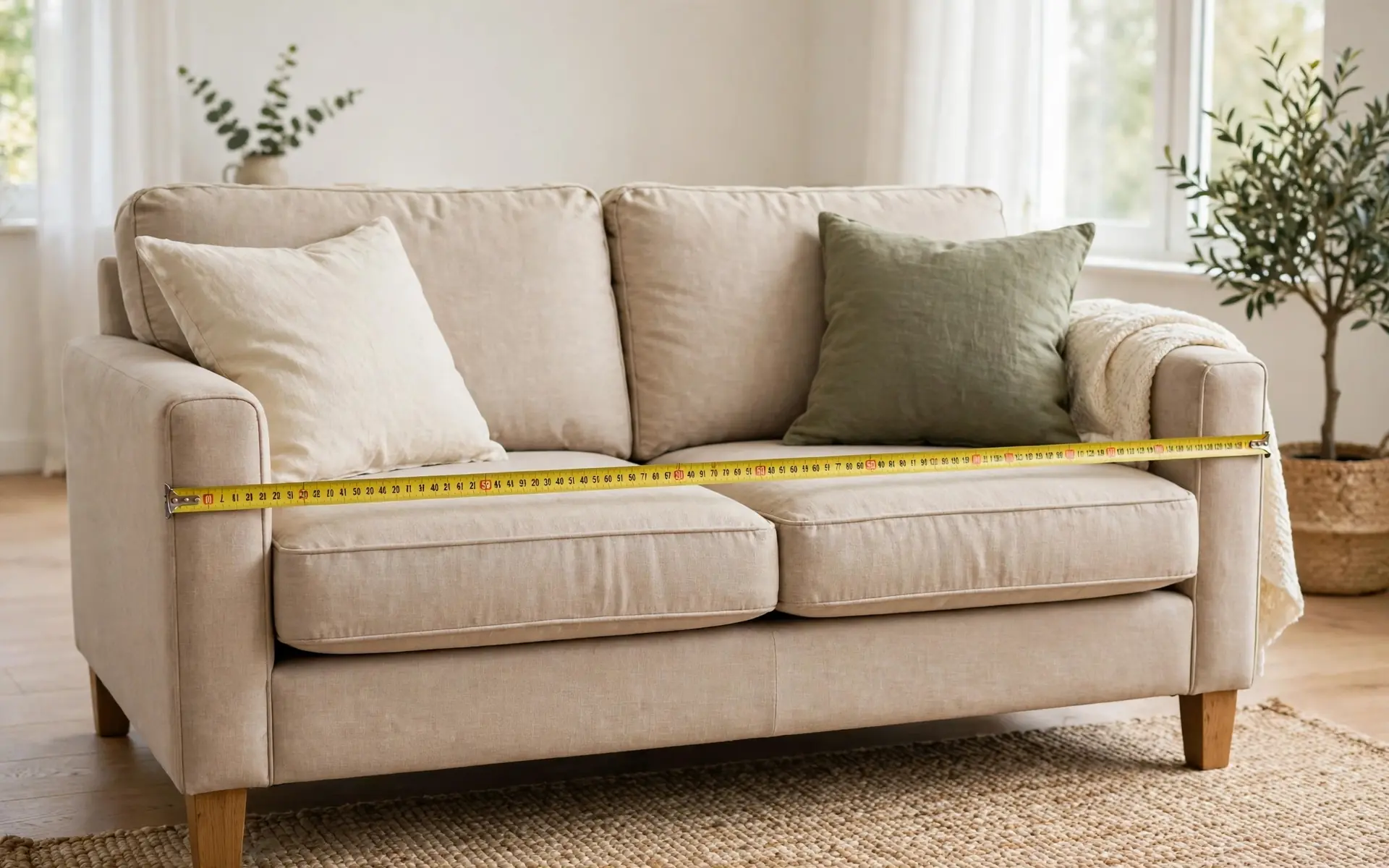
The loveseat is the article’s most useful width, because it is the size a small living room is actually built around. The manufacturer tear sheet lists the Indulge loveseat at 70 inches wide, 35 inches deep, and 32 inches high, a two-seater that sits between the compact loveseats of the low sixties and the three-seat sofas of the low eighties. Seventy inches of sofa needs a wall at least 70 inches long before a single side table, lamp, or walkway is added, which is why apartment floor plans so often show this exact size: it seats two adults with room to spare and still leaves a room feeling like a room.
The fitting check is the depth as much as the width. Thirty-five inches of depth plus the space to walk in front of the sofa means the sofa zone needs roughly five feet of room depth, and a 70-inch-wide sofa pushed against a 70-inch wall leaves no room for end tables at all — plan 80 inches of wall or more if anything else must share it. Measure the wall, then measure the room in front of it, and treat the 70 inches as the sofa’s claim on the wall, not as the room’s total budget.
5. Rectangular Dining Table for Six — 70.86 Inches Long, 0.86 Inches Over (LISTED Near-Miss)
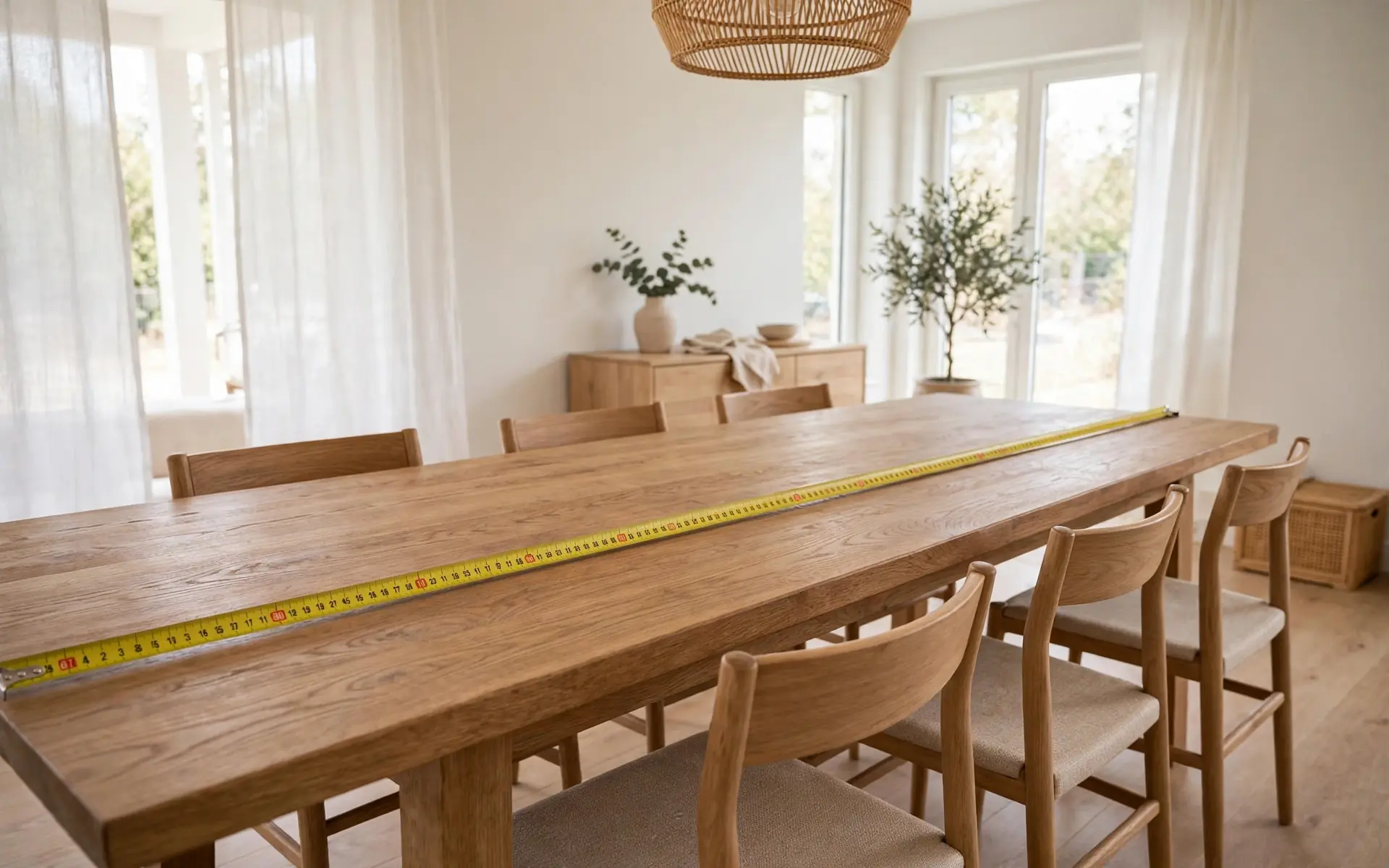
The dining table is the article’s metric detective story, and it explains why so many “70-inch” tables measure a fraction over. The product listing gives 70.86 inches long, 35.43 inches wide, and 29.92 inches high for a rectangular table seating six — and 70.86 inches is 180 centimetres, a round metric size, converted. The table is not a 70-inch table that grew; it is a 180-centimetre table that converts to 70.86 inches, and the 0.86-inch overshoot is the conversion, not a manufacturing error.
That fraction matters in a dining room in a way it would not in a warehouse. A table 70.86 inches long needs chairs pulled out on both long sides, so the room needs the table length plus roughly 36 inches of chair and walking space at each end in the best case, and a rug under it should run at least 24 inches past the table on every side — which turns a 70.86-inch table into a rug roughly 119 inches long. Buy the rug against 70.86, not against 70, and the extra inch stops being a surprise and starts being part of the plan. Seating, meanwhile, is honest at six: three chairs a side at about 24 inches of elbow room each fills 72 inches, so six diners fit snugly and eight would not.
6. A Person 5 Feet 10 Inches Tall — 1.1 Inches Above the Average Man (AVERAGE Near-Miss)
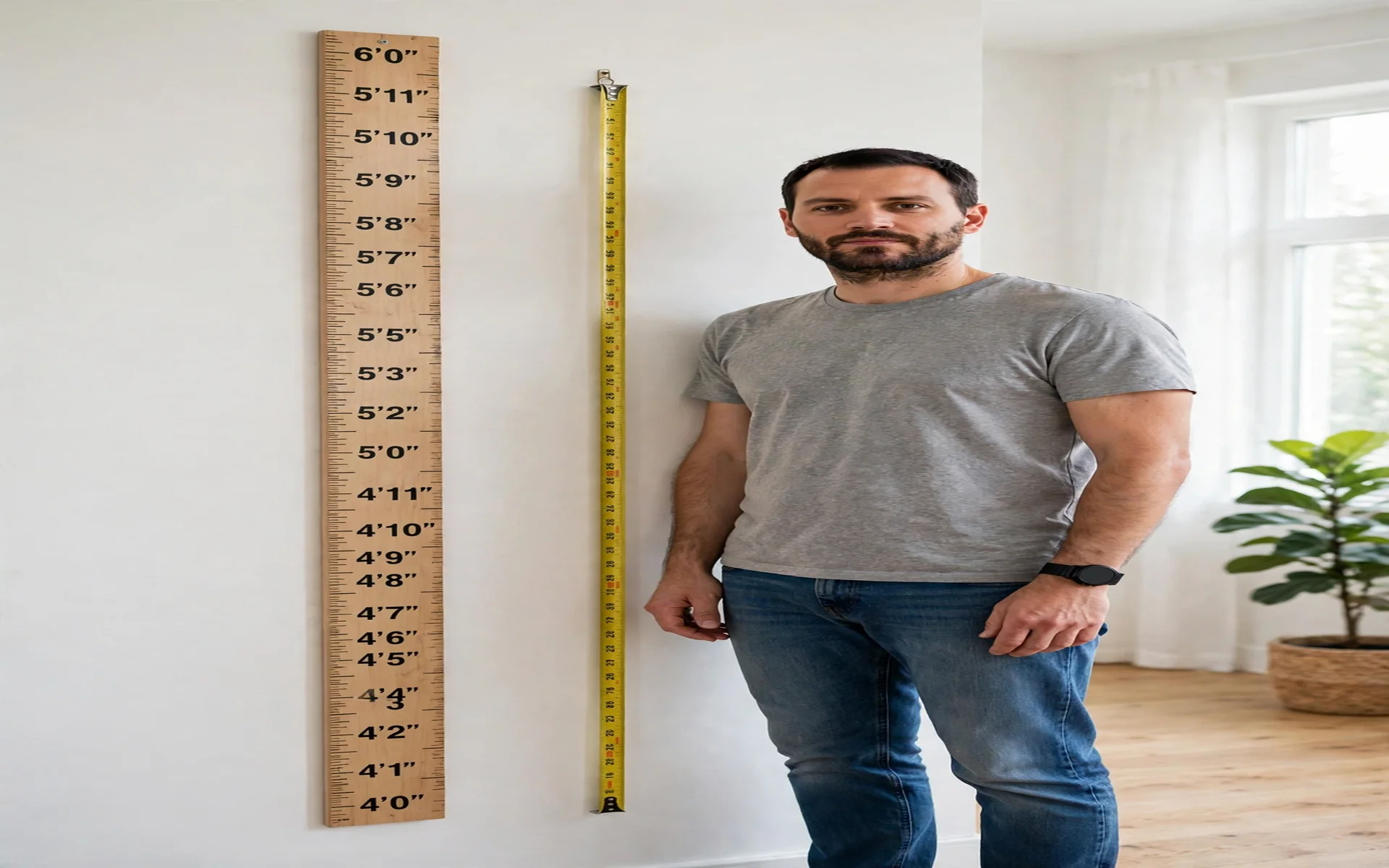
The person is the article’s living scale, and it comes with a correction to a claim repeated across the web. Pages that call 70 inches “the average male height” are rounding up: the CDC FastStats page gives the measured average height for adult men as 68.9 inches, from measured anthropometric data for adults aged 20 and older, so a 70-inch man stands 1.1 inches above the current average, not on it. He is a common height — plenty of men are 5 feet 10 inches — but common is not average, and the distinction is the whole object.
That 1.1 inches is also the most useful human yardstick in the article, because everyone has stood next to a 5-foot-10 person. Seventy inches is the top of that person’s head, which means a 70-inch shelf, a 70-inch fridge, and a 70-inch sofa all meet the same mark: the top of a slightly-above-average man’s head. It is ten inches below the top of a standard 80-inch doorway, which is why a 5-foot-10 person walks through any standard door with room to spare, and two inches below six feet, which is why “nearly six feet” is the honest description and “six feet” is not.
The 70-Inch Shopping Trap: Class Names Are Not Measurements
Three of the six objects teach the same lesson from three directions, and it is worth stating once, plainly. A television class name rounds the diagonal to the nearest friendly number, so a 70-inch class set measures 69.5 inches diagonally. A table sold in the 70-inch family may be a metric size in disguise, so it measures 70.86 inches. A refrigerator’s headline height may include its hinges, so the case measures an inch and an eighth less. None of these is a defect, and all three become expensive only when the buyer quotes the name instead of the sheet: a stand bought against 70 inches of television, a rug bought against 70 inches of table, a cabinet built against 68 and seven-eighths inches of fridge. Open the spec sheet, read the dimension word — diagonal, length, width, height, with or without hinges — and buy against that figure, not against the box.
Fitting 70 Inches Into Real Rooms
In the living room, 70 inches is a loveseat’s width against the wall and a television’s diagonal above it, and the two must never be confused: the sofa needs 70 inches of wall, the television needs about 61. In the bathroom, 70 inches is a freestanding tub’s length on open floor, ten inches longer than the alcove standard, with clearance on all sides rather than three walls. In the kitchen, 70 inches is a refrigerator’s hinge height under the cabinets, with a delivery path longer than the fridge itself. In the dining room, 70.86 inches is a table’s length plus chairs and a rug that runs far past it. And everywhere, 70 inches is a person standing 5 feet 10 inches tall, the scale against which every other object in the article can be checked by eye. The same number behaves differently in every room because the dimension changes — and the fitting question changes with it.
Measuring 70 Inches With What You Already Own
A standard tape measure usually runs 25 feet, so 70 inches is well within it: stretch it to 5 feet 10 inches and mark the spot. Without one, use the objects in this article: a 70-inch loveseat’s width, a 70-inch tub’s length, or the height of a 5-foot-10 friend are all 70 inches you can stand beside. A yardstick is 36 inches, so a yardstick plus 34 inches — just short of another yardstick — reaches 70, and five feet of floor tiles plus ten inches of the sixth tile does the same in a tiled room. For anything that must fit — a fridge cabinet, a tub alcove, a television stand — use a real tape measure, because at 70 inches the misses in this article run from half an inch to nearly nine inches, and guessing throws every one of them away.
Conversion Table
| Unit | 70 inches equals |
|---|---|
| Feet and inches | 5 ft 10 in exactly |
| Feet (decimal) | 5.833 ft |
| Centimetres | 177.8 cm exactly |
| Millimetres | 1,778 mm |
| Metres | 1.778 m |
| Yards | 1.94 yd (1 yd 34 in) |
| Compared with 60 inches | 10 inches longer |
| Compared with 6 feet (72 in) | 2 inches short |
| Compared with a standard door (80 in) | 10 inches shorter |
| Square area 70 in by 70 in | 4,900 sq in (34.03 sq ft) |
| Wrong figures to reject | 5 ft 8 in, 6 ft, and a 70-inch TV width are all wrong |
How 70 Inches Compares With Other Lengths
Seventy inches is ten inches past 60 inches and twenty inches past 50 inches, and thirty inches past 40 inches — a full two and a half feet past the 40-inch mark. Against the foot series it is far shorter: 17 feet is more than twice as long, 16 feet longer still in the other direction, and 15 feet, 14 feet, and 13 feet all run well past it — 70 inches is 5 feet 10 inches, not a foot length at all. And a step up to 80 inches is ten inches longer.
Frequently Asked Questions
How many feet is 70 inches?
Exactly 5 feet 10 inches. Divide 70 by 12 and you get 5 with a remainder of 10, so 70 inches is 5 feet 10 inches — not “about six feet,” but two inches short of it.
Is 5.83 feet the same as 5 feet 8 inches?
No, and this is the most common 70-inch mistake. The .83 in 5.83 feet is 83 percent of a foot, and 83 percent of 12 inches is 10 inches, so 5.83 feet is 5 feet 10 inches. Reading .83 as 8 inches loses two inches and breaks every fitting decision that follows.
How many centimetres is 70 inches — and how many metres?
177.8 centimetres exactly, which is 1.778 metres. Multiply 70 by 2.54 to get 177.8 cm, with no rounding involved; divide by 100 for metres.
How many yards is 70 inches?
1.94 yards, rounded — exactly 1 yard and 34 inches. Divide 70 by 36 to get 1.9444 yards, so “about 1.94 yards” is the honest phrasing, while the feet and centimetre figures are exact.
How wide is a 70-inch TV really? Is it 70 inches wide?
No. A 70-inch-class television measures about 61 inches wide overall — the Samsung set above is 61.4 inches wide — because the 70 inches is the screen diagonal measured corner to corner, and its actual diagonal is 69.5 inches. Measure your stand against the outer width, not against 70.
Is a 70-inch refrigerator really 70 inches tall?
To the top of its door hinges, yes; as a bare case, no. The Samsung model above is 70 inches tall with hinges and doors but 68 and seven-eighths inches without them, so plan cabinet clearance against 70 inches and never let a quote of the case height decide your cabinets.
Is 70 inches tall for a person?
It is a common, slightly above-average height for an adult man. The measured average for US adult men is 68.9 inches, so a 70-inch (5-foot-10) man stands 1.1 inches above average — tall enough to notice, not tall enough to call tall, and ten inches below the top of a standard doorway.
How do I measure 70 inches at home if I do not have a long enough tape measure?
Use a yardstick (36 inches) plus 34 inches, or stand beside a known 70-inch object from this article — a loveseat’s width, a tub’s length, or a 5-foot-10 person’s height. For anything that must fit exactly, borrow or buy a real tape measure, because the misses in this article run from half an inch to nearly nine inches.
Final Thoughts
Seventy inches is 5 feet 10 inches, not 5 feet 8 inches and not six feet — and once the arithmetic and the direction are right, the objects fall into place: a television whose diagonal is 69.5 inches and whose width is 61.4, a bathtub that really is 70 inches long, a refrigerator that is 70 inches tall to its hinges and an inch and an eighth shorter without them, a loveseat that really is 70 inches wide, a dining table that measures 70.86 because it was born 180 centimetres, and a person 1.1 inches above the average man’s height. Six objects, two honest near-misses, one qualifier, and one average, each with its dimension named and its grade printed. That is what 70 inches looks like when it is measured instead of repeated — and the next time a box tells you something “is 70 inches,” you now know the question to ask first: 70 inches of what?
