
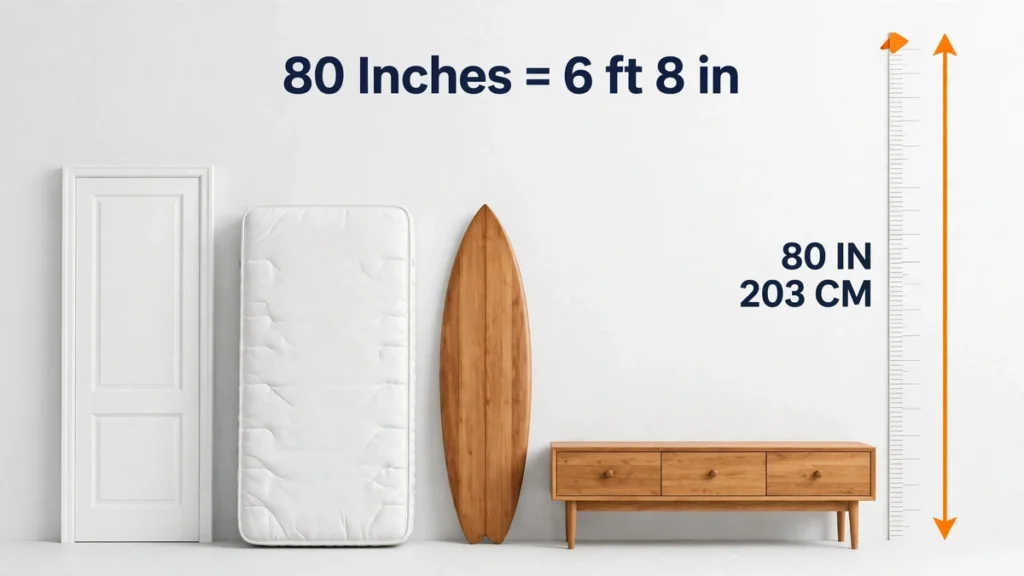
If you have ever wondered how long is 80 inches, the short answer is 6 feet 8 inches — and the longer answer is that 80 inches is probably already in your house, holding up a doorway, holding up your bed, or both. It is the height of the door you walk through every morning and the length of the mattress you sleep on every night, which makes it one of the few measurements on this site that most readers can check without leaving the room. The catch is that 80 inches is also a number sellers round toward: sofas sold as 80 inches that tape out a fraction short, pool tables called bar size that play two inches short, and a decimal, 6.67 feet, that invites a misreading of a whole inch. This article gives you seven single, named things, each checked against its own specification, with the miss printed wherever an object misses. For every size, see the complete inches size guide.
Below are seven objects, and the count itself is part of the honesty. Three are exact at 80 inches for the dimension stated, one more is exact as a nominal industry standard, one is listed at exactly 80 inches, and two are labelled near-misses. Every object’s image sits immediately after its heading, and no object is a stack, a multiple, or a category guess. By the end you will know 80 inches as a door, a bed, a tub, a board, a table, a sofa, and a playing surface — and you will know which of those you can trust to the inch and which you must measure yourself.
Quick Answer
80 inches = 6 feet 8 inches exactly = 203.2 cm = 2.032 m = 2.22 yards (2 yards 8 inches). Do NOT read 6.67 feet as 6 feet 7 inches — the .67 of a foot is 8 inches, not 7. And do NOT buy a sofa, a rug, or a TV stand against the number 80 without checking the spec sheet: the sofa below tapes out at 79.72 inches and the home pool table below plays at 78.
Why 80 Inches Fools Even Careful Shoppers
The first fooling is arithmetic, and it is a single inch that costs real money. Eighty divided by 12 is 6.6667 feet, and the decimal part tempts a reader into writing 6 feet 7 inches, as if .67 meant 7. It does not: .667 of a foot times 12 inches is 8 inches, so 6.67 feet is 6 feet 8 inches, and any page printing 6 feet 7 inches for 80 inches has misread its own calculator by exactly one inch. That inch is the difference between a door that fits its frame and a door that scrapes, so it is worth getting right before anything else in this article.
The second fooling is direction, and it is the same lesson as every length article with a new twist: 80 inches of height is not 80 inches of length, and neither is 80 inches of width. A door is 80 inches tall, a mattress is 80 inches long, a console table is 80 inches wide, and a pool table’s 78 inches is a playing surface measured cushion to cushion, not the table’s outside size. The fitting question changes with the direction — vertical clearance for the door, floor length for the bed, wall length for the table, cue room for the pool table — which is why this article never prints “80 inches” without saying 80 inches of what.
The third fooling is the name on the box. Sellers round to friendly numbers, and two objects below prove it in opposite directions: a sectional sofa sold as 80 inches that measures 79.72 inches, and a bar-box pool table whose home version plays at 78 inches while its coin-operated cousin plays at exactly 80. Neither seller is lying in any way that matters, and both become expensive the moment a buyer quotes the name instead of the sheet. The rule for the whole article is therefore simple: trust the spec sheet, print the deviation, and let the name stay on the box where it belongs.
The 7 Objects
1. A Standard Interior Door — 80 Inches Tall (EXACT, Nominal Standard)
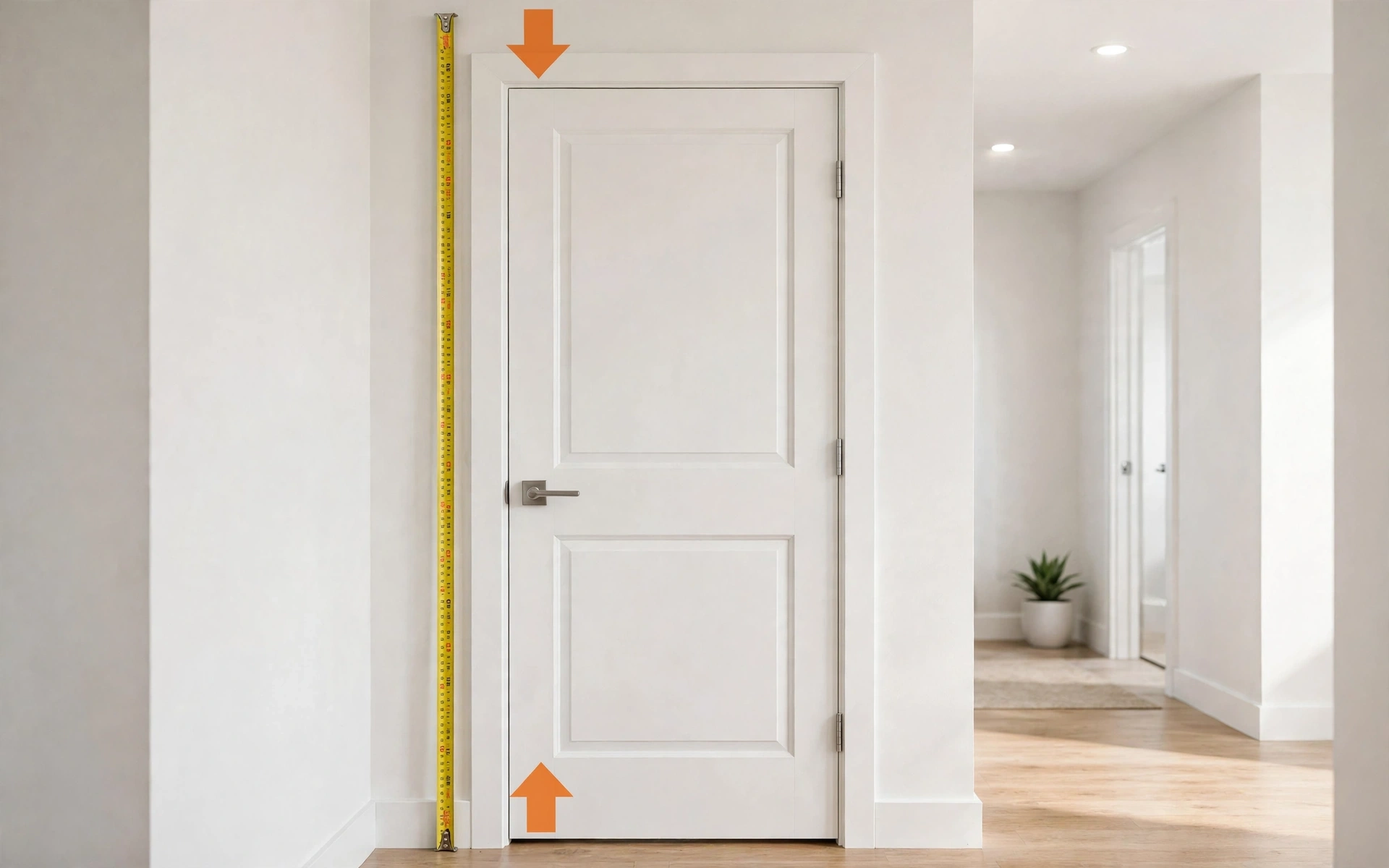
The door is the article’s anchor, because it is the 80 inches nearly every reader already owns. The standard interior door in a modern American home is 32 inches wide by 80 inches tall, and the building code backs the height up: passage doors must be at least 80 inches tall, so 80 inches is not a fashion choice but the floor of the standard. Stand in any doorway in a home built in the last few decades and you are standing inside an 80-inch measurement, with about 16 inches of wall above it under a standard 8-foot ceiling for the header and trim.
The fitting check is the opening, not the slab. A door slab sold as 80 inches tall needs a rough opening a couple of inches taller to take the frame, and the finished opening still has to clear your flooring: thick carpet or a raised threshold can steal an inch of usable clearance from an 80-inch doorway, which is why an 80-inch door in a carpeted room sometimes scrapes. Older homes break the rule in both directions, with 78-inch and 84-inch doors both common before the modern standard settled, so the honest advice is to measure your own door rather than assume it. But for a modern home, the door is the definition of 80 inches: 6 feet 8 inches of vertical clearance, and the reason a 6-foot-8 person can walk through a standard doorway without ducking — exactly, with nothing to spare.
2. A Standard Queen Mattress — 80 Inches Long (EXACT)
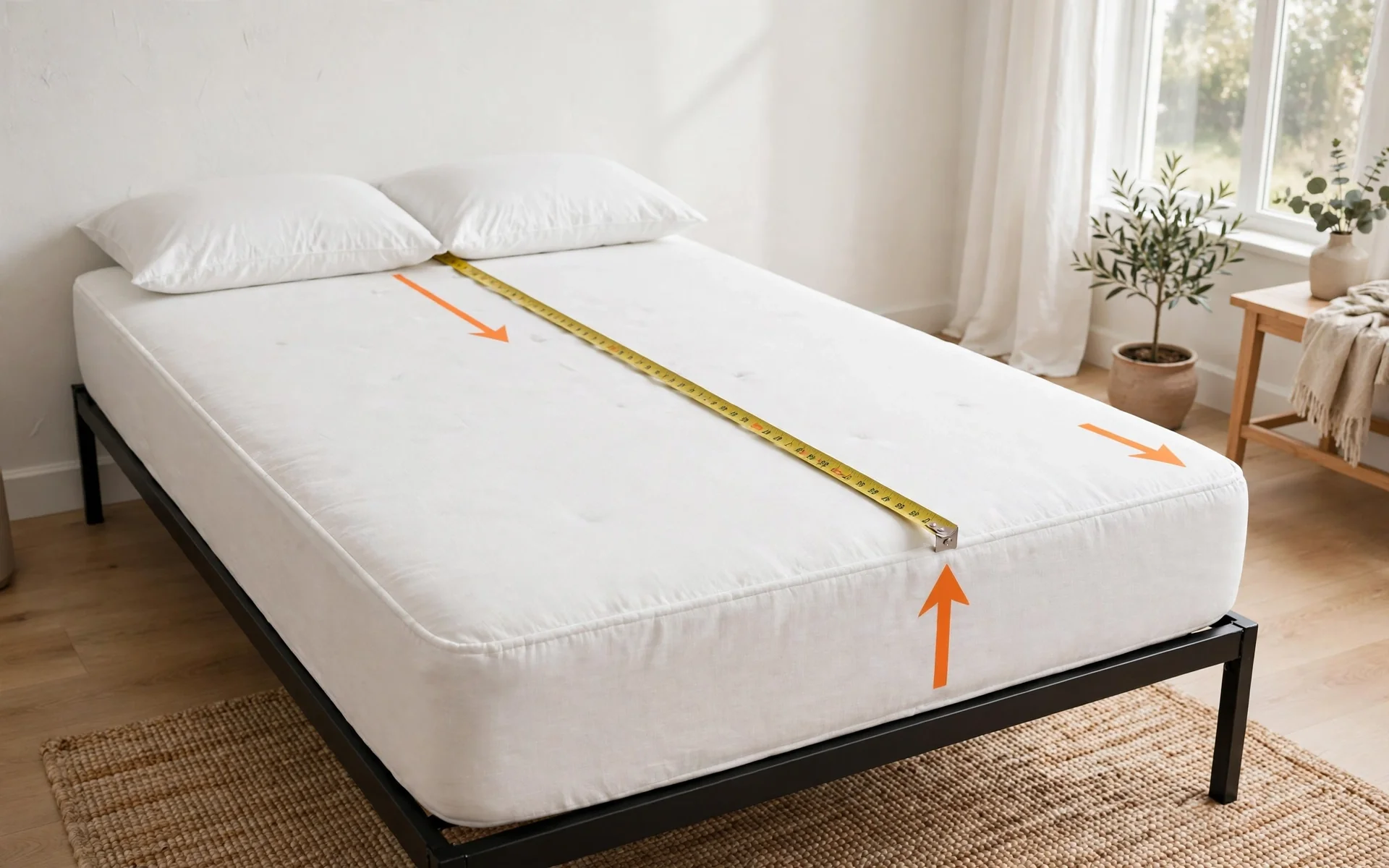
The mattress is the article’s most slept-on 80 inches, in both senses. A standard queen mattress measures 60 inches wide by 80 inches long, and the manufacturer’s size chart states it plainly: 60 by 80, no rounding, no qualifier. Eighty inches of mattress is five inches longer than a full or twin mattress at 75 inches, which is exactly why taller sleepers are steered to a queen: a 6-foot sleeper on a 75-inch mattress has three inches of total clearance for pillow and feet, while on an 80-inch mattress that same sleeper has eight inches to spare.
The fitting check is the frame and the room, not the mattress. A queen bed frame runs a little longer than the mattress itself once the headboard and footboard are counted, so an 80-inch mattress needs roughly 84 to 88 inches of room length before a single nightstand or walkway is added, and a fitted sheet sold as “queen” is cut for this exact 60-by-80 footprint. The same 80-inch length appears on a king mattress too — a king is 76 inches wide by 80 inches long, wider but no longer — so if you already own a king, you already know this length; you just know it with sixteen extra inches of width. Measure the platform, not the name: an RV short queen, at 75 inches, is the trap here, five inches shorter than a standard queen despite sharing the word.
3. ANZZI Gala Freestanding Bathtub — 80 Inches Long (EXACT)
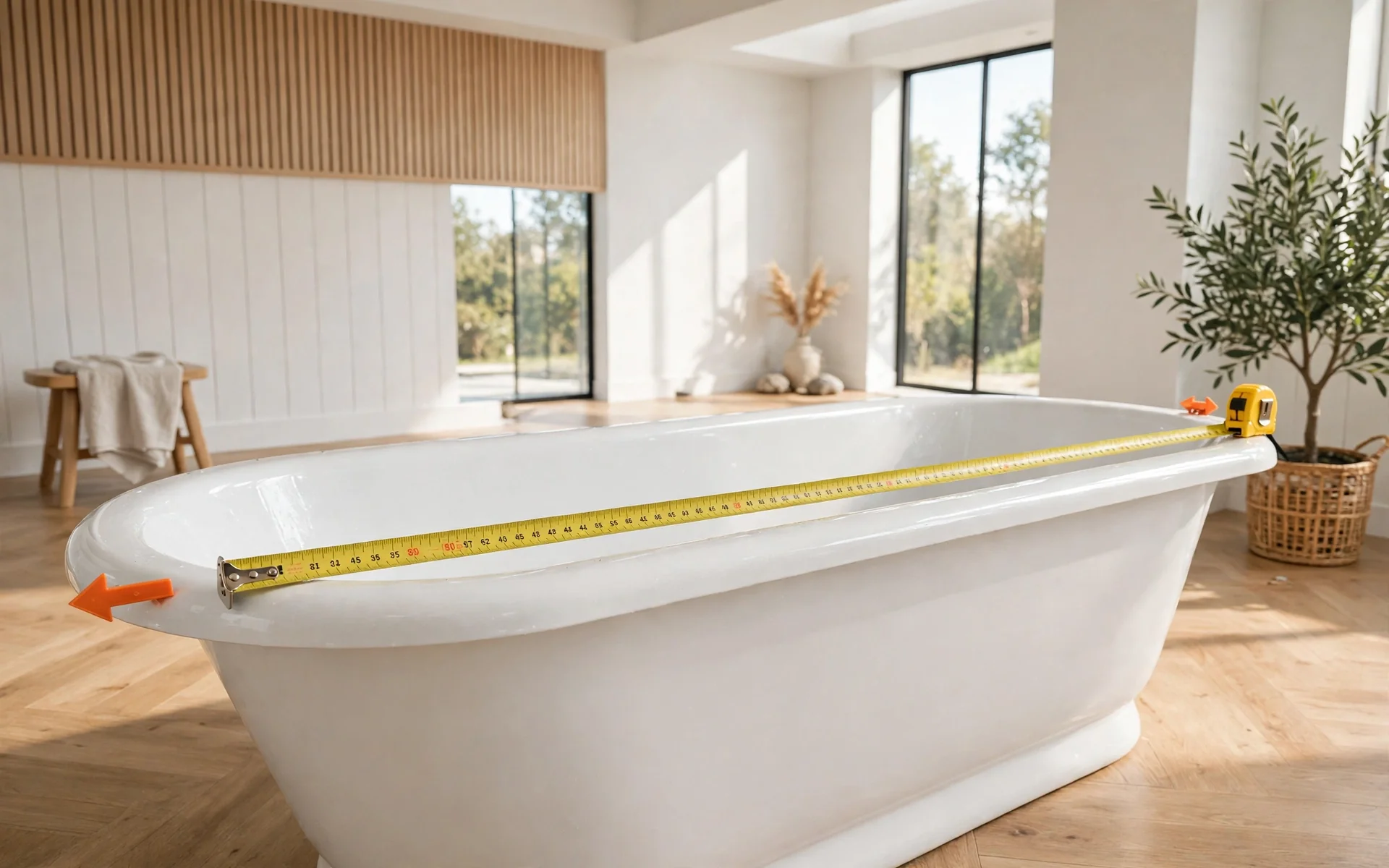
The bathtub is the article’s longest soak and its most dramatic room-changer. The manufacturer’s specification sheet for the ANZZI Gala freestanding tub lists it at 80 inches long, 31 inches wide, and 60 inches high — and the 60-inch height needs one sentence of unpacking, because it is the shower-tower height on this model, not the height of the tub rim you step over. The length, though, is unambiguous: 80 inches of tub, end to end, which is twenty inches longer than the standard 60-inch alcove tub and ten inches longer than the 70-inch freestanding tub in our earlier article.
That extra length changes the bathroom the way the 70-inch tub changed it, only more so. An 80-inch freestanding tub needs clear floor on all sides rather than a three-wall opening, it needs a delivery path wider than any doorway it must pass through on its side, and it needs a water heater and floor structure sized for a tub of this volume rather than a standard one. A bathroom built for a 60-inch alcove cannot swallow an 80-inch freestanding tub without giving up twenty inches somewhere else, and that twenty inches has to come out of vanity, toilet clearance, or walking space. Check the floor plan first, the spec sheet second, and the drain position third — and never order an 80-inch tub against a room measured in feet, because rounding 6 feet 8 inches down to “about six and a half feet” loses two inches you do not have.
4. Otter Riser 6-Foot-8 Wooden Surfboard — 80 Inches Long (EXACT)
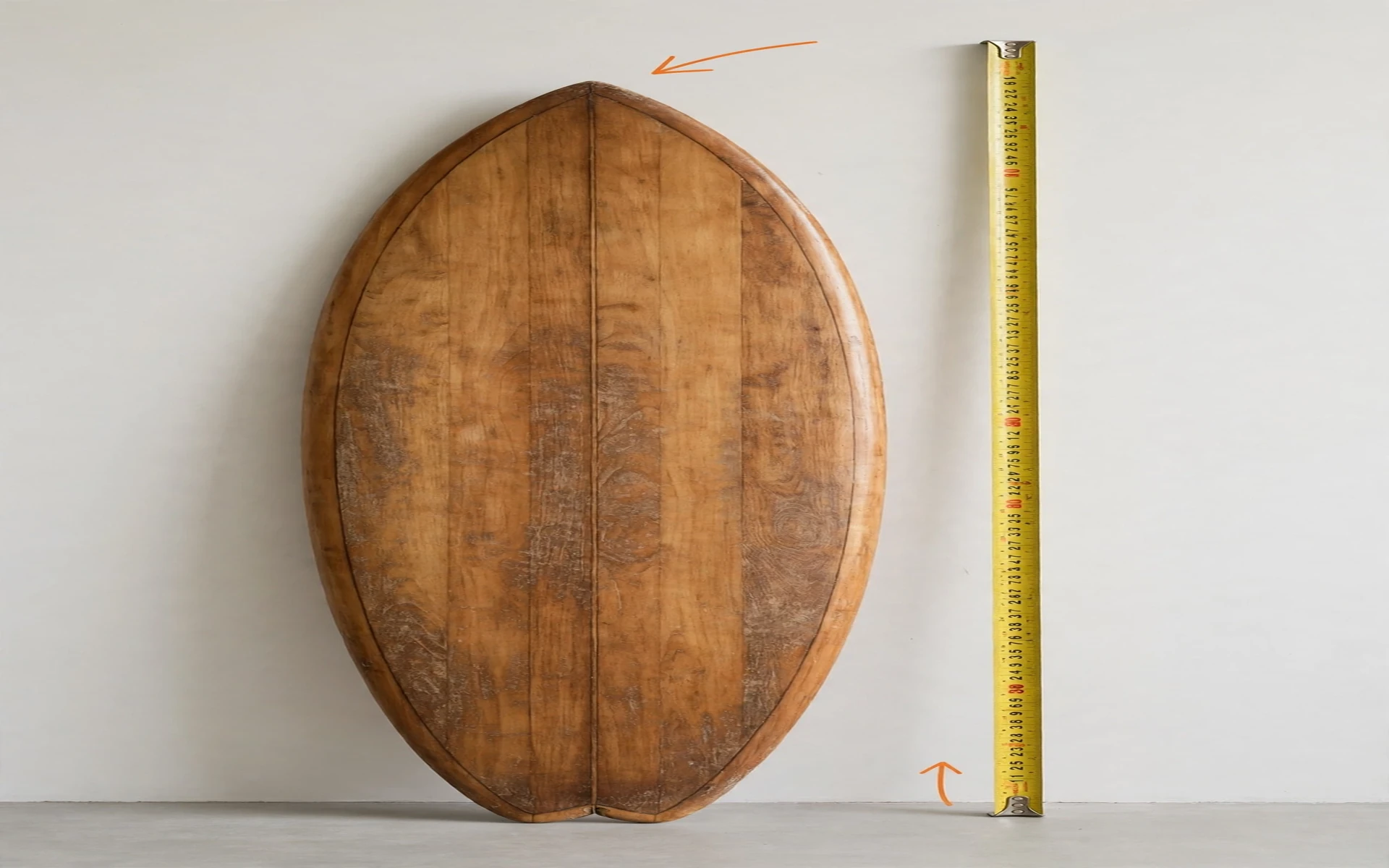
The surfboard is the article’s most elegant exact, because its name is already the measurement. The maker’s own board briefing describes the Riser as six foot eight inches long, 20 and a half inches wide, and two and a half inches thick, carrying about 38 litres of volume — and six foot eight inches is 80 inches, with no conversion, no rounding, and no qualifier. It is a step-up board, built for meatier surf than a shortboard, and its length is the whole point: long enough to paddle into bigger waves early, short enough to turn where a longboard would not.
The fitting check is transport, and it is where 80 inches bites. An 80-inch board fits diagonally across most car roofs and inside many wagons and vans with the seats down, but it does not fit inside a typical sedan trunk, and a roof-rack setup needs crossbars spaced to support a board of this length without letting either end bounce. Measure the board against your car before you buy the board against the waves: an 80-inch board that cannot get to the beach is a wall decoration, and a handsome one, but not the purchase you meant. It is also the article’s best portable yardstick — stand it on its tail next to a door and the two 80-inch objects line up exactly, board against frame, with nothing to spare.
5. Mercana Bela Arched Console Table — 80 Inches Wide (LISTED)
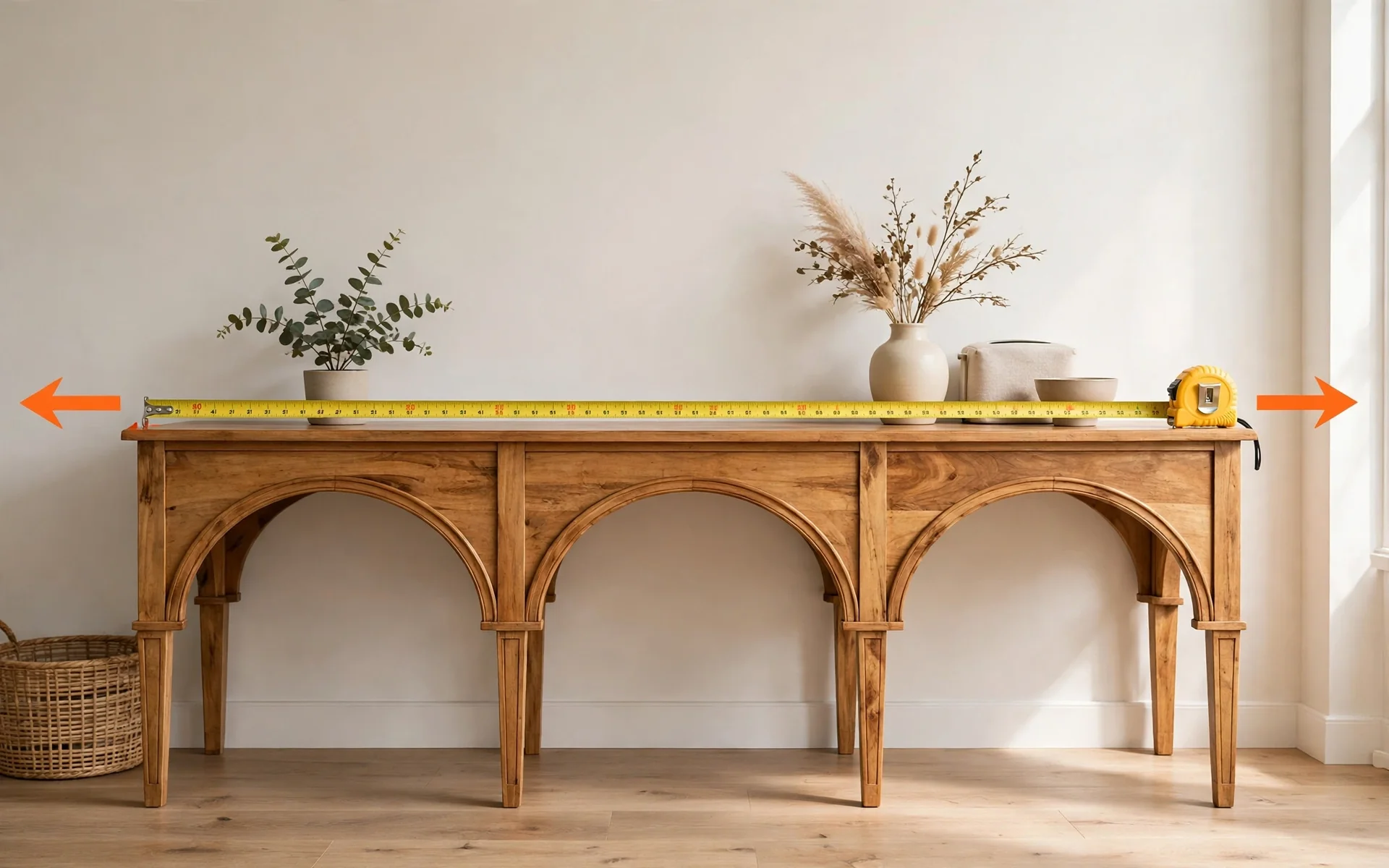
The console table is the article’s widest statement piece and its lesson in wall arithmetic. The manufacturer specification, as listed, gives the Bela arched console table at 80 inches wide, 16 inches deep, and 29 inches high, in solid mango wood with three architectural arches. Eighty inches of console is nearly seven feet of tabletop, which is the point: this is a table built to span behind a large sectional sofa or to anchor a long hallway wall where a standard 60-inch console would look lost.
The fitting check is the wall, and it is stricter than it looks. An 80-inch console needs a wall at least 80 inches long before a single lamp, frame, or walkway is added, and at 16 inches deep it also needs a hallway or sofa-back zone that can give up those 16 inches without pinching traffic. Behind a sofa, the console’s 80 inches should run no longer than the sofa itself, or the ends stick out past the arms and catch hips; in a hallway, 80 inches of table plus 36 inches of walking space means the hallway zone needs roughly nine feet of clear length to work. It is listed rather than graded exact because the figure comes from a retailer-listed manufacturer specification rather than the manufacturer’s own PDF — the number is 80 inches as listed, and the tape, as always, is the final judge.
6. Chireca 80-Inch Convertible Sectional Sofa — 79.72 Inches Wide, 0.28 Inches Short (LISTED Near-Miss)
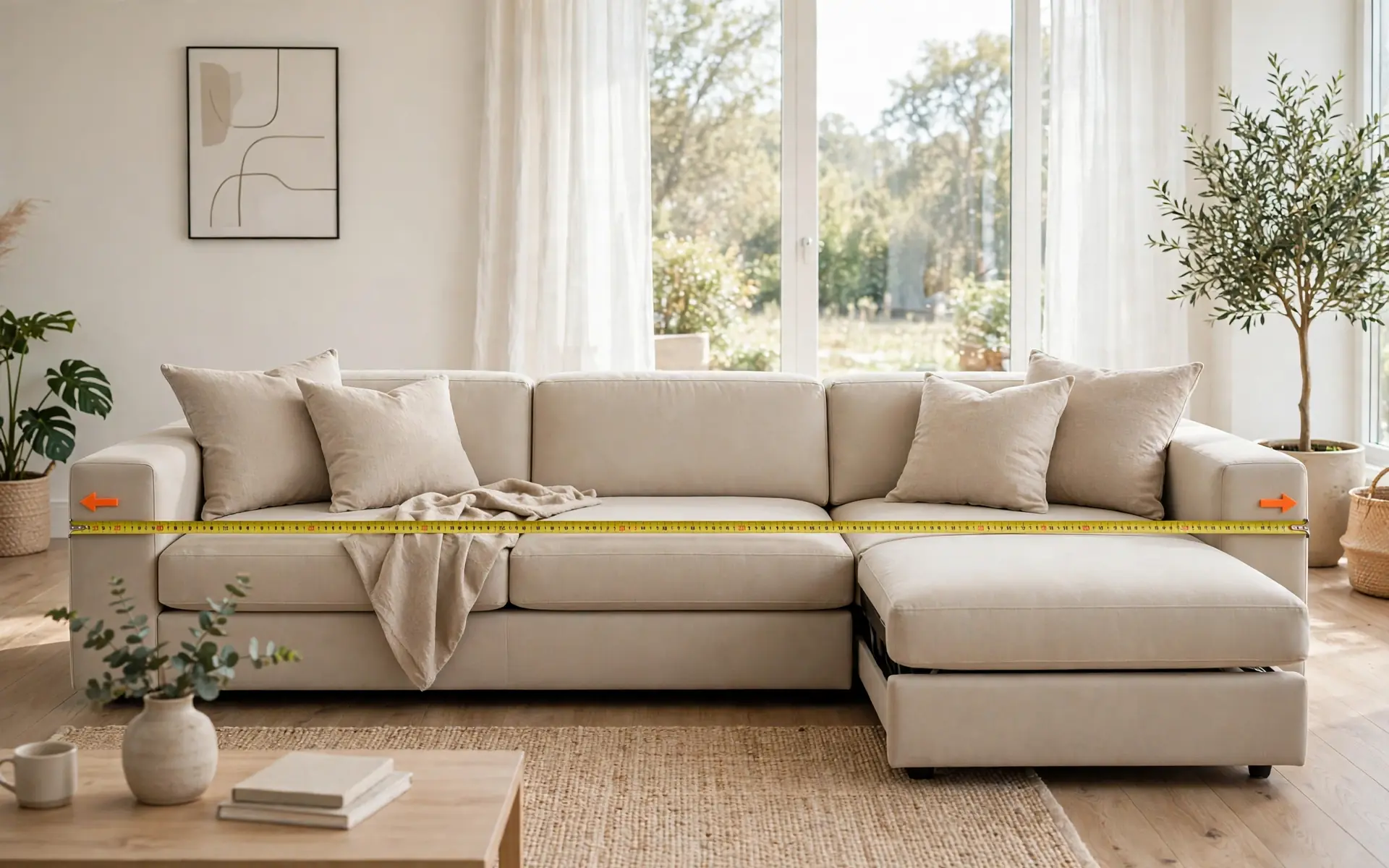
The sofa is the article’s honest near-miss, and it is honest in the most useful way: by almost nothing. The Chireca convertible sectional is sold as an 80-inch sofa, and its product dimensions list it at 79.72 inches wide, 52.36 inches deep, and 34.25 inches high — which means the sofa you buy as “80 inches” tapes out 0.28 inches short of 80, a little more than a quarter of an inch. That is the thickness of a pencil, and in most rooms it changes nothing at all.
It changes everything in exactly one situation, which is why it is printed here rather than rounded away. If you are fitting this sofa into an 80-inch alcove, a built-in nook, or a wall-to-wall run with millimetre tolerance, the quarter inch is your clearance — the sofa fits where a true 80-inch sofa would not, and that is a gift, not a defect. But if you are centring it on a wall with matching side tables, the quarter inch shifts the centre by an eighth of an inch, which nobody will ever see. The lesson generalises to every sofa sold by a round number: the name is a size family, the dimension listing is the measurement, and for most furniture the difference is a quarter inch of grace. Here, unusually, the rounding works in the buyer’s favour — the sofa is a fraction smaller than promised, so it fits a fraction more easily than promised.
7. Home 7-Foot Bar-Box Pool Table Playing Surface — 78 Inches Long, 2 Inches Short (LISTED Near-Miss)
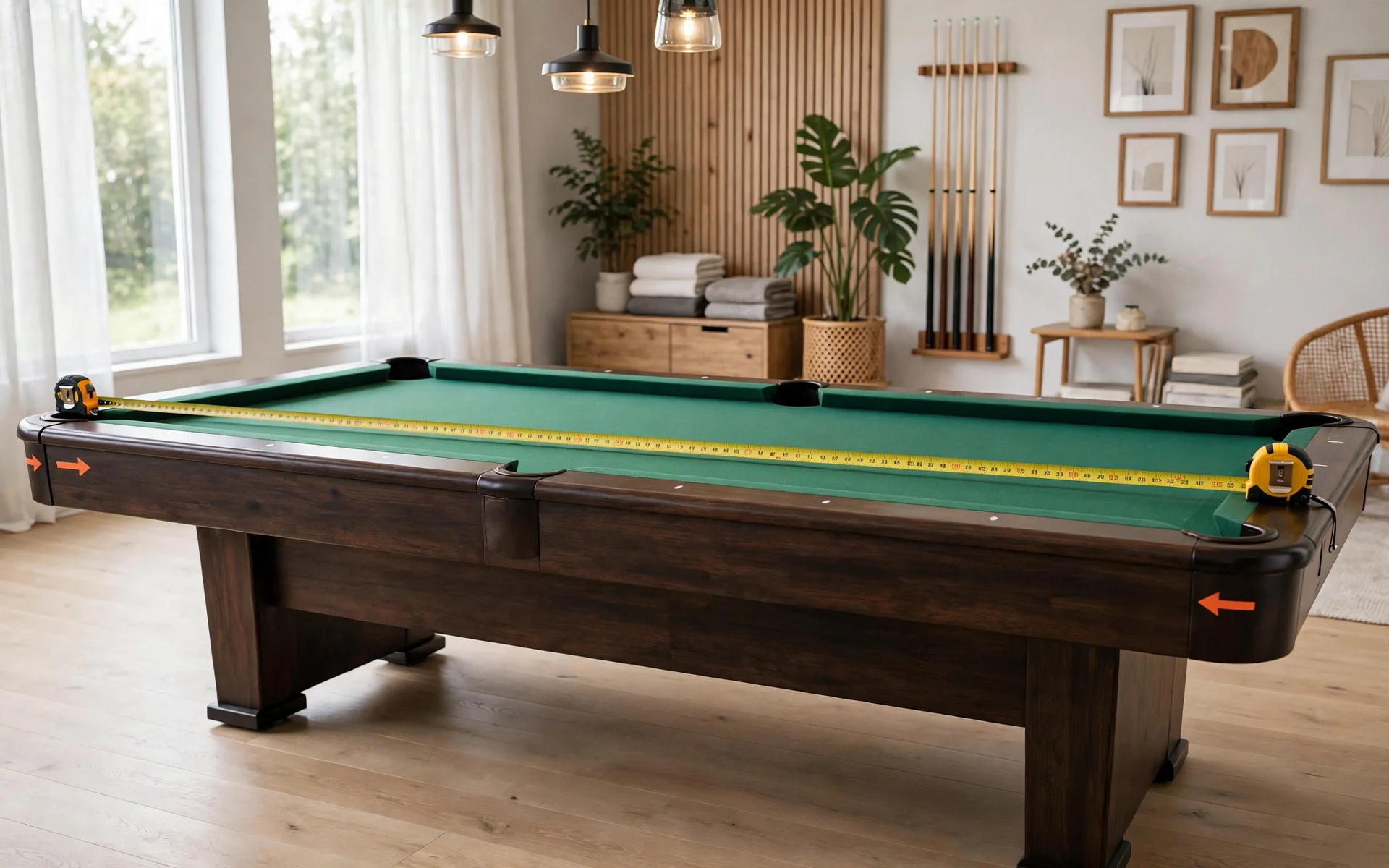
The pool table is the article’s best trap, because the same name means two different measurements. A home 7-foot bar-box pool table has a playing surface of 39 inches by 78 inches, measured cushion nose to cushion nose — which is two inches short of 80, and therefore a near-miss by exactly the width of a cue ball’s diameter. The table’s outside size is larger, since rails and cabinet add roughly a foot on each side, but the playing surface is the number that decides the game, and on a home bar box it is 78 inches, not 80.
The qualifier is what makes this object worth including rather than merely disappointing. Coin-operated bar boxes — the tables in bars and pool halls — play at 40 inches by 80 inches, which is exactly 80 inches long. So “bar box” alone does not settle the question: the home version misses by two inches and the coin-op version hits it dead on, and a buyer who reads a comparison page that calls a bar box “80 inches” without saying which kind has been given the coin-op number for a home table. The fitting check settles it in the room: with standard 58-inch cues, a 78-inch playing surface needs a room roughly 16 feet 2 inches long to shoot comfortably from every side, and the two missing inches against 80 change nothing about the room while changing everything about the claim. Print the kind, print the surface, and never quote the name.
Which 80 Inches Is Yours? A Room-by-Room Fit Guide
In the hallway, 80 inches is the door: 80 inches of vertical clearance, a rough opening a couple of inches taller, and flooring that must not steal the last inch. In the bedroom, 80 inches is the mattress: 80 inches of floor length, a frame a few inches longer, and sheets cut for the 60-by-80 footprint — with the RV short queen, at 75 inches, as the trap. In the bathroom, 80 inches is the tub: 80 inches of open floor, clearance on all sides, and a delivery path wider than the tub on its side. In the garage or on the car roof, 80 inches is the surfboard: 80 inches of length that fits a wagon and defeats a sedan trunk. In the living room, 80 inches is the console’s width against the wall and the sofa’s width a quarter inch short of it, and the two must never be confused: the console needs 80 inches of wall, the sofa needs 79.72, and the side tables need whatever is left. And in the games room, 80 inches is the playing surface that is not there on a home table — 78 inches, with the coin-op table as the one that actually reaches it. The same number behaves differently in every room because the dimension changes — and the fitting question changes with it.
Conversion Table
| Unit | 80 inches equals |
|---|---|
| Feet and inches | 6 ft 8 in exactly |
| Feet (decimal) | 6.667 ft |
| Centimetres | 203.2 cm exactly |
| Millimetres | 2,032 mm |
| Metres | 2.032 m |
| Yards | 2.22 yd (2 yd 8 in) |
| Compared with 6 feet (72 in) | 8 inches longer |
| Compared with 7 feet (84 in) | 4 inches short |
| Compared with 70 inches | 10 inches longer |
| Compared with a standard door (80 in) | Equal — the door IS the standard |
| Square area 80 in by 80 in | 6,400 sq in (44.44 sq ft) |
| Wrong figures to reject | 6 ft 7 in, 7 ft, an 80-inch TV width, and a home bar-box surface of 80 in are all wrong |
Measuring 80 Inches With What You Already Own
A standard tape measure usually runs 25 feet, so 80 inches is well within it: stretch it to 6 feet 8 inches and mark the spot. Without one, use the objects in this article: a standard doorway’s height, a queen mattress’s length, or a 6-foot-8 surfboard stood on its tail are all 80 inches you can stand beside. A yardstick is 36 inches, so two yardsticks plus 8 inches reaches 80, and six feet of floor tiles plus eight inches of the seventh tile does the same in a tiled room. For anything that must fit — a door frame, a tub alcove, a console wall, a pool-table room — use a real tape measure, because at 80 inches the misses in this article run from a quarter inch to two full inches, and guessing throws every one of them away.
How 80 Inches Compares With Other Lengths
Eighty inches is ten inches past 70 inches and twenty past 60 inches, thirty past 50 inches and forty past 40 inches. Against the foot series it is far shorter: 19 feet is more than twice as long, and 18 feet, 17 feet and 16 feet all run well past it — 80 inches is 6 feet 8 inches, not a foot length at all. A step up to 90 inches is ten inches longer.
Frequently Asked Questions
How many feet is 80 inches?
Exactly 6 feet 8 inches. Divide 80 by 12 and you get 6 with a remainder of 8, so 80 inches is 6 feet 8 inches — eight inches past six feet, four inches short of seven.
Is 6.67 feet the same as 6 feet 7 inches?
No, and this is the most common 80-inch mistake. The .67 in 6.67 feet is 67 percent of a foot, and 67 percent of 12 inches is 8 inches, so 6.67 feet is 6 feet 8 inches. Reading .67 as 7 inches loses a full inch and breaks every fitting decision that follows.
How many centimetres is 80 inches — and how many metres?
203.2 centimetres exactly, which is 2.032 metres. Multiply 80 by 2.54 to get 203.2 cm, with no rounding involved; divide by 100 for metres.
How many yards is 80 inches?
2.22 yards, rounded — exactly 2 yards and 8 inches. Divide 80 by 36 to get 2.2222 yards, so “about 2.22 yards” is the honest phrasing, while the feet and centimetre figures are exact.
Is a standard interior door really 80 inches tall?
In a modern home, yes — 32 inches wide by 80 inches tall is the standard bedroom-door size, and passage doors must be at least 80 inches tall. Older homes commonly have 78-inch or 84-inch doors, so measure your own door rather than assuming it matches the standard.
Is a queen mattress really 80 inches long?
Yes. A standard queen mattress measures 60 inches wide by 80 inches long, and a king shares the same 80-inch length at 76 inches wide. Watch out for the RV short queen at 75 inches, which is five inches shorter despite sharing the name.
Is an 80-inch sofa really 80 inches wide?
Not always. The sectional sofa above is sold as 80 inches but measures 79.72 inches wide — a quarter inch short, which usually helps rather than hurts, since it fits a fraction more easily. Always check the dimension listing, not just the name.
Why do some pages say a bar-box pool table is 80 inches long?
Because the coin-operated bar box plays at 40 by 80 inches, which is exactly 80. The home 7-foot bar box plays at 39 by 78 inches, two inches short. The name alone does not settle it — home versus coin-op does, and the playing surface, measured cushion to cushion, is the number that counts.
Final Thoughts
Eighty inches is 6 feet 8 inches, not 6 feet 7 inches and not seven feet — and once the arithmetic and the direction are right, the objects fall into place: a door that really is 80 inches tall, a queen mattress that really is 80 inches long, a freestanding tub that really is 80 inches long, a surfboard whose name is already the measurement, a console table listed at 80 inches wide, a sectional sofa a quarter inch short of the promise, and a home pool table two inches short of it with a coin-operated cousin that hits it exactly. Seven objects, two honest near-misses, one qualifier, and one nominal standard, each with its dimension named and its grade printed. That is what 80 inches looks like when it is measured instead of repeated — and the next time a box tells you something “is 80 inches,” you now know the questions to ask first: 80 inches of what, and measured how?
