

If you have ever wondered how long is 90 feet, the short answer is 27.432 metres — and the longer answer is that 90 feet is the distance between the bases on a baseball diamond, the width of the Golden Gate Bridge, the height of a waterfall in Alabama, and the height of a nine-story building, all at once. A baseball player runs exactly 90 feet from home plate to first base because the rulebook says ninety feet and has said so since 1857. The Golden Gate Bridge is 90 feet wide because its deck carries six lanes and two walkways across that exact width. A nine-story building is about 90 feet tall at the standard ten feet per floor. You do not need three school buses or five pickup trucks to picture 90 feet, because seven single things already are 90 feet, and each one has a specification to prove it.
Below are those seven things, each checked against its own specification, with the miss printed wherever a thing misses. Five of them are exact or listed at 90 feet for the dimension stated, and two are honest near-misses — one four feet over, one ten inches short — with the miss printed in the heading itself. Every object's image sits immediately after its heading, and no object is a stack, a multiple, a fraction, or a category guess. You will not find three giraffes stacked or a third of a football field here, because a fraction of a thing is not a thing that is 90 feet long — it is arithmetic wearing a trench coat. After the objects comes a section the other lists will not write: six claims about 90 feet that the internet states confidently and gets wrong, each corrected with the real number. By the end you will know 90 feet as a base path, a building, a bridge, a waterfall, a statue, a basketball court, and an airliner — and you will know which of those you can trust to the foot and which you must measure yourself.
Quick Answer
90 feet is 1,080 inches — 27.432 metres, 30 yards, and 2,743.2 centimetres. But do NOT trust a list that tells you a Megalodon grew to 90 feet long: the scientifically justifiable maximum is about 50 feet, so the claim is wrong by forty feet. The seven things below are each checked against their own specification, with the miss printed wherever a thing misses.
90 Feet Side by Side: The Nearby Sizes in One Table
Ninety feet is easier to hold in your head when you see it next to the sizes that sit just above and below it, because 90 feet is not a lonely number — it is the gap between several famous measurements. A baseball diamond is exactly 90 feet between bases, which makes it the anchor of this article. An international basketball court is 91.86 feet long, which is less than two feet past 90. An ATR 72-600 airliner is 89 feet 2 inches long, which is ten inches short of 90. An Amtrak Amfleet car is 85 feet 4 inches long, which is four feet eight inches short. An NBA court is 94 feet long, which is four feet over. And thirty yards of a football field is exactly 90 feet, which is the same number in a different uniform. The table below puts all six in one place, and the point of it is the middle column: 90 feet is the number every one of these measurements is measured against, and knowing all six is what lets you find it.
| Thing | Official dimension | 90 feet is… |
|---|---|---|
| Baseball diamond base path (MLB) | 90 ft between bases | exactly the number |
| ATR 72-600 airliner | 89 ft 2 in long | 10 in longer |
| FIBA basketball court | 91.86 ft long | 1.86 ft shorter |
| Amtrak Amfleet I car | 85 ft 4 in long | 4 ft 8 in longer |
| NBA basketball court | 94 ft long | 4 ft shorter |
| Football field, 30 yards | 90 ft (30 yd) | exactly the number |
The table also shows why 90 feet keeps appearing in lists that get it wrong. Every famous thing near 90 feet is a few feet off — 89, 91.86, 94, 85 — and a lazy list rounds the nearest one to 90 and calls it exact. The honest way to use these neighbours is the way this article uses them: print the real number, print the miss, and let the reader see that 90 feet sits ten inches past an airliner and four feet short of a basketball court. That is a measurement you can walk, not a number you have to trust.
The 7 Things That Are 90 Feet
Each object below carries its evidence grade in the heading. EXACT means the figure is a standard's or an authority's own dimension for the named thing. LISTED means the figure is the manufacturer's or operator's published specification for the named model. AVERAGE means the figure is a published average or a standard rule of thumb, with the honest range printed beside it. REPORTED means the figure is a published estimate from a named authority, with the range behind it printed beside it. The grade is the whole point: a list that never grades its numbers is asking you to trust it, and this article would rather show you the receipt.
1. A Baseball Diamond Base Path — Exactly 90 Feet (EXACT)
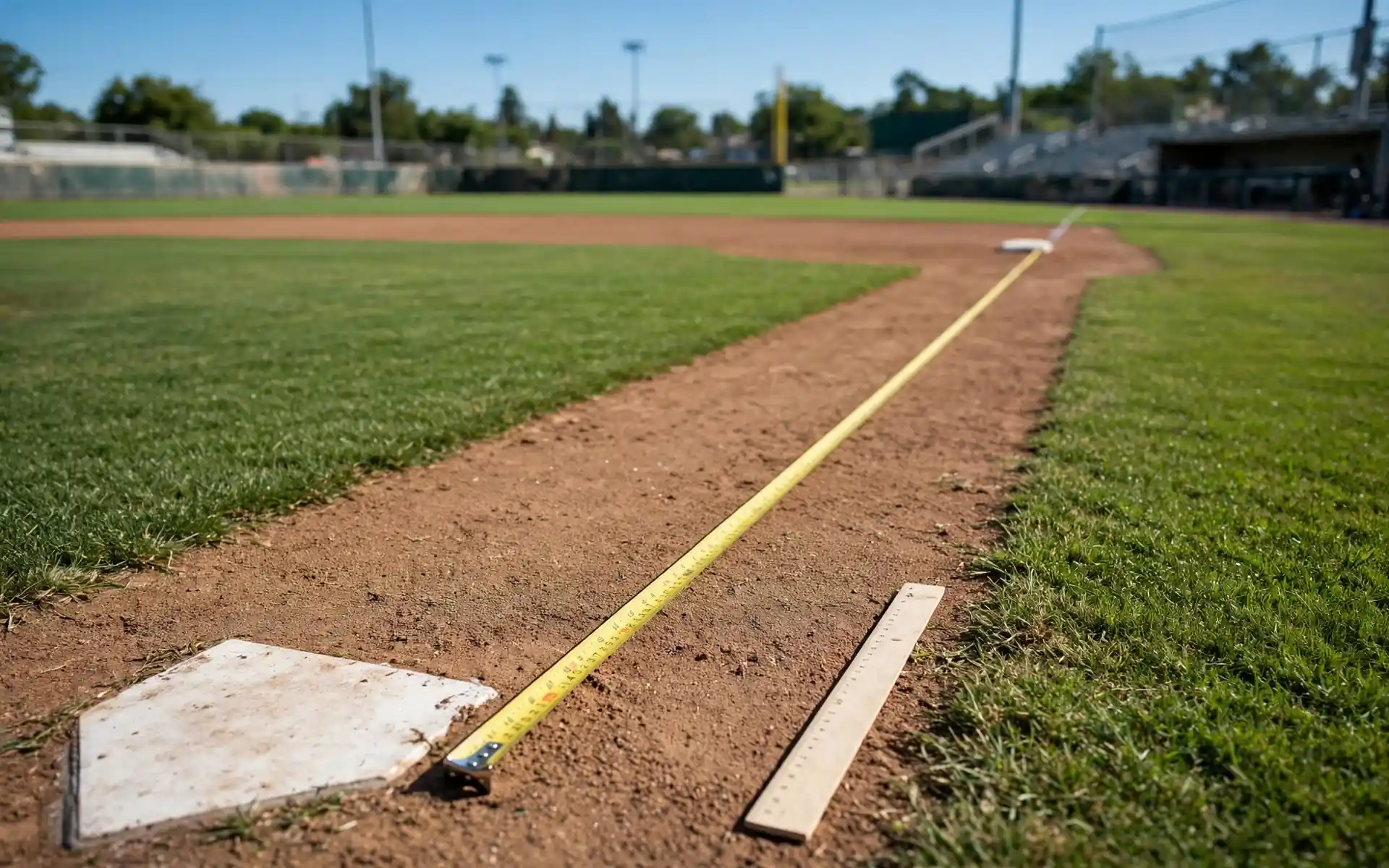
The baseball diamond is the article's cleanest exact, because its 90 feet is written down in the rulebook that governs the game. The Official Baseball Rules of Major League Baseball state it in one sentence: the distance between bases shall be ninety feet. Home plate, first base, second base, and third base sit at the corners of a 90-foot square, and every base path in the game — home to first, first to second, second to third, third to home — is exactly 90 feet. The same distance applies at college level and in high-school baseball, so the 90-foot diamond is the same square in every park in the country, from a high-school field in Ohio to a major-league stadium in New York. It has been the standard since 1857, when the National Association of Base Ball Players fixed it, and it has not changed since.
The fitting check is the bag, because the bases themselves are not points. The corners of the 90-foot square are the points the rule measures, and the base bags sit inside that square: first and third base are placed so they lie inside the square, and second base is centred on its corner, which means the physical distance between the bags themselves is closer to 88 feet. The bases are 18 inches square since 2023, up from 15 inches, and the diagonal from home plate to second base is 127 feet 3 inches. None of that makes the 90-foot figure wrong. It makes it a rulebook figure, and the grade says so: EXACT, with the measurement points printed beside it. Run from home plate to first base and you have run exactly 90 feet — the same 90 feet every professional player has run since the game was standardised.
2. A Nine-Story Building — About 90 Feet Tall (AVERAGE)
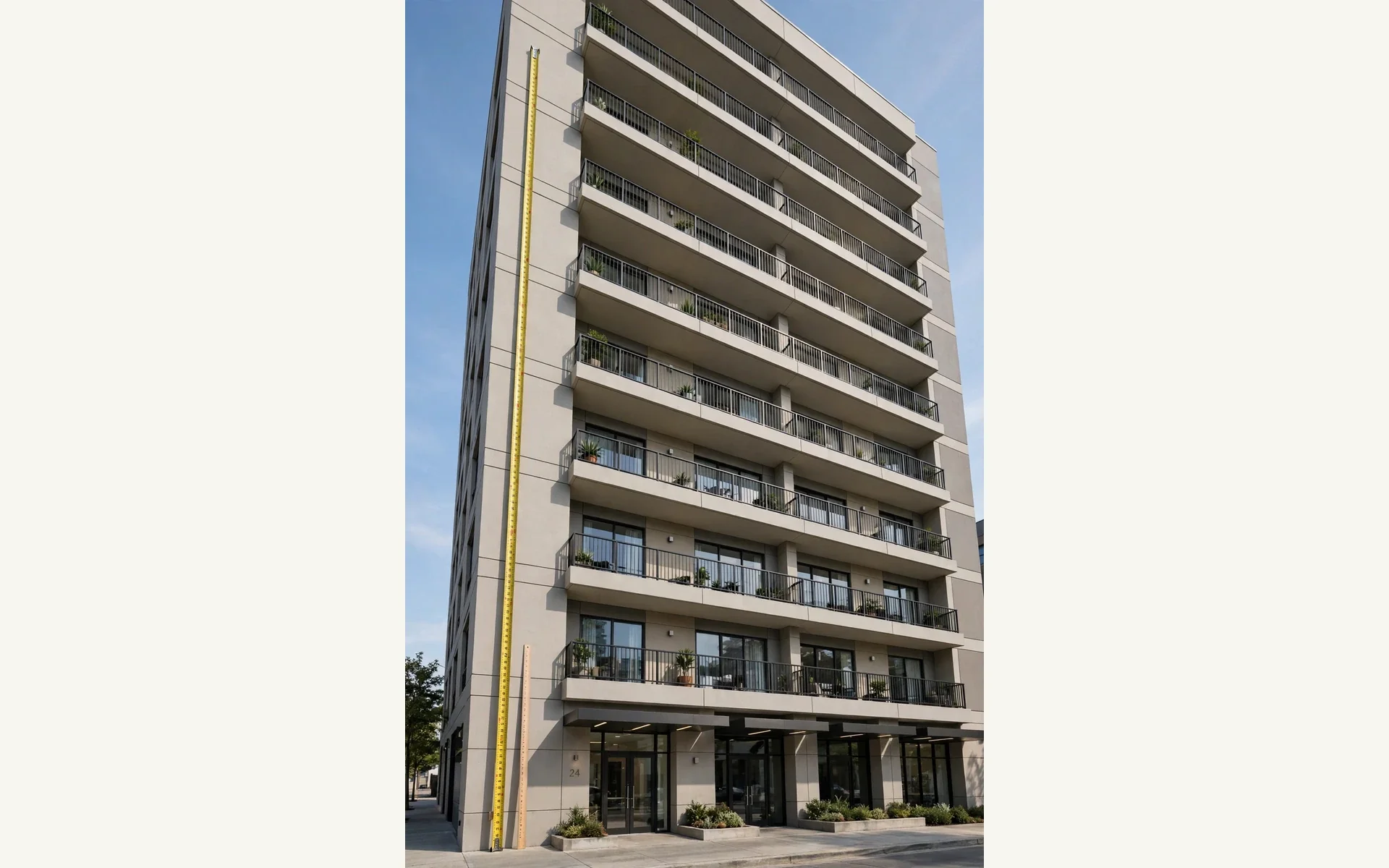
The nine-story building is the article's most useful average, because it is the one you can count from the street. The standard rule of thumb in construction is about 10 feet per story — residential buildings usually run 9 to 10 feet per floor, commercial buildings 10 to 14 feet — so nine stories at 10 feet each is 90 feet. That is the figure every rival list uses, and it is the figure this article uses too, with one difference: the range is printed beside it. A nine-story residential block is about 90 feet tall. A nine-story commercial building, with taller ceilings and deeper floor slabs, can run 90 to 120 feet or more. The 10-foot rule is a rule of thumb, not a building code, and the grade says so: AVERAGE, with the honest range 90 to 120 feet for commercial buildings printed beside the 90-foot residential figure.
The fitting check is the ground floor, because the first story is almost always taller than the rest. Lobbies, shopfronts, and entrances commonly add two to four feet to the ground floor, and the roof — parapet, plant room, lift housing — adds more on top. So a real nine-story building measured from the pavement to the top of the parapet is often 92 to 95 feet, not 90, and the 90-foot figure is the floor-to-floor sum rather than the building's full height. One rival list even uses the 10-foot rule to call a ten-story building 90 feet tall in one place and a nine-story building 90 feet tall in another, which is the same mistake in reverse: nine stories at ten feet is 90, ten stories at ten feet is 100, and the difference is a whole floor. Count nine floors on the block outside your window, and you are looking at about 90 feet — give or take a lobby.
3. The Golden Gate Bridge Deck — Exactly 90 Feet Wide (EXACT)
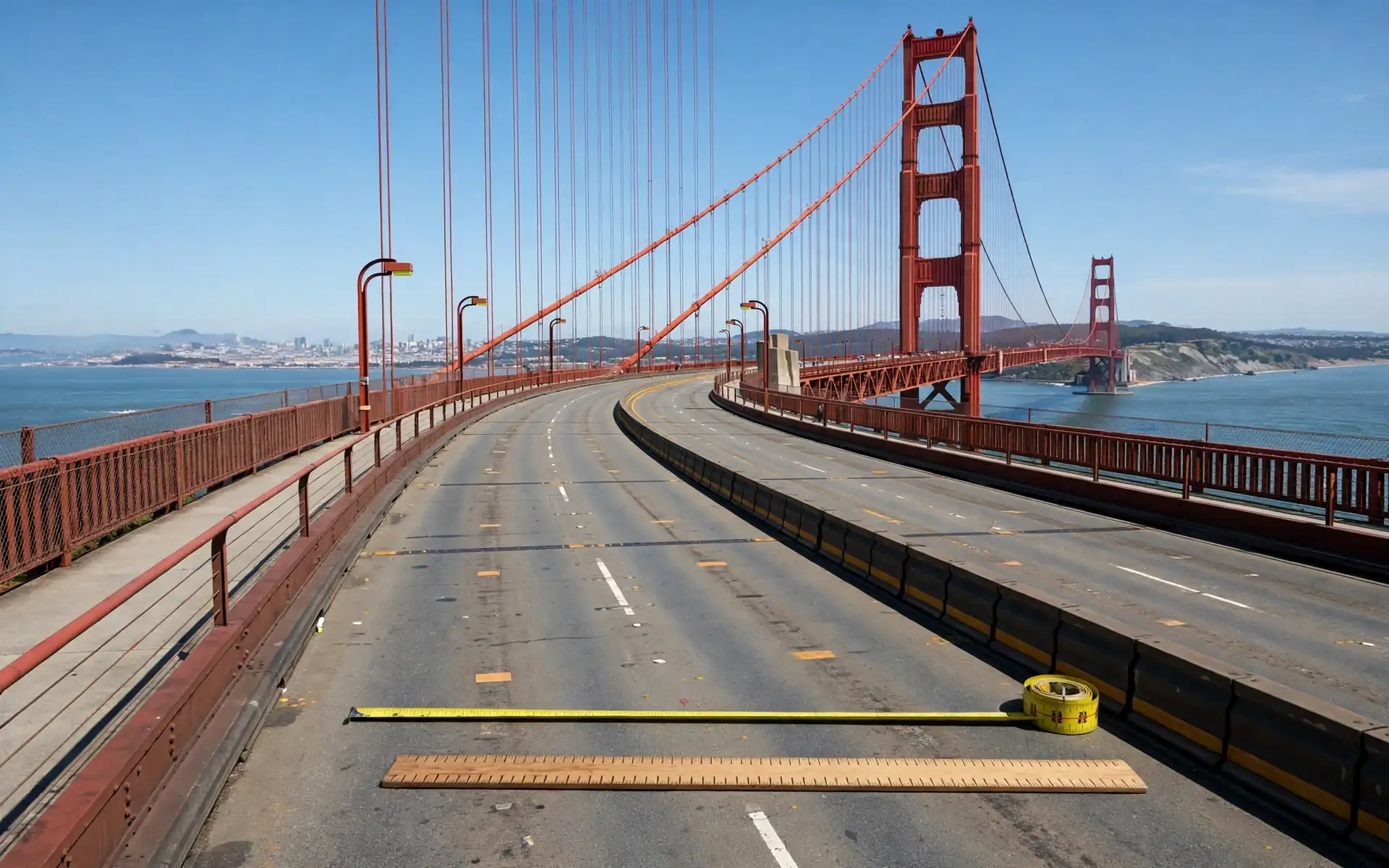
The Golden Gate Bridge is the article's most famous 90 feet, because it is a width millions of people have crossed without knowing the number. The bridge's published characteristics give its width as 90 feet — 27.4 metres — across a total length of 8,980 feet and towers 746 feet tall. The 90 feet is the full deck: six lanes of traffic plus a pedestrian walkway on either side, carried 220 feet above the water at high tide. The roadway itself, between the curbs, is 62 feet wide; the walkways and the structure around the roadway bring the total to 90 feet. The bridge opened in 1937, its deck was replaced section by section between 1982 and 1986 with a lighter steel deck, and the width stayed 90 feet through the whole rebuild — because the towers were built 90 feet apart in the deck's direction, and the deck fits the towers, not the other way round.
The fitting check is the curb, because the 90 feet is the deck and not the road. A driver crossing the bridge drives on 62 feet of roadway, and a pedestrian walks on the walkways outside it — so the 90 feet is the width of the whole structure, and the road is only part of it. The grade is exact because the figure is the bridge authority's own published dimension for this named bridge: width 90 feet, with the 62-foot roadway printed beside it. Drive across it and you have crossed 90 feet of bridge sideways — and 8,980 feet of bridge lengthways, which is the difference between the width of a road and the length of a crossing.
4. Noccalula Falls — 90 Feet Tall (LISTED)

Noccalula Falls is the article's most beautiful 90 feet, because it is a waterfall that drops the whole distance in one fall. The falls stand 90 feet tall on Black Creek in Gadsden, Alabama, dropping over a rock ledge at the foot of Lookout Mountain into Black Creek Gorge, and they are the centrepiece of the 250-acre Noccalula Falls Park, run by the City of Gadsden. The park's own descriptions and the city's guides agree on the figure: a 90-foot waterfall, with a gorge trail that passes behind the falls, a pioneer village, botanical gardens, and a miniature train around it. The falls were listed on the Alabama Register of Landmarks and Heritage in 1976, and the park opened in 1950 on land the city began buying in 1909. A nine-foot bronze statue of Noccalula, the Creek princess of the legend, stands above the falls and watches the water drop the same 90 feet she is said to have fallen.
The fitting check is the rain, because a waterfall's height is fixed and its flow is not. In normal rain the falls run about 20 feet wide across the ledge, with a smaller fall beside the main one, and in dry spells the flow thins to a ribbon — but the drop stays 90 feet in every season, because the ledge does not move. The grade is listed because the figure is the park's and the city's published height for this named waterfall, with the flow printed beside it: 90 feet of drop, 20 feet of width in normal rain. Stand on the gorge trail behind the falls and look up, and you are looking at 90 feet of falling water — the same height as a nine-story building, poured over a cliff.
5. Our Lady of the Rockies — 90 Feet Tall (LISTED)
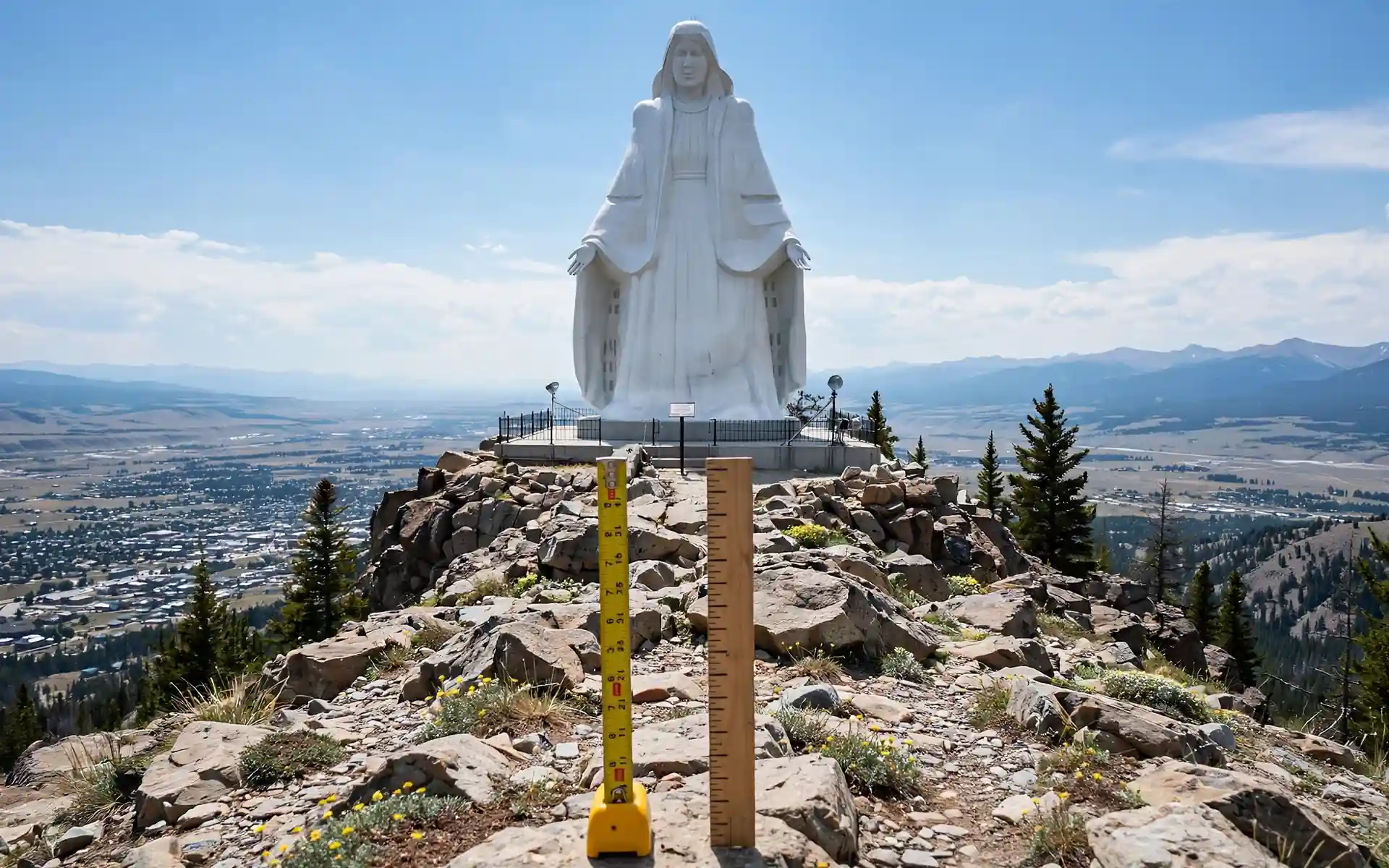
Our Lady of the Rockies is the article's most hard-won 90 feet, because the statue was built in pieces and flown to the top of a mountain by helicopter. The statue stands 90 feet tall on the Continental Divide above Butte, Montana, at a base elevation of 8,510 feet above sea level — about 3,500 feet above the town. It was conceived in 1979 by Butte resident Bob O'Bill as a tribute after his wife recovered from cancer, designed by mining engineer Laurien Eugene Riehl, built by volunteers in sections in the valley below, and airlifted in pieces by an Army National Guard helicopter in December 1985. It is dedicated to all women, especially mothers, it weighs about 80 tons, its hands are each eight feet long, and it is the largest statue of the Virgin Mary in North America. The published figure is 90 feet everywhere it is recorded — the statue's own guides, the city's guides, and the national register of roadside landmarks all give 90 feet.
The fitting check is the rounding, because this is the one object in the article whose published figure is a round number over a metric original. The statue's metric height is given as 27 metres, and 27 metres converts to 88.58 feet — about a foot and five inches short of 90. One reference even lists the height as 89 feet. The grade is listed, not exact, because the figure is the published height for this named statue, and the rounding is printed beside it: the statue is called 90 feet tall, its metric figure is 27 metres, and the difference is the width of a doorway. There is also a story behind the number: the statue was first planned at 120 feet tall, and the aviation authority told the builders that anything taller than 90 feet would need a blinking light on its head — so it was built at 90 feet, and its head and hands are oversized for its body. Stand in Butte and look up at the ridge, and you are looking at 90 feet of statue — and a building permit written by the sky.
6. An NBA Basketball Court — 94 Feet Long, Four Feet Over (EXACT)

The basketball court is the article's most famous near-miss, because every rival list uses it and none of them prints the miss honestly. A standard NBA basketball court is 94 feet long and 50 feet wide — 28.65 by 15.24 metres — with a rim 10 feet above the floor at every level of the game. That makes it four feet longer than 90 feet, and the four feet is the length of a doorway: the court is almost 90 feet, and almost is the word that matters. One rival list says college courts "often hover closer to 90 feet", and that is wrong too — NCAA courts are 94 by 50 feet, identical to the NBA, and the only smaller standard court is the international one, at 28 by 15 metres, which is 91.86 feet long and still not 90. The grade is exact because the figure is the league's own dimension for this named court: 94 feet, not 90, and the four feet is printed in the heading.
The fitting check is the run, because the court is 94 feet but the game is played in less. The three-point line sits 23 feet 9 inches from the basket at the top of the arc and 22 feet in the corners, the free-throw line is 15 feet from the backboard, and the key is 16 feet wide — so a player sprinting from one baseline to the other covers 94 feet, but most of the game's running happens inside 30 feet of the basket. The four feet over is the margin a fast break lives in: a player who beats the defence by a step has about four feet of court to spare, which is the same four feet this article's number misses by. Run from one baseline to the other and you have run 94 feet — then stop four feet short, and you have run 90.
7. An ATR 72-600 Airliner — 89 Feet 2 Inches Long, Ten Inches Short (LISTED)

The ATR 72-600 is the article's closest near-miss, because it misses 90 feet by ten inches — less than the length of a shoe. The ATR 72-600, the twin-engine turboprop regional airliner built by the Franco-Italian manufacturer ATR, is listed by the manufacturer at an overall length of 27.17 metres — 89 feet 2 inches — with a wingspan of 27.05 metres (88 feet 9 inches) and a height of 7.65 metres (25 feet 1 inch). It seats up to 78 passengers and flies short regional routes, which is why it is the aeroplane most people actually board on a short hop: the big jets in this series are 79 feet tall or 238 feet long, and the ATR is the one that comes within ten inches of 90 feet. One rival list rounds the length to "89 feet 1.5 inches", and the manufacturer's own figure is 89 feet 2 inches — a half-inch difference that matters only because this article prints the manufacturer's number, not the rounding. The grade is listed because the figure is the manufacturer's own specification for this named aircraft, with the miss printed in the heading: 89 feet 2 inches, not 90, and the ten inches is the whole story.
The fitting check is the nose, because the length is measured from the tip of the nose to the tip of the tail, and the aeroplane's propellers stick out beyond neither. The ATR's six-blade propellers are 3.93 metres across, and they turn in front of the wings, not ahead of the nose — so the 89 feet 2 inches is the fuselage and tail, and nothing on the aeroplane reaches 90 feet. The ten inches is the length of a paperback book, and it is the closest any airliner in this series comes to 90 feet from below. Stand at the nose of an ATR 72-600 and walk to its tail, and you have walked 89 feet 2 inches — then take one more step, and you have walked 90.
Where the Other Lists Get 90 Feet Wrong
Six wrong numbers about 90 feet circulate so widely that they deserve their own section, because each one is stated confidently on a page that ranks for this exact question. First, the shark: one popular list says the Megalodon "was believed to grow up to 90 feet long", and it was not — the scientifically justifiable maximum, from the largest teeth held in public museums, is about 50 feet, according to the DePaul University paleobiologist who re-measured the species in the journal Historical Biology. The claim is wrong by forty feet, which is nearly the length of the shark itself. Second, the aeroplane: another list says the Boeing 737's wingspan "clocks in right around 90 feet", and no 737 has a wingspan near 90 feet — the original 737-100 and 737-200 span 93 feet, the Classic series spans 94 feet 9 inches, the Next Generation spans 112 feet 7 inches (117 feet 5 inches with winglets), and the MAX spans 117 feet 9 inches. Third, the whale: a list says sperm whales "have stretched close to 80–90 feet", and the largest reliably measured sperm whale is 20.7 metres — 67.9 feet — with typical mature males at 52 to 60 feet; the 80-to-90-foot claims come from jawbone extrapolations and the story of the whale that sank the Essex, and they are disputed as exaggerations. Fourth, the pool: a guide says an Olympic pool's ten lanes, "each measuring 9 feet in width", add up to 90 feet — and the lanes are 2.5 metres (8.2 feet) wide under the world governing body, so ten lanes make 25 metres, which is 82 feet, not 90; the pool itself is 50 metres (164 feet) long. Fifth, the college court: a list says college courts "often hover closer to 90 feet", and NCAA courts are 94 by 50 feet, identical to the NBA — only the international court is smaller, at 91.86 feet, and that is still not 90. Sixth, the hoops: a list whose heading promises nine basketball hoops says in its own text to "visualize ten such heights" — and ten rims at 10 feet each is 100 feet, not 90; the heading is right and the text is wrong by a whole hoop. None of these six numbers belongs in a 90-foot article, and all six are here so you never have to learn that from a purchase, a building plan, or a swimming pool that does not fit its hall.
Fit It or Build It: What 90 Feet Means in Practice
Ninety feet is a number you meet in a permit office, a driveway, and a marina, because it is a threshold. First, the driveway: a standard American football field's 30-yard line is 90 feet from the goal line, which means a 90-foot driveway is three first downs long — and a car parked nose to tail in it leaves room for about five cars, because a typical car is about 15 feet long. Second, the building: a nine-story block at the standard ten feet per story is 90 feet tall, which is why many city height limits sit near 90 feet — below it you are a neighbourhood building, above it you are a tower, and the planning meeting is about the difference. Third, the bridge: the Golden Gate's 90-foot deck carries six lanes and two walkways, which is why a 90-foot road is wide enough for six lanes of traffic and a pavement on each side — and a road built to 90 feet for a bridge deck fits, because the deck was built to 90 feet first. Fourth, the field: a baseball diamond's 90-foot base path is the distance a runner must cover in about four seconds, which is why a 90-foot sprint is the standard fitness test for a base runner — and a field built with 85-foot base paths, like a youth field, changes the game entirely. Fifth, the aeroplane: an ATR 72-600 at 89 feet 2 inches needs a parking stand 90 feet long, because the ten inches of margin is the space the ground crew walks in — and a stand built to 89 feet does not fit the aeroplane it was built for. None of these replaces a tape measure for anything that must fit, but all five will tell you whether 90 feet is the size you think it is before the concrete is poured, the stand is painted, or the building is drawn.
How 90 Feet Compares With Other Lengths
Readers comparing nearby sizes may also want the site’s guides to 80 feet, 70 feet, 60 feet, 50 feet, 40 feet, 30 feet, 20 feet, and 12 feet for the feet series, and 11 cm for the centimetre series. Each of those guides follows the same rule as this one: the spec sheet, the grade, and the miss printed in full. The next size up is a step up to 100 feet, and the complete feet size guide covers every feet size from 1 to 100.
Frequently Asked Questions
How many meters is 90 feet?
90 feet is 27.432 metres exactly. Multiply 90 by 0.3048 — the international foot, fixed by the 1959 agreement — and you get 27.432, with no rounding involved. For everyday use, 27.43 metres is close enough to picture it and wrong enough to misbuy by if you are ordering material: the 0.432 metres is about 17 inches, and 17 inches at this size is a gap that shows.
How many inches is 90 feet?
1,080 inches exactly. Multiply 90 by 12 and you get 1,080 with no rounding, because the foot is defined as exactly 12 inches. In centimetres that is 2,743.2 cm, and in yards it is exactly 30 yards, which is the figure a tape measure will show if it is marked in yards.
How many yards is 90 feet?
Exactly 30 yards. Divide 90 by 3 and you get 30 with no remainder, which makes 90 feet one of the cleanest conversions in the imperial system — a third of a football field's 100 yards, or three first downs of ten yards each. For anything that must fit, use 30 yards; for a quick estimate in your head, a third of a football field is the picture to carry.
How many stories is 90 feet?
About nine stories in a residential building, at the standard 10 feet per story — and about seven to eight stories in a commercial building, where each story runs 10 to 14 feet. The number is not fixed, because story heights vary by building type, by country, and by whether the ground floor has a lobby. For a quick estimate, 90 feet is nine residential stories; for a real building, count the floors and multiply by 10, then add two to four feet for the lobby and the roof.
How far apart are the bases on a baseball diamond?
Exactly 90 feet, at professional, college, and high-school level. The Official Baseball Rules state that the distance between bases shall be ninety feet, and the figure has been the standard since 1857. Youth leagues use shorter base paths — Little League uses 60 feet — so the 90-foot diamond is the adult game, not the children's one. The diagonal from home plate to second base is 127 feet 3 inches.
Is a Megalodon 90 feet long?
No. The scientifically justifiable maximum for Megalodon is about 50 feet (15 metres), based on the largest teeth held in public museums and published in the journal Historical Biology. Older estimates ran as high as 80 to 100 feet, but those came from teeth in private collections that cannot be re-measured, and the re-analysis found that individuals over 50 feet must have been exceptionally rare. A 90-foot Megalodon is a film monster, not a fossil measurement.
Is a Boeing 737's wingspan 90 feet?
No. No Boeing 737 has a wingspan near 90 feet. The original 737-100 and 737-200 span 93 feet, the Classic series spans 94 feet 9 inches, the Next Generation spans 112 feet 7 inches (117 feet 5 inches with winglets), and the MAX spans 117 feet 9 inches. The "right around 90 feet" claim on some lists is wrong for every generation of the aeroplane, and the closest any 737 comes to 90 feet is the original's 93 — three feet over.
What is 90 feet compared to a basketball court?
An NBA basketball court is 94 feet long, so 90 feet is four feet shorter than the court — one step short of the far baseline. An ATR 72-600 airliner is 89 feet 2 inches long, so 90 feet is ten inches longer than the aeroplane — one step past its tail. The two near-misses bracket the number: 89 feet 2 inches on one side, 94 feet on the other, and 90 feet in the gap between them. That is the most honest way to picture 90 feet — not as a thing, but as the step between two things you already know.
Final Thoughts
Ninety feet is the rare measurement that is honest and still misunderstood, because 27.432 metres can be a base path, a height, a width, a drop, or a length — and the number alone never says which. Now you know it as a baseball diamond's base path fixed by its rulebook, a building's nine stories fixed by a rule of thumb, a bridge's deck fixed by its authority, a waterfall's drop fixed by its park, a statue's height fixed by its builders, a basketball court's length fixed by its league, and an airliner's length fixed by its manufacturer — and you know which of those you can trust to the foot and which you must measure yourself. The rule that runs through all seven is the same one this site always uses: trust the spec sheet, print the deviation, and let the name stay on the box where it belongs. Measure twice, in the direction the object actually travels, and 90 feet will fit the first time.
