
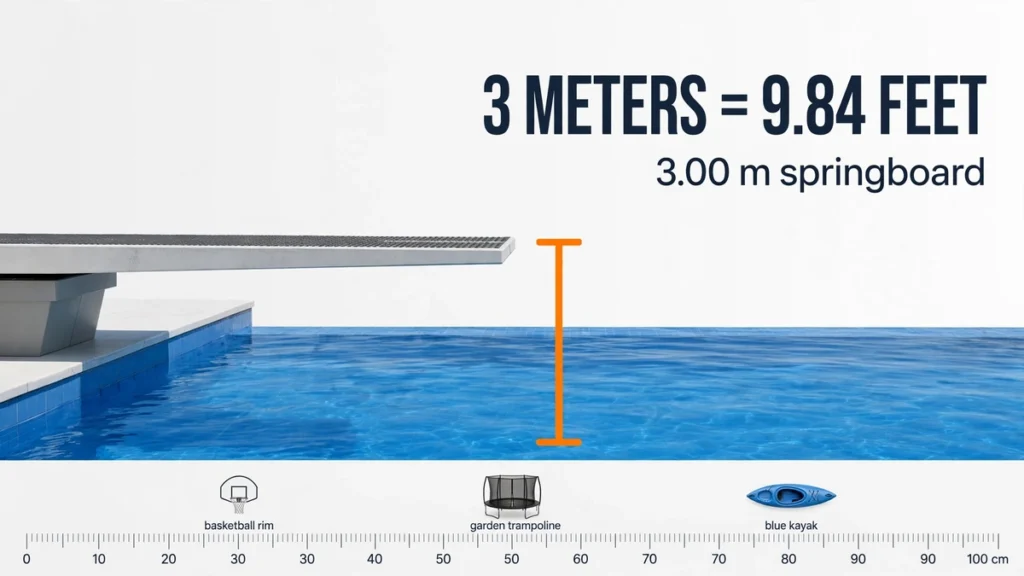
If you have ever wondered how long is 3 meters, the short answer is 9.84 feet — and the longer answer is that 3 meters is the length where a measurement stops being an object you hold and starts being a space you stand in. A centimetre is a knife blade, a metre is a stride, but 3 metres is a wall, a patio, a pool, a garden — it is the smallest length that behaves like a room. That is why it is so hard to picture: you cannot hold it in your hand the way you hold a ruler, and you cannot pace it off the way you pace a metre, because three metres is just past the reach of your arms and just short of a distance worth walking. It sits in the gap between the body and the building, and every guide about it tries to close that gap with something you already know — a car, a sofa, a bed — and almost every one of those comparisons is wrong by a margin that matters.
Below are seven single, named things, each checked against its own specification, with the miss printed wherever a thing misses. Three of them are exact at 3 metres for the dimension stated — an Olympic springboard, a patio umbrella canopy, and a pair of curtains sold by that number — and the other four land 4.8 to 5 centimetres over it, all of them 10-foot items that the guides call “3 metres” without ever printing the 5-centimetre gap. Every object’s image sits immediately after its heading, and no object is a stack, a multiple, a fraction, or a category guess. You will not find a king bed plus walking space here, because a bed plus a gap is arithmetic wearing a mattress, and you will not find a parking space, because a parking space is 9 feet wide and 18 feet long and 3 metres is neither of those numbers. By the end you will know 3 metres as a springboard, a rim, a trampoline, a kayak, an umbrella, a tree, and a curtain — and you will know which of those you can trust to the centimetre and which you must measure yourself.
Quick Answer
3 meters is 9.84 feet exactly — 300 centimetres, 3,000 millimetres, 118.11 inches, and 3.28 yards. But do NOT call it 10 feet: 10 feet is 3.048 metres, which is 4.8 centimetres longer than 3 metres, and 4.8 centimetres at this size is the difference between a tree that fits under the ceiling and one that does not. The honest shortcut is 9 feet 10 inches — and the honest object is an Olympic 3-metre springboard, 3 metres above the water by its sport’s own rules.
Why 3 Metres Is a Room, Not an Object
Three metres is the first length in this series that you cannot pick up. One metre is a long stride, two metres is a tall doorway, and both of those are things your body already knows — you have walked a metre and ducked under two. Three metres is different, because it is longer than you are tall, longer than your arms can reach, and longer than any single piece of furniture you own is likely to be. Stand in the middle of your living room and stretch your arms wide: fingertip to fingertip is roughly your height, about 1.7 metres for most adults, and you would need nearly two of yourself, laid end to end, to cover 3 metres. That is why the number feels abstract in a way that 17 centimetres never does. A santoku blade is a thing; 3 metres is a place. It is the width of a small bedroom wall, the depth of a garden bed, the span of a patio umbrella, the height of a ceiling in a house that feels generous the moment you walk in. The guides that list “things that are 3 metres long” keep reaching for cars and sofas because those are the biggest single objects in a normal life, and even those do not fit: a compact car is 4.5 metres long, a three-seat sofa is 2.3 metres at most, and a king bed is 2.03 metres — every one of them misses by a margin the guide never prints.
The second reason 3 metres feels like a room is that the building trade already treats it as one. A standard interior door is 2.03 metres tall and a standard ceiling in a modern home is 2.4 to 2.7 metres high, so 3 metres is the ceiling height that architects specify when they want a room to feel airy — the “luxury” height that makes a living room breathe. A 3-metre curtain is sold as a pair precisely because it dresses a floor-to-ceiling window in exactly such a room, and a 3-metre umbrella is sold by its canopy diameter precisely because it shades a patio table that seats four. The number shows up wherever a space has to fit a person comfortably and still have air left over: 3 metres of clearance over a walkway, 3 metres of depth for a scuba drill, 3 metres between a diving board and the water it hangs over. It is not a coincidence that the most exact object in this article is a springboard. A springboard is not a thing you hold; it is a height you stand on, over a pool you swim in, in a hall built around it. Three metres is a measurement of rooms, and the only honest way to picture it is to stand inside one.
The 7 Objects
Each object below carries its evidence grade in the heading. EXACT means the figure is a standard’s or an authority’s own dimension for the named thing. LISTED means the figure is the manufacturer’s or operator’s published specification for the named model. The grade is the whole point: a list that never grades its numbers is asking you to trust it, and this article would rather show you the receipt.
1. An Olympic 3-Metre Springboard — 3.00 M Above the Water (EXACT)
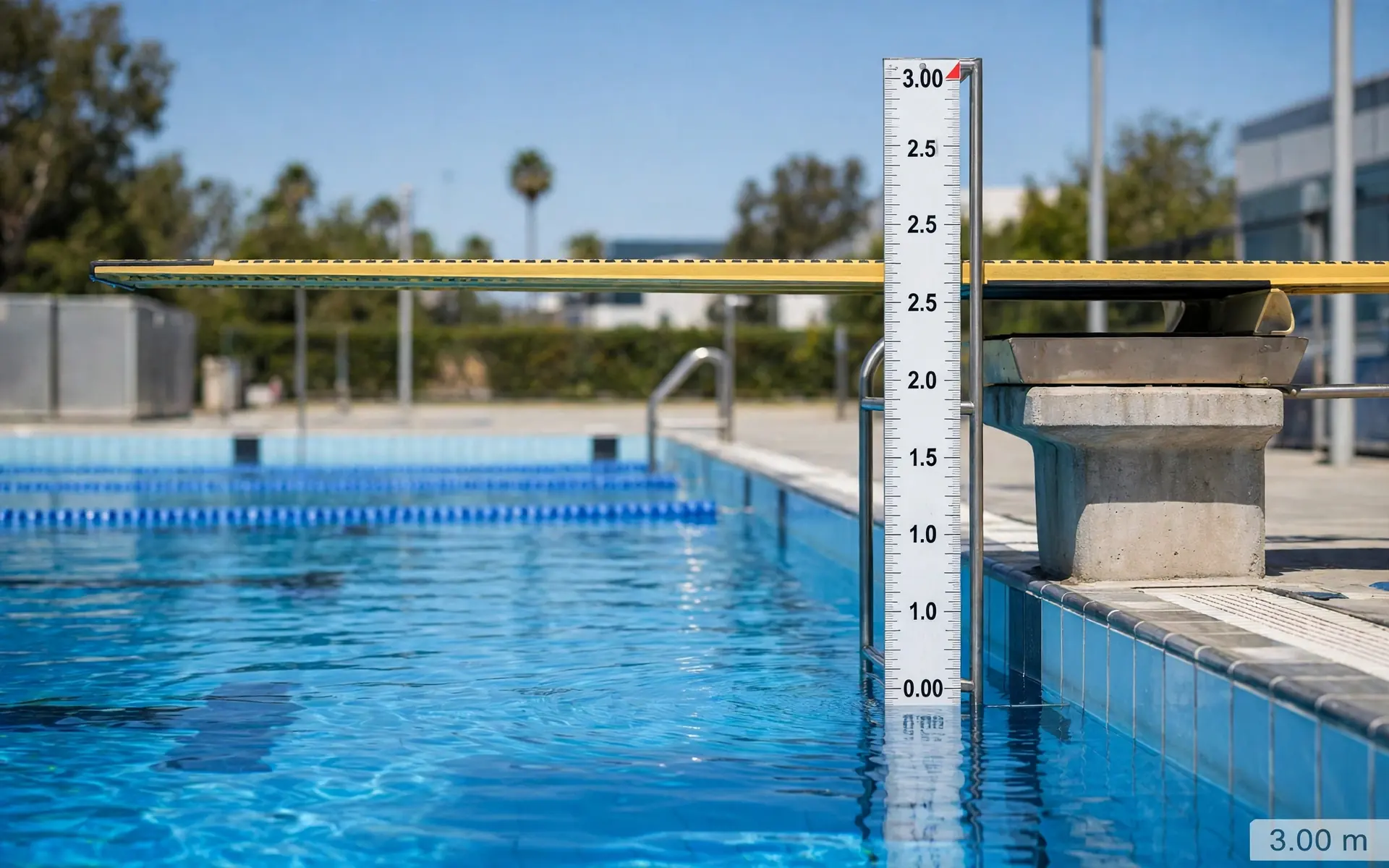
The springboard is the article’s cleanest exact, because its 3 metres is written into the name of the event itself. The diving rules set springboards at 1 metre and 3 metres above the water surface, and the 3-metre board is the one used in Olympic competition — the individual 3-metre springboard and the synchronised 3-metre springboard, for men and women, are four of the eight diving events on the Olympic programme. The board is 4.87 metres long and half a metre wide, and the height is measured from the water surface to the top of the board, with the rules allowing the height to vary by no more than 5 centimetres over and not at all under — so a competition board is 3 metres, or a fraction above it, and never below.
The fitting check is the water, because a 3-metre board is only half the measurement — the pool below it has to be deep enough to catch a diver falling from 9 feet 10 inches, and the rules demand several metres of water under the board before anyone is allowed to dive from it. A backyard pool with a 3-metre board on a shallow end is not a diving pool, it is an accident waiting for a date, and the guides that call any raised board “about 3 metres” never say whether they mean the board, the drop, or the board plus the stand it sits on. The grade is exact because the figure is the sport’s own dimension for the named event: 3 metres above the water, by definition, and the board in your pool is the proof. Stand on one and look down, and you are standing exactly 3 metres above the water — no conversion required, and no other object in this article can say that.
2. A Basketball Rim — 3.05 M Above the Floor (EXACT)
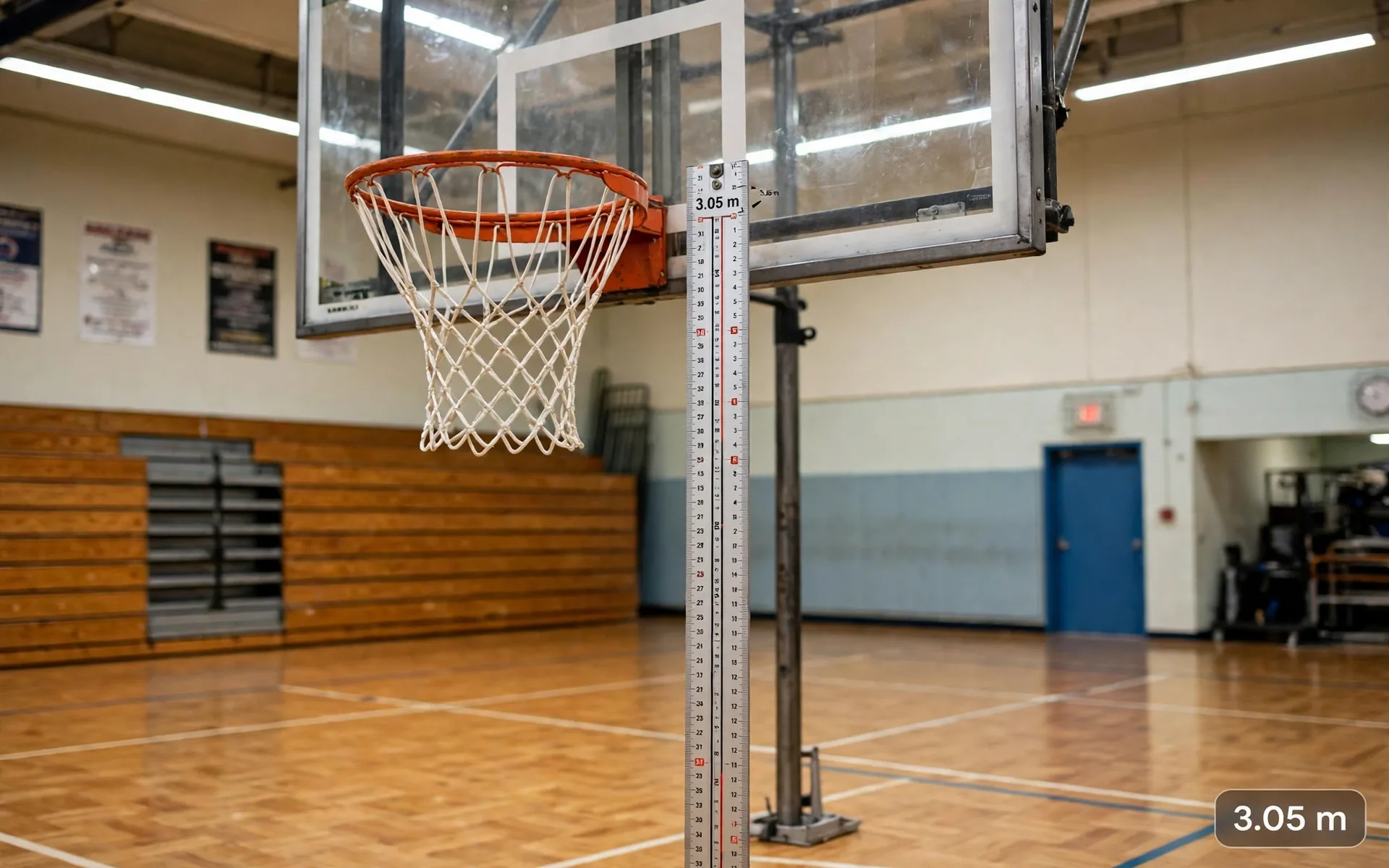
The rim is the article’s most famous near-miss, and the one every guide gets wrong by calling it equal. The basketball rules fix the top of the rim at 10 feet above the playing surface — 3.05 metres — in the NBA, in FIBA, in college ball, and in every high school gym in the United States, and the height has not changed since the sport was invented in 1891, when the first baskets were nailed to a gymnasium balcony railing that happened to sit 10 feet above the floor. Ten feet is 3.048 metres, which the rulebooks round to 3.05, so the rim sits 4.8 centimetres above 3 metres — the width of two fingers — and that is the whole story of this object: it is the closest thing in sport to 3 metres, and it is not 3 metres. It is the rim in your driveway, the rim at the park, and the rim in every arena on television, and every one of them is the same height, because the height is the game.
The fitting check is the floor, because the rim’s 3.05 metres is measured from the playing surface to the top edge of the rim, and a rim hung on a sloped driveway or a court with a raised floor is not 3.05 metres above anything you can stand on. A rim that looks “about 10 feet” from the ground is 10 feet from the court and something else from the grass beside it, and the guides that tell you to picture a basketball hoop never say whether they mean the rim, the backboard, or the pole — the backboard’s lower edge sits at 2.74 metres, a full 31 centimetres below the rim, and a hoop measured to the board is a different number entirely. The grade is exact because the figure is the sport’s own dimension for the named thing: 10 feet, 3.05 metres, by the rulebook, and the 4.8-centimetre miss is printed in the heading itself. Jump for it and you will feel the 5 centimetres — it is the distance between your fingertips and the rim on the jump you almost make.
3. A Skywalker 10 Ft Round Trampoline — 3.048 M Across (LISTED)
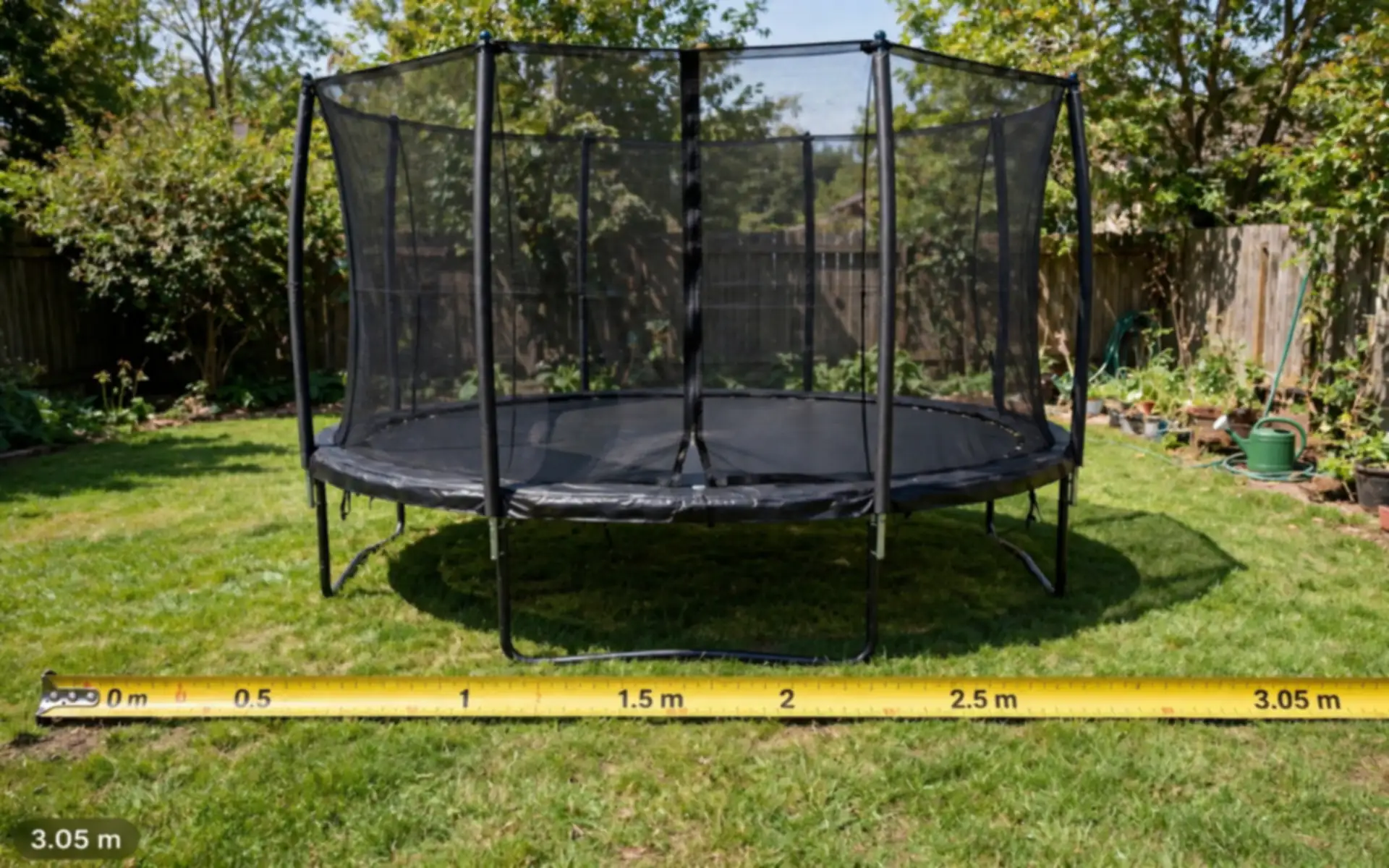
The trampoline is the article’s most useful near-miss, because it is the 3-metre object you can walk all the way around. Skywalker’s 10-foot round trampoline with enclosure lists its frame at 120 inches by 120 inches — 10 feet across, 3.048 metres — with a 175-pound maximum user weight and 64 springs under the mat, and the 10-foot size is the one sold for small backyards precisely because it fits where a 12-foot or 14-foot frame will not. It is the trampoline in the garden, the trampoline in the park, and the trampoline in the catalogue, and every one of them is the same width across the frame, because the frame is the product. Stand at one edge and look across to the other, and you are looking at 3.048 metres — 4.8 centimetres past the number in this article’s title, and the same in every colour the trampoline is sold in.
The fitting check is the mat, because the trampoline’s 10 feet is its frame diameter and its jumping mat is only about 8 to 8.5 feet across — the springs and the padding over them take up the outer ring, so a child bouncing in the middle is jumping on a surface a full 45 centimetres narrower than the number on the box. A garden, a fence line, or a cover bought against “3 metres” fails by nearly half a metre if you measure the mat instead of the frame, and the guides that call a trampoline “almost exactly 3 metres” never say whether they mean the frame, the mat, or the enclosure — the enclosure stands about 2.8 metres tall, which is a different number in a different direction. The grade is listed because the figure is the maker’s own listing for this named model, with the deviation printed in full: 120 inches, not 118.11, and the 4.8 centimetres is the whole story. Measure across the frame before you measure the garden, because the frame is the object in this article you have to fit through a gate.
4. A Pelican Argo 100X Kayak — 3.05 M Long (LISTED)
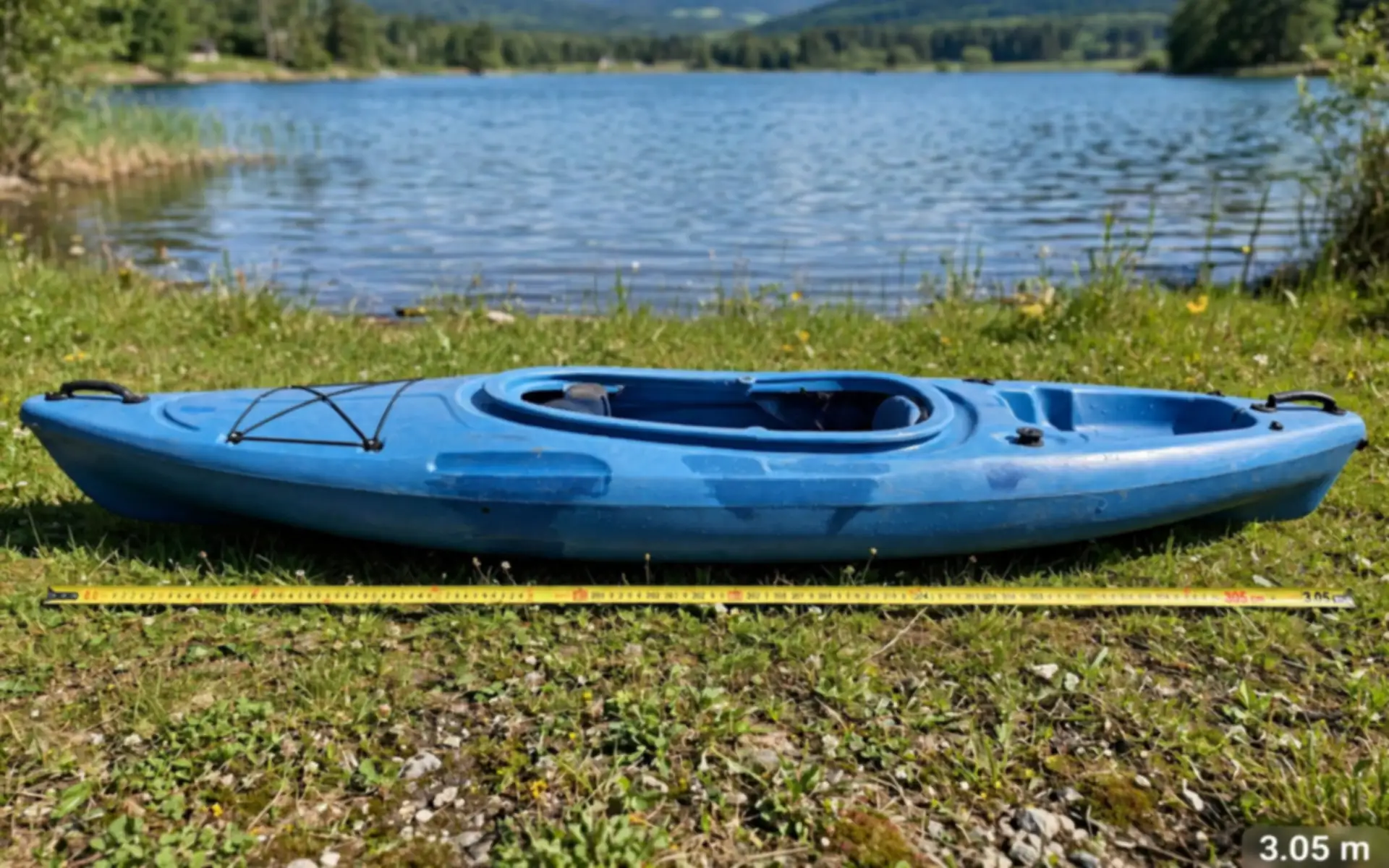
The kayak is the article’s longest near-miss by the smallest margin, and the one that has to fit through the most doors. Pelican’s own specification lists the Argo 100X recreational sit-in kayak at 10 feet long — 120 inches, 305 centimetres — 28 inches wide, 36 pounds, with a 275-pound maximum capacity, moulded from the company’s RAM-X polyethylene, and an independent test lab measured the same hull at 3.05 metres, confirming the maker’s number to the centimetre. Lay one on the ground beside a tape measure and you are looking at 3.05 metres — 5 centimetres past the number in this article’s title, and the same in every colour the kayak is sold in.
The fitting check is the roof rack, because a 3.05-metre kayak is longer than most car roofs and longer than most garage walls are deep, and the number that matters for transport is not the length but the length plus the overhang the law allows — a kayak that fits the car may not fit the garage, and a kayak that fits the garage may not fit through the gate to the water. A roof rack, a wall mount, or a storage sling bought against “3 metres” fails by 5 centimetres if you measure the hull and forget the carry handles, which stick out past the bow and stern by a couple of centimetres each, and the guides that call a kayak “about 10 feet” never say whether they mean the hull, the handles, or the kayak with its paddle strapped on. The grade is listed because the figure is the manufacturer’s own specification for this named model, with the deviation printed in full: 10 feet, 3.05 metres, and the 5 centimetres is the whole story. Measure the hull before you measure the car, because the kayak is the object in this article you have to carry somewhere.
5. An Instahut 3 M Cantilever Patio Umbrella — 3.00 M Canopy (LISTED)
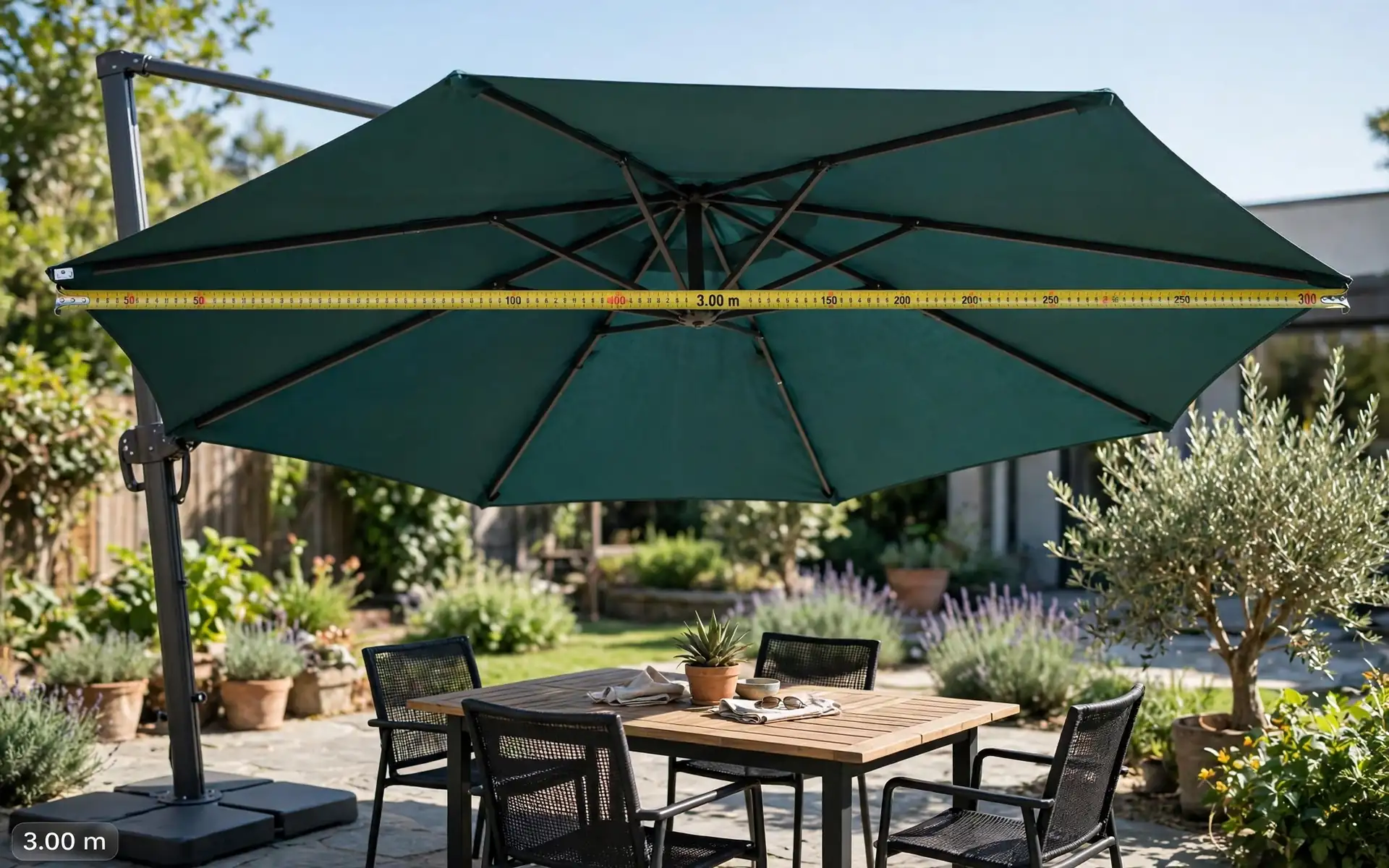
The umbrella is the article’s second exact, and the one that shades the most space. Instahut’s 3-metre cantilever umbrella lists its canopy diameter at 3 metres — 300 centimetres — on a side-post frame, with an overall height of 2.8 metres and 2.3 metres of clearance underneath, in UPF 50+ polyester, and the 3-metre size is the standard for a patio table that seats four, because it throws a circle of shade just wide enough for the table and the chairs around it. Open one over your table and you are sitting under exactly 3 metres of shade — no conversion required, and the same in every colour the umbrella is sold in.
The fitting check is the base, because the umbrella’s 3 metres is its canopy and its base is a separate square a metre across, filled with sand or water to 72 kilograms, and a patio, a deck, or a balcony bought against “3 metres” fails if you measure the shade and forget the footprint — the canopy overhangs the table by design, and a 3-metre canopy on a 2.5-metre deck hangs over the railing and drips rain onto the neighbour’s garden. The guides that call patio umbrellas “almost always 3 metres across” never say which umbrella they mean, because umbrellas are sold in 2.7-metre, 3-metre, and 3.5-metre canopies, and a 2.7-metre canopy is 30 centimetres short of the number in this article’s title — a full chair’s width of missing shade. The grade is listed because the figure is the maker’s own listing for this named model: 300 centimetres, by the maker’s own sheet, and the canopy in your garden is the proof. Measure the canopy before you measure the patio, because the umbrella is the object in this article you sit under.
6. A Balsam Hill BH Fraser Fir Christmas Tree, 10 Ft — 3.048 M Tall (LISTED)
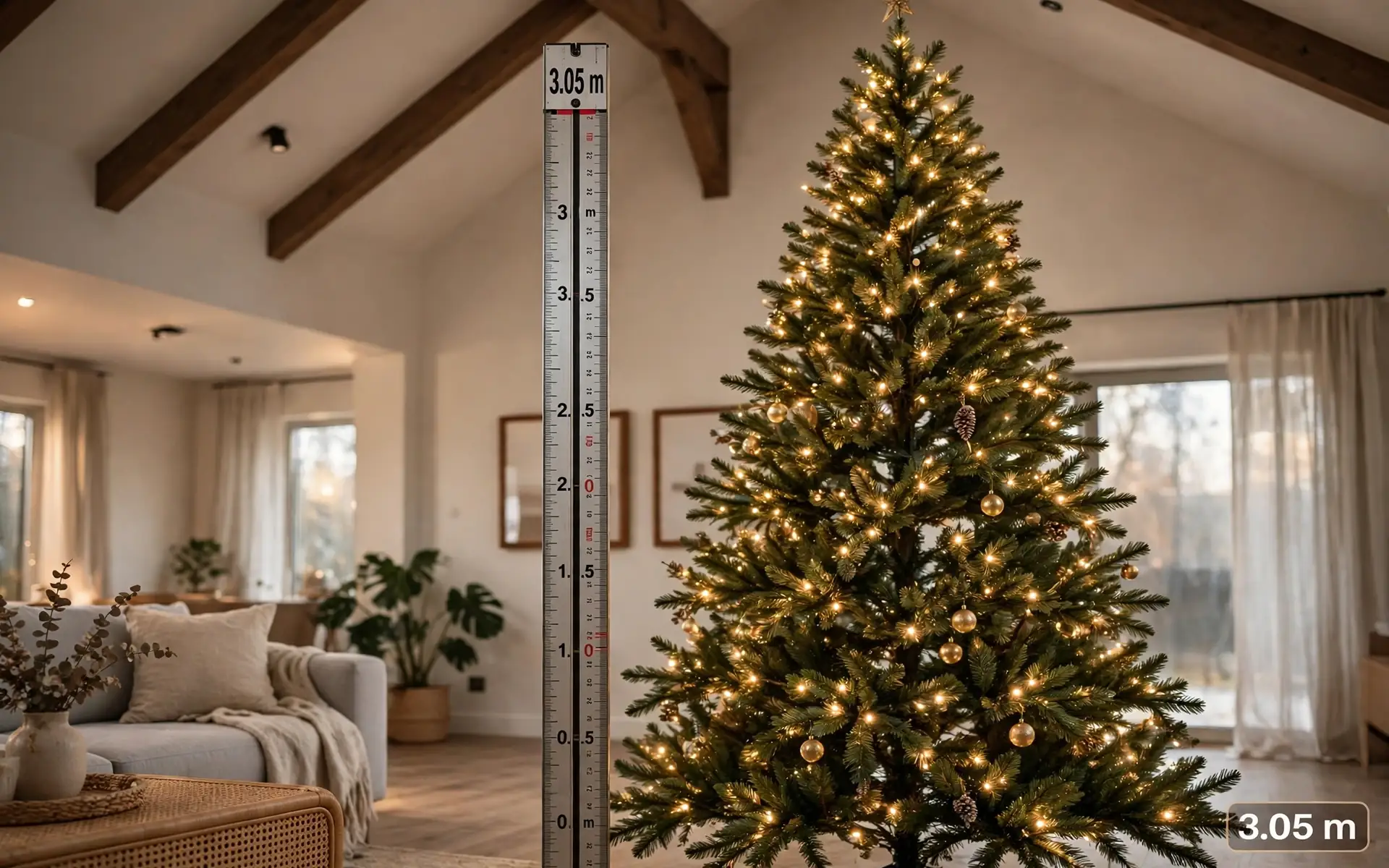
The Christmas tree is the article’s tallest near-miss, and the one with the most expensive fitting check. Balsam Hill’s BH Fraser Fir lists its 10-foot size at 65 inches deep by 65 inches wide by 120 inches high — 3.048 metres tall, with 5,173 branch tips — and the 10-foot size is the one sold for rooms with vaulted or very high ceilings precisely because it does not fit anywhere else. Stand one in your living room and you are looking at 3.048 metres — 4.8 centimetres past the number in this article’s title, and the same in every lighting option the tree is sold in.
The fitting check is the ceiling, because a 3.048-metre tree needs a ceiling higher than 3.048 metres, and most modern ceilings are 2.4 to 2.7 metres high — a full 35 to 65 centimetres too low — so the tree that looks “about 3 metres” in the catalogue will not stand up in the room it was bought for. A 10-foot tree under a 9-foot ceiling has to be bent, cut, or returned, and the guides that call Christmas trees “7 to 9 feet” never say which tree they mean, because trees are sold in half-foot steps from 4.5 feet to 12 feet, and a 9-foot tree is 2.74 metres — 26 centimetres short of the number in this article’s title, a full shelf’s height of missing tree. The grade is listed because the figure is the maker’s own listing for this named model, with the deviation printed in full: 120 inches, not 118.11, and the 4.8 centimetres is the whole story. Measure the ceiling before you measure the tree, because the tree is the object in this article you cannot shorten.
7. IKEA SANELA Curtains, 140×300 Cm — 3.00 M Long (LISTED)
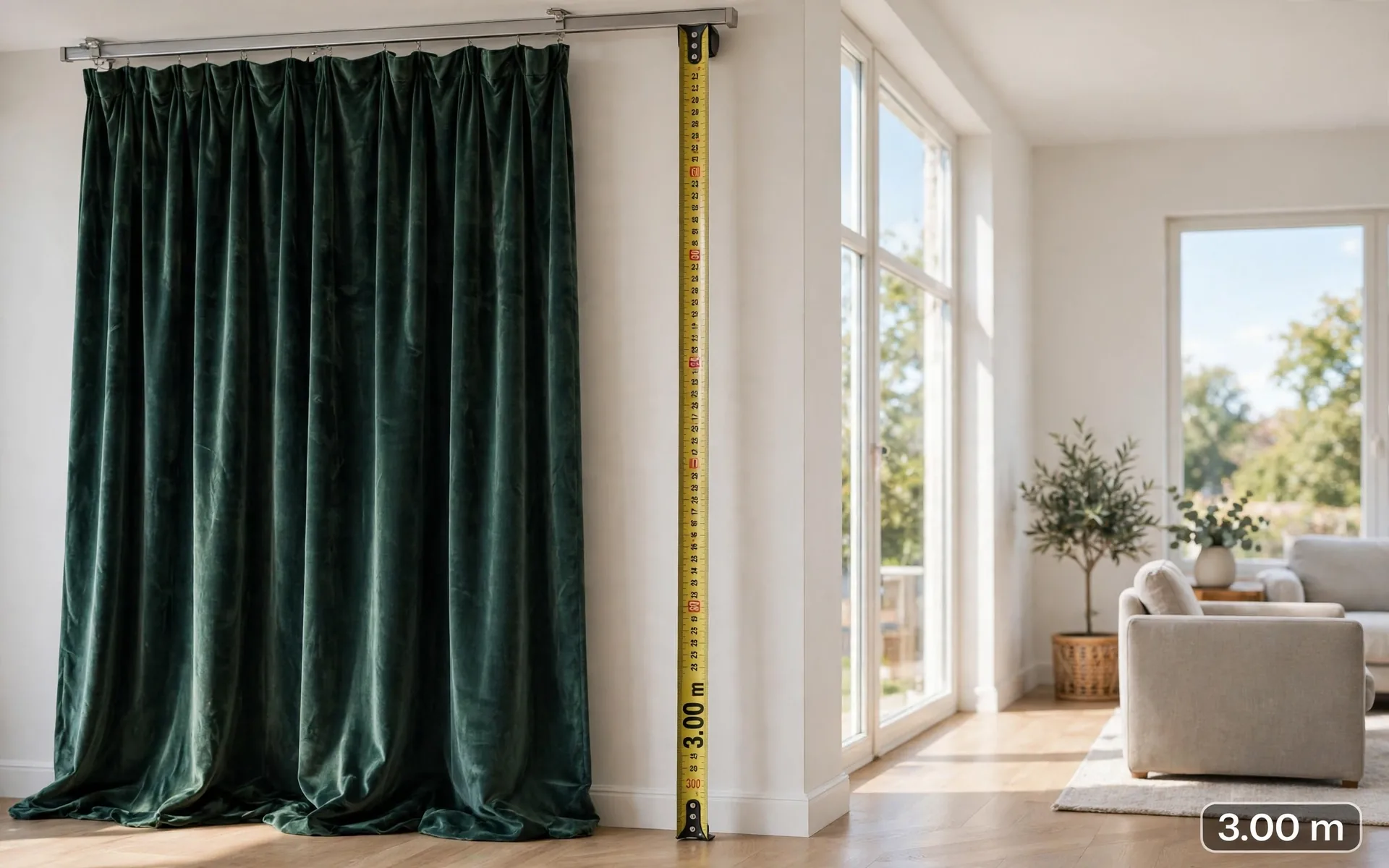
The curtains are the article’s third exact, and the one hanging in the most homes. IKEA’s own listing sells SANELA curtains as a pair at 140 by 300 centimetres per panel — 3 metres long, in pure cotton velvet, with a multi-way header for different hanging options — and IKEA’s own curtain guide states plainly that the length of the curtains in its range is either 250 centimetres or 300 centimetres, so the 3-metre drop is a standard size, not a custom order. It is the curtain in the living room, the curtain in the bedroom, and the curtain in the flat with the floor-to-ceiling window, and every one of them is the same length from the track to the hem, because the length is the product. Hang one from a ceiling track and you are looking at exactly 3 metres of fabric — no conversion required, and the same in every colour the curtain is sold in.
The fitting check is the track, because the curtain’s 3 metres is measured from the top of the track to the floor, and a curtain hung from a rod above the window frame is shorter than a curtain hung from a ceiling track by the distance between the rod and the ceiling — a rod mounted 20 centimetres below the ceiling turns a 3-metre curtain into a 2.8-metre curtain that pools on the floor or hovers above it. A track, a rod, or a hem bought against “3 metres” fails if you measure the fabric and forget the heading, which takes up the top few centimetres, and the guides that call curtains “very long” never say how long, because curtains are sold in 250-centimetre and 300-centimetre drops, and a 250-centimetre curtain is 50 centimetres short of the number in this article’s title — half a metre of missing fabric. The grade is listed because the figure is the maker’s own listing for this named product: 140 by 300 centimetres, by the maker’s own sheet, and the curtain in your window is the proof. Measure the track before you measure the curtain, because the curtain is the object in this article you live with every day.
The Two-Inch Trap: Where the Other Lists Get 3 Metres Wrong
Five wrong numbers about 3 metres circulate so widely that they deserve their own section, because each one is stated confidently on a page that ranks for this exact question. First, the small car: one popular guide calls 3 metres “roughly the length of a small car”, and a compact car runs 9.5 to 13 feet long — 2.9 to 4 metres — which is a range, not a figure, and the small end of it is a city car 2.7 metres long, which is 30 centimetres short. Second, the king bed plus walking space: another guide tells you a king mattress plus 3 feet of clearance “lands close to 3 metres”, and a king mattress is 80 inches long — 2.03 metres — so the guide is adding a gap to a bed and calling the sum an object, which is arithmetic wearing a mattress. Third, the parking space: a third guide calls 3 metres “basically half a parking spot”, and a standard parking space is 9 feet wide and 18 feet long, so 3 metres is one and a half widths of a space — a fraction, not a thing, and the same guide’s own numbers prove it. Fourth, the 3-yard confusion: guide after guide treats 3 metres as 3 yards, and 3 yards is 2.74 metres — 26 centimetres short, nearly a foot — which is the difference between a curtain that pools elegantly on the floor and one that hovers awkwardly above it. Fifth, the decimal-feet trap: one popular guide warns, correctly, that 0.84 feet is not 8 inches — and then its own readers still make the mistake, because 0.84 feet is 10.11 inches, and the guides that print “9.84 feet” without the inches leave every reader to do the multiplication themselves. None of these five numbers belongs in a 3-metre article, and all five are here so you never have to learn that from a purchase.
Judging 3 Metres in a Room Without a Tape
Three metres is a number you can check without a second tool, because the objects in this article are the tools — but only if you use the objects themselves, not your body. First, take the curtains: a 300-centimetre curtain drop is exactly 3 metres from the track to the hem, so stand beside a full-length curtain and you are standing beside 3 metres — but check the drop first, because a 250-centimetre curtain is half a metre short and will lie to you by exactly that much. Second, take the umbrella: a 3-metre canopy is exactly 3 metres across, so open one over the patio table and walk from one edge of the shade to the other — but check the canopy size first, because a 2.7-metre canopy is 30 centimetres short and will lie to you by a chair’s width. Third, take the trampoline: a 10-foot frame is 3.048 metres across, so walk from one edge of the frame to the other and shave off 5 centimetres in your head — the width of two fingers — and you have 3 metres, but measure the frame, not the mat, because the mat is 45 centimetres narrower and will lie to you by nearly half a metre. Fourth, take the floor tiles: commercial floor tiles are 30 centimetres square, so count ten tiles in a straight line and you have exactly 3 metres — but check the tile size first, because residential large-format tiles are 60 centimetres, and five of those is 3 metres while ten of those is 6. None of these replaces a calibrated tool for anything that must fit, but all four will tell you whether 3 metres is the size you think it is before the tree is ordered, the sofa is bought, or the wall is built — and the curtain is the one to trust, because its zero centimetres is the smallest miss you can hang in your home.
3 Metres Against the Sizes Around It
Three metres sits one metre past the stride in the last article — a single metre is 3.28 feet, a distance your legs already know — and a metre and a third past your king bed, which is 2.03 metres on its long edge. Step up the ladder and the rungs crowd together: the 2.7-metre city car, the 3-metre springboard, the 3-metre umbrella canopy, the 3-metre curtain drop, then the 3.048-metre trampoline frame and the 3.048-metre Christmas tree, then the 3.05-metre basketball rim and the 3.05-metre kayak — which are also the largest misses in this article, 5 centimetres over — then 10 feet at 3.048 metres, the round number people keep rounding 3 metres up to, and the reason the rounding is wrong by 4.8 centimetres. The ladder runs 1, 2.03, 2.7, 3, 3, 3, 3.048, 3.048, 3.05, 3.05 — and the point of it is the middle: 3 metres is the only rung with three exact objects behind it, a springboard on one side and a curtain on the other, and all seven objects in this article sit inside a 5-centimetre band, which is why 3 metres is the tightest size in the series to stand inside.
How 3 Meters Compares With Other Lengths
Readers comparing nearby sizes may also want the site’s guides to how long is 10 feet, how long is 9 feet, how long is 3 feet, and how long is 12 feet for the foot series, how big is 15 cm and how big is 14 cm for the centimetre series, 2 meters and 4 meters for the metre series, and the inches hub and feet hub for the full directories. Each of those guides follows the same rule as this one: the spec sheet, the grade, and the miss printed in full.
Frequently Asked Questions
How many feet is 3 meters?
3 meters is 9.84 feet, or 9 feet 10 and 1/8 inches in feet and inches. Multiply 3 by 3.28084 and you get 9.84252 feet — and the trap is rounding that to 10 feet, which overstates the length by 4.8 centimetres, or reading the 0.84 as 8 inches, which understates it by 2 inches. For anything that must fit, use 9.84 feet; for a quick estimate in your head, 9 feet 10 inches is close enough to picture it and only a fraction of an inch short.
Is 3 meters the same as 10 feet?
No, and the difference matters. Ten feet is 3.048 metres, which is 4.8 centimetres longer than 3 metres — nearly 2 inches. If you buy a 10-foot Christmas tree for a 3-metre ceiling, the tree will not fit; if you cut a 10-foot board for a 3-metre gap, you will have 2 inches left over. The honest shortcut is 9 feet 10 inches, which is 3 metres to within a fraction of an inch.
How many inches is 3 meters?
118.11 inches exactly. Multiply 3 by 39.3701 and you get 118.1103 inches, with no rounding that matters for anything you will ever measure by hand. In centimetres that is 300 cm, in millimetres it is 3,000 mm, and in yards it is 3.28 yards rounded — exactly 3.2808 yards, which is the figure a tape measure will show if it is marked in yards.
How many yards is 3 meters?
3.28 yards. Three metres is 3 yards plus about 10 per cent more, because a metre is about 3 inches longer than a yard, and those 3 inches add up three times over. Do not confuse 3 metres with 3 yards: 3 yards is only 2.74 metres, which is 26 centimetres short — nearly a foot — and that is how curtain orders and fence panels end up wrong.
How tall is 3 meters compared to a person?
About 1.7 times the height of an average adult. Most adults stand between 1.6 and 1.8 metres tall, so 3 metres is roughly one and a half to nearly twice a person’s height — taller than the tallest human in history, who reached 2.72 metres and still fell 28 centimetres short of 3. If you stand on your toes and reach up, you still will not touch a 3-metre mark unless you are standing on something.
What is 3 meters long in real life?
The most exact everyday answers are an Olympic 3-metre springboard (3.00 m above the water), a 3-metre patio umbrella canopy (3.00 m across), and a pair of 300-centimetre curtains (3.00 m long). The next closest are a basketball rim (3.05 m high), a 10-foot trampoline (3.048 m across its frame), a 10-foot kayak (3.05 m long), and a 10-foot Christmas tree (3.048 m tall). None of the four near-misses is exact, and each one’s miss is printed beside it in this article.
How do I measure 3 meters without a tape measure?
Use a 300-centimetre curtain drop if you have one — it is 3 metres by its maker’s own listing. Otherwise use a 3-metre umbrella canopy (exactly 3 m across), a 10-foot trampoline frame (3.048 m — shave off 5 centimetres), or ten 30-centimetre floor tiles in a straight line (exactly 3 m). For anything that must fit — a tree, a sofa, a wall — borrow or buy a real tape measure, because at 3 metres the misses in this article run from zero to 5 centimetres, and guessing throws every one of them away.
Will a 10-foot Christmas tree fit under a 3-metre ceiling?
No — not even close enough. A 10-foot tree is 3.048 metres tall, which is 4.8 centimetres taller than a 3-metre ceiling, and that is before the star on top. Worse, most modern ceilings are only 2.4 to 2.7 metres high, which is 35 to 65 centimetres too low for a 10-foot tree. A 10-foot tree needs a vaulted ceiling, a double-height room, or a ceiling above 3.05 metres — measure the ceiling before you order the tree, because the tree is the one object in this article you cannot shorten.
Final Thoughts
Three metres is the rare measurement that is honest and still misunderstood, because 9.84 feet can be a springboard, a rim, a trampoline, a kayak, an umbrella, a tree, or a curtain — and the number alone never says which. Now you know it as a board’s height fixed by its sport, a rim’s height fixed by its rulebook, a frame’s width fixed by its maker, a hull’s length fixed by its maker, a canopy’s width fixed by its maker, a tree’s height fixed by its maker, and a curtain’s length fixed by its maker — and you know which of those you can trust to the centimetre and which you must measure yourself. The rule that runs through all seven is the same one this site always uses: trust the spec sheet, print the deviation, and let the name stay on the box where it belongs. Measure twice, in the direction the object actually travels, and 3 metres will fit the first time.
