
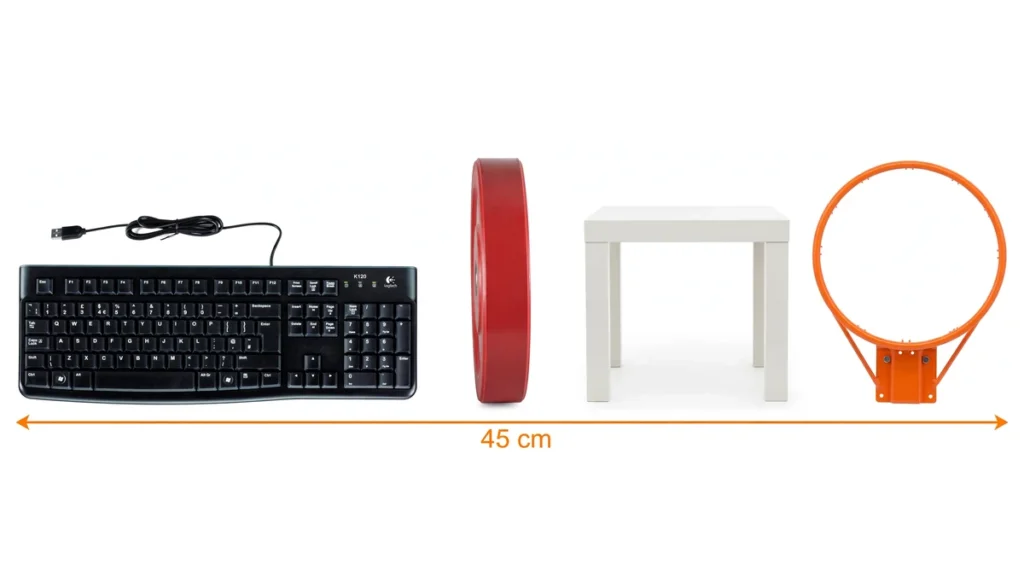
A basketball rulebook says a rim is 450 to 459 millimetres across. A weightlifting rulebook says a competition plate is 450 millimetres, give or take one. A kitchen designer says the hole is 450 millimetres and the machine inside it is 448. An airline says your bag may be 45 centimetres at most, wheels and handles included. None of them is wrong, and none of them is measuring quite the same thing — and that is what how big is 45 cm really means in practice.
Forty-five centimetres is 17.72 inches, 450 millimetres, and 0.45 metres. It is 14.52 cm longer than a foot, exactly one and a half 30 cm rulers, and 5 cm short of half a metre. The seven objects below are the closest honest answers to it: three land on 45 cm exactly, two more sit within a millimetre of it, and the last two carry their miss in the open, with the deviation printed in millimetres where you can see it.
Quick Answer
45 cm is 17.72 inches — 7.2 mm short of 18 inches.
Forty-five centimetres is 17.72 inches, 450 millimetres, and 0.45 metres. Three objects land on it exactly — a Logitech K120 keyboard, an Olympic bumper plate and an IKEA LACK table — and four more sit within 9 millimetres of it, with the miss printed in full.
The bar above shows forty-five 1 cm segments, but it is a diagram, not a ruler: screen sizes vary, so it explains the measurement rather than measuring it. For a real measurement, use the objects below or a tape measure.
The 45 cm Band: 448 to 459 mm
Most sizes in this series are a number. Forty-five centimetres is a band. From the narrowest honest reading to the widest, the things sold, built and ruled as “45 cm” span 448 to 459 millimetres — eleven millimetres between a dishwasher that has to fit a hole and a basketball rim that has to let a ball through. That is not sloppy measurement: four different industries use the same round number for four different jobs, and the job decides where inside the band the thing lands.
The seven objects sort into five kinds of 45 cm. Three are exact: the keyboard, the bumper plate and the side table were all built to 450 mm and measure it. One is a minimum: the basketball rim starts at 450 mm and is allowed to run to 459. One is a maximum: the easyJet bag may be 45 cm at most, and a bag that measures 44 cm is still a legal bag. One is a rulebook rounding: the dartboard is 451 mm because the rulebook’s “18 inches” converts to 451 mm when you do the arithmetic properly. And one is nominal-with-clearance: the dishwasher niche is 450 mm, but the machine that goes inside it is 448 mm, because a machine that measured exactly 450 mm would never slide into a 450 mm hole.
| Object | Kind of 45 cm | Verified figure | Deviation from 45 cm |
|---|---|---|---|
| Logitech K120 keyboard | Exact | 450 mm wide | 0.00 cm |
| Olympic bumper plate | Exact | 450 mm ± 1 mm | 0.00 cm |
| IKEA LACK side table | Exact | 45 cm tall | 0.00 cm |
| Basketball rim | Minimum | 450–459 mm | 0.00 to +0.90 cm |
| easyJet cabin bag | Maximum | 45 × 36 × 20 cm at most | 0.00 cm as a limit |
| Winmau Blade 6 dartboard | Rulebook rounding | 451.0 mm ± 3.0 mm | +0.10 cm |
| Bosch slimline dishwasher | Nominal with clearance | 448 mm in a 450 mm niche | −0.20 cm |
A foot is 30.48 cm, so 45 cm is nearly half a foot longer than a foot. A 448 mm dishwasher in a 450 mm niche is a fit; a 459 mm rim is a fit; a 45 cm bag that is really 45.7 cm is a fine at the gate. The number on the label is the start of the check, not the end of it.
7 Things That Are 45 cm
The seven objects are ordered by how close they land on 45 cm, closest first, and each one carries its evidence grade in the heading. EXACT means the figure is a standard’s or an authority’s own dimension for the named thing. LISTED means the figure is the manufacturer’s published specification for the named model. REPORTED means the figure is a rulebook range, and the object sits at one end of it. Three of the seven land on 45 cm exactly, and the four that do not carry their miss in the open, in millimetres, where you can see it. Five of the seven sit on 45.00 cm exactly in one sense or another, which makes this the tightest list in the centimetre series so far, with a mean absolute deviation of 0.04 cm.
A published 45 cm designation does not mean every manufactured unit measures mathematically 45.000 cm. Keyboards are sold by a width rounded to the millimetre, plates by a diameter with a stated tolerance, tables by a height stated to the centimetre, rims by a rulebook range, bags by a maximum, dartboards by a rulebook figure that retailers round, and dishwashers by a niche the machine is deliberately smaller than. What follows is what the source actually says, with the axis named every time.
1. Logitech K120 Keyboard — Width 450 mm, Exactly 45.00 cm (LISTED)
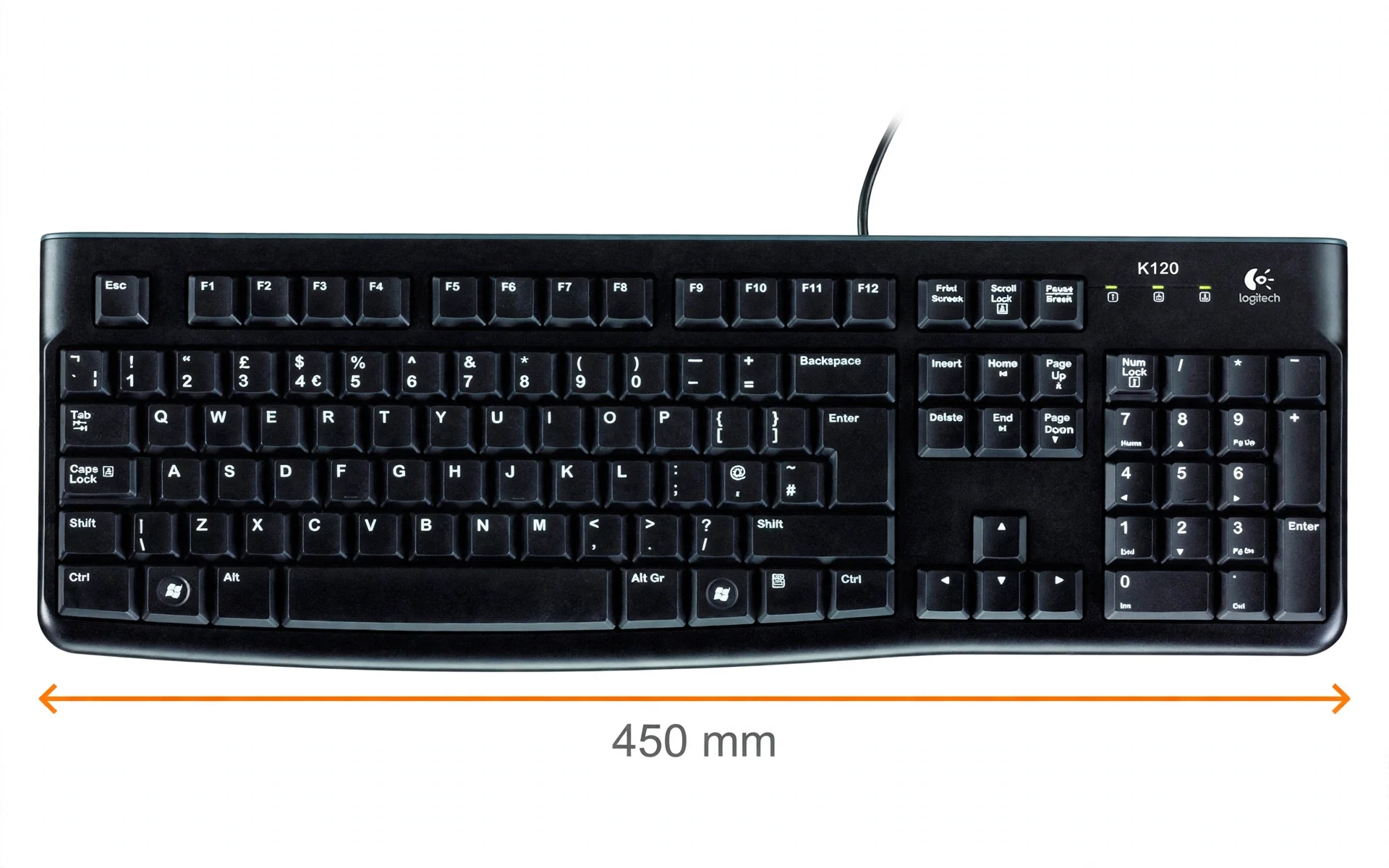
The K120 is the article’s cleanest land-on, because its 450 mm is not one measurement of a thing that happens to be 45 cm long — it is the width the manufacturer publishes for the thing itself. The K120’s user manual lists the width as 17.72 in (450 mm), with a depth of 155 mm and a thickness of 23.5 mm, so the keyboard measures 45.00 cm across, with no deviation to print. Lay it on the desk and its width is the number itself, which is why it is the pocket reference in the measuring section below.
Logitech’s own spec sheet calls the 155 mm front-to-back dimension “Height” and the 23.5 mm thickness “Depth” — do not copy those labels. Say 450 mm wide, 155 mm deep, 23.5 mm thick. The fitting check is the width, because the 450 mm is measured left to right across the keyboard, and a keyboard tray bought against “45 cm” holds the K120 exactly, with nothing to spare and nothing overhanging. The grade is listed because the figure is the manufacturer’s published specification for the named model, with the deviation printed in full: 45.00 cm, zero millimetres off. The manual’s quoted 17.72 inches is the exact conversion of 45 cm — 45 divided by 2.54 is 17.7165 — so the keyboard’s own imperial figure is the trap section’s arithmetic, printed on the box.
2. Olympic Competition Bumper Plate — Diameter 450 mm ± 1 mm, Exactly 45.00 cm (LISTED)
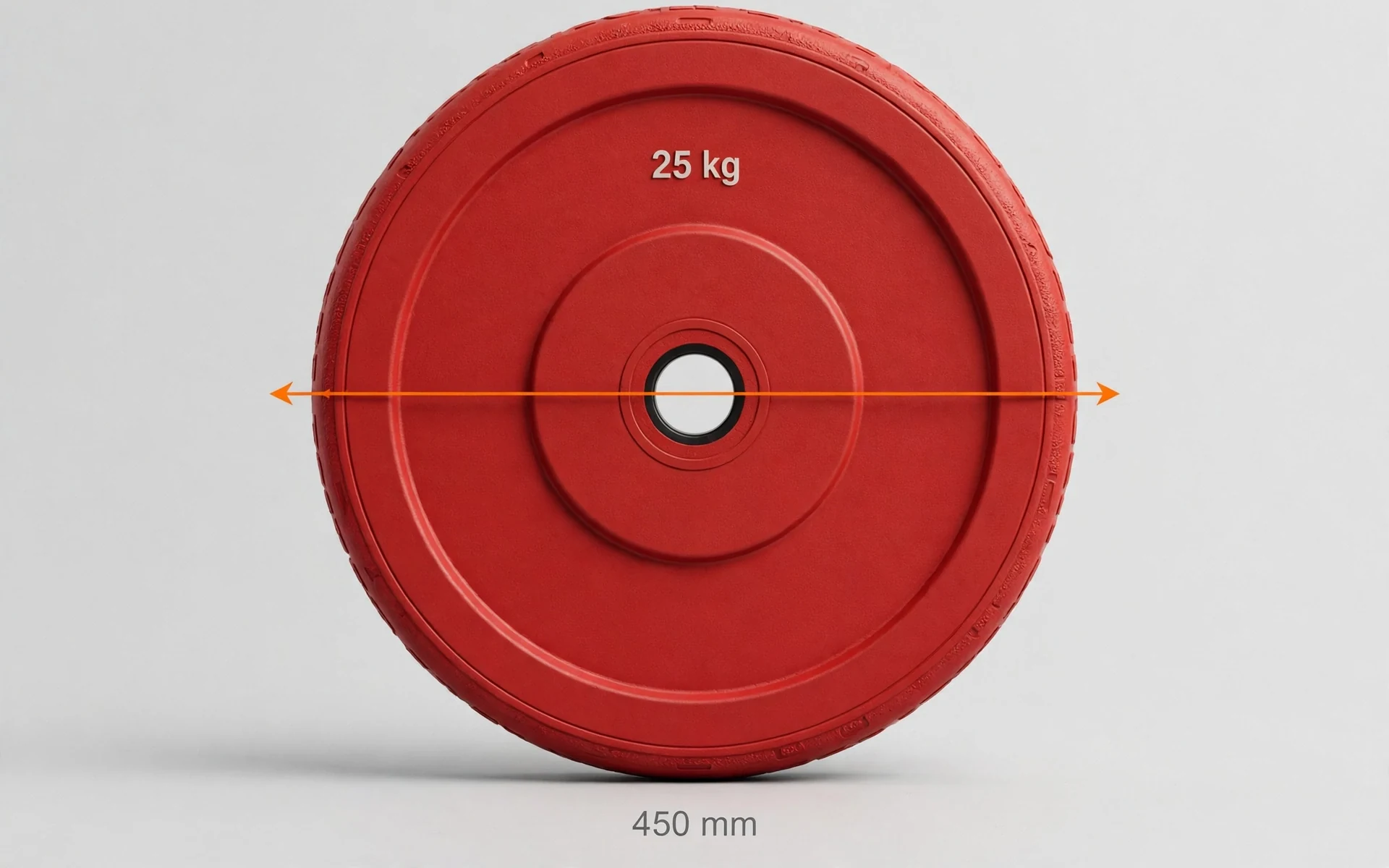
The bumper plate is the article’s second exact land-on, and the one that proves 45 cm is a working size in sport, not just on a desk. The IWF’s equipment rules state that the diameter of the largest discs is 450 mm with a tolerance of ± 1 mm, so a competition plate measures 45.00 cm across, with a permitted wobble of one millimetre in either direction. Stand it on its edge and the distance across it is the number itself.
The fitting check is the word “competition”: the 450 mm figure is for the largest competition discs, the 10 to 25 kg plates, and discs under 10 kg may be smaller. Cheap training bumpers copy the 450 mm diameter without certification, so always say “competition bumper plate” and name the IWF figure. The colour code is part of the standard too: 25 kg red, 20 kg blue, 15 kg yellow, 10 kg green — all 450 mm across, differing only in weight. The grade is listed because the figure is the federation’s published rule for the named equipment, with the deviation printed in full: 45.00 cm, zero millimetres off, plus or minus one millimetre of permitted manufacturing tolerance.
3. IKEA LACK Side Table — Height 45 cm, Exactly 45.00 cm (LISTED)
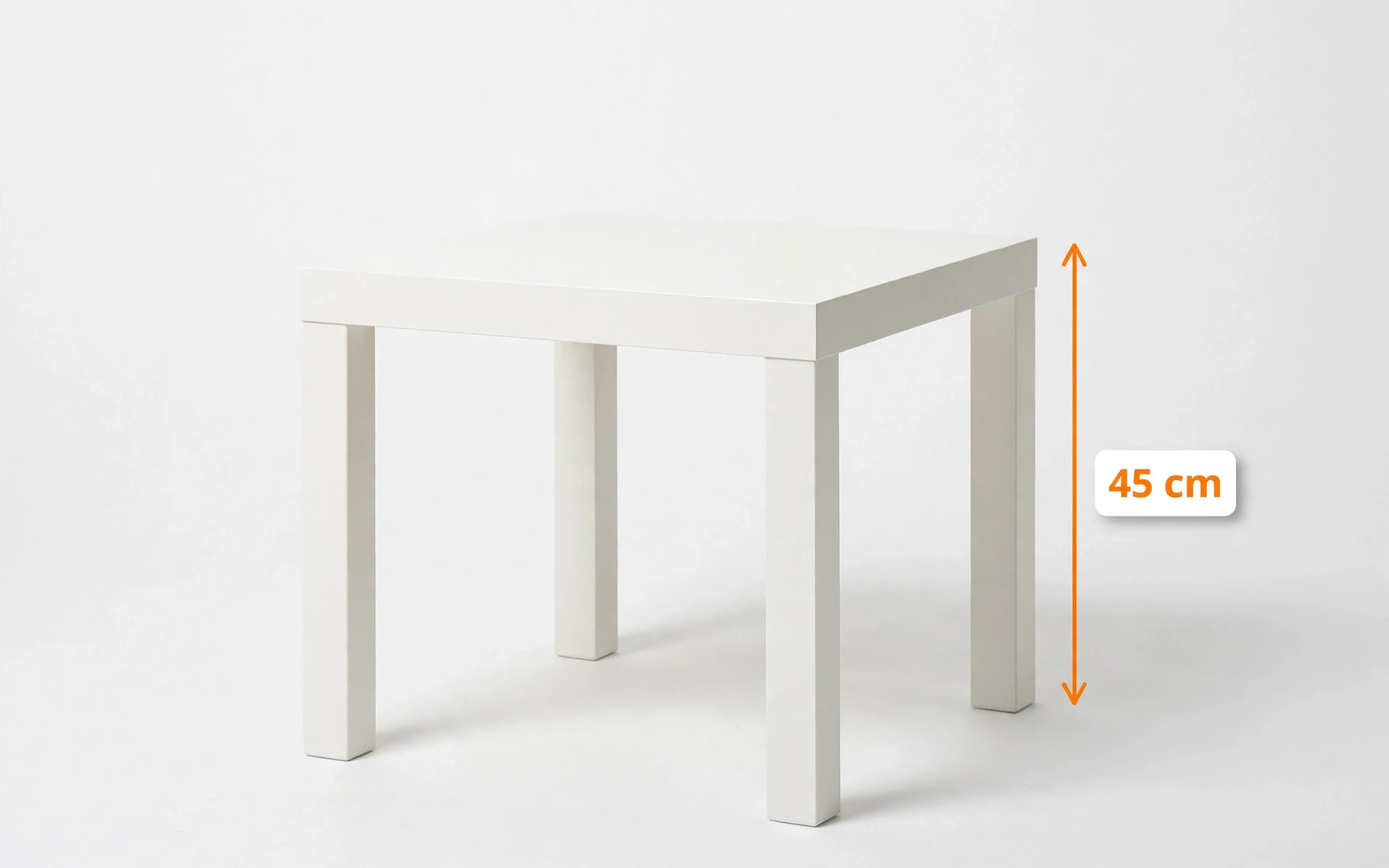
The LACK is the article’s third exact land-on, and the one most readers can check tonight without buying anything. IKEA’s product page lists the LACK side table at 55 × 55 cm on top and 45 cm tall, so the table measures 45.00 cm from floor to tabletop, with no deviation to print. Stand beside it and its height is the number itself — turn it on its side and its height becomes a length you can lay against anything.
The fitting check is the axis, because the 45 cm is the height and the top is 55 × 55 cm. Never write “the LACK table is 45 cm” without “tall”: a shelf bought against “45 cm” for the tabletop holds nothing, because the top is 55 cm across. The LACK coffee table, at 118 × 78 cm, shares the same 45 cm height — the same number wearing a longer top, not a second object. The grade is listed because the figure is the manufacturer’s published specification for the named product, with the deviation printed in full: 45.00 cm, zero millimetres off.
4. Basketball Rim — Inside Diameter 450–459 mm, 45.00 cm at the Minimum (REPORTED)
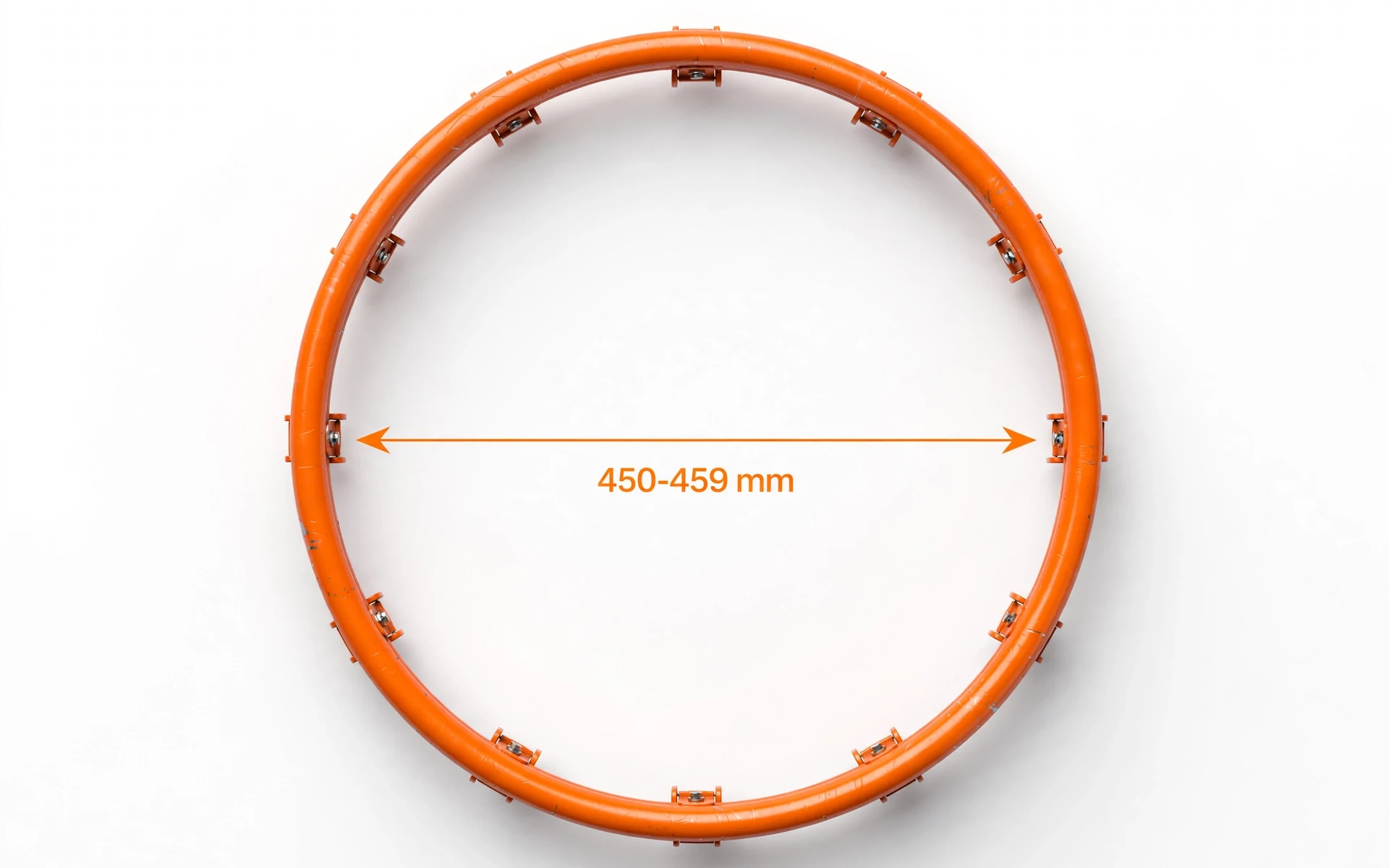
The rim is the article’s hinge, because it is the one object that is not a single number at all. FIBA’s equipment rules state that a rim must have an inside diameter of a minimum of 450 mm and a maximum of 459 mm, so a legal rim measures anywhere from 45.00 cm to 45.90 cm across the inside of the ring. A rim at the FIBA minimum is exactly 45 cm; a rim at the maximum is nine millimetres wider, which is why the grade is reported rather than listed — the rulebook gives a range, and the object sits somewhere inside it.
The fitting check is the word “inside”, because the 450–459 mm is the inside diameter, measured across the opening the ball passes through, and the outside of the ring is wider still. The American ring is 18 inches across, which is 45.72 cm — inside the FIBA band, which is the trap section’s whole point: the FIBA band contains both 450 mm and 457.2 mm, so the same hoop is both 45 cm and 18 inches, depending on which end of the band you measure. The grade is reported because the figure is the rulebook’s own range, with the deviation printed in full: 45.00 cm at the minimum, up to 45.90 cm at the maximum.
5. easyJet Small Cabin Bag — Longest Side 45 cm Maximum, Exactly 45.00 cm as a Limit (LISTED)
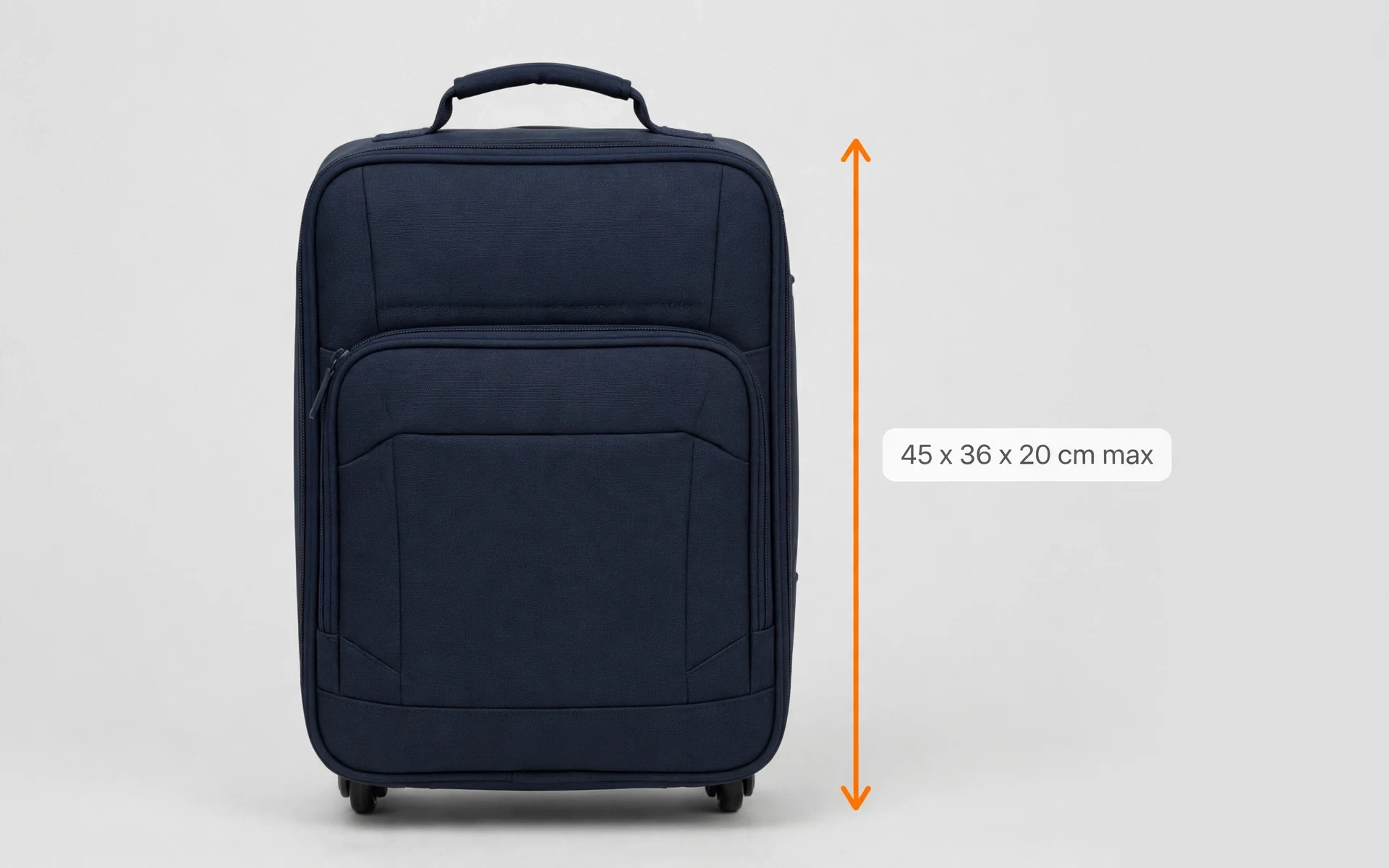
The easyJet bag is the article’s maximum, and the object that most readers will actually have to measure. easyJet’s cabin-bag page states that a small under-seat cabin bag can be a maximum size of 45 × 36 × 20 cm, including any handles and wheels, up to 15 kg, so 45 cm is the longest side a bag may have — not the size of any particular bag. A bag that measures 44 cm on its longest side is still a legal bag, and a bag that measures 46 cm is not, which is why the grade is listed and the deviation is printed as a limit: 45.00 cm as a maximum, zero millimetres of headroom.
The fitting check is the phrase “including any handles and wheels”, because the 45 cm is measured packed, with the wheels and the handle counted, and a bag built to exactly 45 × 36 × 20 cm empty can fail once packed. Measure the bag packed, at the sizer, not the dimensions on the tag. The same bag fails Ryanair’s free allowance of 40 × 30 × 20 cm — five centimetres too long — so the bag that flies free on one airline is charged on the other. Do not confuse it with easyJet’s large cabin bag, 56 × 45 × 25 cm, which has 45 cm as its middle dimension, not its longest.
6. Winmau Blade 6 Dartboard — Overall Diameter 451.0 mm ± 3.0 mm, 45.10 cm (EXACT)
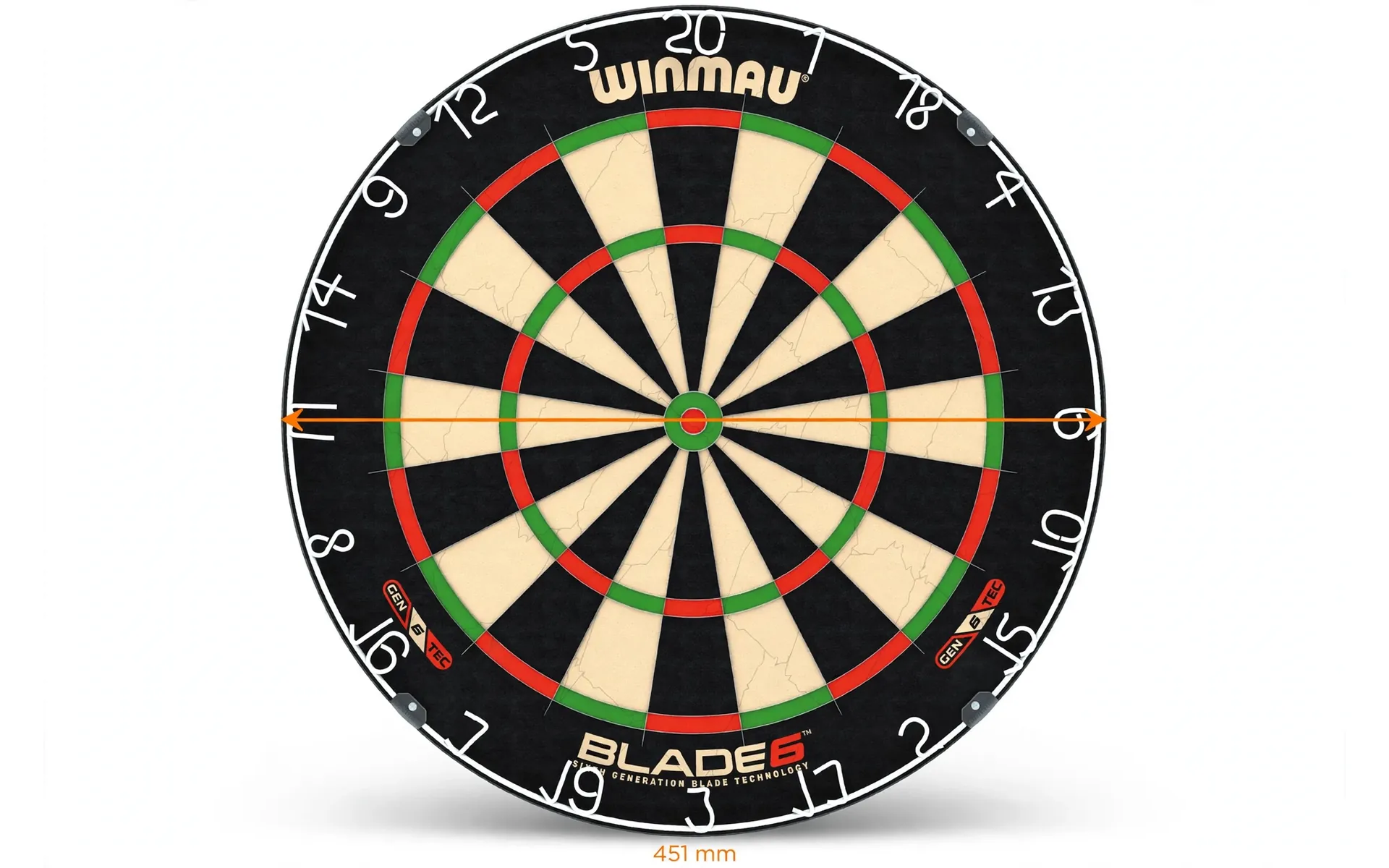
The dartboard is the article’s rulebook rounding, and the object that shows how an imperial standard becomes a metric number. The WDF’s playing rules state that the overall board diameter is 451.0 mm ± 3.0 mm, so a regulation board measures 45.10 cm across — one millimetre past 45 cm, about the thickness of a credit card edge. Hold a tape across the face of the board and the distance from rim to rim is the number — the closest miss that is not a limit or a range, just a rulebook doing its arithmetic in public.
The fitting check is the two numbers: the overall board diameter is 451 mm and the scoring area — the outer edge of the double ring — is only 340 mm. Never confuse the two: a surround bought against “45 cm” for the scoring area leaves eleven centimetres of board hanging over the edge. Retail listings for the Winmau Blade 6 round the board to 450 mm × 38 mm, and the one-millimetre gap between the retail figure and the rulebook figure is retail rounding, not a different board — say so, and the numbers stay honest. The grade is exact because the figure is the federation’s own dimension for the named equipment, with the deviation printed in full: 45.10 cm, one millimetre over.
7. Bosch Serie 2 SPV2HKX42G Slimline Dishwasher — 448 mm in a 450 mm Niche, 44.80 cm (LISTED)

The dishwasher is the article’s furthest miss, and the one that teaches the most useful lesson on the page. The retailer specification for the Bosch Serie 2 SPV2HKX42G states that the appliance measures 81.5 × 44.8 × 55 cm and fits a niche of 815 to 875 × 450 × 550 mm, so the machine is 448 mm wide and the hole it goes into is 450 mm wide. The appliance measures 44.80 cm — two millimetres short of 45 cm, about the thickness of a coin — and the niche measures 45.00 cm exactly, which is why the object is listed as a pair: the hole is the number, and the machine is deliberately two millimetres smaller than the hole.
The fitting check is the pair, because a machine that measured exactly 450 mm would never slide into a 450 mm niche, and the two millimetres are the clearance that makes installation possible. Never write “a slimline dishwasher is 45 cm wide” as a universal: integrated bodies like this one are 448 mm, while freestanding Serie 2 slimlines are listed at 450 mm wide, and the two need different gaps. Bosch’s own small-dishwasher page rounds the slimline to “45 cm wide” and then gives the real figure, 44.8 cm — quote the 44.8 cm figure, not the rounded label. The grade is listed because the figure is the manufacturer’s model specification carried by the retailer: 44.80 cm for the appliance, 45.00 cm for the niche.
The Rim Where 45 cm and 18 Inches Are the Same Hoop
Here is the trap, kept in its supporting section rather than the lead, because the strongest rival page already owns it in full. Forty-five centimetres is 17.72 inches, and 18 inches is 45.72 cm, so 45 cm is 7.2 mm short of 18 inches — and calling 45 cm “18 inches” is wrong by more than a quarter of an inch, which matters when the thing has to fit. Eighteen inches is 45.72 cm, and the 7.2 mm between the two numbers is the gap this whole article is built around: small enough to round away, large enough to fail a fit.
But the basketball rim is the one place where the two numbers describe the same object. FIBA allows a rim from 450 to 459 mm, and the American ring is 18 inches, which is 457.2 mm — inside the FIBA band. A rim at 450 mm is 45 cm and not 18 inches; a rim at 457.2 mm is 18 inches and not 45 cm; and a rim anywhere in between is both, depending on which unit you measure it in.
The trap has an origin, and it is the 2.5 shortcut. Divide 45 by 2.5 and you get 18.0 inches exactly — the lazy divisor produces precisely the wrong round number, which is how “45 cm = 18 in” survives in conversion guides that never check their own arithmetic. The honest shorthand is “just under 18 inches” — “18 inches” hides the 7.2 mm, and “18.0 inches” invents a precision the number does not have. The same trap wears feet: a foot and a half is 45.72 cm, so “a foot and a half” is the same 7.2 mm error in a different unit.
The rounding runs the other way too, and IKEA proves it. The NORDVIKEN chair’s seat height is listed as 45 cm in metric and 17¾ inches in imperial, and 17¾ inches is 45.09 cm — nine-tenths of a millimetre over 45 cm — so the imperial label overstates the metric size by a hair, while an 18-inch label overstates it by 7.2 mm. A 17-inch laptop is the same confusion in a different shape: the 17 inches is the screen diagonal, which is 43.18 cm corner to corner, and the body of a 17-inch laptop is about 40 cm wide — neither number is 45 cm.
| Tape mark | Value | Against 45 cm |
|---|---|---|
| 17 in | 43.18 cm | 1.82 cm short |
| 17 11/16 in | 44.926 cm | 0.74 mm short |
| 17 3/4 in | 45.085 cm | 0.85 mm over |
| 17 23/32 in | 45.006 cm | 0.06 mm over |
| 18 in | 45.72 cm | 7.2 mm over |
On a tape measure, the nearest sixteenth-inch mark is 17 11/16 inches at 44.926 cm, which is 0.74 mm short — close enough for a cut, not close enough for a tight fit. The honest fraction is 17 23/32 inches at 45.006 cm, which is 0.06 mm over, essentially exact, but thirty-seconds are not printed on most tapes, so the practical reading is just under the 17¾-inch mark. And 45 cm is 150% of a 30 cm ruler — mark off the whole ruler and add half a ruler, and the remaining length is the number itself.
Four “45 cm” Claims That Don’t Measure Up
| What a rival list claims | What it actually measures | The difference |
|---|---|---|
| Two basketballs fit side by side through a 45 cm rim | Two size 7 balls are 47.70 cm across; the widest legal rim is 45.9 cm | 1.80 cm too wide — they do not fit |
| A bowling pin is about 45 cm tall | A USBC tenpin is 15 in = 38.1 cm | 6.9 cm short |
| A chain-menu “45 cm pizza” is 45 cm across | An 18-inch pizza is 45.72 cm, rounded down | 0.72 cm over — it is the trap, not a pizza |
| A 450 × 450 mm paving slab is 450 mm across | Nominal label; the current datasheet gives 448 mm actual | 0.20 cm short — a label, not a measurement |
Four of these deserve a longer correction. The two basketballs are the most checkable error in the ranking pages: a rival list claims two basketballs fit side by side through a 45 cm rim “with room to spare”, but a size 7 ball is 23.85 cm across — 29.5 inches of circumference divided by pi — so two side by side need 47.70 cm, which is wider than even the largest legal rim at 45.9 cm. The lead’s own number-one object disproves its own sentence. The bowling pin is the most repeated error: a rival list calls a pin “roughly the height of a standard bowling pin”, but a USBC tenpin is 15 inches (380 mm) tall, which is 38.1 cm — 6.9 cm short of 45 cm — and a candlepin is 40.0 cm, still five centimetres short. The pizza is the most ordinary error: chain-menu “45 cm” pizzas are 18-inch pizzas at 45.72 cm rounded down, and only one manufacturer’s family base is a true 45 cm — a single product, not a standard. And the paving slab is the most instructive error: “450 × 450” is the nominal size, and the current datasheet gives a 448 mm actual work size — the label is not the measurement, and the two millimetres are the same two millimetres as the dishwasher’s clearance.
Three near-misses deserve a line of their own. A newborn baby at 45 cm is below the 3rd percentile for both sexes, not the average: the WHO length-for-age tables put the median length at birth at 49.9 cm for boys and 49.1 cm for girls, and the 3rd percentile at 46.3 cm for boys and 45.6 cm for girls — so 45 cm is shorter than 97 babies in 100, a boundary case, not an object. A “45 cm” artist canvas is 45.72 cm, because a “45 × 60 cm” canvas is really an 18 × 24 inch canvas, and the 45 cm label is the trap again, wearing a frame. And a 45 cm cube tank holds 91.1 litres, about 24.1 US gallons — 45 × 45 × 45 cm is 91,125 cubic centimetres — not the 95 litres and 25 gallons a rival list claims.
How to Measure 45 cm Without a Ruler
| Method | What you get | How close it is |
|---|---|---|
| One and a half 30 cm rulers | 45.00 cm | Exact — the best method in the series |
| Metre stick minus 5 cm | 45.00 cm | Exact — mark 5 cm from the end |
| K120 keyboard, laid flat | 45.00 cm | Exact — the best pocket reference |
| LACK table height, turned sideways | 45.00 cm | Exact — the best furniture reference |
| Tape measure, 17 23/32 in mark | 45.006 cm | 0.06 mm over — essentially exact |
| Tape measure, just under 17 3/4 in | 45.085 cm | 0.85 mm over — take off a hair |
| Basketball rim in the park | 450–459 mm | Within 9 mm — a range, not a mark |
| Elbow to fingertip (cubit) | Roughly 45 cm | Bodies differ by centimetres — a first guess only |
The ruler-and-a-half method is the best of the eight, because the miss is zero and it is the only size in the centimetre series that is an exact multiple of the school ruler — one and a half rulers, end to end, and the number is measured. The metre-stick method is the one to use when you have a metre stick and a pencil: mark five centimetres from the end and measure to the mark. The keyboard method is the one to use when there is nothing to measure with but a desk: the K120 is 450 mm wide, so lay it flat and its width is the number. The LACK method is the one to use when there is furniture and no ruler: the table is 45 cm tall, so turn it on its side and its height becomes a length.
The cubit is the oldest method on the page and the least reliable. Elbow to fingertip is roughly 45 cm on an adult, which is why the cubit survived for thousands of years as a unit — but bodies differ by centimetres, so use it only as a first guess and never as a measurement. The fitting check is the zero mark, because 45 cm starts at the 0 line and not at the end of the ruler. Most plastic rulers carry a few millimetres of blank plastic past the last graduation, so if you measure from the physical edge instead of from the 0 mark you will read long by that margin — about 3 mm on a cheap ruler, which is nearly half the 7.2 mm gap this whole article is about.
45 cm in Every Unit
| Unit | Value |
|---|---|
| Millimetres | 450 mm |
| Metres | 0.45 m |
| Inches | 17.72 in (17 23/32 in) |
| Feet | 1.48 ft (1 ft 5.72 in) |
| Yards | 0.49 yd |
Forty-five centimetres is 450 millimetres, and a centimetre is 10 millimetres, so the conversion is a multiplication by ten that never needs a calculator. In inches it is 45 divided by 2.54, which is 17.7165 inches, rounded to 17.72 — and the rounding is honest, because 17.72 inches times 2.54 is 44.989 cm, a tenth of a millimetre from the mark. In feet it is 1.48, or 1 ft 5.72 in if you want feet and inches rather than a decimal. Seventeen inches is 43.18 cm, so 45 cm is 1.82 cm longer than 17 inches, and 40 cm is 5 cm shorter than 45 cm, and 35 cm is 10 cm shorter than 45 cm, and 25 cm is 20 cm shorter than 45 cm, and 20 cm is 25 cm shorter than 45 cm, which is why the sizes sit next to each other in cases, shelves and laptop bags. Forty-five centimetres is 45% of one metre, so two of them make 90 cm, and it is 5 cm short of half a metre — the medium of the 40–45–50 ladder.
The 45 cm Fit-Check: Before You Buy
– Slimline dishwasher: the niche is 450 mm and the integrated Bosch is 448 mm, so a true 450 mm niche fits it with 2 mm to spare. Measure the niche, not the label — and note that a freestanding slimline listed at 450 mm wide needs a wider gap, because its body is the full 450 mm and there is no clearance left.
– easyJet cabin bag: the sizer is 45 cm maximum including handles and wheels, measured packed. Pack the bag, measure it packed, and check it against the sizer — a bag built to exactly 45 × 36 × 20 cm empty can fail once packed. The same bag fails Ryanair’s 40 × 30 × 20 cm free allowance, so check the airline you are actually flying with, not the one the bag was bought for.
– Compact built-in oven: the 45 cm recess is the hole, not the unit. No unit figure is stated here, because no named model’s installation sheet was verified at draft time — check the installation sheet for the unit’s real height before you order, and measure the recess, not the catalogue label.
– Dartboard: the board is 451 mm across but the scoring area is only 340 mm, so leave wall clearance for the surround, not just the board. A surround bought against “45 cm” for the board fits; a surround bought against “45 cm” for the scoring area leaves eleven centimetres of board hanging over the edge.
– Desk: a 45 cm-deep desk fits a K120 keyboard at 155 mm deep with room for a mug and a notebook, but not a 27-inch monitor at a comfortable focal distance. Buy the desk by its depth, not by its name, and check the monitor’s stand depth in the specifications — the stand, not the screen, is what eats the desk.
The rule underneath all five is the same: measure the space, add clearance, and never trust a “45 cm” label alone. The label is a maximum, a minimum, a nominal size, or a rounded size; the tape is the size. Seven point two millimetres is the price of trusting the label, and a bag that does not fit the sizer is the receipt.
Frequently Asked Questions
Is 45 cm the same as 18 inches?
No. Forty-five centimetres is 17.72 inches, and 18 inches is 45.72 cm, so 45 cm falls 7.2 mm short of 18 inches. Call it “just under 18 inches” and you are right; call it “18 inches” and you are 7.2 mm wrong, which matters when the thing has to fit. The one exception is a basketball rim: FIBA allows 450 to 459 mm, and the American 18-inch ring at 457.2 mm sits inside that band, so the same hoop is both 45 cm and 18 inches.
How many inches is 45 cm?
Forty-five centimetres is 17.72 inches, or 17 23/32 inches as a fraction. The conversion is 45 divided by 2.54, because one inch is defined as exactly 2.54 cm. On a tape measure, the nearest sixteenth-inch mark is 17 11/16 inches at 44.926 cm, 0.74 mm short, and the practical reading is just under the 17¾-inch mark at 45.085 cm.
What everyday objects are 45 cm long?
Seven verified objects, tightest first: a Logitech K120 keyboard at exactly 450 mm wide, an Olympic competition bumper plate at exactly 450 mm across, an IKEA LACK side table at exactly 45 cm tall, a basketball rim at 450 to 459 mm inside diameter, an easyJet small cabin bag at 45 cm maximum, a Winmau Blade 6 dartboard at 451 mm across, and a Bosch slimline dishwasher at 448 mm wide in a 450 mm niche. Every one is verified against the manufacturer’s own specification, the federation’s rulebook, or the airline’s published allowance.
Will a slimline dishwasher fit a 45 cm gap?
Yes, if the gap is a true 450 mm niche: the integrated Bosch SPV2HKX42G is 448 mm wide, leaving 2 mm to spare — but measure the niche, not the label, and note that a freestanding slimline listed at 450 mm wide needs a wider gap, because its body is the full 450 mm and there is no clearance left.
Is a 45 cm exercise ball the same as an 18-inch ball?
No. The 45 cm ball is the smallest standard size, for people under about 152 cm, and an 18-inch ball would be 45.72 cm — buy by the centimetre size on the label, and note that the 45 cm is the diameter at maximum inflation, so an under-inflated ball measures less.
How do I measure 45 cm without a ruler?
One ruler and a half, exactly; a metre stick minus 5 cm; a Logitech K120 keyboard laid flat at 450 mm; an IKEA LACK table’s height turned sideways; or a basketball rim in the park at 450 to 459 mm. Measure from the ruler’s zero mark, not from the plastic edge, or you will read about 3 mm long.
Is a bowling pin 45 cm tall?
No. A USBC tenpin is 15 inches, which is 38.1 cm — nearly 7 cm short of 45 cm — and a candlepin is 40.0 cm, still five centimetres short. The claim appears on comparison pages and is wrong.
What is 45 cm in mm, feet and meters?
Forty-five centimetres is 450 millimetres, 1.48 feet (1 ft 5.72 in), and 0.45 metres — 14.52 cm longer than a foot and 5 cm short of half a metre.
Final Thoughts
Forty-five centimetres is a length that eleven millimetres wide and seven objects deep, and the band is the whole article. The seven objects that measure it — a keyboard, a plate, a table, a rim, a bag, a dartboard and a dishwasher — are all things you can find tonight without buying anything, and every one of them carries the number its source actually publishes, with the miss printed next to it. That is the difference between a measurement and a slogan: the measurement can be checked, and the slogan cannot.
Do not take the round number, and do not take the name. Ask which kind of 45 cm was measured — the exact, the minimum, the maximum, the rounding, or the nominal with clearance — look up the specification, and print the miss when there is one. A bag that does not fit the sizer is a 7.2-millimetre lesson; a keyboard measured across its width is 45 cm, exactly, every time.
