
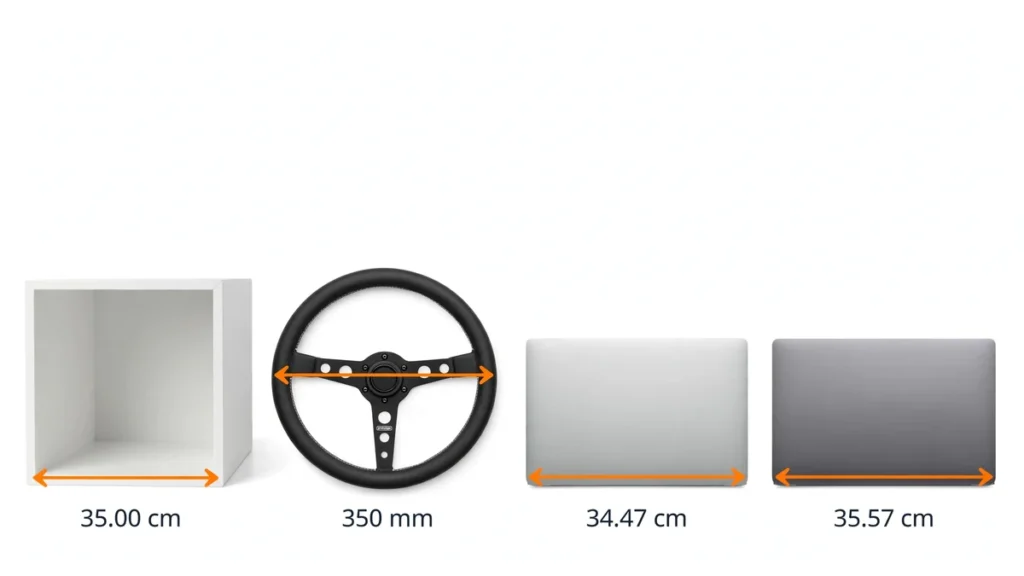
Close a Dell XPS 15 and a 16-inch MacBook Pro and lay them side by side on a desk. One is 34.47 cm wide, the other 35.57 cm — and how big is 35 cm falls in the 11-millimetre gap between them, closer to both than either is to the other. It is also, exactly, the size of an IKEA EKET cube on every side. This article is about that gap: what 35 cm actually is, six things that really measure it, and why nearly everything sold as “14 inches” is 5.6 millimetres longer than it.
Thirty-five centimetres is 13.78 inches, 350 millimetres, and 0.35 metres. It is 4.52 cm longer than a foot, 5 cm longer than a 30 cm ruler, and exactly halfway between 30 and 40 cm. The six objects below are the closest honest answers to it: two land on 35 cm exactly, four miss by 5 to 6 millimetres with the miss printed in full, and every one of them carries the source that proves it.
Quick Answer
35 cm is 13.78 inches — 5.6 mm short of 14 inches.
Thirty-five centimetres is 13.78 inches, 350 millimetres, and 0.35 metres. Two objects land on it exactly — an IKEA EKET cube and a MOMO steering wheel — and four more miss by 0.53 to 0.60 centimetres, with the miss printed in full.
The bar above shows thirty-five 1 cm segments, but it is a diagram, not a ruler: screen sizes vary, so it explains the measurement rather than measuring it. For a real measurement, use the objects below or a tape measure.
The Laptop Bracket: 35 cm Falls Between Two Big Laptops
Thirty-five centimetres sits between the two biggest laptop widths a reader is likely to own. The Dell XPS 15 9530 is 34.47 cm wide, the 16-inch MacBook Pro is 35.57 cm wide, and 35 cm falls 5.3 mm above the Dell and 5.7 mm below the MacBook — an 11 mm window with 35 cm almost exactly in the middle. Whichever of the two laptops is on your desk, you are holding a reference for 35 cm that is within half a centimetre, and if you own both, the gap between them is the size itself.
The axis matters, and it is the width, not the screen. A laptop’s screen size is a diagonal — a 16-inch screen is 40.64 cm corner to corner — while the width is the body measured left to right across the closed lid. Confuse the two and you get a number 5 cm too long. The widths cluster here because the 14-inch screen class and the 15- and 16-inch chassis class meet at this number: a “14-inch” laptop body is about 32 cm wide, a 15-inch chassis is about 34.5 cm, and a 16-inch chassis is about 35.6 cm. Fourteen inches is 35.56 cm, so 35 cm is 5.6 mm short of it — and that 5.6 mm is the trap this article keeps in its supporting section, not its lead, because the lead rival already owns it. Our lead is the bracket and the cube.
6 Things That Are 35 cm
The six objects are ordered by how close they land on 35 cm, closest first, and each one carries its evidence grade in the heading. EXACT means the figure is a standard’s or an authority’s own dimension for the named thing. LISTED means the figure is the manufacturer’s published specification for the named model. Two of the six land on 35 cm exactly, and the four that do not carry their miss in the open, in millimetres, where you can see it — and the point of the ordering is that the miss grows as you read, so the last object is the one that stretches the number furthest. The four that miss all land within 0.7 mm of each other on either side of the line, at 34.47, 35.56, 35.57 and 35.60 cm — the 14-inch cluster, which gets its own section below.
A published 35 cm designation does not mean every manufactured unit measures mathematically 35.000 cm. Cubes are sold by a nominal size that the maker states to the centimetre, steering wheels by a diameter rounded to the millimetre, laptops by a width that varies a fraction of a millimetre between production runs, violins by a body length that is a standard, not a measurement of one instrument. What follows is what the source actually says, with the axis named every time, so you can check it yourself.
1. IKEA EKET Cabinet, 35×35×35 cm — Exactly 35.00 cm (LISTED)

The EKET cube is the article’s cleanest land-on, because its 35 cm is not one measurement of a thing that happens to be 35 cm long — it is the thing itself, a cube sold by its size on every side. IKEA’s product page lists the EKET cabinet at 35×35×35 cm, width, depth and height all the same, so the cube measures 35.00 cm on every face, with no deviation to print. Set it on the floor and its width is the number itself, which is why it is the pocket reference in the measuring section below, and why it is the object that settles the shelf-depth argument in the fit-check.
The fitting check is the word “cabinet”, because the 35 cm belongs to the cabinet body and not to everything you put in it. A shelf bought against “35 cm” holds the EKET and not a true 14-inch object, because a true 14-inch object is 35.56 cm and overhangs the cube by 5.6 mm — the trap again, printed on the cube’s own label. The grade is listed because the figure is the manufacturer’s published specification for the named product, with the deviation printed in full: 35.00 cm, zero millimetres off. Note the imperial label with care: IKEA also lists the cube as 13¾ inches, and 13¾ inches is 34.925 cm, 0.75 mm short of 35 cm — the metric 35 cm is the specification, and the imperial is rounded down.
2. MOMO Prototipo Steering Wheel, 350 mm — Diameter Exactly 35.00 cm (LISTED)
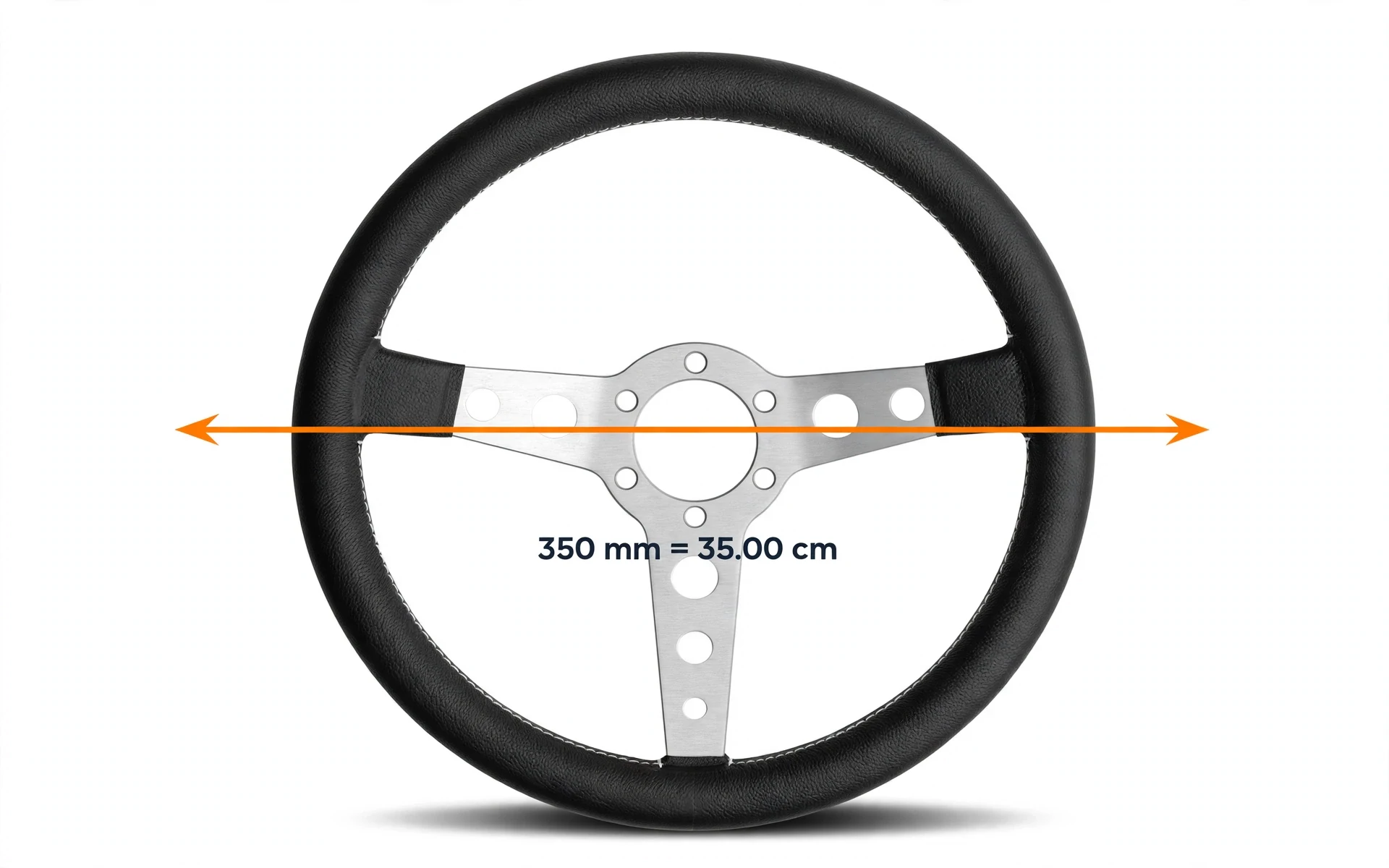
The steering wheel is the article’s second exact land-on, and the one that proves 35 cm is a working size, not a furniture size. MOMO’s official 2021 Street & Track catalog lists the Prototipo Black Edition at a diameter of 350 mm, so the wheel measures 35.00 cm rim to rim through the centre, with no deviation to print. Hold it by the rim and the distance across the wheel is the number itself, which is why it sits second on this page and why it is the object to reach for when someone asks what 35 cm looks like in a car.
The fitting check is the diameter, because the 350 mm is measured straight across the rim through the centre, and the wheel is not 35 cm in any other direction. A hub or a boss kit bought against “35 cm” fits the wheel’s diameter; a steering-wheel cover bought against “35 cm” for the grip circumference does not, because the circumference is 110 cm, not 35. The grade is listed because the figure is the manufacturer’s published specification for the named model, with the deviation printed in full: 35.00 cm, zero millimetres off. Always name the 350 mm version — the Prototipo also comes in 320 mm and 370 mm, and neither of them is 35 cm.
3. Dell XPS 15 9530 — Width 34.47 cm (LISTED)
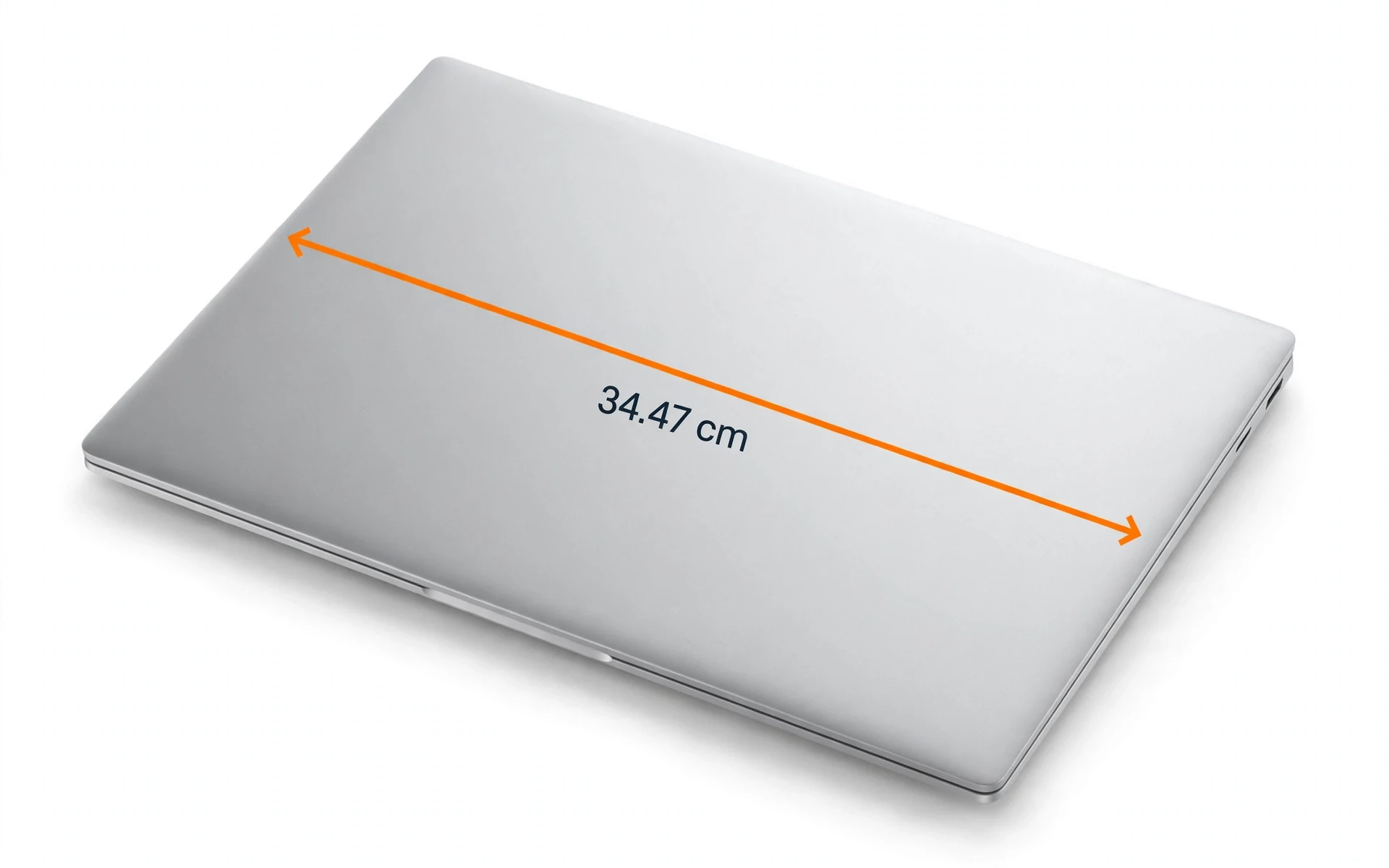
The XPS 15 is the article’s lower bracket, the laptop that falls 5.3 mm short of 35 cm. Dell’s official Setup and Specifications for the XPS 15 9530 lists the width as 344.72 mm, so the laptop runs 34.47 cm across the closed lid — 0.53 cm short of 35 cm, about the width of a pencil. Lay it closed on the desk and its width ends visibly short of the mark, and “add five millimetres” is the honest instruction for closing the gap.
The fitting check is the model, because the 344.72 mm width is the 9500–9530 chassis. Older XPS 15 models, the 9550 through the 7590, are 357 mm wide — a different chassis and a different number — so always name the 9530. The grade is listed because the figure is the manufacturer’s published specification for the named model, with the deviation printed in full: 34.47 cm, 5.3 mm short. Paired with the MacBook Pro below, it is the bracket: one laptop 5.3 mm under 35 cm, one 5.7 mm over, and 35 cm between them.
4. US Legal Paper — Long Side 35.56 cm (EXACT)
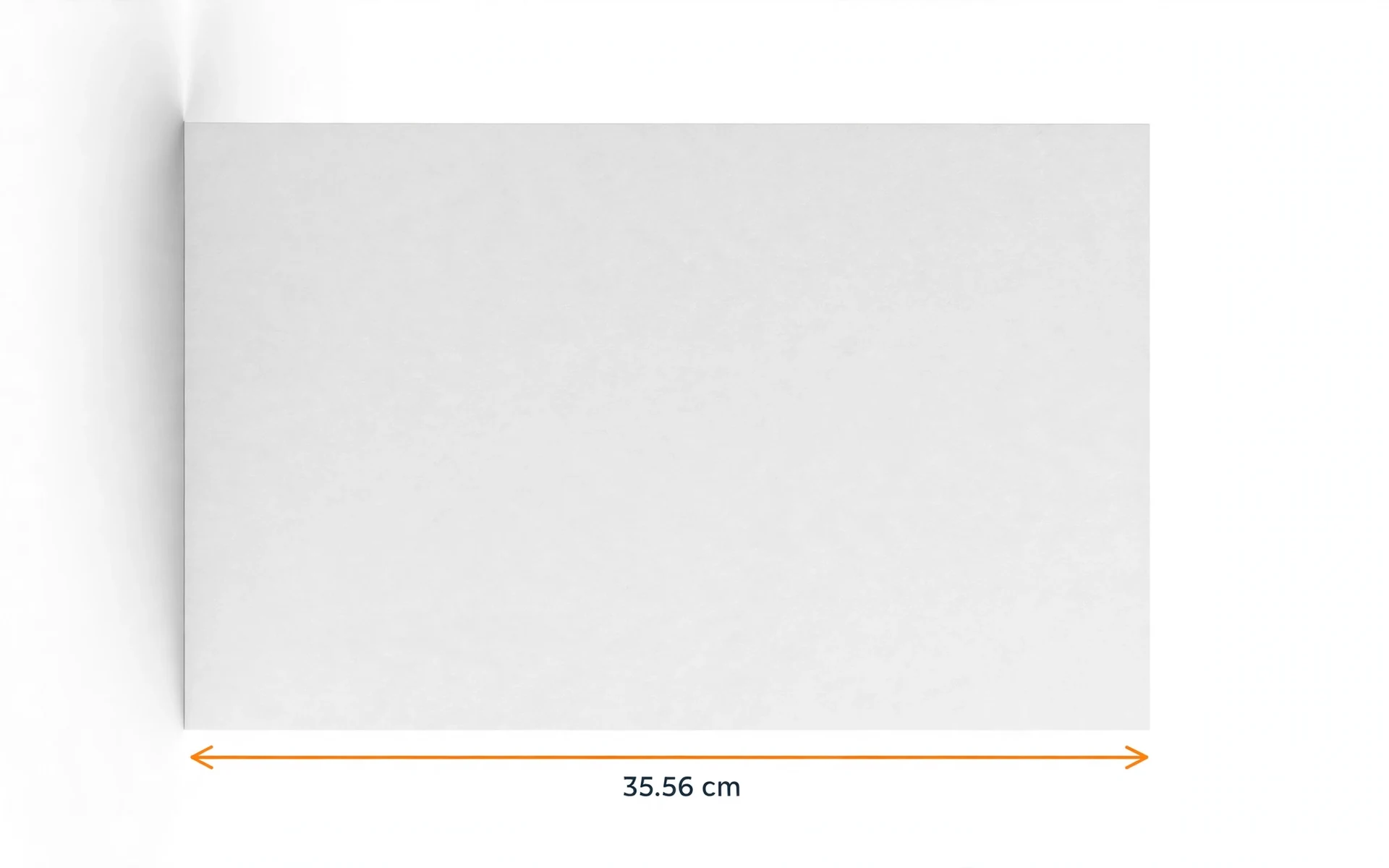
Legal paper is the article’s most useful near-miss, because it is the sheet you already own and can measure tonight. US legal paper is 8.5 × 14 inches, which converts to 215.9 × 355.6 mm, so the long side runs 35.56 cm — 0.56 cm past 35 cm, about the thickness of a pencil. Hold the sheet upright and its long edge ends visibly past the mark, and “take off six millimetres” is the honest instruction for closing the gap.
The fitting check is the long side, because the 35.56 cm is the 14-inch edge and the short side is 21.59 cm. A folder bought against “35 cm” holds the sheet lengthways with 5.6 mm to spare only if the folder is truly 35.56 cm inside; a folder that is exactly 35 cm inside does not, because the sheet is 5.6 mm too long. The grade is exact because the figure is the standard’s own dimension for the named format — ANSI/ASME Y14.1, carried in ANSI X3.151 — with the deviation printed in full: 35.56 cm, 5.6 mm over. Legal paper and the MacBook Pro already appear as the lead examples in our own 14-inch article; here they return as members of the 35.56 cm cluster, not as a repeat of that article.
5. Apple MacBook Pro, 16-Inch — Width 35.57 cm (LISTED)

The MacBook Pro is the article’s upper bracket, the laptop that overshoots 35 cm by 5.7 mm. Apple’s official technical specifications list the 16-inch MacBook Pro at a width of 14.01 inches, 35.57 cm, so the laptop runs 35.57 cm across the closed lid — 0.57 cm past 35 cm, about the thickness of a pencil. Lay it closed on the desk and its width ends visibly past the mark, and “take off six millimetres” is the honest instruction for closing the gap.
The fitting check is the screen size on the box, because the width is 35.57 cm and the screen is 16 inches diagonally, which is 40.64 cm corner to corner. A sleeve bought against “16 inches” that is really sized to the screen diagonal will swallow the laptop; a sleeve bought against “35 cm” will not close, because the laptop is 5.7 mm wider than the sleeve — the fit-check below works through the numbers. The grade is listed because the figure is the manufacturer’s published specification for the named model, with the deviation printed in full: 35.57 cm, 5.7 mm over. The width is the same across every 16-inch generation, from the M1 Pro of 2021 to the M5 of 2026, so do not tie it to one chip year — and always say “16-inch MacBook Pro”, never just “MacBook”, because our 30 cm article already measured a different machine, the 13-inch MacBook Air at 30.41 cm wide.
6. Full-Size (4/4) Violin — Body Length 35.6 cm (EXACT)
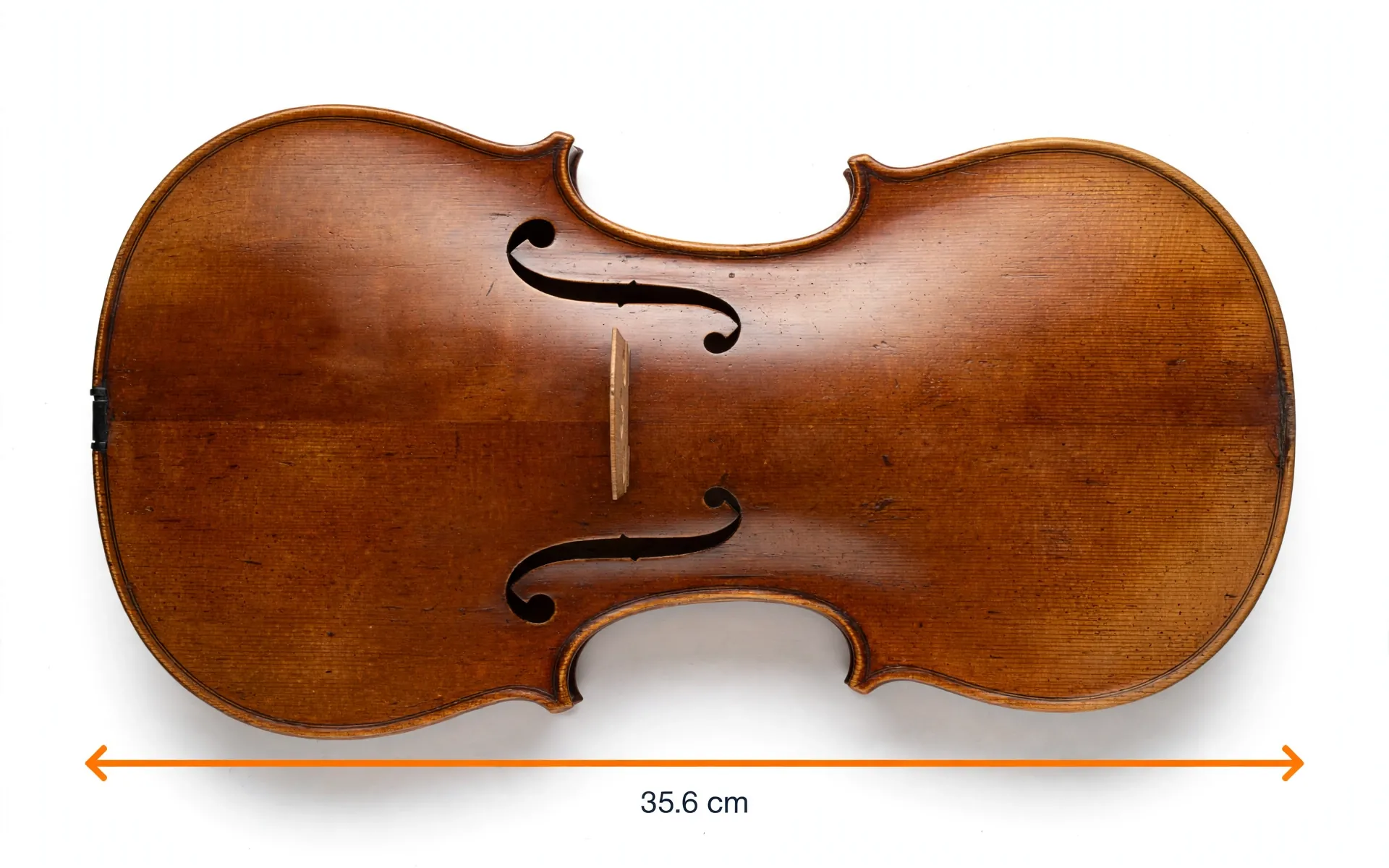
The violin is the article’s furthest miss, and the one that carries the music. The body length of a full-size, or 4/4, violin is 356 mm, so the body runs 35.6 cm — 0.60 cm past 35 cm, just over half a centimetre, or about the width of a fingernail. Set it on the bench and the body ends visibly past the mark, and “take off six millimetres” is the honest instruction for closing the gap.
The fitting check is the word “body”, because the 356 mm is the body alone, excluding the neck and the scroll. A case bought against “35.6 cm” for the body holds the violin; a case bought against “35.6 cm” for the whole instrument does not, because the neck and scroll add roughly another 23 cm past the body. The grade is exact because the figure is the standard dimension for the named size, with the deviation printed in full: 35.6 cm, 6.0 mm over. The 356 mm is the modern standard; some 17th-century models are smaller, and a conflicting secondary source that lists a 4/4 body at 15.6 inches, 39.6 cm, is wrong — it confuses the total length with the body length, so do not use it.
The 14-Inch Cluster: Why So Many Things Land 5.6 mm Over
Four of the six objects on this page sit at 35.56, 35.57 and 35.60 cm — legal paper, the MacBook Pro, the violin, and the 14-inch wok that never made the list — and they are not 35 cm objects at all. They are 14-inch objects. Fourteen inches is 35.56 cm by definition, so anything built to a 14-inch size lands 5.6 mm past 35 cm, and the cluster is what a 14-inch world looks like when you measure it in centimetres. The EKET cube and the MOMO wheel are the only two objects on the page that were built to 35 cm; the other four were built to 14 inches, and the centimetre figure is the conversion.
The trap has an origin, and it is the 2.5 shortcut. Divide 35 by 2.5 and you get 14.0 inches exactly — the lazy divisor produces precisely the wrong round number, which is how “35 cm = 14 in” survives in conversion guides that never check their own arithmetic. One rival conversion page even teaches the trick as a tip: multiply centimetres by 0.4, and 35 × 0.4 = 14, presented as “very close” to the real answer of 13.78. It is not very close when the whole point of the page is precision — it is the 5.6 mm error, presented as a method. The honest shorthand is “just under 14 inches” — “14 inches” hides the 5.6 mm, and “14.0 inches” invents a precision the number does not have.
The trap cuts both ways, and IKEA proves it. The EKET cube’s own label says 13¾ inches, and 13¾ inches is 34.925 cm — 0.75 mm short of 35 cm — so the imperial label understates the metric size by three-quarters of a millimetre, while a 14-inch label overstates it by 5.6 mm. A foot is 30.48 cm, so 35 cm is 4.52 cm longer than a foot, and a 14-inch laptop is not 35.56 cm wide at all: the 14 inches is the screen diagonal, and the body of a 14-inch laptop is about 32 cm wide. Measure the body, not the screen, and measure the metric figure, not the rounded label.
| Tape mark | Value | Against 35 cm |
|---|---|---|
| 13 in | 33.02 cm | 1.98 cm short |
| 13 3/4 in | 34.925 cm | 0.75 mm short |
| 13 13/16 in | 35.084 cm | 0.84 mm over |
| 13 25/32 in | 35.004 cm | 0.04 mm over |
| 14 in | 35.56 cm | 5.6 mm over |
On a tape measure, the nearest sixteenth-inch mark is 13¾ inches at 34.925 cm, which is 0.75 mm short — close enough for a cut, not close enough for a tight fit. The honest fraction is 13 25/32 inches at 35.004 cm, which is 0.04 mm over, essentially exact, but thirty-seconds are not printed on most tapes, so the practical reading is the 13¾-inch mark plus a hair. And 35 cm is 116.7% of a 30 cm ruler — mark off the whole ruler and add 5 cm, and the remaining length is the number you have left over.
Three “35 cm” Claims That Don’t Measure Up
| What a rival list claims | What it actually measures | The difference |
|---|---|---|
| A Neapolitan pizza is 35 cm across | 35 cm is the maximum diameter; authentic pizzas run 22–35 cm | A cap, not a size — most are smaller |
| A 35×35 cm cushion pad is a standard size | No manufacturer specification found; a nominal retail size | Unverified — IKEA’s own inner pads are 50×50 cm |
| A newborn baby’s head is about 35 cm | A circumference, and the WHO medians at birth are 34.5 cm (boys) / 33.9 cm (girls) | Under 35 cm, and a loop, not a straight length |
Three of these deserve a longer correction. The Neapolitan pizza is the most confident error in the ranking pages: a rival list calls a 35 cm pizza an “exactly 35 cm” object, but the AVPN rule and EU Regulation 97/2010 set 35 cm as the maximum diameter — “a variable diameter not exceeding 35 cm” — and authentic pizzas run 22 to 35 cm. A pizza is 35 cm only at the largest allowed size, which makes it a cap, not a size, and the object belongs in a corrections section, not in a list of things that measure 35 cm. The cushion pad is the most ordinary error: a rival list calls a 35×35 cm cushion pad a standard size, but no manufacturer specification for a 35×35 pad was found anywhere in research, and IKEA’s own INNER cushion pads are sold in 50×50 cm. It is a nominal retail size, not a standard, and a nominal size is not a measurement. And the newborn’s head is the most miscategorised error: a rival list calls a newborn’s head “about 35 cm” as if it were a length, but a head circumference is a loop measured around the head, not a straight line, and the WHO Child Growth Standards put the median head circumference at birth at 34.5 cm for boys and 33.9 cm for girls — under 35 cm on both counts.
One near-miss deserves a line of its own. A 14-inch flat-bottom wok is 35.56 cm across the rim — 5.6 mm over 35 cm, the same 5.6 mm as the trap, in the other direction. No named wok, no manufacturer, no specification was verified in research, so it stays a near-miss and never becomes a core object: the diameter is nominal, the model is unnamed, and the 5.6 mm is the trap again, wearing a frying pan.
How to Measure 35 cm Without a Ruler
| Method | What you get | How close it is |
|---|---|---|
| EKET cube, any side | 35.00 cm | Exact — the best pocket reference |
| 30 cm ruler + credit card short side (53.98 mm) | 35.40 cm | 4.0 mm over — take off four millimetres |
| A4 long edge (29.7 cm) + credit card short side | 35.10 cm | 1.0 mm over — the closest card trick |
| Legal paper, long edge | 35.56 cm | 5.6 mm over — take off six millimetres |
| Tape measure, 13 3/4 in mark | 34.925 cm | 0.75 mm short — add a hair |
The EKET method is the best of the five, because the miss is zero and the cube is in a million living rooms. The A4-and-card method is the one to use when there is nothing to measure with — the A4 long edge is 29.7 cm by the ISO 216 standard and the card’s short side is 53.98 mm by the ISO/IEC 7810 ID-1 standard, so the two together are 35.10 cm, one millimetre over. The ruler-and-card method is the one to use when you have a school ruler and a wallet — 30 cm plus 53.98 mm is 35.40 cm, four millimetres over, so take four millimetres off. The tape method is the most accurate, because the 13¾-inch mark is 0.75 mm from the number and the tape is the tool the number came from.
The fitting check is the zero mark, because 35 cm starts at the 0 line and not at the end of the ruler. Most plastic rulers carry a few millimetres of blank plastic past the last graduation, so if you measure from the physical edge of the ruler instead of from the 0 mark you will read long by that margin — about 3 mm on a cheap ruler, which is more than half the 5.6 mm gap this whole article is about. Measure from 0, and the ruler is honest; measure from the edge, and the ruler lies by more than half the trap.
35 cm in Every Unit
| Unit | Value |
|---|---|
| Millimetres | 350 mm |
| Metres | 0.35 m |
| Inches | 13.78 in (13 25/32 in) |
| Feet | 1.15 ft (1 ft 1.78 in) |
| Yards | 0.38 yd |
Thirty-five centimetres is 350 millimetres, and a centimetre is 10 millimetres, so the conversion is a multiplication by ten that never needs a calculator. In inches it is 35 divided by 2.54, which is 13.7795 inches, rounded to 13.78 — and the rounding is honest, because 13.78 inches times 2.54 is 34.999 cm, a hundredth of a millimetre from the mark. In feet it is 1.15, or 1 ft 1.78 in if you want feet and inches rather than a decimal. 40 cm is 5 cm longer than 35 cm, and 35 cm is 15 cm longer than 20 cm, 16 cm longer than 19 cm, and 17 cm longer than 18 cm, which is why the sizes sit next to each other in cases, shelves and laptop sleeves. Thirty-five centimetres is 35% of one metre, so three of them make just over a metre, and it is exactly halfway between 30 and 40 cm — the medium of the 30–35–40 ladder. Centimetres are the unit on furniture and storage listings, inches are the unit in US hardware and laptop sleeves, and millimetres are the unit in engineering and steering-wheel specs — and 35 cm is the size where all three meet, because it is a cube, a steering wheel, two laptops, a sheet of paper and a violin at once.
The 35 cm Fit-Check: Before You Buy
– Laptop sleeve: a 16-inch MacBook Pro at 35.57 cm does NOT fit a 35 cm laptop sleeve. Buy a sleeve with at least 35.6 cm of interior width — in practice a sleeve sold for a “14-inch” laptop — and check the interior width in the specifications, not the screen size on the box. The Dell XPS 15 at 34.47 cm fits a 35 cm sleeve with 5.3 mm to spare, which is why the two laptops belong in one bracket and not two.
– EKET cube: a true 14-inch object at 35.56 cm overhangs a 35 cm EKET cube by 5.6 mm. Measure the object, not the label — if the listing says “14 inches”, the object is 35.56 cm, and the cube is 35.00 cm, and the 5.6 mm is the difference between a fit and an overhang.
– Storage box: the IKEA KVARNVIK storage box with lid is 25×35×20 cm, so its 35 cm long side holds A4 paper (29.7 cm) and US letter paper (27.94 cm) lengthwise with room to spare. Buy by the long side, not by the box’s name, and check the interior dimensions — the lid adds height, not length.
– Pizza pan: a 14-inch pizza pan is 35.56 cm across, so it needs a shelf gap wider than 35 cm. A shelf built to exactly 35 cm holds a true 35 cm pan and not a 14-inch one, and the 5.6 mm is the difference between a pan that slides in and a pan that does not.
The rule underneath all four is the same: measure the space, add clearance, and never trust a “14-inch” label alone. The label is a screen size, a nominal size, or a rounded size; the tape is the size. Five point six millimetres is the price of trusting the label, and a sleeve that does not close is the receipt.
Frequently Asked Questions
Is 35 cm the same as 14 inches?
No. Thirty-five centimetres is 13.78 inches, and 14 inches is 35.56 cm, so 35 cm falls 5.6 mm short of 14 inches. Call it “just under 14 inches” and you are right; call it “14 inches” and you are 5.6 mm wrong, which matters when the thing has to fit.
How many inches is 35 cm?
Thirty-five centimetres is 13.78 inches, or 13 25/32 inches as a fraction. The conversion is 35 divided by 2.54, because one inch is defined as exactly 2.54 cm. On a tape measure, the nearest sixteenth-inch mark is 13¾ inches at 34.925 cm, 0.75 mm short.
What everyday objects are 35 cm long?
Six verified objects, tightest first: an IKEA EKET cabinet at exactly 35.00 cm on every side, a MOMO Prototipo steering wheel at exactly 35.00 cm across, a Dell XPS 15 9530 at 34.47 cm wide, US legal paper at 35.56 cm on the long side, a 16-inch MacBook Pro at 35.57 cm wide, and a full-size violin body at 35.6 cm long. Every one is verified against the manufacturer’s own specification or the standard.
Will a 16-inch MacBook Pro fit in a 35 cm laptop sleeve?
No. It is 35.57 cm wide — buy a sleeve with at least 35.6 cm of interior width, in practice a sleeve sold for a “14-inch” laptop, and check the interior width in the specifications, not the screen size on the box. The Dell XPS 15 at 34.47 cm fits a 35 cm sleeve with 5.3 mm to spare.
How do I measure 35 cm without a ruler?
Use an IKEA EKET cube for exactly 35.00 cm, or take an A4 sheet’s long edge (29.7 cm) plus a credit card’s short side (53.98 mm) for 35.10 cm, or a 30 cm ruler plus a credit card for 35.40 cm. Measure from the ruler’s zero mark, not from the plastic edge, or you will read about 3 mm long.
Is a Neapolitan pizza really 35 cm across?
Only at the largest allowed size. The AVPN rule and EU Regulation 97/2010 cap the diameter at 35 cm; authentic pizzas run 22 to 35 cm, so 35 cm is the maximum, not the size.
What is 35 cm in mm, feet and meters?
Thirty-five centimetres is 350 millimetres, 1.15 feet (1 ft 1.78 in), and 0.35 metres — 35% of a metre, and exactly halfway between 30 and 40 cm.
Is 35 cm longer than a foot?
Yes — 4.52 cm longer than 12 inches (30.48 cm), roughly two finger-widths. It is also 5 cm longer than a 30 cm ruler and exactly halfway between 30 and 40 cm, which is why it shows up in furniture, storage and laptop sleeves rather than in rooms.
Final Thoughts
Thirty-five centimetres is a length that falls between two laptops and inside one cube, and the gap is the whole article. The six objects that measure it — a storage cube, a steering wheel, two laptops, a sheet of legal paper and a violin — are all things you can find tonight without buying anything, and every one of them carries the number its source actually publishes, with the miss printed next to it. That is the difference between a measurement and a slogan: the measurement can be checked, and the slogan cannot.
The habit worth keeping is the one this article is built on. Do not take the round number, and do not take the name. Ask which axis was measured — the width or the screen diagonal, the body or the whole instrument, the diameter or the circumference — look up the specification, and print the miss when there is one. A sleeve that does not close is a 5.6-millimetre lesson; a cube measured on every side is 35 cm, exactly, every time.
