
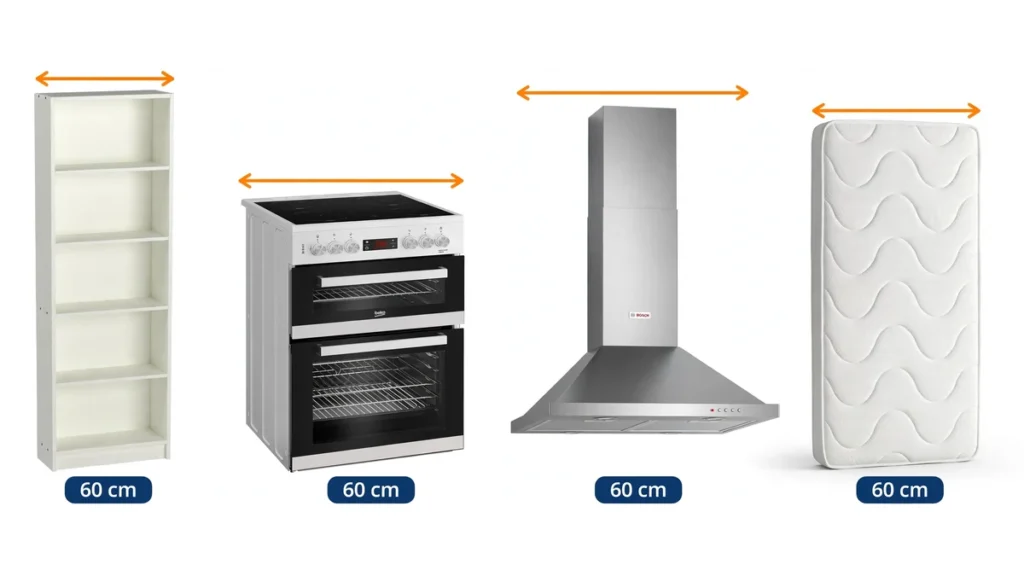
Take a metre stick — the one in the kitchen drawer, or the tape in the toolbox — and fold it at the 40 cm mark. The longer piece in your hand is 60 cm, and it is the size the world keeps building to. So how big is 60 cm, really? It is exactly three fifths of a metre, the piece that completes the metre when you put it next to 40 cm, and it is the width of the bookcase in the hallway, the cooker in the kitchen, the washing machine in the utility room and the cot mattress in the nursery. This article is about that number: what 60 cm actually is, seven things that really measure it, and the 9.6 mm gap that separates it from the 24 inches it keeps getting confused with.
Sixty centimetres is 23.62 inches, 600 millimetres, and 0.60 metres. It is exactly double 30 cm, exactly three fifths of a metre, and exactly the partner 40 cm needs to make one metre — two sizes that turn up together in furniture and product dimensions for a reason. The seven objects below are the closest honest answers to it: six land on 60 cm exactly, one misses by a single millimetre with the miss printed in full, and every one of them carries the source that proves it.
Quick Answer
60 cm is 23.62 inches — 9.6 mm short of 24 inches.
Sixty centimetres is 23.62 inches, 600 millimetres, and exactly three fifths of a metre. Six objects land on it exactly — a bookcase, a cooker, a hood, a washer, a cot mattress and a worktop — and one more misses by a single millimetre, with the miss printed in full.
The bar above shows sixty 1 cm segments, but it is a diagram, not a ruler: screen sizes vary, so it explains the measurement rather than measuring it. For a real measurement, use the objects below or a tape measure.
Three-Fifths of a Metre: The Size That Completes the Metre
Sixty centimetres is three fifths of a metre — not approximately, not near enough, but exactly. A metre is 100 cm, and 60 divided by 100 is 0.6, which is three fifths in its lowest terms. That fraction is the whole story of this size, because a fraction is a relationship, and 60 cm relates to the metre the way no other size in this series does: it is the larger piece of the metre split at 40 cm, and a 40 cm length plus a 60 cm length make exactly one metre. Five 60 cm lengths laid end to end make exactly three metres. A pair of 30 cm rulers end to end is exactly 60 cm, and three 20 cm lengths do the same. The number is not a random point on the tape; it is a joint in the metric system itself.
That is why metric manufacturing keeps landing on 600 mm. A kitchen is built in 600 mm modules because a 600 mm module is three fifths of a metre: big enough for a cooker, a washing machine, a dishwasher or a sink base, and small enough that five of them fit a three-metre wall. A bookcase is 60 cm wide because 60 cm is a shelf that holds a row of paperbacks and still fits a hallway. A worktop is 600 mm deep because 600 mm is the depth a person can reach across without stretching. The size is not popular by accident. It is the largest round fraction of a metre that still fits a small room, and the smallest round fraction that still does a real job.
The ladder runs 20, 40, 60, 80, 100 — and 60 cm sits in the middle of it, with 40 cm below and 80 cm above. It is 10 cm longer than 50 cm, which is the half metre, and the step from a half to three fifths is the step from a size that halves the metre to a size that completes it with a partner. That partner is the reason this article is built the way it is: the objects below are the evidence, but the fraction is the argument, and the argument is that 60 cm is not just a length you can measure — it is a length you can count with.
7 Things That Are 60 cm
The seven objects are ordered by how close they land on 60 cm, closest first, and each one carries its evidence grade in the heading. LISTED means the figure is the manufacturer’s published specification for the named model. Six of the seven land on 60 cm exactly, and the one that does not carry its miss in the open, in millimetres, where you can see it — the mean absolute deviation across all seven is 0.014 cm.
A published 60 cm designation does not mean every unit measures mathematically 60.000 cm: cookers are sold by a nominal width, mattresses by a flat size that changes under weight, worktops by a depth that sits on a shallower unit, fridges by a width that is a millimetre over the round number. What follows is what the source actually says, with the axis named every time, so you can check it yourself.
1. IKEA GERSBY Bookcase, Width 60 cm — Exactly 60.00 cm (LISTED)
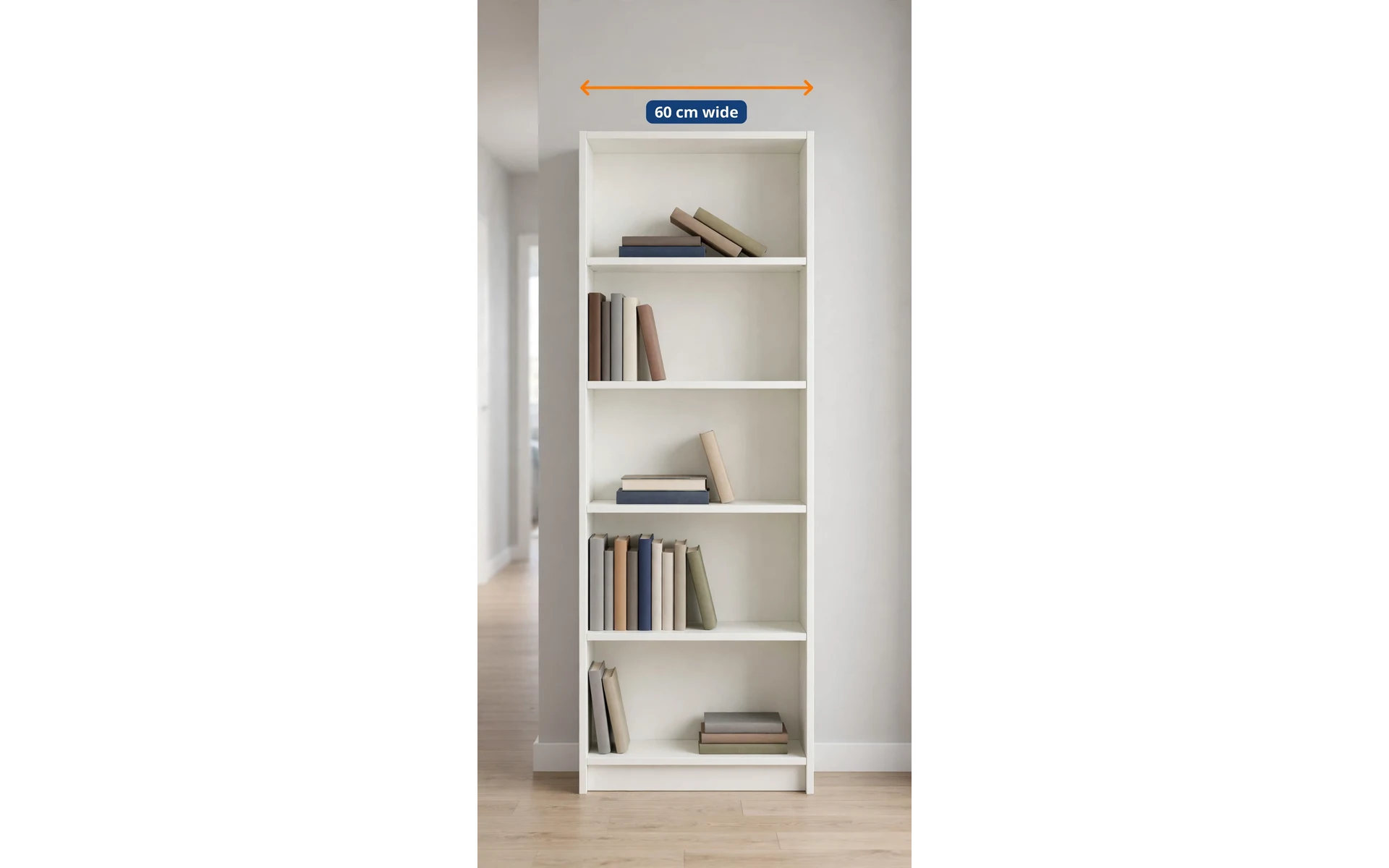
The GERSBY bookcase is the article’s cleanest land-on, because its 60 cm is not one measurement of a thing that happens to be 60 cm wide — it is the width the bookcase is sold by, in every version of it. IKEA’s product page lists the GERSBY bookcase at 60 × 180 cm, so the bookcase measures 60.00 cm across its front, with no deviation to print. Stand it in the hallway and its width is the number itself, which is why it sits first on this page.
The fitting check is the depth, because the 60 cm is the width and nothing else. The bookcase is only 24 cm deep and 180 cm tall, so a reader picturing a 60 cm-deep bookcase will misjudge the hallway space by more than double. The 24 cm depth is the reason it fits a hallway at all: it holds a row of paperbacks and still leaves the passage clear. Anchor it to the wall before loading the top shelf — IKEA’s own instruction — because a 180 cm bookcase that is only 24 cm deep is a lever waiting for a reason to tip. The grade is listed because the figure is the manufacturer’s published specification for the named product, with the deviation printed in full: 60.00 cm, zero millimetres off.
2. Beko KDDF653 Dual Fuel Double Oven Cooker, Width 600 mm — Exactly 60.00 cm (LISTED)
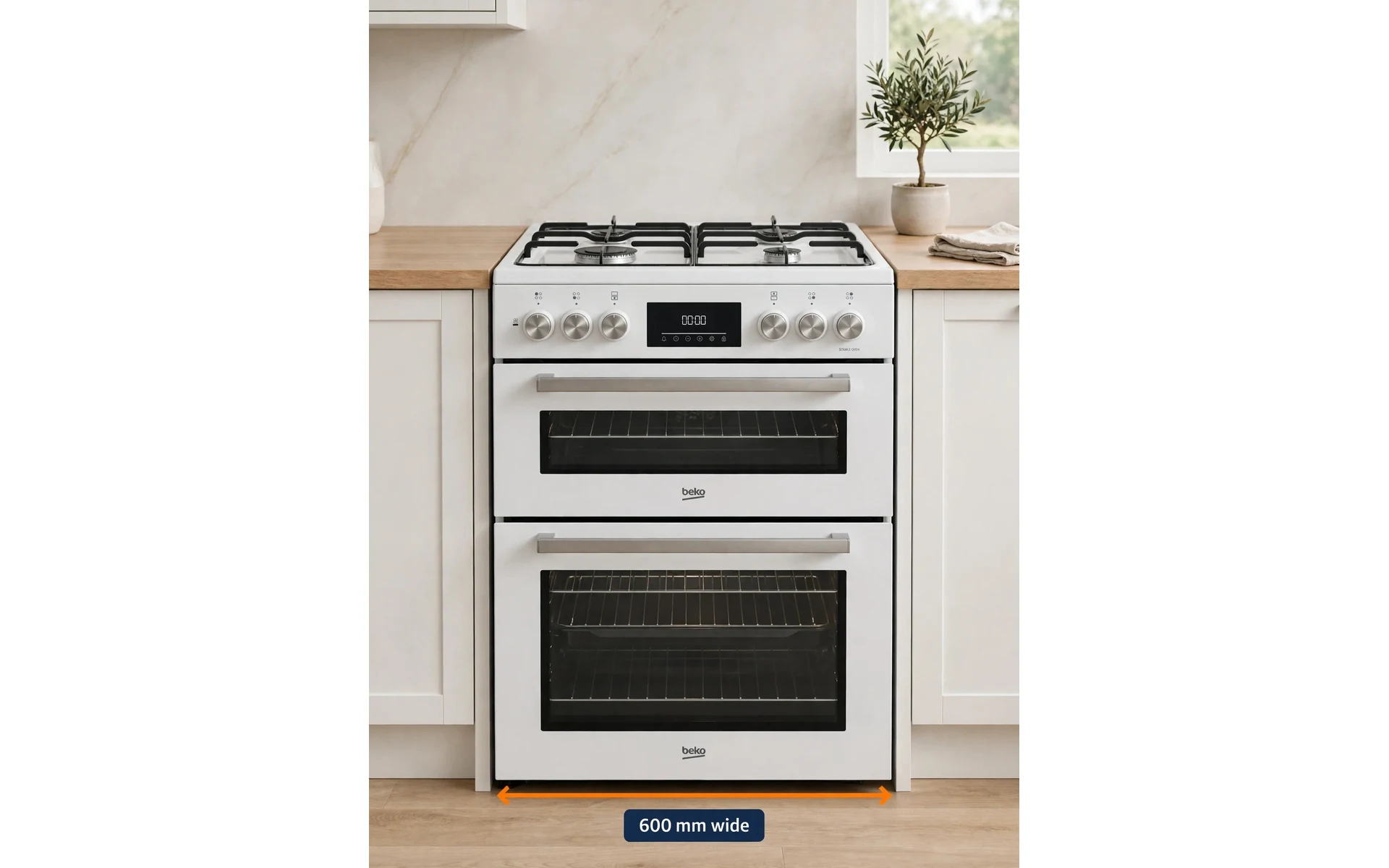
The Beko cooker is the article’s hardest-working land-on, and the one that proves 60 cm is a kitchen size twice over. Beko’s product page lists the KDDF653 at 600 mm wide, with the full dimensions given as 900 mm high, 600 mm wide and 600 mm deep, so the cooker measures 60.00 cm across its front — and 60.00 cm front to back as well, 60 cm in two directions at once. Stand in front of it and its width is the number itself, which is why it sits second on this page.
The fitting check is the box, because the cooker body is 600 mm wide but its carton is wider than its body. A buyer who measures the box will think the cooker needs a wider gap than it does, and a kitchen planned on the box will waste worktop. Plan the gap on the body — 600 mm — and check the depth too, because 600 mm of cooker has to sit against a worktop that is usually 600 mm deep, with no room to spare. Say which axis the arrow measures: the width, across the front — never imply the 900 mm height is 60 cm. The grade is listed because the figure is the manufacturer’s published specification for the named model, with the deviation printed in full: 60.00 cm, zero millimetres off. The 60 cm cooker is the standard cooker in the range: the 50 cm cooker is the narrow one for a small kitchen, and the 60 cm one is the one most kitchens are built around.
3. Bosch DWP64BC50A Wall-Mounted Cooker Hood, Width 600 mm — Exactly 60.00 cm (LISTED)
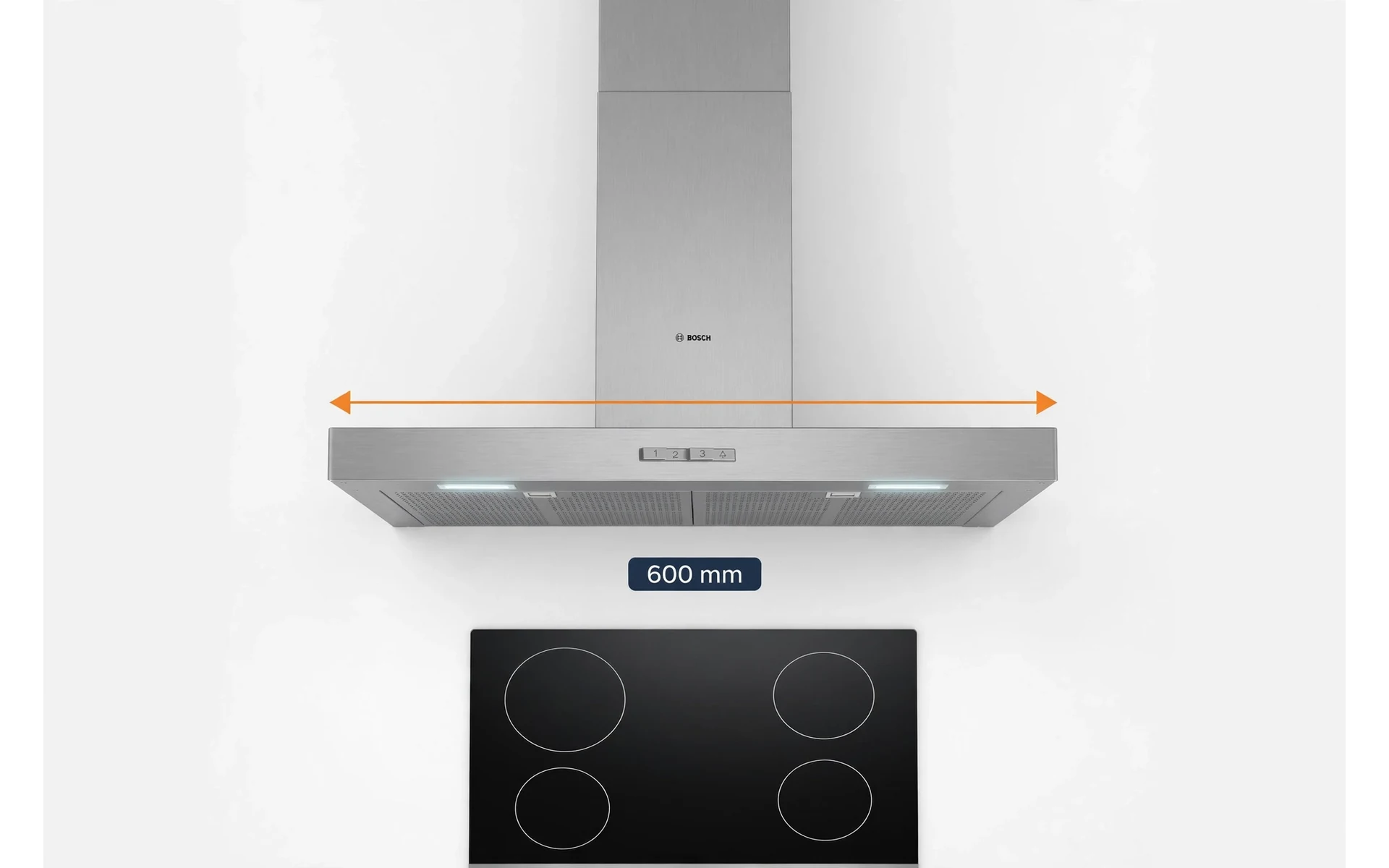
The Bosch hood is the article’s most precise land-on, because its 600 mm is a width that has to match another width exactly. Bosch’s specification sheet lists the DWP64BC50A at 600 mm wide, with the full dimensions given as 799–975 mm high, 600 mm wide and 500 mm deep, so the hood measures 60.00 cm across its front, with no deviation to print. Hang it over the hob and its width is the number itself, which is why it sits third on this page.
The fitting check is the axis, because the 600 mm is the WIDTH across the front, and the hood has two other dimensions that are easy to confuse with it. Its chimney telescopes from 799 mm to 975 mm tall and its depth is 500 mm — never quote either as the hood’s size, and the image arrow must run horizontally across the front, not vertically up the chimney. A 600 mm hood sits over a 600 mm hob, and that match is the whole point: the hood is the width of the thing it serves. The grade is listed because the figure is the manufacturer’s published specification for the named model, with the deviation printed in full: 60.00 cm, zero millimetres off.
4. Samsung WW90CGC04AAE 9 kg Washing Machine, Width 600 mm — Exactly 60.00 cm (LISTED)
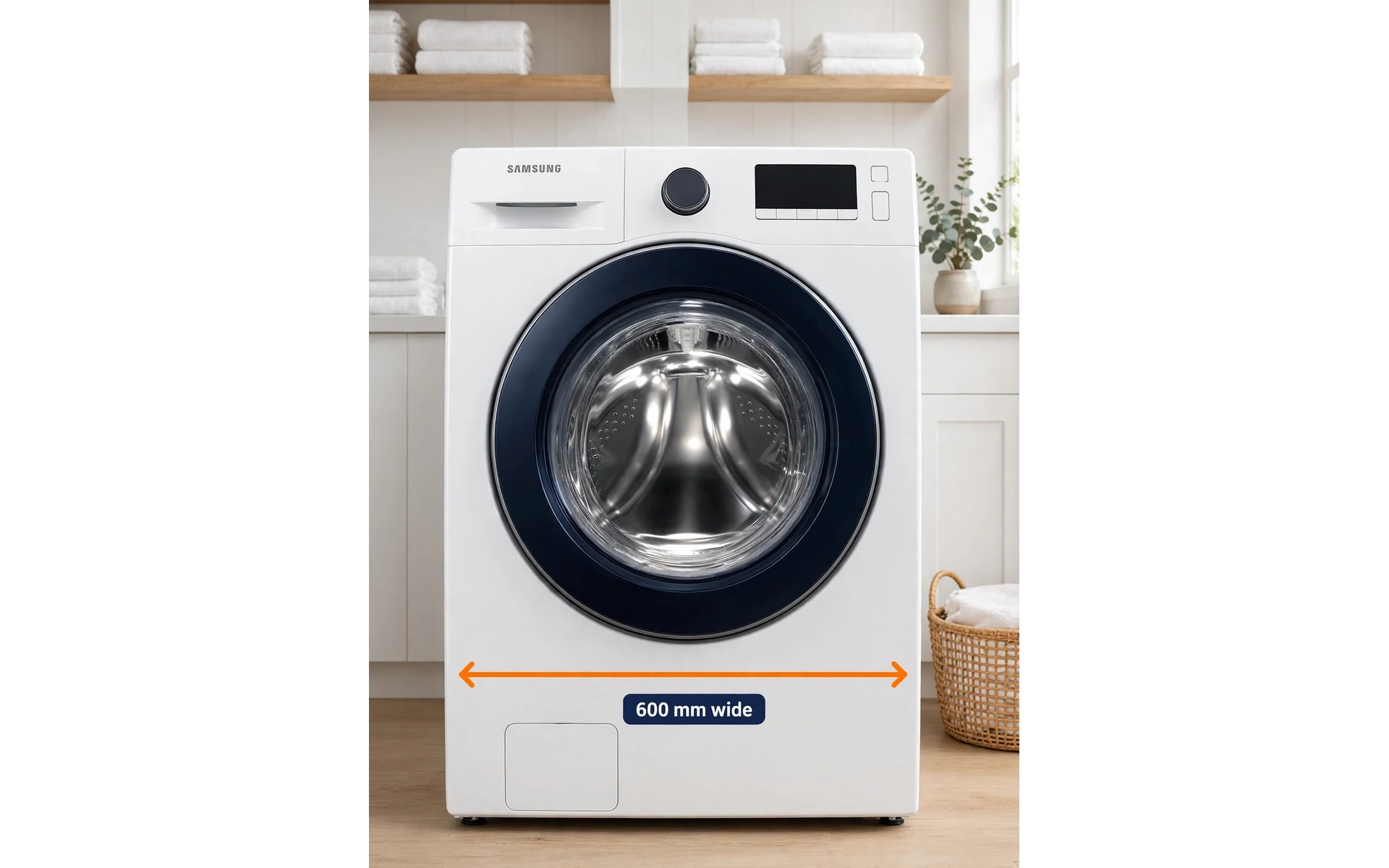
The Samsung washer is the article’s most everyday land-on, and the one that proves 60 cm is a laundry size as well as a kitchen size. Samsung’s user manual lists the WW90CGC04AAE at 600 mm wide, with the full dimensions given as 600 mm wide, 850 mm high and 550 mm deep, so the washer measures 60.00 cm across its front, with no deviation to print. Slide it into its gap and its width is the number itself, which is why it sits fourth on this page.
The fitting check is the clearance, because a 600 mm washer needs a 600 mm gap plus room for the hoses and for vibration. A washer that fits the gap with nothing to spare will walk across the floor on a fast spin, and a washer whose hoses are kinked behind it will leak where you cannot see it. Measure the gap with the door closed and the hoses connected, and remember the depth is 550 mm — the machine is shallower than the 600 mm worktop it often sits under, which is why the hoses and the waste pipe have somewhere to go. The grade is listed because the figure is the manufacturer’s own specification for the named model, with the deviation printed in full: 60.00 cm, zero millimetres off. Note the source honestly: the figure comes from Samsung’s own user manual, and the copy linked here is the manual as reproduced by a manual archive, because no Samsung product page for this exact model code was found live at draft time.
5. IKEA KRUMMELUR Foam Mattress for Cot, Width 60 cm — Exactly 60.00 cm (LISTED)
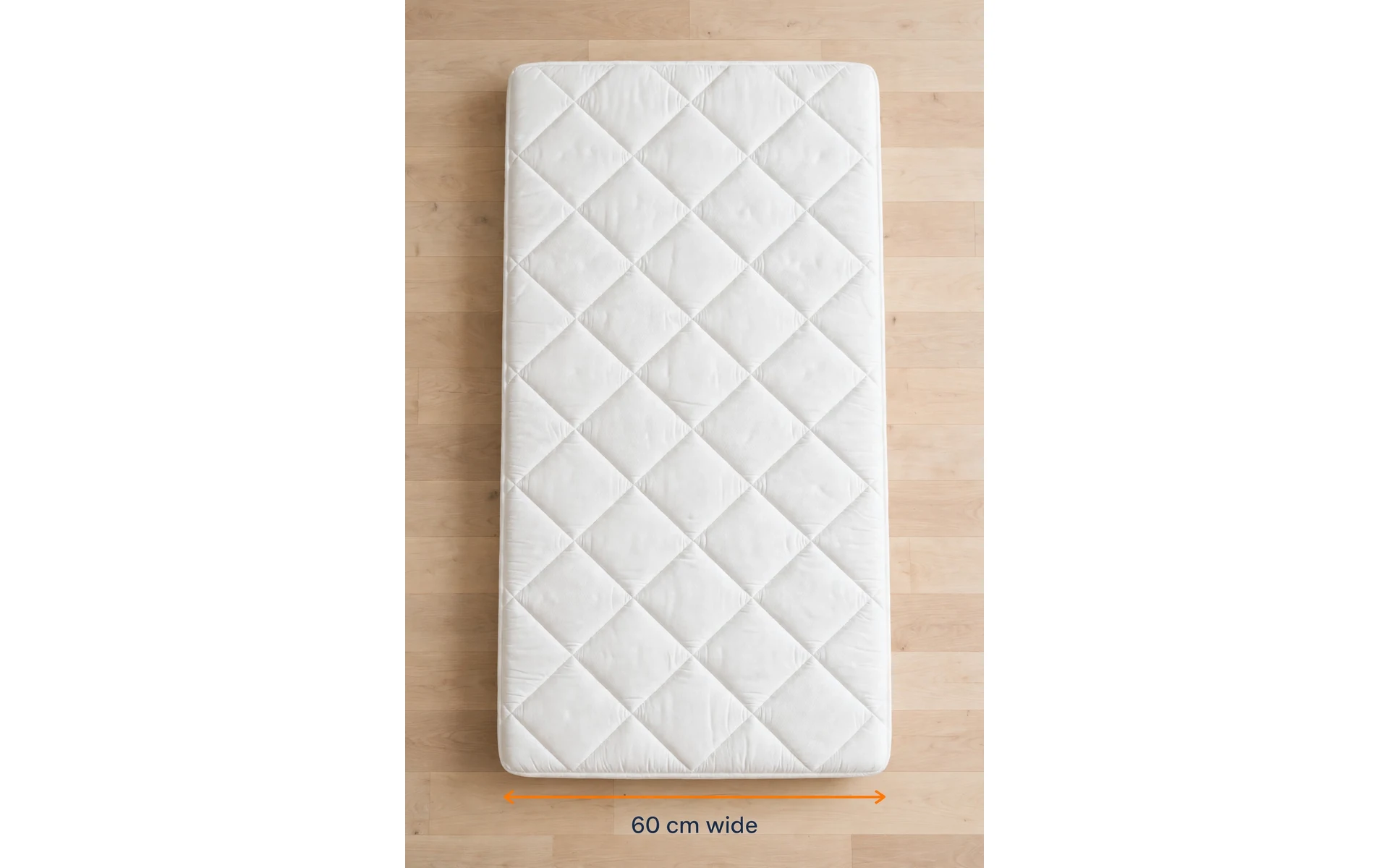
The KRUMMELUR mattress is the article’s softest land-on, and the one that proves 60 cm is a nursery size. IKEA’s product page lists the KRUMMELUR at 60 × 120 × 8 cm, so the mattress measures 60.00 cm on its short side, with no deviation to print. Lay it flat in the cot and its width is the number itself, which is why it sits fifth on this page.
The fitting check is the word “sold”, because the 60 × 120 cm is the flat, uncompressed size. Foam compresses under a baby’s weight and the cover is removable and machine washable at 60°C, so a mattress that has been slept on will not hold its listed width to the millimetre — measure it flat, fresh from the packet, and the 60 cm is there. The mattress is 8 cm thick, with two different surfaces: one wavy side with medium-firm comfort and one smooth side which is firmer. And the safety note matters more than the measurement: always use the same size cot and mattress, because a gap between the mattress and the cot side is a gap a baby’s head could be trapped in. The grade is listed because the figure is the manufacturer’s published specification for the named product, with the deviation printed in full: 60.00 cm, zero millimetres off.
6. Wilsonart Mondego Oak Laminate Kitchen Worktop, Depth 600 mm — Exactly 60.00 cm (LISTED)
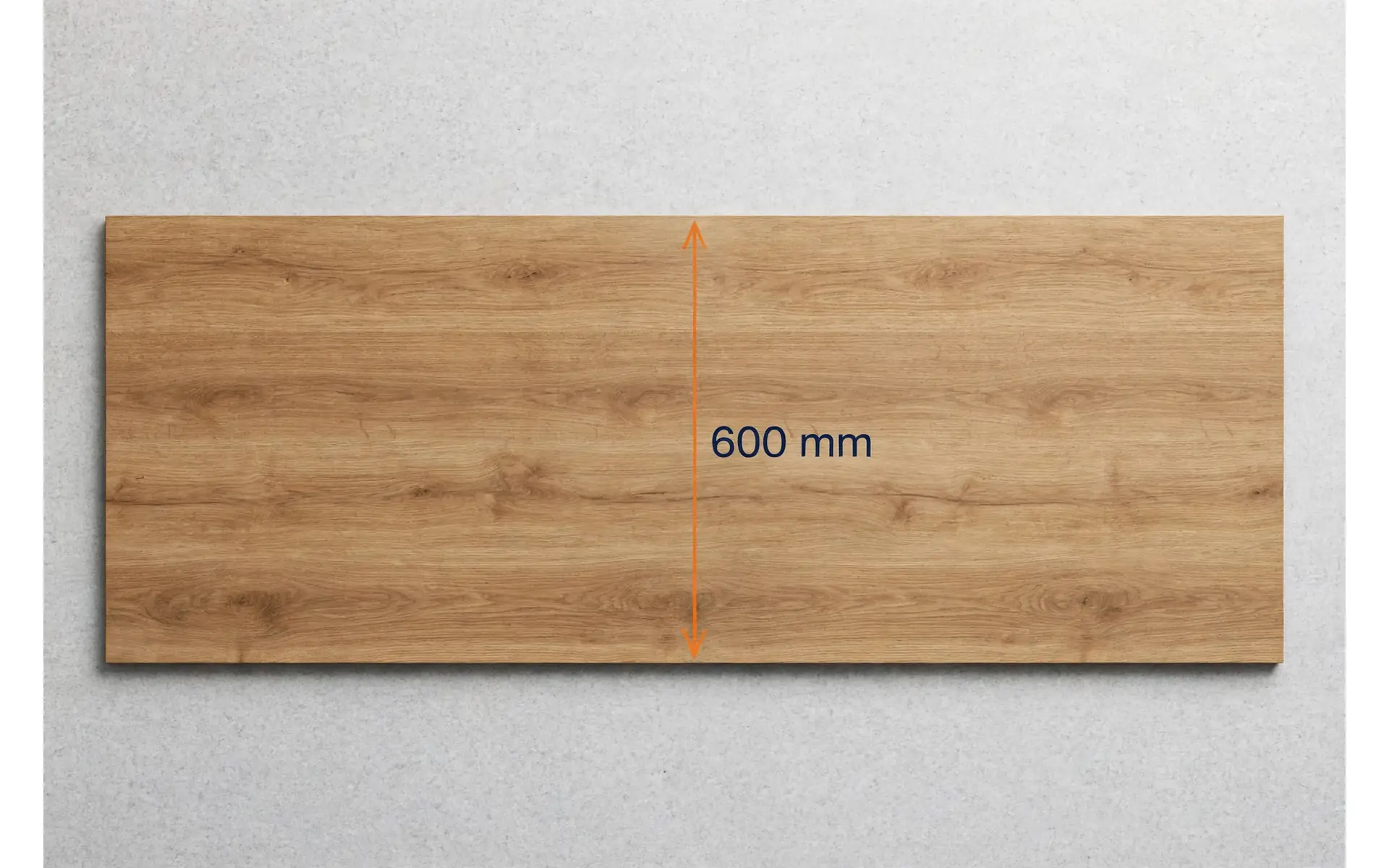
The Wilsonart worktop is the article’s most useful land-on, because its 60 cm is a depth you already own if you own a kitchen. Screwfix’s specification table lists the Wilsonart worktop at 600 mm deep, with the full dimensions given as 3000 mm long, 600 mm deep and 38 mm thick, so the worktop measures 60.00 cm from its front edge to the wall, with no deviation to print. Run a finger along the front edge and the depth is the number itself, which is why it sits sixth on this page.
The fitting check is the overhang, because the worktop is 600 mm deep but it sits on base units that are 570 mm deep, with a 10 mm overhang at the front. Say “600 mm deep” for the worktop and never write “the kitchen unit is 600 mm deep” — the unit is 570 mm, and the extra 30 mm is the worktop’s thickness and overhang, not the cabinet. Hob cut-outs go 50 mm from the front edge and 60 mm from the rear edge, and those two small numbers are the reason the 600 mm depth matters: cut the hole in the wrong place and the hob will not sit flat. The grade is listed because the figure is the manufacturer’s dimension for the named product, carried in the retailer’s specification table, with the deviation printed in full: 60.00 cm, zero millimetres off.
7. Smeg FAB28 50’s Style Fridge, Width 601 mm — 1 mm Over 60.00 cm (LISTED)
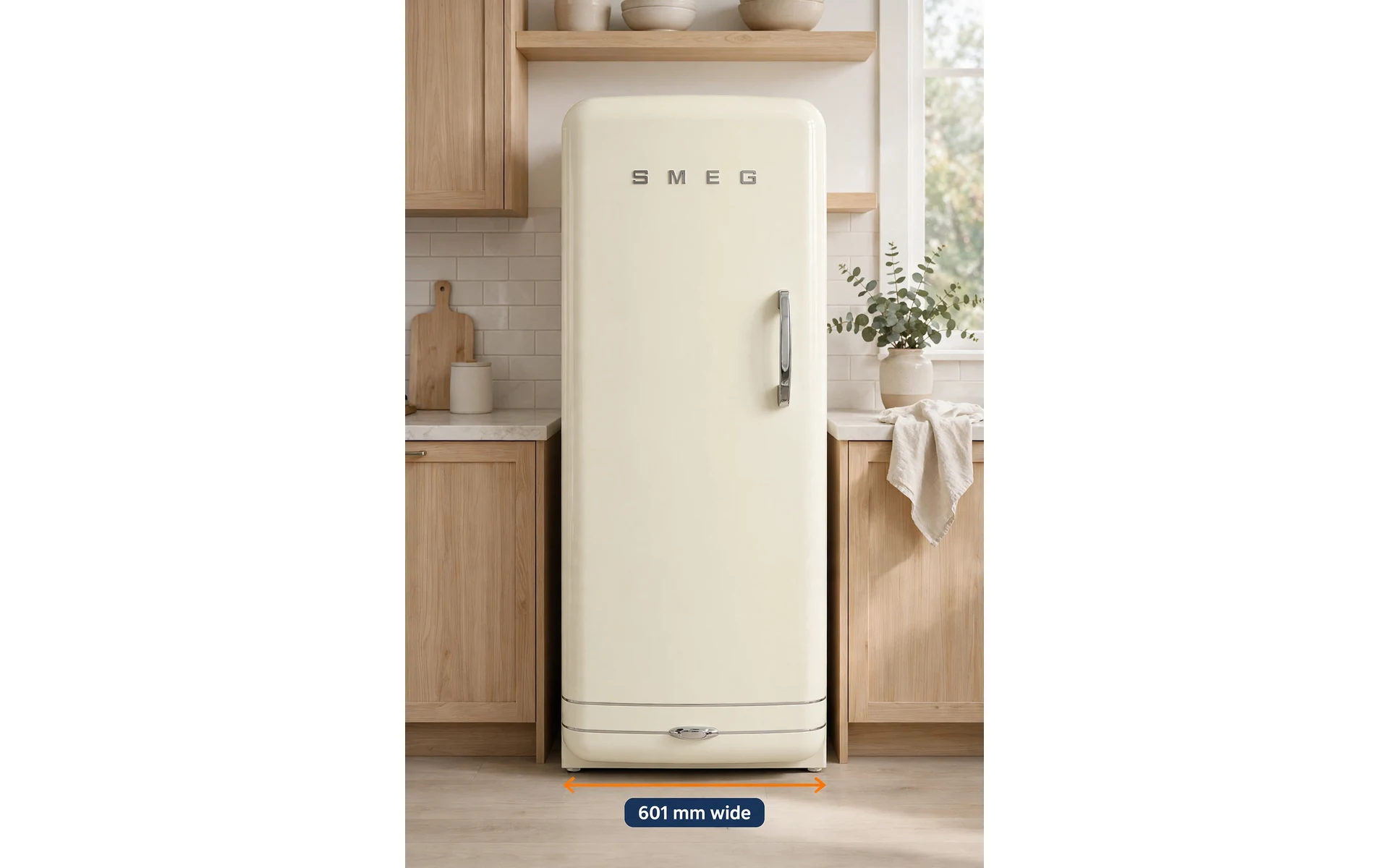
The Smeg fridge is the article’s furthest miss, and the one that carries the honest millimetre. Smeg’s product page lists the FAB28 at 601 mm wide, with the full dimensions given as 1530 mm high, 601 mm wide and 728 mm deep, so the fridge measures 60.10 cm across its front — one millimetre over 60 cm, about the thickness of a fingernail. Stand in front of it and its width is the number itself, near enough, which is why it sits seventh on this page.
The fitting check is the millimetre, because a fridge sold as a “60 cm fridge” that measures 601 mm needs a 601 mm gap, not a 600 mm one. A gap cut to exactly 600 mm will not take it, and the one millimetre is the whole difference between a fridge that slides in and a fridge that does not. The door needs 898 mm clear when fully open, so the gap is not the only measurement that matters — check the swing too, or the door will hit the wall every time you open it. The grade is listed because the figure is the manufacturer’s published specification for the named model, with the deviation printed in full: 601 mm, 1.0 mm over. Do not call it “exactly 60 cm” — say “601 mm”, and show the working, because the 1 mm is the honest part.
The 24-Inch Twin: The 9.6 mm That Breaks the Fit
Twenty-four inches is 60.96 cm, so 60 cm falls 9.6 mm short of 24 inches — about a fingernail’s width, and about the thickness of the gap that breaks a tight fit. Two of the laziest mental-math shortcuts in the world both produce exactly the wrong round number: 60 divided by 2.5 is 24.0 inches exactly, and 60 times 0.4 is 24 inches exactly. The two most common tricks both erase the whole 9.6 mm gap in one step, which is how “60 cm = 24 in” survives in conversion guides that never check their own arithmetic. The honest shorthand is “just under 24 inches” — “24 inches” hides the 9.6 mm, and “24.0 inches” invents a precision the number does not have.
The trap has a family, and it is a big one. Anything built to 24 inches is 60.96 cm, and the 24-inch product family is everywhere: kids’ 24-inch bike wheels, 24-inch televisions, 24-inch monitors and 24-inch pizzas are all sold as “24 inch”, and every one of them is 9.6 mm too long for a 60 cm space. Sellers make it worse by describing a 60 cm product as “24 inch” after a careless conversion, so the label and the specification sheet disagree, and the buyer who trusts the label buys a thing that does not fit. 2 feet is 60.96 cm too, so the same trap wears a feet label as well: a “2-foot” product is 60.96 cm, not 60 cm, and the 9.6 mm is the same gap in a different unit.
The reverse case is the one that actually breaks fits. A 60 cm object fits a 24-inch space with 9.6 mm to spare — that direction is safe. A 24-inch product does NOT fit a 60 cm space, and that is the case that breaks the fit: the product is 9.6 mm too long, and no amount of pushing will make it shorter. If the fit matters, trust the millimetre figure on the specification sheet, not the inch figure in the product title.
| Tape mark | Value | Against 60 cm |
|---|---|---|
| 23 in | 58.42 cm | 1.58 cm short |
| 23 1/2 in | 59.69 cm | 3.1 mm short |
| 23 9/16 in | 59.849 cm | 1.51 mm short |
| 23 5/8 in | 60.0075 cm | 0.075 mm over |
| 23 21/32 in | 60.087 cm | 0.87 mm over |
| 23 11/16 in | 60.166 cm | 1.66 mm over |
| 24 in | 60.96 cm | 9.6 mm over |
On a tape measure, the nearest sixteenth-inch mark is 23 5/8 inches at 60.0075 cm, which is 0.075 mm over — essentially exact, and the mark to use. The mark just before it, 23 9/16 inches at 59.849 cm, is 1.51 mm short, which is close enough for a cut and not close enough for a tight fit. And 60 cm is 200% of a standard 30-centimetre ruler — mark off the whole ruler and mark it off again, and the two rulers end to end are the number itself.
“60 cm” on the Label, 598 or 601 mm in Real Life
A “60 cm” label is a size class, and the millimetre figure on the specification sheet is the size the factory actually made. The two are not the same number, and this article’s objects prove it twice over. The Bosch DWP64BC50A in the list above is 600 mm wide, exactly — but its sibling, the Bosch DWP64CC50M, is sold as the same “60 cm” hood and measures 598 mm. Bosch’s specification sheet lists the DWP64CC50M at 598 mm wide, and the 2 mm is not a mistake: the hood is built 2 mm under so it slides into a 600 mm slot without catching on the sides. A “60 cm” dishwasher from the same maker is 598 mm wide for exactly the same reason — the clearance is designed in, and the label rounds it away.
The Smeg FAB28 at the end of the list is the same story in the other direction: sold as a 60 cm fridge, measured at 601 mm wide. The millimetre over is the manufacturing reality, and the centimetre on the box is the size class it belongs to. A 600 × 600 mm floor tile is dual-labelled “24 × 24 inches” in some markets, and a true 24-inch tile would be 60.96 cm — the two labels on the same tile disagree by 9.6 mm, and the tile is 600 mm, not 609.6 mm. And a 60 cm foam roller can really be a relabelled 24-inch roller at 61 cm: the product was designed as a 24-inch roller and renamed, and the new name is a rounding of the old size, not a measurement of the new one.
The rule is simple, and it is the rule this whole article runs on: the millimetre figure on the specification sheet is the size the factory made, and the centimetre figure on the box is the size class it belongs to. When the two disagree, the millimetre figure wins, because the millimetre figure is the one the gap has to fit.
Four “60 cm” Claims That Don’t Measure Up
| What a rival list claims | What it actually measures | The difference |
|---|---|---|
| An acoustic guitar is about 60 cm long | A standard dreadnought is about 104 cm long overall | About 44 cm out — a guitar is not 60 cm |
| An adult forearm, elbow to wrist, is about 60 cm | Elbow to wrist is about 25–30 cm; elbow to fingertip is about 45–47 cm | About 32 cm out — a forearm is not 60 cm |
| A standard school desk is roughly 60 cm high | Standard desk height is 72–75 cm | 12–15 cm out — a school desk is not 60 cm |
| A laptop screen is around 60 cm diagonally | The largest common laptop is 18 in, about 46 cm diagonally | About 14 cm out — no production laptop has a 60 cm screen |
Four of these deserve a longer correction. The guitar is the most confident error in the ranking pages: a rival list calls an acoustic guitar “very close to 60 cm” long, but a standard dreadnought is about 104 cm long overall and its body is about 40 cm wide — 60 cm is neither the length nor the width of any standard acoustic guitar. The forearm is the most checkable error: a rival list says the length from elbow to wrist is approximately 60 cm for many adults, but an adult forearm, elbow to wrist, is about 25–30 cm, and elbow to fingertip is about 45–47 cm — 60 cm is roughly elbow to fingertip on a very tall person plus a hand, not a forearm on anyone. The school desk is the most ordinary error: a rival list says many standard school desks are roughly 60 cm high, but standard desk and table height is 72–75 cm, and 60 cm is a child’s table or a coffee-table height, not a school desk. And the laptop screen is the most impossible error: a rival essay claims many laptops have screen sizes around 60 cm diagonally, but 60 cm diagonal is 23.6 inches, and the largest common laptop is 18 inches, about 46 cm diagonally — no production laptop has a 60 cm screen.
Two near-misses deserve a line of their own. A 24-inch television is about 55 cm wide, not 60 cm, because the 24 inches is the diagonal, not the width — the screen’s width is the diagonal times the cosine of the aspect angle, and on a 16:9 screen that comes out at about 53 cm before the bezel. And a carry-on case is not “around 60 cm”: the standard cabin limits are 55 cm and 56 cm, so a 60 cm case exceeds both and is checked luggage, not carry-on — the claim only works for the minority of airlines allowing 60 cm and more, and the page never says which.
How to Measure 60 cm Without a Ruler
| Method | What you get | How close it is |
|---|---|---|
| Two 30 cm rulers end to end | 60.00 cm | Exact — the only exact ruler method in the series |
| A2 sheet, long side | 59.4 cm | 6.0 mm short |
| Two A4 sheets end to end, long edges | 59.4 cm | 6.0 mm short |
| Kitchen worktop, front edge to wall | 600 mm | Exact — the permanent household reference |
| KRUMMELUR cot mattress, short side flat | 60 cm | Exact flat, uncompressed |
| Tape measure, 23 5/8 in mark | 60.0075 cm | 0.075 mm over — essentially exact |
| Six bank cards in a row | 51.36 cm | 8.64 cm short — add just under nine centimetres |
The two-ruler method is the best of the seven, because the miss is zero — two 30 cm rulers laid end to end make exactly 60 cm, and it is the only exact ruler method in the series, because 60 cm is exactly double the length of the ruler almost every home owns. The A2 method is the one to use when there is a printer and no ruler: the long side of an A2 sheet is 59.4 cm, six millimetres short. The worktop method is the one to use when there is a kitchen and no ruler: the worktop is 600 mm deep, so run a finger along the front edge and the depth is the number itself. The tape method is the most accurate, because the 23 5/8-inch mark is 0.075 mm from the number.
The fitting check is the zero mark, because 60 cm starts at the 0 line and not at the end of the ruler. Most plastic rulers carry a few millimetres of blank plastic past the last graduation, so if you measure from the physical edge of the ruler instead of from the 0 mark you will read long by that margin — about 3 mm on a cheap ruler, which is nearly a third of the 9.6 mm gap this whole article is about. Measure from 0, and the ruler is honest; measure from the edge, and the ruler lies by nearly a third of the trap. And if you own a KRUMMELUR cot mattress or a 600 mm-deep worktop, you already own a permanent 60 cm reference — keep it in mind the next time you need the number and the tape measure is in another room. Do not measure with body parts: forearms and strides vary by centimetres from person to person, and a forearm is about 25–30 cm, not 60 cm — use manufactured objects, not body parts.
60 cm in Every Unit
| Unit | Value |
|---|---|
| Millimetres | 600 mm |
| Metres | 0.60 m |
| Inches | 23.62 in (23 5/8 in) |
| Feet | 1.97 ft (1 ft 11.62 in) |
| Yards | 0.66 yd |
Sixty centimetres is 600 millimetres, and a centimetre is 10 millimetres, so the conversion is a multiplication by ten that never needs a calculator. In inches it is 60 divided by 2.54, which is 23.6220 inches, rounded to 23.62 — and the rounding is honest, because 23.62 inches times 2.54 is 59.995 cm, five hundredths of a millimetre from the mark. In feet it is 1.97, or 1 ft 11.62 in if you want feet and inches rather than a decimal. 40 cm is 20 cm shorter than 60 cm, and 50 cm is 10 cm shorter than 60 cm. 45 cm is 15 cm shorter than 60 cm, and 35 cm is 25 cm shorter than 60 cm. 25 cm is 35 cm shorter than 60 cm, and 20 cm is 40 cm shorter than 60 cm. Sixty centimetres is 60% of one metre, so five 60 cm lengths laid end to end make exactly 3 m, and it is the middle of the 20–40–60–80–100 ladder. Centimetres are the unit on furniture, kitchen and bathroom listings, inches are the unit in US hardware and bike and television sizes, and millimetres are the unit in engineering, appliances and worktops — and 60 cm is the size where all three meet, because it is a bookcase, a cooker, a hood, a washer, a mattress, a worktop and a fridge at once.
The 60 cm Fit-Check: Before You Buy
– Cooker gap: a 60 cm cooker needs a 60 cm gap, but its carton is wider than its body — measure the gap, not the box, and check the depth (600 mm) against the worktop before the delivery van arrives. A kitchen planned on the box wastes worktop.
– Hood width: a 600 mm hood sits over a 600 mm hob, but the 598 mm body of its sibling leaves 2 mm of clearance — check the chimney height range (799–975 mm) against the ceiling, not just the width, or the hood will not reach the ceiling or will hang too low.
– Washer gap: a 600 mm washer needs a 600 mm gap plus hose and vibration clearance — measure the gap with the door closed and the hoses connected, or the machine will walk on its first fast spin.
– Fridge gap: a 601 mm Smeg needs a 601 mm gap, not 600 mm, and the door needs 898 mm clear when fully open — check the swing as well as the width, or the door will hit the wall every time you open it.
– Worktop depth: a 600 mm-deep worktop overhangs a 570 mm-deep base unit by 10 mm at the front — plan the hob cut-out 50 mm from the front edge and 60 mm from the rear edge, or the hob will not sit flat.
– Bookcase depth: a 60 cm-wide GERSBY is only 24 cm deep — it fits a hallway, but anchor it to the wall before loading the top shelf, because a 180 cm bookcase that is only 24 cm deep is a lever waiting for a reason to tip.
The rule underneath all six is the same: measure the space, add clearance, and never trust a rounded label alone. The label is a screen size, a nominal size, a carton size or a rounded size; the tape is the size. Nine point six millimetres is the price of trusting the label, and a cooker that does not fit is the receipt.
Frequently Asked Questions
Is 60 cm the same as 24 inches?
No. A 24-inch object measures 60.96 cm, so 60 cm is 23.62 inches — 9.6 mm shorter, about a fingernail’s width. Close enough to confuse on a label, far enough to break a tight fit.
How many inches is 60 cm?
Sixty centimetres is 23.622 inches (60 divided by 2.54). The nearest tape mark is 23 5/8 inches at 60.0075 cm, 0.075 mm over — essentially exact. 23 9/16 inches is 59.849 cm, 1.51 mm short.
What everyday objects are 60 cm long?
Seven verified objects, tightest first: an IKEA GERSBY bookcase at exactly 60.00 cm wide, a Beko KDDF653 cooker at exactly 600 mm wide, a Bosch DWP64BC50A cooker hood at exactly 600 mm wide, a Samsung WW90CGC04AAE washing machine at exactly 600 mm wide, an IKEA KRUMMELUR cot mattress at exactly 60 × 120 cm and a Wilsonart Mondego Oak worktop at exactly 600 mm deep — plus a Smeg FAB28 fridge at 601 mm, one millimetre over. Every one is verified against the manufacturer’s own specification or the retailer’s specification table.
Is 60 cm exactly three-fifths of a metre?
Yes, 0.60 m exactly — not an approximation. And 40 cm plus 60 cm makes exactly one metre, which is why the two sizes turn up together in furniture and product dimensions.
Will a 24-inch appliance fit a 60 cm space?
No. Anything built to 24 inches measures 60.96 cm — 9.6 mm too long. Measure the gap in millimetres and trust the specification sheet, not the rounded inch figure in the product title.
How do I measure 60 cm without a ruler?
Two 30 cm rulers end to end give exactly 60 cm, or take an A2 sheet’s long side for 59.4 cm, or two A4 sheets for 59.4 cm, or a kitchen worktop, which is 600 mm deep, or a tape at the 23 5/8-inch mark for 60.0075 cm. Measure from the ruler’s zero mark, not from the plastic edge, or you will read about 3 mm long.
What is 60 cm in feet and inches?
Sixty centimetres is 1.97 feet, which is 1 ft 11.62 in — one foot and a little under twelve inches, just short of two feet.
Is a “60 cm” cooker hood really 60 cm wide?
The Bosch DWP64BC50A is 600 mm exactly, but its sibling the DWP64CC50M is 598 mm — both are sold as 60 cm hoods, and the 2 mm is clearance so the hood slides into a 600 mm slot. Check the millimetre figure on the specification sheet, not the centimetre figure on the box.
Final Thoughts
Sixty centimetres is a length that runs a whole house — a bookcase, a cooker, a hood, a washer, a mattress, a worktop and a fridge — and the fraction is the whole article. The seven objects that measure it are all things you can find tonight without buying anything, and every one of them carries the number its source actually publishes, with the miss printed next to it. That is the difference between a measurement and a slogan: the measurement can be checked, and the slogan cannot.
Do not take the round number, and do not take the name. Ask which axis was measured — the width or the depth, the height or the chimney, the body or the carton, the worktop or the unit — look up the specification, and print the miss when there is one. A cooker that does not fit is a 9.6-millimetre lesson; a metre folded at 40 cm is 60 cm, exactly, every time.
