
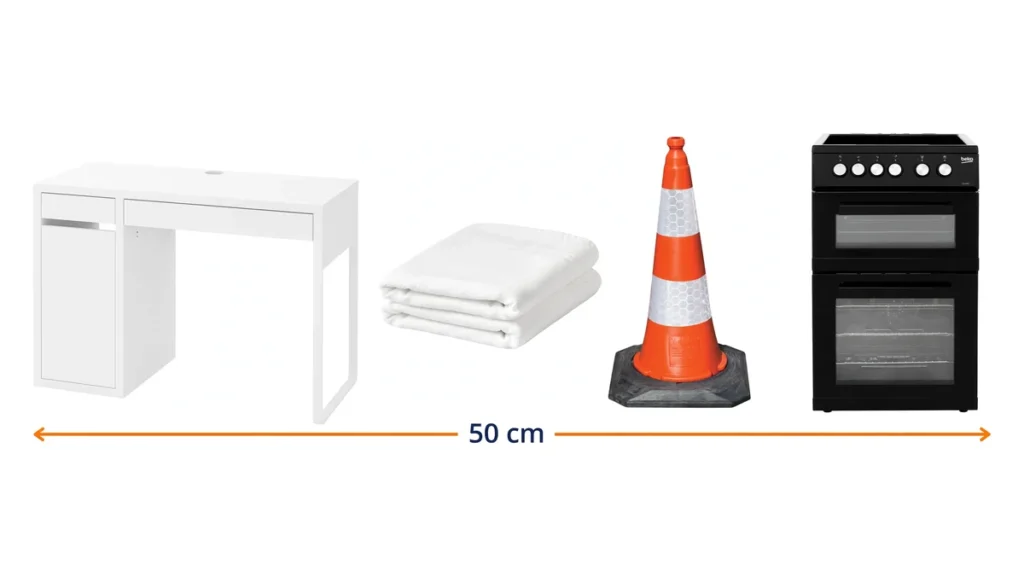
Measure the depth of the desk you are sitting at, the width of the cooker in the kitchen, the height of the radiator under the window and the width of the hand towel by the sink. Four different rooms, four different jobs — and one number: 50 cm. So how big is 50 cm, really? It is exactly half a metre, and it is the size metric manufacturing keeps coming back to, because it is big enough to work at and small enough to fit a small room. This article is about that number: what 50 cm actually is, eight things that really measure it, and the 8 mm gap that separates it from the 20 inches it keeps getting confused with.
Fifty centimetres is 19.69 inches, 500 millimetres, and 0.50 metres. It is 19.52 cm longer than a foot, exactly double 25 cm, and exactly half of one metre — two of them laid end to end make exactly one metre. The eight objects below are the closest honest answers to it: six land on 50 cm exactly, two miss by less than 2 millimetres with the miss printed in full, and every one of them carries the source that proves it.
Quick Answer
50 cm is 19.69 inches — 8 mm short of 20 inches.
Fifty centimetres is 19.69 inches, 500 millimetres, and exactly half a metre. Six objects land on it exactly — a desk, a towel, a traffic cone, a radiator, a cooker and a sheet of B2 paper — and two more miss by less than 2 millimetres, with the miss printed in full.
The bar above shows fifty 1 cm segments, but it is a diagram, not a ruler: screen sizes vary, so it explains the measurement rather than measuring it. For a real measurement, use the objects below or a tape measure.
The 500 mm Module: One Size That Runs the Whole House
Fifty centimetres is not a coincidence that happens to turn up in five different rooms. It is a module. Metric manufacturing builds in 100 mm steps, and 500 mm is the human-scale step in that ladder: 100 mm is a hand’s breadth, 200 mm is a small shelf, 300 mm is a deep drawer, 400 mm is a seat, 500 mm is a working surface, and 600 mm is a full kitchen worktop. The step at 500 mm is the one that fits a person — a desk you can sit at, a cooker you can stand in front of, a radiator that warms a room without eating the wall, a towel that dries your hands without hanging to the floor, a sheet of paper big enough to draw on.
Walk the house and the module shows itself. The desk in the study is 50 cm deep. The cooker in the kitchen is 50 cm wide. The radiator under the window is 500 mm high. The towel by the sink is 50 cm wide. The sheet of B2 paper on the drawing board is 500 mm on its short edge. Five different rooms, five different jobs, one number, one reason: the makers all build to the same 100 mm ladder, and 500 mm is where the ladder meets the body. A desk 40 cm deep leaves no room for a keyboard and a monitor; a cooker 60 cm wide needs a kitchen built around it. Five hundred millimetres is big enough to work at and small enough to fit, and that is why it keeps appearing.
The module is also why 50 cm is so easy to misjudge: the number is everywhere, so it feels familiar, and people round it — to 20 inches, to a “500 mm” unit whose cabinet is really 488 mm. The rest of this article checks that familiarity: eight things that really are 50 cm, the 8 mm that separates it from 20 inches, four claims that do not measure up, and a fit-check for the day you buy one of these things yourself.
8 Things That Are 50 cm
The eight objects are ordered by how close they land on 50 cm, closest first, and each one carries its evidence grade in the heading. EXACT means the figure is a standard’s or an authority’s own dimension for the named thing. LISTED means the figure is the manufacturer’s published specification for the named model. AVERAGE means the figure is a published median for a population, not a measurement of one individual. Six of the eight land on 50 cm exactly, and the two that do not carry their miss in the open, in millimetres, where you can see it — the mean absolute deviation across all eight is 0.34 mm.
A published 50 cm designation does not mean every unit measures mathematically 50.000 cm: desks are sold by a nominal depth, towels by a flat size that changes in the wash, paper by a nominal size with a stated tolerance, newborns by a population median. What follows is what the source actually says, with the axis named every time, so you can check it yourself.
1. IKEA MICKE Desk, Depth 50 cm — Exactly 50.00 cm (LISTED)
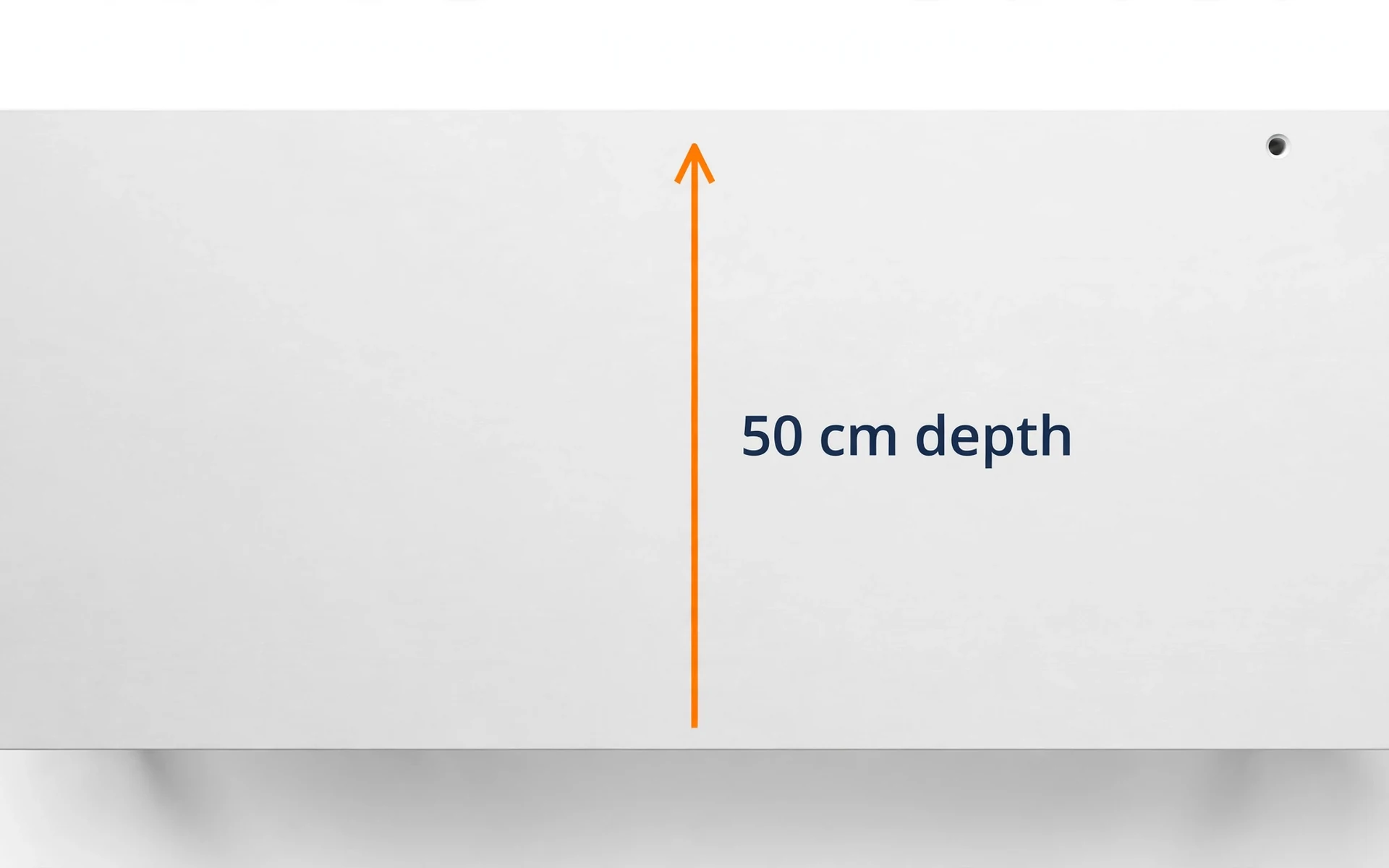
The MICKE desk is the article’s cleanest land-on, because its 50 cm is not one measurement of a thing that happens to be 50 cm long — it is the depth the desk is sold by, on every version of it. IKEA’s product page lists the MICKE desk at 105 × 50 cm, and all three widths — 73 cm, 105 cm and 142 cm — share the same 50 cm depth, so whichever MICKE you own, its depth is 50.00 cm, with no deviation to print. Sit at it and the distance from the front edge to the wall is the number itself, which is why it is the pocket reference in the measuring section below, and why it is the object that settles the desk-depth argument in the fit-check.
The fitting check is the axis, because the 50 cm is the depth, front to back, and not the width. A monitor arm clamp bought against “50 cm” needs that full depth to grip; a desk bought against “105 cm” for its width gives you a 50 cm work surface, not a 105 cm one. The grade is listed because the figure is the manufacturer’s published specification for the named product, with the deviation printed in full: 50.00 cm, zero millimetres off. Note the imperial label with care: IKEA also lists the desk as 41⅜ × 19⅝ inches, and 19⅝ inches is 49.848 cm, 1.53 mm short of 50 cm — the metric 50 cm is the specification, and the imperial is rounded down. Never write “the MICKE desk is 19⅝ inches deep” as if it were exact.
2. IKEA VÅGSJÖN Hand Towel, 50 × 100 cm — Exactly 50.00 cm (LISTED)
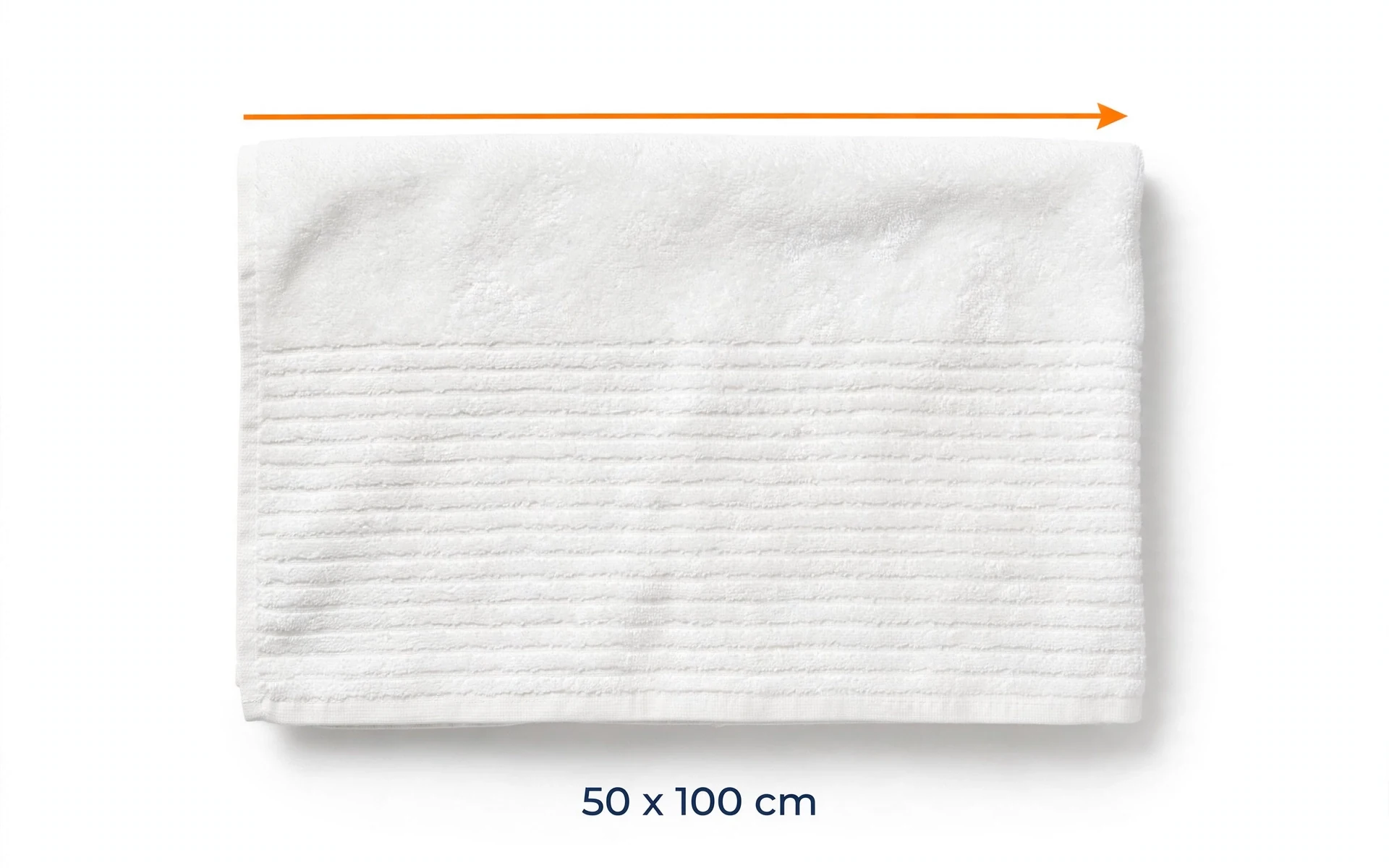
The hand towel is the article’s softest land-on, and the one that proves 50 cm is a textile size as well as a furniture size. IKEA’s product page lists the VÅGSJÖN hand towel at 50 × 100 cm, so the towel measures 50.00 cm on its short side, with no deviation to print. Hang it by the sink and its width is the number itself, which is why it sits second on this page.
The fitting check is the word “sold”, because the 50 × 100 cm is the flat, unwashed size. Cotton towels shrink slightly in the wash and stretch when hung, so a towel that has been through the laundry a dozen times will not hold its listed width to the millimetre — measure it flat, fresh from the packet, and the 50 cm is there. The grade is listed because the figure is the manufacturer’s published specification for the named product, with the deviation printed in full: 50.00 cm, zero millimetres off. The towel is also the article’s cheapest reference: it costs less than a tape measure and it lives in a million bathrooms.
3. JSP Navigator Traffic Cone, 500 mm High — Exactly 50.00 cm (LISTED)
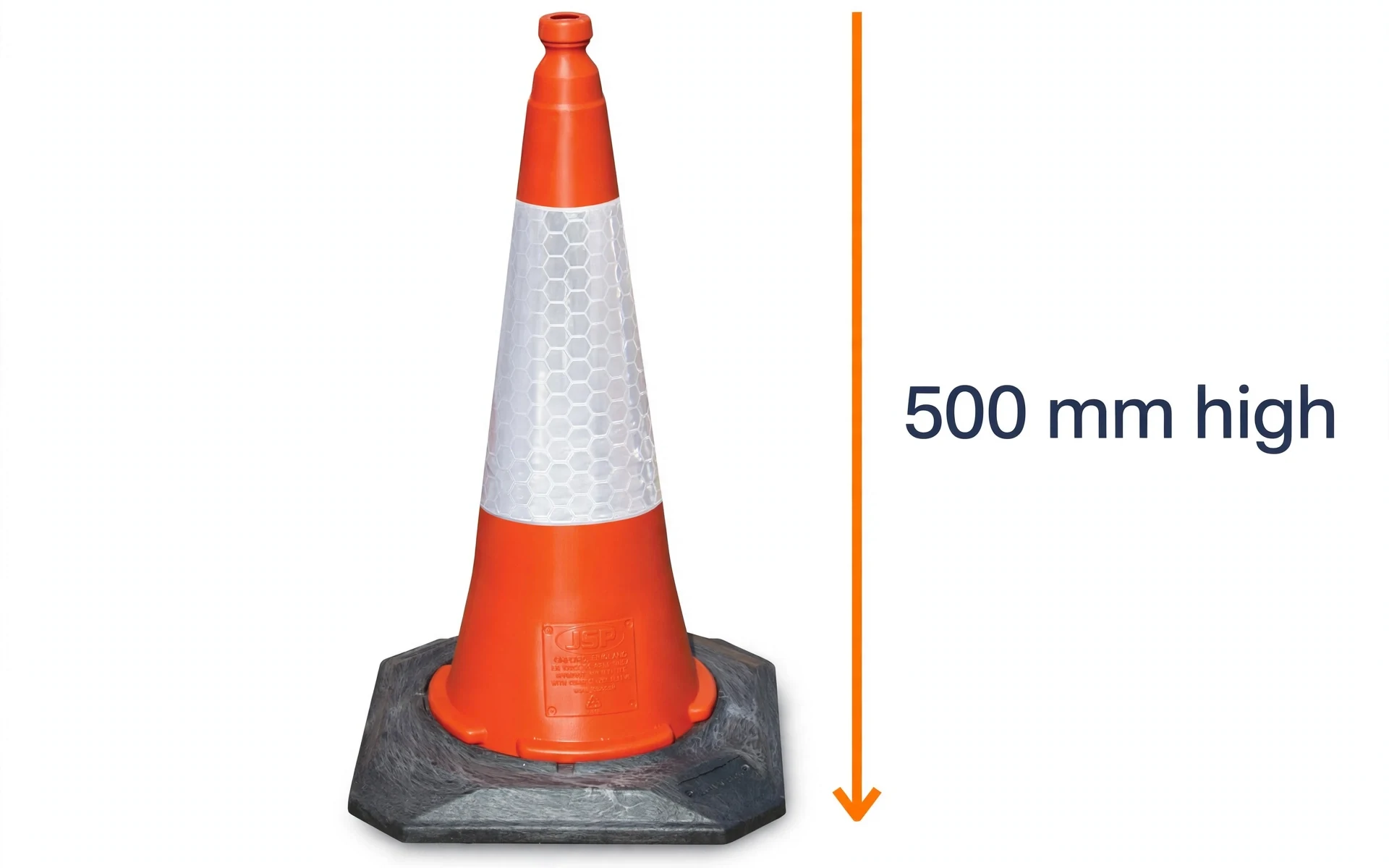
The traffic cone is the article’s most public land-on, and the one that proves 50 cm is a safety size, not just a household size. JSP’s specification sheet lists the Navigator cone at 500 mm high, tested to EN13422, so the cone measures 50.00 cm from its base to its tip, with no deviation to print. Stand it on the pavement and its height is the number itself, which is why it sits third on this page.
The fitting check is the axis, because the 500 mm is the HEIGHT, and the base is wider — roughly 280 mm across — so never quote the base width as the cone’s size. A cone bought against “500 mm” for its height is a half-metre cone; a cone bought against “500 mm” for its footprint is a different cone altogether. The grade is listed because the figure is the manufacturer’s published specification for the named model, with the deviation printed in full: 50.00 cm, zero millimetres off. The 500 mm cone is the small cone in the range — the 750 mm and 1 m cones are the ones you see on motorways — which is exactly why it is useful: it is the cone that fits in a car boot.
4. Stelrad Classic Compact Radiator, 500 mm High — Exactly 50.00 cm (LISTED)
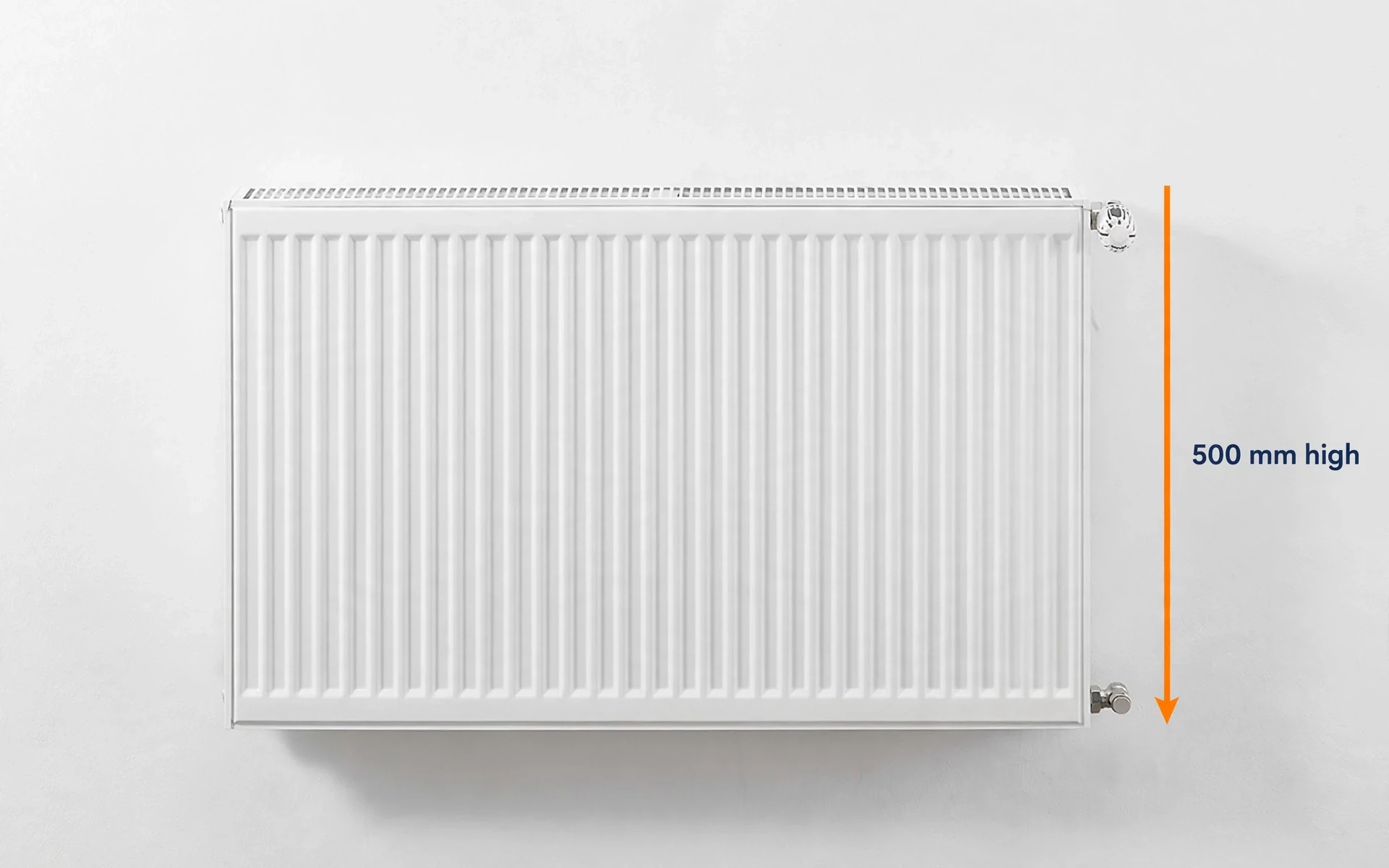
The radiator is the article’s warmest land-on, and the one that proves 50 cm is a heating size. Stelrad’s product page lists the Classic Compact range in heights from 300 mm to 700 mm, and Stelrad’s own announcement of the range describes a further 26 models in its new 500 mm high range, so a 500 mm Classic Compact measures 50.00 cm from its top edge to its bottom edge, with no deviation to print. Mount it under a window and its height is the number itself, which is why it sits fourth on this page.
The fitting check is the height, because the 500 mm is the panel height and nothing else. A radiator’s pipe centres are NOT 500 mm apart — they sit inside the panel height — so measure the centres on the technical data before you drill, and never take the panel height as the pipe spacing. The grade is listed because the figure is the manufacturer’s published specification for the named range, with the deviation printed in full: 50.00 cm, zero millimetres off. The 500 mm height is the middle of the range: 300 mm is the low one for under a low sill, 700 mm is the tall one for a big room, and 500 mm is the one that fits under most windows.
5. Beko KDVC563A Double Oven Electric Cooker, Width 500 mm — Exactly 50.00 cm (LISTED)

The cooker is the article’s hardest-working land-on, and the one that proves 50 cm is a kitchen size. Beko’s product page lists the KDVC563A at 500 mm wide, with the full dimensions given as 900 mm high, 500 mm wide and 600 mm deep, so the cooker measures 50.00 cm across its front, with no deviation to print. Stand in front of it and its width is the number itself, which is why it sits fifth on this page.
The fitting check is the box, because the cooker body is 500 mm wide but its carton is 560 mm wide. A buyer who measures the box will think the cooker needs a 56 cm gap, and a kitchen planned on the box will waste 6 cm of worktop. Plan the gap on the body — 500 mm — and check the depth too, because 600 mm of cooker has to sit against a worktop that is usually 600 mm deep, with no room to spare. The grade is listed because the figure is the manufacturer’s published specification for the named model, with the deviation printed in full: 50.00 cm, zero millimetres off. The 50 cm cooker is the narrow cooker in the range: the 60 cm cooker is the standard one, and the 50 cm one is the one that fits a small kitchen.
6. ISO B2 Paper, Short Edge 500 mm — Exactly 50.00 cm Nominal (EXACT)
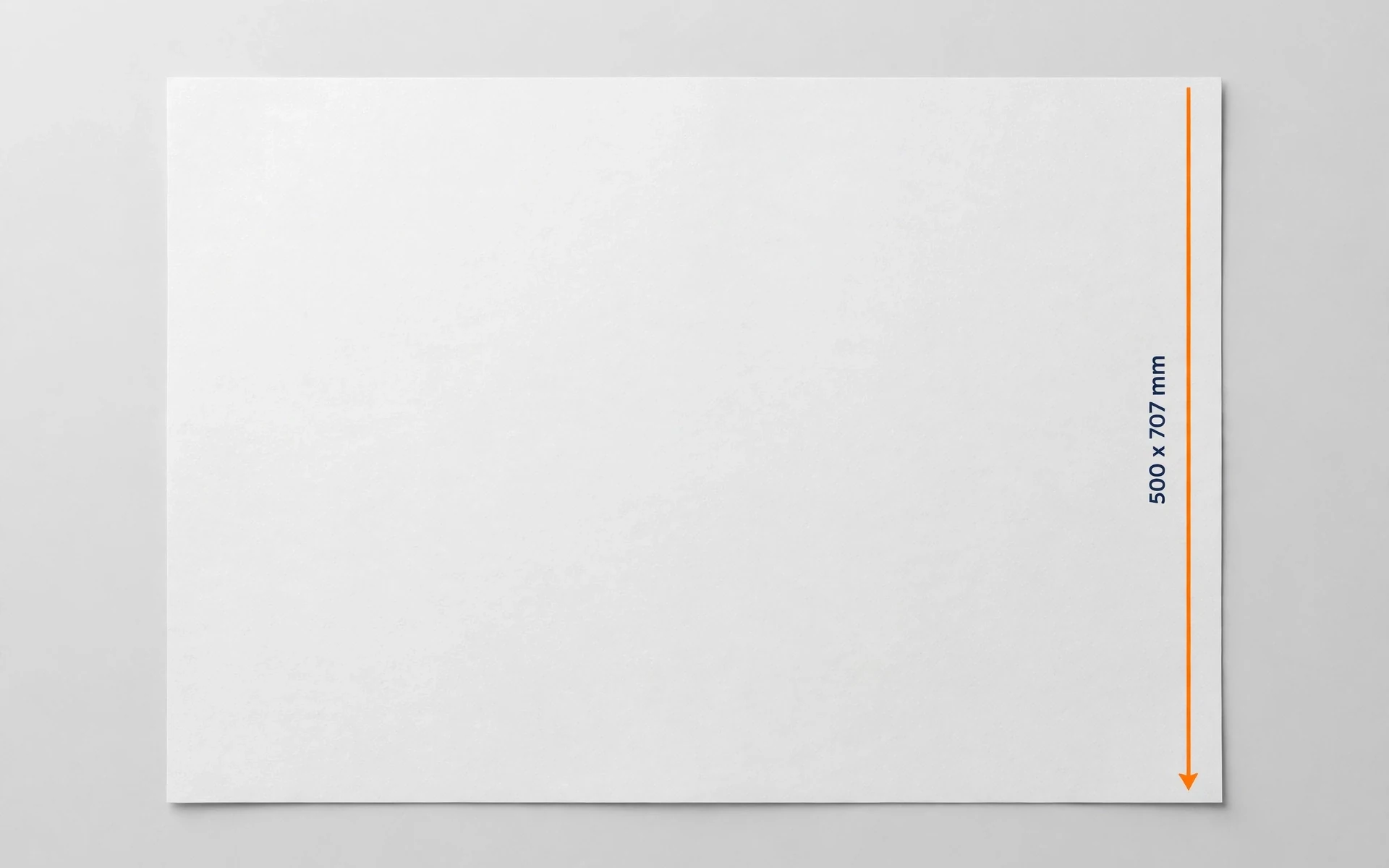
B2 paper is the article’s most exact land-on, because its 500 mm is not a manufacturer’s choice at all — it is the standard’s own dimension. ISO 216 sets B2 paper at 500 × 707 mm, so a sheet of B2 measures 500 mm on its short edge, with no deviation to print beyond the standard’s own tolerance. Lay it on the drawing board and its short edge is the number itself, which is why it sits sixth on this page.
The fitting check is the word “nominal”, because ISO 216 allows a tolerance of ±2 mm on the 500 mm edge, so a real B2 sheet is 500 mm nominal, not 500.000 mm to the micron. A sheet cut 2 mm short is still a B2 sheet, and a sheet cut 2 mm long is still a B2 sheet — the standard says so. The grade is exact because the figure is the standard’s own dimension for the named format, with the deviation printed in full: 500 mm nominal, ±2 mm. The 707 mm long edge is the other half of the story: B2 is the sheet that sits between A2 and A1 in the B series, and its short edge is the one that lands on 50 cm.
7. Average Newborn Baby, Length at Birth — 49.9 cm Boys, 49.1 cm Girls (AVERAGE)
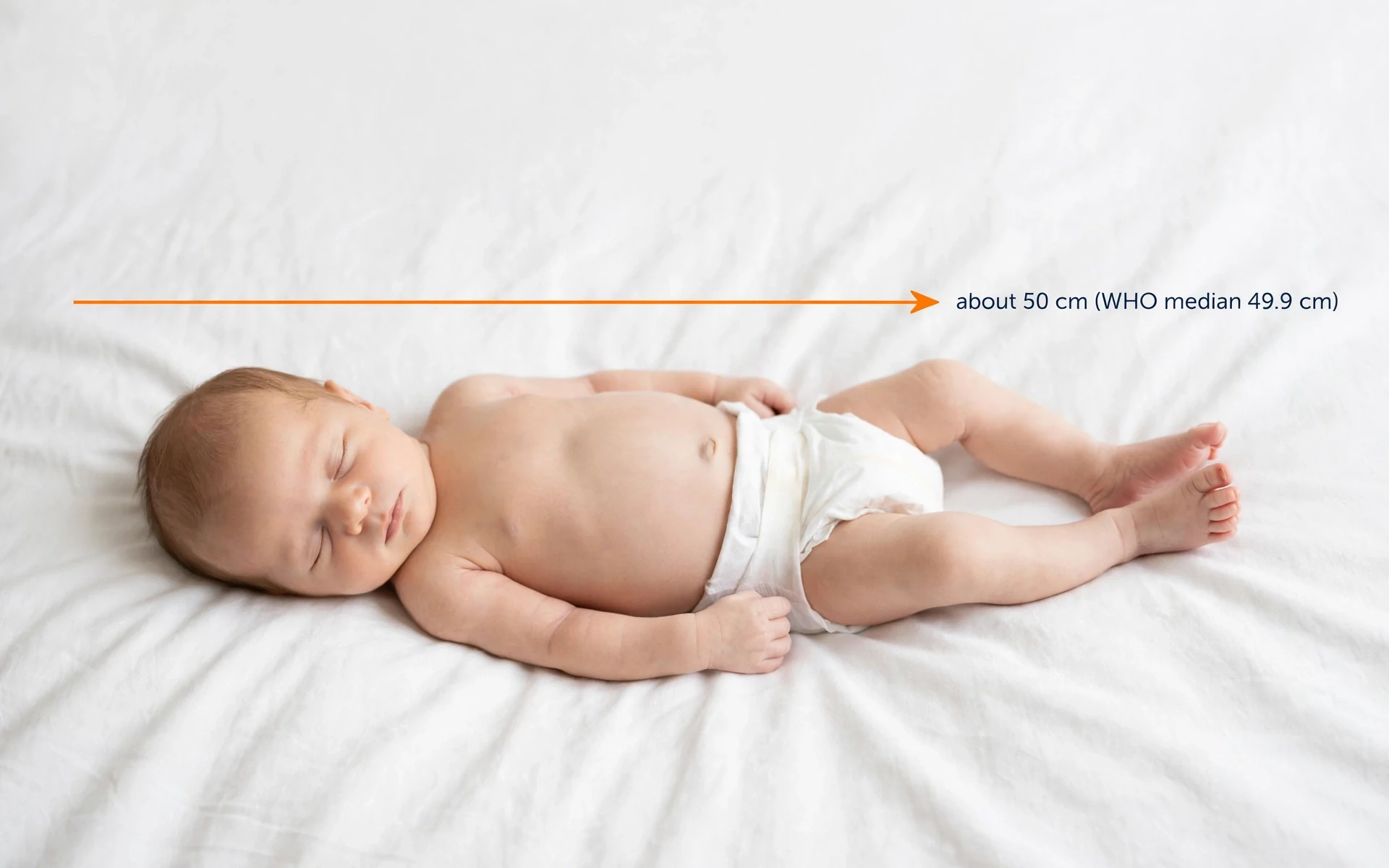
The newborn is the article’s softest land-on, and the one that proves 50 cm is a human size. The WHO Child Growth Standards put the median length at birth at 49.9 cm for boys, and the WHO LMS parameters put the girls’ median at 49.1 cm, so the average newborn measures 49.9 cm if it is a boy and 49.1 cm if it is a girl — 1 mm short of 50 cm for boys, 9 mm short for girls. Lay a newborn on a blanket and its length is, on average, the number itself, which is why it sits seventh on this page.
The fitting check is the word “average”, because a median is a population figure, not a measurement of one baby. Most full-term newborns land between about 48 and 52 cm, so no single baby is obliged to be 50 cm long, and it would be wrong to write “a newborn baby is 50 cm long” as a fact about an individual baby. The grade is average because the figure is a published median for a population, with the deviation printed in full: 49.9 cm, 1.0 mm short, and 49.1 cm, 9.0 mm short. The newborn is also the article’s most memorable reference: a baby is about half a metre long, and half a metre is about a baby long.
8. Meinl Snarecraft Cajon, Height 19¾ in — 50.165 cm (LISTED)

The cajon is the article’s furthest miss, and the one that carries the music. Sweetwater’s specification lists the Snarecraft cajon at 19.75 inches tall, 11.75 inches wide and 11.75 inches deep, so the drum measures 19¾ inches high — and 19.75 × 2.54 is 50.165 cm, which is 1.65 mm past 50 cm, about the thickness of a coin. Sit on it and its height is the number itself, near enough, which is why it sits eighth on this page.
The fitting check is the seat, because the cajon’s height is also its seat height — the player sits on the drum. A cajon that is 50.2 cm tall is a seat 50.2 cm high, so check it against your chair before you buy: a drum that is the wrong height to sit on is a drum you will not play. The grade is listed because the figure is the manufacturer’s published dimension for the named model, carried in the retailer’s specification, with the deviation printed in full: 50.165 cm, 1.65 mm over. Do not call it “exactly 50 cm” — say “about 50.2 cm”, and show the working, because the 1.65 mm is the honest part.
The 20-Inch Family: The 8 mm That Breaks the Fit
Twenty inches is 50.8 cm, so 50 cm falls 8.0 mm short of 20 inches — about the diameter of a pencil, and about the thickness of the gap that breaks a tight fit. Two of the laziest mental-math shortcuts in the world both produce exactly the wrong round number: 50 divided by 2.5 is 20.0 inches exactly, and 50 times 0.4 is 20 inches exactly. The two most common tricks both erase the whole 8 mm gap in one step, which is how “50 cm = 20 in” survives in conversion guides that never check their own arithmetic. The honest shorthand is “just under 20 inches” — “20 inches” hides the 8 mm, and “20.0 inches” invents a precision the number does not have.
The trap has a family, and it is a big one. Anything built to 20 inches is 50.8 cm, and the 20-inch product family is everywhere: kids’ bike wheels, box fans, small televisions and carry-on cases are all sold as “20 inch”, and every one of them is 8 mm too long for a 50 cm space. Sellers make it worse by describing a 50 cm product as “20 inch” after a careless conversion, so the label and the specification sheet disagree, and the buyer who trusts the label buys a thing that does not fit. IKEA proves the trap cuts both ways: the MICKE desk’s own imperial label says 19⅝ inches, and 19⅝ inches is 49.848 cm, so the imperial label understates the metric size by 1.53 mm while a 20-inch label overstates it by 8 mm. If the fit matters, trust the centimetre figure on the specification sheet, not the inch figure in the product title.
| Tape mark | Value | Against 50 cm |
|---|---|---|
| 19 in | 48.26 cm | 1.74 cm short |
| 19 5/8 in | 49.848 cm | 1.53 mm short |
| 19 21/32 in | 49.927 cm | 0.73 mm short |
| 19 11/16 in | 50.006 cm | 0.06 mm over |
| 19 3/4 in | 50.165 cm | 1.65 mm over |
| 20 in | 50.8 cm | 8.0 mm over |
On a tape measure, the nearest sixteenth-inch mark is 19 11/16 inches at 50.006 cm, which is 0.06 mm over — essentially exact, and the mark to use. The mark just before it, 19⅝ inches at 49.848 cm, is 1.53 mm short, which is close enough for a cut and not close enough for a tight fit. And 50 cm is 164% of a standard 30-centimetre ruler — mark off the whole ruler and add 20 cm, and the remaining length is the number you have left over.
Four “50 cm” Claims That Don’t Measure Up
| What a rival list claims | What it actually measures | The difference |
|---|---|---|
| A skateboard deck is roughly 50 cm long | A standard deck is about 80 cm (31.5 in) long | 30 cm out — a skateboard is not 50 cm |
| 3.5 pencils laid end to end make 50 cm | 3.5 × 19 cm = 66.5 cm | 16.5 cm out — the right multiplier is 2.63 |
| Two “10-inch” burpless cucumbers make 50 cm | 2 × 25.4 cm = 50.8 cm | 8 mm out — the trap in vegetable form |
| A “500 mm” vanity unit is 500 mm wide | The Crosswater Mada’s basin and total width are 500 mm, but its cabinet body is 488 mm | 12 mm out on the part you plan the gap on |
Four of these deserve a longer correction. The skateboard is the most confident error in the ranking pages: a rival list calls a skateboard deck “roughly 50 cm” long, but a standard skateboard deck is about 80 cm, or 31.5 inches, long — 30 cm out. The pencils are the most checkable error: a rival list says 3.5 pencils make 50 cm, but a No. 2 pencil is about 19 cm, and 3.5 × 19 cm is 66.5 cm, not 50 cm. The correct multiplier is 2.63 pencils — lay two pencils end to end and add about two-thirds of a third, and you are there. The cucumbers are the trap in vegetable form: two “10-inch” burpless cucumbers are 2 × 25.4 cm, which is 50.8 cm, not 50 cm — the page presents the trap number as the answer. And the vanity unit is the most useful error: a rival list calls a “500 mm” vanity unit exactly 50 cm wide, but the Crosswater Mada’s total width is 500 mm while its cabinet body is 488 mm, so the 500 mm is the basin and the total, not the cabinet. Check which dimension the listing quotes before you plan the gap, or the unit will arrive 12 mm narrower than the hole you cut for it.
Two near-misses deserve a line of their own. A red panda’s head-to-body length is given two ways in the same rival page — “roughly 50 to 64 cm” in one paragraph and 51 to 73 cm from the zoo’s own fact sheet in the next — so “from about 50 cm” is not established; it is a rounding presented as a lower bound, and it stays a correction, never an object. And a hand is not 50 cm either: a rival essay claims the distance from fingertip to wrist “sits close to what fifty centimeters covers”, but the average adult hand, wrist crease to middle fingertip, is 19.3 cm — about 30 cm short. The writer confused a hand with something three times longer.
How to Measure 50 cm Without a Ruler
| Method | What you get | How close it is |
|---|---|---|
| Half a metre stick, or a 1 m tape folded at the middle | 50.00 cm | Exact — the best method of all |
| A4 long edge (29.7 cm) + short edge (21.0 cm) | 50.70 cm | 7.0 mm over — take off seven millimetres |
| 30 cm ruler + 20 cm | 50.00 cm | Exact — mark the ruler, then mark 20 cm more |
| Two US No. 10 envelopes end to end | 48.26 cm | 1.74 cm short — add just under two centimetres |
| Six bank cards in a row | 51.36 cm | 1.36 cm over — take off just over a centimetre |
| Tape measure, 19 11/16 in mark | 50.006 cm | 0.06 mm over — essentially exact |
| MICKE desk depth, or a 50 × 100 cm towel laid flat | 50.00 cm | Exact — the permanent household reference |
The half-metre method is the best of the seven, because the miss is zero — fold a 1 m tape at its middle and the fold is 50 cm. The A4 method is the one to use when there is nothing to measure with: the two edges together are 50.7 cm, seven millimetres over. The envelope method is the one to use when you have post and no ruler: two envelopes are 48.26 cm, so add just under two centimetres. The tape method is the most accurate, because the 19 11/16-inch mark is 0.06 mm from the number.
The fitting check is the zero mark, because 50 cm starts at the 0 line and not at the end of the ruler. Most plastic rulers carry a few millimetres of blank plastic past the last graduation, so if you measure from the physical edge of the ruler instead of from the 0 mark you will read long by that margin — about 3 mm on a cheap ruler, which is more than a third of the 8 mm gap this whole article is about. Measure from 0, and the ruler is honest; measure from the edge, and the ruler lies by more than a third of the trap. And if you own a MICKE desk or a 50 × 100 cm towel, you already own a permanent 50 cm reference — keep it in mind the next time you need the number and the tape measure is in another room.
50 cm in Every Unit
| Unit | Value |
|---|---|
| Millimetres | 500 mm |
| Metres | 0.50 m |
| Inches | 19.69 in (19 11/16 in) |
| Feet | 1.64 ft (1 ft 7.69 in) |
| Yards | 0.55 yd |
Fifty centimetres is 500 millimetres, and a centimetre is 10 millimetres, so the conversion is a multiplication by ten that never needs a calculator. In inches it is 50 divided by 2.54, which is 19.6850 inches, rounded to 19.69 — and the rounding is honest, because 19.69 inches times 2.54 is 49.999 cm, a hundredth of a millimetre from the mark. In feet it is 1.64, or 1 ft 7.69 in if you want feet and inches rather than a decimal. 40 cm is 10 cm shorter than 50 cm, and 60 cm is 10 cm longer. 35 cm is 15 cm shorter than 50 cm, and 25 cm is exactly half of 50 cm — two of them laid end to end make 50 cm. 20 cm is 30 cm short of 50 cm, and 19 cm is 31 cm short of 50 cm. Fifty centimetres is 50% of one metre, so two 50 cm lengths laid end to end make exactly 1 m, and it is the middle of the 40–50–60 ladder. Centimetres are the unit on furniture, kitchen and bathroom listings, inches are the unit in US hardware and bike and television sizes, and millimetres are the unit in engineering, radiators and cones — and 50 cm is the size where all three meet, because it is a desk, a towel, a cone, a radiator, a cooker, a sheet of paper, a baby and a drum at once.
The 50 cm Fit-Check: Before You Buy
– Cooker gap: a 50 cm cooker needs a 50 cm gap, but its carton is 560 mm wide — measure the gap, not the box, and check the depth (600 mm) against the worktop before the delivery van arrives. A kitchen planned on the box wastes 6 cm of worktop.
– Desk depth: a MICKE desk is 50 cm deep, and a monitor arm clamp needs that full depth to grip. A 20-inch (50.8 cm) monitor stand overhangs the desk by 8 mm, so measure the stand, not the screen size on the box.
– Radiator height: a 500 mm-high radiator’s pipe centres are NOT 500 mm apart — they sit inside the panel height. Measure the centres from the technical data, not from the panel, or the pipes will not line up with the valves.
– Aquarium stand: a 50 cm cube aquarium holds 125 litres of water, which is about 125 kg — the stand must be rated for the weight, not just the footprint. A stand that fits the cube and not the weight will fail slowly and then all at once.
– Cajon seat: a cajon 50.2 cm tall is also a seat 50.2 cm high — check it against your chair before you buy, because a drum that is the wrong height to sit on is a drum you will not play.
The rule underneath all five is the same: measure the space, add clearance, and never trust a rounded label alone. The label is a screen size, a nominal size, a carton size or a rounded size; the tape is the size. Eight millimetres is the price of trusting the label, and a cooker that does not fit is the receipt.
Frequently Asked Questions
Is 50 cm the same as 20 inches?
No. A 20-inch object measures 50.8 cm, so 50 cm is 19.69 inches — 8 mm shorter, about a pencil’s diameter. Close enough to confuse on a label, far enough to break a tight fit.
How many inches is 50 cm?
Fifty centimetres is 19.685 inches (50 divided by 2.54). The nearest tape mark is 19 11/16 inches at 50.006 cm, 0.06 mm over — essentially exact. 19¾ inches is 50.165 cm, 1.65 mm over.
What everyday objects are 50 cm long?
Eight verified objects, tightest first: an IKEA MICKE desk at exactly 50.00 cm deep, an IKEA VÅGSJÖN hand towel at exactly 50 × 100 cm, a JSP Navigator traffic cone at exactly 500 mm high, a Stelrad Classic Compact radiator at exactly 500 mm high, a Beko KDVC563A cooker at exactly 500 mm wide, and ISO B2 paper at exactly 500 mm on its short edge — plus the average newborn at 49.9 cm and a Meinl Snarecraft cajon at 50.17 cm. Every one is verified against the manufacturer’s own specification, the standard, or the WHO tables.
Is 50 cm exactly half a metre?
Yes, 0.50 m exactly — not an approximation. Two 50 cm lengths laid end to end make exactly 1 metre, which is why it appears so often in furniture and product dimensions.
Will a 20-inch TV or bike wheel fit a 50 cm space?
No. Anything built to 20 inches is 50.8 cm — 8 mm too long. Measure the gap in centimetres and trust the specification sheet, not the rounded inch figure in the product title.
How do I measure 50 cm without a ruler?
Fold a 1 m tape at its middle for exactly 50 cm, or take an A4 sheet’s long edge (29.7 cm) plus its short edge (21.0 cm) for 50.7 cm, or two No. 10 envelopes for 48.26 cm, or six bank cards for 51.36 cm, or a tape at the 19 11/16-inch mark for 50.006 cm. Measure from the ruler’s zero mark, not from the plastic edge, or you will read about 3 mm long.
What is 50 cm in feet and inches?
Fifty centimetres is 1.64 feet, which is 1 ft 7.69 in — one foot and a little under eight inches.
Is a 500 mm vanity unit really 500 mm wide?
The basin and total width are 500 mm, but the cabinet body can be narrower — the Crosswater Mada’s body is 488 mm against a 500 mm total — so check which dimension the listing quotes before you plan the gap.
Final Thoughts
Fifty centimetres is a length that runs a whole house — a desk, a towel, a cone, a radiator, a cooker, a sheet of paper, a baby and a drum — and the module is the whole article. The eight objects that measure it are all things you can find tonight without buying anything, and every one of them carries the number its source actually publishes, with the miss printed next to it. That is the difference between a measurement and a slogan: the measurement can be checked, and the slogan cannot.
Do not take the round number, and do not take the name. Ask which axis was measured — the depth or the width, the height or the base, the body or the carton, the basin or the cabinet — look up the specification, and print the miss when there is one. A cooker that does not fit is an 8-millimetre lesson; a desk measured on its depth is 50 cm, exactly, every time.
