
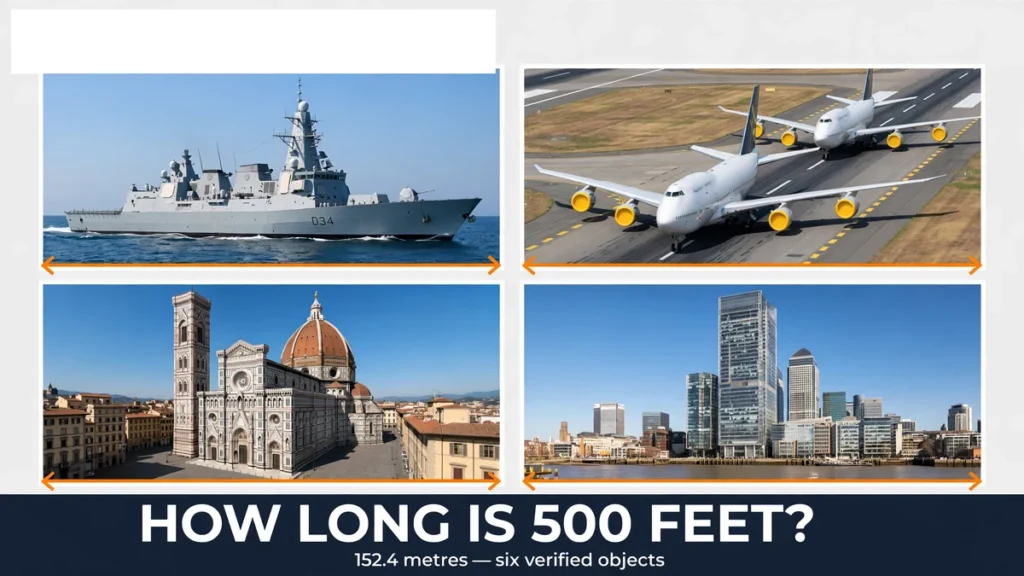
A tower in London was sold at 152 metres tall. The developer said 152 metres. The contractor said 152 metres. The trade press said 152 metres. Then the building was finished, and the lists that measure what was actually built say 134 metres — eighteen metres of brochure, sixty feet of marketing, gone. Five hundred feet has the same problem in reverse: it is a round number, and round numbers attract round claims, and the claims are only ever checked when somebody puts a tape on the thing itself.
How long is 500 feet, then, in plain terms? It is 152.4 metres exactly — 6,000 inches, 166.67 yards, or 0.0947 miles. It is a destroyer drawn to the round number on purpose, two of the longest airliners ever built parked nose to tail, a cathedral laid out in 1296, and a Canary Wharf tower that stops four and a half feet short. The six objects below are the closest honest answers to it: one lands on 500.00 feet exactly, one stops four inches over, and the furthest is 8.20 feet short — and every one of them carries the source that proves it, with the miss printed next to it.
Quick Answer
500 feet is 152.4 metres — the length of a Type 45 destroyer.
500 feet is 152.4 metres, 6,000 inches and 0.0947 miles. One object lands on the number exactly — a Type 45 destroyer at 152.4 m — and the other five sit within 8.20 feet: two 747-8 airliners at 500 ft 4 in, Florence Cathedral at 501.97 ft, 10 Upper Bank Street at 495.41 ft, two A340-600 airliners at 494.49 ft and a Type 26 frigate at 491.80 ft.
The bar above shows fifty 10-foot segments, but it is a diagram, not a ruler: screen sizes vary, so it explains the measurement rather than measuring it. For a real measurement, use the objects below or a tape measure.
The 152-Metre Tower That Is 134 Metres Tall
The trap in this article is a brochure, not a unit. A building’s height is not one number; it is a number plus a moment in the building’s life, and the moment decides the number. The Atlas Building at 145 City Road in London is the exhibit. The tower was marketed for years at 152 metres — the developer’s own material called it a 152-metre tower, Mace, the contractor that built it, still describes its twelve stepped blades as soaring 152 metres high, and the trade press repeated 152 metres in every announcement, because 152 metres is a round, sellable number and the tallest residential tower in London’s Tech City needed a round, sellable number. Then the building was finished in 2018, and the tallest-buildings lists give the as-built height as 134 metres — 440 feet, forty storeys, and eighteen metres shorter than the brochure. The London list gives 134.5 metres and the United Kingdom list gives 134 metres — a fifty-centimetre spread between the two lists — but both agree on the point that matters: the tower is not 152 metres, and it never was. The 152 metres was the design height, published before the concrete was poured; the 134 metres is the as-built height. None of the sources is lying. The wrong thing is quoting the brochure as though it were the building.
The rival pages never ask which moment a height belongs to. South Bank Tower in London carries three published heights at once: the tall-buildings database gives 150 metres. The tower’s own reference entry gives the roof as 151 metres, and the planning permission that approved the extension gives a finished height of 154.86 metres. Three measurements, three different answers, a spread of 4.86 metres — and the tower is the same tower in all three. The original King’s Reach Tower was 111 metres when completed in 1972; eleven storeys were added between 2013 and 2016, and every source quotes a different stage of that extension. And then there is the tower in Salford that the tall-buildings list files as “152 m / 500 ft” — Cortland at Colliers Yard, fifty storeys, completed in 2022. One hundred and fifty-two metres is 498.69 feet, not 500 feet, so the 500 feet in that listing is a rounded conversion, not a measurement — a rounding error wearing a headline.
| Marketed or listed height | What the building actually measures | The miss |
|---|---|---|
| Atlas Building, London, marketed | 152 m on the brochure / 134 m as built | 18.00 m / 60.37 ft of brochure |
| South Bank Tower, London, three figures | 150 m (database) / 151 m (roof) / 154.86 m (permission) | 4.86 m spread, no single figure |
| Cortland at Colliers Yard, listed “152 m / 500 ft” | 152 m = 498.69 ft | 1.31 ft short of the listed 500 ft |
| 40 Bank Street, London | 153 m (502 ft) | 1.97 ft over 500 ft |
| 25 Bank Street, London | 153 m (502 ft) | 1.97 ft over 500 ft |
| One Churchill Place, London | 156 m (512 ft) | 11.81 ft over 500 ft |
The table is the article in miniature: the honest comparisons cluster within a few feet of 500, and the dishonest ones never say which figure they are quoting. Two Canary Wharf towers — 40 Bank Street and 25 Bank Street — both measure 153 metres, and both are closer to 500 feet than the tower this article opens with is to its own brochure. The rule for this article is simple: name the thing, name the moment, print the miss. A tower is 152 metres on the brochure and 134 metres as built; a destroyer is 152.4 metres by the class specification and 152 metres on the operator’s rounded page; a cathedral is 153 metres long and 90 metres wide. The six objects below all carry their miss in the heading, and the tower that opens this article is not among them — because a tower with two heights is a warning, not an object.
6 Things That Are 500 Feet
The six objects are ordered by how close they land on 500 feet, closest first, and each one carries its evidence grade in the heading. EXACT means the figure is the operator’s published dimension for the named thing. LISTED means the figure is the manufacturer’s published specification for the named model. REPORTED means the figure is a published reference measurement — a tallest-buildings list entry, a cathedral’s listed dimensions, or a class reference — not a manufacturer spec. One of the six lands on 500.00 feet exactly, one stops four inches over, and the furthest is 8.20 feet short, so the mean absolute deviation is 3.43 feet and no object is more than 1.6% away from the number.
A published 500 ft designation does not mean every unit measures 500.000 ft: a destroyer is quoted in round metres, a jet is quoted to the nose while its cabin is twelve metres shorter, a cathedral is quoted along its length while its width is sixty metres less, and a frigate is quoted at its design length before it has entered service. What follows is what the source actually says, with the axis and the moment named.
1. Type 45 (Daring-Class) Destroyer, Length 152.4 m (500 ft 0 in) — Exactly 500.00 ft (EXACT)
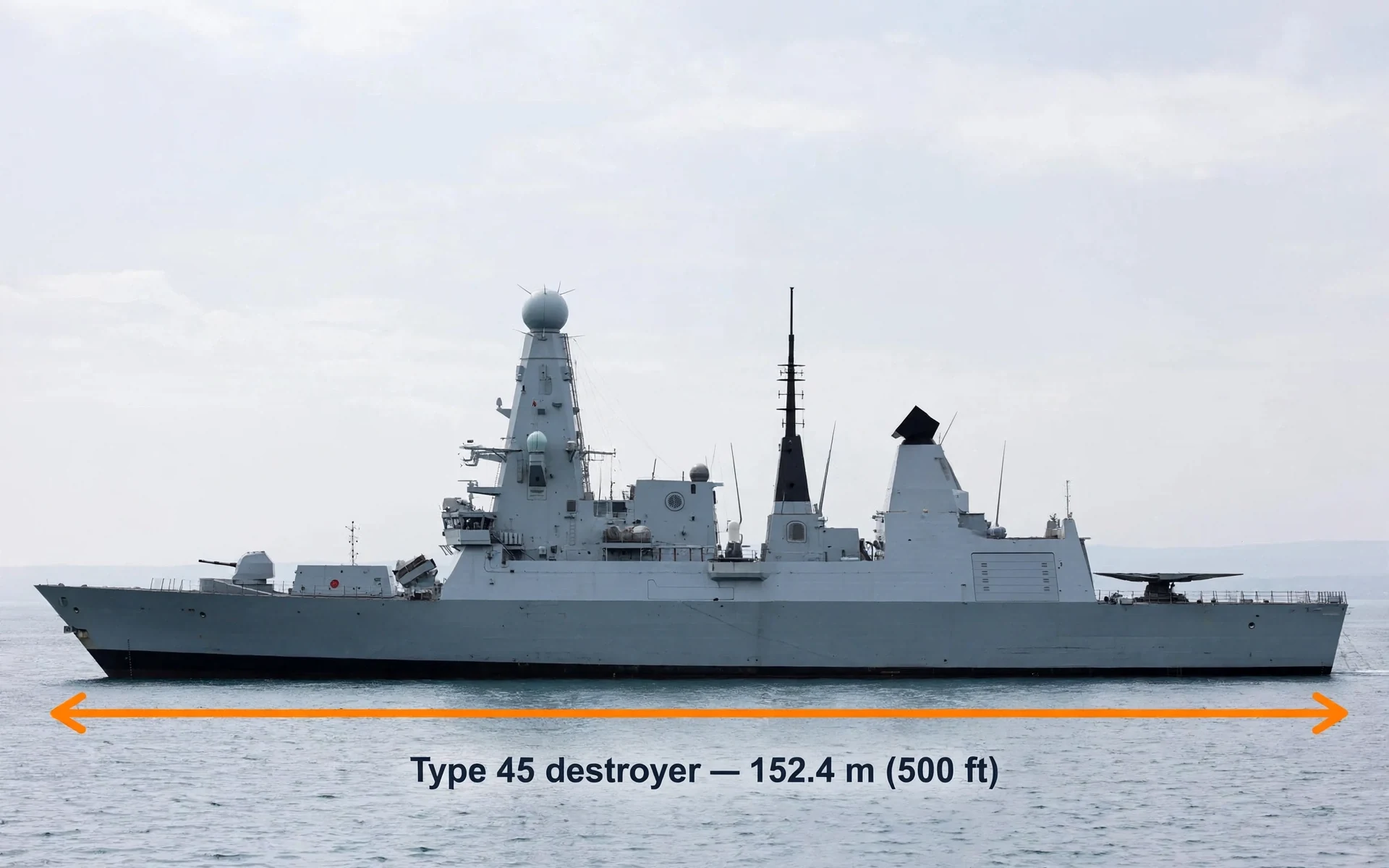
The destroyer is the article’s cleanest land-on, because its 500 feet is the design, not a rounding of it. The Royal Navy’s own statistics page rounds the class length to 152 metres; the class specification is 152.4 m (500 ft 0 in), with a beam of 21.2 m, a draught of 7.4 m and a displacement of 7,350 to 8,500 tonnes, so the destroyer measures exactly 500 feet from bow to stern — 500 ft 0 in, with no deviation to print. Six ships share the figure — Daring, Dauntless, Diamond, Dragon, Defender and Duncan — built by BAE Systems to replace the Type 42 destroyers; HMS Daring was launched on 1 February 2006 and commissioned on 23 July 2009. Walk the quay at Portsmouth beside one and its length is the number itself, which is why it sits first on this page.
The fitting check is the berth, because the ship is 152.4 m long but only 21.2 m wide with a 7.4 m draught, and a berth is sold by the length it can hold plus clearance for fenders and mooring lines. A harbour that sells a “500 ft berth” sells 500 ft of water, and a 152.4 m destroyer needs more than that once fenders and lines are counted — so the berth for this ship is a 160 m berth, not a 500 ft one. The grade is exact because the figure is the operator’s published dimension for the named class: 152.4 m, zero centimetres off. One caution: the operator’s own page rounds the length to 152 metres, which converts to 498.69 ft — 1.31 ft short — so the article uses the specification figure. Never write “the Type 45 is 152 metres” without “152.4 m (500 ft 0 in)” beside it.
2. Two Boeing 747-8, Length 152.50 m (500 ft 4 in) — 0.10 m / 0.33 ft Over (LISTED)
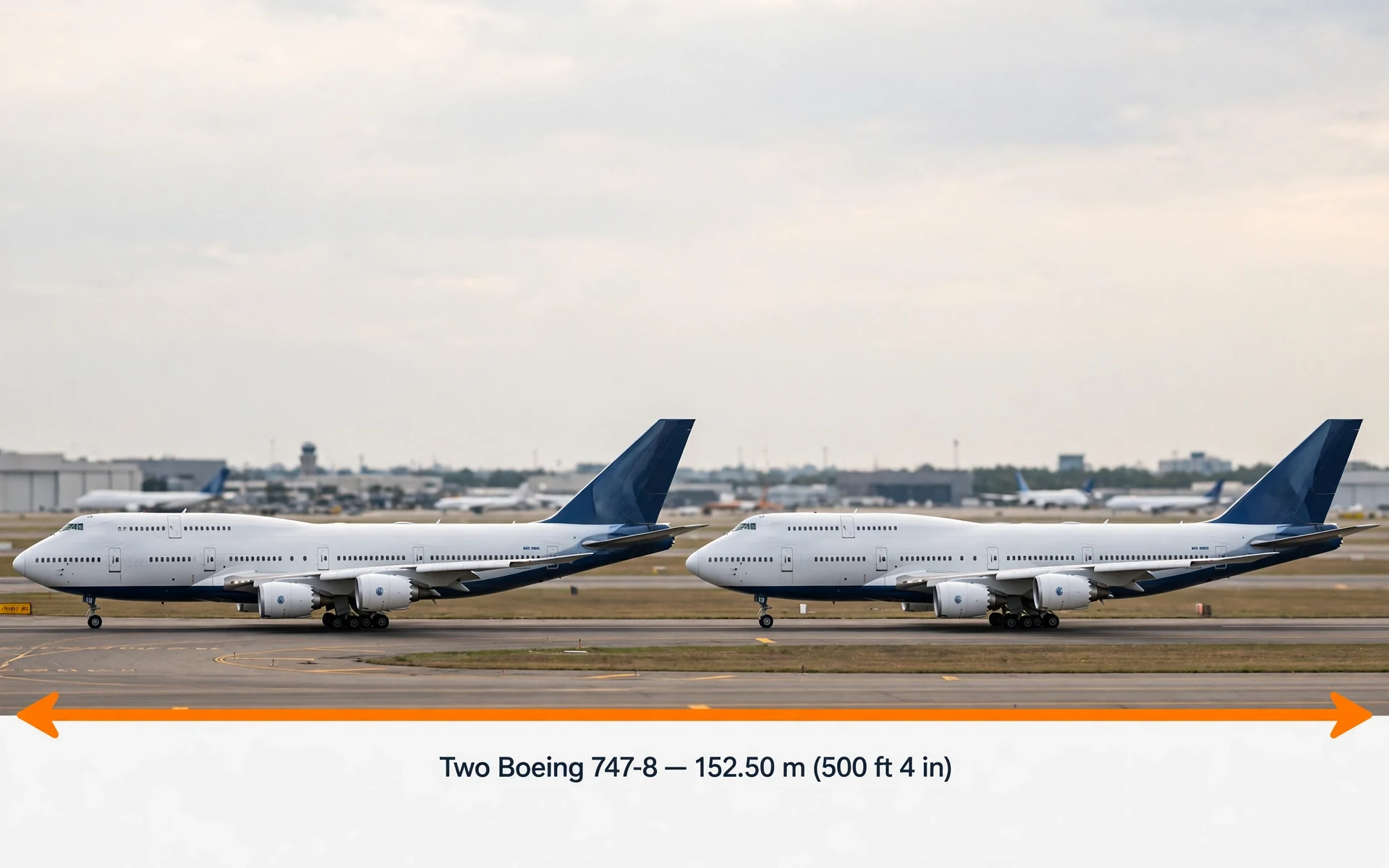
The jets are the article’s longest land-on, and the one that proves 500 feet is an airport measurement as well as a harbour one. Boeing’s specification puts it at 250 feet 2 inches (76.25 metres), with a wingspan of 68.40 m and a height of 19.35 m, so two 747-8s parked nose to tail measure 152.50 m — 500 ft 4 in, four inches over 500 feet, the second-tightest land-on in this article. The stretch is what does it: the 747-8’s fuselage was lengthened by 18.3 feet over the 747-400, which at 231 ft 10 in would leave a two-plane line 36 feet short of the mark, and the longer fuselage made the 747-8 the longest airliner in service until the 777-9, which at 76.72 m is longer but undelivered. Stand at the gate beside one and the pair is the number itself, plus a handspan, which is why the two aircraft sit second on this page.
The fitting check is the wingspan, because each 747-8 is 76.25 m long but its wingspan is 68.40 m, so two aircraft nose to tail are 152.50 m long and 136.80 m of wingspan side by side — two different numbers, and the stand that fits the length must also fit the span. The cabin is shorter still: the main cabin is 63.25 m long, so thirteen metres of each aircraft is nose, tail cone and cargo hold — the part passengers sit in is shorter than the part that lands on the number. The grade is listed because the figure is the manufacturer’s published specification as carried by the reference page, with the deviation printed in full: 152.50 m, 0.10 m over. One caution: an older cached reference page still shows 246 ft 10 in (75.23 m) for the Intercontinental — the pre-2009 plan, a 140-inch stretch, before both variants were offered at the same 250 ft 2 in — and some sources round 76.25 m to 76.3 m, which would be 250 ft 4 in. The article uses 76.25 m, the current specification. Never write “two 747-8s are exactly 500 feet” — they are 500 ft 4 in, four inches over.
3. Florence Cathedral (Santa Maria del Fiore), Length 153 m (502 ft) — 0.60 m / 1.97 ft Over (REPORTED)
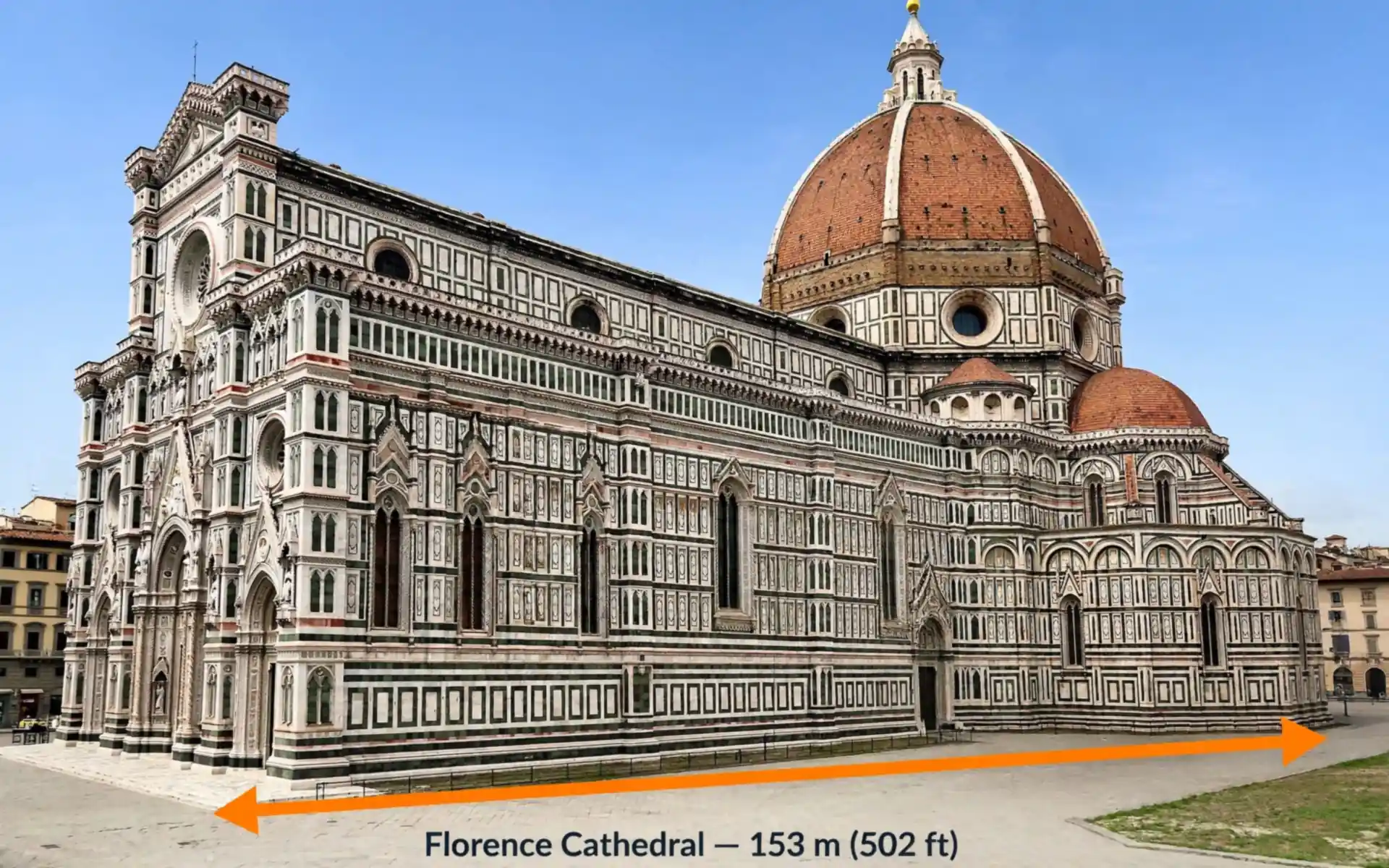
The cathedral is the article’s oldest land-on, and the one that proves 500 feet is a length laid out in the 1290s as well as a length drawn in the 2000s. The cathedral’s published dimensions give the length as 153 metres (502 ft), with a width of 90 metres at the transept and a height of 114.5 metres to the lantern, so the cathedral measures 153 m from the west front to the apse behind Brunelleschi’s dome — 1.97 feet over 500 feet, the third-tightest land-on in this article. The first stone was laid on 8 September 1296, the dome was completed in 1436, and the facade was not finished until 1887 — a building that took 140 years to roof and 591 years to face. Stand at the west front and look east, and its length is the number itself, plus two feet, which is why it sits third on this page.
The fitting check is the width, because the cathedral is 153 m LONG but 90 m wide at the transept, and the two are not the same number. Ninety metres is 295.28 feet, not 300 feet — the cathedral’s own listing prints the rounded 300 ft, and one rival page repeats it without checking, so the article states 295 ft and notes the error. The height is a third number again: 114.5 m to the lantern, while the floor-to-the-base-of-the-lantern figure is about 90 m — the same building, four numbers, and the axis decides which. The grade is reported because the figure is a published reference measurement, not a manufacturer spec — the cathedral was consecrated in 1436, and its dimensions are carried in the reference literature. The deviation is printed in full: 153 m, 1.97 ft over. Never write “the cathedral is 153 metres tall” — it is 153 metres long.
4. 10 Upper Bank Street, London, Height 151 m (495 ft) — 1.40 m / 4.59 ft Short (REPORTED)
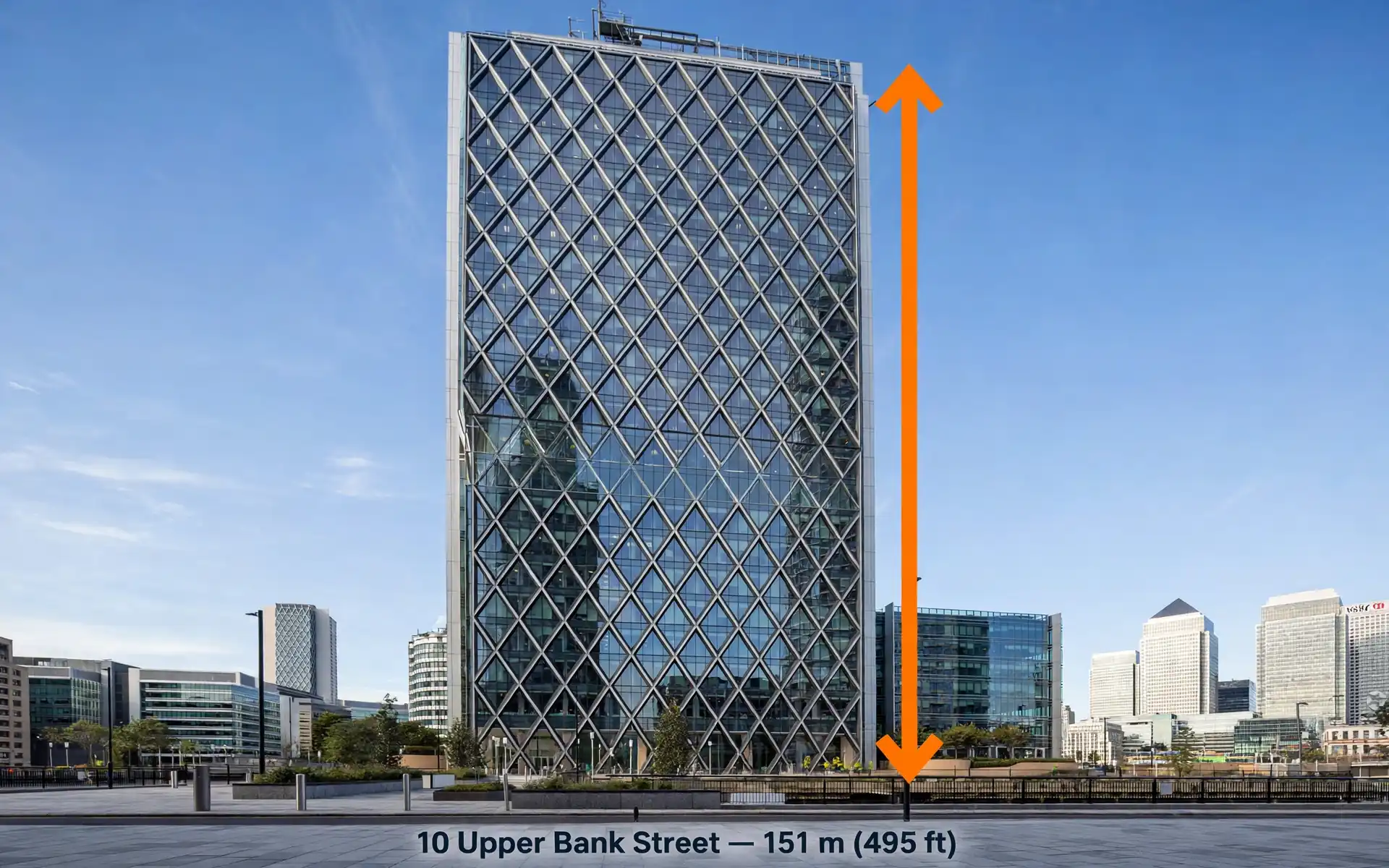
The tower is the article’s second-closest building, and the one that proves 500 feet is a Canary Wharf height as well as a Florence length. The building’s reference page gives the roof height as 151 metres (495 ft), with 32 storeys, completed in 2003, so the tower measures 151 m from the pavement to its roof — 4.59 feet short of 500 feet, the fourth-tightest land-on in this article. It is the global headquarters of the law firm Clifford Chance, designed by Kohn Pedersen Fox, and its diamond-lattice facade tells it apart from its neighbours at a glance. Stand on the dockside below it and its height is the number itself, minus a tall man’s reach, which is why it sits fourth on this page.
The fitting check is the roof, because the 151 m is the ROOF height, and there is no spire or antenna counted on top of it — what you see is what is measured. The fitting check is also the neighbours, because the Canary Wharf cluster has three towers at 151 to 153 metres: 10 Upper Bank Street at 151 m, and 40 Bank Street and 25 Bank Street both at 153 m, so the three towers sit within two metres of each other and within two feet of the number in either direction. A guide that says “the Canary Wharf tower is 153 metres” without saying which tower has the right number for the wrong building. The grade is reported because the figure is a published reference measurement, carried in the tallest-buildings lists. The deviation is printed in full: 151 m, 4.59 ft short. Never write “the tallest building in Canary Wharf” — One Canada Square is 235 m, and 10 Upper Bank Street is not it.
5. Two Airbus A340-600, Length 150.72 m (494 ft 6 in) — 1.68 m / 5.51 ft Short (LISTED)
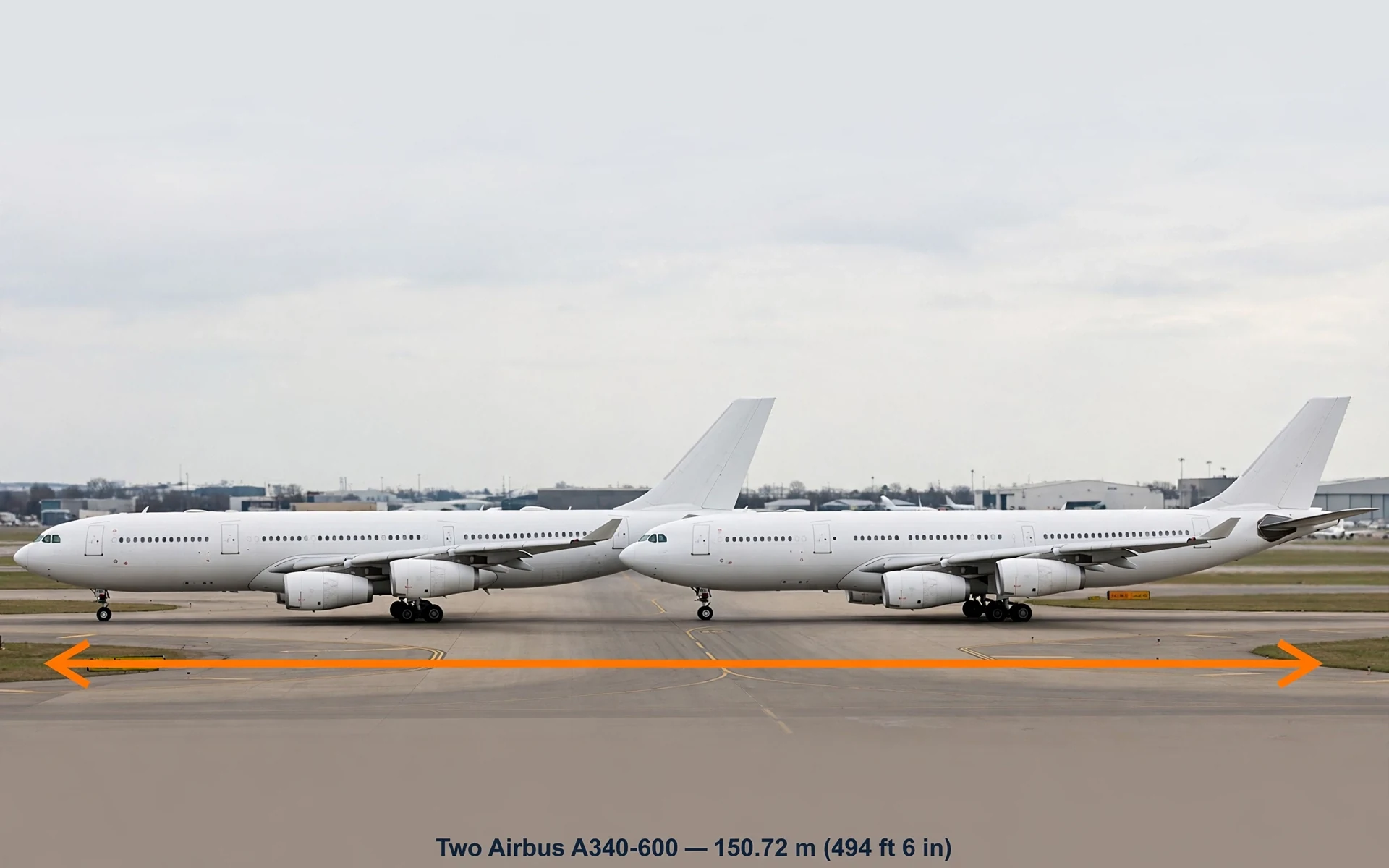
The airliners are the article’s longest pencil, because they are the longest airliner ever built before the 747-8 took the title. Airbus’s own data puts the A340-600 at 247 feet 3 inches (75.36 metres), with a wingspan of 63.45 m and a height of 17.93 m, so two A340-600s parked nose to tail measure 150.72 m — 494 ft 6 in, 5.51 feet short of 500 feet, the fifth-tightest land-on in this article. The stretch is what does it: the -600’s fuselage was lengthened by twelve metres over the A340-500, which made it the longest airliner in the world from 2002 until the 747-8 flew in 2010 — and the two aircraft in this article are the two longest airliners ever built, 0.89 metres apart per aircraft. Stand at the gate beside one and the pair is the number itself, minus two long strides, which is why the two aircraft sit fifth on this page.
The fitting check is the cabin, because each A340-600 is 75.36 m long overall but its cabin is only 60.98 m long, and its fuselage is only 5.64 m across. Fourteen metres of the aircraft is nose, tail cone and cargo hold, and the part passengers sit in is shorter than the part that lands on the number. The grade is listed because the figure is the manufacturer’s published specification as carried by the length guide, with the deviation printed in full: 150.72 m, 5.51 ft short. Do not confuse the variants: the A340-200 is 59.39 m, the A340-300 is 63.69 m and the A340-500 is 67.93 m — the -600 is the one that lands nearest 500 feet in a pair. And do not merge the two pairs in this article: two 747-8s are 152.50 m and two A340-600s are 150.72 m, so the pairs sit 1.78 m apart, and their wingspans differ by 4.95 m a side, so a stand that fits one pair does not automatically fit the other.
6. Type 26 (City-Class) Frigate, Length 149.9 m (491 ft 10 in) — 2.50 m / 8.20 ft Short (LISTED)
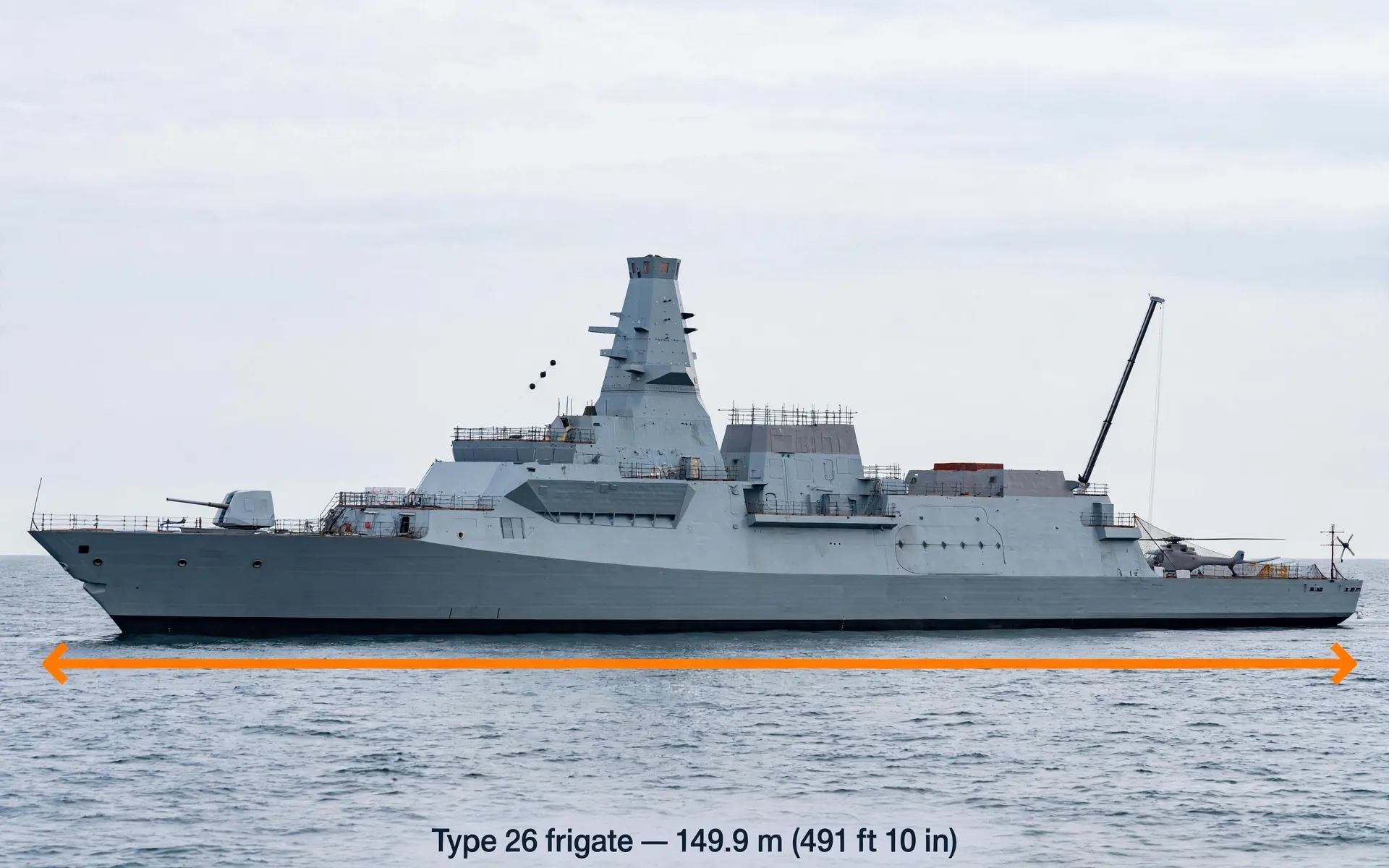
The frigate is the article’s furthest land-on, and the one that proves 500 feet is a design length as well as a built length. The class reference page gives the length as 149.9 metres (491 ft 10 in), with a beam of 20.8 m and a displacement of 6,900 tonnes, so the frigate measures 149.9 m from bow to stern — 8.20 feet short of 500 feet, the furthest land-on in this article. Eight hulls are planned for the Royal Navy — Glasgow, Cardiff, Belfast, Birmingham, Sheffield, Newcastle, Edinburgh and London — built by BAE Systems at Govan and Scotstoun on the Clyde; HMS Glasgow was launched in 2022, with entry into service in the late 2020s. Stand on the Clyde beside her and her length is the number itself, minus two and a half metres, which is why she sits sixth on this page.
The fitting check is the word “design”, because the Type 26 is still being built and the 149.9 m is the design length from the builder’s specification, not a measurement of a ship in the water. The Australian and Canadian variants of the same design are 151.4 m — a different, longer variant — so a guide that quotes 151.4 m for a Royal Navy ship has given the export figure for the home ship. The grade is listed because the figure is the builder’s published specification as carried by the class reference page, with the deviation printed in full: 149.9 m, 8.20 ft short. One caution: the displacement is 6,900 tonnes unloaded and more than 8,000 tonnes fully loaded, so the weight and the length are two different numbers, and a berth planned for 149.9 m of ship still needs the 20.8 m beam checked separately. Never write “the Type 26 is 151.4 metres” — that is the export variant, not the Royal Navy ship.
Six “500 Foot” Claims That Don’t Measure Up
| What a rival list claims | What it actually measures | The difference |
|---|---|---|
| The Washington Monument’s obelisk is about 500 ft | The monument is 555 ft; the 500 ft is the observation level | 55 ft out — the obelisk is 555 ft, not 500 ft |
| 500 ft is exactly 166 yards | 166 yd is 498 ft; 500 ft is 166.67 yd | 2 ft out — the yard figure is not exact |
| Five city buses are 500 ft | Five 40–45 ft buses are 200–225 ft | 275–300 ft out — it takes 12.5 buses |
| Ten tennis courts are 500 ft | Ten 78 ft courts are 780 ft | 280 ft out — it takes 6.4 courts |
| The Gateway Arch span is about 500 ft | The Arch is 630 ft tall and 630 ft wide | 130 ft out — the span is 630 ft, not 500 ft |
| A football field with end zones is 300 ft | The field is 360 ft with end zones (300 ft without) | 500 ft is 1.39 fields with end zones, 1.67 without |
| Florence Cathedral is 90 m (300 ft) wide | 90 m is 295.28 ft | 4.72 ft out — the 300 ft is a rounding error |
Seven of these deserve correction. The monument is the most repeated error in the ranking pages: a rival list says the Washington Monument’s main stone obelisk measures approximately 500 feet tall, but the monument stands 555 feet tall, and the 500 feet is the height of the observation level, not the obelisk. The same page says “stands exactly 555 feet tall” in one section and “the main stone obelisk portion measuring approximately 500 feet” in another — the two cannot both describe the obelisk. Five hundred feet is 90.1% of the monument, not the monument itself.
The yards are the most checkable error: a rival list says 500 feet is “exactly equal to 166 yards”, but 166 yards is 498 feet — two feet short — and 500 feet is 166.67 yards. Three feet make a yard, so the conversion is a division by three that never comes out even, and a page that writes “exactly” next to a rounded yard figure has rounded the number and then denied the rounding. The buses are the most self-refuting error: a rival list heads a section “Length of 5 City Buses Parked End to End” and then says a city bus is 40 to 45 feet long — five buses are 200 to 225 feet, and the page’s own figure refutes its own heading. It takes twelve and a half buses, not five. The tennis courts are the same error in the same article: a rival list heads a section “Length of 10 Tennis Courts in a Row” and then says a court is 78 feet and “roughly six and a half courts cover 500 ft” — ten courts are 780 feet, and the heading and the body cannot both be true. The Arch is the most confident error: a rival list gives the Gateway Arch span as about 500 feet, but the Arch is 630 feet tall and exactly as wide as it is tall — 130 feet over the claim, and the page never says which span it means.
The football field is the most careless error: a rival list says a field including end zones measures 300 feet and therefore 500 feet is 1.67 fields, but a field including end zones is 360 feet; 300 feet is the field excluding them. Five hundred divided by 360 is 1.39 fields, not 1.67 — and the same page’s own FAQ says the field including end zones is 360 feet, so the page’s own figure refutes its own conclusion. And the cathedral is the most precise error: a rival list says Florence Cathedral is 90 metres (300 feet) wide, but 90 metres is 295.28 feet — a 4.72 ft error inside the article’s own featured object, repeated from the cathedral’s own listing without checking. The width is 295 feet; the 300 feet is a rounding error wearing a conversion.
Four near-misses deserve a line of their own. The cathedral’s reference entry gives the length as 518 feet for St Paul’s in London — 158 metres, 18.37 feet over 500 feet — and the dome is 111 metres to the cross, so the building is 518 feet long and 365 feet tall. Blackpool Tower stands 158.12 m to the top of its flagpole — 518.77 feet, 18.77 feet over — but the observation deck sits at 380 feet, so the 518-foot number belongs to the flagpole tip. The Great Pyramid as built was 146.6 metres — 481 feet, 19 feet short — while the Arleigh Burke destroyer at 509 ft 6 in is 9.48 feet over. And three Olympic pools are 492.13 feet — 7.87 feet short — the honest pool count, and the reason the pools are a measuring reference here rather than an object: the pools belong to the 150-metre article, and a pool that is 150 metres is not 500 feet.
How to Measure 500 Feet Without a Tape
| Method | What you get | How close it is |
|---|---|---|
| Five 100 ft lengths end to end | 500.00 ft | Exact — the cleanest method of all |
| 200 steps at a 2.5 ft stride | 500.00 ft | Estimate — the walking method |
| Twelve and a half school buses at 40 ft | 500.00 ft | Exact at 40 ft a bus — the school method |
| Exactly 25 20-ft containers | 500.00 ft | Exact — the yard method |
| A metric tape at 152.4 m | 500.00 ft | Exact — the tape method |
| fifteen 10-metre lengths end to end | 492.13 ft | 7.87 ft short — the metric method |
| Six tennis courts end to end | 468.00 ft | 32.00 ft short — the club method |
| Twelve 40-ft containers | 480.00 ft | 20.00 ft short — the short yard |
| About 33 cars at 15 ft | 495.00 ft | 5.00 ft short — the car-park method |
| Three Olympic pools end to end | 492.13 ft | 7.87 ft short — the honest pool count |
| 1.67 football fields, goal to goal | 500.00 ft | Exact — the field method |
The five 100-foot lengths are the best of the eleven, because the miss is zero and the reference is a length every tape carries — mark one end, walk five lengths of a hundred feet, and you have covered 500 feet. The steps are the one to use when there is nothing to measure with: 200 ordinary steps at 2.5 feet each are exactly 500 feet, and the count is easy to remember because 500 divided by 2.5 is 200 — and at a 0.76 metre stride it is 200.5 steps, half a step over the round count. The containers are the most exact method that needs no tape at all: a 20-foot container is exactly 20 feet, so twenty-five of them are exactly 500 feet, and twelve 40-foot containers are 480 feet — twenty feet short — and the half-container is the whole lesson. The tape method is the most accurate, because 152.4 metres is 500 feet exactly — the foot has been defined as 0.3048 metres since 1959, so the metric tape and the imperial tape agree to the millimetre.
The fitting check is the stride, because a step is not a fixed length. A tall adult walking briskly covers 500 feet in as few as 170 steps, and a child or a short-stride walker needs 230 or more — so the 200-step figure is an average, not a measurement. Measure your own stride over 10 metres first, then multiply — and the steps method stops being a guess. And if you drive, you already own a permanent 500-foot reference: at 25 miles per hour you cover 500 feet in 13.6 seconds, and at 60 miles per hour in 5.7 seconds.
500 Feet in Every Unit
| Unit | Value |
|---|---|
| Millimetres | 152,400 mm |
| Centimetres | 15,240 cm |
| Metres | 152.4 m |
| Kilometres | 0.1524 km |
| Inches | 6,000 in |
| Feet | 500 ft |
| Yards | 166.67 yd (166 yd 2 ft) |
| Miles | 0.0947 mi |
Five hundred feet is 152,400 millimetres, and a foot is 304.8 millimetres, so the conversion is a multiplication by 304.8. In inches it is 500 times 12, which is 6,000 inches exactly — the only conversion in this table with no rounding anywhere. In yards it is 500 divided by three, which is 166.67 yards, or 166 yards and two feet if you want yards and feet rather than a decimal — and 166 yards on a tape is 498 feet, two feet short, while 167 yards is 501 feet, one foot over. 100 feet is 30.48 metres, so 500 feet is exactly five 100-foot lengths. 150 metres is 492.13 feet, so 500 feet is 7.87 feet longer than 150 metres — the trap, and the reason a specification that says 500 feet must never be read as 150 metres. 100 metres is 328.08 feet, so 500 feet is 1.52 times 100 metres. 30 metres is 98.43 feet, so 500 feet is 5.08 times 30 metres. 40 metres is 131.23 feet, so 500 feet is 3.81 times 40 metres. 500 feet is exactly 152.4 × 1 metre, exactly 15.24 × 10 metres, exactly 304.8 × 50 cm, exactly 60 × 100 inches, exactly 25 × 20 feet and exactly 12.5 × 40 feet — the cleanest ladder in the feet series at this scale, because 500 divides by 5, 10, 20, 25, 40, 100 and 125 without a remainder anywhere.
And then there is the three-way trap, because 500 is a number that travels across units. A yard is three feet — 0.9144 m — so 500 yards is 1,500 feet, exactly three times 500 feet, and 457.2 metres. Five hundred metres is 1,640.42 feet, 3.28 times 500 feet, and 500 feet is 152.4 metres, 2.4 metres longer than 150 metres. The same number in three units is three different distances, and the reader who hears “500” and trusts the number rather than the unit is 1,000 feet short on yards and 1,140 feet short on metres. Feet are the unit on US tapes and product listings, metres are the unit on naval specifications and cathedral listings, where a Type 45 is 152.4 m and a Duomo is 153 m — and 500 feet is the distance where all of them meet, because it is a destroyer, two pairs of jets, a cathedral, a tower and a frigate at once.
The 500-Foot Fit-Check: Before You Book, Build or Bet
– Destroyer berth: a 152.4 m Type 45 needs a berth longer than 152.4 m plus fenders and lines — book a 160 m berth, not a 500 ft one — and never quote the displacement (7,350–8,500 tonnes) as a length, because tonnage is weight.
– Frigate berth: a 149.9 m Type 26 needs a berth longer than 149.9 m, and the two Royal Navy hulls are 2.5 m apart in length, so a berth that fits one does not automatically fit the other — and never quote the 151.4 m export variant for a Royal Navy ship.
– Jet stand: two 747-8s need a stand longer than 152.50 m with wingtip clearance on a 68.40 m span each, and two A340-600s need a stand longer than 150.72 m with a 63.45 m span each — the two pairs are 1.78 m apart in length and 4.95 m apart in span, so a stand that fits one pair does not automatically fit the other.
– Tower quote: the Atlas is 152 m on the brochure and 134 m as built — quote the as-built figure with the source, and never present a marketed height as a measurement, because eighteen metres of brochure is the price of trusting the brochure.
– Cathedral measure: Florence is 153 m long but 90 m wide — length is not width, and the width is 295 feet, not 300 feet — so a scaffold planned for a 300 ft width is planned for the wrong number by nearly five feet.
– Container yard: twelve and a half 40-foot containers are 500 feet of boxes, but the yard needs gaps between them for the crane, so the yard is longer than 500 feet — and twelve containers are 480 feet, twenty feet short.
The rule underneath all six is the same: name the thing, name the moment, print the miss, and never trust a round number alone. The number is a design size, a marketed size, a rounded size or a brochure size; the tape is the size.
Frequently Asked Questions
How many metres is 500 feet?
Five hundred feet is exactly 152.4 metres. One foot has been defined as exactly 0.3048 metres since the 1959 international agreement, so 500 times 0.3048 is 152.4 with no rounding anywhere.
Is 500 feet the same as 150 metres?
No. One hundred and fifty metres is 492.13 feet, so 500 feet is 7.87 feet (2.40 metres) longer — close enough to invite swapping, far enough to wreck a measurement that matters. A specification that truly says 500 feet is 152.4 metres, never a flat 150.
What things are 500 feet long?
Six verified objects, tightest first: a Type 45 destroyer at exactly 500 feet, two Boeing 747-8 airliners at 500 ft 4 in, Florence Cathedral at 501.97 feet long, 10 Upper Bank Street in London at 495.41 feet tall, two Airbus A340-600 airliners at 494.49 feet, and a Type 26 frigate at 491.80 feet long.
How many football fields is 500 feet?
One and two-thirds fields goal to goal (300 feet), or 1.39 fields with the end zones (360 feet). A field with end zones is 360 feet, not 300 feet — 300 feet is the field excluding them.
How long does it take to walk 500 feet?
About 1 minute 49 seconds at a normal 1.4 metres per second (109 seconds), or about 1 minute 54 seconds at 3 miles per hour. Not fifteen minutes — 200 steps at 2.5 feet a step cover it, and a brisk fifteen-minute walk covers about 1,350 metres.
How tall is a 500-foot building?
About 50 storeys at 10 feet a floor — but floors run 9 to 11 feet, so a 50-storey building is really 450 to 550 feet. The nearest NAMED building is 10 Upper Bank Street in London at 151 metres (495.41 feet), 4.59 feet short.
How many school buses or shipping containers make 500 feet?
Twelve and a half school buses at 40 feet each (twelve buses are 480 feet, 20 feet short); twelve and a half 40-foot shipping containers, or exactly twenty-five 20-foot containers; about thirty-three cars at 15 feet each.
How do I measure 500 feet without a tape?
Lay five 100-foot lengths end to end, exactly; count 200 ordinary steps at about 2.5 feet each; or use a metric tape at 152.4 metres, exactly. Three Olympic pools are 492.13 feet — 7.87 feet short — and six tennis courts are 468 feet, 32 feet short.
Final Thoughts
Five hundred feet is a distance you sail, fly, walk and build — a destroyer, two pairs of jets, a cathedral, a tower and a frigate — and the moment is the whole article. The six objects that measure it are all things you can find tonight without buying anything: a warship, four jets, a cathedral, a tower and a frigate — and every one of them carries the number its source actually publishes, with the miss printed next to it. That is the difference between a measurement and a slogan: the measurement can be checked, and the slogan cannot.
Do not take the round number, and do not take the name. Ask which moment was measured — the brochure or the building, the design or the delivery, the specification or the rounded page, the length or the width, the roof or the spire, the nose or the cabin, the home ship or the export variant, the obelisk or the observation level — look up the specification, and print the miss when there is one. A tower that shrinks eighteen metres between the brochure and the building is a sixty-foot lesson; and five hundred feet, measured honestly, is 500.00, 500.33, 501.97, 495.41, 494.49 and 491.80 — never just “about 500”.
