
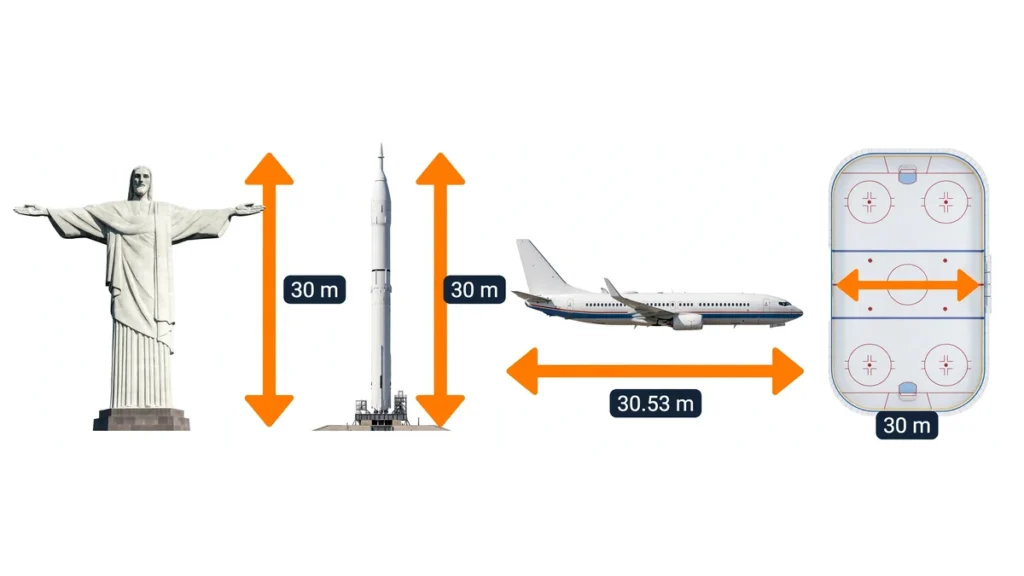
Nobody stumbles on thirty metres. A statue is built to it, a rink is painted to it, a rocket is assembled to it, a jet is stretched to it. The whale is the only one that grew to it — and even the whale stopped ten centimetres short. That is what thirty metres is: not a size you find, but a size somebody chose, written into a rulebook, a specification sheet or a design brief, and then built, painted or grown to fit. So how long is 30 meters, really? It is the height of a statue that was designed in metres, the width of a rink that a rulebook fixes, the height of a rocket that a space agency lists, and the length of the largest animal ever measured — minus ten centimetres.
Thirty metres is 98.43 feet, 3,000 centimetres, and exactly three hundredths of a kilometre. It is 48 cm short of 100 feet, 2.57 m longer than 30 yards, and more than three times longer than 30 feet. The seven objects below are the closest honest answers to it: three land on 30.00 m exactly, two stop exactly 10 cm short, one runs 53 cm over, and the seventh is an average with its band printed — and every one of them carries the source that proves it.
Quick Answer
30 metres is 98.43 feet — 48 cm short of 100 feet.
Thirty metres is 98.43 feet, 3,000 centimetres, and exactly three hundredths of a kilometre. Three objects land on it exactly — a statue, a rink and a rocket — the blue whale and a regional jet both stop 10 cm short, a classic jet runs 53 cm over, and a 10-storey residential building stands at about 30 metres.
The bar above shows thirty 1 metre segments, but it is a diagram, not a ruler: screen sizes vary, so it explains the measurement rather than measuring it. For a real measurement, use the objects below or a tape measure.
30 Metres Is a Standard, Not a Size
Thirty metres is not a size you find in the wild. It is a size somebody chose, and then the world was built to match. The statue on Corcovado was designed in metres, and its makers chose 30. The ice rink is 30 m wide because the rulebook says so, and the rulebook says so because the game was designed in metres. The rocket is 30 m tall because the European Space Agency’s data table says so, and the table says so because the rocket was built to that height. The two jets are 29.90 m and 30.53 m long because their manufacturers’ airport planning documents say so, and the documents say so because the aircraft were stretched and sized to those lengths. The whale is the only one that grew to it, and even the whale stopped ten centimetres short — the longest scientifically measured blue whale is 29.9 m, and every other large adult is shorter still. The building is 30 m tall because ten residential floors at three metres each add up to thirty, and the moment the floors are offices instead of flats, the same ten storeys stand 33 to 39 metres.
That is the lesson of this article, and it is the reason 30 metres keeps appearing in places that have nothing to do with each other. Thirty metres is a round number in the unit the world designs in, and round numbers in the design unit become standards: a statue height, a rink width, a rocket height, a field length, a hose length, a tape length. The imperial world has its own round numbers — 100 feet, 30 yards — and those numbers are not the same numbers, which is where the trap lives. A product designed in feet and sold as “30 m” is really 30.48 m; a product designed in metres and sold as “100 feet” is really 30.00 m, and the buyer has been promised half a metre that is not in the box. The number on the label is the standard. The second number is the size. Measure the second number.
7 Things That Are 30 Metres
The seven objects are ordered by how close they land on 30 m, closest first, and each one carries its evidence grade in the heading. EXACT means the figure is the published design figure for the named thing. LISTED means the figure is the manufacturer’s published specification, the governing body’s rulebook figure, or the authority’s published record for the named model or standard. REPORTED means the figure is the longest scientifically measured value, reported by an authority, not a measurement of an average individual. AVERAGE means the figure is a planning rule of thumb for a class of buildings, not a measurement of one building. Three of the seven land on 30.00 m exactly, two stop exactly 10 cm short — the whale and the regional jet, the same 10 cm, one grown and one built — one runs 53 cm over, and the seventh is an average. The mean absolute deviation across the six measured objects is 0.10 m.
A published 30 m designation does not mean every unit measures mathematically 30.000 m: statues are measured without their pedestals, rinks are built to a permitted range, rockets are quoted to the nearest metre, whales are measured from rostrum tip to tail notch, jets are measured nose to tail, and buildings are counted in floors. What follows is what the source actually says, with the axis named every time, so you can check it yourself.
1. Christ the Redeemer Statue, Height 30 m — Exactly 30.00 m (EXACT)
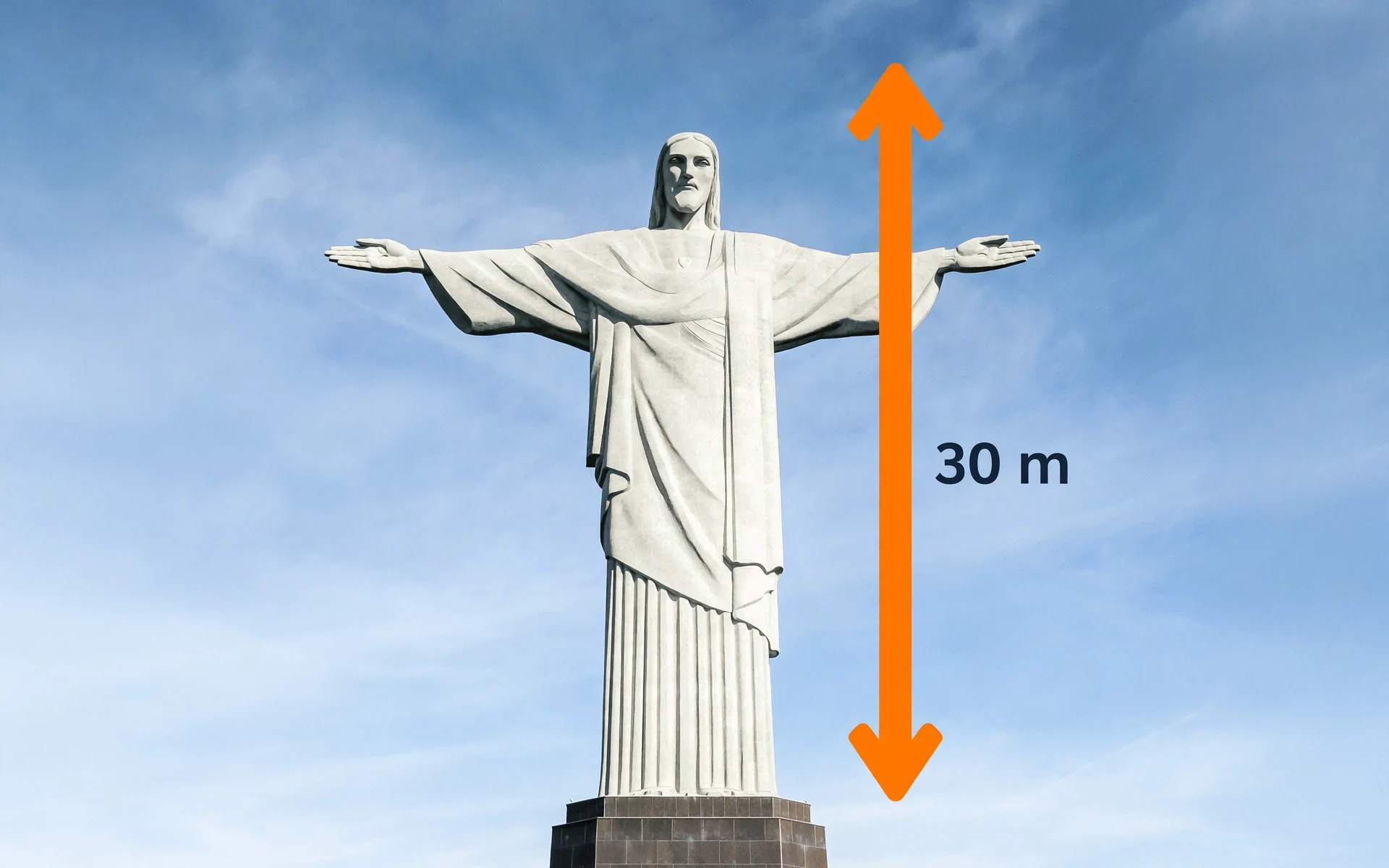
The statue is the article’s cleanest land-on, because its 30 m is the height the statue was designed to, on the mountain it was built for. Britannica puts the monument at 98 feet (30 metres) tall, with arms stretching 92 feet (28 metres), and the statue sits on a base about 26 feet (8 metres) high, so the figure measures 30.00 m from its base to the top of its head, with no deviation to print. Stand on the plaza at its feet and its height is the number itself, which is why it sits first on this page.
The fitting check is the word “statue”, because the STATUE is 30 m and the MONUMENT is 38 m. The 8 m pedestal is stone, not statue, and the 28 m arm span is width, not height — three numbers, one monument, and only one of them is 30 m. A guide that says “Christ the Redeemer is 30 metres tall” without “the statue” has given you the figure and hidden the pedestal; a guide that says “the monument is 30 metres tall” is wrong by 8 m. The grade is exact because the figure is the published design height of the statue itself, with the deviation printed in full: 30.00 m, zero centimetres off. The statue was completed in 1931, built of reinforced concrete and soapstone, and it is the largest Art Deco sculpture in the world — and it is the only object in this article that was built to be looked at, not to be used, which is why its number is the roundest of all.
2. IIHF Ice Hockey Rink, Championship Sheet, Width 30 m — Exactly 30.00 m (LISTED)
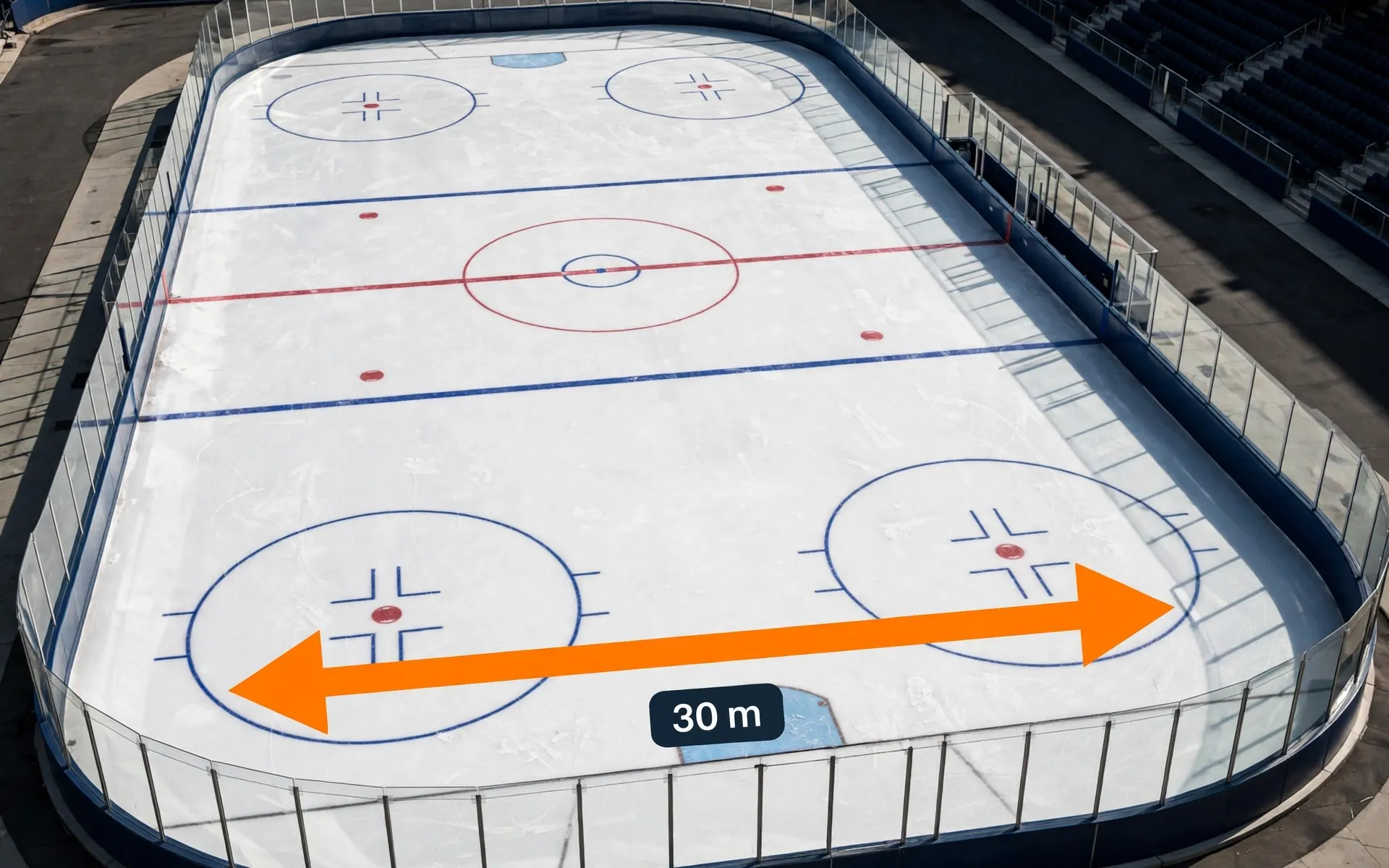
The rink is the article’s widest land-on, and the one that proves 30 m is a sports size. The IIHF’s own rulebook sets the official rink at 60 m long and 26–30 m wide, and the Western Australia sports dimensions guide puts the championship sheet at 60 m long and 30 m wide, so the championship rink measures 30.00 m across its short side, with no deviation to print. Stand at the boards and the width is the number itself, which is why it sits second on this page.
The fitting check is the word “championship”, because the CHAMPIONSHIP sheet is 60 × 30 m but the rulebook permits 26–30 m widths, and recent Olympic tournaments were played on 26 m ice — the NHL width. A rink built to the 26 m minimum is 4 m narrower than the championship sheet, and a rink built to the NHL standard is 25.91 m wide, 4.09 m narrower than the IIHF maximum. Never write “every IIHF rink is 30 m wide” — the rulebook gives a range, and 30 m is its top. The grade is listed because the figure is the governing body’s rulebook figure for the championship sheet, with the deviation printed in full: 30.00 m, zero centimetres off. The 60 m length is the other half of the story: the rink is twice as long as it is wide, and its 30 m is the width, not the length — never quote the long side as the rink’s size.
3. Vega Rocket, Height 30 m — Exactly 30.00 m (LISTED)
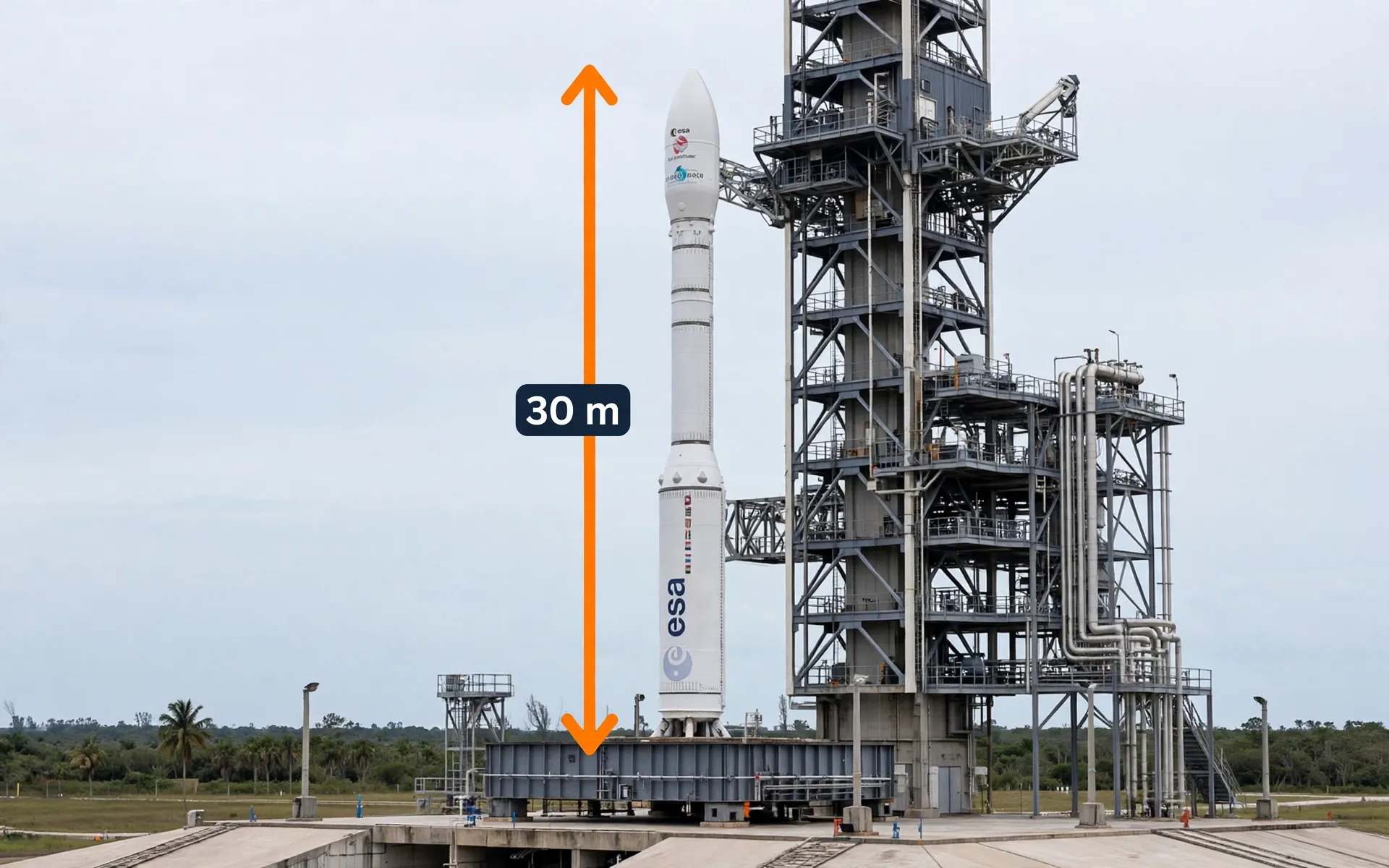
The rocket is the article’s tallest land-on in the truest sense, and the one that proves 30 m is a space size. ESA’s own data table lists the Vega at 30 m tall, with a diameter of 3 m and a liftoff mass of 137 tonnes, so the rocket measures 30.00 m from the launch pad to the tip of its fairing, with no deviation to print. Stand at the base of the launch mount and its height is the number itself, which is why it sits third on this page.
The fitting check is the 0.2 m, because ESA’s headline figure is 30 m but a technical source gives 30.2 m at lift-off — the difference is the fairing configuration and the rounding, and the honest figure is “30 m, with some technical sheets giving 30.2 m”. Never write “the Vega is exactly 30.00 m” without that note; the rocket is 30 m to the nearest metre, and the 20 cm is the rounding, not a mistake. The grade is listed because the figure is the space agency’s published specification for the named launcher, with the deviation printed in full: 30.00 m on ESA’s own table, 0.20 m over on the technical sheet. Vega flew 20 times between 2012 and 2024 and made its last flight on 5 September 2024, carrying Sentinel-2C — the rocket is retired, and it is still 30 m tall. Its successor, Vega-C, is 34.8 m — a different rocket, and the two must never be confused.
4. Blue Whale, Longest Scientifically Measured — 29.90 m (REPORTED)
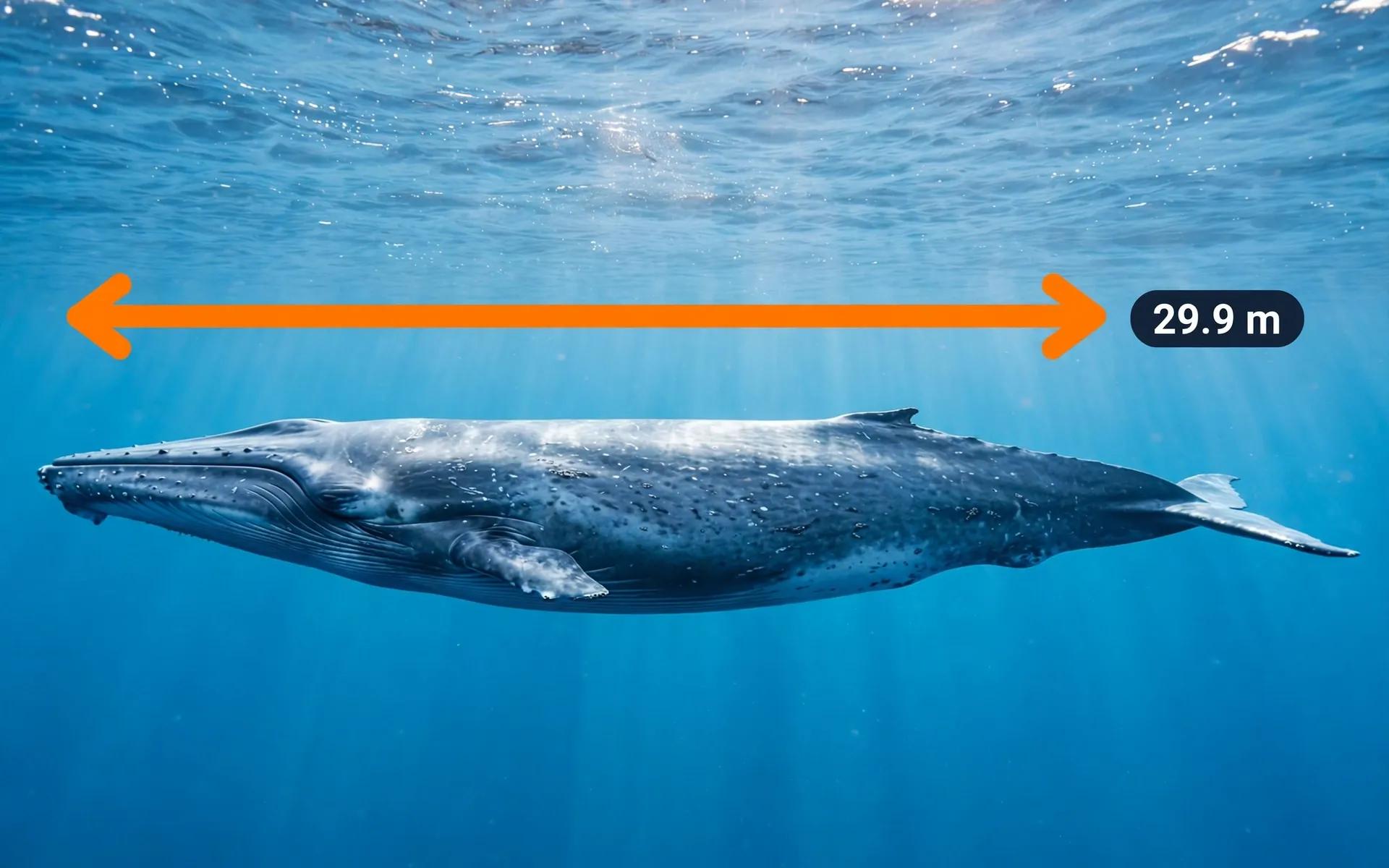
The blue whale is the article’s largest land-on, and the one that proves 30 m is an animal size. COSEWIC’s assessment records the longest scientifically validated blue whale at 29.9 m (98 ft), so the largest blue whale ever measured by scientists measures 29.90 m from rostrum tip to tail notch — 10 cm short of 30 m, and no deviation to hide. Swim beside one and its length is, at the very longest, the number itself minus a hand’s breadth, which is why it sits fourth on this page.
The fitting check is the word “scientifically”, because the International Whaling Commission’s database reports 88 individuals longer than 30 m, including one at 33 m — but those were whalers’ piecemeal measurements, taken on factory ships by men who were not trained to measure animals, and the longest scientifically measured individual is 29.9 m. A guide that says “blue whales grow to 33 m” has quoted the whalers, not the scientists. Typical large adults run 24–27 m, so most blue whales are 3–6 m shorter than this article’s number, and the 29.9 m animal was a pregnant female caught in the Antarctic in the 1937–38 season, its measurement verified by a US Coast Guard whaling inspector. The grade is reported because the figure is the longest scientifically measured value, reported by an authority, with the deviation printed in full: 29.90 m, 10 cm short. The blue whale is also the article’s heaviest reference: a 30 m individual weighs in excess of 180 tonnes, and the largest accurately weighed by the National Marine Mammal Laboratory was a 177-tonne female — a length you can picture, and a weight you cannot.
5. Embraer E170 Regional Jet, Overall Length — 29.90 m (LISTED)
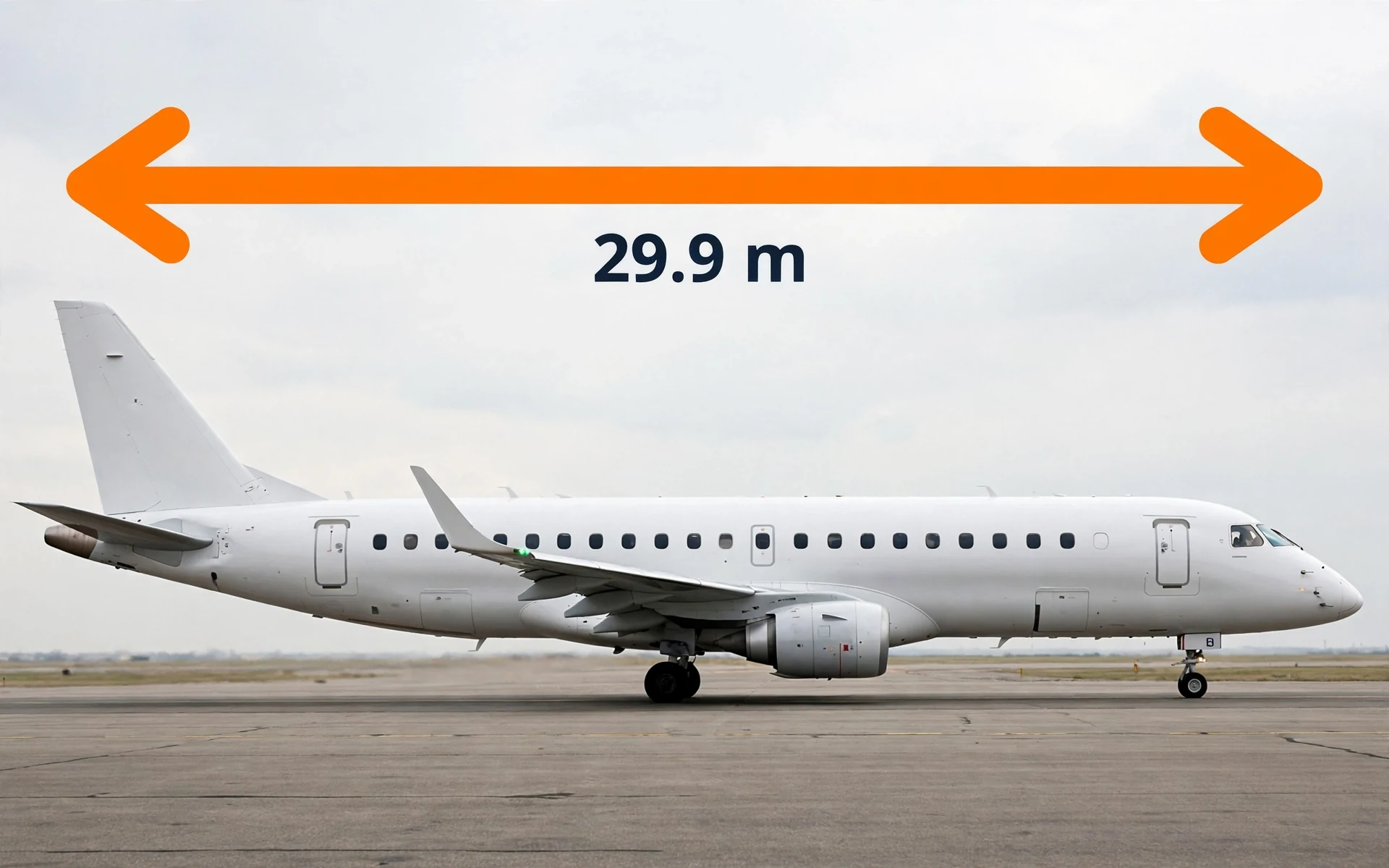
The regional jet is the article’s neatest land-on, because it stops at exactly the same 10 cm as the whale — one grown, one built. Embraer’s Airport Planning Manual lists the E170’s overall length at 29.90 m (98 ft 1 in), with a wingspan of 26.00 m and a height of 9.85 m, so the aircraft measures 29.90 m from nose to tail — 10 cm short of 30 m, and no deviation to hide. Stand at its nose on the apron and its length is the number itself minus a hand’s breadth, which is why it sits fifth on this page.
The fitting check is the word “overall”, because the OVERALL length is 29.90 m and the fuselage length is also 29.90 m — on this aircraft the two are the same figure, since the tail does not extend past the fuselage. Do not confuse that with the 737-200 below, where the aircraft length (30.53 m) exceeds the fuselage length (29.54 m) by 0.99 m. The E170 is the smallest member of Embraer’s first-generation E-Jet family, it first flew in 2002, production ended in 2017, and its stretched sibling the E175 is 31.67 m — a different aircraft, 1.77 m longer, and the two must never be confused. The grade is listed because the figure is the manufacturer’s published specification for the named model, with the deviation printed in full: 29.90 m, 10 cm short. The whale and the jet share the same 10 cm for opposite reasons: the whale stopped growing, and the jet was built to stop there.
6. Boeing 737-200, Length — 30.53 m (LISTED)
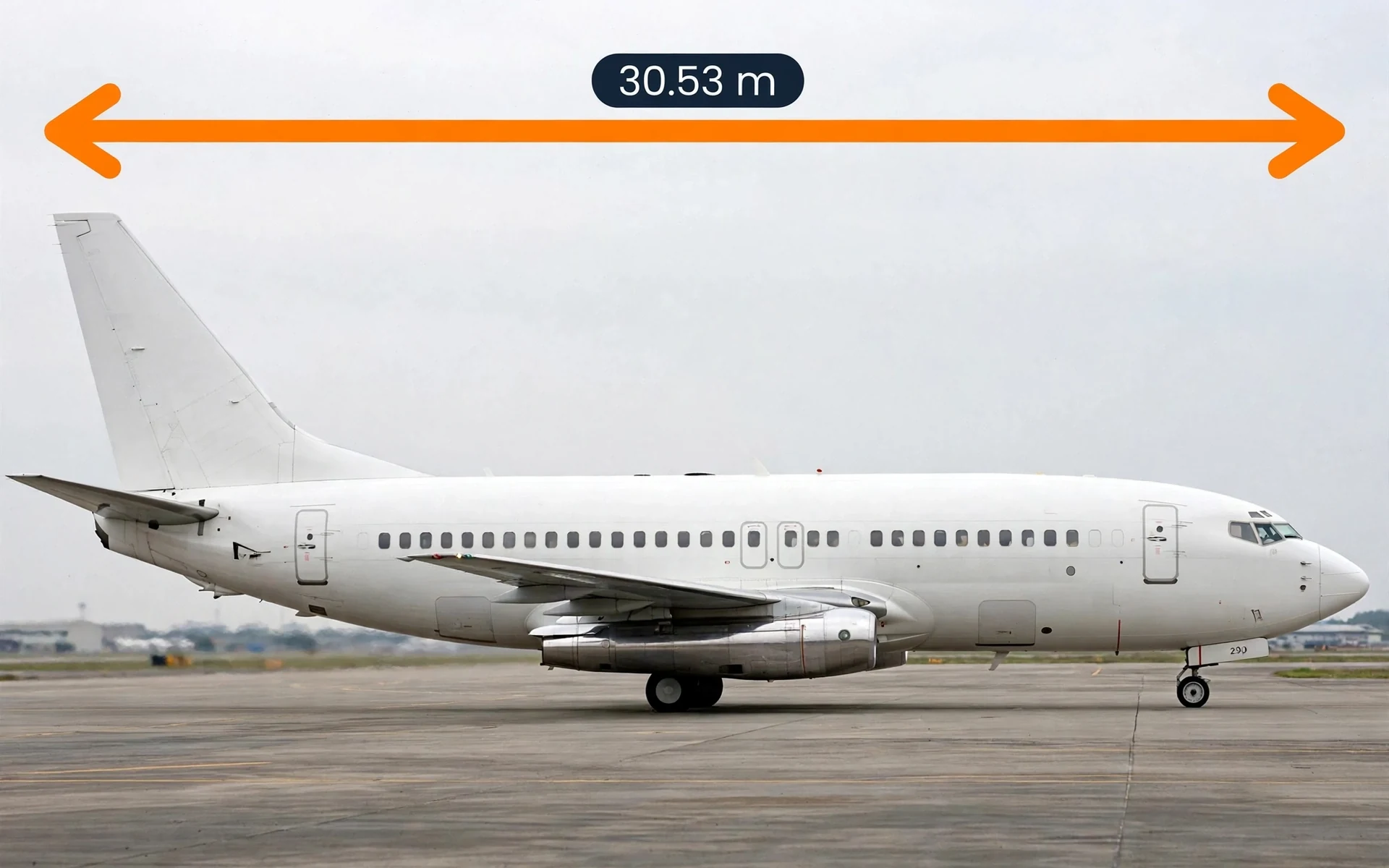
The classic jet is the article’s only over-shoot, and the one that proves 30 m is an aviation size in both directions. Boeing’s Airport Planning document lists the 737-200 at 100 ft 2 in (30.53 m) long, with a wingspan of 28.35 m and a height of 11.23 m, so the aircraft measures 30.53 m from nose to the tip of its horizontal stabiliser — 53 cm over 30 m, and no deviation to hide. Stand at its nose on the apron and its length is the number itself plus half a metre, which is why it sits sixth on this page.
The fitting check is the stretch, because the 737-200 is 1.88 m longer than the 737-100 it was stretched from: Boeing added a 36-inch plug ahead of the wing and a 40-inch plug behind it, and the 100 ft 2 in is the result. The 737-100 is 28.65 m — 1.35 m shorter — and the fuselage length of the -200 is 29.54 m, so the aircraft is 0.99 m longer than its own fuselage, and the extra metre is the tail. Never write “the 737-200 is 30 metres long” without the 53 cm; the aircraft is 30.53 m, and “30 m” is a rounding that hides half a metre. The grade is listed because the figure is the manufacturer’s published specification for the named model, with the deviation printed in full: 30.53 m, 53 cm over. One thousand one hundred and fourteen were built, production ended in 1988, and the -200 is the most-produced member of the original 737 generation — the jet that made 30 m an aviation number.
7. 10-Storey Residential Building, Height — About 30 m (AVERAGE)
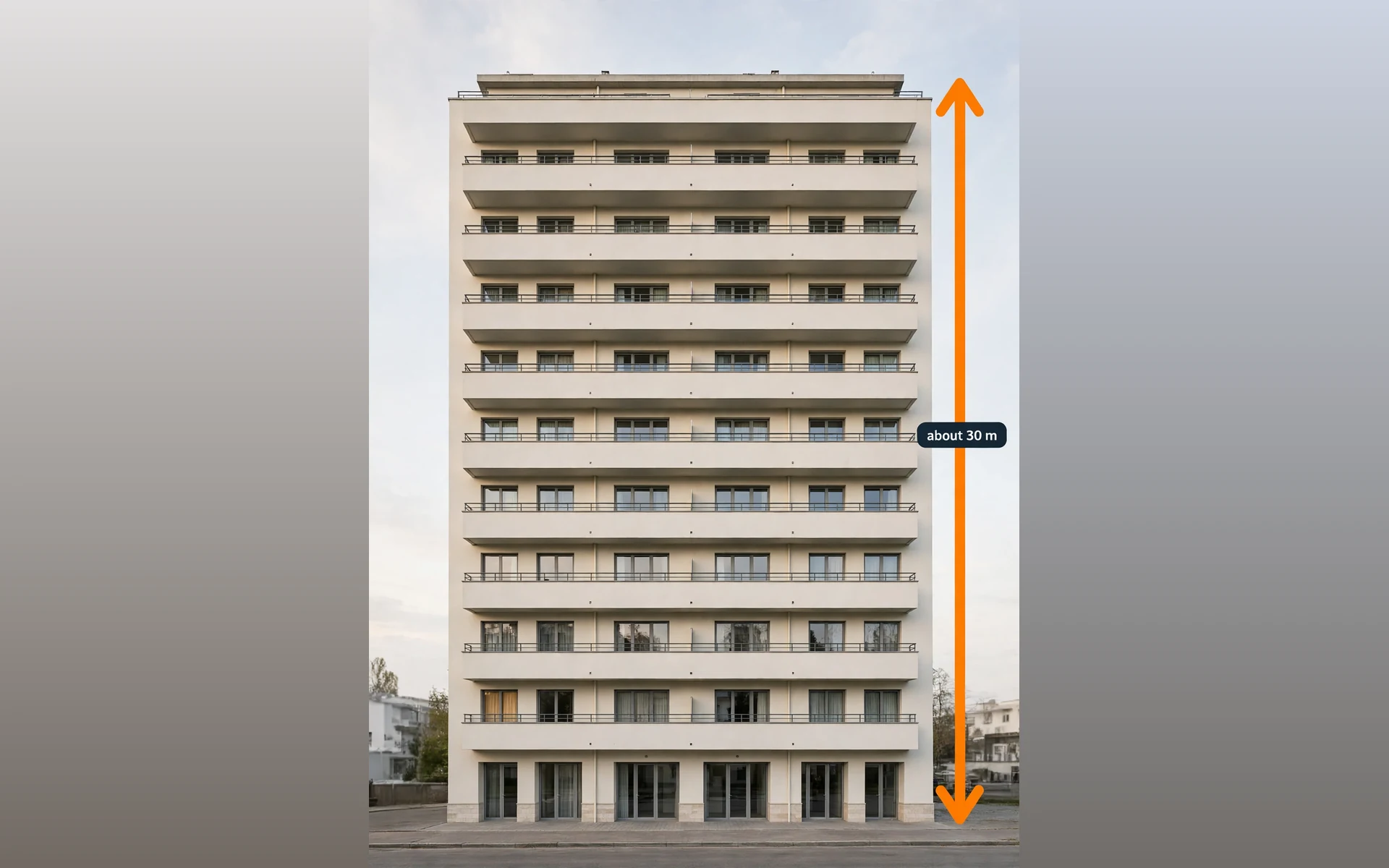
The building is the article’s most familiar land-on, and the one that proves 30 m is a city size. A residential floor is built at about 3 m floor-to-floor — roughly an 8 ft ceiling plus the floor and ceiling structure — so ten residential floors stack to about 30 m, and the average 10-storey residential block measures about 30 m from the pavement to the roof. Count ten ordinary apartment floors up a facade and you have paced out 30 metres vertically, which is why it sits seventh on this page.
The fitting check is the word “residential”, because a RESIDENTIAL block of ten storeys is about 30 m but an OFFICE block of ten storeys is 33–39 m — commercial floors are built at 3.3–3.9 m each, for ducts, lighting and cabling — and a double-height lobby or a rooftop plant room adds metres the count never shows. Real residential blocks run 24–35 m depending on floor heights, parapets and roof structures, so “about 30 m” is a planning rule, not a measurement of any one building. Never write “a 10-storey building is 30 metres tall” as a fact about a specific building — always “about 30 metres”, with the band printed. The grade is average because the figure is a published planning rule of thumb for a class of buildings, with the deviation printed in full: about 30 m, with a real band of 24–35 m. The building is also the article’s most useful reference: it is the only object you can measure without leaving the street, and the only one that is also a measuring method.
The 100-Foot Trap: The 48 cm That Isn’t There
One hundred feet is 30.48 metres. Thirty metres is 98.43 feet. The difference is 48 cm — about 1 foot 7 inches, roughly the length of a forearm and a hand — small enough to vanish in a product listing and large enough to matter the moment something has to fit, reach, or comply. The trap runs through retail in both directions, and it is the largest trap in the metres series so far, because the error here is nearly half a metre — bigger than the 12 mm at 75 cm and the 10 cm at 30 m’s own whale.
Products designed in feet are routinely advertised as “30 m” in metric listings when they are really 30.48 m: 100 ft hoses, 100 ft cords, 100 ft ropes, 100 ft tapes. A 100-foot measuring tape is 30.48 m long, not 30 m, and a contractor who buys “30 m of tape” and gets a 100-foot reel has 48 cm of tape he did not ask for — which is the harmless direction. Products designed in metres come out at exactly 30.00 m and get rounded up to “100 feet” in American listings, which quietly promises the buyer half a metre that is not in the box — which is the expensive direction. A 30 m garden hose sold as “100 feet” is 48 cm shorter than the buyer was promised, and a 30 m extension cord sold the same way leaves a tool 48 cm short of its outlet.
The netball court is the trap wearing a rulebook: the court is 30.5 m long by 15.25 m wide, and those figures are 100 ft and 50 ft restated in metres — 100 ft is 30.48 m, rounded to 30.5 m in the rulebook. The court is a genuine 100-foot standard, and neither number is 30. The yacht is the trap wearing a model name: the Azimut Grande 30M is 28.7 m overall on Azimut’s own page, while broker listings round it to “98 ft (30 m)” — the name is the size class, not the size, and a berth booked for “a 30-metre yacht” fits a 28.7 m boat with room to spare. The water-polo field is the trap wearing a history: the men’s field was 30.00 m until 2024, and World Aquatics shortened it to 25 m from 2025, so a pool still marked 30 m is an old marking, not a current standard.
The yard version of the same mistake is larger and catches people more often. Thirty yards is 27.43 metres — so calling 30 metres “about 30 yards” throws away more than two and a half metres, about the height of a room. When the fit matters, trust the figure in the specification table, in whichever unit the product was designed.
| Tape mark | Value | Against 30 m |
|---|---|---|
| 98 ft 5 in | 29.9975 m | 2.5 mm short |
| 98 ft 5 1/8 in | 30.0007 m | 0.7 mm over |
| 98 ft 6 in | 30.0229 m | 2.3 cm over |
| 100 ft | 30.48 m | 48 cm over |
| 30 yd | 27.43 m | 2.57 m short |
On a tape measure, the nearest inch mark is 98 ft 5 in at 29.9975 m, which is 2.5 mm short — close, but not the mark to use. The exact eighth-inch mark is 98 ft 5⅛ in at 30.0007 m, which is 0.7 mm over — essentially exact, and the mark to use. The mark most guides give, “about 100 feet”, is 30.48 m, 48 cm over, which is close enough for a guess and not close enough for a cut. And 30 m is exactly three 10-metre lengths, ten 3-metre lengths, six 5-metre lengths, fifteen 2-metre lengths, or thirty 1-metre lengths — mark off three 10 m runs and the remaining length is the number you have left over.
Five “30 m” Claims That Don’t Measure Up
| What a rival list claims | What it actually measures | The difference |
|---|---|---|
| An NBA basketball court is just about 30 m long | An NBA court is 94 ft = 28.65 m | 1.35 m short — a FIBA court is 28 m, 2 m short |
| Ten basketball hoops stacked make 30 m | A hoop rim is 3.05 m high; ten are 30.5 m | 50 cm over — the trap size again |
| Four soccer goals side by side make about 30 m | A goal is 7.32 m wide; four span 29.28 m | 72 cm short |
| Half a soccer field’s width is about 30 m | An international field is 64–75 m wide; half is 32–37.5 m | 2–7.5 m over, never 30 m |
| An Olympic pool is 25–30 m wide | An Olympic pool is 50 m long by 25 m wide | No competition pool is 30 m wide |
Five of these deserve a longer correction. The basketball court is the most checkable error in the ranking pages: a rival list says an NBA court is “just approximately” 30 m long, but an NBA court is 94 ft, which is 28.65 m — 1.35 m short, a gap taller than a person — and a FIBA court is 28 m, a full 2 m short. The hoops are the most repeated error: a rival list stacks ten basketball hoops to make 30 m, but a hoop rim sits 3.05 m above the floor, so ten rims stacked are 30.5 m — 50 cm over, and 30.5 m is the netball court, the trap size, not 30 m. The soccer goals are the most confident error: a rival list lines up four goals to make about 30 m, but a goal is 7.32 m wide between the posts, so four goals span 29.28 m — 72 cm short, and the four goals would leave a gap wider than a doorway. The soccer field is the most careless error: a rival list takes half the width of a soccer field as about 30 m, but an international field is 64–75 m wide, so half the width is 32–37.5 m — never 30 m, at either end of the range. And the Olympic pool is the most invented error: a rival list gives competition pools as “roughly 25 to 30 metres wide”, but an Olympic pool is 50 m long by 25 m wide, and no competition pool is 30 m wide as a standard — the range was invented to fill the gap.
Four near-misses deserve a line of their own. The Azimut Grande 30M is 28.7 m overall on the manufacturer’s own page — 1.3 m short of its own name. The men’s water-polo field was 30 m until 2024 and is 25 m now — a rule change, not a typo. Thirty metres is the Advanced Open Water depth limit, not the recreational limit: Open Water divers are limited to 18 m, and the recreational ceiling is 40 m with the Deep Diver specialty — a rival list that calls 30 m “the maximum depth for recreational divers” has mistaken one rung of the ladder for the top. And one-third of an American football field is 30.48 m, not 30 m — the field is 91.44 m goal line to goal line, and one-third of it is exactly 100 feet, the trap size. One more range exhibit, from the lists that love them: three school buses span 27–33 m and six to seven cars span 27–35 m — ranges, not measurements, and the ranges are wider than a bus and wider than a car.
How to Measure 30 Metres Without a Tape
| Method | What you get | How close it is |
|---|---|---|
| Count ten residential floors up a facade | About 30.00 m | About — the best method of all, if the floors are residential |
| Forty ordinary steps at 0.75 m each | 30.00 m | Estimate, ±10% — good for a lot, not for cutting |
| A FIBA court (28 m) plus two long strides | About 30.00 m | About — two strides of about 1 m each |
| Three 10 m lengths end to end | 30.00 m | Exact — the metres ladder in your hands |
| Tape at the 98 ft 5⅛-inch mark | 30.0007 m | 0.7 mm over — essentially exact |
| A Stanley 30M long tape, pulled once | 30.00 m | Exact — the tool built for this distance |
| A 100 ft tape, pulled fully, minus half a metre | 30.00 m | Exact — if you remember the 48 cm |
The ten-floor count is the best of the seven, because it needs nothing but a building and eyes — find any ordinary apartment block, count ten residential floors up the facade, and you are looking at about 30 metres of height. The steps method is the one to use when there is nothing to count with: forty ordinary steps at about 75 cm each land close to 30 m, and it is the fastest large-length estimate there is. The court method is the one to use when you have a gym and no tape: pace a FIBA court, 28 m end line to end line, then take two long strides past the line — about a metre each — and you have covered 30 m to within a step. The tape method is the most accurate, because the 98 ft 5⅛-inch mark is 0.7 mm from the number.
The fitting check is the straight line, because 30 m is a straight-line distance and not the route you walk. A path that bends around a building, a fence or a parked car is longer than the straight line between its ends, and a 30 m tape that sags between two people reads long by the sag — hold it taut, or use a laser measure, and the number is honest. And if you own a 30 m surveyor’s long tape, you already own a permanent 30 m reference — keep it in mind the next time you need the number and the building is not in sight.
30 Metres in Every Unit
| Unit | Value |
|---|---|
| Millimetres | 30,000 mm |
| Centimetres | 3,000 cm |
| Kilometres | 0.03 km |
| Inches | 1,181.10 in (98 ft 5.1 in) |
| Feet | 98.43 ft (98 ft 5.1 in) |
| Yards | 32.81 yd |
Thirty metres is 3,000 centimetres, and a metre is 100 centimetres, so the conversion is a multiplication by a hundred that never needs a calculator. In inches it is 30 times 39.3701, which is 1,181.1024 inches, rounded to 1,181.10 — and the rounding is honest, because 1,181.10 inches times 2.54 is 2,999.99 cm, one hundredth of a millimetre from the mark. In feet it is 98.43, or 98 ft 5.1 in if you want feet and inches rather than a decimal. 10 metres is exactly one-third of 30 metres, and 100 metres is 3.33 times 30 metres, so three 10 m lengths laid end to end make exactly 30 m, a hundred 30 cm lengths laid end to end make exactly 30 m, and 30 m plus 70 m makes exactly 100 m. 30 feet is 9.14 m, so 30 m is 3.28 times longer than 30 feet, and 30 inches is 76.2 cm, so 30 m is 39.37 times longer than 30 inches. Metres are the unit on rulebooks, specifications and design briefs, feet are the unit on US tapes and product listings, and inches are the unit on aircraft data sheets — and 30 m is the size where all three meet, because it is a statue, a rink, a rocket, a whale, two jets and a building at once.
The 30-Metre Fit-Check: Before You Buy, Book or Build
– Yacht berth: an Azimut Grande 30M is 28.7 m overall, not 30 m — book the berth by the length overall plus clearance for fenders and lines, not by the model name, or the boat will arrive 1.3 m shorter than the berth you paid for.
– 737 gate stand: a 737-200 is 30.53 m long with a 28.35 m wingspan — park by the airport planning document, not by the “30 m” shorthand, and allow wingtip clearance on both sides before the stand is assigned.
– Rink build: an IIHF championship sheet is 60 m by 30 m but an NHL sheet is 60.96 m by 25.91 m — a rink built to one standard cannot host the other’s game without a rebuild, so check the width on the rulebook before the concrete is poured.
– Rocket mount: a Vega is 30 m tall but only 3 m across and 137 tonnes — the launch mount must be taller than the rocket plus the transporter, and the height is the rocket, not the facility.
– Building plan: ten residential floors are about 30 m but ten office floors are 33–39 m — count the floors, then check the floor-to-floor height, and allow for a double-height lobby and a rooftop plant room before the height is quoted.
– Whale watch: a 29.9 m blue whale needs a tank no aquarium on Earth has — the number is a record, not a size you will ever meet, and the whale you actually see will be 24–27 m.
The rule underneath all seven is the same: ask which standard the number was built to, and never trust a rounded label alone. The label is a size class, a model name, a rounded size or an old marking; the tape is the size. Forty-eight centimetres is the price of trusting the label, and a hose that falls half a metre short of its outlet is the receipt.
Frequently Asked Questions
Is 30 meters the same as 100 feet?
No. One hundred feet is 30.48 metres, so 30 metres is 98.43 feet — 48 cm shorter, about a forearm and a hand. Close enough to confuse on a listing, far enough to matter the moment something has to fit, reach or comply.
How many feet is 30 meters?
Thirty metres is 98.4252 feet (30 × 3.28084). The nearest tape marks are 98 ft 5 in (29.9975 m, 2.5 mm short) and 98 ft 6 in (30.0229 m, 2.3 cm over); the exact eighth-inch mark is 98 ft 5⅛ in (30.0007 m, essentially exact).
What everyday things are 30 meters long?
Seven verified objects, tightest first: Christ the Redeemer at exactly 30 m tall, the IIHF championship ice hockey rink at exactly 30 m wide, and the Vega rocket at exactly 30 m tall — plus the blue whale and the Embraer E170, both at 29.90 m, 10 cm short, the Boeing 737-200 at 30.53 m, 53 cm over, and a 10-storey residential building at about 30 m. Every one is verified against the governing body’s rulebook, the manufacturer’s own specification, the space agency’s data table, or the scientific record.
Is a blue whale really 30 meters long?
Only the largest one ever scientifically measured comes close. The scientific record is 29.9 metres, measured by the US National Marine Mammal Laboratory and verified by a US Coast Guard whaling inspector in 1937–38; reliably measured blue whales rarely exceed 28 metres, and typical large adults run 24 to 27 metres. The 33-metre figures in older whaling accounts were never scientifically verified, so “up to about 30 metres” is the honest version of the claim.
How tall is a 10-story building in meters?
About 30 metres, if it is residential. Apartment floors are usually built at roughly 3 metres floor to floor, so ten of them stack to around 30 metres. Office buildings run taller — commercial floors are commonly 3.3 to 3.9 metres — so a 10-storey office block can reach 33 to 39 metres, and a double-height lobby adds metres the count never shows.
Is 30 meters the same as 30 yards?
No, and the gap is bigger than the 100-foot trap. Thirty yards is 27.43 metres, so 30 metres is about 2.57 metres longer — roughly a room’s height. In the other direction, 30 metres converts to 32.81 yards. The yard is a shorter unit than the metre, and over a 30-unit length the difference adds up to far more than the better-known 30 m versus 100 ft gap.
How do I measure 30 meters without a tape?
Count ten residential floors up a facade; take forty ordinary steps at about 75 cm each; pace a FIBA basketball court (28 m) and add two long strides past the end line; or lay three 10 m lengths end to end. For a real measurement, a 30 m surveyor’s long tape is the tool built for exactly this distance — pull it once, hold it taut, and the number is honest.
Is the men’s water polo field 30 meters long?
It was, until 2024. World Aquatics shortened the men’s field to 25 metres from 2025, so both sexes now play on 25 × 20 m. A field marked 30 m is either an old marking or a pool built to the old rule — and the overall field of play, goals included, was 30.60 m, not 30.00 m, even under the old rule.
Final Thoughts
Thirty metres is a length that runs a whole world — a statue, a rink, a rocket, a whale, two jets and a building — and the standard is the whole article. The seven objects that measure it are all things somebody chose, built, painted or grew to a number, and every one of them carries the number its source actually publishes, with the miss printed next to it. That is the difference between a measurement and a slogan: the measurement can be checked, and the slogan cannot.
Do not take the round number, and do not take the name. Ask which standard was measured — the statue or the monument, the championship sheet or the permitted range, the rocket or its successor, the verified record or the whalers’ tale, the overall length or the fuselage, the residential floors or the office floors — look up the specification, and print the miss when there is one. A hose that falls half a metre short is a 48-centimetre lesson; a statue measured without its pedestal is 30 m, exactly, every time.
