
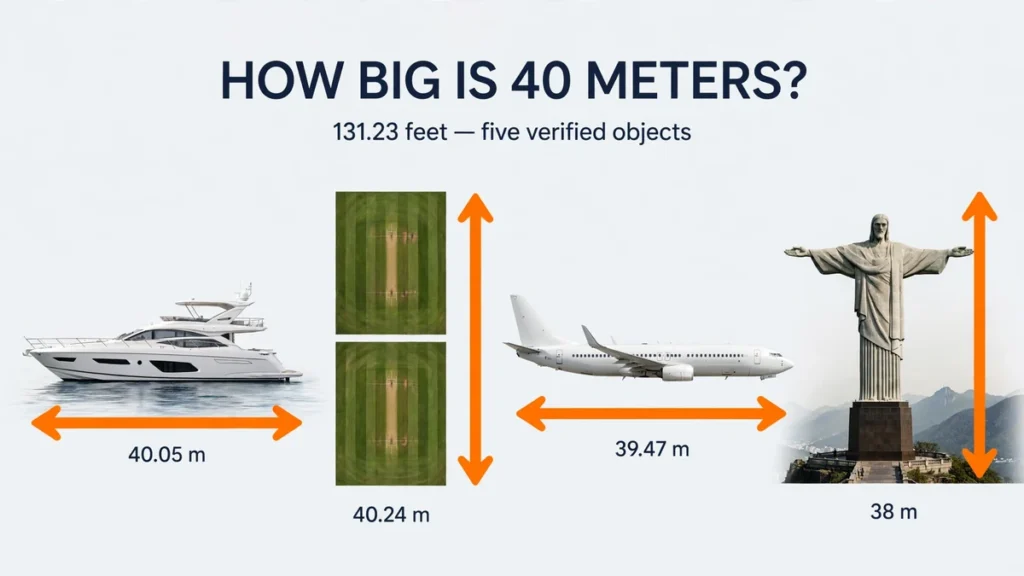
Forty yards is not forty metres. The most famous forty in sport — the NFL Combine’s 40-yard dash — is run over 36.576 metres, which is 3.424 metres short of forty metres, and every page that pictures forty metres while thinking in yards is short by the same 3.424 metres before it starts. Forty metres is 131.23 feet, four-fifths of an Olympic pool, a hair longer than a Boeing 737-800 and a hair shorter than a 40.05-metre yacht. This article is about that number: what forty metres actually is, five things that really measure it, and the miss printed next to each one — because every rival page says “about”, and “about” is where the miss hides.
How big is 40 meters, then, in plain terms? It is 131.23 feet — 131 ft 2.8 in — or 43.74 yards, or 1,574.80 inches, or 0.04 kilometres. It is four 10-metre lengths, or 160 lengths of 25 centimetres, or about 53 walking steps. The five objects below are the closest honest answers to it: a yacht 5 cm over, two cricket pitches 24 cm over, a Boeing 737-800 half a metre short, a Rio statue 2 metres short and an Airbus A320 2.43 metres short — and every one of them carries the source that proves it.
Quick Answer
40 metres is 131.23 feet — 3.42 metres longer than 40 yards.
Forty metres is 131.23 feet, 1,574.80 inches and 0.04 kilometres. Three objects land within half a metre — a 40.05 m yacht, two cricket pitches at 40.24 m and a Boeing 737-800 at 39.47 m — and the other two, a 38 m statue and a 37.57 m Airbus, sit within 2.5 m.
The bar above shows forty 1 m segments, but it is a diagram, not a ruler: screen sizes vary, so it explains the measurement rather than measuring it. For a real measurement, use the objects below or a tape measure.
The 3.42-Metre Gap: 40 Yards Is Not 40 Metres
The trap in this article is a shared number. Forty yards and forty metres both start with “40”, and the brain files them in the same drawer. They are not the same drawer. A yard is three feet — 0.9144 m — so 40 yards is 36.576 m, and 40 metres is 3.424 m longer than 40 yards. The NFL Combine’s 40-yard dash, the sprint every draft prospect is judged by, is run over 36.576 m. The record for it, 4.22 seconds, is a record over 36.576 m, not over 40 m. A 40-metre sprint for an elite sprinter takes about four and a half to five seconds — a different race over a different distance that happens to share a number.
The same shared number bites in feet. Forty feet is only 12.192 metres — less than a third of forty metres — so a reader who hears “40” and thinks in feet is 27.8 metres short, and a page that writes “40 metres is about the length of a school bus” has made exactly that mistake in reverse: a standard school bus is about 12.5 m long, which is roughly forty FEET, and forty metres is about three of them. The number is innocent. The unit is the whole story.
And then there is “about”. Every rival page in this niche leans on the word — about 40 metres, almost 40 metres, nearly 40 metres, roughly 40 metres — and the word is doing heavy lifting, because the misses it hides run from 3.42 m to 140 m. Six blue whales are about 180 m, not 40 m. Two tennis courts are 47.54 m, not “a little longer” than 40 m. Three semi-trucks are about 66 m. Two basketball courts are 57.30 m, which is not a “slight” overshoot. A bowling lane doubled is 36.58 m. The Ha’Penny Bridge is 43 m. The Chicago Water Tower is 47 m. The rule for this article is simple: if a comparison needs the word “about”, print the miss next to it. The five objects below all carry their miss in the heading.
| Rival “about 40 m” claim | What it actually measures | The miss |
|---|---|---|
| 40 yards (the 40-yard dash) | 36.576 m | 3.424 m short |
| Two bowling lanes | 36.58 m | 3.42 m short |
| Four double-decker buses | 40–44 m (or 36 m — the rivals disagree) | 0–4 m either way |
| Two-fifths of Big Ben | 38.4 m | 1.60 m short |
| A 13-storey building | 39 m (13 × 3 m) | 1.00 m short |
| Ha’Penny Bridge | 43 m | 3.00 m over |
| Two tennis courts | 47.54 m | 7.54 m over |
| Three semi-trucks | ~66 m | ~26 m over |
| Two basketball courts | 57.30 m | 17.30 m over |
| Six blue whales | ~180 m | ~140 m over |
The table is the article in miniature: the honest comparisons cluster within a few metres of 40, and the dishonest ones are the ones that never print a number. Forty metres is a distance you cross — a sprint, a pool length, a runway, a berth — not a thing you hold, and the only way to picture a distance is to stand it next to things that have been measured. That is what the next five sections do.
5 Things That Are 40 Metres
The five objects are ordered by how close they land on 40 m, closest first, and each one carries its evidence grade in the heading. LISTED means the figure is the manufacturer’s published specification for the named model. EXACT means the figure is the manufacturer’s or certifying authority’s published dimension. REPORTED means the figure is an authority rule or a published reference measurement, not a manufacturer spec. Three of the five land within 0.53 m of 40 m, and the furthest is 2.43 m short — so the combined list has a mean absolute deviation of 1.05 m, and no object in it is more than 6% away from the number.
A published 40 m designation does not mean every unit measures mathematically 40.000 m: yachts are sold by a length overall that is longer than the waterline, cricket pitches are measured between creases that exclude the run-ups, jets are certified by a length that rounds to 39.5 m on one document and 39.47 m on another, statues are quoted with or without their pedestals, and airliners share a fuselage across two engine generations. What follows is what the source actually says, with the axis named every time, so you can check it yourself.
1. Sunseeker 131 Yacht, Length Overall 40.05 m — 5 cm Over (LISTED)
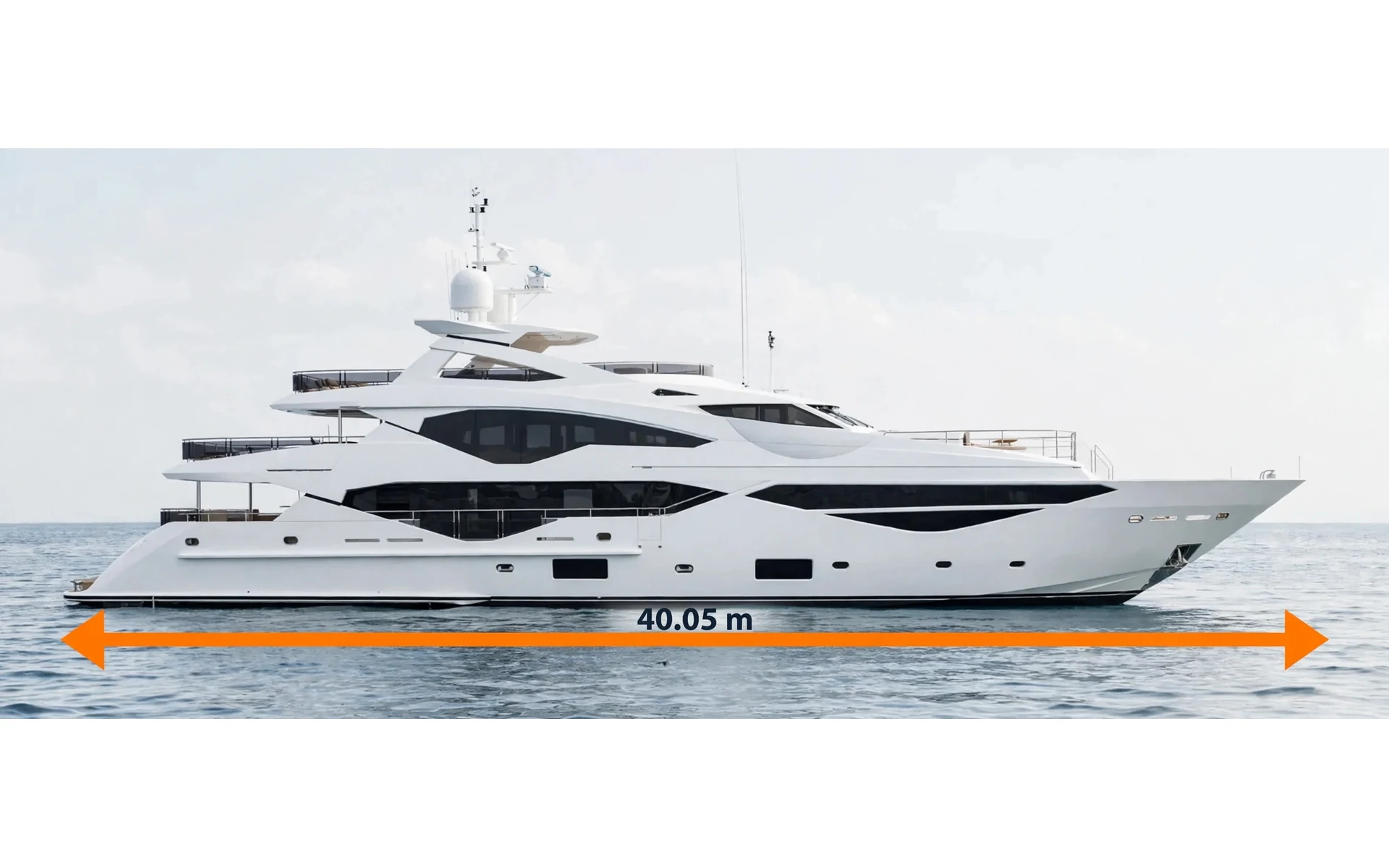
The yacht is the article’s closest land-on, because its 40.05 m is the length the model is sold by, on the manufacturer’s own model data. The 131 Yacht’s published model data lists her length overall at 40.05 m (131 ft 5 in), with a beam of 8.09 m, a draft of 2.7 m and twin MTU 12V 4000 M93 diesels, so the yacht measures 40.05 m from bow to stern — 5 cm over 40 m, the tightest land-on in this article and one of the tightest in the whole series. Stand on the quay beside her and her length is the number itself, plus a hand’s width, which is why she sits first on this page.
The fitting check is the waterline, because the yacht is 40.05 m long OVERALL but only about 31–33 m long at the waterline, depending on the hull — the 2010 hull’s waterline length is 30.81 m. Length overall is the number that decides the berth; length at the waterline is the number that decides the speed. A marina that sells a “40 m berth” sells 40 m of water, and a 40.05 m yacht needs more than 40 m of it once fenders and mooring lines are counted — so the berth for this yacht is a 45 m berth, not a 40 m one. The grade is listed because the figure is the manufacturer’s published model specification, carried in the model announcement and corroborated by three independent broker listings that all agree on 40.05 m, with the deviation printed in full: 40.05 m, 5 cm over. One caution: individual hulls vary by a few centimetres — a 2010 hull is listed at 40.02 m — so the model figure is 40.05 m and a single hull may read 3 cm shorter. Never write “the yacht is exactly 40 m” — she is 5 cm over, and the 5 cm is the whole point of putting her first.
2. Two Cricket Pitches End to End, Length 40.24 m — 24 cm Over (REPORTED)
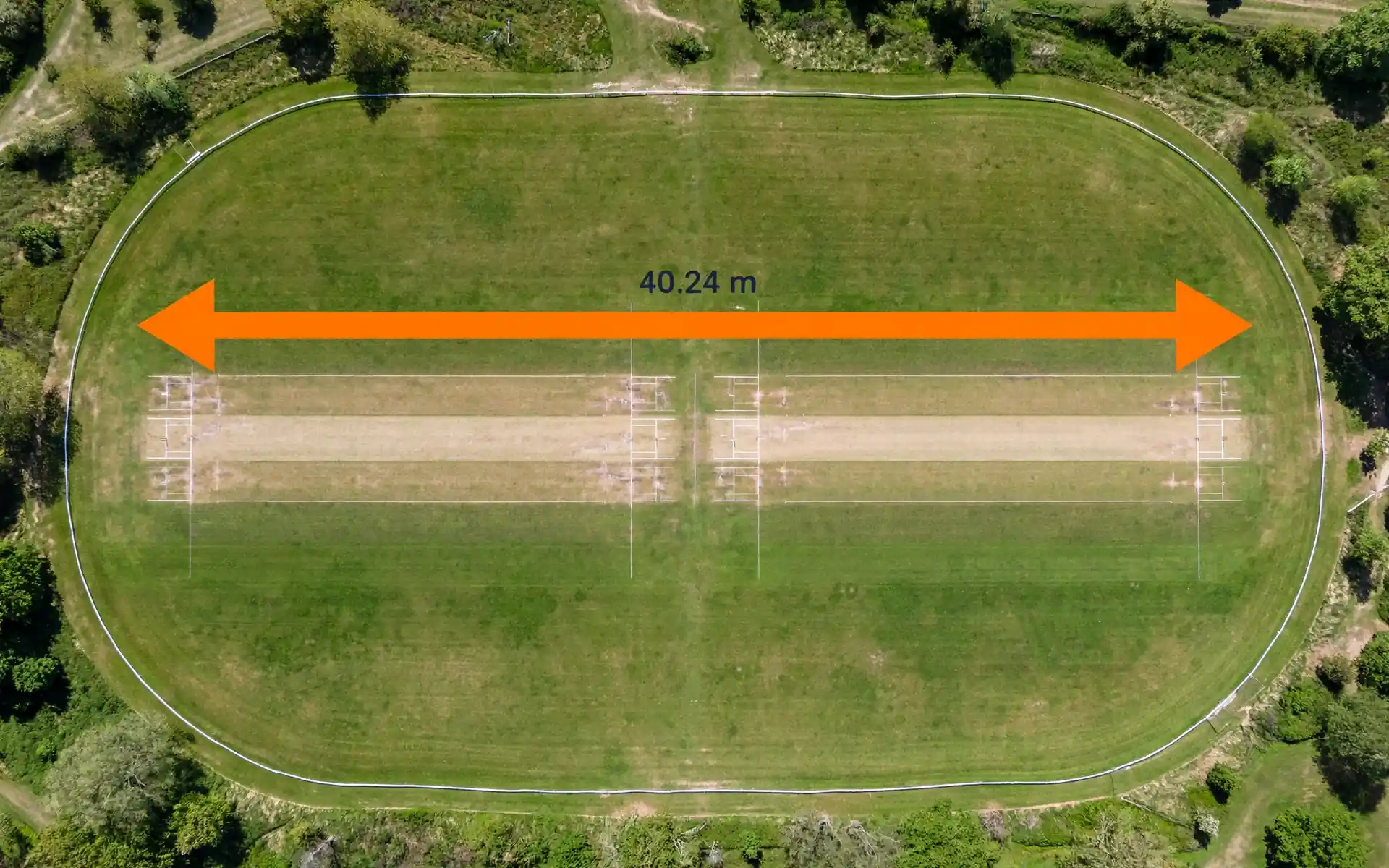
The two pitches are the article’s most useful land-on, because they are the 40 m object most readers can walk. The MCC Laws of Cricket put the pitch at 22 yards — 20.12 m — long and 10 ft (3.05 m) wide, bounded at either end by the bowling creases, so two pitches laid end to end measure 40.24 m — 24 cm over 40 m, the second-tightest land-on in this article. Walk from one set of stumps to the far set, turn around, walk it again, and you have walked 40.24 m, which is why this object sits second on this page — and why it is the pocket reference in the measuring section below.
The fitting check is the crease, because the 20.12 m is measured BETWEEN the bowling creases, and the bowler’s run-up is not part of the pitch. A bowler runs in from well behind the stumps, and the field stretches far beyond the pitch on every side, so “two pitches” is 40.24 m of prepared strip, not 40.24 m of cricket ground — the ground itself is an oval 130–150 m across. Never write “a cricket pitch is 40 m” — that is the error this article exists to correct: one pitch is 20.12 m, and it takes two of them to make 40 m. The grade is reported because the figure is an authority rule, not a manufacturer spec — the Laws of Cricket are the sport’s own rulebook, and the 20.12 m is a stipulated dimension, not a measurement of one ground. The deviation is printed in full: 40.24 m, 24 cm over. And the number has a twin worth one line: two bowling lanes, foul line to head pin, are 36.58 m — exactly 3.42 m short of 40 m, the same 3.42 m as the yard gap, by pure coincidence.
3. Boeing 737-800, Length 39.47 m — 53 cm Short (EXACT)
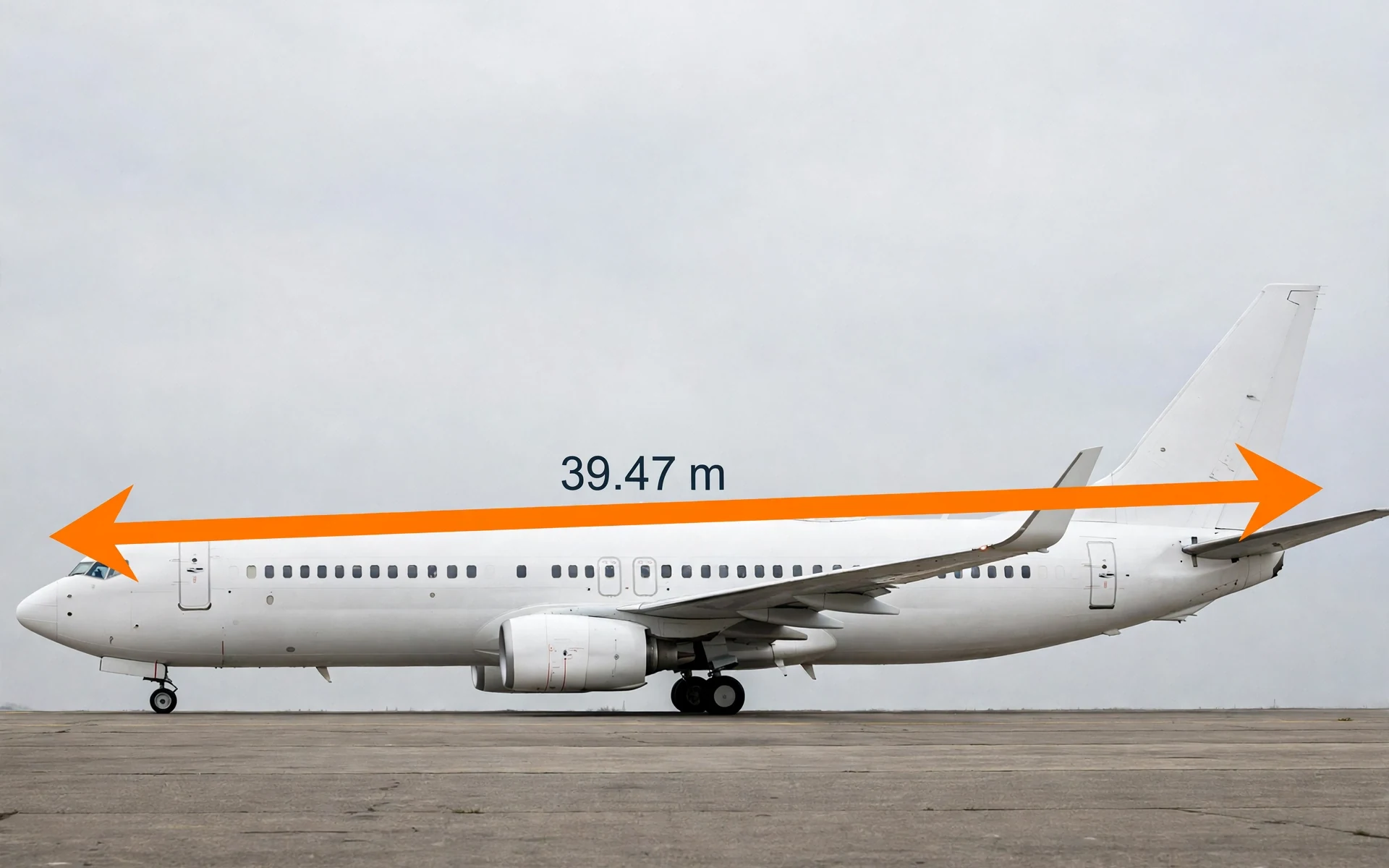
The 737-800 is the article’s most-flown land-on, because it is the jet most readers have already sat inside. The EASA type certificate data sheet lists the 737-800 at 39.5 m (129 ft 6 in), and 129 ft 6 in is 39.4728 m, so the aircraft measures 39.47 m from nose to tail — 53 cm short of 40 m, the third-tightest land-on in this article. Stand at the gate beside one and its length is the number itself, minus half a metre, which is why it sits third on this page.
The fitting check is the wingspan, because the 737-800 is 39.47 m LONG but its wingspan is 35.79 m with winglets (34.32 m without), and its height is 12.55 m. Length decides the stand; wingspan decides the wingtip clearance; height decides the hangar door. A gate sized for a 40 m aircraft fits the 737-800 with half a metre to spare on length — and then needs the wingtip clearance checked separately, because the wingspan is a different number from the length. The grade is exact because the figure is the certifying authority’s published dimension for the named variant, with the deviation printed in full: 39.47 m, 53 cm short. Do not confuse the variants: the 737-700 is 33.63 m (6.37 m short) and the 737-900ER is 42.11 m (2.11 m over) — the -800 is the one that lands on 40 m, and it is the best-selling 737 Next Generation variant, with 5,238 aircraft built. And do not confuse the length with the wingspan: the rival page that calls the 747’s wingspan “just over half” of 40 m has the fraction backwards — 40 m is 58.8% of the 747’s 68 m span, and a wingspan is not a length in the first place.
4. Christ the Redeemer, Total Height 38 m — 2.00 m Short (REPORTED)
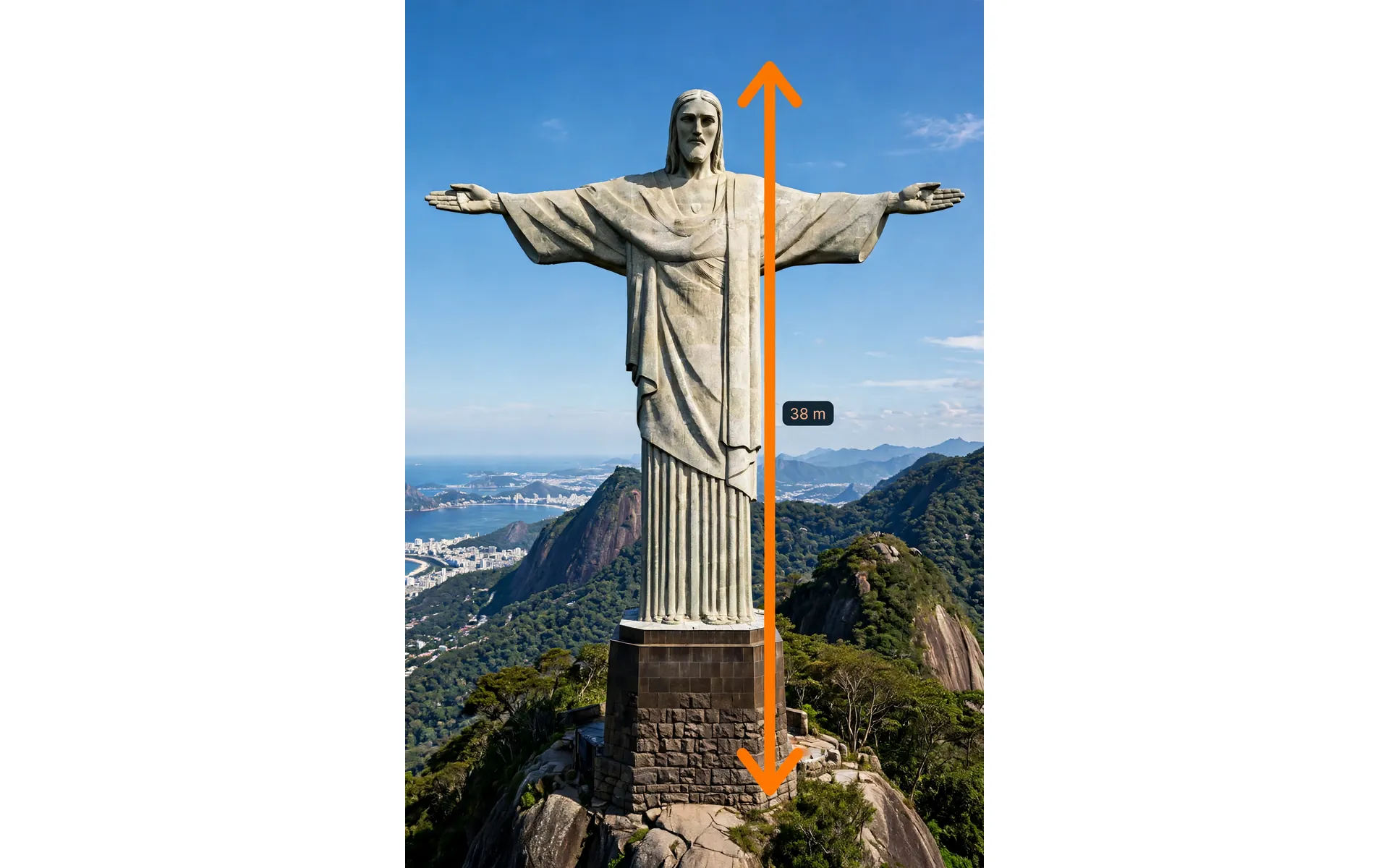
The statue is the article’s tallest land-on in the wrong direction, and the one that proves 40 m is a building height as well as a length. The figure is 30 m tall and the pedestal 8 m, so the monument is 38 m in all, with arms spanning 28 m and the summit of Corcovado 710 m above the sea — so the statue measures 38 m from the base of its pedestal to the top of its head, 2.00 m short of 40 m. Stand on the viewing deck beside it and its height is the number itself, minus two metres, which is why it sits fourth on this page.
The fitting check is the pedestal, because the FIGURE is 30 m and the TOTAL is 38 m, and the two numbers answer different questions. A guide that says “the statue is 38 m tall” without “with its pedestal” has given the right number for the wrong thing, and a guide that says “the statue is 30 m tall” has given the figure’s height, not the monument’s. The 8 m pedestal is a fifth of the total — leave it out and the statue shrinks by a fifth. The grade is reported because the figure is a published reference measurement, not a manufacturer spec — the statue was built between 1922 and 1931, and its dimensions are carried in the reference literature, not on a data sheet. The deviation is printed in full: 38 m, 2.00 m short. And the statue carries its own building comparison: 38 m is the height of a 13-storey block — thirteen floors at 3 m a floor is 39 m, and at 10 ft a floor it is 39.62 m — so the statue and the 13-storey building are the same height to within a metre, and either one is the pocket reference for the other.
5. Airbus A320, Length 37.57 m — 2.43 m Short (EXACT)
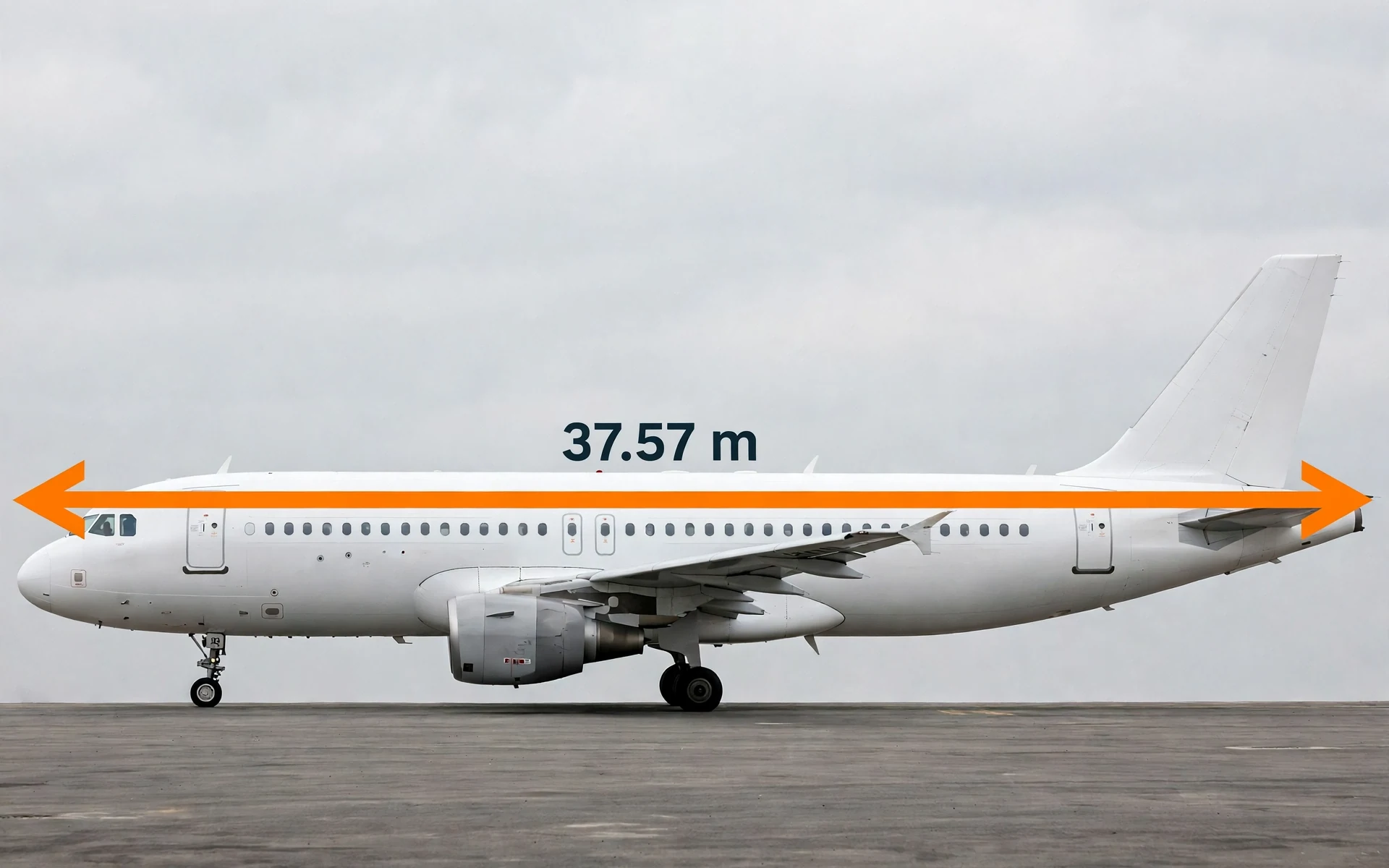
The A320 is the article’s second jet, and the one that proves 40 m is a two-aircraft race. Airbus’s own A320neo page lists the overall length at 37.57 m (123 ft 3 in), with a wingspan of 35.80 m with Sharklets and a height of 11.76 m, so the aircraft measures 37.57 m from nose to tail — 2.43 m short of 40 m, the furthest land-on in this article. Stand at the gate beside one and its length is the number itself, minus two and a half metres, which is why it sits fifth on this page.
The fitting check is the cabin, because the A320 is 37.57 m long overall but its cabin is only 27.51 m long. Ten metres of the aircraft is nose, cockpit, tail cone and systems — the part passengers never sit in. A stand sized for the 737-800 (39.47 m) fits the A320 with 1.90 m to spare, which is the gap between the two jets: park them nose to tail and the 737-800 sticks out 1.90 m further. The grade is exact because the figure is the manufacturer’s own published dimension for the named family, with the deviation printed in full: 37.57 m, 2.43 m short. Do not confuse the family: the A319 is 33.84 m (6.16 m short) and the A321 is 44.51 m (4.51 m over) — the A320 is the one that lands nearest 40 m — and do not merge the generations: the ceo and the neo share the 37.57 m fuselage but carry different engines, weights and ranges, so quote the length from either and the performance from the right one. The two jets in this article are the two best-selling narrow-bodies in the world, and they sit 1.90 m apart on the same number.
Five “40 Metre” Claims That Don’t Measure Up
| What a rival list claims | What it actually measures | The difference |
|---|---|---|
| Six blue whales nose to tail make 40 m | Six × ~30 m ≈ 180 m | ~140 m out — 40 m is about one and a third blue whales |
| 40 m is about the length of a large school bus | A standard school bus is ~12.5 m | ~27.5 m out — 40 m is about three buses |
| Four tennis courts end to end make 40 m | Four × 23.77 m = 95.08 m | 55.08 m out — and two courts are 47.54 m, 7.54 m over |
| Three semi-trucks end to end make 40 m | Three × ~22 m ≈ 66 m | ~26 m out — two semis are ~44 m, already over |
| 40 m reaches a bit above the Statue of Liberty’s waist | The pedestal alone is 47 m | 40 m does not reach the statue’s feet, let alone its waist |
Five of these deserve a longer correction. The whales are the most checkable error in the ranking pages: a rival list says roughly six blue whales nose to tail make 40 m, but the Smithsonian puts the blue whale at up to 100 feet — about 30 m — so six of them span about 180 m, and 40 m is about one and a third blue whales, not six. The error is 140 m on a 40 m target, which is not a rounding — it is a number that was never divided. The school bus is the most confident error: a rival list calls 40 m “approximately the length of a large school bus”, but its own figure for the bus is 35–40 ft, which is 10.7–12.2 m, and 40 m is 131 ft — the page’s own numbers refute its own conclusion, and a second rival page makes the mirror error by claiming two school buses are 20 m each, when a 20 m standard bus does not exist. The tennis courts are the most repeated error: one rival list heads a section “Four tennis courts end to end” and then says “almost two of them” in the paragraph underneath — four courts are 95.08 m, two are 47.54 m, and neither is 40 m. The semi-trucks are the most honest-looking error: a rival list says three semis make 40 m and then admits two of them “cover most of 40 meters”, but two semis at ~22 m each are already 44 m — the third takes it to 66 m, not to 40 m. And the statue is the most visual error: a rival list says 40 m would reach “a bit above the statue’s waist” on the Statue of Liberty, but the statue’s pedestal alone is 47 m tall, so 40 m does not reach the statue’s feet — the waist sits at about 70 m, thirty metres above the claim.
Four near-misses deserve a line of their own. The Ha’Penny Bridge is 43 m long — 3 m over 40 m, and one rival page calls it “nearly perfect” at 42 m, which is wrong by a metre before the comparison even starts. A bowling lane is 18.29 m from foul line to head pin, not “about 20 m” — so two lanes are 36.58 m, 3.42 m short, the same 3.42 m as the yard gap, by coincidence. The Chicago Water Tower is 47 m tall — 7 m over, which is not “only a little taller”. And two NBA basketball courts are 57.30 m — 17.30 m over, which is not a “slight” overshoot, it is a 43% overshoot. One more trap exhibit, from the yard family: the 40-yard dash is 36.576 m, and the 40-metre sprint is a different race — never compare a 4.22-second dash time with a 40-metre time, because the dash is 3.424 m shorter.
How to Measure 40 Metres Without a Tape
| Method | What you get | How close it is |
|---|---|---|
| Two cricket pitches end to end | 40.24 m | 0.24 m over — the best method of all |
| Four 10-metre lengths end to end | 40.00 m | Exact — the cleanest method in the meters series |
| A Boeing 737-800 parked nose to tail | 39.47 m | 0.53 m short — the airport method |
| 53 steps at a 0.76 m stride | 40.28 m | 0.28 m over — the walking method |
| A 13-storey block at 3 m a floor | 39.00 m | 1.00 m short — the building method |
| Tape at the 131 ft 3 in mark | 40.01 m | 0.01 m over — essentially exact |
| Three school buses end to end | ~37.50 m | ~2.50 m short — the honest bus count |
| An Olympic pool, four-fifths of a length | 40.00 m | Exact — four-fifths of 50 m |
The two pitches are the best of the eight, because the miss is 24 cm and the reference is a place you can walk — mark one set of stumps, walk to the far set, turn around and walk it again, and you have covered 40.24 m. The four 10-metre lengths are the only exact method that needs no object at all: forty metres is four times ten metres, and four lengths of anything 10 m long — a 10 m tape, a 10 m rope, four 10-metre strides of a surveyor’s chain — land on the number itself. The tape method is the most accurate, because 131 ft 3 in is 40.01 m — 131 ft is 39.93 m (7 cm short) and 132 ft is 40.23 m (23 cm over), so the mark to use is 131 ft and three inches. The steps method is the one to use when there is nothing to measure with: 53 average steps at a 0.76 m stride are 40.28 m, and the count is easy to remember because 40 divided by 0.76 is 52.6 — call it 53 and you are a quarter of a metre over.
The fitting check is the stride, because a step is not a fixed length. A tall adult walking briskly covers 40 m in as few as 45 steps, and a child or a short-stride walker needs 60 or more — so the 53-step figure is an average, not a measurement, and it is only as good as the stride behind it. Measure your own stride over 10 m first (count the steps, divide 10 by the count), then multiply — and the steps method stops being a guess. And if you own a cricket ground, you already own a permanent 40 m reference — keep it in mind the next time you need the number and the tape measure is in another room.
40 Metres in Every Unit
| Unit | Value |
|---|---|
| Millimetres | 40,000 mm |
| Centimetres | 4,000 cm |
| Metres | 40 m |
| Kilometres | 0.04 km |
| Inches | 1,574.80 in (1,575 in = 40.005 m) |
| Feet | 131.23 ft (131 ft 2.80 in) |
| Yards | 43.74 yd |
| Miles | 0.0249 mi |
Forty metres is 40,000 millimetres, and a metre is 1,000 millimetres, so the conversion is a multiplication by a thousand that never needs a calculator. In inches it is 40 divided by 0.0254, which is 1,574.803 inches, rounded to 1,574.80 — and the rounding is honest, because 1,575 inches is 40.005 m, five millimetres over the mark, which is the nearest whole inch there is. In feet it is 131.23, or 131 ft 2.80 in if you want feet and inches rather than a decimal — and 131 ft on a tape is 39.93 m, 7 cm short, while 132 ft is 40.23 m, 23 cm over. Forty centimetres is exactly one-hundredth of 40 metres, so 100 lengths of 40 cm make exactly 40 m, and 40 metres is forty times 1 metre, exactly four times 10 metres, exactly 80 times 50 cm, and 25 cm goes into 40 metres exactly 160 times — the cleanest ladder in the meters series, because 40 divides by 10, 25, 50 and 40 cm without a remainder anywhere. 100 feet is 30.48 metres, so 40 m is 9.52 m longer than 100 ft, and 30 inches is 0.762 metres, so 40 m is 52.49 times 30 inches. Metres are the unit on runways, pitches and pool decks, feet and yards are the units in US sport — the 40-yard dash, the 131 ft tape mark — and millimetres are the unit in aircraft and yacht specifications, where a 737-800 is 39,473 mm and a Sunseeker is 40,050 mm — and 40 m is the distance where all of them meet, because it is a yacht, two pitches, a jet, a statue and a second jet at once.
The 40-Metre Fit-Check: Before You Book, Build or Bet
– Yacht berth: a 40.05 m yacht needs a berth longer than 40.05 m plus fenders and lines — book a 45 m berth, not a 40 m one — and never quote the waterline length (about 31–33 m) as the berth length, because the berth is sold by length overall.
– Cricket ground: two pitches are 40.24 m of prepared strip, but the playing area needs run-ups behind both sets of stumps and boundaries beyond them — measure the strip, then the run-ups, then the boundary, and never present 40.24 m as the size of the ground.
– Jet stand: a 737-800 needs a stand sized for 39.47 m of length plus wingtip clearance on a 35.79 m span, and an A320 needs a different stand (37.57 m long, 35.80 m span) — the two jets are 1.90 m apart in length and 1 cm apart in span, so a stand that fits one does not automatically fit the other.
– Statue visit: the 38 m total needs the 8 m pedestal counted — the figure alone is 30 m — so a viewing platform planned for a 30 m statue is planned 8 m short, and a 13-storey building at 3 m a floor (39 m) is the better pocket reference for the whole monument.
– Sprint bet: the 40-yard dash is 36.576 m, so a “40 m sprint” time and a “40-yard dash” time are not comparable — a 4.22-second dash is a record over 36.576 m, and a 40 m sprint for an elite sprinter is about four and a half to five seconds. Never bet the two numbers against each other.
The rule underneath all five is the same: name the axis, print the miss, and never trust a round number alone. The number is a size class, a nominal size, a model size or a rounded size; the tape is the size. Three point four two metres is the price of thinking in yards, and a yacht that does not fit its berth is the receipt.
Frequently Asked Questions
How many feet is 40 meters?
Forty metres is 131.2336 feet — 131 ft 2.8 in. On a tape, 131 ft is 39.93 m (7 cm short) and 132 ft is 40.23 m (23 cm over); the mark to use is 131 ft 3 in, which is 40.01 m, essentially exact.
Is 40 meters the same as 40 yards?
No. Forty yards is 36.576 m, so 40 metres is 3.424 m longer — about eleven feet. The NFL Combine’s 40-yard dash is run over 36.576 m, not 40 m, and its 4.22-second record is a record over that shorter distance.
What everyday objects are 40 meters long?
Five verified objects, tightest first: a Sunseeker 131 Yacht at 40.05 m long, two cricket pitches end to end at 40.24 m, a Boeing 737-800 at 39.47 m long, Christ the Redeemer at 38 m tall including its pedestal, and an Airbus A320 at 37.57 m long. Every one is verified against the manufacturer’s specification, the certifying authority or the sport’s own rulebook.
How tall is a 40-meter building?
About 13 storeys at 3 m a floor (39 m, 1 m short) — or 39.62 m at 10 ft a floor (0.38 m short). Christ the Redeemer at 38 m is the same height as a 13-storey block, pedestal included, so either one is the pocket reference for the other.
How long is a Boeing 737-800?
Thirty-nine point four seven metres (129 ft 6 in), 0.53 m short of 40 m. The Airbus A320 is 37.57 m, 2.43 m short — the two jets sit 1.90 m apart, and the 737-800 is the best-selling 737 Next Generation variant, with 5,238 aircraft built.
How many steps is 40 meters?
About 53 steps at a 0.76 m average stride (40 divided by 0.76 is 52.6). A tall adult walking briskly may need as few as 45 steps, and a child or short-stride walker 60 or more — measure your own stride over 10 m first, then multiply.
Is 40 meters longer than an Olympic swimming pool?
No. An Olympic pool is exactly 50 m long, so 40 m is four-fifths of one length — 10 m short of the far wall. A 25 m short-course pool plus 15 m makes exactly 40 m.
How do I measure 40 meters without a tape?
Lay two cricket pitches end to end (40.24 m, 0.24 m over); lay four 10-metre lengths end to end, exactly; use a Boeing 737-800’s length (0.53 m short); or count 53 average steps. Tape at the 131 ft 3 in mark for 40.01 m, essentially exact.
Final Thoughts
Forty metres is a distance you cross — a sprint, a pool length, a runway, a berth — and the miss is the whole article. The five objects that measure it are all things you can find tonight without buying anything: a yacht, two pitches, two jets and a statue — and every one of them carries the number its source actually publishes, with the miss printed next to it. That is the difference between a measurement and a slogan: the measurement can be checked, and the slogan cannot.
Do not take the round number, and do not take the name. Ask which unit was measured — the yard or the metre, the foot or the metre, the length overall or the waterline, the pitch or the run-up, the figure or the pedestal, the length or the wingspan, the cabin or the aircraft — look up the specification, and print the miss when there is one. A yacht that does not fit its berth is a 5-centimetre lesson; a dash that is not a sprint is a 3.42-metre one; and forty metres, measured honestly, is 40.05, 40.24, 39.47, 38 and 37.57 — never just “about 40”.
