
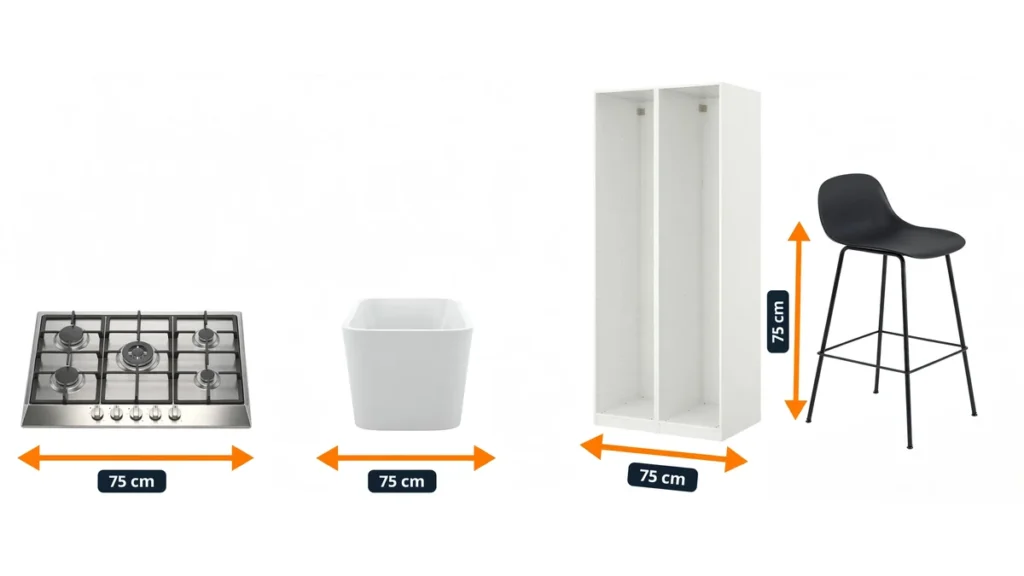
The gas hob in the box is 750 millimetres wide. The hole it has to drop into is 560. The bath is 750 millimetres wide, and the panel that finishes its end is 75 centimetres — but the water inside it never touches either number. The wardrobe frame is 75 centimetres wide and 58 deep, and the doors arrive in a different box. So how big is 75 cm, really? It is the size you buy, and it is never quite the size you get. This article is about that number: what 75 cm actually is, six things that really measure it, and the second number each one carries — the one that decides whether it fits.
Seventy-five centimetres is 29.53 inches, 750 millimetres, and exactly three-quarters of a metre. It is 12 mm short of 30 inches, 25 cm longer than 50 cm, and exactly two and a half rulers laid end to end. The six objects below are the closest honest answers to it: five land on 75 cm exactly, the sixth straddles it — the average one-year-old boy 7.5 mm over and the average girl 10 mm under — and every one of them carries the source that proves it.
Quick Answer
75 cm is 29.53 inches — 12 mm short of 30 inches.
Seventy-five centimetres is 29.53 inches, 750 millimetres, and exactly three-quarters of a metre. Five objects land on it exactly — a gas hob, a bath, a wardrobe frame, a bar stool and a reef tank — and the average one-year-old straddles it, 7.5 mm over for boys and 10 mm under for girls.
The bar above shows seventy-five 1 cm segments, but it is a diagram, not a ruler: screen sizes vary, so it explains the measurement rather than measuring it. For a real measurement, use the objects below or a tape measure.
75 cm Comes With a Second Number
Seventy-five centimetres is a buying size. It is the number printed on the box, the number in the product title, the number on the specification sheet — and it is never the number that has to fit. Every one of the six objects below carries a second number, and the second number is the one that decides the fit. The gas hob is 750 mm wide, but the hole it drops into is 560 mm. The bath is 750 mm wide outside, but the water inside it never spans 750 mm, and the panel that finishes its end is a separate part. The wardrobe frame is 75 cm wide but 58 cm deep, and its doors are sold separately. The bar stool’s seat is 750 mm high, but the stool itself is 975 mm tall. The reef tank is 75 cm long outside, but its 10 mm glass eats the length inside. The average one-year-old is 75.7 cm if it is a boy and 74.0 cm if it is a girl — never 75.0 cm for either.
That is the lesson of this article, and it is the reason 75 cm keeps appearing in shops in the first place. Seventy-five centimetres is exactly three-quarters of a metre, and the quarter-metre ladder — 25, 50, 75, 100 — is the ladder metric manufacturing builds on. Add one more 25 cm length to 75 cm and you have a full metre; take one away and you have the half metre. The size is a fraction of a metre that still fits a small room, which is why it turns up as a hob width, a bath width, a wardrobe width, a stool seat and a tank length, all at once. The number on the label is the size class. The second number is the size. Measure the second number.
6 Things That Are 75 cm
The six objects are ordered by how close they land on 75 cm, closest first, and each one carries its evidence grade in the heading. LISTED means the figure is the manufacturer’s published specification for the named model. AVERAGE means the figure is a published median for a population, not a measurement of one individual. Five of the six land on 75 cm exactly, and the sixth straddles it — the average boy 7.5 mm over, the average girl 10 mm under — so the combined average is 74.9 cm, 1.2 mm short, and the mean absolute deviation across all six is 0.02 cm on that combined average.
A published 75 cm designation does not mean every unit measures mathematically 75.000 cm: hobs are sold by a nominal width with a cut-out smaller than the body, baths by an outer width that is wider than the water, wardrobes by a frame width with the doors sold separately, stools by a seat height that is not the total height, tanks by an outer length that includes the glass, and babies by a population median. What follows is what the source actually says, with the axis named every time, so you can check it yourself.
1. Bosch Serie 6 PCS7A5B90 Gas Hob, Width 750 mm — Exactly 75.00 cm (LISTED)
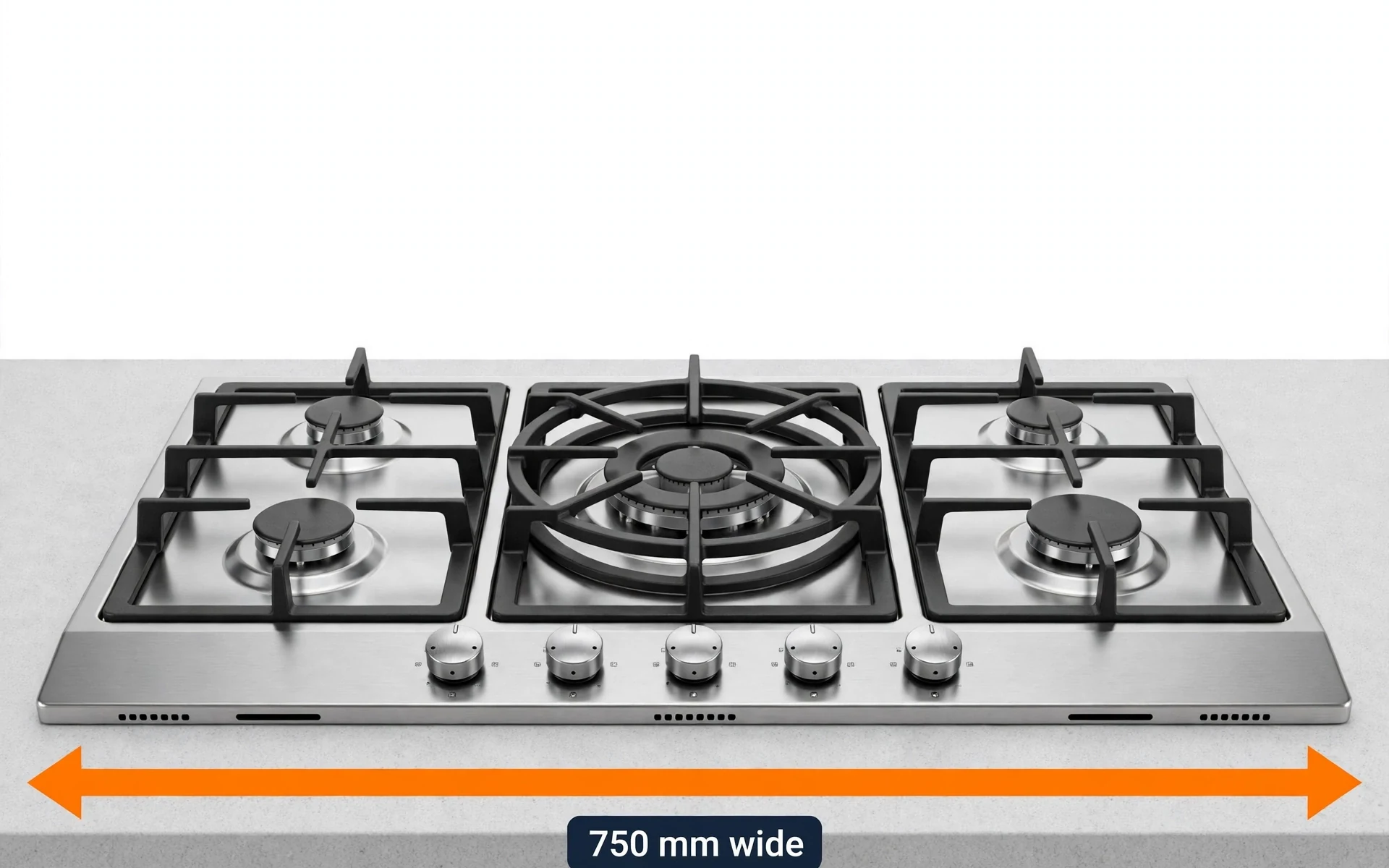
The gas hob is the article’s cleanest land-on, because its 75 cm is the width the hob is sold by, on the manufacturer’s own specification sheet. Bosch’s specification sheet lists the PCS7A5B90 at 750 mm wide, with the full dimensions given as 45 × 750 × 520 mm, and five burners including a wok burner, so the hob measures 75.00 cm across its front, with no deviation to print. Stand in front of it and its width is the number itself, which is why it sits first on this page.
The fitting check is the cut-out, because the hob is 750 mm wide but the hole it drops into is only 560–562 mm wide and 480–492 mm deep. The hob overhangs the hole by roughly 95 mm on each side, which is how a gas hob works — the body sits on the worktop and only the base drops through — so a buyer who measures the hob and cuts a 75 cm hole has cut a hole the hob will fall straight through. Measure the cut-out, not the hob. The packed product is 793 mm wide, and that is the carton, not the hob — never quote the box as the appliance. The grade is listed because the figure is the manufacturer’s published specification for the named model, with the deviation printed in full: 75.00 cm, zero millimetres off.
2. Ideal Standard Concept Bath E7354, Width 750 mm — Exactly 75.00 cm (LISTED)
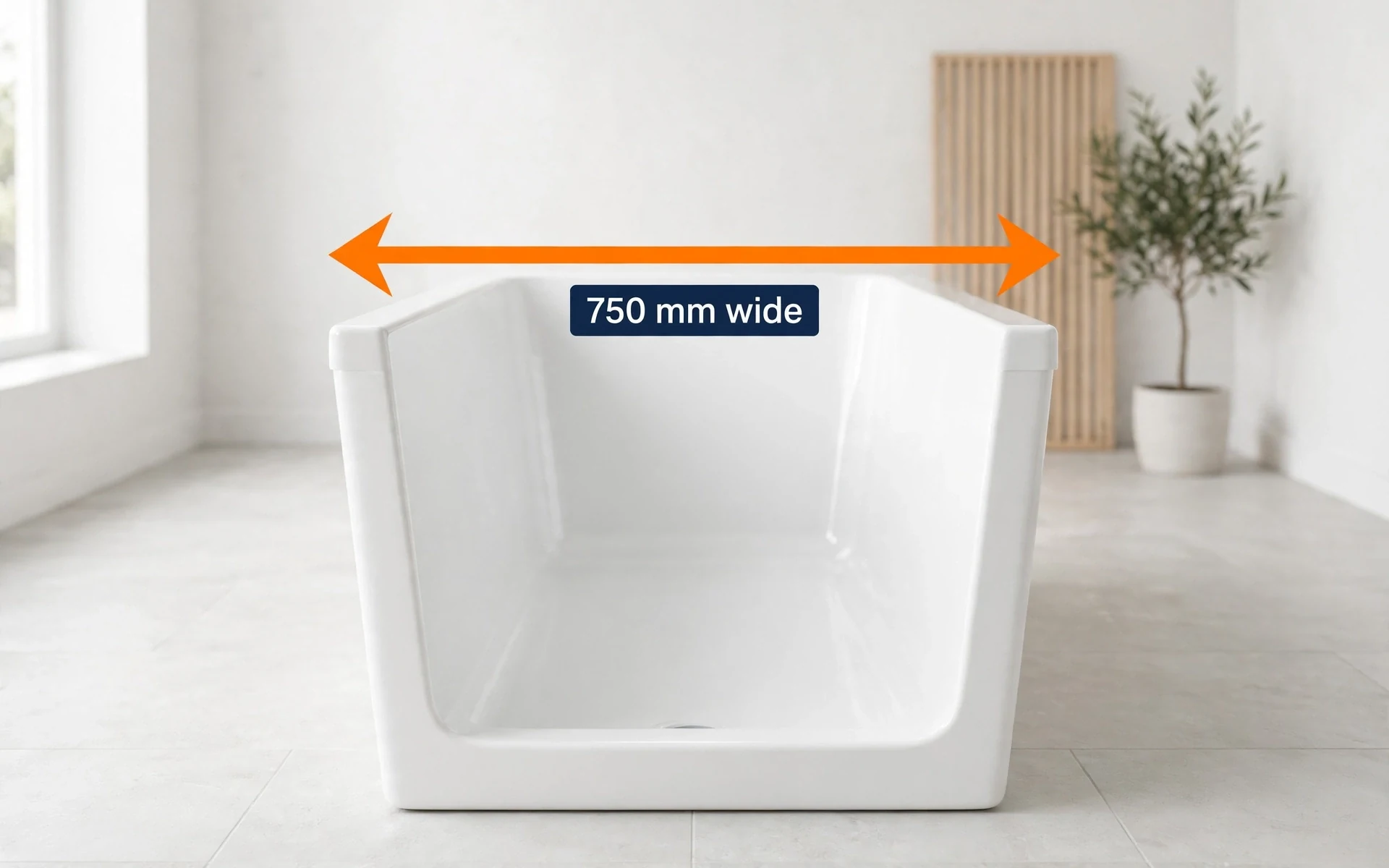
The bath is the article’s wettest land-on, and the one that proves 75 cm is a bathroom size. Ideal Standard’s data sheet lists the Concept E7354 at 1700 × 750 mm, with a capacity of 186 litres to overflow and built to EN 198:2008, so the bath measures 75.00 cm across its short side, with no deviation to print. Stand at its end and its width is the number itself, which is why it sits second on this page.
The fitting check is the word “outside”, because 750 mm is the OUTER width, and the water inside it never spans 750 mm — the internal bathing width is less, and the 186 litres is the capacity “to overflow”, not the water you actually bathe in. The 75 cm end panel is a separate part, not part of the bath, so a bathroom planned on “750 mm” for the bath still needs the panel, the waste position and the tap holes planned separately. The grade is listed because the figure is the manufacturer’s published specification for the named model, with the deviation printed in full: 75.00 cm, zero millimetres off. The 1700 mm length is the other half of the story: this is a full-length bath, and its 75 cm is the width, not the length — never quote the long side as the bath’s size.
3. IKEA PAX Wardrobe Frame, Width 75 cm — Exactly 75.00 cm (LISTED)
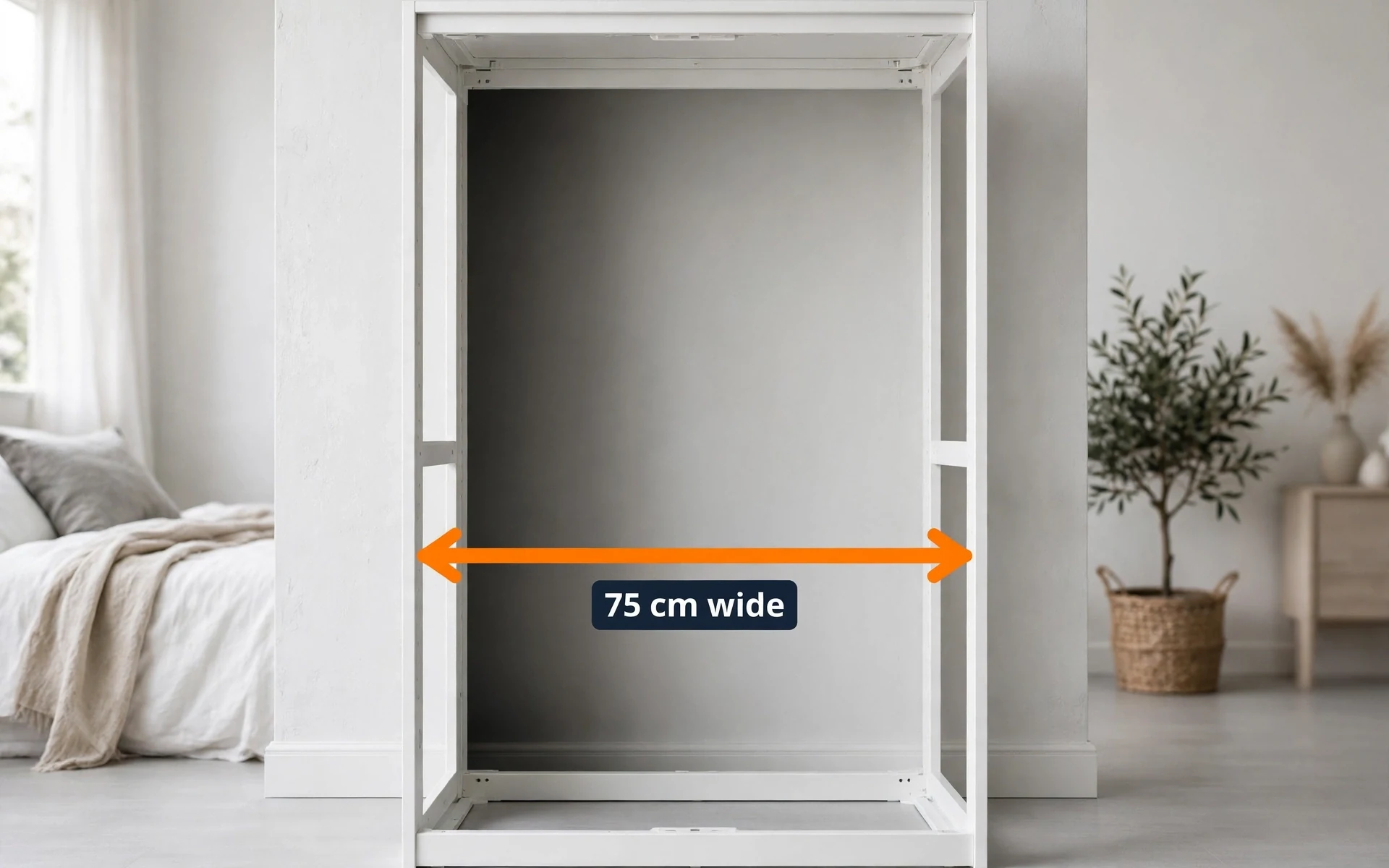
The wardrobe frame is the article’s most useful land-on, because it is the 75 cm object most readers already own. IKEA’s product page lists the PAX frame at 75 × 58 × 201 cm, so the frame measures 75.00 cm across its front, with no deviation to print. Stand in front of it and its width is the number itself, which is why it sits third on this page — and why it is the pocket reference in the measuring section below.
The fitting check is the depth, because the frame is 75 cm WIDE and 58 cm DEEP. Never write “the PAX is 75 cm deep” — that is the exact error a rival list makes, and it is wrong by 17 cm. The doors, hinges and interiors are sold separately, so a wardrobe bought against “75 cm” for its width still needs the doors measured, and the adjustable feet compensate for an uneven floor, not for a gap that is the wrong size. The grade is listed because the figure is the manufacturer’s published specification for the named product, with the deviation printed in full: 75.00 cm, zero millimetres off. Note the imperial label with care: IKEA also lists the frame as 29½ inches, and 29½ inches is 74.93 cm, 0.7 mm short of 75 cm — the metric 75 cm is the specification, and the imperial is rounded down. Never write “the PAX frame is 29½ inches wide” as if it were exact.
4. Muuto Fiber Bar Stool Tube Base, Seat Height 750 mm — Exactly 75.00 cm (LISTED)
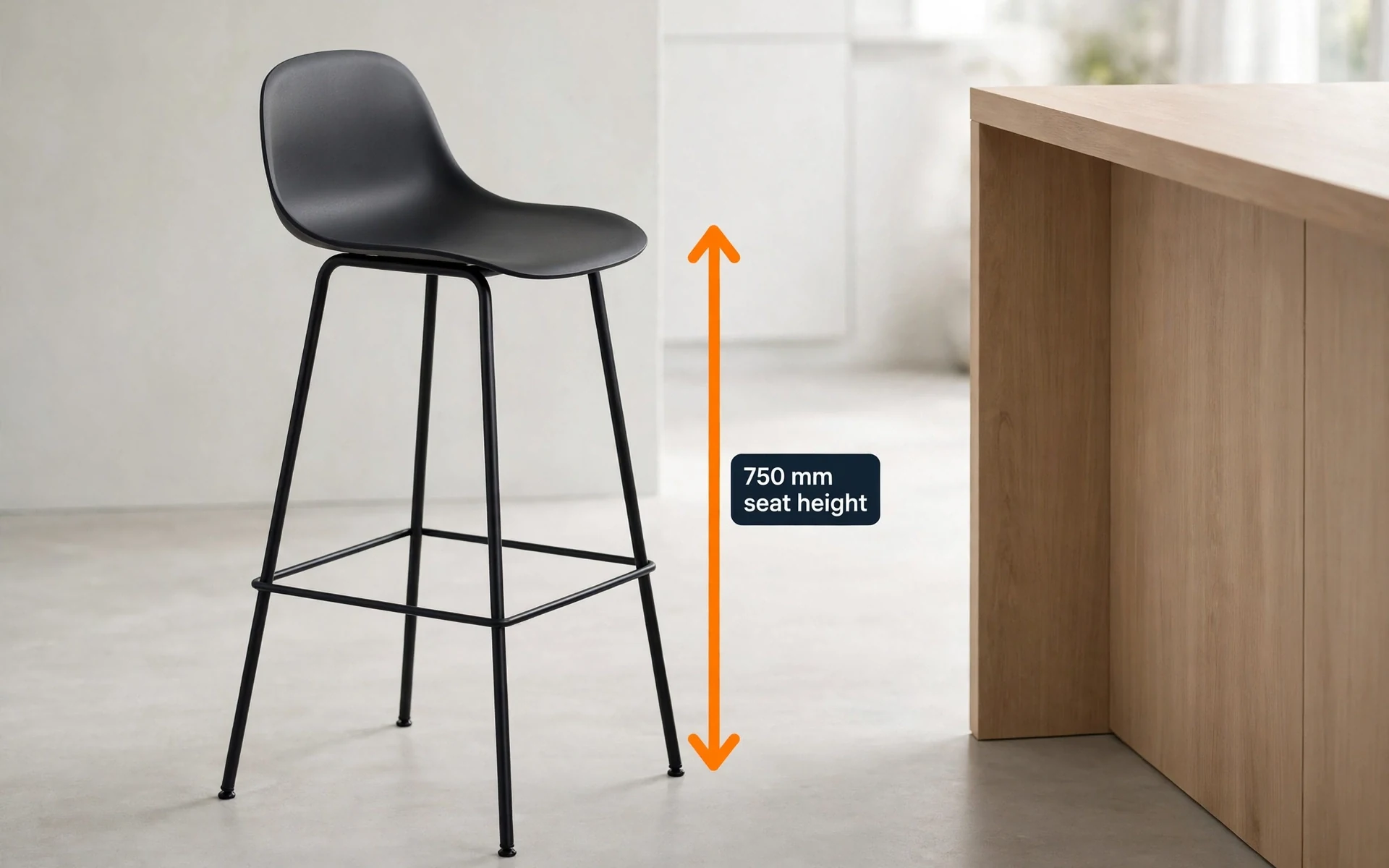
The bar stool is the article’s tallest land-on in the wrong direction, and the one that proves 75 cm is a seating size. Muuto’s product listing gives the Fiber Bar Stool Tube Base a 750 mm seat height, with the full dimensions given as 445 mm wide, 465 mm deep and 975 mm tall overall, so the seat measures 75.00 cm from the floor, with no deviation to print. Sit on it and the seat under you is the number itself, which is why it sits fourth on this page.
The fitting check is the word “seat”, because the SEAT is 750 mm and the stool is 975 mm tall. Never write “the Muuto stool is 75 cm tall” without the word “seat” — the stool is 22.5 cm taller than its seat, and a buyer who plans a 75 cm gap for the whole stool has planned a gap the stool will not fit through. The 65 cm counter stool is a different product, and the two must never be confused. The grade is listed because the figure is the manufacturer’s published specification for the named model, with the deviation printed in full: 75.00 cm, zero millimetres off. A 750 mm seat belongs under a 105 cm bar, which leaves about 30 cm of knee room — the comfortable gap is 20–30 cm — and Muuto’s own “29.5 in” label is 74.93 cm, the same 0.7 mm rounding as the PAX frame.
5. Ultum Nature Systems R75 Reef Tank, Length 75 cm — Exactly 75.00 cm (LISTED)
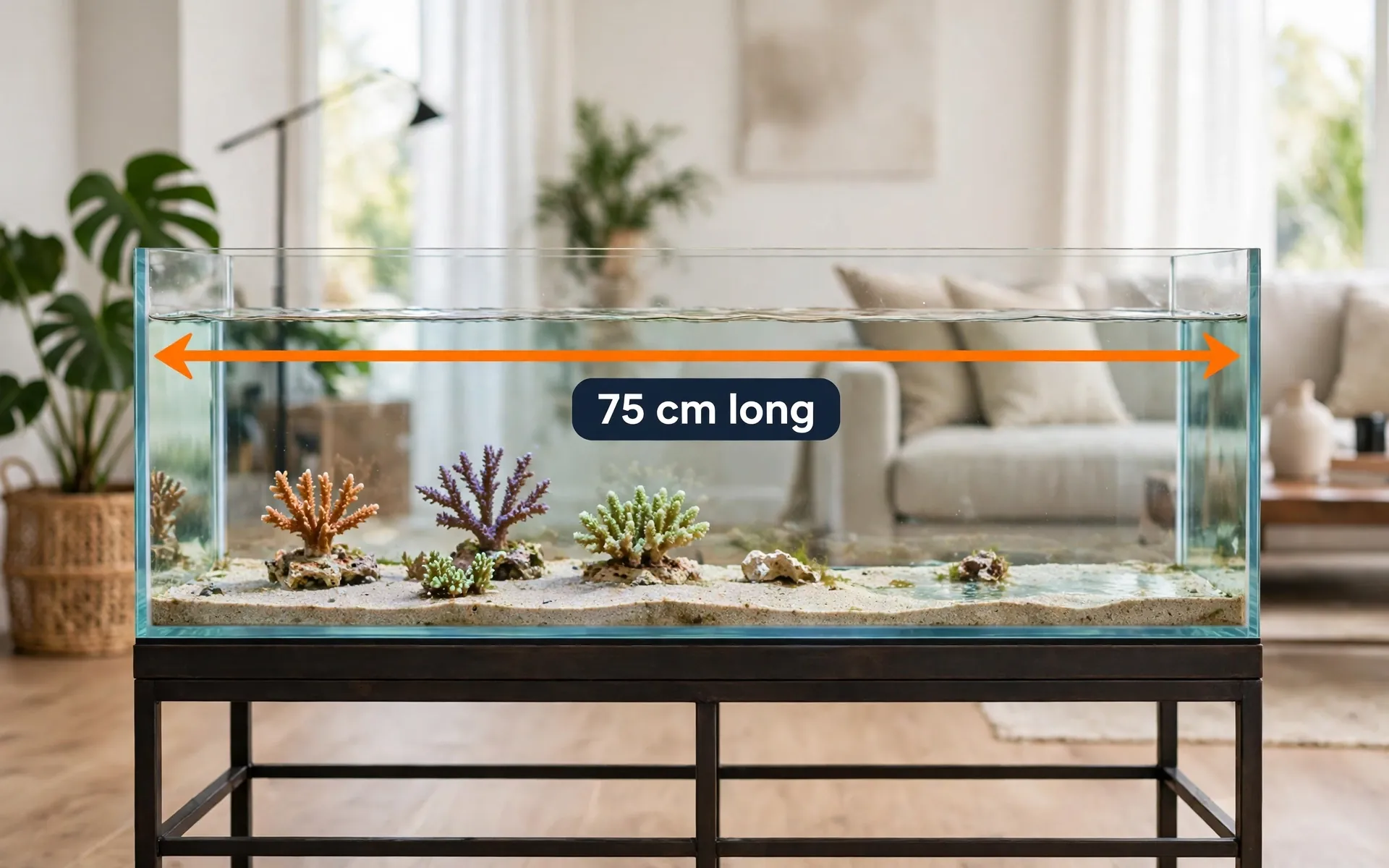
The reef tank is the article’s heaviest land-on, and the one that proves 75 cm is a pets size as well as a furniture size. The retailer’s specification lists the R75 tank at 75 × 50 × 50 cm, with a tank volume of 160 litres and a total volume of 211 litres including the sump, so the tank measures 75.00 cm along its long side, with no deviation to print. Stand in front of it and its length is the number itself, which is why it sits fifth on this page.
The fitting check is the glass, because the tank is 75 cm long OUTSIDE and its glass is 10 mm thick, so the water inside it spans about 73 cm, not 75 cm — two panes of glass eat 20 mm of the length. The 211 litres is the tank plus the sump, not the tank alone, so never present 211 litres as the tank’s own volume. The grade is listed because the figure is the manufacturer’s dimension for the named model, carried in a retailer’s specification and corroborated by a second retailer listing the same 29.53-inch figures — with the deviation printed in full: 75.00 cm, zero millimetres off. The tank is also the article’s heaviest reference: 160 litres of water is about 160 kg, so the stand must be rated for the weight, not just the footprint, and a stand that fits the tank and not the weight will fail slowly and then all at once.
6. Average One-Year-Old Child, Length — 75.7 cm Boys, 74.0 cm Girls (AVERAGE)
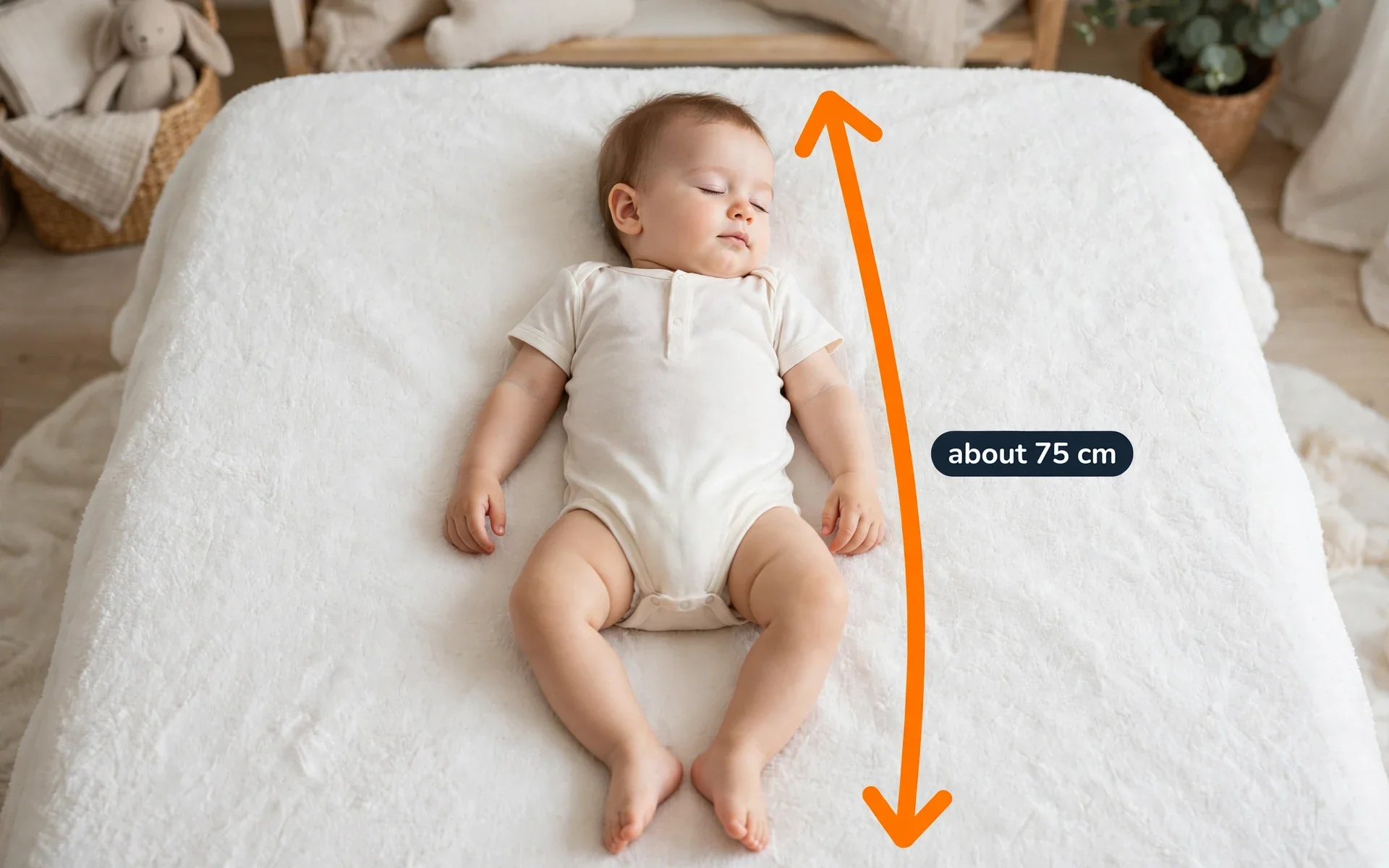
The one-year-old is the article’s softest land-on, and the one that proves 75 cm is a human size. The WHO Child Growth Standards put the median length at 12 months at 75.7 cm for boys, and the WHO LMS parameters put the girls’ median at 74.0 cm, so the average one-year-old measures 75.7 cm if it is a boy and 74.0 cm if it is a girl — 7.5 mm over 75 cm for boys, 10 mm under for girls, and 74.9 cm on the combined average. Lay a one-year-old down on a blanket and its length is, on average, the number itself, which is why it sits sixth on this page.
The fitting check is the word “average”, because a median is a population figure, not a measurement of one child. The 3rd-to-97th-percentile range for boys at 12 months runs from 71.3 cm to 80.2 cm, so no single child is obliged to be 75 cm long, and it would be wrong to write “a one-year-old is 75 cm long” as a fact about an individual child. Length under 24 months is measured lying down, not standing, so the figure is a recumbent length — a child measured standing would read shorter. The grade is average because the figure is a published median for a population, with the deviation printed in full: 75.7 cm, 7.5 mm over, and 74.0 cm, 10.0 mm under. The one-year-old is also the article’s most memorable reference: a one-year-old is about three-quarters of a metre long, and three-quarters of a metre is about a one-year-old long.
The 30-Inch Family: The 12 mm That Breaks the Fit
Thirty inches is 76.2 cm, so 75 cm falls 12.0 mm short of 30 inches — about the width of a thumbnail, and about the thickness of the gap that breaks a tight fit. Two of the laziest mental-math shortcuts in the world both produce exactly the wrong round number: 75 divided by 2.5 is 30.0 inches exactly, and 75 times 0.4 is 30 inches exactly. The two most common tricks both erase the whole 12 mm gap in one step, which is how “75 cm = 30 in” survives in conversion guides that never check their own arithmetic. The honest shorthand is “just under 30 inches” — “30 inches” hides the 12 mm, and “30.0 inches” invents a precision the number does not have. This is the largest trap in the centimetre series so far, because the error here is a full 12 mm — bigger than the 8 mm at 50 cm and the 9.6 mm at 60 cm.
The trap has a family, and it is a big one. Anything built to 30 inches is 76.2 cm, and the 30-inch product family is everywhere: dining tables 30 inches tall, bar stools with 30-inch seats, US kitchen ranges 30 inches wide, table-tennis tables 76 cm high, 30-inch television diagonals, and 29-inch bicycle wheels that measure about 75 cm with a tyre fitted. Sellers make it worse by describing a 75 cm product as “30 inch” after a careless conversion, so the label and the specification sheet disagree, and the buyer who trusts the label buys a thing that does not fit. The trap cuts the other way too: the PAX frame’s own imperial label says 29½ inches, and the Muuto stool’s says 29.5 inches, and 29½ inches is 74.93 cm, so the imperial labels understate the metric size by 0.7 mm while a 30-inch label overstates it by 12 mm. If the fit matters, trust the centimetre figure on the specification sheet, not the inch figure in the product title.
| Tape mark | Value | Against 75 cm |
|---|---|---|
| 29 in | 73.66 cm | 1.34 cm short |
| 29½ in | 74.93 cm | 0.70 mm short |
| 29 9/16 in | 75.089 cm | 0.89 mm over |
| 29 17/32 in | 75.009 cm | 0.09 mm over |
| 30 in | 76.2 cm | 12.0 mm over |
On a tape measure, the nearest sixteenth-inch mark is 29 9/16 inches at 75.089 cm, which is 0.89 mm over — close, but not the mark to use. The exact 32nds mark is 29 17/32 inches at 75.009 cm, which is 0.09 mm over — essentially exact, and the mark to use. The mark most guides give, “just past 29½ inches”, is 74.93 cm, 0.70 mm short, which is close enough for a cut and not close enough for a tight fit. And 75 cm is exactly two and a half 30 cm school rulers — mark off two whole rulers and half of a third, and the remaining length is the number you have left over.
Five “75 cm” Claims That Don’t Measure Up
| What a rival list claims | What it actually measures | The difference |
|---|---|---|
| Three 30 cm rulers laid end to end make 75 cm | 3 × 30 cm = 90 cm | 15 cm out — the right count is two and a half rulers |
| A 32-inch TV is nearly 75 cm | A 32-inch diagonal is 81.28 cm | 6.3 cm out — and a 30-inch TV is 76.2 cm, the trap |
| A folding chair’s seat is about 75 cm high | A chair seat sits at about 45 cm | 30 cm out — 75 cm is roughly the top of the backrest |
| Kitchen worktops are typically 75–90 cm high | The standard worktop height is about 90 cm | Wrong at the low end — 75 cm is a dining-table height |
| A standard wardrobe is about 75 cm deep | The standard wardrobe depth is about 60 cm | 15 cm out — 75 cm is the PAX frame’s width, not its depth |
Five of these deserve a longer correction. The rulers are the most checkable error in the ranking pages: a rival list says three 30 cm rulers laid end to end make 75 cm, but three 30 cm rulers span 90 cm, not 75 cm. The correct count is two and a half rulers — lay two end to end and add half of a third, and you are there. The television is the most expensive error: a rival list calls a 32-inch TV “nearly 75 cm”, but a 32-inch diagonal is 81.28 cm, 6.3 cm over, and a 30-inch TV is 76.2 cm — the trap size, not 75 cm. The folding chair is the most dangerous error for a buyer: a rival list puts an ordinary folding chair’s seat at about 75 cm high, but a chair seat sits at about 45 cm, and 75 cm is roughly the top of the backrest. A seat bought against “75 cm” would be a bar stool, not a chair. The worktops are the most confident error: a rival list gives kitchen worktops as 75–90 cm high, but the standard worktop height is about 90 cm, and 75 cm is a dining-table height, not a worktop height. And the wardrobe is the mirror image of our own object: a rival list calls the standard wardrobe depth about 75 cm, but the standard depth is about 60 cm — the PAX frame is 58 cm deep — and 75 cm is its WIDTH.
Four near-misses deserve a line of their own. A table-tennis table is 76 cm high, 1 cm over 75 cm — the trap in sport form, because the ITTF’s own rules put the playing surface 76 cm above the floor. A baritone ukulele is 76.2 cm long, 1.2 cm over — a member of the 30-inch family, not a 75 cm object. Half a yoga mat is 85–90 cm, not 75 cm — half of 170–180 cm is 85–90 cm, and the rival page that says otherwise has divided by the wrong number. And a “750 mm” vanity unit is not always 750 mm wide where it counts: the ILUME Bowral 750 specification sheet lists the top at 750 mm and the cabinet at 735 mm, so the 750 mm is the top, not the cabinet — check which dimension the listing quotes before you plan the gap, or the unit will arrive 15 mm narrower than the hole you cut for it. One more trap exhibit, from a stool that is almost our object: IKEA’s YNGVAR bar stool is sold as a 29½-inch seat, which is 74.93 cm — 1 mm short of 75 cm. It is a different product from the Muuto stool, and the 1 mm is the 0.7 mm rounding in action.
How to Measure 75 cm Without a Ruler
| Method | What you get | How close it is |
|---|---|---|
| Three-quarter mark on a metre stick | 75.00 cm | Exact — the best method of all |
| Two and a half 30 cm school rulers | 75.00 cm | Exact — mark two rulers, then half of a third |
| Three 25 cm lengths end to end | 75.00 cm | Exact — the quarter-metre ladder in your hands |
| PAX frame width, or a NORDVIKEN table’s height | 75.00 cm | Exact — the permanent household reference |
| Tape at the 29 17/32-inch mark | 75.009 cm | 0.09 mm over — essentially exact |
| Two A4 long edges + one dollar bill | 75.00 cm | Exact — 59.4 cm + 15.6 cm |
| Three US No. 10 envelopes end to end | 72.39 cm | 2.61 cm short — add just over two and a half centimetres |
The three-quarter mark is the best of the seven, because the miss is zero — mark half the metre stick (50 cm), then half of the remaining half, and the mark is 75 cm. The rulers method is the one to use when there is nothing to measure with: two and a half rulers laid end to end are exactly 75 cm, and it is the cleanest ruler method in the series. The A4-and-dollar method is the one to use when you have post and a wallet and no ruler: two A4 long edges (59.4 cm) plus one dollar bill (15.6 cm) make exactly 75.0 cm. The tape method is the most accurate, because the 29 17/32-inch mark is 0.09 mm from the number.
The fitting check is the zero mark, because 75 cm starts at the 0 line and not at the end of the ruler. Most plastic rulers carry a few millimetres of blank plastic past the last graduation, so if you measure from the physical edge of the ruler instead of from the 0 mark you will read long by that margin — about 3 mm on a cheap ruler, which is a quarter of the 12 mm gap this whole article is about. Measure from 0, and the ruler is honest; measure from the edge, and the ruler lies by a quarter of the trap. And if you own a PAX wardrobe, you already own a permanent 75 cm reference — keep it in mind the next time you need the number and the tape measure is in another room.
75 cm in Every Unit
| Unit | Value |
|---|---|
| Millimetres | 750 mm |
| Metres | 0.75 m |
| Inches | 29.53 in (29 17/32 in) |
| Feet | 2.46 ft (2 ft 5.53 in) |
| Yards | 0.82 yd |
Seventy-five centimetres is 750 millimetres, and a centimetre is 10 millimetres, so the conversion is a multiplication by ten that never needs a calculator. In inches it is 75 divided by 2.54, which is 29.5276 inches, rounded to 29.53 — and the rounding is honest, because 29.53 inches times 2.54 is 74.996 cm, four hundredths of a millimetre from the mark. In feet it is 2.46, or 2 ft 5.53 in if you want feet and inches rather than a decimal. 25 cm is exactly one-third of 75 cm, and 50 cm is exactly two-thirds of 75 cm, so three 25 cm lengths laid end to end make exactly 75 cm, and 75 cm plus 25 cm makes exactly 1 m. 45 cm is 30 cm shorter than 75 cm, and 40 cm is 35 cm shorter than 75 cm, and 35 cm is 40 cm shorter than 75 cm, and 29 inches measures 73.66 cm, so 75 cm is 1.34 cm longer than 29 inches. Centimetres are the unit on furniture, kitchen and bathroom listings, inches are the unit in US luggage, television and bicycle sizes, and millimetres are the unit in hob, bath and tank specifications — and 75 cm is the size where all three meet, because it is a hob, a bath, a wardrobe, a stool, a tank and a one-year-old at once.
The 75 cm Fit-Check: Before You Buy
– Hob cut-out: a 750 mm hob needs a 560–562 mm cut-out, not a 75 cm one — measure the cut-out and check the worktop depth (520 mm) against the cabinet before the delivery van arrives. A kitchen planned on the hob’s width wastes the hole.
– Bath gap: a 750 mm-wide bath needs a true 750 mm gap plus the 75 cm end panel, and the waste position decides the plumbing, not the width. Measure the gap, then the panel, then the waste.
– PAX doors: a 75 cm frame is 75 cm wide but 58 cm deep, and the doors and interiors are sold separately — measure the frame, then the doors, and allow for the adjustable feet on an uneven floor.
– Stool to bar: a 750 mm seat belongs under a 105 cm bar, which leaves about 30 cm of knee room — and a 74.9 cm stool is a different product, 1 mm shorter, so check the seat height on the specification sheet, not the rounded inch figure in the title.
– Tank stand: a 75 cm tank holds about 160 litres of water, which is about 160 kg — the stand must be rated for the weight, not just the footprint, and the 10 mm glass eats the internal length, so the water spans about 73 cm, not 75 cm.
– Baby clothes: 75 cm is a clothes-size label, not a child — buy the 12–18-month size by the brand’s height chart, not by the 75 cm figure, because the average one-year-old boy is 75.7 cm and the average girl is 74.0 cm, and no individual child is obliged to be either.
The rule underneath all six is the same: measure the space, add clearance, and never trust a rounded label alone. The label is a size class, a nominal size, a carton size or a rounded size; the tape is the size. Twelve millimetres is the price of trusting the label, and a hob that falls through its hole is the receipt.
Frequently Asked Questions
Is 75 cm the same as 30 inches?
No. A 30-inch object measures 76.2 cm, so 75 cm is 29.53 inches — 12 mm shorter, about the width of a thumbnail. Close enough to confuse on a label, far enough to break a tight fit.
How many inches is 75 cm?
Seventy-five centimetres is 29.5276 inches (75 divided by 2.54). The nearest tape marks are 29½ inches (74.93 cm, 0.7 mm short) and 29 9/16 inches (75.09 cm, 0.9 mm over); the exact 32nds mark is 29 17/32 inches (75.009 cm, essentially exact).
What everyday objects are 75 cm long?
Six verified objects, tightest first: a Bosch Serie 6 PCS7A5B90 gas hob at exactly 750 mm wide, an Ideal Standard Concept E7354 bath at exactly 750 mm wide, an IKEA PAX wardrobe frame at exactly 75 cm wide, a Muuto Fiber bar stool with a seat height of exactly 750 mm, and an Ultum Nature Systems R75 reef tank at exactly 75 cm long — plus the average one-year-old at 75.7 cm for boys and 74.0 cm for girls. Every one is verified against the manufacturer’s own specification, the retailer’s specification, or the WHO tables.
Is 75 cm exactly three quarters of a metre?
Yes, 0.75 m exactly — not an approximation. Add one 25 cm length and you land on a full metre, which is why 75 cm appears so often in furniture and product dimensions.
Will a 30-inch TV fit a 75 cm space?
No. A 30-inch diagonal is 76.2 cm — 12 mm too big — and a 32-inch TV is 81.28 cm diagonal. Measure the space in centimetres and trust the specification sheet, not the rounded inch figure in the product title.
What size bar stool goes with a 105 cm bar?
A 75 cm seat, like the Muuto Fiber bar stool — about 30 cm of knee room under the bar top. A 74.9 cm stool (IKEA YNGVAR, sold as a 29½-inch seat) is a different product, 1 mm shorter.
How do I measure 75 cm without a ruler?
Take the three-quarter mark on a metre stick; lay two and a half 30 cm rulers end to end, exactly; use a PAX wardrobe frame’s width; tape at the 29 17/32-inch mark; or take two A4 long edges plus one dollar bill for exactly 75.0 cm. Measure from the ruler’s zero mark, not from the plastic edge, or you will read about 3 mm long.
Does a 75 cm hob need a 75 cm cut-out?
No. The Bosch PCS7A5B90 is 750 mm wide but its cut-out is only 560–562 mm wide — the hob overhangs the hole. Measure the cut-out, not the hob.
Final Thoughts
Seventy-five centimetres is a length that runs a whole house — a hob, a bath, a wardrobe, a stool, a tank and a one-year-old — and the second number is the whole article. The six objects that measure it are all things you can find tonight without buying anything, and every one of them carries the number its source actually publishes, with the miss printed next to it. That is the difference between a measurement and a slogan: the measurement can be checked, and the slogan cannot.
Do not take the round number, and do not take the name. Ask which axis was measured — the width or the cut-out, the outside or the inside, the frame or the doors, the seat or the stool, the tank or the sump, the average or the child — look up the specification, and print the miss when there is one. A hob that does not fit is a 12-millimetre lesson; a wardrobe measured on its width is 75 cm, exactly, every time.
