
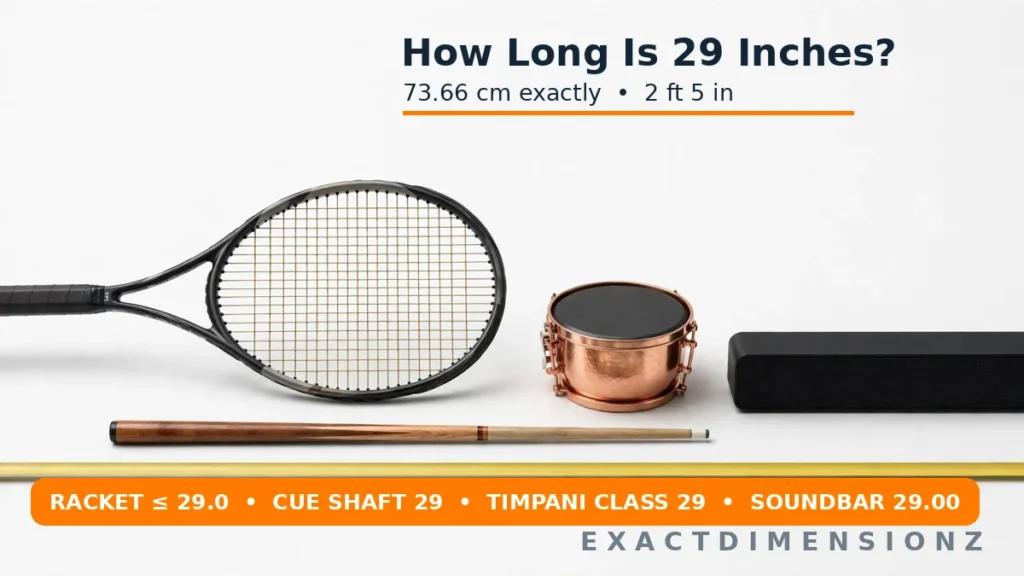
If you are asking how long is 29 inches, start with the one fact nobody argues about: 29 inches is exactly 73.66 centimetres, exactly 736.6 millimetres, two feet five inches of tape. The complete inches size guide puts that length in context. What gets argued about — quietly, on spec sheets and luggage tags — is where the 29-inch line actually falls. On a tennis racket it is a legal ceiling written into a rulebook. On a snooker table it is a line of chalk-white print drawn across the cloth. On a suitcase it is a name the maker’s own measurements contradict by three-quarters of an inch. And on a bicycle wheel it is a class name wrapped around a rim that measures 24.5 inches. So this article runs a line test. Twelve things that claim 29 inches each show where their line falls — drawn by a rulebook, drawn on the object itself, or drawn only on the label — and each leaves with its grade printed next to the claim.
The number itself has a useful address. Twenty-nine inches is how long is 16 inches plus how long is 13 inches — five inches past two feet, seven inches short of a yard. In feet it is 2.4167, a rounded figure; in yards, 0.8056, also rounded. Only the metric twins are exact, because one inch is exactly 2.54 centimetres by definition. Everything below is about the other kind of claim: not what 29 inches converts to, but which objects honestly own it. From here, it is a step down to 28 inches on one side and a step up to 30 inches on the other.
29 inches = 73.66 cm exactly (736.6 mm • 2.4167 ft • 0.8056 yd) — two feet five. But where the 29-inch line falls depends on who drew it. A rulebook draws two of them: no tennis racket may exceed 29.0 in, and snooker’s baulk line sits exactly 29 in from the cushion. A tape finds five more: a pool cue’s shaft, a 29-inch youth bat, a folding table’s height, a sound bar’s width, a family tire’s diameter. Four live on labels only — an ultrawide monitor 27.1 in wide, a “29-inch” suitcase its maker specs at 29.75, a 29er wheel built on a 24.5-inch rim, a timpani in a 29 size class. And one — the violin bow, at 29.5 — steps over the line. Twelve lines, drawn and graded below.
How the Line Test Works
Three questions decide every case below. First: who drew the line — a rulebook, a manufacturer’s spec sheet, or a marketing name? Second: where does it fall — on the object itself, in one direction you can measure, or nowhere on the object at all? Third: can the figure be checked in thirty seconds with a tape, a sidewall code or a published table? Each object carries a Line check line with one of four grades. RULEBOOK LINE means a governing body fixes the 29 and enforces it. TAPE LINE means a tape laid on the object, in the direction the name promises, reads 29. LABEL LINE means the 29 is a class, a diagonal or a rounded name, while the object itself measures something else. And NEAR LINE means the object lands close — but measurably off, over or under, with the gap printed.
The twelve split four ways. Two lines are drawn by rulebooks. Five are drawn on the objects themselves. Four exist only on labels. And one — the longest-serving near miss in music — steps over the line entirely. Read the grades in order and a pattern builds that no flat list of “things that are 29 inches long” will show you: the closer a number sits to money, fit or eligibility, the more honestly it behaves.
Drawn by a Rulebook: Two Lines With Referees
1. The Tennis Racket: 29 Inches Is the Legal Ceiling
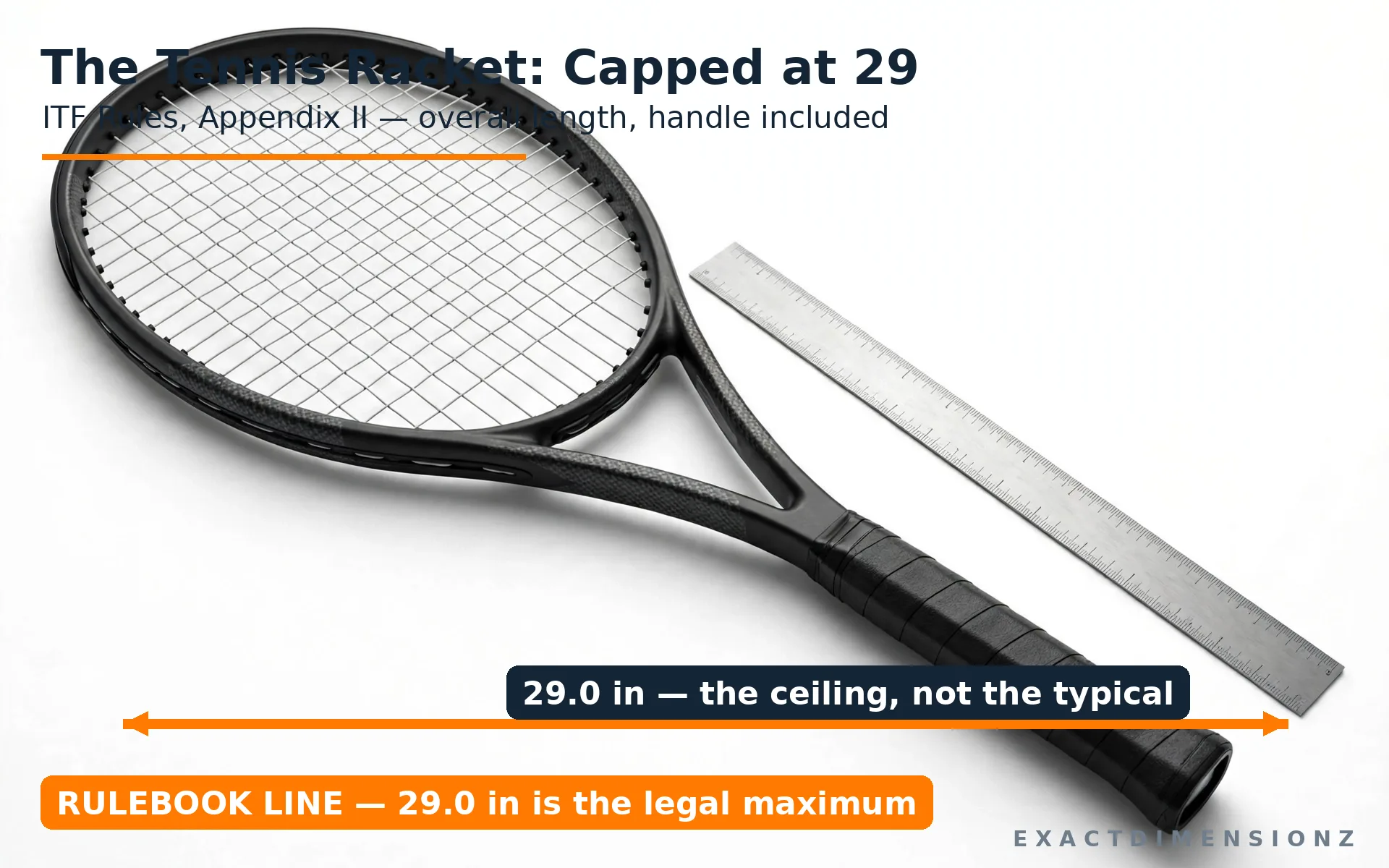
Tennis is the rare sport that caps its equipment at exactly this article’s number. Appendix II of the ITF Rules of Tennis states it without decoration: the racket “shall not exceed 73.7 cm (29.0 inches) in overall length, and 31.7 cm (12.5 inches) in overall width,” handle included, with the hitting surface capped at 39.4 by 29.2 centimetres. A racket one millimetre longer is not a big racket; it is an illegal one, and it cannot be used in sanctioned play at any level.
Notice what kind of 29 this makes the racket. Almost no racket measures it. Standard adult rackets run 27 to 27.5 inches, the length the professional game settled on generations ago, and “extended” models stretch to 28 or 28.5 for extra leverage on serve. The 29.0 in the rulebook is a ceiling the industry almost never touches — a line drawn at the outer edge of the possible. That is still a genuine 29-inch reference, and arguably the most disciplined one in this article: it is the only object here whose 29 is policed.
The evidence: ITF Rules of Tennis, Appendix II — maximum overall racket length 73.7 cm (29.0 in); maximum width 31.7 cm (12.5 in).
Line check: RULEBOOK LINE — 29 inches is the longest a tennis racket is allowed to be. Test it yourself: measure any extended-length racket butt cap to head tip; if it reads past 29.0, it is a training aid or a wall hanger, not a match racket.
2. The Snooker Baulk Line: The Only 29 That Is Literally a Line
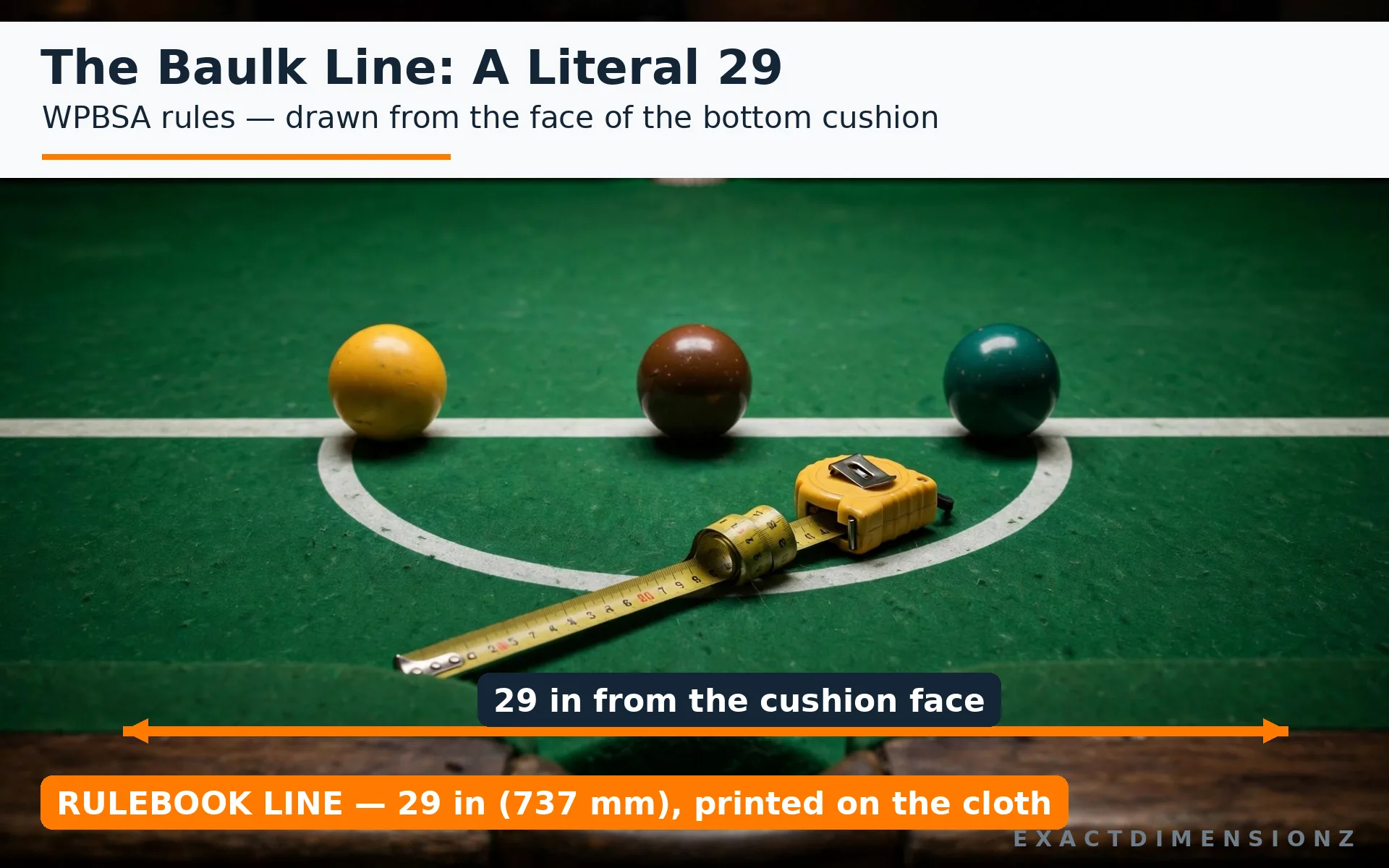
Every other entry in this article borrows the word “line” as a metaphor. This one is a line. The WPBSA’s official rules of snooker define the standard table in Section 1, and clause (d) reads: “A straight line drawn 29in (737mm) from the face of the bottom cushion and parallel to it is called the Baulk-line, and that line and the intervening space is termed the Baulk.” The semicircle of the “D” is then described on that line, with a radius of 11.5 inches, and the brown spot sits at its centre. Every break-off in every professional frame starts behind a line drawn exactly 29 inches from the cushion face.
Two honest footnotes, both in the rulebook’s favour. The first is that the WPBSA prints the metric twin as 737 mm — the nearest millimetre — while a true 29 inches is 736.6 mm; the imperial figure governs, and the book says its bracketed figures are metric equivalents to the nearest millimetre. The second is that the baulk line’s 29 is a distance, not a size: it measures the gap between a cushion and a stripe of cloth on a playing area 11 feet 8.5 inches long. Like the 15-inch bowling pin elsewhere in this series, it is a number an officialdom wrote down and then held the world to.
The evidence: WPBSA Official Rules, Section 1 clause (d) — baulk line drawn 29 in (737 mm) from the face of the bottom cushion; the “D” radius 11.5 in (292 mm).
Line check: RULEBOOK LINE — the only literal line in the article, drawn on the cloth of every regulation table. Test it yourself: on any full-size snooker table, measure from the baulk cushion’s face to the line. The tape reads 29 — and the D’s curve is centred on it.
Drawn on the Object: Five Lines the Tape Finds
3. The Pool Cue Shaft: Half a Cue, All 29 of It

A two-piece pool cue is two 29s screwed together. Predator — the cue maker whose shafts half the professional game plays with — sells its cues in halves of exactly this length: on Predator’s own product page for the P3 Prowler, the customisation table lists shaft length options of 29″ and 30″ and a butt length of 29″. Choose the standard build and the shaft in your hand — tip, ferrule and joint collar — is 29 inches; the butt behind it is 29 more; the assembled cue is the game’s standard 58.
The shaft earns its grade because its length is a working specification, not a silhouette. A shaft’s length shapes how the cue bridges and balances, makers offer the 30-inch option precisely because the standard is 29, and the number is printed where buyers choose between the two. There is no diagonal convention here, no case-versus-whole split. The 29 is the piece, the whole piece, measured the way you would measure it.
The evidence: Predator’s published specification for its cues — shaft length 29 in (30 in optional), butt length 29 in; assembled standard cue 58 in.
Line check: TAPE LINE — a true 29, end to end, on the front half of the cue. Test it yourself: unscrew any standard two-piece cue and lay the shaft beside a tape. Joint to tip, it reads 29.
4. The 29-Inch Youth Baseball Bat: A Size Run That Tells the Truth
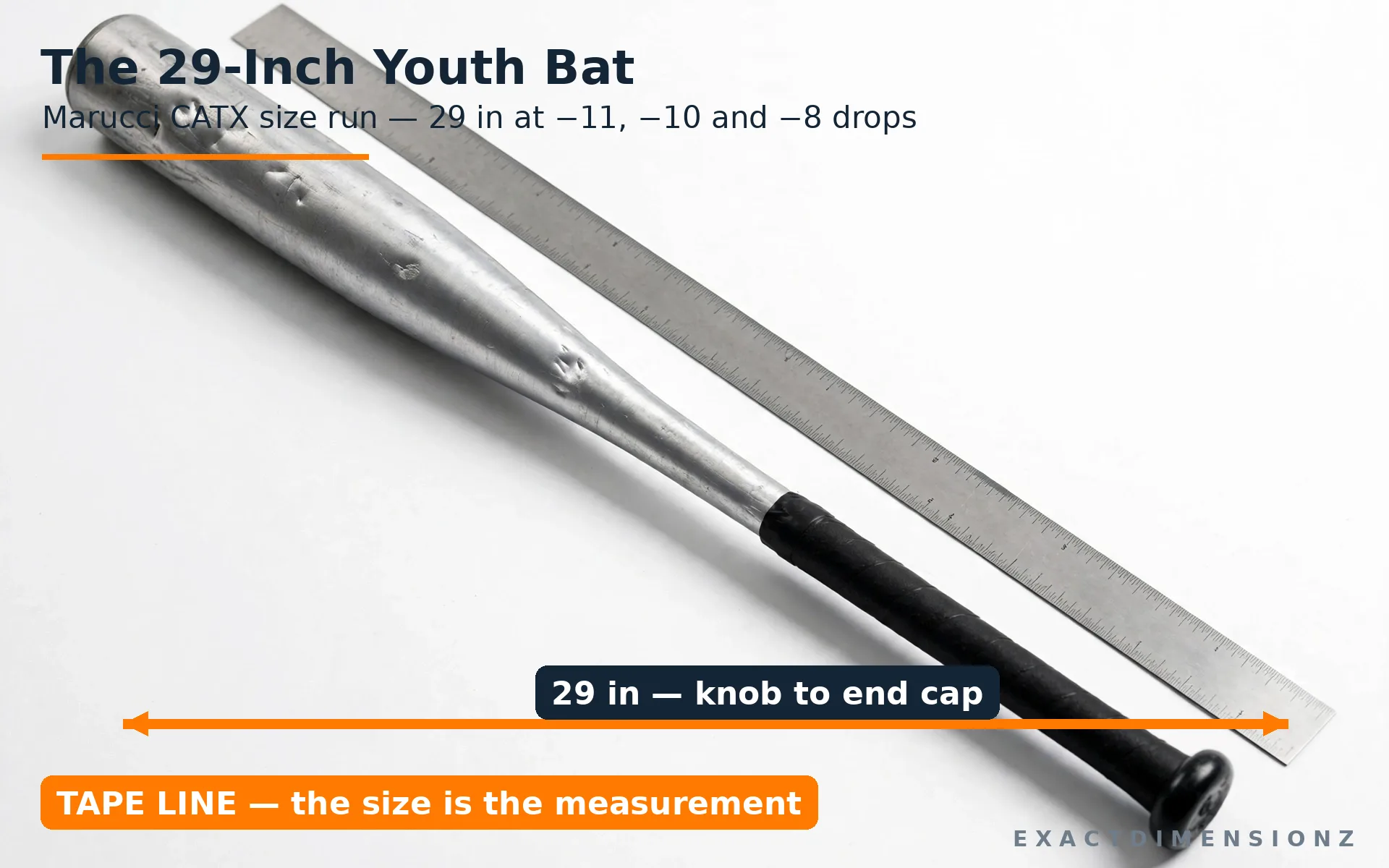
Baseball bats are sold the way shoes are sold — in a run of sizes, each one a real tape measurement — and 29 inches is one of the standard stops. Marucci’s CATX line, one of the most-played youth bats in North America, is offered in a 29-inch length across its drops: specification listings for the range, such as the CATX Rckless USA listing, show the size run climbing 26, 27, 28, 29, 30, 31 — the 29 paired with 18 ounces at drop −11, 19 at −10, 21 at −8. The number on the knob is the length of the bat, knob to end cap, and fitting charts send players to it by height and weight.
Bat length is a number with consequences, which is why it behaves. A 29 swung by a player fitted for a 27 costs bat speed; a 29 in the hands of a player who has outgrown a 27 buys reach on the outside corner. Coaches measure, chart and enforce the size run because the wrong inch is visible in the swing. Contrast the honest run of bat sizes with the nominal sizes elsewhere in this article: nobody has ever had to publish a “packing length” for a baseball bat.
The evidence: Marucci CATX size run — 29 in offered at 18 oz (−11), 19 oz (−10) and 21 oz (−8), in a run from 26 to 32 in.
Line check: TAPE LINE — the size is the measurement. Test it yourself: stand a 29-inch bat on its knob and run a tape to the end cap. Then check the fitting chart: the same 29 is what it recommends for players around 4 ft 9 in to 5 ft 2 in.
5. The Folding Table: 29 Inches Is Its Working Height
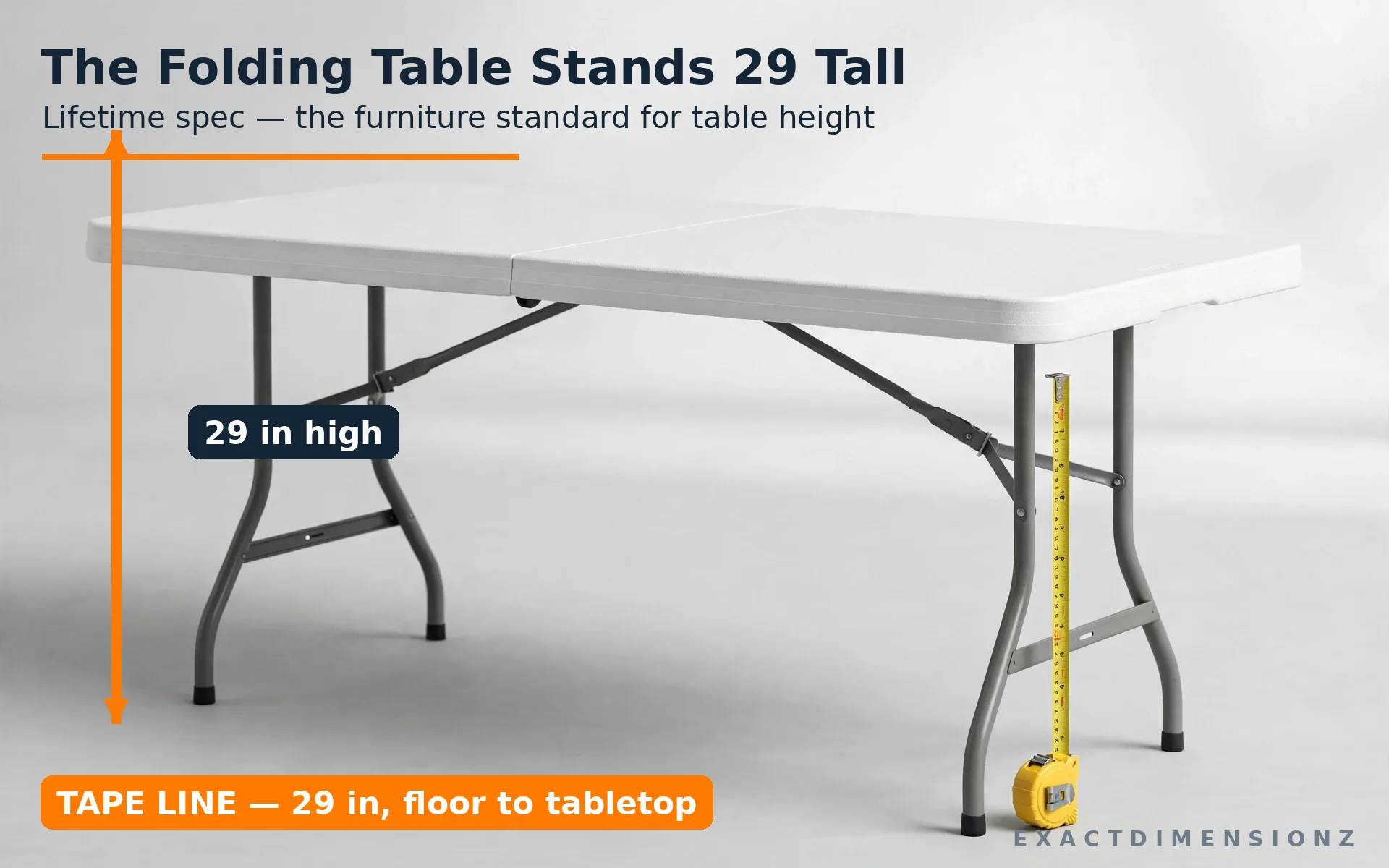
The most useful 29 in your building is holding up somebody’s lunch right now. The commercial folding table — the six-foot banquet and classroom staple — stands 29 inches tall: Lifetime’s specification for its 6-foot commercial folding table gives assembled dimensions of 71.9 × 29.9 × 29 inches, the third figure being the height from floor to tabletop. The maker’s adjustable four-foot table tells the same story from the other direction: Lifetime’s own spec sheet lists its three height settings as 22 inches (children’s), 29 inches (table height) and 36 inches (counter height). Twenty-nine is not an accident of one product; it is the furniture industry’s standard working height for a table you sit at.
That standardisation is why the folding table’s 29 is trustworthy in a way a suitcase’s never is. Table height is ergonomics: chair seats sit at 17 to 19 inches, knees and elbows land where they land, and a table built at 27 or 31 inches would be felt by every person who used it. The 29 is checked by bodies, daily, which is the strongest enforcement mechanism in this article after the ITF’s.
The evidence: Lifetime’s published dimensions — 6-ft commercial table 71.9 × 29.9 × 29 in assembled; adjustable table’s middle setting named “29in (Table Height)”.
Line check: TAPE LINE — floor to tabletop, on the furniture standard. Test it yourself: measure your dining or desk table’s height. If it is a standard table, the tape reads 29 to 30 — and if it reads 36, you are measuring a counter, which is a different standard entirely (see the Corrections Desk).
6. The 29-Inch Sound Bar: A Width You Can Measure From the Couch

Vizio’s SB2920-C6 is named for its width, and unusually for consumer electronics, the name survives a tape. The specifications in Vizio’s manual for the SB2920-C6 give the product dimensions as 3.00 × 29.00 × 3.00 inches — a bar 29 inches wide, 3 inches tall and 3 inches deep, carrying two 2.5-inch full-range drivers. The model number itself encodes the size: SB29, in the maker’s own numbering. It was built to sit under the televisions of its era, most of them in the 32-inch class — which are, by the diagonal convention, about 28 inches wide. The bar is wider than the screen it served, and both numbers are honest; they are simply measuring different lines.
Hold the sound bar next to the monitor in the label section below and the contrast sharpens. Both are electronics sold by an inch figure. The bar’s figure is its width, printed to two decimals in the manual and true on the object. The monitor’s figure is a diagonal class, and no straight edge of the machine comes within two inches of it. Same aisle, same kind of label, opposite relationships with the tape.
The evidence: Vizio SB2920-C6 manual, specifications — product dimensions 3.00 × 29.00 × 3.00 in; sound bar size 29; two 2.5-in drivers.
Line check: TAPE LINE — 29.00 inches of width, as specified. Test it yourself: measure any 29-class sound bar end to end. The manual’s two-decimal figure is the one your tape finds.
7. The Family-Car Tire: 29.0 Inches, Published in the Data Book
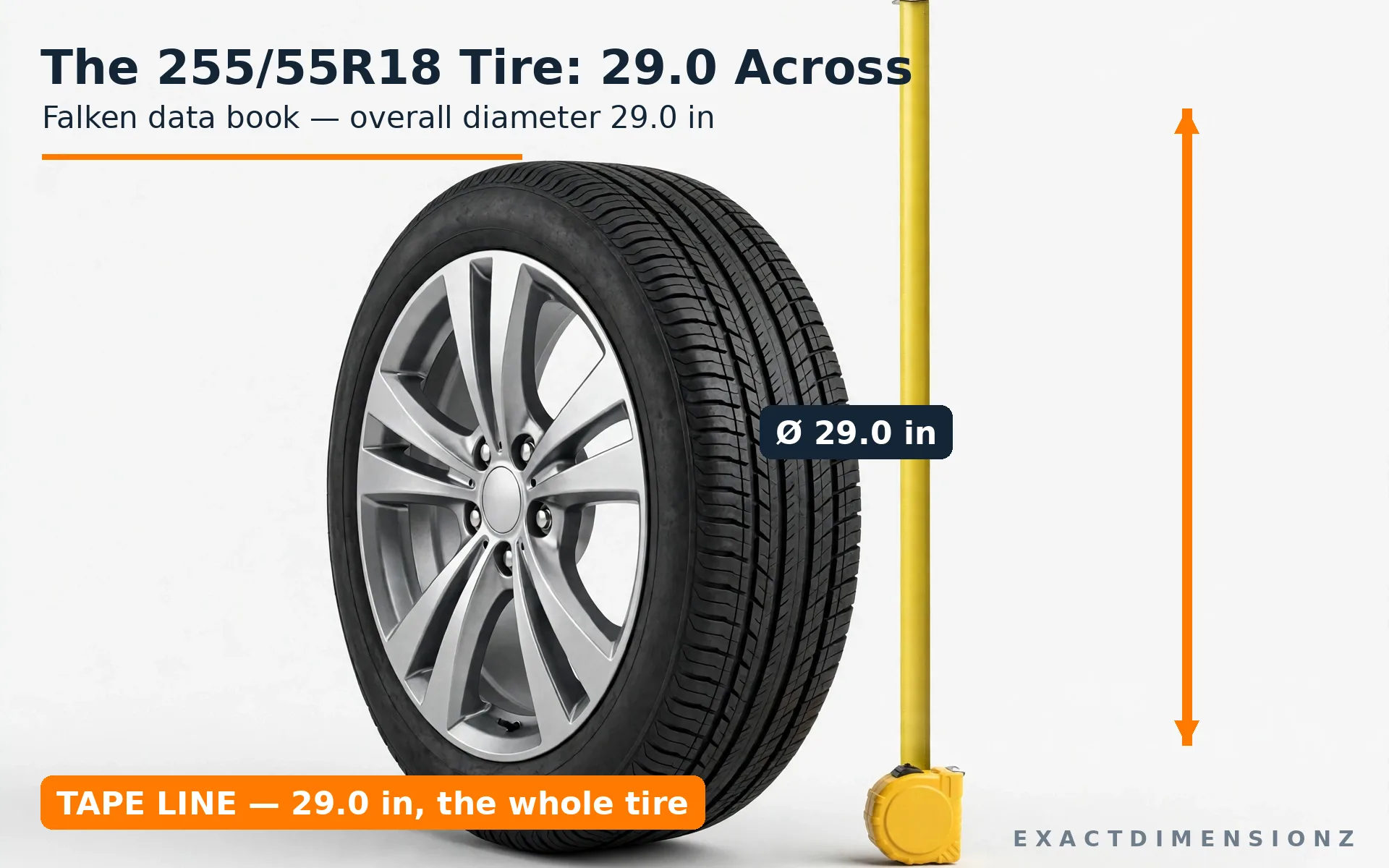
Somewhere in the data book your tire fitter trusts, a common crossover size carries this article’s number to the decimal. Falken’s published tire data book (the manufacturer’s catalogue, hosted on a retailer’s document server) lists the 255/55R18 at an overall diameter of 29.0 inches, on an 8-inch measuring rim, with a section width of 10.4 inches. That diameter is the whole tire, bead to bead across the tread — the circle that has to fit the wheel arch, clear the suspension and keep the speedometer honest.
The figure also survives arithmetic, which is more than most entries in the label section can say. Read the sidewall code the way this series read the motorcycle tire in the 21-inch article: 255 millimetres of width, a sidewall 55% as tall — 140.25 mm, about 5.52 inches — above an 18-inch rim and the same below it. Rim plus two sidewalls: 18 + 5.52 + 5.52 = 29.04 inches, which the data book rounds to its published 29.0. A diameter stated by the maker, derivable from the code on the tire itself, and true of the whole object. The tire’s 29 is as honest as a manufactured number gets — with the working caveat that wear and inflation move a real tire by small fractions around it.
The evidence: Falken data book — 255/55R18 XL 109V: overall diameter 29.0 in, section width 10.4 in, measuring rim 8.0 in.
Line check: TAPE LINE — a published 29.0 across the whole tire. Test it yourself: run the sidewall maths on any tire: (width × aspect ÷ 25.4 × 2) + rim. When the data book and the code agree, the number is real.
Drawn on the Label: Four Lines the Object Never Drew
8. The 29-Inch Ultrawide Monitor: A Diagonal in a 27-Inch Body
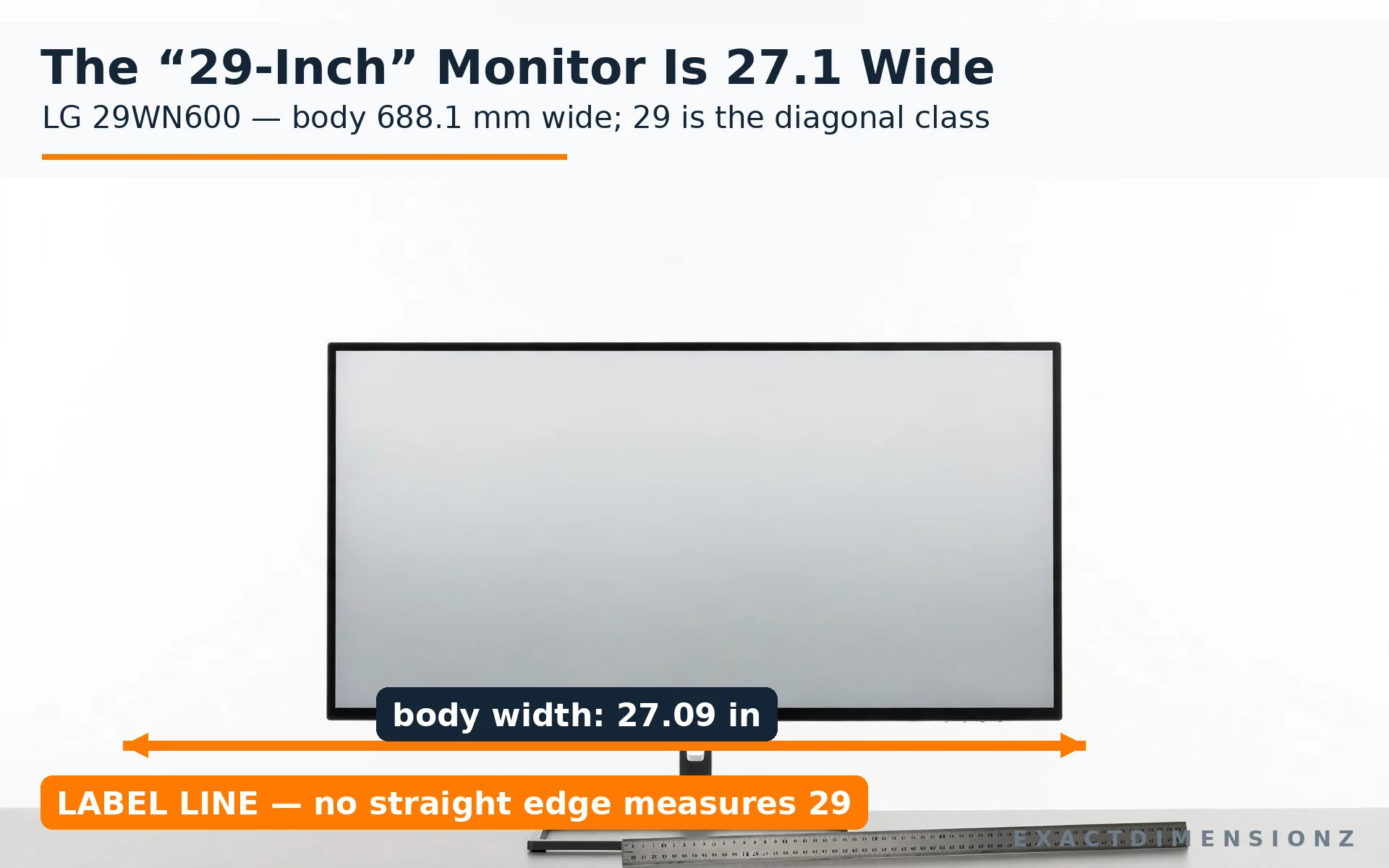
LG’s 29WN600 is sold as a 29-inch UltraWide, and LG’s own specification page is where the claim both stands and dissolves. The general section lists the size as 29″/73.0 cm — the class figure, and even its metric twin is a rounding: a true 29 inches is 73.66 cm, not 73.0. Then the dimensions section gives the machine itself: 688.1 mm wide with or without its stand — 27.09 inches — and 313.2 mm tall without the stand, just over 12.3 inches. The widest straight line on the entire monitor is two inches short of its name. The 29 lives where screen sizes always live: on the diagonal of the panel, corner to corner, the one direction nobody furnishes a room by.
This is the screen-class convention doing what it always does, and LG is not deceiving anyone — the spec sheet prints every true figure on the same page as the class name. The deception, such as it is, happens downstream, when a size guide copies “29-inch monitor” into a list of things that are 29 inches long, next to objects whose 29 you can touch. A diagonal is a real measurement; it is just not a length the object presents to the world in any direction you would lean a tape against.
The evidence: LG 29WN600 specifications — size listed 29″/73.0 cm; set dimensions 688.1 mm wide (27.09 in), 313.2 mm tall without stand (12.33 in).
Line check: LABEL LINE — the 29 is the panel’s diagonal class; the body is 27.1 inches wide. Test it yourself: measure any “29-inch” ultrawide across its body. You will read about 27 — then measure corner to corner of the glass to find where the name lives.
9. The “29-Inch” Suitcase That Its Maker Specs at 29.75
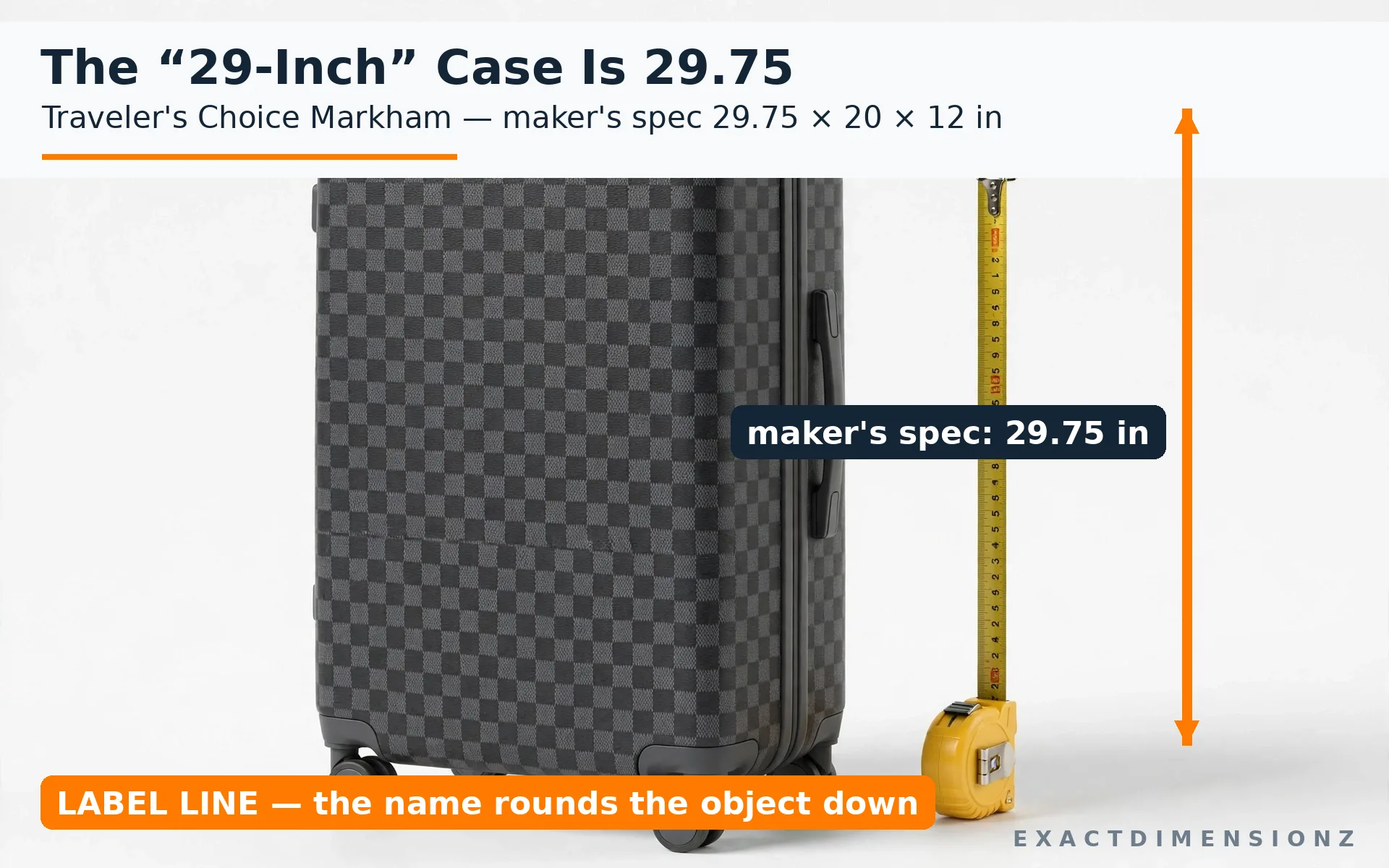
Traveler’s Choice sells the Markham as a 29-inch large checked spinner, and then — to its credit — publishes the truth one line down. The manufacturer’s product page specifications read: “Markham Large Spinner (29.75″ x 20″ x 12″ +2″ expandable, 12.79 lbs)”. The bag named 29 stands 29.75 inches tall. The name is the rounded class; the maker’s own tape says otherwise, in the maker’s own store. And the 29-class is checked luggage by design: it is nearly eight inches taller than the 14-inch wide side that caps a carry-on, and it gains 2 inches more of depth when expanded.
Luggage is where label lines cost money, because airlines measure the whole object — wheels, handles and all — against written limits, and they charge for the difference. A traveller who believed the spam-page claim corrected in the Desk below, that a 29-inch case “might be considered a carry-on,” would learn otherwise at the gate, expensively. The Markham’s maker did everything right: name the class, print the measurement. The failure mode belongs to anyone who reads the name and stops.
The evidence: Traveler’s Choice Markham specifications — sold as 29 in; manufacturer’s stated dimensions 29.75 × 20 × 12 in, plus 2 in expansion; 12.79 lb.
Line check: LABEL LINE — the object is three-quarters of an inch more than its name. Test it yourself: for any suitcase, skip the product name and find the maker’s dimension line. If the two disagree, the dimension line is the one the airline will use.
10. The 29er Wheel: A 24.5-Inch Rim Wearing a 29-Inch Name
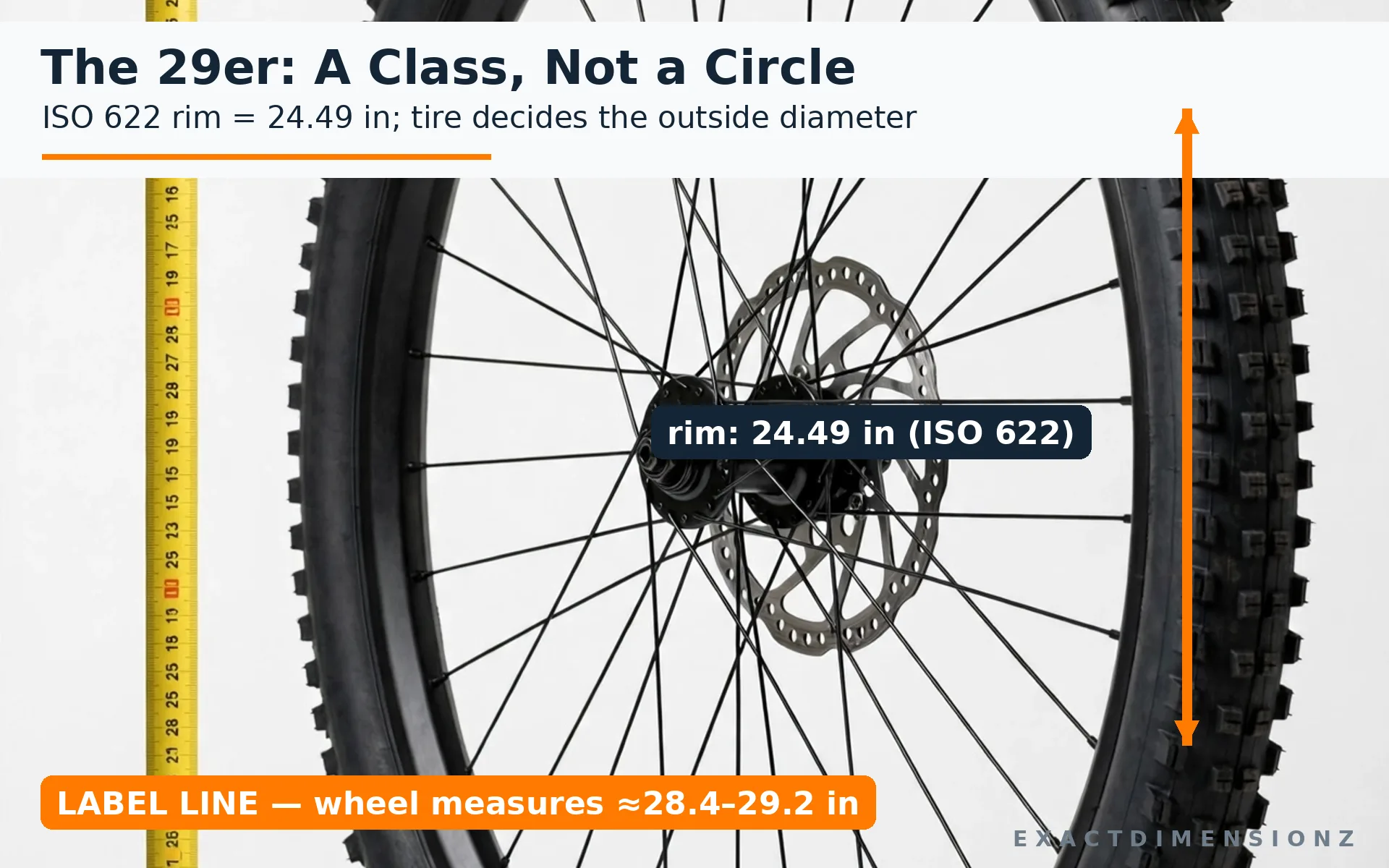
The 29er is mountain biking’s favourite number and its most successful rounding. The wheel’s engineering identity is not 29 of anything: it is the ISO 622 rim, the same bead seat diameter as a 700c road wheel — 622 millimetres, which is 24.49 inches. Retailer specification listings for the tires that define the class say it plainly, in listings such as this Schwalbe range page: “Tire Diameter/ISO: 29”/622″. The 29 is the class name; the 622 is the standard. What the finished wheel measures depends entirely on the tire hung on that rim: add two sidewalls of rubber to 622 mm and a 2.0-inch trail tire brings the outside diameter to roughly 28.4 inches, while a fat 2.4-inch tire reaches about 29.2. The name is true only at the plump end of the range it names.
None of this stops the 29er being a fine reference for the neighbourhood of 29 — a mounted wheel is a big, honest circle somewhere between 28.4 and 29.2 inches tall. But graded as a claim, it is the purest label line in this article: a number that describes no fixed part of the object, anchored to a rim two and a half inches smaller than itself, completed by a tire the name knows nothing about. The class is real. The measurement is a range.
The evidence: ISO/ETRTO bead seat diameter 622 mm (24.49 in) for the class listed as 29″/622; mounted outside diameter ≈28.4 in with a 2.0-in tire, ≈29.2 in with a 2.4-in tire.
Line check: LABEL LINE — 29 is the class; the rim is 24.5 and the wheel is a range. Test it yourself: measure a 29er’s wheel top to bottom, then read the tire’s ISO number off the sidewall. The first number changes with the tire; the second never does.
11. The 29-Inch Timpani: A Size Class in an Orchestra
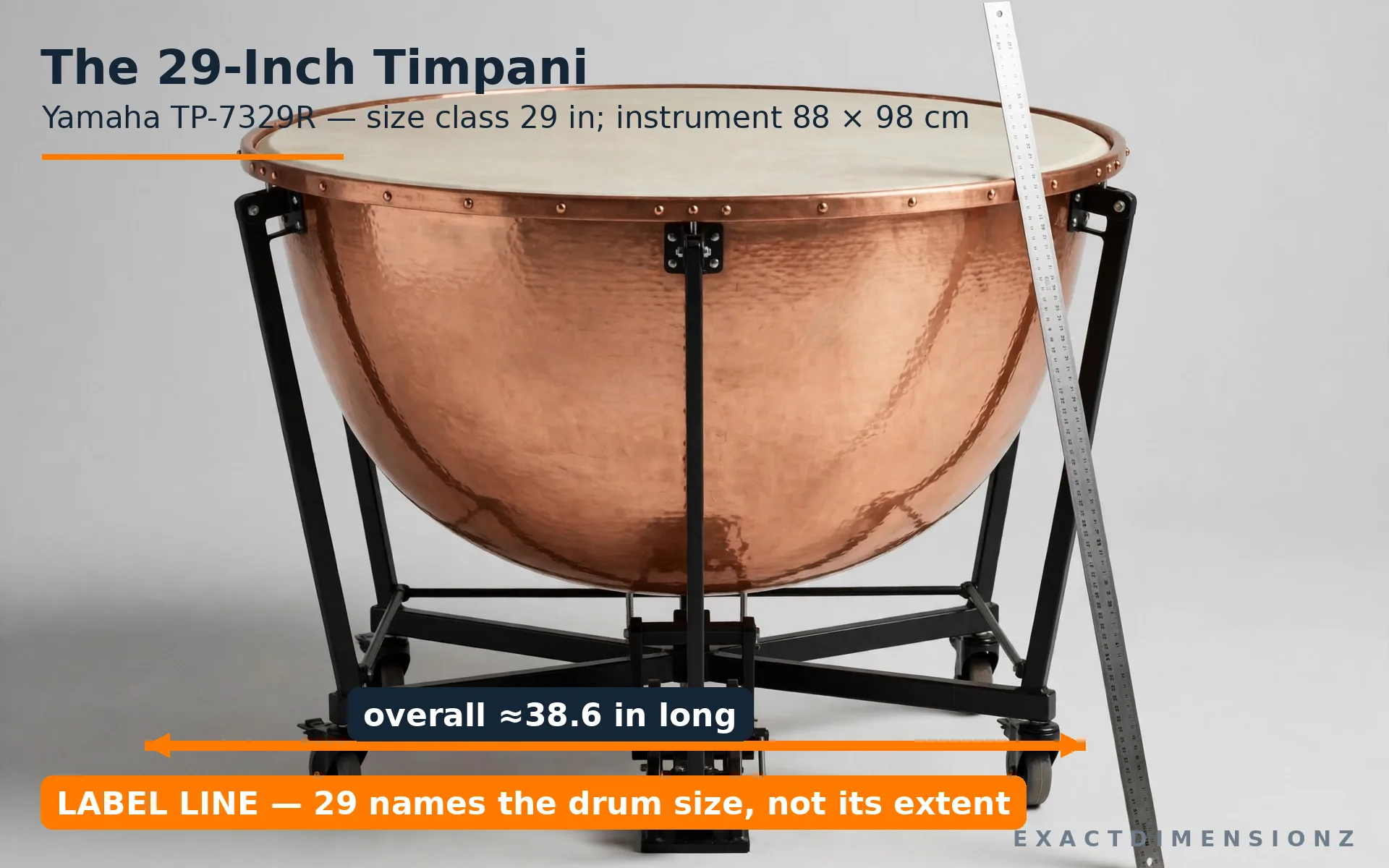
Orchestral timpani come in a run of sizes — 20, 23, 26, 29, 32 — and Yamaha’s professional line states the run openly. In Yamaha’s TP-7300R lineup table, the TP-7329R is listed at size 29″ (74 cm), range F to D-flat, with overall dimensions of 88 × 98 × 85 centimetres and a weight of 43 kilograms. Read the two numbers together: the instrument is nearly 39 inches long overall, stands 85 centimetres high — and its “size” is 29. The size names the drum: the head class the bowl is built to take, in a family where each step up buys a lower range of notes.
Drum sizing is an old, honourable label line — the floor tom in this series’ 16-inch article works the same way, with the diameter naming the instrument while depth rides along unmentioned. The timpani’s 29 is meaningful to everyone who buys, tunes or wheels one: it fixes the head, the bowl and the pitch range. It simply is not the measurement of the object in any direction a tape can find, and a reader picturing a 29-inch instrument would picture something a full ten inches shorter than the copper bowl on its frame.
The evidence: Yamaha TP-7300R lineup — TP-7329R size 29″ (74 cm), range F–D♭; overall 88 × 98 × 85 cm; 43 kg.
Line check: LABEL LINE — 29 names the drum’s size class, not its extent. Test it yourself: measure a 29-inch timpani across its frame. You will read roughly 35 inches of width and 39 of length; the 29 lives in the head it takes.
Over the Line: The Violin Bow
12. The Full-Size Violin Bow: 29.5 Inches, and Proud of It

The last claimant does not fall short of the line; it steps over it, by the length of a thumbnail. A full-size (4/4) violin bow is the longest standard bow in the string family, and bow maker CodaBow’s sizing guide lists it at 29.5 inches — with the fractional sizes stepping down from there: 27 for the 3/4, 24.5 for the 1/2. Working bows in the trade run 74 to 75 centimetres, 29.1 to 29.5 inches, tip to screw end. By any honest grading this is the closest miss in the article: half an inch over the number, on an object whose whole professional life is spent being measured against strings, cases and other bows.
The bow earns its own group because it breaks the pattern the other eleven built. The rulebook lines are exact by enforcement; the tape lines are exact by specification; the label lines are inexact by convention. The bow is inexact by craft — a handmade object, made of pernambuco or carbon fibre to a traditional length that was never this article’s number to begin with. It was borrowed into “things that are 29 inches” lists by rounding, and rounding a 29.5 down to 29 is how near misses harden into facts. Stated at its true figure, it is a superb reference — for 29.5 inches.
The evidence: CodaBow’s published bow sizing — full-size (4/4) violin bow 29.5 in; trade range 74–75 cm (29.1–29.5 in).
Line check: NEAR LINE — over by up to half an inch, disclosed. Test it yourself: measure a full-size bow from tip to the end of the screw. Expect 29.1 to 29.5 — close enough to picture 29, too honest to be called it.
The Line-Up Card: All Twelve, Graded on One Scale

The full draw, in one view. Two rulebook lines — the racket’s ceiling and the baulk line’s stripe — are the only 29s in the article backed by a referee. Five tape lines — cue shaft, bat, table, sound bar and tire — are the 29s you can verify with your own hands this week. Four label lines — monitor, suitcase, 29er and timpani — name classes, diagonals and product families while the objects measure 27.1, 29.75, a range around a 24.5-inch rim, and a 39-inch instrument respectively. And one near line, the bow, overshoots by up to half an inch and says so. Twelve claims, twelve grades, no two quite the same kind of true.
Keep the card’s shape in mind, because it generalises past 29. In any size list, the entries backed by rulebooks and spec sheets cluster at the claimed number, and the entries backed by names and classes scatter around it — sometimes charmingly, sometimes expensively. The scatter is not a reason to distrust the number. It is a reason to ask, every time, where the line was drawn.
Build Twenty-Nine Yourself: Six Builds, Honest Totals

No rulebook handy? Build the length. The units below are the verified ones this series trusts: the US quarter is 0.955 inches in diameter per the US Mint; a dollar bill is 6.14 × 2.61 inches per the Bureau of Engraving and Printing; a bank card’s long edge is 3.37 inches under ISO/IEC 7810; US letter paper is a true 11 inches long; a baseball’s diameter runs 2.86 to 2.94 inches, from the rulebook’s 9 to 9.25-inch circumference. A bill, note, runs just past 6 inches — and a yardstick is three 12-inch rulers end to end.
| Build | Pieces | True total | Verdict |
|---|---|---|---|
| Yardstick, marked short | 36 in, marked 7 in from one end | 29.00 in | Dead on — the mark is the measurement |
| Three letter sheets, overlapped | 11 in + 9 in + 9 in (2 in overlap at each joint) | 29.00 in | Dead on — set the overlaps with any ruler |
| Ten baseballs in a row | 10 × 2.86–2.94 in diameter | 28.6–29.4 in | A range, not a point — honest either way |
| Two letter sheets + one bill + one quarter | 22 in + 6.14 in + 0.955 in | 29.10 in | 0.10 over — indistinguishable in practice |
| Eight bank cards + two quarters | 8 × 3.37 in + 2 × 0.955 in | 28.87 in | 0.13 short — closer than most labels |
| Thirty quarters in a row | 30 × 0.955 in | 28.65 in | Short by 0.35 — and 29 quarters make only 27.70 |
The quarter row deserves its footnote, because it is the folk build for this number: “29 quarters must make 29 inches.” A quarter is 0.955 inches wide, so twenty-nine of them make 27.70 inches — short by 1.30, a gap you can see from across the room — and even thirty coins land at 28.65. Counts are not lengths; this series has now convicted that sentence at 21 inches and at 29. The builds that work work because somebody did the arithmetic first and published the total, including the two that miss on purpose.
The Corrections Desk: Six Rival Claims, Corrected
Twenty-nine inches has a thin search results page, and thin pages breed confident errors. Each correction below names the claim, where it circulates, and the primary source that overturns it.
1. “A child of around 2–3 years old might be approximately this tall.” The most-read “How Big Is 29 Inches” page on the web illustrates 29 inches with a toddler of two to three. The World Health Organization’s length-for-age standards put the median boy at 73.28 cm at 10 months — within half a centimetre of 29 inches (73.66 cm) — and at 87.82 cm, or 34.6 inches, at 24 months. A 29-inch child is a baby of about ten months, not a toddler of two to three years. The claim is wrong by roughly 5.6 inches and more than a year of growth. This is the flagship correction of the article: the page’s friendliest example is its biggest error.
2. “29 inches is roughly the height of a standard kitchen counter.” The same page. Kitchen counters are built to a 36-inch finished height — a 34.5-inch base cabinet plus a 1.5-inch top, the build-up set out in cabinet-industry planning references drawing on KraftMaid’s size guide. Twenty-nine inches is table height, as the folding table above shows. The page took the dining room’s number and filed it in the kitchen — seven inches low, in the room where seven inches decides whether you chop at elbow height or at your hips.
3. “A 29-inch luggage might be considered a carryon bag for airlines.” Also the same page, and the most expensive error of the three. Carry-on limits are written rules: United’s maximum carry-on, for example, is 22 × 14 × 9 inches — a 22-inch ceiling, as NerdWallet’s summary of the airline’s policy lays out. A 29-class case exceeds that ceiling by seven inches before its wheels are counted, and the Markham above shows its maker classing it, correctly, as large checked luggage. There is no airline on which a 29-inch case is a carry-on.
4. A rival conversion page’s use-case table: “20 inches = diameter of a large pizza” and “10 inches = width of a standard ruler.” The highest-ranking conversion page for this keyword illustrates its table with two broken references. Papa John’s published size ladder runs 10, 12, 14, 16 inches — a large pizza is 14, an extra-large 16, and 20 is no size any major chain sells; even two 8-inch personal pies side by side span only 16. And a standard ruler is 12 inches long and about one inch wide; “10 inches” is neither its length nor its width. The page’s conversion maths is exact — 29 × 2.54 = 73.66 — which makes its examples worse, not better: precision in the arithmetic, invention in the illustrations. (The full table appears on the same conversion page.)
5. “29 inches is exactly 2.41666666667 feet.” Achievers’ conversion essay prints the word “exactly” in front of a decimal that cannot be exact: 29 ÷ 12 is 2.41666…, repeating forever, and any written version of it — theirs, or this article’s 2.4167 — is a rounding. The distinction sounds pedantic until it is the difference between a conversion and a claim: call rounded figures rounded, every time, and the exact ones stay believable.
6. “Some extended tennis rackets reach exactly 30 inches.” A rival 30-inch list presents 30-inch rackets as a playing category, one inch past this article’s number. The ITF cap in Line 1 forbids it: a racket over 29.0 inches overall is illegal for sanctioned play, full stop, and the same list’s “adult rackets typically measure 27–29 inches” stretches the typical past the truth — the standard adult racket is 27 to 27.5, and 29 is the ceiling almost nobody touches. Thirty-inch rackets exist as novelties and training aids. As tennis equipment, they do not.
Closing: Ask Where the Line Falls
Twenty-nine inches turns out to be a question disguised as a length. Drawn by a rulebook, it is a ceiling a racket may not cross and a stripe a snooker table may not move. Drawn on an object, it is a cue shaft, a bat, a table’s height, a sound bar’s width, a tire’s diameter — five numbers you can check with your own hands. Drawn on a label, it is a diagonal, a rounded class, a rim’s nickname, a drum’s family name — four numbers that are true of something and false of the object in front of you. And drawn by a craftsman four centuries ago, it is a violin bow, half an inch over, in a tradition that never promised you 29 at all.
So the guidance this article leaves is a single question, the one every line check above answered: where does the line fall? On the object, in the rulebook, or only on the label? Ask it of a suitcase before the airport asks it of you, of a screen before you buy the sleeve, of a wheel before you trust the class name. The inch itself never lies. It is exactly 2.54 centimetres, at 29 as at every other count. What varies is the honesty of the line drawn in its name — and now you know how to grade the drawing.
