
Drive north out of Sault Ste. Marie on the Trans-Canada Highway, and after about two hours of rock cuts and lake glimpses a goose appears on the hill above the road — a Canada goose the size of a house, wings half-spread, neck up, staring down the highway like it owns the place. It is 28 feet tall. Stand underneath it and you are standing underneath the answer to how long is 28 feet, because the bird's height is the number in this article's title, measured the way a statue is measured: from the rock to the top of the head, 28 feet, no rounding, no "about". The goose has been there since 1963, it has been rebuilt twice, and it is the only object in this article that most readers can drive to and stand under — which is a better way to learn a length than any conversion table, because a conversion table never made anyone look up.
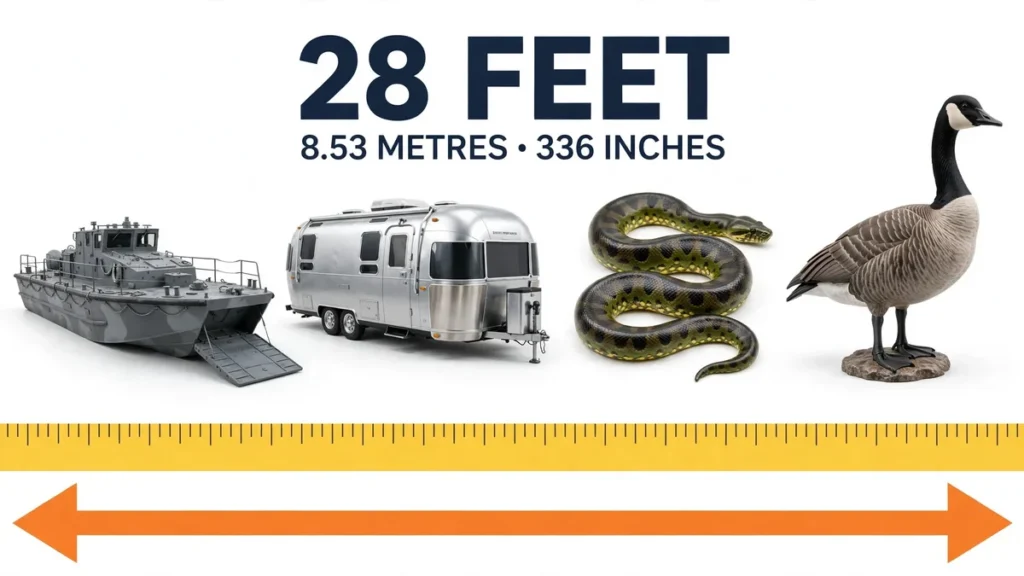
Here is the second thing, and it is the reason this article's six objects are arranged the way they are: 28 feet is the only length in this series that is round in no system at all. It is 9 yards and a foot left over, 8.5344 metres, 336 inches, and 853.44 centimetres, and none of those numbers is clean — the yardage has a remainder, the metres run to four decimal places, and the inches are the only whole number in the set. The six things below are the closest honest answers to it: two of them land on 28 feet exactly, and the other four carry their miss in the open with the miss printed in full — including the ladder, which is 28 feet by its size and 25 feet by its working length, the most honest split in the whole article. By the end you will know 28 feet as a landing craft, a goose, a set of fingernails, a snake, a travel trailer, and a ladder — and you will know which of those you can trust to the inch, which ones miss by inches you can see, and which numbers about 28 feet do not survive a tape measure at all.
The One Foot Left Over: Why 28 Feet Has No Round Name
Twenty-eight feet is a length that refuses to sit still in any system, because the roundness lives one foot away in every direction. Divide 28 by 3 and you get 9 yards with a foot left over, which makes 28 feet the rare length in this series that is exact in no system at all: 9 yards 1 foot, 8.5344 metres, 336 inches, 853.44 centimetres — and the only one of those that comes out whole is the inches, which is the least useful number for picturing anything. The guides that answer this question with a conversion essay get that part right and then stop, as if the arithmetic were the answer — and the arithmetic is only the address. The answer is what sits at the address, and what sits there is a landing craft whose hull is 28 feet to the inch, a goose statue that is 28 feet tall, and a set of fingernails that took thirty years to grow four and a half inches past it.
That is also why "call it 8.5 metres" is the gentlest rounding in this article, and still a rounding you should know about. Eight and a half metres is 27 feet 10.6 inches — 1.4 inches short of 28 feet — which is the thickness of a finger missing from your measurement, and a trailer bay or a boat slip bought against "8.5 metres" fails by that much before anything is built. The honest shortcut is 8.53 metres, or 9 yards 1 foot, or 336 inches — three names for the same tape — and the only one of the three that is round anywhere is the last. The trap to avoid is the divide-by-three shortcut: 28 divided by 3 is 9.33, and if you mistake that for metres you get 9.33 metres, which is 80 centimetres — 31 inches, two and a half feet — too long, which is a miss you could cut a piece of lumber by. The guides that list "things that are 28 feet long" keep reaching for the school bus and the giraffe because those are the biggest single things in a normal life with 28 in their name — and neither of them is 28 feet, one by seven feet and the other by ten. The bus is the object this article measures properly, in the corrections section, and the giraffe is the object it refuses to measure at all.
Quick Answer
28 feet is 8.5344 metres exactly — 853.44 centimetres, 8,534.4 millimetres, 336 inches, and 9 yards 1 foot (9.33 yards). But do NOT call it 9.33 metres: dividing 28 by 3 gives 9.33, and 9.33 metres is 80 centimetres — 31 inches — too long. And do NOT call it 8 metres either: 8 metres is 26 feet 3 inches, which is 1 foot 9 inches shorter than 28 feet. The honest shortcut is 8.53 metres — and the honest objects are the Lake Assault LC28 landing craft, 28 feet of hull by the maker's own specification, the Wawa Goose, 28 feet tall by the town that built it, and a Werner extension ladder that is 28 feet long when fully extended and 25 feet long when you actually work from it.
How to Read the Six Objects Below
The six objects below are ordered by how close they land, and each one carries its evidence grade in the heading. EXACT means the figure is a standard's or an authority's own dimension for the named thing. LISTED means the figure is the manufacturer's or operator's published specification for the named model. AVERAGE means the figure is an authority's published average or range for the named thing. REPORTED means the figure is the largest verified measurement an expert source reports for the named thing. Two of the six land on the number with no miss at all, and the four that do not carry their miss in the open, in inches, where you can see it — including the ladder, whose two numbers are both true at once, and the snake, whose 28 feet belongs to history rather than to the present day.
1. A Lake Assault LC28 Landing Craft — Hull Length 28 Ft 0 In (LISTED)
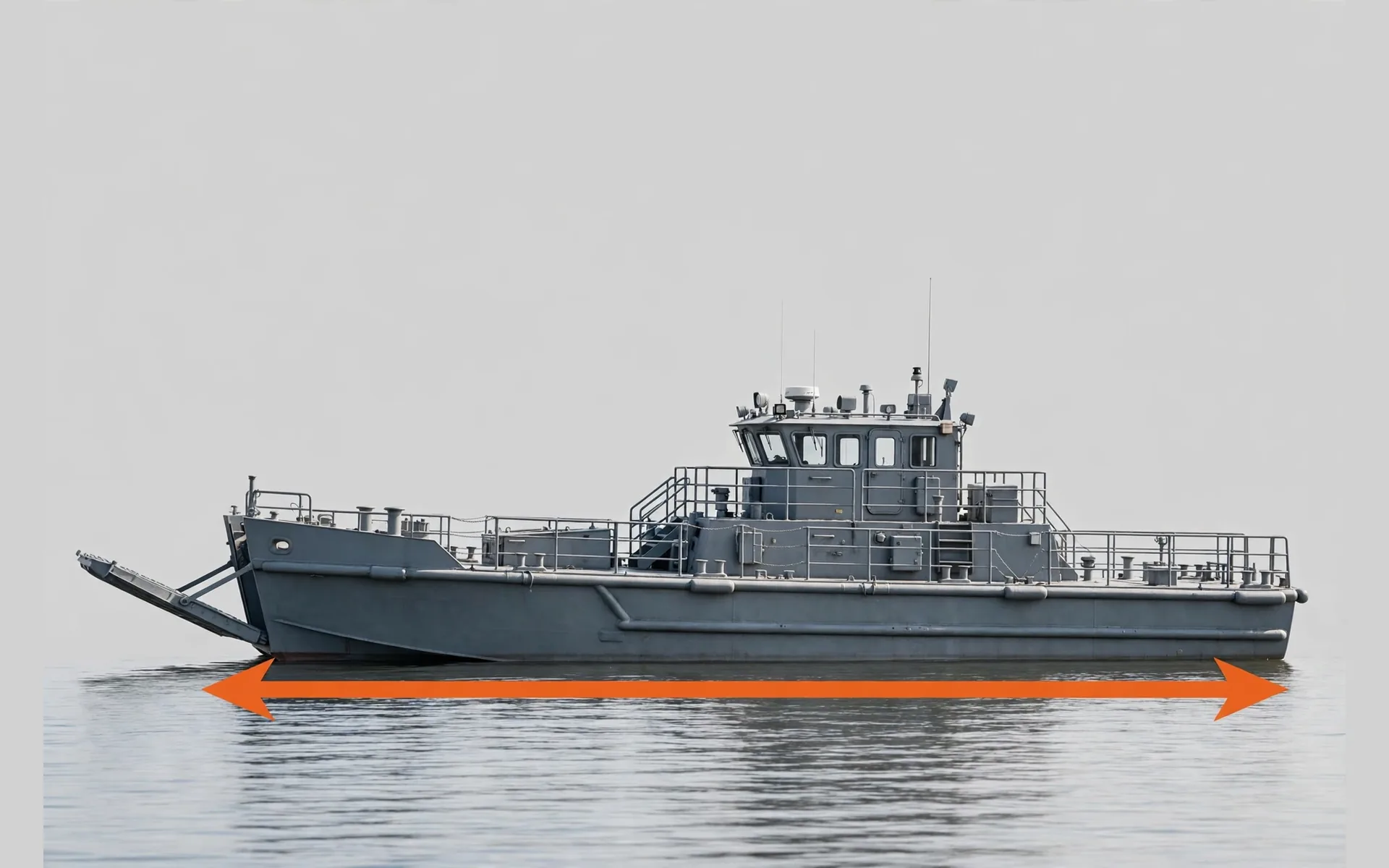
The landing craft is the article's cleanest land-on, because its 28 feet is printed in a government specification for a working boat, and there is nowhere for the number to hide. The Lake Assault LC28-9.5-FB is a 28-foot landing craft with a walk-around pilot house, built by Fraser Shipyards in Superior, Wisconsin, and sold to fire departments and agencies on a GSA contract — and Lake Assault's GSA specification sheet lists the hull length as 28 feet, with the careful note that the figure does not include the outboard engines, the engine guard, or the rub rails. Walk from the bow door to the transom and you have walked 28 feet — the same on every LC28 ever built, because the hull is the product, and the number in the model name is the hull length, not a floorplan code or a class name.
The fitting check is the bow door, because the boat's 28 feet is the hull and the thing people misjudge is what hangs off it. The LC28 carries a 64-inch hydraulically operated bow door that drops down to become a working platform, a 1,500-gallon-per-minute fire pump, a beam of 9 feet 6 inches, and a person-and-cargo capacity of 3,500 pounds, and the boat itself weighs about 9,100 pounds before the trailer — so a slip or a trailer bought against "28 feet" for this boat needs 28 feet of hull plus the outboards behind it, which the specification is careful to exclude. The guides that call a 28-foot boat "a common size" are right about the popularity and silent about the tape — and the grade is listed because the figure is the maker's own specification for the named model, with the deviation printed in full: 28 feet 0 inches, zero inches of miss. Measure the hull before you measure the slip, because the landing craft is the object in this article you drive into the water.
2. The Wawa Goose — 28 Ft Tall (REPORTED)
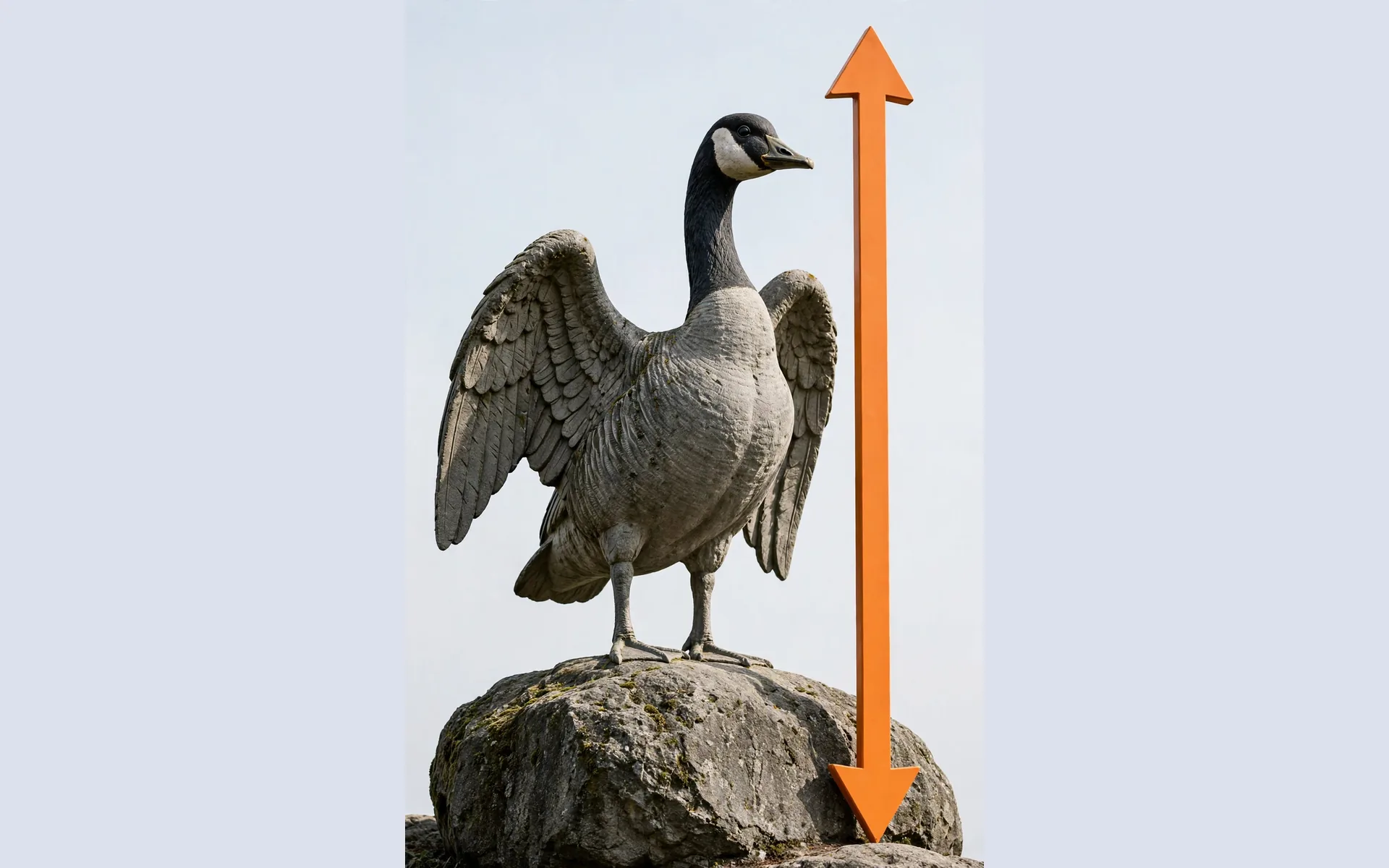
The goose is the article's most visible land-on, because it is 28 feet of steel standing on a rock where two highways meet, and you can drive to it. The Wawa Goose Monument stands at the junction of the Trans-Canada Highway and Highway 101 in Wawa, Ontario — a town whose name comes from the Ojibwe word for wild goose — and Northern Ontario Travel lists it as 28 feet tall, 22 feet long, with a wingspan of 20 feet, the largest goose statue of its kind in Canada. The first goose was unveiled in 1963, built of plaster over chicken wire by local businessman Al Turcott to draw tourists into town after the highway was re-routed past the downtown, and it did not survive the winters; the steel replacement did, and the third version, covered in a rust-proof bronze exterior, was unveiled on 1 July 2017 for Canada's 150th birthday. Stand underneath it and look up and you have looked up 28 feet — the same on every version of the statue, because the height is the product.
The fitting check is the length, because the goose's 28 feet is its height and the thing people misjudge is the other two numbers in the story: the bird is 22 feet long and its wingspan is 20 feet, so a photograph bought against "28 feet of goose" needs 28 feet of sky above the rock and 22 feet of ground behind it. The guides that list the goose as "28 feet tall and erected in 1960" are right about the height and three years early on the date — the statue was built to mark the completion of the final link of the Trans-Canada Highway, and the first version was unveiled in 1963, not 1960, which is a correction for later in this article. The grade is reported because the figure is the tourism body's published dimension for the named monument, with the deviation printed in full: 28 feet tall, 0 inches of miss, 22 feet long. Measure the height before you measure the photograph, because the goose is the object in this article you drive to.
3. Lee Redmond's Fingernails — 28 Ft 4.5 In Combined (REPORTED)
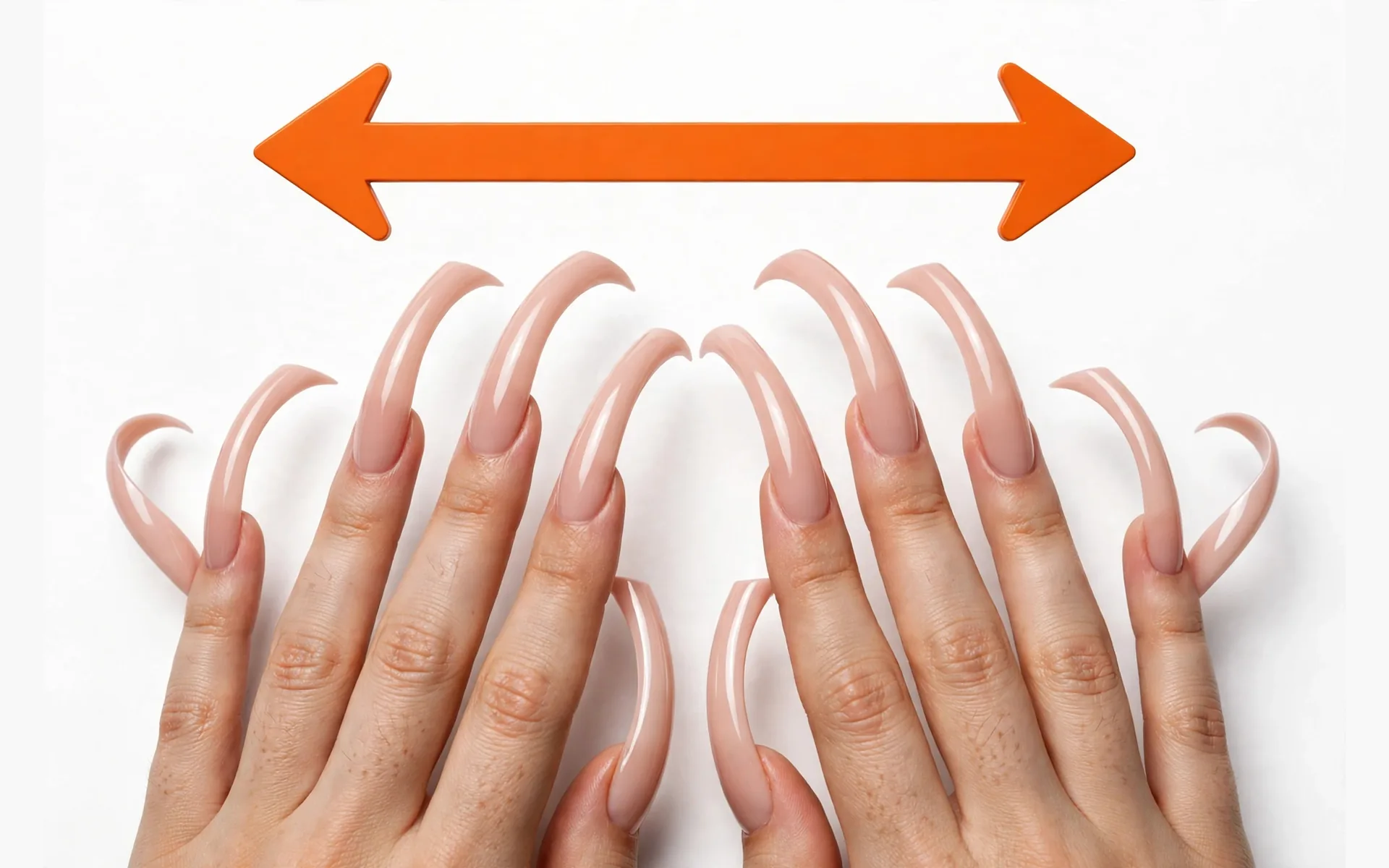
The fingernails are the article's strangest land-on, because they are 28 feet of human being, grown one millimetre at a time over thirty years. Lee Redmond of Salt Lake City, Utah, stopped filing her fingernails in 1979 as a personal challenge to see how long she could go without cutting them, and by 2008 they had grown to a combined length of 8.65 metres — 28 feet 4.5 inches — as measured on the set of the Italian television show Lo Show dei Record in Madrid on 23 February 2008, a measurement Guinness World Records still lists as the longest fingernails on a pair of hands ever (female). The longest single nail was her right thumb, 90 centimetres — 2 feet 11 inches — long, which is longer than most toddlers are tall, and she kept the nails in a zip-lock bag after they were lost, because thirty years of growth does not fit in a drawer. Lay all ten nails end to end and you have laid out 28 feet 4.5 inches — four and a half inches past the number in this article's title, and the same on every retelling, because the nails are the product.
The fitting check is the total, because the nails' 28 feet is a sum and the thing people misjudge is what is being added: ten nails, five on each hand, none of them longer than 2 feet 11 inches on its own, and the 28 feet only exists when you add them all together. The guides that list the nails as "28 feet long" are right about the number for once — it is the one claim in the rival list that survives a check against the record book, to the half-inch — and the grade is reported rather than listed only because no tape measure was ever published with the hands, only the record book's own measurement. The fitting check is also the ending, because in early 2009, a year after the measurement, Redmond was a passenger in a car crash and the impact snapped all ten nails off, and she kept them in a bag and never grew them back; the record stood until Diana Armstrong's 13.06 metres in 2022. The grade is reported because the figure is the record book's own measurement of the named thing, with the deviation printed in full: 28 feet 4.5 inches, four and a half inches over. Measure all ten before you measure one, because the nails are the object in this article you grow.
4. A Green Anaconda — 27 Ft 9 In, 44-In Girth (REPORTED)

The anaconda is the article's closest miss, and the one that proves a record can be true and still not be 28 feet. The green anaconda is the heaviest snake in the world, a constrictor of the Amazon's slow rivers and swamps, and the largest one ever reported was a female shot in Brazil around 1960 that measured 8.45 metres — 27 feet 9 inches — with a girth of about 111 centimetres, 44 inches, a figure Guinness World Records' longest-snake page still cites as the historical report. Stretch that snake out straight and you have stretched out 27 feet 9 inches — three inches short of the number in this article's title, and the same on every retelling, because the snake is the product. The 44-inch girth is the detail that proves the story travelled intact: the rival list quotes the same 44 inches, and the same 28 feet, and the girth is right while the length is three inches generous — which is the difference between a measurement and a rounding.
The fitting check is the present day, because the anaconda's 27 feet 9 inches belongs to 1960 and the thing people misjudge is how much smaller the verified snakes of today are. The largest female in Dr Jesús Rivas's field study of 1,000 wild green anacondas measured 5.21 metres — 17 feet 1 inch — and weighed 97.5 kilograms, which is eleven feet shorter than the historical record, and the stories of 30-foot and 40-foot anacondas that still circulate are the ones no one has ever produced a specimen for. The guides that call the longest anaconda "about 28 feet long" are right about the animal and three inches generous about the tape — and the grade is reported because the figure is a historical report carried by the record book, not a modern measurement, with the deviation printed in full: 27 feet 9 inches, three inches short, 44 inches around. Measure the field study before you measure the legend, because the anaconda is the object in this article you do not want to meet.
5. An Airstream Flying Cloud 28RB — 28 Ft 2 In Long (LISTED)
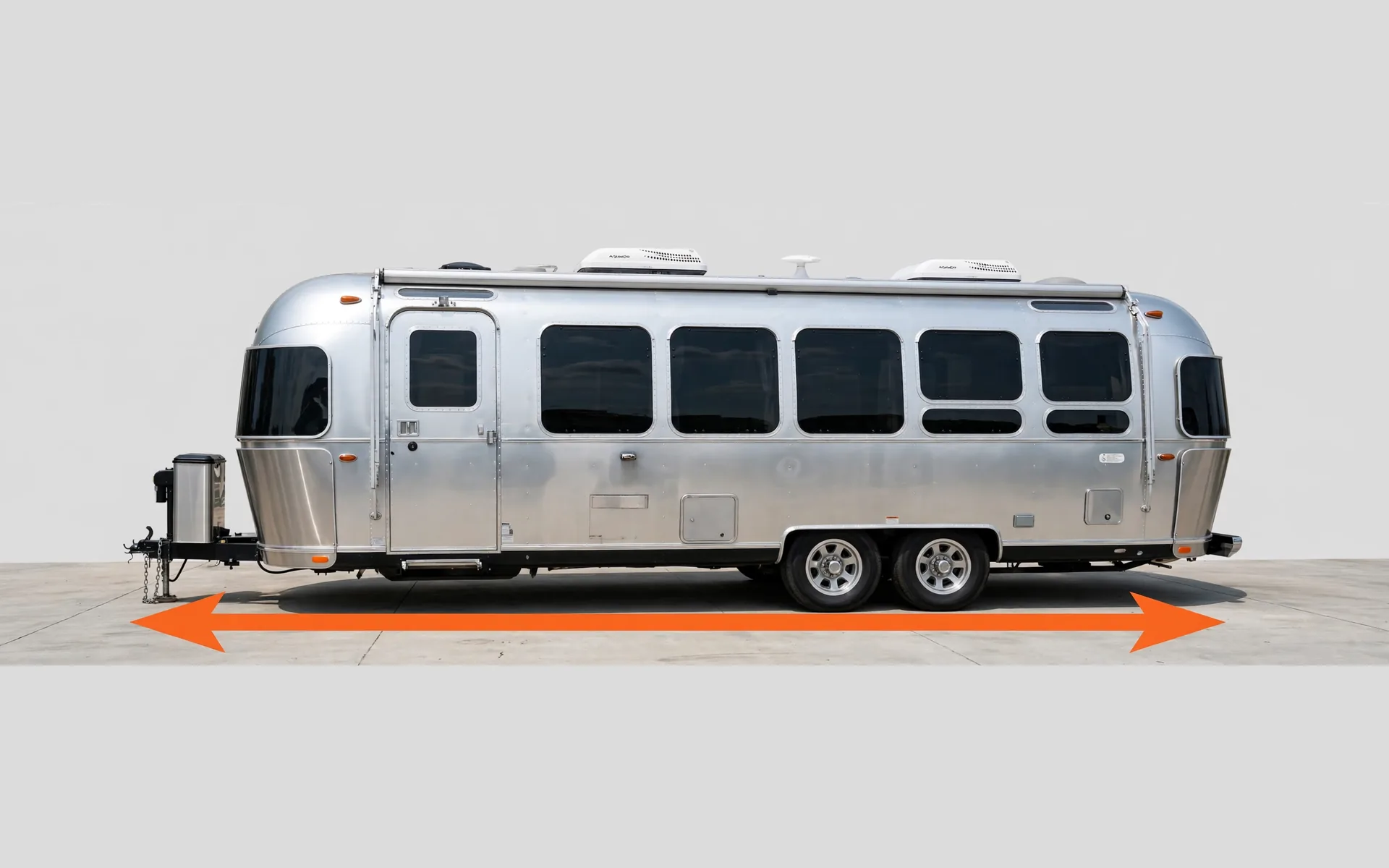
The Airstream is the article's most instructive miss, because it is the trailer whose name is a number and whose tape disagrees by two inches — for the second time in this series. The Flying Cloud 28RB is Airstream's rear-bedroom travel trailer, and the maker's own brochure lists it at 28 feet 2 inches long outside, 8 feet 5.5 inches wide, sleeping six, with a base weight of 5,900 pounds and a gross vehicle weight rating of 7,600 pounds. Tow one onto a site and walk from the hitch to the rear bumper and you have walked 28 feet 2 inches — two inches past the number in this article's title, and the same on every 28RB ever sold, because the shell is the product.
The fitting check is the sister model, because the Airstream's extra two inches live next to a trap this series has already sprung once. The Flying Cloud 27FB — the trailer in the previous article in this series — is also 28 feet 2 inches long outside, which means the 27 and the 28 are the same shell with different floorplans inside, and the "28" in 28RB is a floorplan code, not a tape measure, exactly as the "27" in 27FB was. A campsite bought against "28 feet" for this trailer fails by two inches if you trust the name instead of the brochure, and the guides that call the 28RB "a 28-foot Airstream" are right about the model and two inches wrong about the measurement, because two inches is the difference between a trailer that fits its pitch and one that hangs into the road. The grade is listed because the figure is the brochure's own dimension for the named model, with the deviation printed in full: 28 feet 2 inches, two inches over. Measure the hitch before you measure the pitch, because the Airstream is the object in this article you tow.
6. A Werner D6228-2 Extension Ladder — 28 Ft Long, 25 Ft of Work (LISTED)
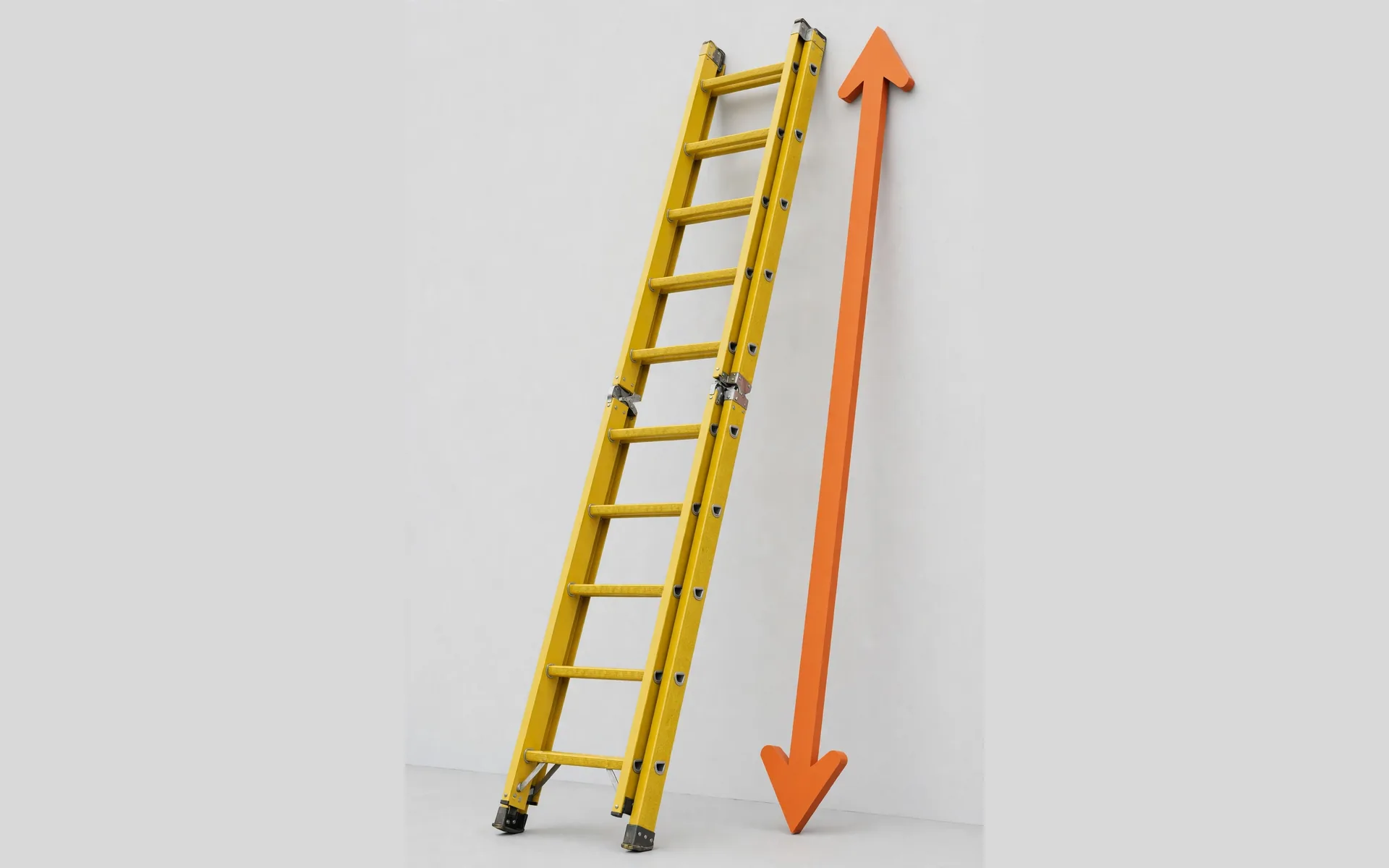
The ladder is the article's most honest object, because it is 28 feet long and 25 feet long at the same time, and both numbers are true. The Werner D6228-2 is a 28-foot Type IA fibreglass D-rung extension ladder, and Werner's own specification sheet lists it as a 28-foot ladder with a 300-pound duty rating, a reach height of 27 feet, and a maximum working length of 25 feet, weighing about 59.5 pounds. Lean it against a wall, fully extended, and the rails run 28 feet from the feet to the top — the same on every D6228-2 ever sold, because the rails are the product.
The fitting check is the overlap, because the ladder's 28 feet is the full extended length and the thing people misjudge is how much of it you can actually use. The two sections overlap by 3 feet when the ladder is extended, which is why the maximum working length is 25 feet and not 28, and the reach height is 27 feet because a person standing on the highest safe rung — four rungs down from the top, by the maker's own rule — reaches about 27 feet with their hands. A roof bought against "28 feet" for this ladder needs 25 feet of working length and 27 feet of reach, not 28 feet of either, and the guides that call a 28-foot ladder "28 feet of ladder" are right about the size class and wrong about the work, because three feet of overlap is the difference between a ladder that reaches the gutter and one that stops a rung short. The grade is listed because the figure is the maker's own size for the named model, with the deviation printed in full: 28 feet by the size, 25 feet by the work, 27 feet by the reach. Measure the overlap before you measure the wall, because the ladder is the object in this article you climb.
The 6 Objects at a Glance
| Object | Figure | Miss vs 28 ft | Grade |
|---|---|---|---|
| Lake Assault LC28 landing craft hull | 28 ft 0 in | 0 | LISTED |
| Wawa Goose monument height | 28 ft | 0 | REPORTED |
| Lee Redmond's fingernails, combined | 28 ft 4.5 in | 4.5 in over | REPORTED |
| Green anaconda, Guinness-cited female | 27 ft 9 in | 3 in short | REPORTED |
| Airstream Flying Cloud 28RB | 28 ft 2 in | 2 in over | LISTED |
| Werner D6228-2 extension ladder | 28 ft (25 ft working) | 0 by size | LISTED |
Twenty-eight feet sits on a round number in no system, and the table is the proof. Step across the list and the numbers barely move: the landing craft and the goose at 28 feet exactly, the anaconda three inches short, the trailer two inches over, the nails four and a half inches over — and the point of it is the middle: 28 feet has two land-ons behind it that you can drive and drive to, three misses you can grow, meet, and tow, and a ladder that is two lengths at once, and every object with a fixed figure sits inside a four-and-a-half-inch band, which is why 28 feet is a size you can trust to the inch and still call it one number.
Pacing Out 28 Feet With What You Already Own
Twenty-eight feet is a number you can check without a second tool, because the objects in this article are the tools — but only if you use the objects themselves, not your body. First, take the steps: the University of Iowa puts the average adult's walking step at 2.5 feet, so take 11 steps and you have walked 27.5 feet — six inches short — and take 12 steps and you have walked 30 feet, two feet over, so the honest count is 11.2 steps, and anyone who tells you 11 paces is rounding away six inches. Second, take the football field: a first down is 10 yards, 30 feet, so 28 feet is 93.3% of a first down — stand on the goal line and walk to the 9-yard line and you have walked 27 feet, and one more foot takes you to 28, and the 2 feet left to the first-down marker are the gap between this article's number and the next one. Third, take the bowling lane: a lane is 60 feet from the foul line to the head pin, so 28 feet is just under half a lane — stand at the foul line and walk 28 feet down the lane and you are not yet halfway to the pins, and the rest of the lane is the part you have not walked. Fourth, take the basketball court: an NBA court is 94 feet long, so 28 feet is just under three-tenths of it — stand at one baseline and walk 28 feet down the court and you are not yet a third of the way to the far basket. None of these replaces a calibrated tool for anything that must fit, but all four will tell you whether 28 feet is the size you think it is before the trailer is towed or the ladder is leaned — and the steps are the one to trust, because their 0.2 is the smallest miss you can walk.
Six 28-Foot Numbers That Do Not Survive a Tape Measure
Six wrong numbers about 28 feet circulate so widely that they deserve their own section, because each one is stated confidently on a page that ranks for this exact question. First, the robot: one popular guide says the world's largest robot stands 28 feet tall and weighs about five tons, and Guinness's largest-humanoid-vehicle record measures the Mononofu at 8.46 metres — 27 feet 9 inches — tall and 7.3 tonnes, so the guide is three inches generous on the height and more than two tons light on the weight. Second, the beaver: another guide says the Giant Beaver in Beaverlodge, Alberta stands 15 feet tall and 28 feet long, and the beaver itself is 18 feet long and 15 feet high, sitting on a 20-foot log — the 28-foot figure appears nowhere in the sources, and the town's own site calls the whole monument about 8 metres, 26 feet, tall. Third, the motorhome: another guide says Class C motorhomes have an average length of 28 feet, and a class average is not a thing — Class C motorhomes range from about 20 to about 33 feet, and no named model in the class is 28 feet by its specification. Fourth, the giraffe: another guide says 28 feet is the height of a mature giraffe, and the tallest giraffe ever measured stood 19 feet — males top out at 18 feet — so the guide is nine to ten feet generous, which is the height of a whole extra giraffe's neck and shoulders. Fifth, the school bus: another guide says 28 feet is the length of a standard school bus parked vertically, and a standard school bus is 35 to 45 feet long — 28 feet is roughly two-thirds of a bus, not a bus, and parking it vertically does not make it shorter. Sixth, the killer whale: another guide says the largest female killer whale ever reported stood 28 feet tall, and the numbers are right but the words are wrong — the US Fish & Wildlife Service lists the largest recorded female at 8.5 metres, 28 feet, long and 16,500 pounds, which is a length, not a height, and a record maximum, not a typical female, since most adult females measure 16 to 23 feet. None of these six numbers belongs in a 28-foot article as an object, and all six are here so you never have to learn that from a purchase.
How 28 Feet Compares With Other Lengths
Readers comparing nearby sizes may also want the site’s guides to 27 feet, 29 feet, 26 feet, 25 feet, 24 feet, 23 feet, 22 feet, and 30 feet for the foot series, and the feet hub and inches hub for the full directories. Each of those guides follows the same rule as this one: the spec sheet, the grade, and the miss printed in full.
Frequently Asked Questions
How many meters is 28 feet?
28 feet is exactly 8.5344 meters, usually rounded to 8.53 meters. Multiply 28 by 0.3048 and you get 8.5344 — and the trap is rounding that to 8.5 meters, which understates the length by 1.4 inches, or dividing 28 by 3 and calling the answer metres, which gives 9.33 metres and overstates it by 80 centimetres. For anything that must fit, use 8.5344 meters; for a quick estimate in your head, 8.53 meters is close enough to picture it and only 0.4 millimetres short.
How many inches is 28 feet?
336 inches exactly. Multiply 28 by 12 and you get 336, with no rounding at all. In centimetres that is 853.44 cm, in millimetres it is 8,534.4 mm, and in yards it is 9 yards 1 foot — 9.33 yards — which is the only one of the conversions in this article that does not come out whole, and the reason 28 feet has no round name in any system.
How many yards is 28 feet?
9 yards and 1 foot — 9.33 yards. There are 3 feet in a yard, and 28 divided by 3 is 9 with 1 foot left over, which is the reason 28 feet has exact objects where 27 feet had a round number: 27 feet was 9 yards on the nose, and 28 feet is 9 yards plus the foot that would not fit. In metres, 9 yards 1 foot is 8.53 metres, which is the same figure as the Lake Assault landing craft's hull.
How many steps does it take to walk 28 feet?
Eleven steps and a fifth of a twelfth, at the average adult's step length. The University of Iowa puts the average walking step at 2.5 feet, so 11 steps cover 27.5 feet — six inches short of 28 feet — and 12 steps cover 30 feet, which is two feet over. The honest count is 11.2 steps, and anyone who tells you 11 paces is rounding away six inches.
Is 28 feet the same as 8.5 meters?
No, and the difference is 1.4 inches. Eight and a half meters is 27 feet 10.6 inches, which is 1.4 inches shorter than 28 feet — the thickness of a finger missing from your measurement. For picturing the length in your head, 8.5 meters will mislead you by that much; for anything that must fit — a trailer bay, a boat slip, a ladder's reach — use 8.53 meters, which is 28 feet to within 0.4 millimetres.
What common objects are 28 feet long?
The most exact everyday answers are a Lake Assault LC28 landing craft (28 feet of hull, by the maker's specification) and the Wawa Goose monument (28 feet tall, by the town's own tourism body). The next closest are a green anaconda (27 feet 9 inches, three inches short, by the record book's historical report), an Airstream Flying Cloud 28RB (28 feet 2 inches, two inches over, by the maker's brochure), Lee Redmond's fingernails (28 feet 4.5 inches combined, by the record book's measurement), and a Werner D6228-2 extension ladder (28 feet fully extended, 25 feet of working length). A school bus is 35 to 45 feet and a giraffe tops out at 19 feet — neither is 28 feet, whatever the guides say.
How long is a 28-foot ladder really?
28 feet when fully extended, 25 feet when you work from it, and 27 feet of reach. The Werner D6228-2 is sold as a 28-foot ladder, and its rails do run 28 feet from the feet to the top when it is fully extended — but the two sections overlap by 3 feet, so the maximum working length is 25 feet, and the reach height is 27 feet because the highest safe standing level is four rungs down from the top. Buy the ladder for the 25 feet of work, not the 28 feet of size, and the roof will fit the first time.
Is a school bus 28 feet long?
No. A standard school bus is 35 to 45 feet long, so 28 feet is roughly two-thirds of a yellow school bus — the length of the bus with its back third cut off — and parking it vertically does not make it shorter. The guides that call a school bus "typically around 28 feet" are describing a short bus or a minibus, not the standard school bus, and the standard one is seven to seventeen feet longer than the number in this article's title.
Final Thoughts
Twenty-eight feet is the rare measurement that is round in no system and exact in two objects, because nine yards and a foot left over can be a landing craft, a goose, a set of fingernails, a snake, a travel trailer, and a ladder — and the number alone never says which. Now you know it as a hull's length fixed by its maker, a statue's height fixed by its town, a record fixed by its measurer, a snake's length fixed by history, a trailer's length fixed by its brochure, and a ladder's length fixed by its overlap — and you know which of those you can trust to the inch, which ones miss by inches you can see, and which numbers about 28 feet belong in the corrections section instead of the list. The rule that runs through all six is the same one this site always uses: trust the spec sheet, print the deviation, and let the name stay on the box where it belongs. Measure twice, in the direction the object actually travels, and 28 feet will fit the first time.
