
The most famous hundred metres on Earth is not a hundred metres. The home straight of a standard 400-metre track — the straight every rival page calls “exactly 100 metres” — is 84.39 metres long, and the 100-metre dash is run on a straight that has been stretched 15.61 metres past it. The other famous hundred, the football field, is 100 yards, which is 91.44 metres, and the field with its end zones is 109.73 metres — so the field is either 8.56 metres short of a hundred metres or 9.73 metres over it, and never the number itself. One hundred metres is 328.08 feet, a tenth of a kilometre, and the distance Usain Bolt covered in 9.58 seconds. This article is about that number: what a hundred metres actually is, six things that really measure it, and the miss printed next to each one — because every rival page says “about”, and “about” is where the miss hides.
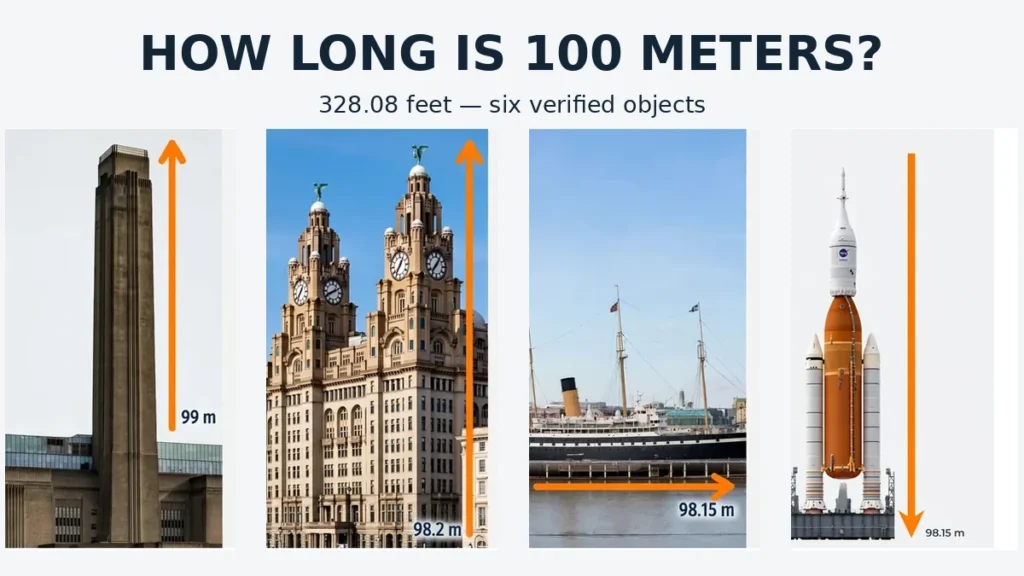
How long is 100 meters, then, in plain terms? It is 328.08 feet — 328 ft 1 in — or 109.36 yards, or 3,937.01 inches, or 0.1 kilometres. It is ten lengths of 10 metres, or a hundred 1-metre lengths, or about 132 walking steps. The six objects below are the closest honest answers to it: a chimney 1 metre short, a building 1.80 metres short, a ship and a rocket that are both 322 feet long and both 1.85 metres short, a clock tower 4 metres short and four tennis courts 4.92 metres short — and every one of them carries the source that proves it.
Quick Answer
100 metres is 328.08 feet — 8.56 metres longer than 100 yards.
One hundred metres is 328.08 feet, 3,937.01 inches and 0.1 kilometres. Five objects land within 2 metres — a 99 m chimney, a 98.2 m building, a 322 ft ship and a 322 ft rocket — and the other two, a 96 m tower and four tennis courts at 95.08 m, sit within 5 m.
The bar above shows one hundred 1 m segments, but it is a diagram, not a ruler: screen sizes vary, so it explains the measurement rather than measuring it. For a real measurement, use the objects below or a tape measure.
The 8.56-Metre Gap: 100 Yards Is Not 100 Metres
The trap in this article is a shared number, and it is the same trap as the 40-metre article’s, one scale up. One hundred yards and one hundred metres both start with “100”, and the brain files them in the same drawer. They are not the same drawer. A yard is three feet — 0.9144 m — so 100 yards is 91.44 m, and 100 metres is 8.56 m longer than 100 yards, or 9.36 yards longer. The American football field is 100 yards from goal line to goal line, which is 91.44 m, and 120 yards from end zone to end zone, which is 109.73 m. So the field that every rival page calls “almost exactly 100 metres” is either 8.56 metres short of a hundred metres or 9.73 metres over it — and no rival page says which one it means, because the page has not decided whether the end zones count.
The same shared number bites on the running track, and here the error is worse, because four of the five rival pages share it. A standard 400-metre track is two straights and two bends: the straights are 84.39 metres each and the bends are 115.61 metres each on the running line, and twice 84.39 plus twice 115.61 is exactly 400.00 metres. The home straight is therefore 84.39 metres long — 15.61 metres short of a hundred metres — and the 100-metre dash is run on a straight that has been extended 15.61 metres past the home straight, out of the bend and into the ground beyond it. A page that writes “one straightaway on an outdoor running track measures exactly 100 meters” has measured the race, not the track, and has presented the race as the track. The dash is exactly 100 metres. The straightaway is 84.39 metres. They are two different things that happen to share a stadium.
And then there is “about”. Every rival page leans on the word — about 100 metres, almost 100 metres, nearly 100 metres, roughly 100 metres — and the word is doing heavy lifting, because the misses it hides run from 4.92 m to 541.79 m. Twenty-seven tennis courts are 641.79 m, not 100 m. Eight step-deck trailers are 117 to 129 m, not 100 m. One and a half hockey rinks are 90 m, not 100 m. A bowling lane is 18.29 m, not 21.3 m. The rule for this article: if a comparison needs the word “about”, print the miss next to it.
| Rival “about 100 m” claim | What it actually measures | The miss |
|---|---|---|
| A football field, goal line to goal line | 91.44 m | 8.56 m short |
| A football field, end zone to end zone | 109.73 m | 9.73 m over |
| One track straightaway | 84.39 m | 15.61 m short |
| Three basketball courts | 85.95 m | 14.05 m short |
| One and a half hockey rinks | 90.00 m | 10.00 m short |
| Eight step-deck trailers | 117–129 m | 17–29 m over |
| Two Boeing 737s | 78.94 m | 21.06 m short |
| Twenty-seven tennis courts | 641.79 m | 541.79 m over |
| A bowling lane, at 21.3 m each | 18.29 m each | 3.01 m per lane |
| A football field, “usually around 110 m” | 91.44 m or 109.73 m | Neither figure is 110 m |
The table is the article in miniature: the honest comparisons cluster within a few metres of 100, and the dishonest ones never print a number. That is what the next six sections do — six things that have been measured.
6 Things That Are 100 Metres
The six objects are ordered by how close they land on 100 m, closest first, and each one carries its evidence grade in the heading. EXACT means the figure is the manufacturer’s or certifying authority’s published dimension. REPORTED means the figure is an authority rule or a published reference measurement, not a manufacturer spec. Five of the six land within 2 metres of 100 m, and the furthest is 4.92 m short — a mean absolute deviation of 2.57 m, and no object more than 5% away.
A published 100 m designation does not mean every unit measures mathematically 100.000 m: a chimney is quoted in round metres, a building is quoted to the top of its spires while its roof sits 47.3 m lower, a ship and a rocket share the same 322-foot figure from two different centuries, and four tennis courts are quoted from a rulebook that rounds 23.7744 m to 23.77 m. What follows is what the source actually says, with the axis named every time, so you can check it yourself.
1. Tate Modern Chimney, Height 99 m — 1.00 m Short (EXACT)
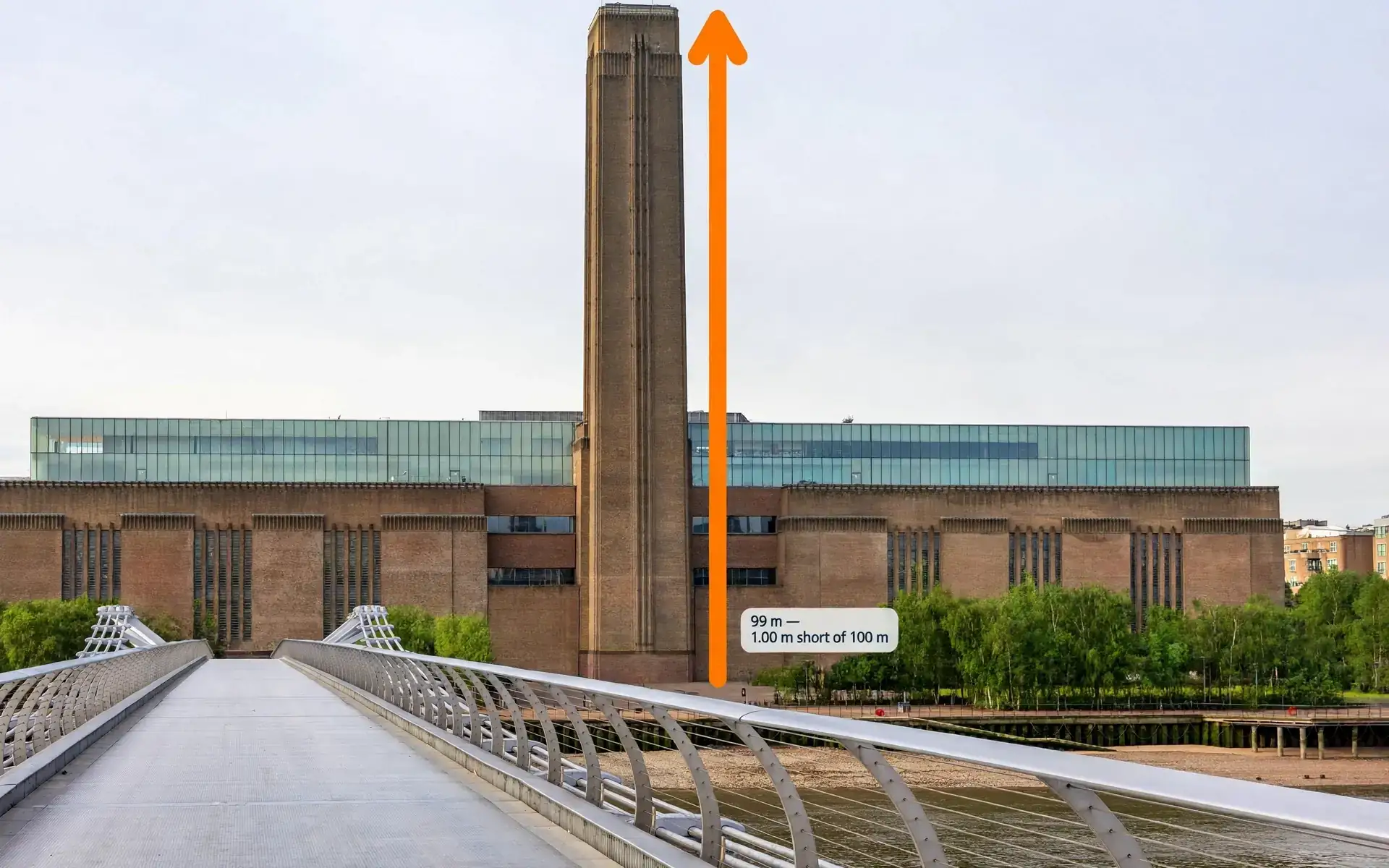
The chimney is the article’s closest land-on, because its 99 m is the height the building’s own owner publishes for it, on the institution’s own facts page. Tate’s own facts-and-figures page lists the chimney at 99 m (325 ft), “specifically built to be lower than the dome of St Paul’s Cathedral”, so the chimney measures 99 m from the ground to its top — 1.00 m short of 100 m, the tightest land-on in this article and one of the tightest in the whole series. That is why it sits first on this page.
The fitting check is the building: the chimney is 99 m tall but the building it serves is 200 m long, and the Turbine Hall inside it is 152 m long and 35 m high — a vertical number on a horizontal building, and the two must never be swapped. The grade is exact because the figure is the owner’s own published dimension for its own building, with the deviation printed in full: 99 m, 1.00 m short. One caution: 325 ft converts to 99.06 m, so the precise miss is 0.94 m — the article states Tate’s rounded 99 m. Never write “the chimney is exactly 100 m” — it is a metre short, and the metre is the whole point of putting it first.
2. Royal Liver Building, Architectural Height 98.2 m — 1.80 m Short (REPORTED)
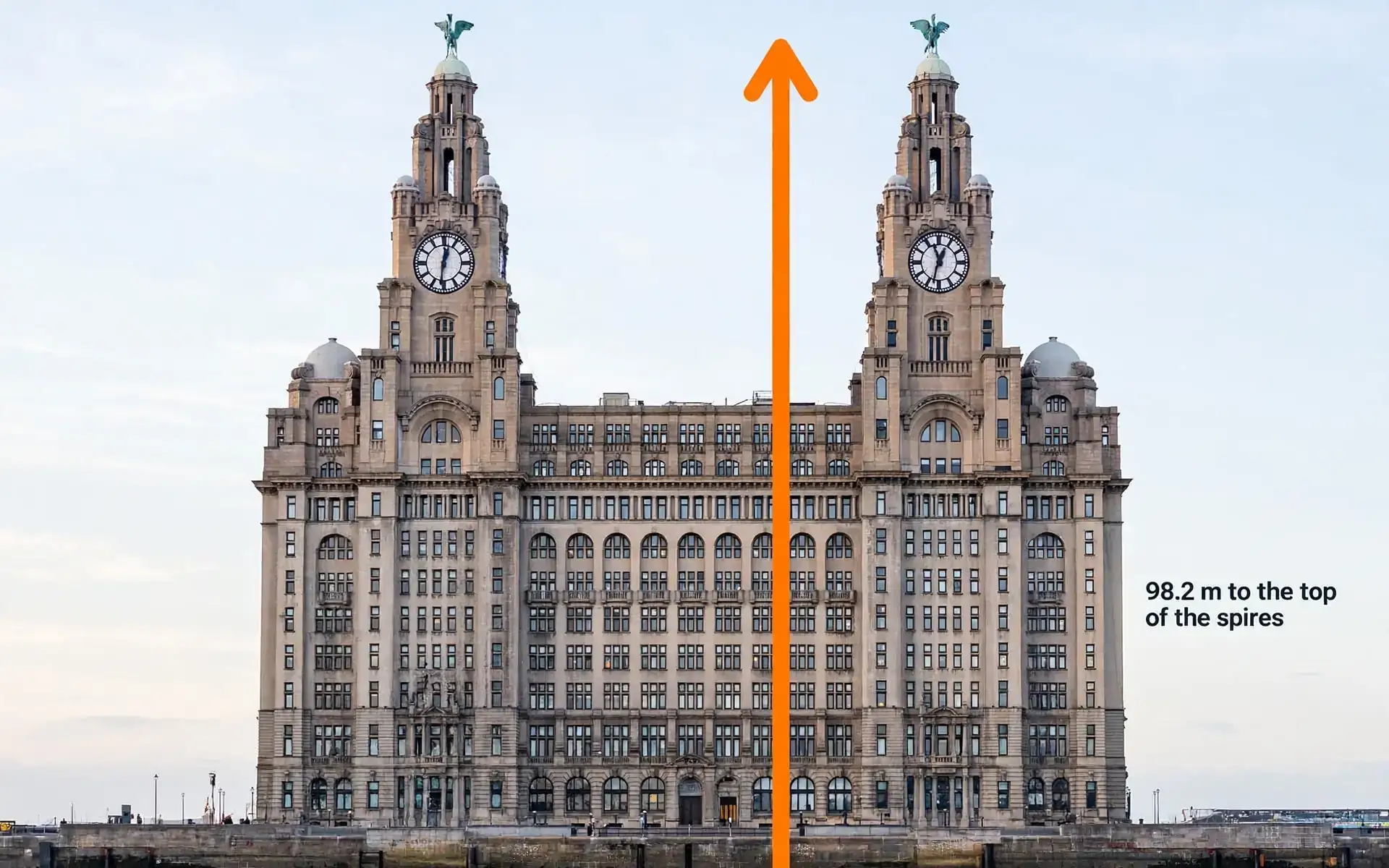
The Liver Building is the article’s second-closest land-on, and the one that proves 100 m is a building height as well as a length. The building stands at 98.2 m (322 ft) tall to the top of the spires, 103.7 m (340 ft) to the top of the Liver Birds and 50.9 m (167 ft) to the main roof, so the building measures 98.2 m from the ground to the top of its clock-tower spires — 1.80 m short of 100 m, the second-tightest land-on in this article. That is why it sits second on this page.
The fitting check is the roof, because the building is 98.2 m to the spires but only 50.9 m to the main roof — the clock towers add 47.3 m, nearly half the total height, on top of a thirteen-storey block. A guide that says “the Liver Building is 98 metres tall” without “to the top of the spires” has given the right number for the wrong thing. And the birds add a third number: the two Liver Birds are 5.5 m high each, and with them the building reaches 103.7 m — 3.7 m OVER 100 m — so the same building is 1.80 m short to the spires and 3.70 m over to the birds, and the axis decides which. The grade is reported because the figure is a published reference measurement — the building was completed in 1911, and its dimensions are carried in the reference literature. The deviation is printed in full: 98.2 m, 1.80 m short.
3. SS Great Britain, Length Overall 322 ft (98.15 m) — 1.85 m Short (REPORTED)
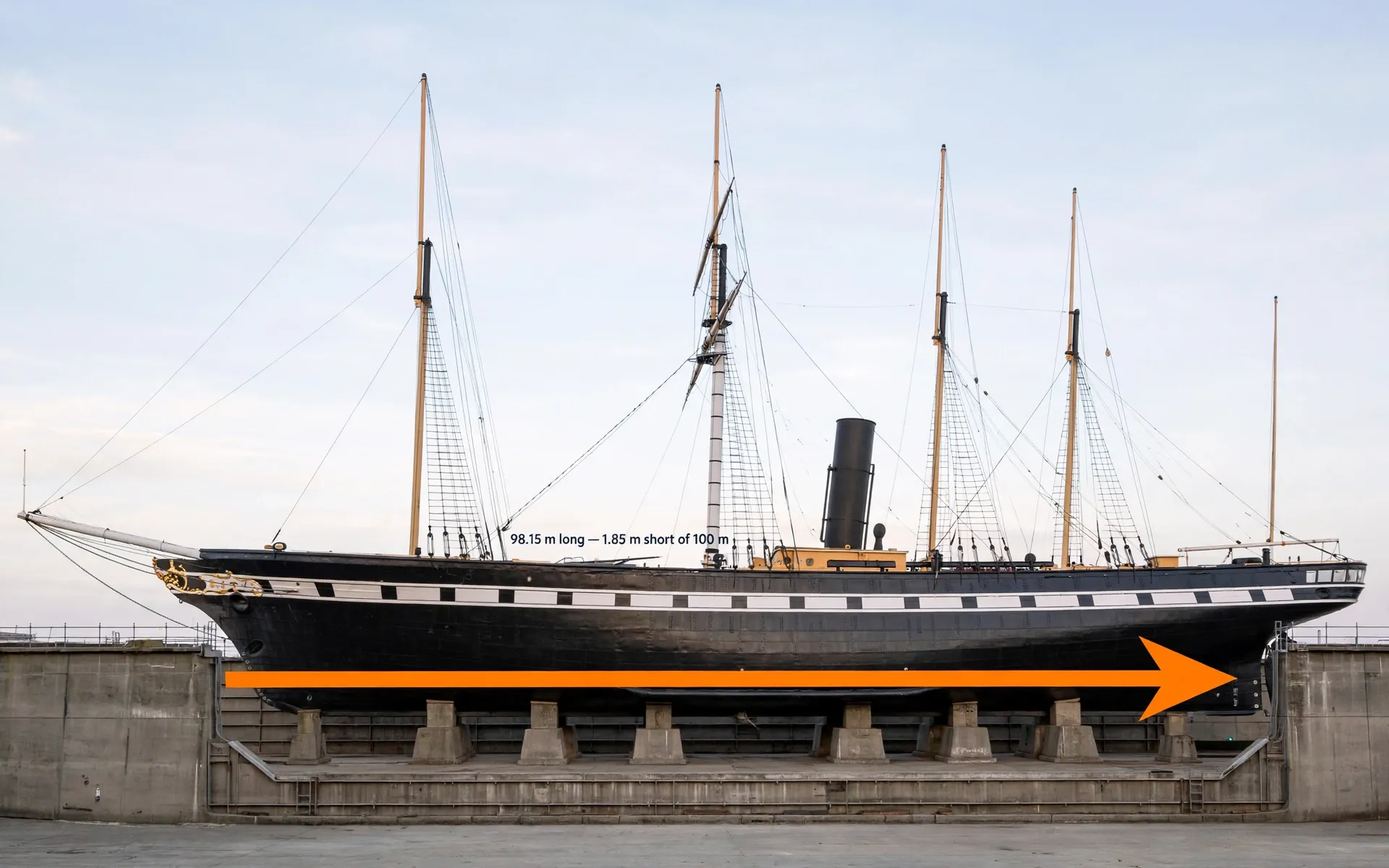
The ship is the article’s oldest land-on, and the one that proves 100 m is a Victorian number as well as a modern one. The American Society of Mechanical Engineers’ landmark record gives her overall length as 322 feet, and 322 ft is 98.15 m, so the ship measures 98.15 m from bow to stern — 1.85 m short of 100 m, the joint-third-tightest land-on in this article. That is why she sits third on this page.
The fitting check is the beam, because the ship is 98.15 m LONG but 15.39 m wide (50 ft 6 in) with a draught of 4.9 m (16 ft), and her 3,400-ton displacement is a weight, not a length. Length decides the dry dock; beam decides the dock’s width; draught decides the dock’s depth. A dry dock built for a 100 m ship fits the Great Britain with 1.85 m to spare on length — and then needs the beam and the draught checked separately, because a ship is three numbers at once. The grade is reported because the figure is a published reference measurement — the ship was launched in 1843, and her dimensions are carried in the engineering landmark record. The deviation is printed in full: 98.15 m, 1.85 m short.
4. SLS Block 1, Height 322 ft (98.15 m) — 1.85 m Short (EXACT)
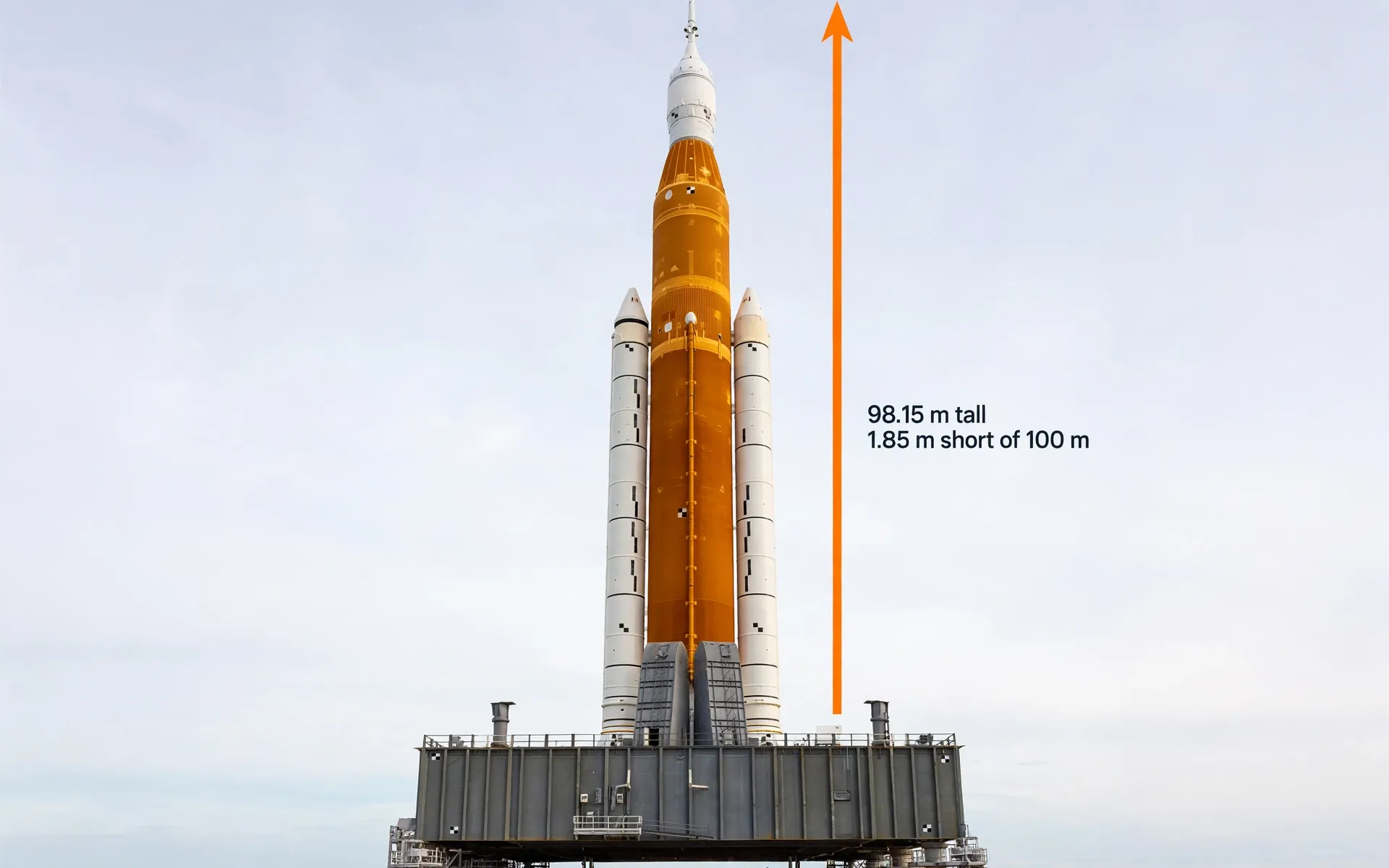
The rocket is the article’s newest land-on, and the one that shares its number with the ship above it. NASA’s own SLS pages put the Block 1 vehicle at 322 feet tall, “higher than the Statue of Liberty”, and 322 ft is 98.15 m, so the rocket measures 98.15 m from the launch pad to the tip of the Orion spacecraft — 1.85 m short of 100 m, the joint-third-tightest land-on in this article. That is why it sits fourth on this page.
The fitting check is the spacecraft, because the rocket is 98.15 m tall WITH the Orion spacecraft on top, and the core stage alone is 65 m (213 ft) long with an 8.4 m diameter. Thirty-three metres of the vehicle is boosters, upper stage and spacecraft — the part that leaves the pad is not the part that goes to the Moon. A guide that says “the SLS is 98 metres tall” without “Block 1, with Orion” has given the right number for one configuration of a rocket that comes in three: Block 1B and Block 2 will be 111 m (365 ft) tall, taller than the Saturn V, and the 98 m figure will not apply to them. The grade is exact because the figure is NASA’s own published dimension for the named configuration: 98.15 m, 1.85 m short. And the coincidence is the hinge of this article: the SLS and the SS Great Britain are both 322 feet, both 98.15 m, both 1.85 m short — the first modern ocean liner, launched in 1843, and the Moon rocket, first flown in 2022, measure the same, 179 years apart. The statue it is taller than stands 93 m from ground level to torch — the copper statue itself is 46 m, and the rest is pedestal and foundation.
5. Elizabeth Tower (Big Ben), Height 96 m — 4.00 m Short (EXACT)
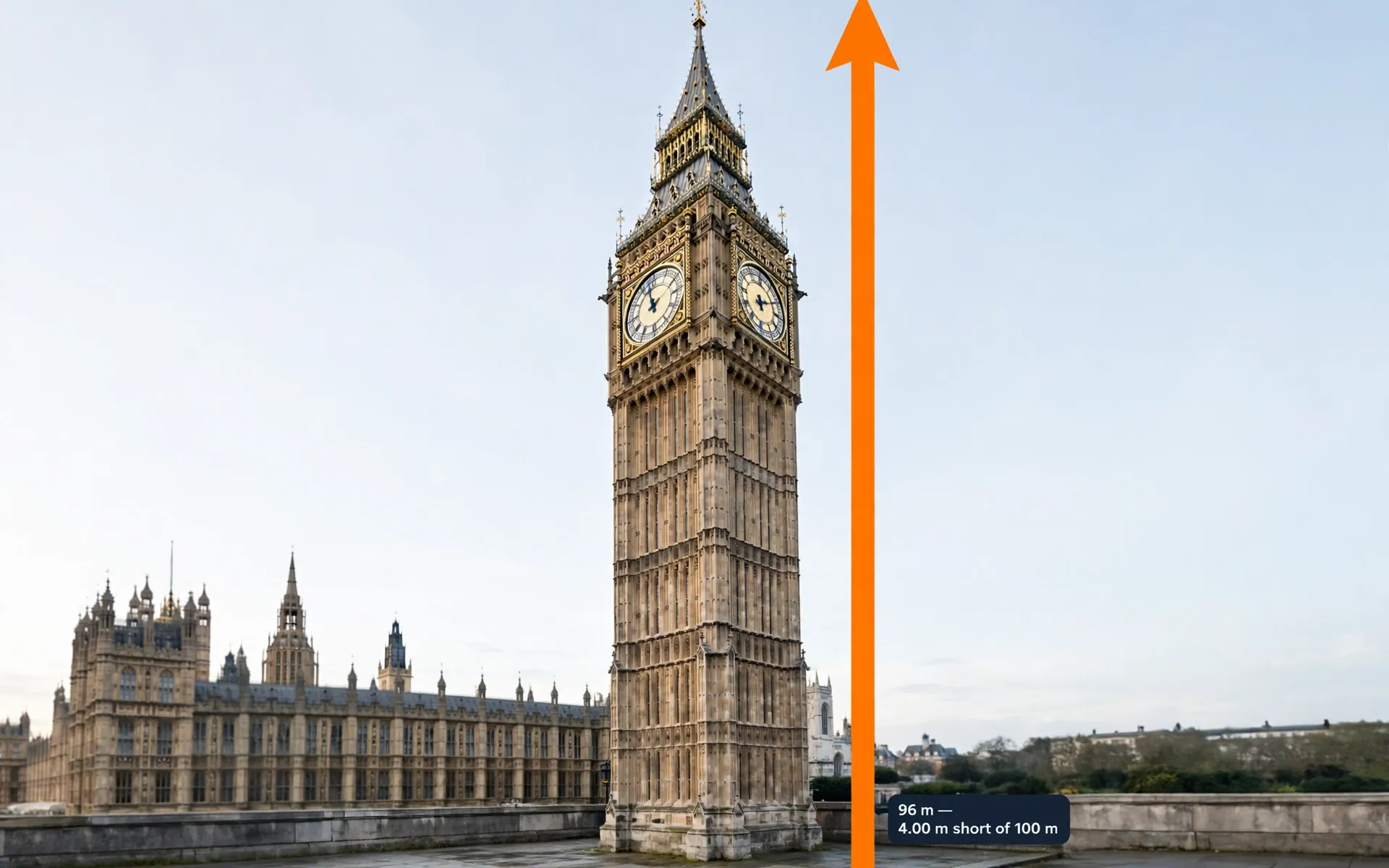
The tower is the article’s most famous land-on, and the one that proves 100 m is a bell tower as well as a chimney. UK Parliament’s own towers page gives the Elizabeth Tower as 96.3 m (316 ft), “commonly known as Big Ben after its main bell”, and Parliament’s own facts page says “11 floors. 96 metres.”, so the tower measures 96 m from the ground to the tip of its spire — 4.00 m short of 100 m, the fifth-tightest land-on in this article. That is why it sits fifth on this page.
The fitting check is the bell, because “Big Ben” is the Great Bell, not the tower — the bell weighs 13.7 tonnes and hangs in the belfry 334 steps up, while the tower is the Elizabeth Tower, renamed in 2012 for the Diamond Jubilee. A guide that says “Big Ben is 96 metres tall” has given the bell the tower’s height, and a guide that says “the tower is 96 metres” without “to the tip of the spire” has given the right number for the wrong part — the clock faces are 7 m across and sit well below the spire. The grade is exact because the figure is the authority’s own published dimension for its own tower: 96 m, 4.00 m short — the precise figure is 96.3 m, so the real miss is 3.68 m. Never write “Big Ben is 96 metres tall” — the bell is 13.7 tonnes, the tower is 96 metres, and the two are not the same thing.
6. Four Tennis Courts End to End, Length 95.08 m — 4.92 m Short (REPORTED)
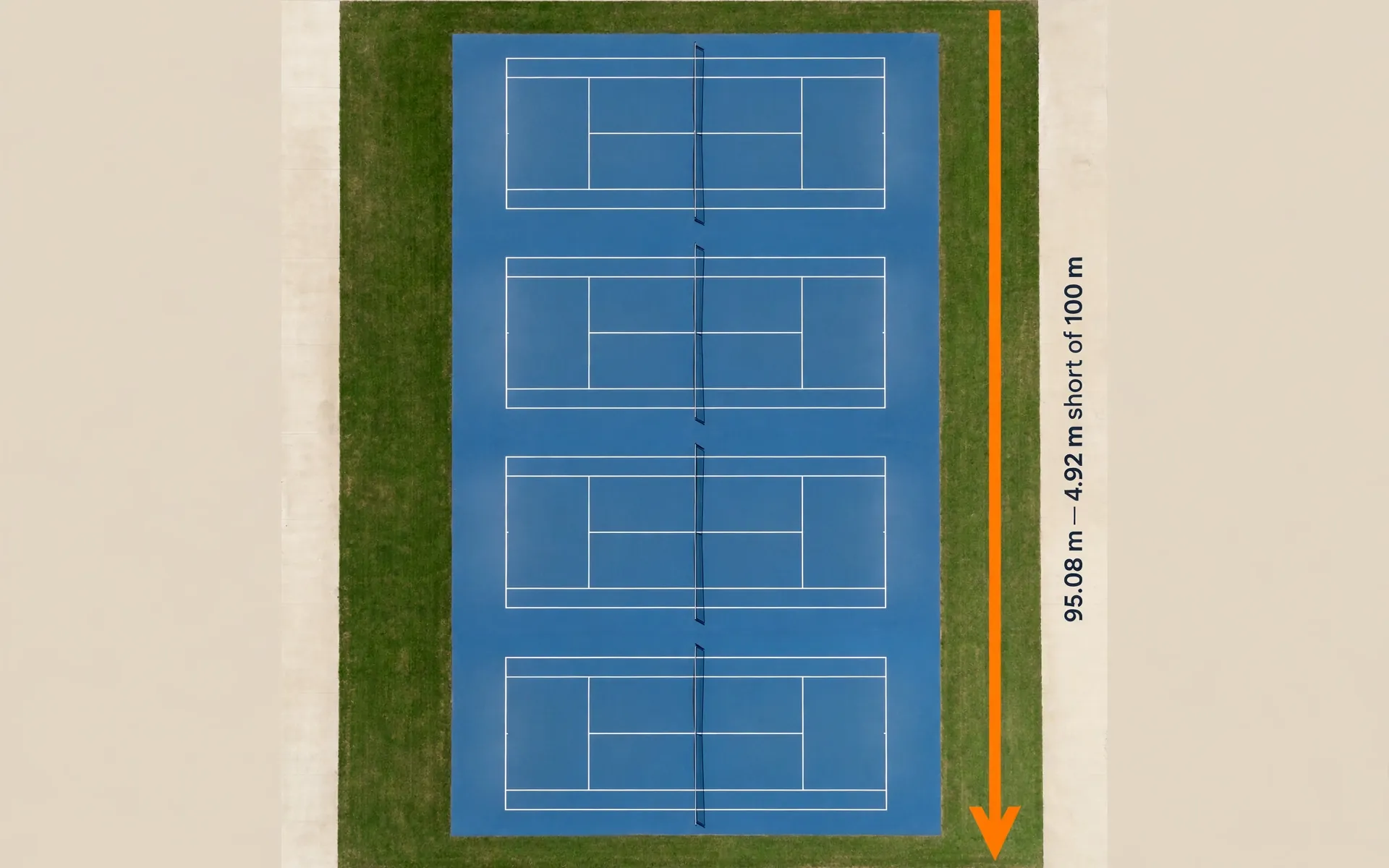
The four courts are the article’s furthest land-on, and the one that proves 100 m is a sports measurement as well as a building height. ITF Rule 1 puts the court at 78 feet (23.77 m) long, baseline to baseline, for singles and doubles alike, so four courts laid end to end measure 95.08 m — 4.92 m short of 100 m, the furthest land-on in this article. That is why it sits sixth on this page — and why it is the pocket reference in the measuring section below.
The fitting check is the run-off, because the 95.08 m is measured BETWEEN the baselines, and the ITF recommends 6.40 m of clear space behind each baseline. Four courts with their run-off are 95.08 m plus twice 6.40 m — 107.88 m — so “four courts” is 95.08 m of painted lines, not 95.08 m of tennis facility, and the facility is 12.80 m longer than the courts. Never write “four tennis courts are 100 m” — that is the error this article exists to correct: four courts are 95.08 m, and it takes 4.2 courts to make 100 m. The grade is reported because the figure is an authority rule — the 23.77 m is a stipulated dimension in the sport’s own rulebook, not a measurement of one court. The deviation is printed in full: 95.08 m, 4.92 m short.
Six “100 Metre” Claims That Don’t Measure Up
| What a rival list claims | What it actually measures | The difference |
|---|---|---|
| Twenty-seven tennis courts end to end make 100 m | 27 × 23.77 m = 641.79 m | 541.79 m out — it takes 4.2 courts, not 27 |
| Eight step-deck trailers end to end make 100 m | 8 × 14.63–16.15 m = 117–129 m | 17–29 m out — six trailers are 87.8–96.9 m |
| One and a half hockey rinks make 100 m | 1.5 × 60 m = 90 m | 10 m out — it takes 1.67 rinks |
| A football field is “usually around 110 m” long | 91.44 m goal to goal, 109.73 m with end zones | Neither figure is 110 m |
| A bowling lane is 21.3 m long, so 4.7 lanes make 100 m | A lane is 18.29 m; 4.7 × 18.29 = 85.96 m | 14.04 m out — the lane figure is wrong first |
| The Eden Project biome is 100 m wide | One source says 100 m, another says 110 m | 10 m of disagreement — the figure is disputed |
Six of these deserve a longer correction. The tennis courts are the most checkable error in the ranking pages: a rival list says twenty-seven tennis courts end to end make 100 m, but a court is 23.77 m long, so twenty-seven span 641.79 m. The error is 541.79 m on a 100 m target — a number that was never multiplied. The step-deck trailers are the most honest-looking error: a rival list says eight trailers make 100 m and gives the trailer as 48 to 53 feet, but 48 feet is 14.63 m and 53 feet is 16.15 m, so eight trailers are 117 to 129 m — the page never does the multiplication its own figures demand. The hockey rinks are the simplest error: a rival list says one and a half rinks make 100 m, but a rink is 60 m long, so one and a half are 90 m — ten metres short, and the page’s own figure (60 m) refutes its own conclusion. The football field is the most repeated error: one rival list says the field is “usually around 110 meters long” excluding the end zones, but it is 91.44 m excluding them and 109.73 m including them — “110 m excluding” is neither figure. The bowling lane is the most circular error: a rival list says a lane is 21.3 m long and therefore 4.7 lanes make 100 m, but a lane is 18.29 m from foul line to head pin, so 4.7 lanes are 85.96 m — the comparison only works because the lane figure is wrong first. And the Eden Project biome is the most interesting error, because it is not a mistake but a dispute: one encyclopaedia entry gives the Rainforest Biome as 100 m wide, the Architects’ Journal’s contemporary report gives it as 110 m wide, and the Eden Project’s own Architecture page gives no width at all — so the 100 m figure cannot be stated as a fact.
Four near-misses deserve a line of their own. Three blue whales are not 100 m — at the longest scientifically measured 29.9 m, three are 89.7 m, and at typical adult size (24–27 m) three are 72–81 m: a maximum presented as a point. Two Boeing 737s are not “a bit short” of 100 m — two 737-800s are 78.94 m, 21.06 m short, a fifth of the distance missing. A 30-storey building is not 99 m — it is an estimate, not a measurement, and the estimate depends on the floor height: 30 office floors at 3.3 m are 99 m, but 30 residential floors at 3.05 m are 91.5 m. The New York long block is not 100 m — the long blocks, avenue to avenue, are about 274 m, and the short blocks, street to street, are about 80 m: a page that calls the long block “close to 100 metres” has the two blocks backwards. And the Saturn V is not 100 m — NASA’s own Saturn V page puts the rocket at 111 metres (363 ft, precisely 110.64 m), 10.64 m over, the rocket that overshoots — and the SLS Block 1B and Block 2 will be 111 m, taller than the Saturn V.
How to Measure 100 Metres Without a Tape
| Method | What you get | How close it is |
|---|---|---|
| Ten 10-metre lengths end to end | 100.00 m | Exact — the cleanest method in the meters series |
| Two Olympic pools end to end | 100.00 m | Exact — two 50 m pools, no arithmetic |
| A FIFA pitch at its minimum length | 100.00 m | Exact — the legal floor, not the usual size |
| UK motorway marker posts, one gap | 100.00 m | Exact — the posts are spaced 100 m apart |
| 3.5 basketball courts end to end | 100.28 m | 0.28 m over — the gym method |
| Tape at the 328 ft 1 in mark | 100.00 m | Essentially exact — 328 ft 1 in is 99.9998 m |
| About 132 steps at a 0.76 m stride | 100.42 m | 0.42 m over — the walking method |
| Four tennis courts end to end | 95.08 m | 4.92 m short — the club method |
| A 100 m sprint, Bolt’s time | 9.58 s | The time method — 10.44 m/s average |
| A 100 m walk, normal pace | 71 s | The time method — 1.4 m/s average |
The ten 10-metre lengths are the best of the ten, because the miss is zero — a hundred metres is ten times ten metres, and ten lengths of anything 10 m long land on the number itself. The two pools are the only exact method that needs no measuring at all: an Olympic pool is 50 m, two of them are 100 m, and the only thing to check is that the pool is a long-course 50 m pool and not a 25 m short-course one — two short-course pools are 50 m, half the number. The FIFA pitch is the only exact method that needs a rulebook: FIFA Law 1 sets the international touchline at 100–110 metres, so a pitch built at the minimum is exactly 100 m — but most professional pitches are 105 m, 5 m over, so check the pitch before you trust it. The tape method is the most accurate, because 328 ft 1 in is 99.9998 m — 328 ft is 99.97 m (3 cm short) and 329 ft is 100.28 m (28 cm over), so the mark to use is 328 ft and one inch. The steps method is the one to use when there is nothing to measure with: 132 average steps at a 0.76 m stride are 100.42 m, and the count is easy to remember because 100 divided by 0.76 is 131.6 — call it 132 and you are 0.42 m over.
The fitting check is the stride, because a step is not a fixed length: a tall adult walking briskly covers 100 m in as few as 115 steps, and a child needs 150 or more — so the 132-step figure is an average, not a measurement. Measure your own stride over 10 m first, then multiply. And if you drive on a British motorway, you already own a permanent 100 m reference — the small roadside marker posts are exactly 100 m apart, so the gap between two of them is the number, and the gap between ten of them is a kilometre.
100 Metres in Every Unit
| Unit | Value |
|---|---|
| Millimetres | 100,000 mm |
| Centimetres | 10,000 cm |
| Metres | 100 m |
| Kilometres | 0.1 km |
| Inches | 3,937.01 in (3,937 in = 99.9997 m) |
| Feet | 328.08 ft (328 ft 1.01 in) |
| Yards | 109.36 yd |
| Miles | 0.0621 mi |
One hundred metres is 100,000 millimetres — a multiplication by a thousand that never needs a calculator. In inches it is 100 divided by 0.0254, which is 3,937.008 inches, rounded to 3,937.01 — and the rounding is honest, because 3,937 inches is 99.9997 m, the nearest whole inch there is. In feet it is 328.08, or 328 ft 1.01 in if you want feet and inches rather than a decimal — and 328 ft on a tape is 99.97 m, 3 cm short, while 329 ft is 100.28 m, 28 cm over. One hundred centimetres is exactly one-hundredth of 100 metres, so 100 lengths of 100 cm make exactly 100 m, and 100 metres is a hundred times 1 metre, exactly ten times 10 metres, exactly twenty times 5 metres, exactly fifty times 2 metres, exactly 200 times 50 cm, exactly 400 times 25 cm, exactly two and a half 40-metre lengths and a little more than three 30-metre lengths — the cleanest ladder in the meters series, because 100 divides by 1, 2, 5, 10, 25, 50 and 100 without a remainder anywhere. 100 feet is 30.48 metres, so 100 m is 3.28 times 100 ft, and 100 inches is 2.54 metres, so 100 m is 39.37 times 100 inches, and 30 inches is 0.762 metres, so 100 m is 131.23 times 30 inches. Metres are the unit on tracks, pitches and pool decks, feet and yards are the units in US sport, and millimetres are the unit in rocket and ship specifications, where an SLS is 98,146 mm and the SS Great Britain is 98,146 mm — the same number to the millimetre, because both are 322 feet.
The 100-Metre Fit-Check: Before You Build, Book or Bet
– Chimney: the 99 m is the chimney, not the building — the Bankside building is 200 m long and the Turbine Hall is 152 m long — so a platform planned for a 99 m building is planned for the wrong thing.
– Liver Building: the 98.2 m is to the top of the spires, the roof is 50.9 m, and the birds add 5.5 m more to 103.7 m — so a scaffold planned for the spires, the roof and the birds needs three different heights. Name the axis before you book the scaffold.
– Ship: the SS Great Britain is 98.15 m long but 15.39 m wide with a 4.9 m draught — so a dry dock built for a 100 m ship fits her length with 1.85 m to spare, but still has to be wider than 15.39 m and deeper than 4.9 m.
– Rocket: the SLS Block 1 is 98.15 m tall with Orion on top, and the core stage alone is 65 m — so a hangar planned for a 98 m rocket fits Block 1, but Block 1B and Block 2 will be 111 m, and the hangar will not fit them.
– Tower: the Elizabeth Tower is 96 m to the tip of its spire, the clock faces are 7 m across and sit well below the spire, and the Great Bell weighs 13.7 tonnes — so a lift planned for a 96 m tower needs 334 steps to the belfry.
– Tennis courts: four courts are 95.08 m of painted lines, but the ITF recommends 6.40 m of run-off behind each baseline — so four courts with run-off are 107.88 m, and a fence built at 95.08 m leaves the players nowhere to run.
The rule underneath all six is the same: name the axis, print the miss, and never trust a round number alone. The number is a size class, a nominal size, a model size or a rounded size; the tape is the size. Eight point five six metres is the price of thinking in yards, fifteen point six one metres is the price of thinking the straightaway is the race, and a rocket that does not fit its hangar is the receipt.
Frequently Asked Questions
How many feet is 100 meters?
One hundred metres is 328.08399 feet — 328 ft 1.01 in. On a tape, 328 ft is 99.97 m (3 cm short) and 329 ft is 100.28 m (28 cm over); the mark to use is 328 ft 1 in, which is 99.9998 m, essentially exact.
Is 100 meters the same as 100 yards?
No. One hundred yards is 91.44 m, so 100 metres is 8.56 m longer — about 9.36 yards. A football field is 100 yards goal line to goal line (91.44 m) and 109.73 m with its end zones, so the field is never 100 metres.
What everyday objects are 100 meters long?
Six verified objects, tightest first: the Tate Modern chimney at 99 m tall, the Royal Liver Building at 98.2 m to the top of its spires, the SS Great Britain at 98.15 m long, the SLS Block 1 rocket at 98.15 m tall, the Elizabeth Tower at 96 m tall, and four tennis courts end to end at 95.08 m. Every one is verified against the owner’s specification, the authority or the rulebook.
How tall is a 100-meter building?
About 30 storeys at 3.3 m a floor (99 m, office) or 33 at 3.05 m (100.65 m, residential) — both estimates. The nearest NAMED building is the Royal Liver Building at 98.2 m to its spires, 1.80 m short.
How long is a 100-meter dash straight?
The dash is run on a straight that measures exactly 100 m, but the home straight of a standard 400 m track is only 84.39 m — the dash straight is extended 15.61 m past it. Four rival pages state the home straight is 100 m; all four are wrong by 15.61 m.
How many steps is 100 meters?
About 132 steps at a 0.76 m average stride (100 divided by 0.76 is 131.6). At a 0.8 m stride it is 125 steps, and at a 0.75 m stride it is 133 steps. Sprinters cover it in about 45 strides.
Is 100 meters longer than a football field?
Longer than the playing field (91.44 m) by 8.56 m, and shorter than the field with its end zones (109.73 m) by 9.73 m. It is 9.36 yards longer than 100 yards, and the field is never 100 metres either way.
How do I measure 100 meters without a tape?
Lay ten lengths of 10 metres end to end, exactly; swim two Olympic pools (100.00 m exactly); walk a FIFA pitch at its minimum length (100 m); count about 132 average steps; or use the gap between two UK motorway marker posts, which are exactly 100 m apart. Never use the track’s home straight, which is 84.39 m.
Final Thoughts
One hundred metres is a distance you run, walk, sail and launch — a sprint, a ship, a rocket, a chimney — and the miss is the whole article. The six objects that measure it are all things you can find tonight without buying anything: a chimney, a building, a ship, a rocket, a tower and four tennis courts — and every one of them carries the number its source actually publishes, with the miss printed next to it. That is the difference between a measurement and a slogan: the measurement can be checked, and the slogan cannot.
Do not take the round number, and do not take the name. Ask which unit was measured — the yard or the metre, the straightaway or the race, the chimney or the building, the spires or the roof, the length or the beam, the vehicle or the core stage, the bell or the tower, the lines or the run-off — look up the specification, and print the miss when there is one. A rocket that does not fit its hangar is a 12.85-metre lesson; a straightaway that is not a race is a 15.61-metre one; and a hundred metres, measured honestly, is 99, 98.2, 98.15, 98.15, 96 and 95.08 — never just “about 100”.
