
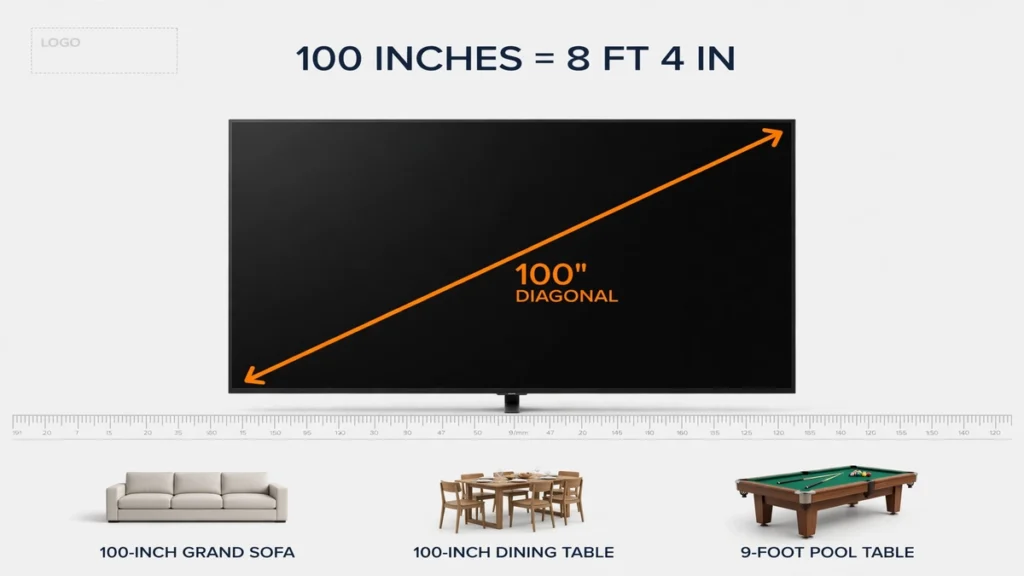
If you have ever wondered how long is 100 inches, the short answer is 8 feet 4 inches — and the longer answer is that it is the length where furniture stops being "large" and starts being a logistics problem. One hundred inches is four inches past a standard 8-foot ceiling height, twenty inches past the door you walk through every morning, and long enough that a delivery driver will ask about your hallway before asking about your signature. It is the width of a grand sofa, the length of a banquet-size dining table, and the diagonal of the biggest television most living rooms will ever hold — three very different shapes that happen to share one number.
Below are seven single, named things, each checked against its own specification, with the miss printed wherever a thing misses. Six are exact at 100 inches for the dimension stated, and one is an honest range that contains 100 inches rather than hitting it dead on. Every object's image sits immediately after its heading, and no object is a stack, a multiple, or a category guess. You will not find sixteen dollar bills or two bicycles parked end to end here, because a chain of small things is not a thing that is 100 inches long — it is arithmetic wearing a trench coat. By the end you will know 100 inches as a television, a sofa, a screen, a pool table, a dining table, a curtain, and a bed frame — and you will know which of those you can trust to the inch and which you must measure yourself.
Quick Answer
100 inches is 8 feet 4 inches exactly — 254 centimetres, 2.54 metres, and 2.78 yards. But do NOT buy wall space, a stand, or a doorway plan against the number 100 without checking which dimension it is: a 100-inch television is only about 88 inches wide, because screens are sold by the diagonal.
The Diagonal Trap: Why Two of These Objects Are Not 100 Inches Wide
Two objects in this article carry the number 100 in their name and measure nothing like 100 inches across your wall. That is not a defect in the objects — it is how screens are sold. Televisions and projector screens are measured corner to corner, on the diagonal, and for a 16:9 screen the geometry is fixed: width equals the diagonal times 0.8716, height equals the diagonal times 0.4903. Run those numbers on 100 inches and you get a visible image about 87.2 inches wide and 49 inches tall. The missing 12.8 inches of width is the single most expensive misunderstanding in this article, because stands, wall mounts, and media walls are all bought against width. Whenever this article says a screen is 100 inches, it means the diagonal — and it prints the width beside it, so you never have to guess. The same discipline runs through everything below: every object names its dimension in its heading, so a length is never mistaken for a width, a drop is never mistaken for a span, and a frame is never mistaken for the mattress inside it.
The 7 Objects
1. A Hisense 100U88QG 100-Inch Television — 100 Inches Diagonally, 87.8 Inches Wide (EXACT)
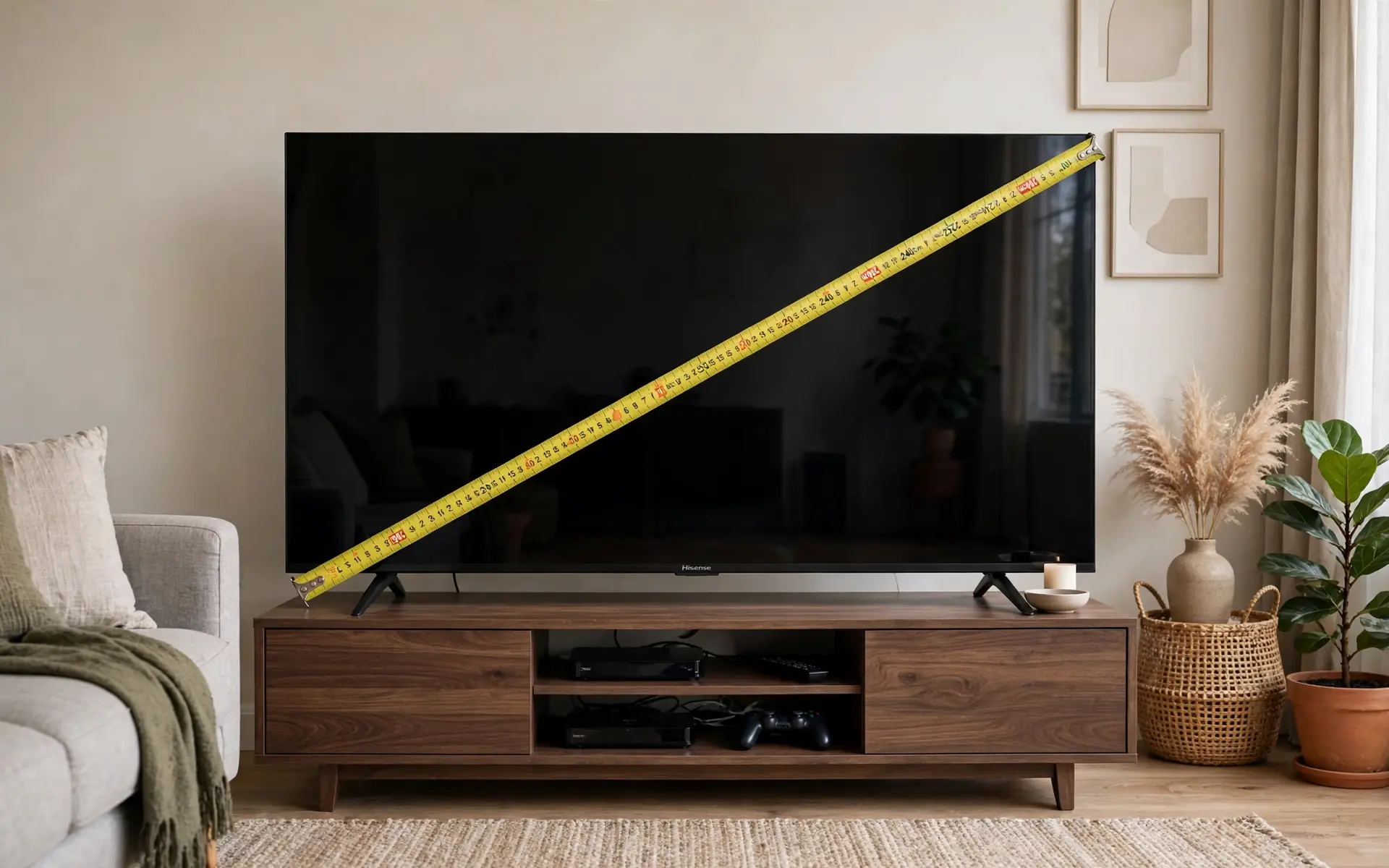
The television is the object most readers come looking for, and it is the one most often misdescribed. Hisense's own specification page for the 100U88QG lists it as a 100-inch class set, and its dimensions without the stand are 87.8 inches wide by 50.5 inches tall — so the 100 inches is the screen diagonal, corner to corner, and the width that decides whether it fits your wall is a full 12.2 inches smaller. With the stand, the height rises to 51.9 inches and the footprint deepens to 18.9 inches, which is the number that decides whether it fits your console at all.
The fitting check is the wall and the viewing distance, in that order. Budget about 88 inches of clear wall width plus a few inches of breathing room on each side, not 100 — but do not celebrate the saving, because a 100-inch screen also wants roughly 10 to 12 feet of seating distance before it stops feeling like the front row of a cinema. The grade is exact for the diagonal, with the deviation printed in full: 100 inches diagonally, 87.8 inches wide, and the diagonal is never the width. Measure the stand, measure the wall, and measure the sofa distance — in that order — before the box arrives, because the box itself runs about 94 inches long and will not fit every elevator or hallway flat.
2. A SUNPAN Rafael 100-Inch Grand Sofa — 100 Inches Wide (EXACT)
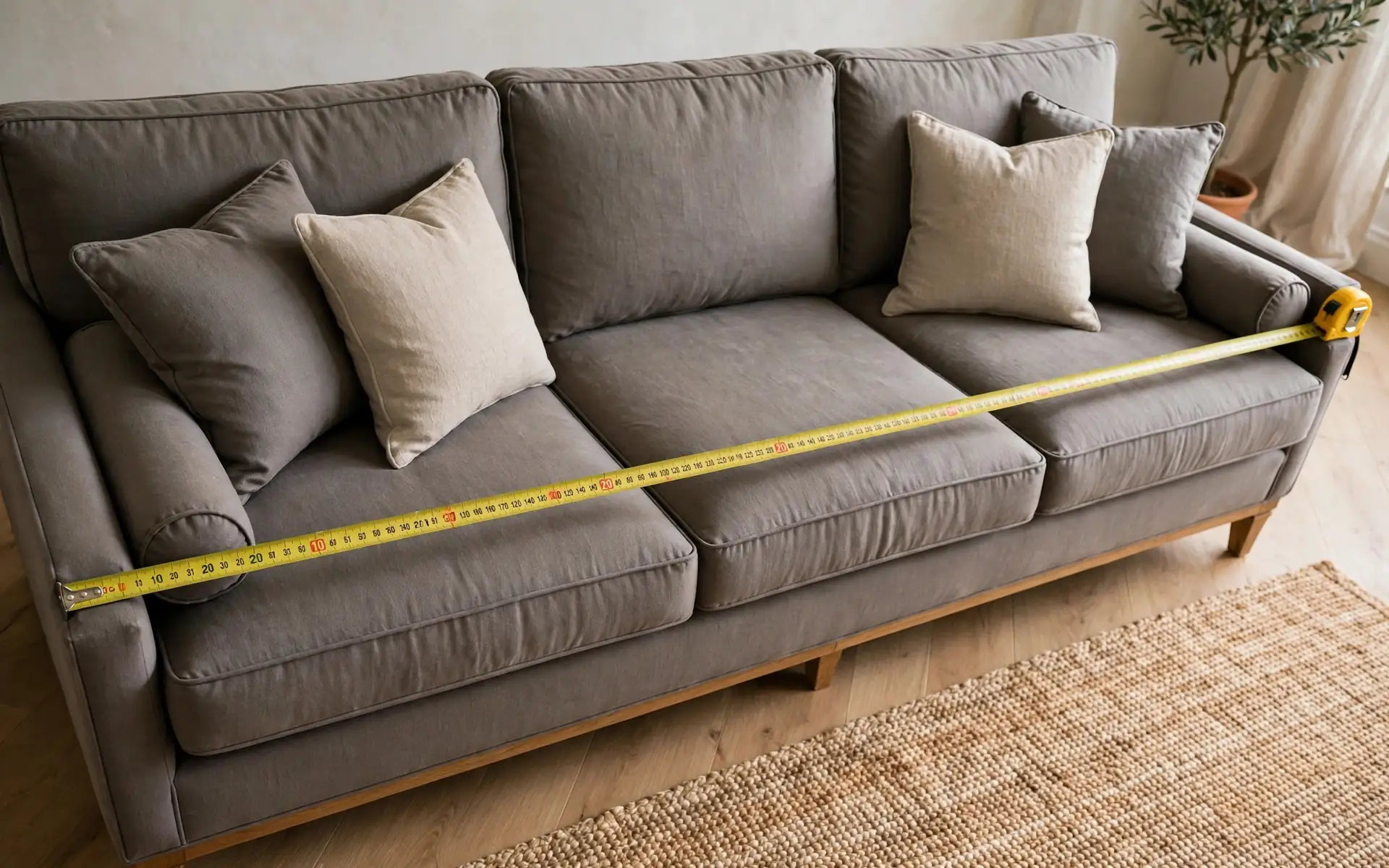
The sofa is the article's widest seat and its lesson in living-room scale. The manufacturer's specification lists the Rafael at 100 inches wide, 35 inches deep, and 32 inches high — a genuine 100 inches of sofa, end to end, in full-grain leather. This is the size sellers call a grand sofa: four adults can sit without negotiating elbows, or one very tall person can nap lengthwise with room to spare. It is the first size at which a sofa becomes the room's horizon line rather than a piece inside it.
The fitting check is the delivery path, and it is stricter than the wall. A 100-inch sofa needs a wall at least 100 inches long before a single side table is added, but it also needs to arrive: a standard interior doorway is only about 32 inches wide, so a 100-inch sofa travels on its end, tilted, and turned, and a tight hallway corner can defeat it entirely. Measure the wall, measure the doorway diagonal, and measure the elevator if there is one, in that order, before the delivery truck arrives. The grade is exact because the figure is the manufacturer's own dimension for this named model, not a size family — and the tape, as always, is the final judge.
3. A Screen Innovations Zero Edge 100-Inch Projector Screen — 100 Inches Diagonally, About 87 Inches Wide (EXACT)

The projector screen is the article's second diagonal and its best proof that the trap repeats in every room. Screen Innovations' specification for the Zero Edge 100-inch fixed-frame screen gives a 100-inch diagonal image with a viewing area 87-3/16 inches wide by 49 inches tall, and overall dimensions of 88-3/8 inches wide by 50-3/16 inches tall including the slim frame. The 100 inches is real, and it runs corner to corner — which means a buyer who budgets 100 inches of wall for this screen over-budgets by nearly a foot, while a buyer who budgets 88 inches of wall gets it exactly right.
The fitting check is the wall width in the horizontal direction only, plus the throw distance: a 100-inch screen wants a projector placed and a seating row set back far enough that the image fills the eye without forcing head-turning, roughly 10 to 12 feet for most rooms. The grade is exact for the diagonal, with the width printed beside it in the heading itself. Print the diagonal, print the width, and never quote the name — the rule from the television holds here word for word, because the geometry is the same and the mistake costs the same.
4. A 9-Foot Pool Table Playing Surface — 100 Inches Long, 50 Inches Wide (EXACT)
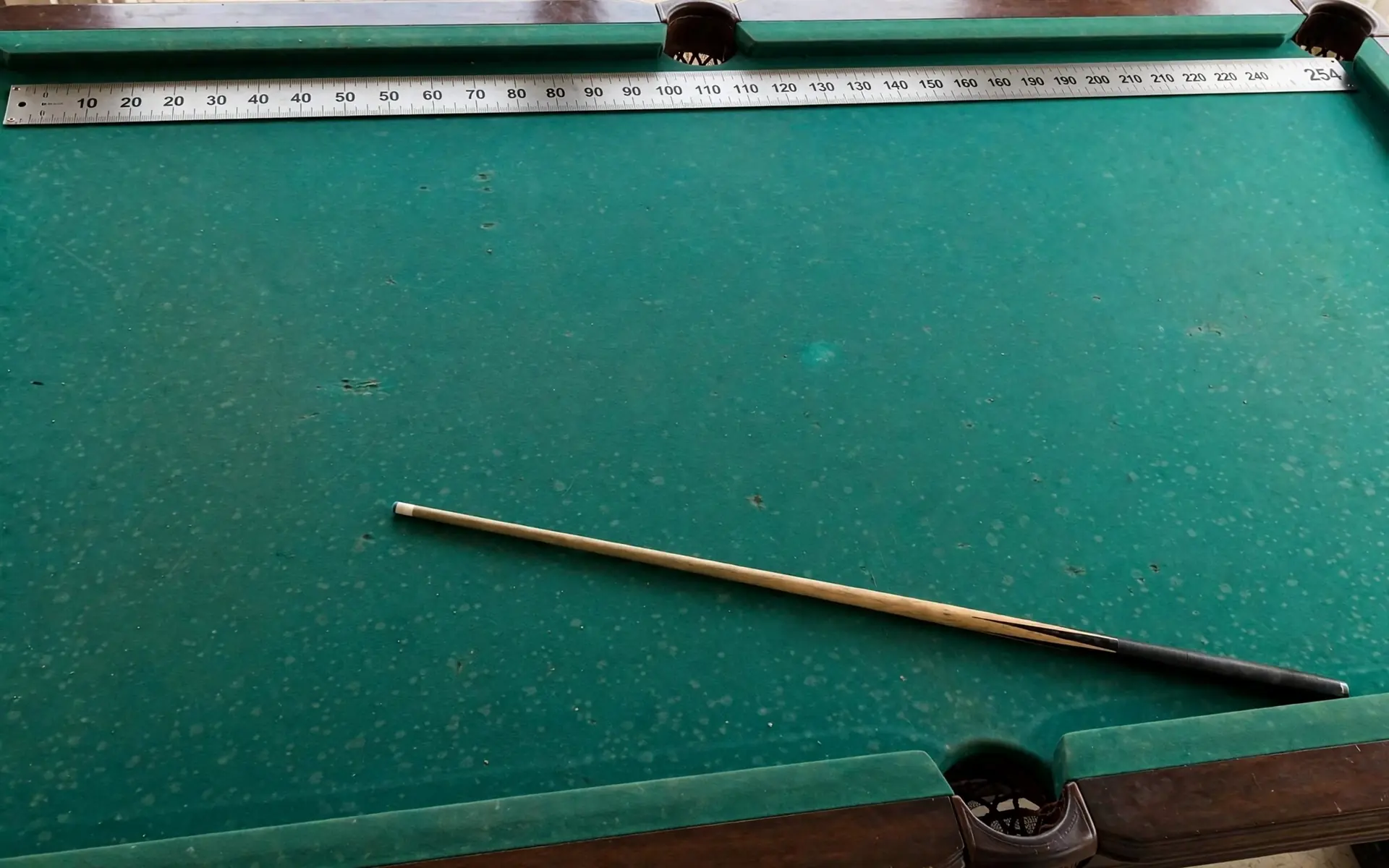
The pool table is the article's most elegant exact, because its 100 inches is written into the rules of the game. The World Pool-Billiard Association's tournament table and equipment specifications fix the playing surface of a 9-foot table at 100 inches by 50 inches, cushions excluded, with a tolerance of one-eighth of an inch. That is not a manufacturer's choice or a retailer's round number; it is the dimension that lets the same table host a championship in any country, and it is why a 9-foot table is called 9 feet even though its playing surface is 8 feet 4 inches — the "9 feet" is the nominal class, the 100 inches is the tape.
The fitting check is the cue room, not the table. With standard 58-inch cues, a 100-inch playing surface needs a room roughly 17 feet long and 13 feet 6 inches wide to shoot comfortably from every side, and the table's outside size — rails and cabinet included — runs larger than the playing surface in both directions. The grade is exact because the figure is a governing body's specification with its tolerance printed: 100 inches, plus or minus an eighth, cushion nose to cushion nose. Measure the room, not the name, and remember that the "9-foot" table is the one object in this article whose name is longer than its measurement.
5. A SUNPAN Hoyos 100-Inch Dining Table — 100 Inches Long (EXACT)
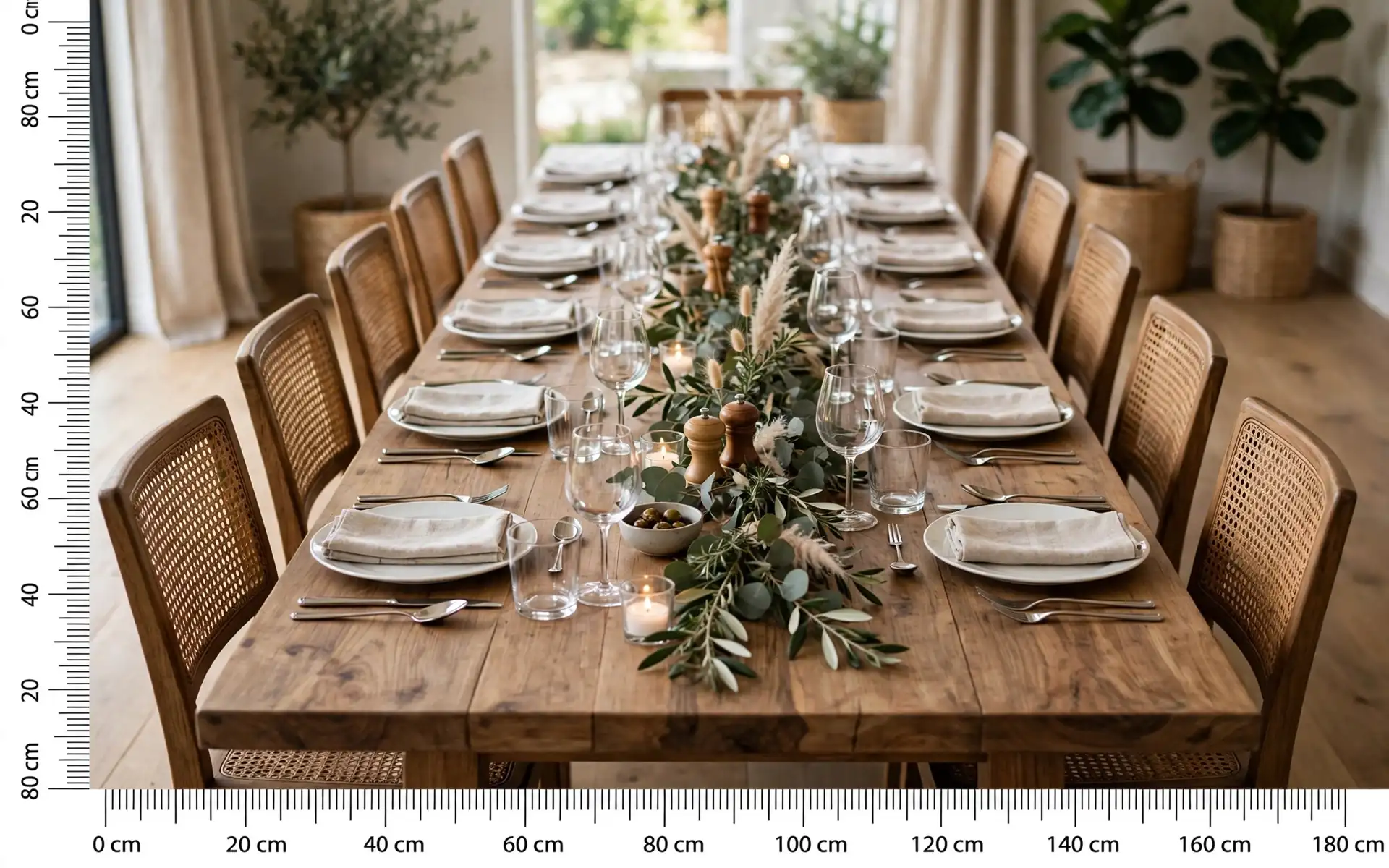
The dining table is the article's most sociable 100 inches. The manufacturer's specification lists the Hoyos at 100 inches long, 46 inches wide, and 30 inches high — 100 inches of tabletop, end to end, which seats eight to ten adults with the standard 24 to 30 inches of elbow room per diner along the sides. This is the table size at which a dinner party stops being a squeeze and starts being a room: four per long side plus one at each end, with the middle still free for serving dishes.
The fitting check is the walking space, and it is stricter than it looks. A 100-inch table needs chairs pulled out on both long sides, which adds roughly 24 inches per side beyond the 46-inch width, plus at least 36 inches of clearance behind each chair — so the dining zone needs a room at least 12 feet wide and 14 feet long before a sideboard is added, and a delivery path that can take a 100-inch top around its corners. The grade is exact because the figure is the manufacturer's own dimension for this named model. Check the room first, the table second, and the chair count third — and never order a 100-inch table against a room measured in feet, because rounding 8 feet 4 inches down to "about eight feet" loses four inches you do not have.
6. Nanspring 100-Inch-Long Curtain Panels — 100 Inches of Drop (EXACT)
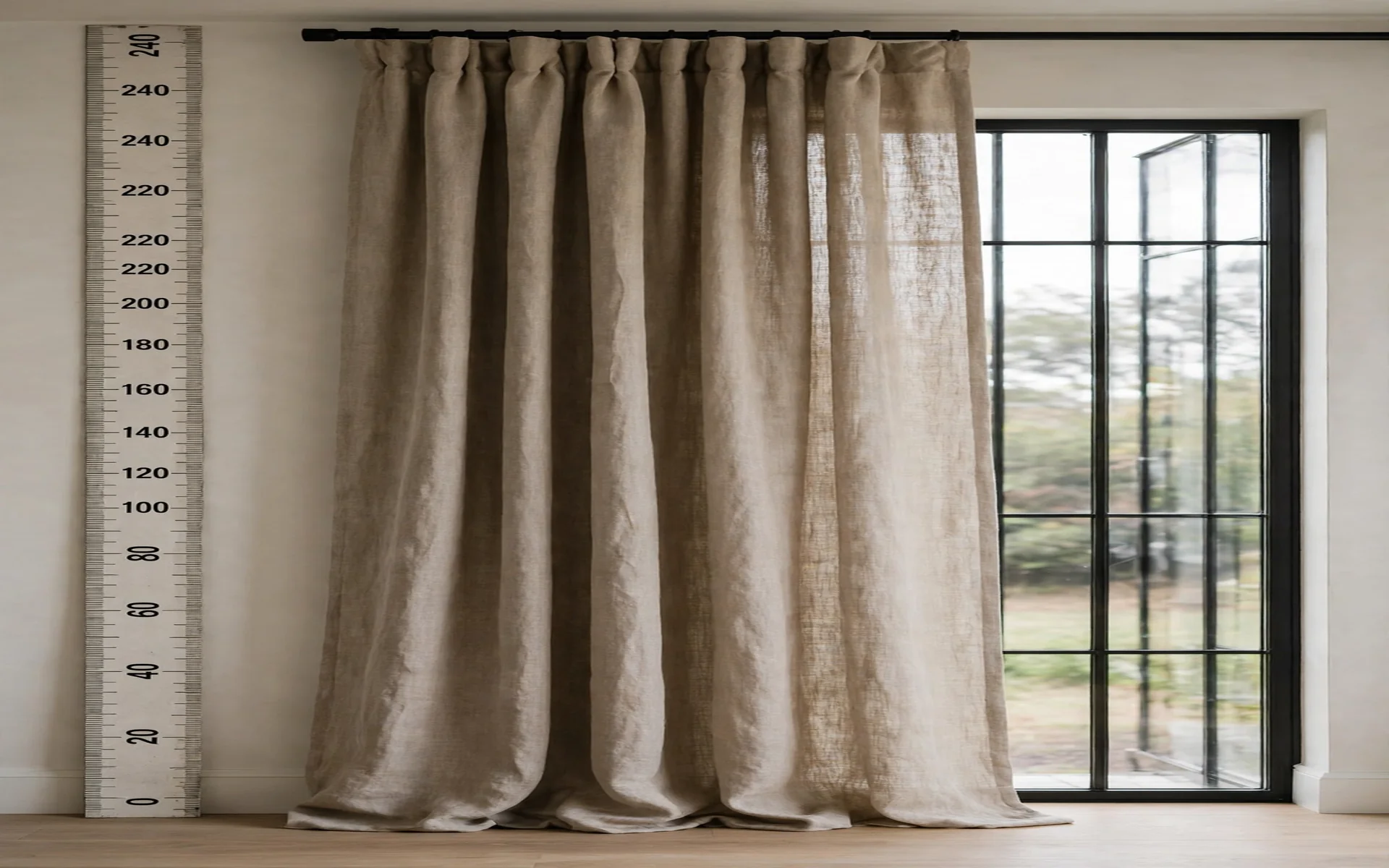
The curtains are the article's vertical 100 inches, and the one most likely to be bought for the wrong ceiling. The manufacturer's product listing gives these linen panels as 52 inches wide by 100 inches long — and here the 100 inches is the drop, the distance from rod to floor, not the width across the window. A 100-inch drop is made for high ceilings and tall windows: it suits a rod mounted near a 9-foot ceiling, where it hangs to the floor with a slight break, and it swamps a standard 8-foot room, where it puddles nearly a foot of fabric on the floor.
The fitting check is the rod height, not the window width. Measure from the rod position to the floor, subtract nothing for the header if the panels hang from rings or back tabs as listed, and remember that width is a separate purchase: two 52-inch panels give about 104 inches of flat fabric, which gathers to cover roughly 50 to 70 inches of window depending on fullness. The grade is exact because the figure is the manufacturer's listed panel length for this named product. Hang the rod first on paper, measure the drop second, and only then order — because a curtain that is 100 inches long is a curtain that has already decided your ceiling height for you.
7. A King-Size Bed Frame, Headboard to Footboard — Typically 95 to 102 Inches Overall (AVERAGE)

The bed frame is the article's honest range, and it is here precisely because it refuses to be exact. A standard king mattress measures 76 inches wide by 80 inches long — that 80-inch length is the industry standard, not a guess — but nobody sleeps on a bare mattress. Add a headboard at one end and a footboard at the other, and the complete frame typically runs 95 to 102 inches overall, depending on how thick the headboard is and whether the footboard adds anything at all. One hundred inches sits inside that range, near its middle, which makes a king bed frame one of the most relatable ways to picture 100 inches — and one of the least precise.
The fitting check is the wall and the walkway, and both punish rounding. A king frame at the top of the range needs a wall at least 102 inches long before a single nightstand is added, and a bedroom needs roughly 24 inches of walking space at the foot plus room to make the bed — so a room planned for a "100-inch bed" can fail by two inches at the headboard or succeed by two inches at the foot, depending on the frame you actually buy. The grade is average, not exact, because the figure is a range for a class of frames, not a measurement of one named model: the mattress is exactly 80 inches, the frame is typically 95 to 102, and 100 is where most of them land. Measure your frame, not the category, and let the range stay a range.
Measure 100 Inches in Your Room: The Tape-and-Doorway Test
Before you buy anything in this article, run the test that catches the mistakes the spec sheets cannot. First, the ceiling: a standard 8-foot ceiling is 96 inches, so anything 100 inches tall — a curtain drop hung high, a tree, a screen stood on end — does not stand upright under it, full stop. You are four inches into the drywall, and no amount of tilting fixes a vertical measurement. Second, the doorway: a standard interior door is about 32 inches wide and 80 inches tall, so a 100-inch object never goes through flat — it goes on its end, on its diagonal, or not at all, and a hallway corner tighter than 36 inches can stop a sofa or a table cold. Third, the wall: tape a 100-inch line on the floor with painter's tape, then tape the object's other dimension beside it, and walk around the outline before you order. A 100-inch sofa outline on your living-room floor looks much bigger than 100 inches on a product page, and that is the point — the tape is the only reviewer that never rounds. Fourth, the delivery: ask for the box dimensions, not the product dimensions, because a 100-inch television ships in a box about 94 inches long and a 100-inch tabletop ships in a crate longer than itself, and the box is what has to clear your elevator, your stairwell, and your front door.
100 Inches Against the Sizes Around It
| Measurement | Inches | How it compares with 100 inches |
|---|---|---|
| Standard interior door height | 80 | 20 inches shorter |
| A 90-inch grand sofa or screen diagonal | 90 | 10 inches shorter |
| Standard 8-foot ceiling | 96 | 4 inches shorter — 100 inches does not stand up under it |
| 100 inches | 100 | 8 ft 4 in, 254 cm, 2.54 m, 2.78 yd |
| Regulation ping-pong table length | 108 | 8 inches longer |
| 9-foot ceiling | 108 | 8 inches taller — the first ceiling a 100-inch object clears comfortably |
How 100 Inches Compares With Other Lengths
Readers comparing nearby sizes may also want the site's guides to 90 inches, 80 inches, 60 inches, and 50 inches for the inch series, and 11 feet, 20 feet, 30 feet, and 40 feet for the foot series. Each of those guides follows the same rule as this one: the spec sheet, the grade, and the miss printed in full. For the whole range in one place, see the complete inches size guide.
Frequently Asked Questions
How many feet is 100 inches?
100 inches is 8 feet 4 inches exactly. Divide 100 by 12 and you get 8.333… feet — and the trap is reading that decimal as 8 feet 3 inches. It is not: one-third of a foot is one-third of 12 inches, which is 4 inches, so 8.33 feet is 8 feet 4 inches. If you cut a board to 8 feet 3 inches for a 100-inch span, you will be an inch short, and an inch short at this size is a return, not a rounding error.
How many centimetres and metres is 100 inches?
254 centimetres exactly, which is 2.54 metres. Multiply 100 by 2.54 and you get 254 with no rounding involved, because the inch is defined as exactly 25.4 millimetres by international agreement. In millimetres that is 2,540 mm, and in yards it is 2.78 yards rounded — exactly 2 yards, 2 feet, and 4 inches.
How many yards is 100 inches?
About 2.78 yards, or exactly 2 yards 2 feet 4 inches. Divide 100 by 36 and you get 2.777…, so "2.78 yards" is the honest rounded figure and "about 3 yards" is the one to reject — it overstates the length by a full 8 inches, which is enough to misbuy fabric, carpet, or a curtain rod.
Is a 100-inch TV 100 inches wide?
No. A 100-inch television is 100 inches on the diagonal, corner to corner, and roughly 87 to 88 inches wide depending on the model — the Hisense set in this article measures 87.8 inches wide without its stand. The same is true of a 100-inch projector screen, whose visible image is about 87.2 inches wide and 49 inches tall. Measure your stand or wall against the width on the spec sheet, never against the number 100.
Will a 100-inch sofa fit through a standard doorway?
Not flat, and sometimes not at all. A standard interior doorway is about 32 inches wide and 80 inches tall, so a 100-inch sofa has to travel on its end, tilted through the opening, and a tight hallway corner can stop it cold. Measure the doorway diagonal — the longest straight line through the opening — and the tightest turn on the delivery path before you order, and ask the seller for the sofa's packaged dimensions as well as its assembled ones.
Is 100 inches taller than a standard ceiling?
Yes, by four inches. A standard modern ceiling is 8 feet, which is 96 inches, so anything 100 inches tall cannot stand upright beneath it. That is why 100-inch curtain panels are made for 9-foot ceilings and why an 8-foot room needs a 96-inch drop instead. If your ceiling is 9 feet (108 inches), a 100-inch object clears it with 8 inches to spare — the first ceiling height where 100 inches stops being a problem.
How big a room do you need for a 100-inch dining table?
A room at least 12 feet wide and 14 feet long, before a sideboard is added. The table itself is 100 inches long and 46 inches wide, but chairs pulled out on both long sides add roughly 24 inches per side, and you need at least 36 inches of clearance behind each chair for someone to walk past or stand up. A 100-inch table in a smaller room still seats ten people — it just seats them against the walls.
How do I measure 100 inches without a long tape measure?
Use a standard yardstick (36 inches) twice plus 28 inches, or stand beside a known 100-inch object from this article: a king bed frame's overall length, a 100-inch sofa's width, or a 9-foot pool table's playing surface are all 100 inches you can walk beside. For anything that must fit — a wall, a doorway, a ceiling — borrow or buy a real tape measure, because at 100 inches the misses in this article run from an eighth of an inch to more than a foot, and guessing throws every one of them away.
Final Thoughts
One hundred inches is the rare measurement that is exact and still misunderstood, because 8 feet 4 inches can be a width, a length, a diagonal, a drop, or a frame — and the number alone never says which. Now you know it as a television diagonal that is not a width, a sofa width that will test your hallway, a screen diagonal with the same geometry, a pool table surface fixed by the rules of the game, a dining table that seats a party, a curtain drop that chooses your ceiling, and a bed frame that lands near 100 inches without promising it. The rule that runs through all seven is the same one this site always uses: trust the spec sheet, print the deviation, and let the name stay on the box where it belongs. Measure twice, in the direction the object actually travels, and 100 inches will fit the first time.
