
A tower in Paris is sold as 150 metres tall. Measure it from the concrete slab it stands on and it is 140 metres. Measure it from the ground on its west side and it is 151 metres. Measure it to the roof and it is 157.2 metres. Count the spire and it is 167 metres. There are four honest heights for one tower, and 150 metres is none of them — it is the round number on the brochure, and the brochure is not a tape measure. That is the whole problem with 150 metres: it is a round number, and round numbers attract round claims, and the claims are only ever checked when somebody puts a tape on the thing itself.
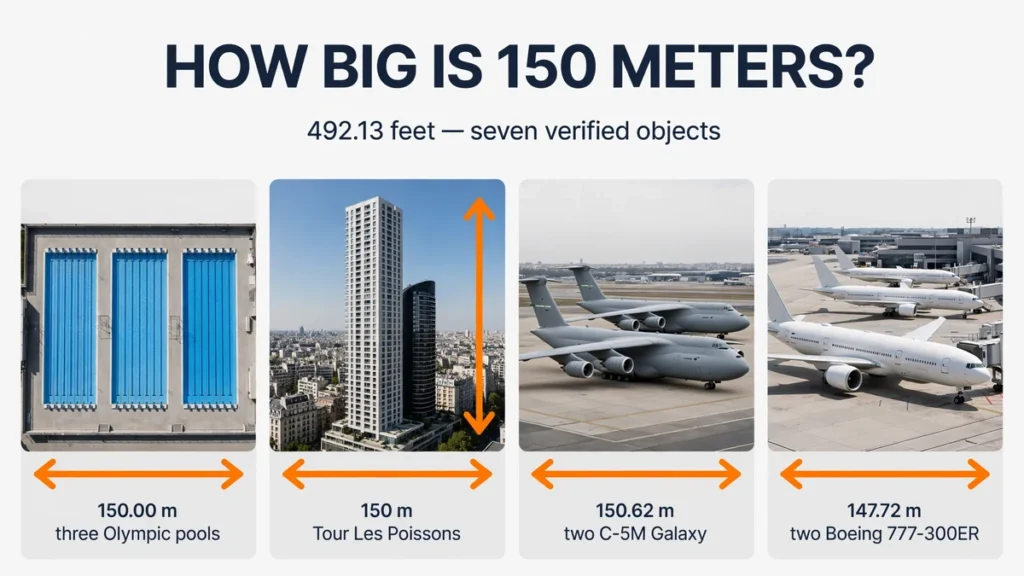
How big is 150 meters, then, in plain terms? It is 492.13 feet — 492 ft 1.5 in — or 164.04 yards, or 5,905.51 inches, or 0.15 kilometres. It is three Olympic swimming pools laid end to end, a Paris tower that really is 150 metres, two heavy jets nose to tail, and a pyramid built four and a half thousand years ago that stood 146.6 metres when it was finished. The seven objects below are the closest honest answers to it: two land on 150.00 m exactly, one stops 62 cm over, and the furthest is 6 m over — and every one of them carries the source that proves it, with the miss printed next to it.
Quick Answer
150 metres is 492.13 feet — the length of three Olympic pools end to end.
150 metres is 492.13 feet, 5,905.51 inches and 0.15 kilometres. Two objects land on the number exactly — three Olympic pools at 150.00 m and Tour Les Poissons at 150 m — and the other five sit within 6 m: two C-5M transports at 150.62 m, two 777-300ER airliners at 147.72 m, the Great Pyramid at 146.6 m as built, the Skyper at 153.8 m and the superyacht Dilbar at 156 m.
The bar above shows one hundred and fifty 1 m segments, but it is a diagram, not a ruler: screen sizes vary, so it explains the measurement rather than measuring it. For a real measurement, use the objects below or a tape measure.
The 150-Metre Tower That Is Four Different Heights
The trap in this article is a datum, not a unit. A building’s height is not one number; it is a number plus a place you measure from, and the place decides the number. Tour Trinity in La Défense, Paris, is the exhibit. The Trinity tower’s own reference entry gives four heights for the same tower: 140 metres from the concrete slab the tower stands on, 151 metres from the natural ground level on its west facade, 157.2 metres to the roof, and 167 metres including the spire. Four measurements, four different answers, and the round number the tower is sold as — 150 metres — is not among them. The slab is 11 metres below the ground on one side because the tower stands on a lid over a seven-lane expressway; the ground on the west side is lower than the ground on the east side; the roof is higher than the top floor; and the spire is not a floor at all. None of those four numbers is wrong. The wrong thing is quoting any one of them without saying which one it is.
The rival pages do exactly that, and they do it to a whole skyline. One rival list calls Tour Trinity, the Skyper in Frankfurt and Hotel Arts in Barcelona “150 metres” — three towers, one number — and none of the three measures 150 m by any published datum. The Skyper’s published roof height is 153.8 m, which is 3.8 m over. Hotel Arts is 154 m, which is 4 m over. Torre Eurosky in Rome is 155 m, Marienturm in Frankfurt is 155 m, and Torre Picasso in Madrid is 157 m. The list is not a list of 150-metre buildings; it is a list of buildings between 151 and 157 metres that have all been rounded down to the target number, and the rounding is doing the work the measurement should have done.
| Rival “150 m” building | What it actually measures | The miss |
|---|---|---|
| Tour Trinity, Paris | 140 m from the slab / 151 m from the ground / 157.2 m to the roof / 167 m with the spire | No datum is 150 m |
| Skyper, Frankfurt | 153.8 m to the roof | 3.80 m over |
| Hotel Arts, Barcelona | 154 m | 4.00 m over |
| Torre Eurosky, Rome | 155 m | 5.00 m over |
| Marienturm, Frankfurt | 155 m | 5.00 m over |
| Torre Picasso, Madrid | 157 m | 7.00 m over |
| Blackpool Tower | 158.1 m to the peak | 8.10 m over |
| Singapore Flyer | 165 m | 15.00 m over |
| Washington Monument | 169.05 m | 19.05 m over |
The table is the article in miniature: the honest comparisons cluster within a few metres of 150, and the dishonest ones are the ones that never print a number at all. Four of the eight buildings in one rival list never get a height printed next to them — Torre Eurosky, Torre Picasso, the Rotterdam tower and Marienturm are described, praised and filed under “about 150 metres” without a single figure. A building with no number is not a comparison; it is a postcard. Blackpool Tower stands 158.1 m to its peak, which is 8.1 m over the number and 5.1 m over the tallest “150 m” building in the list — and at least the tower’s height is published, which is more than the list manages for half its entries.
And then there is the yard version of the same mistake. A yard is three feet — 0.9144 m — so 150 yards is 137.16 m, and 150 metres is 12.84 m longer than 150 yards. The same shared number bites in feet: 150 feet is only 45.72 m, less than a third of 150 metres, so a reader who hears “150” and thinks in feet is 104.28 m short.
The rule for this article is simple: name the thing, name the datum, print the miss. A tower is 150 m tall from a stated ground to a stated roof. A statue is 128 m as a figure and 153 m as a monument. A pool is 50.000 m between the touch pads and 50.020 m wall to wall. A jet is 73.86 m nose to tail and 71.67 m of fuselage. The seven objects below all carry their miss in the heading, and the tower that opens this article is not among them — because a tower with four heights is a warning, not an object.
7 Things That Are 150 Metres
The seven objects are ordered by how close they land on 150 m, closest first, and each one carries its evidence grade in the heading. EXACT means the figure is the operator’s published dimension for the named thing. LISTED means the figure is the manufacturer’s published specification for the named model. REPORTED means the figure is a published reference measurement — a rulebook figure, a tallest-buildings list entry, or an archaeological reference — not a manufacturer spec. Two of the seven land on 150.00 m exactly, one stops 62 cm over, and the furthest is 6.00 m over, so the mean absolute deviation is 2.30 m and no object is more than 4% away from the number.
A published 150 m designation does not mean every unit measures mathematically 150.000 m: pools are measured between touch pads, not walls; towers are measured from a stated ground to a stated roof; jets are measured nose to tail; pyramids are measured as built, not as they stand; and yachts are sold by a length overall that is longer than the waterline. What follows is what the source actually says, with the axis and the datum named every time, so you can check it yourself.
1. Three Olympic Swimming Pools End to End, Length 150.00 m — Exactly 150.00 m (REPORTED)
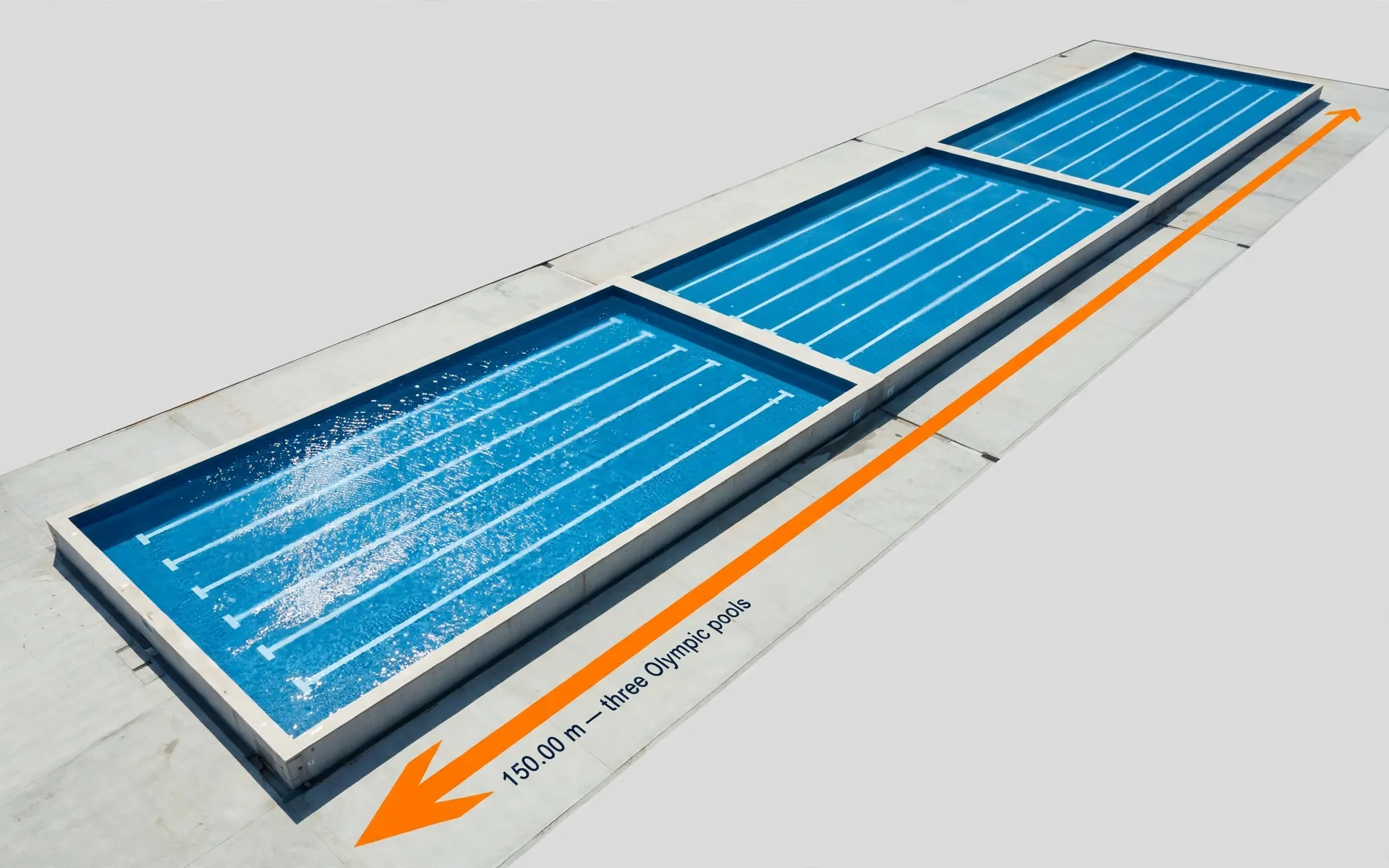
The pools are the article’s cleanest land-on, because their 50 m is the length the sport is ruled to, on the rulebook the sport is swum to. World Aquatics sets the long-course pool at exactly 50.000 m between the touch pads, with a tolerance of +0.010 m and −0.000 m — a course one centimetre short fails — so three pools laid end to end measure 150.00 m, with no deviation to print. Walk the deck of one pool, turn around, walk it again, walk it a third time, and you have walked 150.00 m, which is why the pools sit first on this page.
The fitting check is the touch pad, because the 50.000 m is measured BETWEEN the touch pads, and the pool itself is built 2 to 3 cm longer to make room for them. Wall to wall, with pads at both ends, a pool is 50.020 to 50.030 m — so three pools wall to wall are 150.06 to 150.09 m, six to nine centimetres over the headline figure. Never write “three pools are 150 m wall to wall” — that is 6 to 9 cm out, and the 6 to 9 cm is the whole point of the tolerance. The grade is reported because the figure is the governing body’s rulebook figure, not a manufacturer spec — World Aquatics writes the rule, and the 50.000 m is a stipulated dimension, not a measurement of one pool. The deviation is printed in full: 150.00 m, zero centimetres off.
2. Tour Les Poissons, Courbevoie, Height 150 m — Exactly 150.00 m (REPORTED)
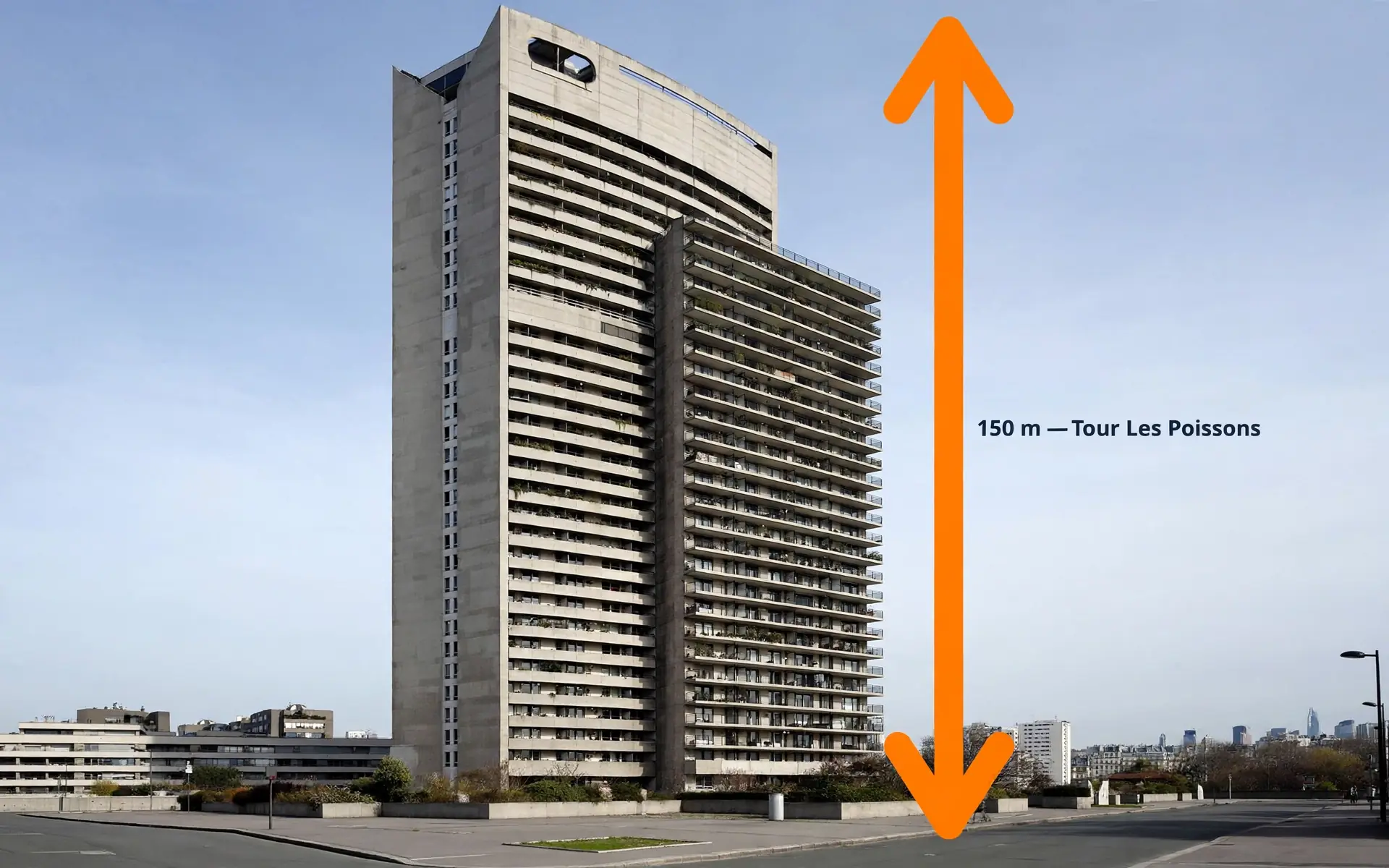
The tower is the article’s second land-on, and the one that proves a 150-metre building really exists — you just have to look in the right district and check the right list. The published Paris tallest-buildings list gives Tour Les Poissons at 150 m, with 42 floors, completed in 1970, and the tower was the tallest building in the Paris region from 1970 to 1973, so the tower measures 150.00 m from the ground to its roof, with no deviation to print. Stand on the pavement in Courbevoie and look up, and its height is the number itself, which is why it sits second on this page — and why it is the answer to the tower that opens this article.
The fitting check is the district, because Tour Les Poissons and Tour Trinity stand in the same business district, La Défense, and the two towers are the trap in miniature: one is 150 m and the other is sold as 150 m but measures 151 m from the ground, 157.2 m to the roof and 167 m with the spire. The difference between them is the datum: Les Poissons is 150 m by the standard height measurement, and Trinity is 150 m by no measurement at all. The grade is reported because the figure is a published tallest-buildings list entry, not a developer spec — the list ranks buildings by standard height measurement, and the 150 m is the list’s figure. The deviation is printed in full: 150.00 m, zero centimetres off.
3. Two Lockheed C-5M Super Galaxy, Length 150.62 m — 62 cm Over (EXACT)
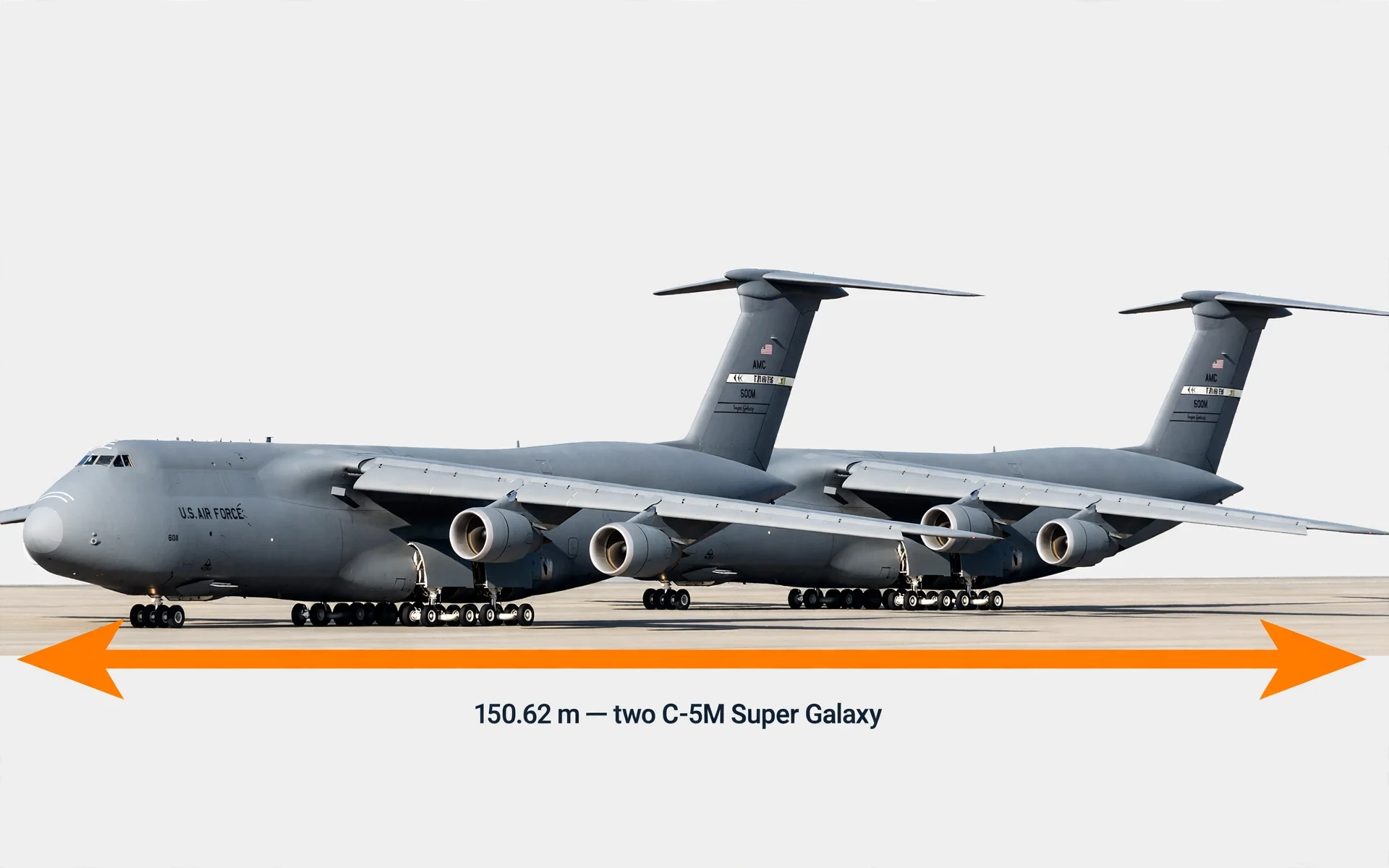
The transports are the article’s heaviest land-on, because they are the largest aircraft in the United States Air Force inventory, and two of them nose to tail are the closest pair in this article. The US Air Force fact sheet lists the C-5M at 247 ft 1 in, which is 75.31 m, with a wingspan of 67.89 m and a height of 19.84 m, so two Super Galaxies parked nose to tail measure 150.62 m — 62 cm over 150 m, the third-tightest land-on in this article. Stand at the nose of one on the apron and the pair stretches the number itself, plus a stride, which is why the two aircraft sit third on this page.
The fitting check is the cargo hold, because each C-5M is 75.31 m long overall but its cargo compartment is only 43.8 m long. Thirty-one and a half metres of the aircraft is nose visor, cockpit, ramps and tail — the part no cargo ever sits in. Two aircraft nose to tail are 150.62 m of aeroplane, but the cargo space inside them is 87.6 m. The grade is exact because the figure is the operator’s published dimension for the named variant, with the deviation printed in full: 150.62 m, 62 cm over. Do not confuse the length with the wingspan: the C-5M is 75.31 m long but its wingspan is 67.89 m, so two aircraft nose to tail are 150.62 m long and 135.78 m of wingspan side by side — two different numbers, and the stand that fits the length must also fit the span.
4. Two Boeing 777-300ER, Length 147.72 m — 2.28 m Short (LISTED)
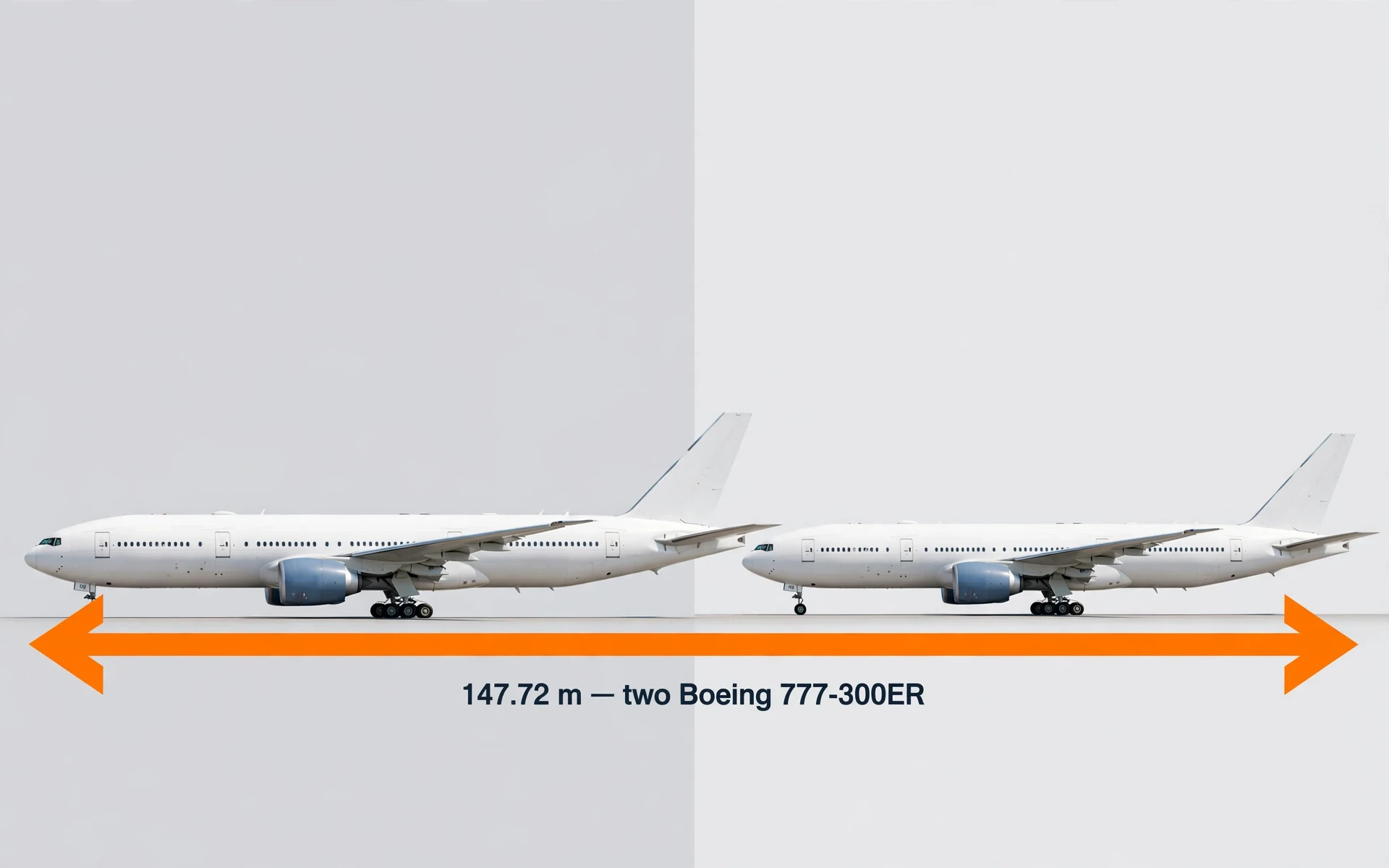
The airliners are the article’s most-flown land-on, because they are the long-haul twinjet most readers have already sat inside. KLM’s own 777-300ER specifications list the length at 73.86 m, with a wingspan of 64.80 m and a height of 18.50 m, so two 777-300ERs parked nose to tail measure 147.72 m — 2.28 m short of 150 m, the fourth-tightest land-on in this article. Stand at the gate beside one and the pair is the number itself, minus two long strides, which is why the two aircraft sit fourth on this page.
The fitting check is the fuselage, because each 777-300ER is 73.86 m long overall but its fuselage is only 71.67 m, and its cabin is only 53.75 m. Two metres of the aircraft is nose and tail cone, and twenty metres of it is the part passengers never sit in. The grade is listed because the figure is the manufacturer’s published specification as carried by the operator, with the deviation printed in full: 147.72 m, 2.28 m short. Do not confuse the variants: the 777-200 series is 63.73 m (10.13 m shorter) and the 777-9 is 76.72 m (2.86 m longer) — the -300ER is the one that lands nearest 150 m in a pair. And do not merge the two pairs in this article: two C-5Ms are 150.62 m and two 777-300ERs are 147.72 m, so the pairs sit 2.90 m apart, and their wingspans differ by 3.09 m a side, so a stand that fits one pair does not automatically fit the other.
5. Great Pyramid of Giza, Original Height 146.6 m — 3.40 m Short (REPORTED)
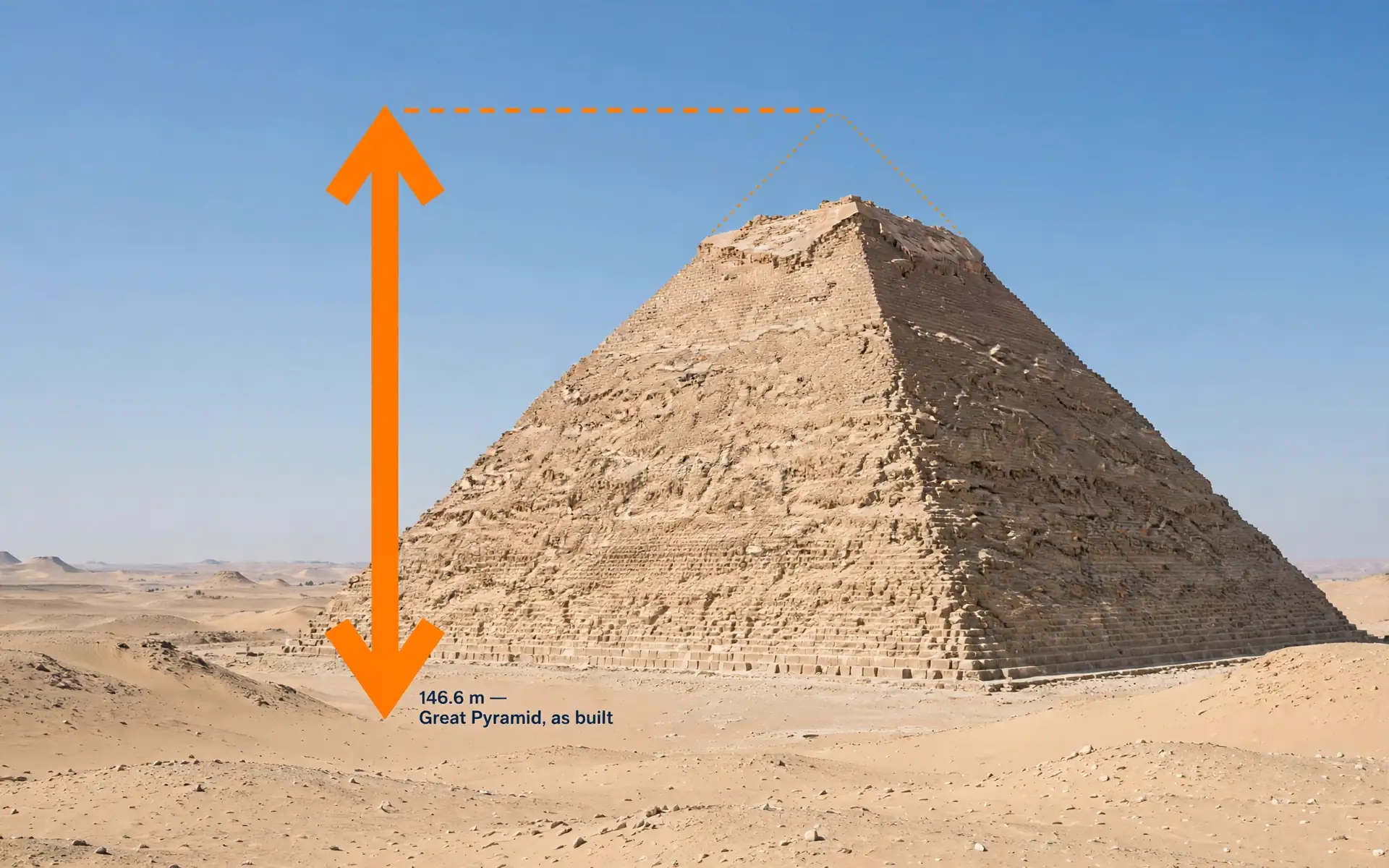
The pyramid is the article’s oldest land-on, and the one that proves 150 m is a height as well as a length — and that a height can change without the building moving. Initially standing at 146.6 metres, the Great Pyramid was the world’s tallest human-made structure for more than 3,800 years, and its design dimensions were 280 royal cubits high by 440 cubits on each side of its base, so the pyramid measures 146.6 m from its base to its original apex — 3.40 m short of 150 m, the fifth-tightest land-on in this article. Stand on the Giza plateau beside it and its height is the number itself, minus three and a half metres, which is why it sits fifth on this page.
The fitting check is the word “originally”, because the Pyramid WAS 146.6 m and STANDS 138.5 m today. Most of its smooth white limestone casing was removed over the centuries, which lowered the pyramid by 8.1 m and left the flat-topped core that visitors see now. A guide that says “the Great Pyramid is 146.6 metres tall” without “originally” has given you a height the building no longer has. The grade is reported because the figure is a published reference measurement, not a manufacturer spec — the pyramid was built around 2560 BC, and its dimensions are carried in the reference literature, not on a data sheet. The deviation is printed in full: 146.6 m, 3.40 m short.
6. Skyper, Frankfurt, Height 153.8 m — 3.80 m Over (REPORTED)
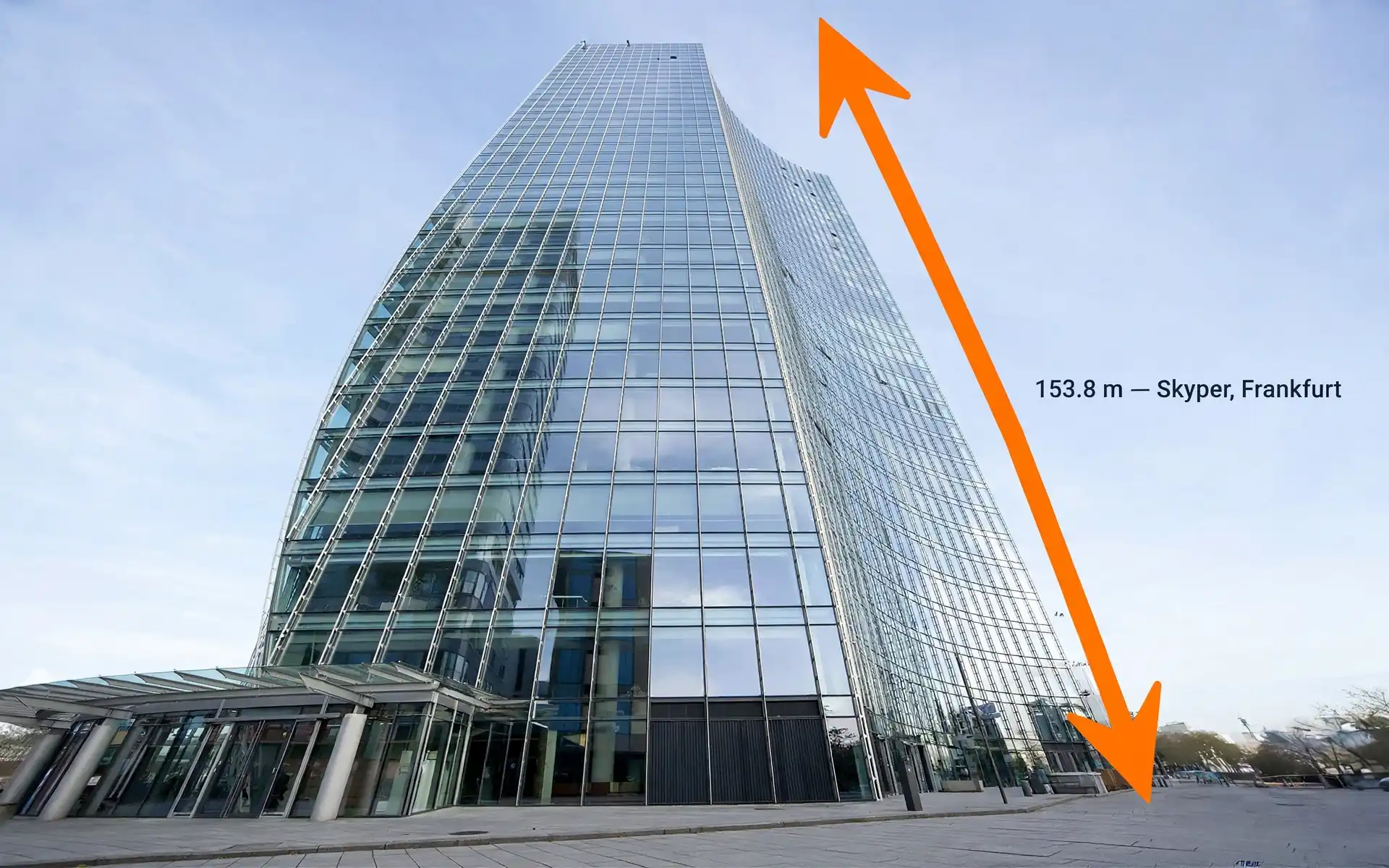
The Skyper is the article’s most-corrected land-on, because it is the tower one rival list calls “150 metres” and another list measures at 153.8 m — and the second list is right. The Skyper stands 153.8 m to its roof, with 38 storeys, completed in 2004, so the tower measures 153.8 m from the pavement to its roof — 3.80 m over 150 m, the sixth-tightest land-on in this article. Stand on Taunusanlage beside it and its height is the number itself, plus a tall man’s reach, which is why it sits sixth on this page.
The fitting check is the roof, because the 153.8 m is the ROOF height, and the Skyper is a three-part complex: the tower, the 20 m Skyper Carré block, and the 1915 Villa Holzmann, a listed neoclassical villa linked to the tower by a 9 m glass atrium. A guide that says “the Skyper complex is 153.8 metres” has given you one building’s height for three buildings. The grade is reported because the figure is a published reference measurement, not a developer spec — the tower’s height is carried in the tallest-buildings lists, and the 153.8 m is the list figure. The deviation is printed in full: 153.8 m, 3.80 m over.
7. Dilbar Superyacht, Length Overall 156 m — 6.00 m Over (LISTED)
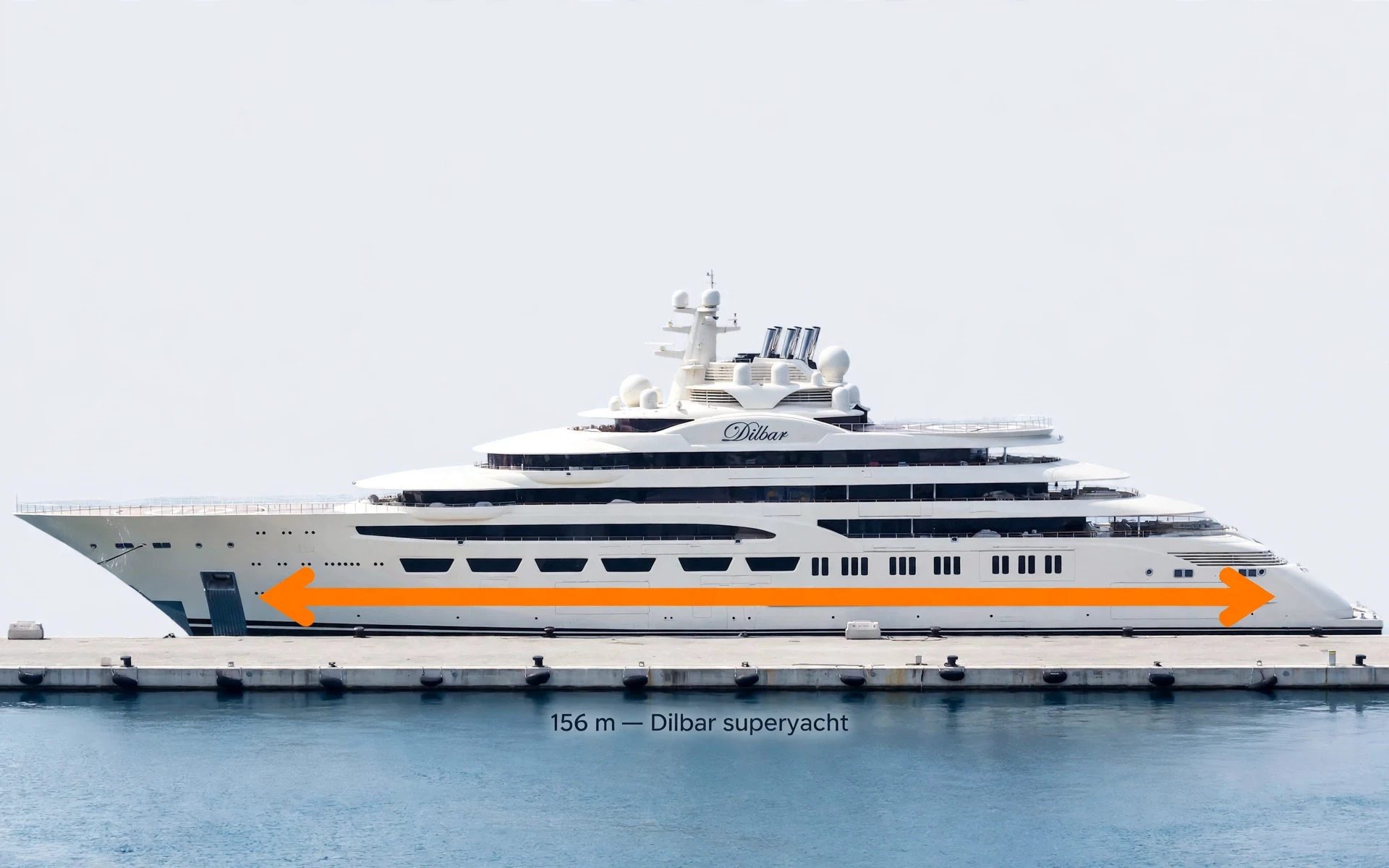
The yacht is the article’s longest land-on, and the one that proves 150 m is a berth as well as a length. Boat International puts the Dilbar at 156 m, built by the German yard Lürssen and delivered in 2016, with a beam of 24 m, a draft of 6.1 m and a gross tonnage of 15,917, so the yacht measures 156 m from bow to stern — 6.00 m over 150 m, the furthest land-on in this article. Stand on the quay beside her and her length is the number itself, plus a small boat, which is why she sits seventh on this page.
The fitting check is the berth, because the yacht is 156 m long OVERALL and a berth is sold by the length it can hold plus clearance for fenders and mooring lines. A marina that sells a “150 m berth” sells 150 m of water, and a 156 m yacht needs more than 150 m of it once fenders and lines are counted — so the berth for this yacht is a 160 m berth, not a 150 m one. The grade is listed because the figure is the builder’s published specification as carried by the yachting trade press, with the deviation printed in full: 156 m, 6.00 m over. One caution: the Dilbar is the largest yacht in the world by gross tonnage, not by length — the longest yacht, the Azzam, is 180.61 m — so never write “the Dilbar is the longest yacht in the world”.
Seven “150 Metre” Claims That Don’t Measure Up
| What a rival list claims | What it actually measures | The difference |
|---|---|---|
| 150 m is just under half a football field | The field is 91.44 m (109.73 m with end zones) | 150 m is 1.64 fields — longer than the whole field |
| 150 m is one and a half Olympic pools | One pool is 50 m; 150 m is three pools | 75 m out — one and a half pools is 75 m, not 150 m |
| 150 m is 1.5 soccer fields | A FIFA field is 100–110 m; 1.5 × 10⁵ m = 157.5 m | 7.50 m over at the average; the range is 150–165 m |
| The Spring Temple Buddha is 128 m, slightly shorter | The statue is 128 m; the monument total is 153 m | 22 m short as a statue, 3 m over as a monument |
| 150 m is one and a half times Big Ben | Big Ben is 96 m; 1.5 × 96 m = 144 m | 6.00 m short — 150 m is 1.56× Big Ben |
| 150 m is nine-tenths of the Washington Monument | The monument is 169.05 m; 150 ÷ 169.05 = 88.7% | 19.05 m short; nine-tenths would be 152.1 m |
| The Shambles is roughly 150 m long | No published measurement exists | Unverified — a street length with no source |
Seven of these deserve a longer correction. The football field is the most checkable error in the ranking pages: a rival list says 150 metres is “just under half the length of a standard American football field (which is 160 yards or about 146 meters excluding end zones)”, but a field excluding end zones is 100 yards — 91.44 m — and including end zones it is 120 yards — 109.73 m — and 160 yards is 146.3 m, a number that belongs to no football field at all. And 150 m is longer than 146 m, not “just under half” of it: 150 m is 1.64 fields, which is more than the whole field, not half of it.
The pools are the most self-refuting error: one rival list heads a section “One and a Half Olympic Swimming Pools” and then says in the paragraph underneath that “150 meters equals the length of three Olympic swimming pools placed end to end”. Three pools is right and one and a half pools is 75 m — the heading and the paragraph cannot both be true, and the paragraph is the one that did the arithmetic. The soccer fields are the most repeated error: two rival pages call 150 m “1.5 soccer fields”, but a FIFA field is 100 to 110 m long, so 1.5 fields is 150 to 165 m — a 15 m range presented as one comparison — and at the 105 m average it is 157.5 m, 7.5 m over. The statue is the most visual error: a rival list calls the Spring Temple Buddha “128 meters, marginally more limited than the height we are talking about”, but 128 m is 22 m short of 150 m, which is not marginal. The Buddha’s reference entry gives the statue at 128 m, the monument at 153 m with its pedestal, and 208 m with the reshaped hill — so the page quotes the figure and never mentions the pedestal, and it is wrong in both directions at once: 22 m short as a statue, 3 m over as a monument.
The Big Ben claim is the most confident error: a rival list says 150 m is “one and a half times as tall as Big Ben”, but Big Ben is 96 m tall, and 1.5 times 96 is 144 m — 6 m short of 150 m. The true multiple is 1.56. The Washington Monument is the most careless error: a rival list says 150 m is “roughly nine-tenths” of the monument, and writes “one hundred meters” where it means 150 m, and 150 divided by 169.05 is 88.7%, not 90% — nine-tenths of the monument would be 152.1 m. And the Shambles is the most unverifiable error: a rival list says the York street “is roughly 150 meters in length”, and no source, no survey and no measurement is cited anywhere on the page — the street’s length is not a published dimension, and a claim with no source is not a comparison, it is a guess.
Four near-misses deserve a line of their own. The Golden Gate Bridge tower is 227 m tall, so 150 m is 66.1% of it — the rival page’s “66%” is arithmetically right, but it is a fraction of a tower, not a thing that measures 150 m, and the page never says it is the tower rather than the bridge, which is 2,737 m long. A 50-storey building is 150 m only at 3 m residential floors — office floors run 3.3 to 3.9 m, so a 50-storey office block is 165 to 195 m. A 150 m running track is circular: a track built to be 150 m long is 150 m long because it was built to be. And city blocks are 80 to 120 m long, so “one and a half city blocks” is 120 to 180 m — a 60 m range.
How to Measure 150 Metres Without a Tape
| Method | What you get | How close it is |
|---|---|---|
| Three Olympic pools end to end | 150.00 m | Exact — the best method of all |
| Fifteen 10-metre lengths end to end | 150.00 m | Exact — the cleanest method in the meters series |
| A Tour Les Poissons laid flat | 150.00 m | Exact — the tower method |
| 200 steps at a 0.75 m stride | 150.00 m | Estimate — the walking method |
| Two C-5M Super Galaxy nose to tail | 150.62 m | 0.62 m over — the airport method |
| Tape at the 492 ft 2 in mark | 150.01 m | 0.01 m over — essentially exact |
| Two 777-300ERs nose to tail | 147.72 m | 2.28 m short — the gate method |
| Six tennis courts end to end | 142.62 m | 7.38 m short — the honest court count |
| Five NBA courts end to end | 143.25 m | 6.75 m short — the gym method |
The three pools are the best of the nine, because the miss is zero and the reference is a place you can walk — mark one end wall, walk to the far wall, turn around, walk it again, walk it a third time, and you have covered 150.00 m between the touch pads. The fifteen 10-metre lengths are the only exact method that needs no object at all: 150 metres is fifteen times ten metres, and fifteen lengths of anything 10 m long land on the number itself. The tape method is the most accurate, because 492 ft 2 in is 150.01 m — 492 ft is 149.96 m (4 cm short) and 493 ft is 150.27 m (27 cm over), so the mark to use is 492 ft and two inches. The steps method is the one to use when there is nothing to measure with: 200 ordinary steps at a 0.75 m stride are exactly 150 m, and the count is easy to remember because 150 divided by 0.75 is 200 — and at a 0.76 m stride it is 197 steps, three short of the round count.
The fitting check is the stride, because a step is not a fixed length. A tall adult walking briskly covers 150 m in as few as 170 steps, and a child or a short-stride walker needs 220 or more — so the 200-step figure is an average, not a measurement. Measure your own stride over 10 m first (count the steps, divide 10 by the count), then multiply — and the steps method stops being a guess.
150 Metres in Every Unit
| Unit | Value |
|---|---|
| Millimetres | 150,000 mm |
| Centimetres | 15,000 cm |
| Metres | 150 m |
| Kilometres | 0.15 km |
| Inches | 5,905.51 in (492 ft 1.51 in) |
| Feet | 492.13 ft (492 ft 1.51 in) |
| Yards | 164.04 yd |
| Miles | 0.0932 mi |
One hundred and fifty metres is 150,000 millimetres, and a metre is 1,000 millimetres, so the conversion is a multiplication by a thousand that never needs a calculator. In inches it is 150 divided by 0.0254, which is 5,905.5118 inches, rounded to 5,905.51 — and the rounding is honest, because 5,906 inches is 150.0124 m, one centimetre over the mark. In feet it is 492.13, or 492 ft 1.51 in if you want feet and inches rather than a decimal — and 492 ft on a tape is 149.96 m, 4 cm short, while 493 ft is 150.27 m, 27 cm over. 30 metres is 98.43 feet, so 150 m is five times 30 m, and 40 metres is 131.23 feet, so 150 m is 3.75 times 40 m. 150 metres is exactly fifteen lengths of 10 metres, exactly 150 × 1 metre, exactly 300 × 50 cm, and 600 × 25 cm — the cleanest ladder in the meters series at this scale, because 150 divides by 10, 25, 50 and 30 without a remainder anywhere. 100 feet is 30.48 metres, so 150 m is 4.92 times 100 ft, and 30 inches is 0.762 metres, so 150 m is 196.85 times 30 inches. Metres are the unit on rulebooks and specifications, feet and yards are the units on US tapes and product listings, and millimetres are the unit in aircraft data sheets, where a C-5M is 75,310 mm and a 777-300ER is 73,860 mm — and 150 m is the distance where all of them meet, because it is three pools, a tower, two pairs of jets, a pyramid, a second tower and a yacht at once.
The 150-Metre Fit-Check: Before You Book, Build or Bet
– Yacht berth: a 156 m Dilbar needs a berth longer than 156 m plus fenders and lines — book a 160 m berth, not a 150 m one — and never quote the gross tonnage (15,917 GT) as a length, because tonnage is volume, not size.
– Jet stand: two 777-300ERs need a stand longer than 147.72 m with wingtip clearance on a 64.80 m span each, and two C-5Ms need a stand longer than 150.62 m with a 67.89 m span each — the two pairs are 2.90 m apart in length and 3.09 m apart in span, so a stand that fits one pair does not automatically fit the other.
– Pool build: three pools are 150.00 m between the touch pads but 150.06 to 150.09 m wall to wall — count the pads, and never present the wall-to-wall figure as the swum distance, because a course one centimetre short fails certification.
– Pyramid visit: the Pyramid was 146.6 m as built and stands 138.5 m today — quote the date with the height, and never present the original height as the height a visitor sees, because the top 8 to 10 metres are gone.
– Tower quote: Tour Trinity is 151 m from the ground, 157.2 m to the roof and 167 m with the spire — quote the datum with the height, and never present a brochure’s round 150 m as a measurement, because no datum on that tower is 150 m.
– Sprint bet: Bolt’s 14.35 s is a straight-track world best, not a bend time and not a world record — 150 m is not a standard record event — and a 150 m time and a 200 m time are not comparable, because the bend costs time the straight never charges.
The rule underneath all seven is the same: name the thing, name the datum, print the miss, and never trust a round number alone. The number is a size class, a model size, a rounded size or a brochure size; the tape is the size.
Frequently Asked Questions
How many feet is 150 meters?
One hundred and fifty metres is 492.12598 feet — 492 ft 1.5 in. On a tape, 492 ft is 149.96 m (4 cm short) and 493 ft is 150.27 m (27 cm over); the mark to use is 492 ft 2 in, which is 150.01 m, essentially exact.
Is 150 meters the same as 150 feet?
No. One hundred and fifty feet is 45.72 metres, so 150 metres is 3.28 times longer — 104.28 m longer, about the length of a soccer field. The same number in feet is less than a third of the same number in metres.
What everyday things are 150 meters long?
Seven verified objects, tightest first: three Olympic swimming pools end to end at exactly 150.00 m, Tour Les Poissons in Paris at exactly 150 m tall, two Lockheed C-5M Super Galaxy transports at 150.62 m, two Boeing 777-300ER airliners at 147.72 m, the Great Pyramid of Giza at 146.6 m as built, the Skyper in Frankfurt at 153.8 m tall, and the superyacht Dilbar at 156 m long.
How tall is a 50-story building in meters?
About 150 metres, if it is residential. Apartment floors are usually built at roughly 3 metres floor to floor, so fifty of them stack to around 150 metres. Office buildings run taller — commercial floors are commonly 3.3 to 3.9 metres — so a 50-storey office block can reach 165 to 195 metres, and a double-height lobby adds metres the count never shows.
How long does it take to walk 150 meters?
About 1 minute 47 seconds at a normal walking pace of 1.4 metres per second (107 seconds), or about 100 seconds at a brisk 1.5 metres per second. Not fifteen minutes — a brisk fifteen-minute walk covers about 1,350 metres.
How fast can 150 meters be run?
Usain Bolt’s world best is 14.35 seconds on a straight track in Manchester on 17 May 2009 — an average of 10.45 metres per second, the fastest footrace ever run by average speed. A trained club sprinter runs about 16 to 17 seconds; an average adult takes about 30 to 45 seconds. World Athletics reports Bolt’s 14.35 s as a world best, not a world record, because 150 m is not a standard record event.
Is 150 meters longer than a football field?
Yes, much longer. An American football field is 91.44 metres between the goal lines (109.73 metres with the end zones), so 150 metres is 1.64 fields — longer than the whole field, not half of it. A soccer field is 100 to 110 metres long, so 150 metres is about one and a half soccer fields — 157.5 metres at the 105-metre average, 7.5 metres over.
How do I measure 150 meters without a tape?
Lay three Olympic pools end to end (150.00 m, exactly); lay fifteen lengths of 10 metres end to end, exactly; or count 200 ordinary steps at about 75 cm each (197 at a 0.76 m stride). For a real measurement, tape at the 492 ft 2 in mark for 150.01 m, essentially exact.
Final Thoughts
One hundred and fifty metres is a distance you cross — three pools, a tower, two pairs of jets, a pyramid, a second tower and a yacht — and the datum is the whole article. The seven objects that measure it are all things you can find tonight without buying anything: a pool, two towers, four jets, a pyramid and a yacht — and every one of them carries the number its source actually publishes, with the miss printed next to it. That is the difference between a measurement and a slogan: the measurement can be checked, and the slogan cannot.
Do not take the round number, and do not take the name. Ask which datum was measured — the slab or the ground, the roof or the spire, the touch pads or the walls, the nose or the fuselage, the building as built or the building as it stands, the figure or the monument, the length overall or the waterline — look up the specification, and print the miss when there is one. A yacht that does not fit its berth is a 6-metre lesson; a tower with four heights is a 17-metre one; and one hundred and fifty metres, measured honestly, is 150.00, 150.00, 150.62, 147.72, 146.6, 153.8 and 156 — never just “about 150”.
