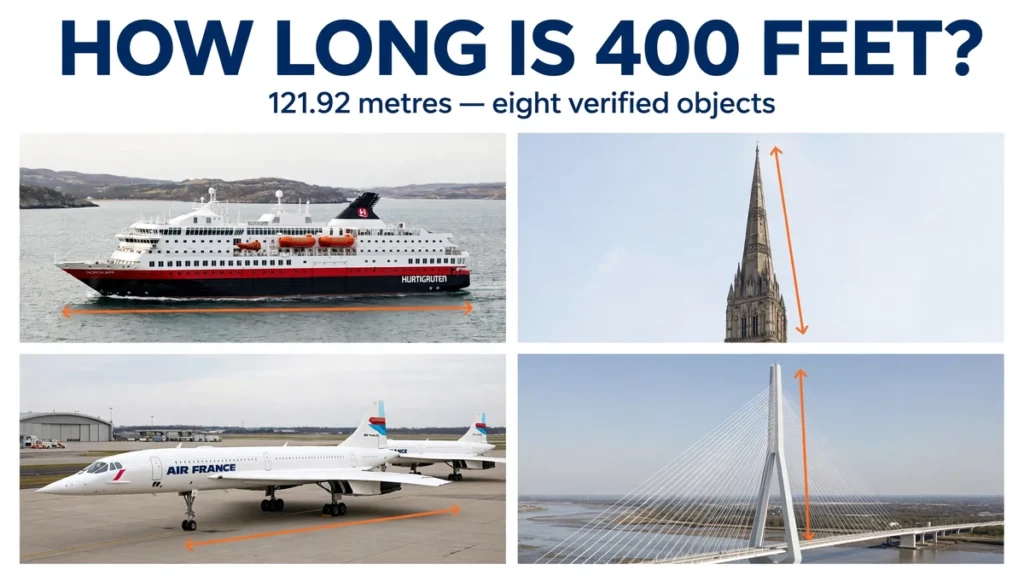
How Long Is 400 Feet? 8 Verified Objects, Ship to Spire
Table of Contents
A page about 400 feet says 400 feet is 1,219 metres. It is 121.92 metres — the page is wrong by a factor of ten about its own number, while its own converter says 121.92 metres. The same page says 400 feet is about the length of four American football fields laid end to end. Four fields are 1,200 feet. Four hundred feet is one field and a third. Another page says a football field including its end zones is exactly 400 feet long. It is exactly 360 feet. A third page says fifty-seven parked cars at seven feet each make 399 feet. Seven feet is the width of a car, not the length — fifty-seven cars bumper to bumper are 855 feet.
How long is 400 feet, then, in plain terms? It is 121.92 metres — 4,800 inches, 133.33 yards, 0.12192 kilometres — or about one and a third football fields, or exactly 160 average steps, or a Norwegian coastal ship her own operator rounds to 400 feet. The eight objects below are the closest honest answers to it: one lands 12 centimetres short, three land within a metre and a half, and the furthest is 4.92 metres short — and every one carries the source that proves it, with the miss printed next to it.
Quick Answer
400 feet is 121.92 metres — the length of a 121.8 m Norwegian coastal ship.
400 feet is 121.92 metres, 4,800 inches and 0.12192 kilometres. One object lands within 12 cm — the MS Nordlys at 121.8 m — and the other seven sit within 4.92 m: the Salisbury Cathedral spire at 123 m, two Concordes at 123.32 m, the Mersey Gateway south pylon at 125 m, the Octopus at 126.20 m, the Sedov at 117.5 m, the Stratolaunch at 385 ft and the Edificio España at 117 m.
121.92 mmetres
4,800 ininches
133.33 ydyards
0.12192 kmkilometres
0100 ft200 ft300 ft400 ft
The bar above shows forty 10 ft segments, but it is a diagram, not a ruler: screen sizes vary, so it explains the measurement rather than measuring it. For a real measurement, use the objects below or a tape measure.
The 400-Foot Page That Made 400 Feet Ten Times Too Long
The trap in this article is not a unit. It is a page that cannot multiply its own number. A ranking page about 400 feet opens by telling the reader that 400 feet is “roughly 1,219 meters” — and 1,219 metres is 4,000 feet, not 400. The decimal point slipped one place to the right. The same page’s own comparison table says a football field with end zones is 380 feet, and its own converter at the bottom says 400 feet is 121.92 metres. The page disagrees with itself twice. The answer is the converter’s: 121.92 metres, exactly, because 400 × 0.3048 is 121.92 and a foot is 0.3048 metres by definition.
The football field is where the rivals go wrong most often, in three different ways at once. One page says a field including its end zones is “exactly 400 feet long” — it is exactly 360 feet, because the field is 100 yards (300 feet) goal line to goal line and the end zones add 10 yards (30 feet) each. Another does the arithmetic as “360 ft + 2×10 ft = 380 ft” — the end zones are 10 YARDS, not 10 feet, so the sum is 300 + 30 + 30 = 360 feet. A third says a field is “about the length” of 400 feet, excluding the end zones — 400 feet is 100 feet longer than the 300-foot field, a third longer, not “about” the same. Three pages, three different fields, and none of them is 360 feet.
Rival “400 ft” claim
What it actually measures
The miss
400 feet is roughly 1,219 metres
121.92 m
1,097.08 m out — ten times too long
A football field with end zones is exactly 400 feet
360 ft (120 yd)
40 ft out
Fifty-seven cars at 7 feet each make 399 feet
57 cars at ~15 ft are 855 ft
456 ft out — 7 ft is the width, not the length
Five school buses end to end are pretty close to 400 feet
Five buses at the page’s own maximum (38.9 ft) are 194.5 ft
205.5 ft out — it takes ten buses
The Grandeur of the Seas is approximately 400 feet
279 m (915 ft 4 in)
515 ft out
The Golden Gate Bridge towers are 400 feet
746 ft above water, 500 ft above roadway
346 ft / 100 ft out
The car error is the most instructive: a car is about 15 feet long and about 7 feet wide, so fifty-seven cars bumper to bumper are 57 lengths, and 57 × 15 is 855 feet — more than twice 400 feet. The page multiplied the width and called it a length; its arithmetic (57 × 7 = 399) is correct arithmetic about the wrong number. The bus error is the same shape in reverse: a page whose heading says FOUR city buses and whose paragraph says NINE, when four buses at 40 to 45 feet are 160 to 180 feet and nine at 45 feet are 405 feet.
And then there is the ship that is not 400 feet at all. One rival page names a cruise ship — the Grandeur of the Seas — and calls her “approximately 400 feet” long. She is 279 metres, which is 915 feet 4 inches: more than twice 400 feet, 515 feet over. The page named the ship, which is more than most rival pages manage, and then got her length wrong by 129 percent. The Golden Gate error is the same shape: a page calls the bridge’s towers 400 feet tall, and the towers are 746 feet above the water and 500 feet above the roadway — neither figure is 400 feet, and the page never says which height it means.
The rule for this article is simple: name the thing, name the axis, print the miss. A ship is 121.8 metres long overall and 103.8 metres at the waterline; a spire is 123 metres from the ground to the tip; a Concorde is 61.66 metres nose to tail and 25.6 metres wingtip to wingtip; a pylon is 125 metres tall and the pylon next to it is 110 metres; a yacht is 126.20 metres long overall; a sailing ship is 117.5 metres overall and 108.7 metres of hull; an aircraft is 385 feet across and 238 feet long; a building is 117 metres to the roof and 107 metres architecturally. The eight objects below all carry their miss in the heading.
How to Measure 400 Feet Without a Tape
Before the objects, a tape of your own — because the rivals’ arithmetic is the reason this article exists, and the reader should be able to check every claim in it with nothing more than their feet. The best method needs no object at all: 400 feet is exactly four 100-foot lengths, so pace off four of them, or count exactly 160 steps at an average 0.762-metre (2.5-foot) stride — 121.92 divided by 0.762 is exactly 160.0. The second-best method needs a sports field: an American football field is 360 feet from end zone to end zone, so walk the field and add 40 feet — one end zone and a third of another — and you have 400 feet. The third needs a hockey rink: a regulation NHL rink is 200 feet from end to end, so two rinks laid end to end are exactly 400 feet.
Method
What you get
How close it is
Four 100-foot lengths end to end
400.00 ft
Exact
Exactly 160 steps at a 0.762 m stride
400.00 ft
Exact
Two NHL hockey rinks end to end
400.00 ft
Exact
A football field with end zones, plus 40 ft
400.00 ft
Exact
About 27 cars bumper to bumper at 15 ft each
405.00 ft
5 ft over
The steps method is the one to use when there is nothing to measure with, and it is the only method in the table that needs a warning: a step is not a fixed length. A tall adult walking briskly covers 400 feet in as few as 140 steps, and a child or a short-stride walker needs 190 or more — so the 160-step figure is an average, not a measurement. Measure your own stride over 10 metres first (count the steps, divide 10 by the count), then multiply. The car-park method needs its caution too: a car is about 15 feet long, so 27 cars are 405 feet, 5 feet over — and a car is about 7 feet wide, so 57 cars are 399 feet of width, the rival page’s error, not a measurement. The time method is the one to use when there is nothing to count: 400 feet at a normal walking pace takes 87 seconds — a minute and twenty-seven seconds — and at a brisk pace it takes 81 seconds. A world-class sprinter covers it in about 12 seconds.
The fitting check is the stride, and it is also the drone. In the United States, the Federal Aviation Administration caps drones at 400 feet above ground level — so 400 feet is not only a length on the ground, it is a legal ceiling in the air. The ceiling is measured above the ground directly below the drone, not above sea level and not above the take-off point, so a drone flown up a hillside is 400 feet above the slope beneath it. That is the same datum lesson as the rest of this article: the number is only honest when the place it is measured from is named with it.
8 Things That Are 400 Feet
The eight objects are ordered by how close they land on 400 feet, closest first, and each one carries its evidence grade in the heading. EXACT means the figure is the operator’s or manufacturer’s published dimension. LISTED means the figure is the manufacturer’s published specification for the named model, as carried by a reputable source. REPORTED means the figure is a published reference measurement — a tallest-buildings list entry, a project record, or a ship register entry. One of the eight lands within 12 centimetres of 400 feet, three land within a metre and a half, and the furthest is 4.92 metres short — a mean absolute deviation of 2.98 metres, no object more than 4 percent away.
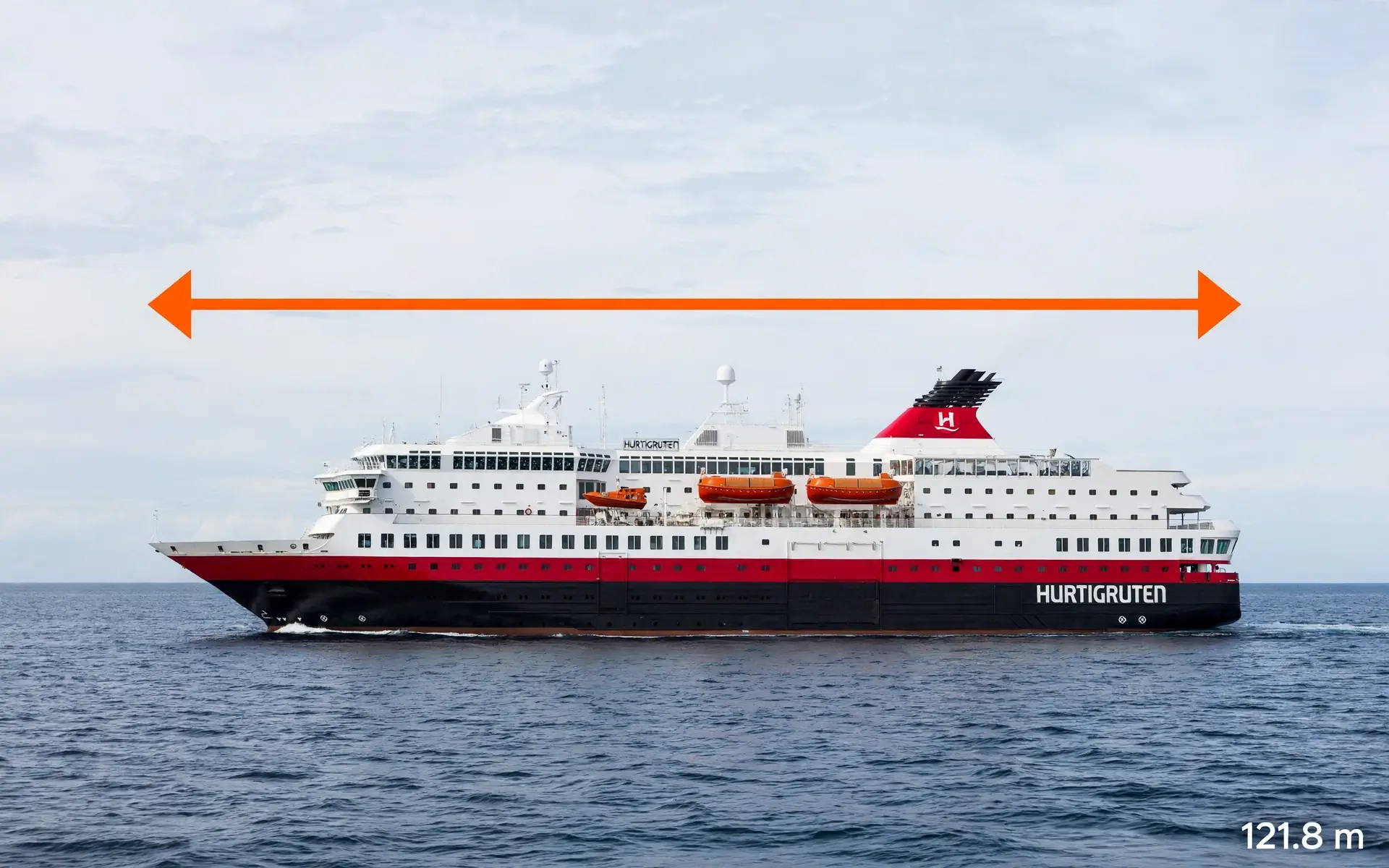
1. MS Nordlys, Length Overall 121.8 m (399 ft 7 in) — 12 cm Short (EXACT)
The ship is the article’s closest land-on, because her 121.8 metres is the length her own operator publishes for her — and the operator rounds it to 400 feet. Hurtigruten’s own ship page lists the MS Nordlys at “Length 121.8 m / 400 ft”, built in 1994 at the Volkswerft yard in Germany, with 505 beds and a speed of 18 knots, so the ship measures 121.8 metres from bow to stern — 12 centimetres short of 400 feet, the tightest land-on in this article and one of the tightest in the whole series.
The fitting check is the rounding: the operator’s own page rounds 399 feet 7 inches up to 400 feet. The precise figure is 121.8 metres, which is 399.61 feet — 39 hundredths of a foot short of the number, about the length of a shoe — and a berth sold as “400 feet” would fit her with 12 centimetres to spare. But a berth sold as “400 feet” is a length, not a width, and the Nordlys is 19.2 metres wide with a gross tonnage of 11,204, so the berth must be wider than 19.2 metres as well as longer than 121.8 metres. The grade is exact because the figure is the operator’s published dimension for its own ship. Never write “the Nordlys is exactly 400 feet” — she is 121.8 metres, and the 12 centimetres is the difference between a rounding and a measurement. Her sister ships Kong Harald and Richard With are the same 121.8 metres, so the class, not just the ship, lands on the number.
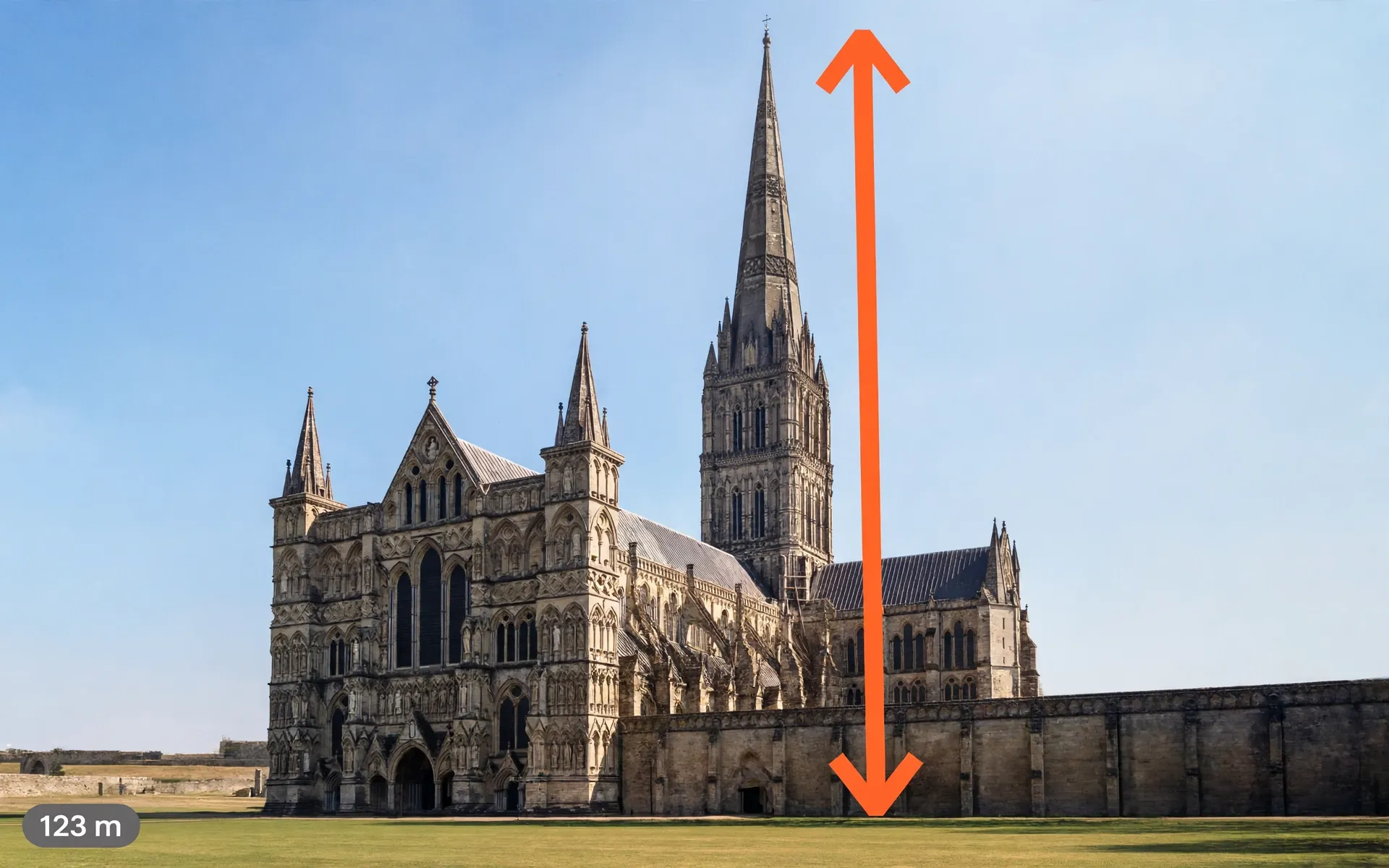
2. Salisbury Cathedral Spire, Height 123 m (404 ft) — 4 ft Over (REPORTED)
The spire is the article’s oldest land-on, and the one that proves 400 feet is a height as well as a length — and that a height can stand for seven hundred years without moving. Salisbury Cathedral’s reference entry gives the spire at 404 feet (123 metres), the tallest church spire in England, with the tower and spire completed by 1330, so the spire rises 123 metres from the ground to its tip — 4 feet over 400 feet, the second-tightest land-on in this article.
The fitting check is the building: the spire is 123 metres tall but the cathedral it crowns is 135 metres long — the building is longer than the spire is tall — and the tower and spire together added 6,500 tonnes to a building whose foundations are only 1.2 metres deep, on marshy ground. A scaffold planned for a 123-metre spire must reach the tip, not the tower. The grade is reported because the figure is a published reference measurement, not a builder’s spec — the cathedral was built between 1220 and 1258 and the spire was added by 1330. The deviation is printed in full: 123 m, 4 feet over — the precise conversion is 403.54 feet, so the real miss is 3.54 feet. Never write “the spire alone is 123 metres tall” — the 123 metres is the tower and spire together, from the ground to the tip.
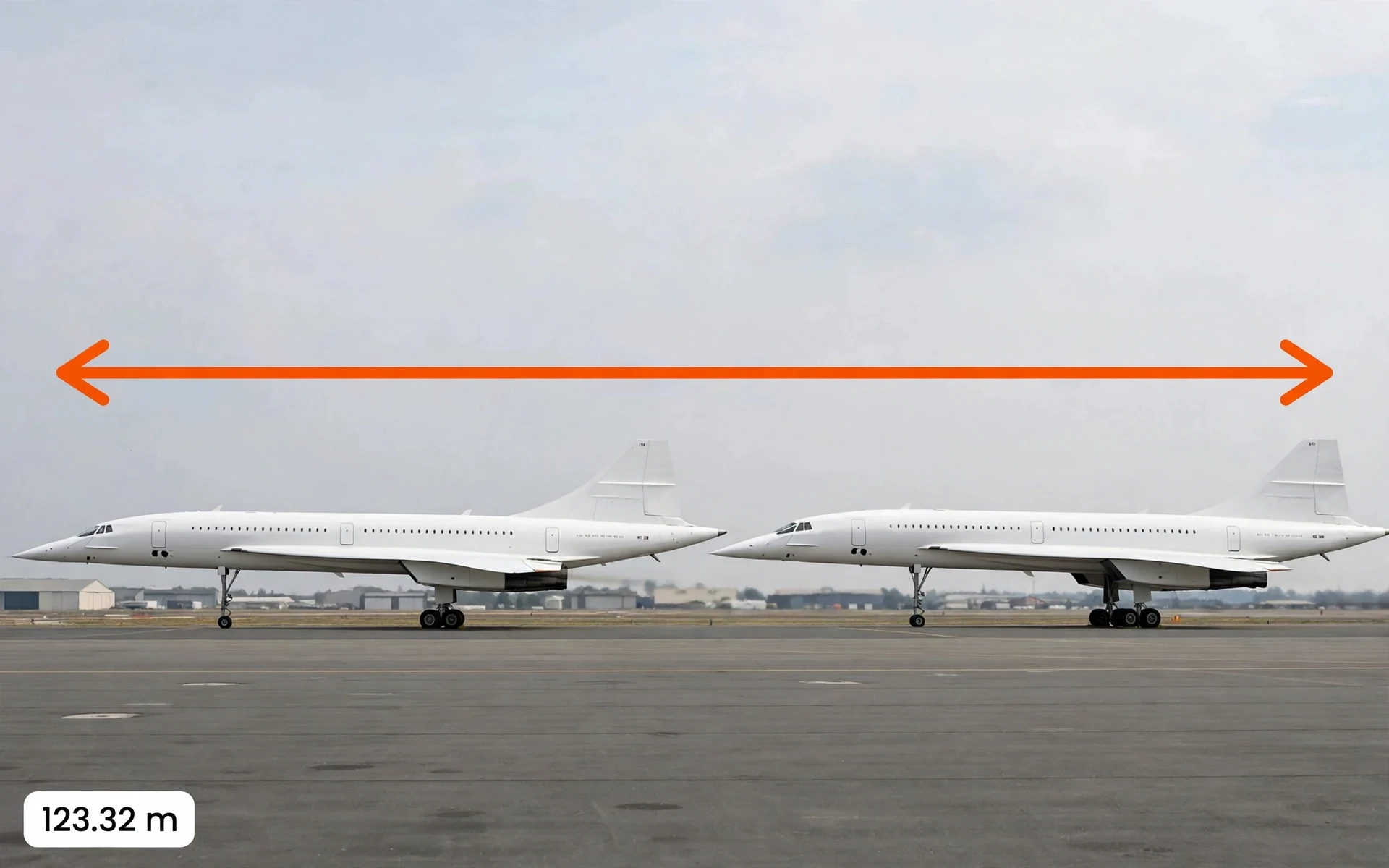
3. Two Concorde, Length 123.32 m (404.59 ft) — 4.59 ft Over (LISTED)
The jets are the article’s fastest land-on, because they are the only supersonic airliners ever flown in regular service, and two of them nose to tail are the closest pair in this article. Concorde’s specification table lists the length at 202 feet 4 inches (61.66 metres), with a wingspan of 84 feet (25.6 metres) and a height of 40 feet (12.2 metres), so two Concordes parked nose to tail measure 123.32 metres — 4.59 feet over 400 feet, the third-tightest land-on in this article.
The fitting check is the fuselage: each Concorde is 61.66 metres long overall but its fuselage is only 39.32 metres inside — twenty-two metres of the aircraft is nose, tail cone and droop-nose mechanism. Two aircraft nose to tail are 123.32 metres of aeroplane, but the cabin space inside them is 78.64 metres, and the wingspan of the pair side by side would be 51.2 metres. The grade is listed because the figure is the manufacturer’s published specification as carried by the reference literature and confirmed by Eurocontrol’s aircraft database, which lists the same 61.66-metre length. Do not confuse the length with the wingspan: a Concorde is 61.66 metres long but only 25.6 metres across, so two aircraft nose to tail are 123.32 metres long and two aircraft wingtip to wingtip are 51.2 metres wide — two different numbers, and a stand that fits the length must also fit the span. And do not confuse the Concorde with the Tu-144: the Soviet supersonic airliner was 65.7 metres long, so two of them would be 131.4 metres — 31 feet over 400 feet, a different aircraft and a worse fit.
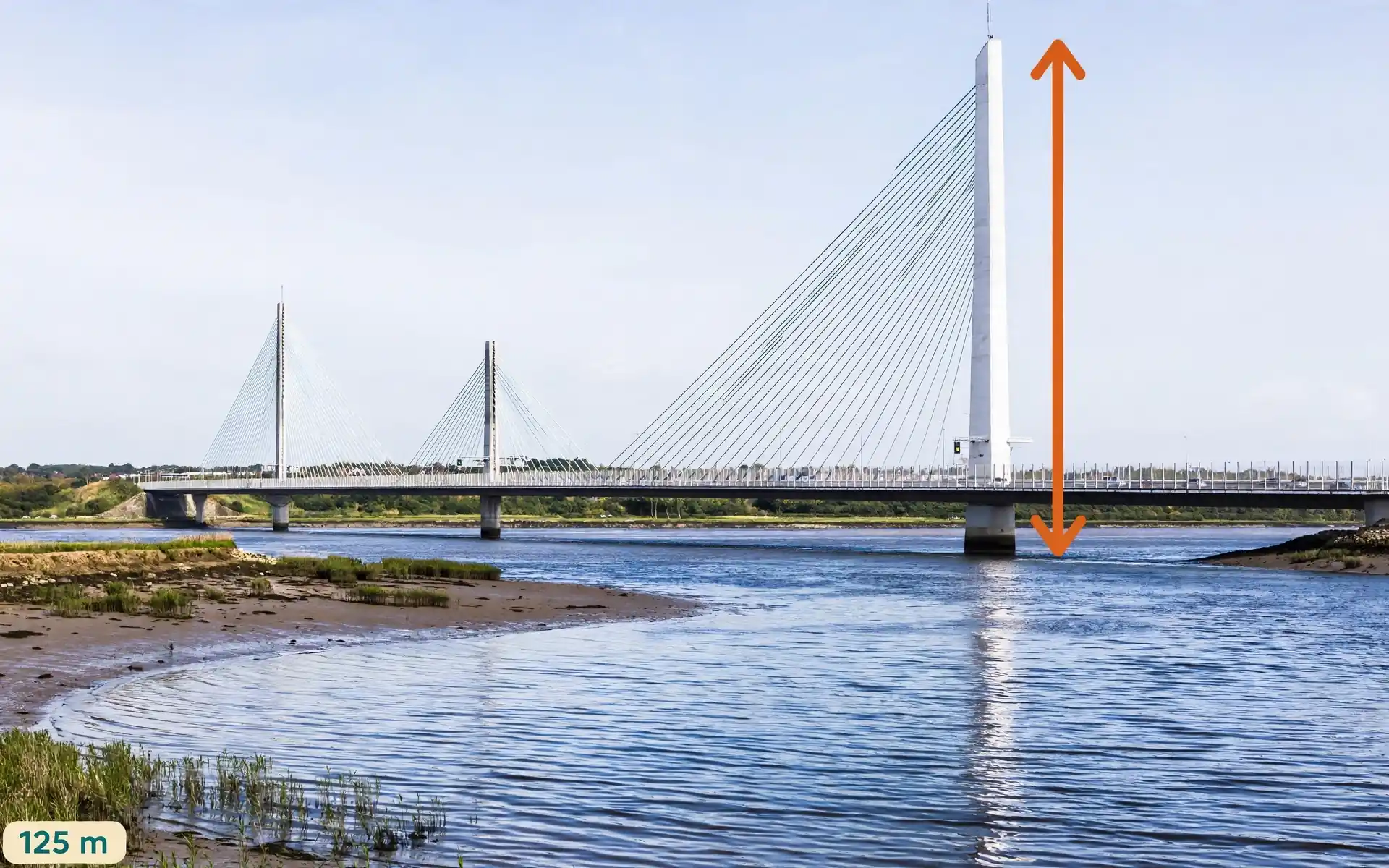
4. Mersey Gateway Bridge South Pylon, Height 125 m (410 ft) — 10 ft Over (REPORTED)
The pylon is the article’s newest land-on, and the one that proves 400 feet is a bridge height as well as a ship length — and that a bridge can have three different heights at once. The bridge’s reference entry gives the south pylon at 125 metres high, with the north pylon at 110 metres and the central pylon at 80 metres, so the south pylon measures 125 metres from the river bed to its top — 10 feet over 400 feet, the fourth-tightest land-on in this article.
The fitting check is the pylon: the bridge has three pylons and they are three different heights — 125 metres, 110 metres and 80 metres — and the article’s object is the SOUTH pylon only. A guide that says “the Mersey Gateway Bridge is 125 metres tall” without “the south pylon” has given one pylon’s height for a bridge with three, and the central pylon is 45 metres shorter than the south one. The heights were capped by the flight paths into Liverpool John Lennon airport, which is why the central pylon is the shortest of the three. The grade is reported because the figure is a published reference measurement, not a manufacturer spec — the bridge opened in October 2017. The deviation is printed in full: 125 m, 10 feet over. Never write “the bridge is 410 feet long” — the cable-stayed section is about a kilometre long and the whole crossing is 2.25 kilometres, and the 125 metres is a height, not a length.
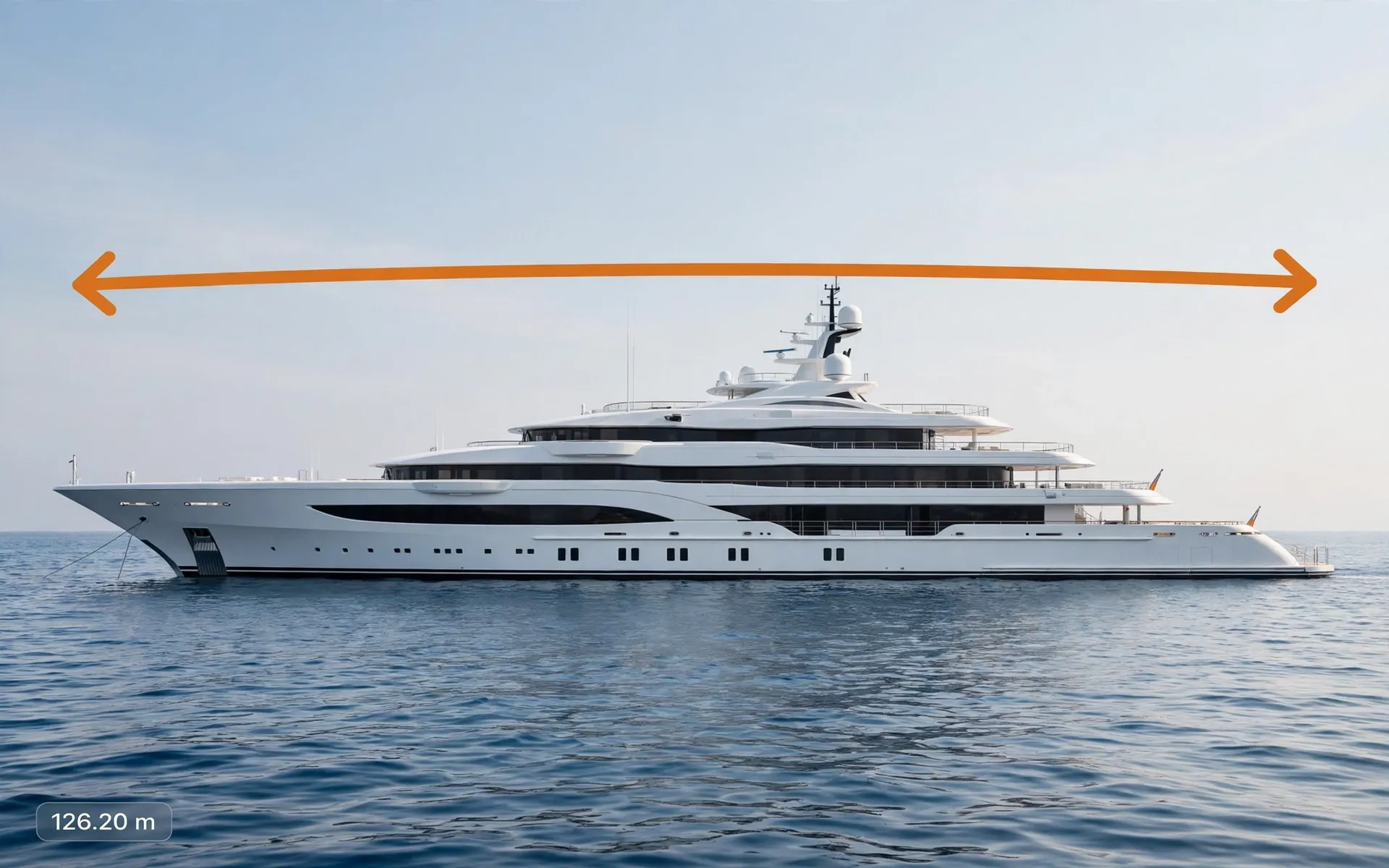
5. Octopus Superyacht, Length Overall 126.20 m (414 ft 1 in) — 14 ft Over (LISTED)
The yacht is the article’s longest sea land-on, and the one that proves 400 feet is a berth as well as a length. Boat International puts the Octopus at 126.18 metres, built by the German yard Lürssen and delivered in 2003, with a beam of 21.00 metres, a draft of 5.76 metres and a gross tonnage of 9,932, so the yacht measures 126.20 metres from bow to stern — 14 feet over 400 feet, the fifth-tightest land-on in this article.
The fitting check is the berth: the yacht is 126.20 metres long OVERALL and a berth is sold by the length it can hold plus clearance for fenders and mooring lines. A marina that sells a “400-foot berth” sells 400 feet of water, and a 414-foot yacht needs more than 400 feet of it once fenders and lines are counted — so the berth for this yacht is a 430-foot berth, not a 400-foot one — and never quote the gross tonnage (9,932 GT) as a length, because tonnage is volume, not size. The grade is listed because the figure is the builder’s published specification as carried by the yachting trade press. One caution: the reference entry gives 126.20 metres and the trade directory gives 126.18 metres — a 2-centimetre spread that changes nothing, and the article uses 126.20 metres. And do not confuse her with the Dilbar: the Dilbar is 156 metres long and sits in the 150-metre article, and the two yachts are 30 metres apart.
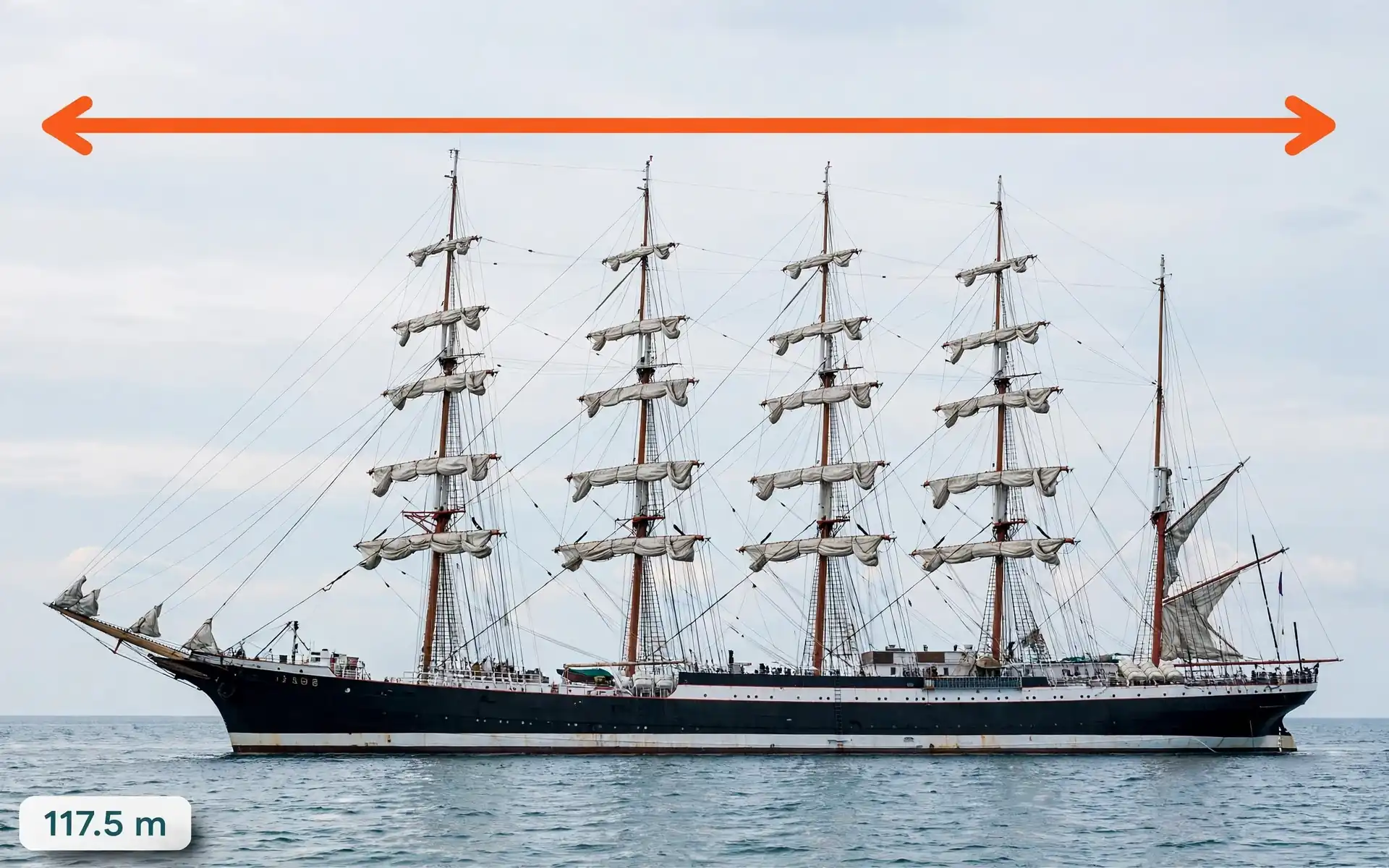
6. STS Sedov, Length Overall 117.5 m (385 ft 6 in) — 14.50 ft Short (REPORTED)
The barque is the article’s oldest land-on, and the one that proves 400 feet is a sailing-ship length as well as a motor-ship one — and that a sailing ship is three lengths at once. The Sedov’s reference entry gives the length at 117.5 metres (385 feet 6 inches) overall, with a hull of 108.7 metres and a deck of 100 metres, so the ship measures 117.5 metres from the tip of her bowsprit to her stern — 14.50 feet short of 400 feet, the sixth-tightest land-on in this article.
The fitting check is the bowsprit: the Sedov is 117.5 metres OVERALL but her hull is 108.7 metres and her deck is 100 metres — the bowsprit adds 8.8 metres, and the deck is 17.5 metres shorter than the overall. A dry dock built for a 117.5-metre ship fits her overall length, but a berth measured by the deck would leave 17.5 metres of her hanging over the end. The grade is reported because the figure is a published reference measurement, not a builder’s spec — the ship was launched in 1921 as the Magdalene Vinnen II. One caution: the Sedov was for almost eighty years the largest traditional sailing ship in operation, and she is still sailing as a training ship — so never write “the Sedov was 117.5 metres” as if she were gone. Her four steel masts carry 4,195 square metres of sail, which is the second number that decides whether a harbour can take her — the masts, not the hull, decide the air draft.
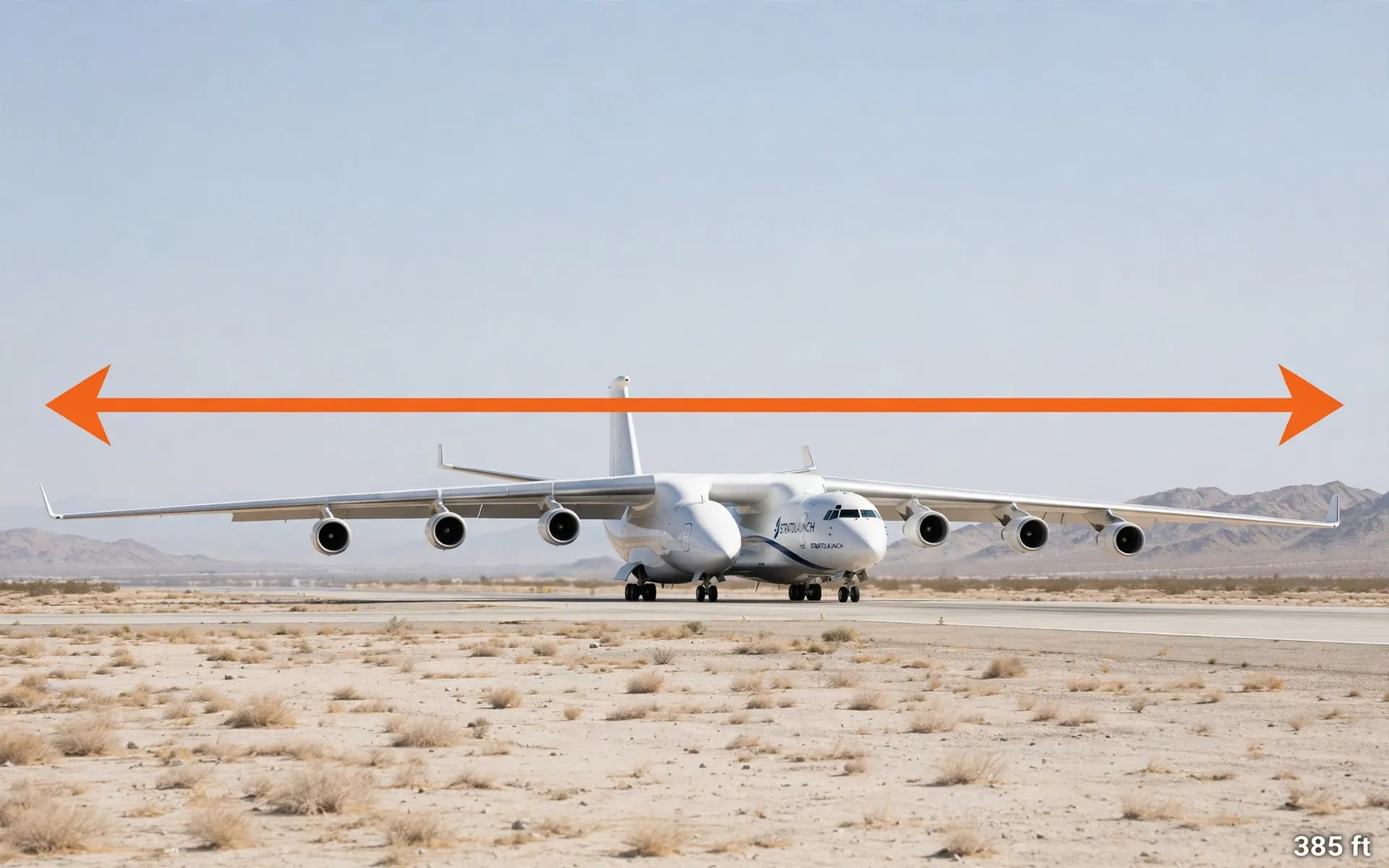
7. Stratolaunch Roc, Wingspan 385 ft (117.35 m) — 15 ft Short (EXACT)
The aircraft is the article’s widest land-on, and the one that proves 400 feet is a wingspan as well as a length — and that the widest aircraft ever flown is still 15 feet short of it. Stratolaunch’s own Roc page gives the total wingspan at 385 feet, with a length of 238 feet and a height of 50 feet, so the aircraft measures 385 feet from wingtip to wingtip — 15 feet short of 400 feet, the seventh-tightest land-on in this article.
The fitting check is the wing: the Roc is 385 feet ACROSS but its fuselages are 238 feet LONG and it stands 50 feet tall — three different numbers, and the article’s object is the wingspan only. A hangar planned for a 385-foot wingspan must be wider than 385 feet, but a hangar planned for a 238-foot aircraft must be longer than 238 feet, and the two are not the same hangar. The grade is exact because the figure is the manufacturer’s published dimension for its own aircraft — the precise metric is 117.348 metres, stated as 117.35 metres. Do not confuse the wingspan with the length: the Roc is wider than a football field is long (300 feet) and wider than the Saturn V rocket is tall (363 feet), and it needs 3,700 metres of runway to take off.
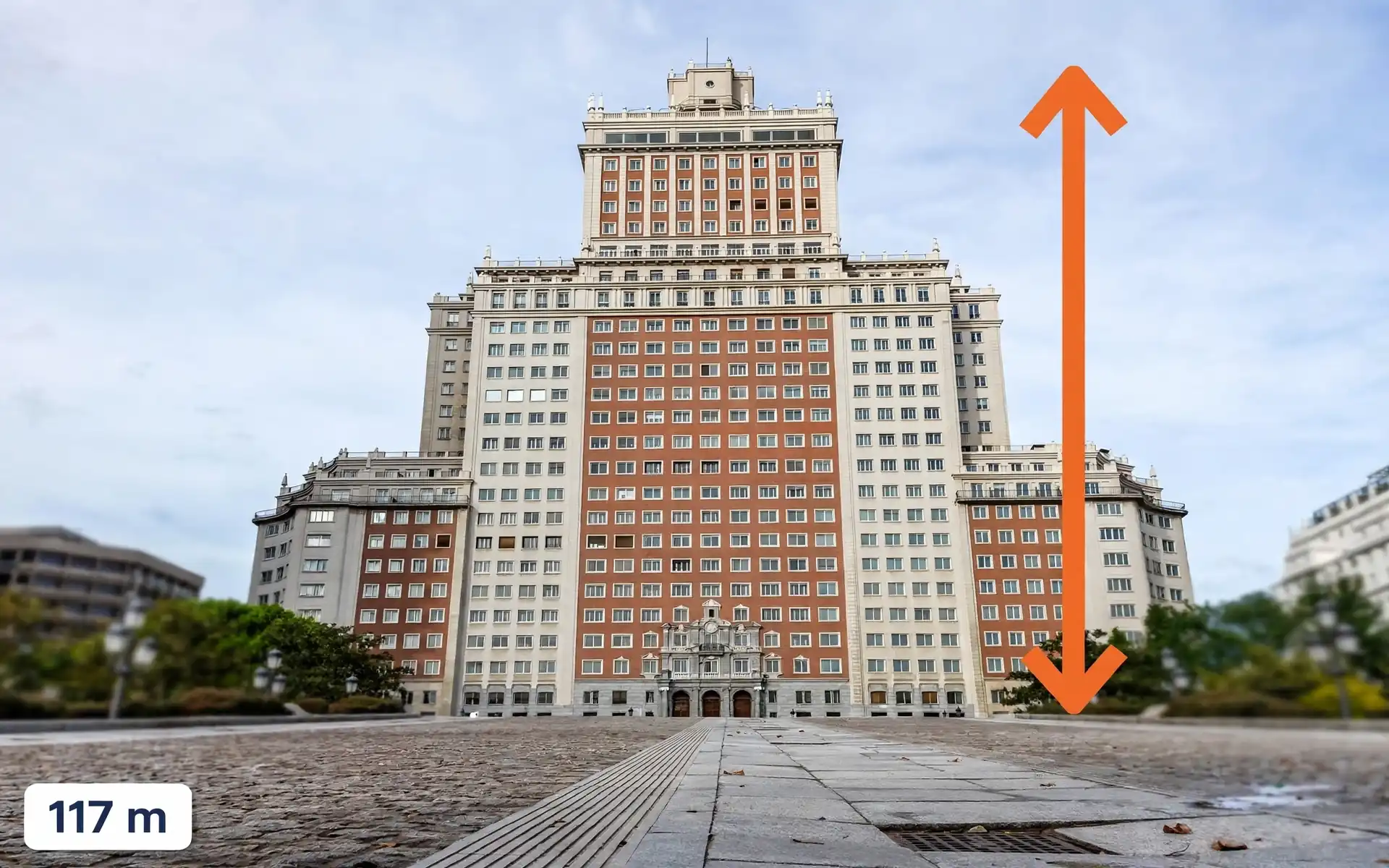
8. Edificio España, Height 117 m (384 ft) — 16 ft Short (REPORTED)
The building is the article’s furthest land-on, and the one that proves 400 feet is a roof height as well as a spire height — and that a roof and an architectural height are two different numbers for one building. The Edificio España reference entry gives the roof at 117 metres (384 feet) and the architectural height at 107 metres (351 feet), with the building completed in 1953 at the end of Madrid’s Gran Vía, so the building measures 117 metres from the pavement to its roof — 16 feet short of 400 feet, the furthest land-on in this article.
The fitting check is the crown: the building is 117 metres to the ROOF but 107 metres architecturally — the stepped neo-baroque crown adds 10 metres that the architectural height does not count. A guide that says “the Edificio España is 117 metres tall” without “to the roof” has given the right number for the wrong datum, and a guide that says “107 metres” without “architecturally” has given the other number for the same building. The grade is reported because the figure is a published reference measurement, not a developer spec — the building was the tallest in Spain until the Torre de Madrid, at 142 metres, overtook it. The deviation is printed in full: 117 m, 16 feet short. Never write “the Edificio España is 384 feet tall” without “to the roof” — and never confuse it with the Torre de Madrid next door, which is 142 metres (466 feet), 66 feet over 400 feet, a different building by the same architects.
Eight “400 Feet” Claims That Don’t Measure Up
What a rival list claims
What it actually measures
The difference
400 feet is roughly 1,219 metres
121.92 m
1,097.08 m out — ten times too long
400 feet is about four football fields
Four fields are 1,200 ft (1,440 ft with end zones)
800–1,040 ft out
A football field with end zones is exactly 400 feet
360 ft (120 yd)
40 ft out
Eight of these deserve a longer correction. The decimal slip is the most checkable error in the ranking pages: a rival list says 400 feet is “roughly 1,219 meters”, but 400 × 0.3048 is 121.92, and 1,219 metres is 4,000 feet — the page’s own converter, at the bottom of the same page, says 121.92 metres, so the page refutes itself. The four fields are the most confident error: a rival list says 400 feet is “about the length of four American football fields laid end to end”, but four fields are 1,200 feet or 1,440 feet — 400 feet is one field and a third, not four fields.
The football field is the most repeated error: three rival pages treat the field as the 400-foot reference, and all three get the end zones wrong. One says the field with end zones is “exactly 400 feet” — it is exactly 360 feet. One does the arithmetic as “360 ft + 2×10 ft = 380 ft” — the end zones are 10 yards, not 10 feet, so the sum is 300 + 30 + 30 = 360 feet. One says the field is “about the length” of 400 feet excluding the end zones — 400 feet is 100 feet longer than the 300-foot field, a third longer, not “about” the same. The ship is the most named error: a rival page names the Grandeur of the Seas and calls her “approximately 400 feet”, but the ship’s reference entry gives her at 279 metres (915 feet 4 inches) — 515 feet over. The towers are the most visual error: a rival page calls the Golden Gate Bridge towers 400 feet tall, but the bridge district’s own published statistics give the towers at 746 feet above the water and 500 feet above the roadway — neither figure is 400 feet, and the page never says which height it means.
The wingspans are the most precise-looking error: a rival page says two Boeing 747 wingspans are “just slightly over 400 feet”, but a 747-400 wingspan is 211 feet 5 inches, so two are 422 feet 10 inches — 23 feet over, not “slightly” — and a 747-8 wingspan is 224 feet 5 inches, so two are 448 feet 10 inches — 49 feet over. The school buses are the most self-refuting error: a rival page says five large school buses end to end are “pretty close to 400 feet”, and its own range for a bus is 20.9 to 38.9 feet, so five buses at the maximum are 194.5 feet — the page’s own figures refute its own conclusion, and it takes ten 40-foot buses to make 400 feet. The cars are the most instructive error: a rival page says fifty-seven parked cars at seven feet each make 399 feet, and 57 × 7 is 399 — but seven feet is a car’s width, not its length, and fifty-seven cars bumper to bumper at 15 feet each are 855 feet. It takes about 27 cars at 15 feet to make 400 feet.
Four near-misses deserve a line of their own, and three of them deserve credit. The London Eye is 443 feet (135 metres) — the rival page’s figure is right, and 400 feet is 43 feet short of it. Kingda Ka was 456 feet (139 metres) — the rival page’s figure was right, but the ride closed permanently on 10 November 2024 and was demolished on 28 February 2025, so the page presents a landmark that no longer exists. Half the Ain Dubai is 410 feet — the rival page’s arithmetic is right (820 ÷ 2 = 410), and 400 feet is 10 feet short of it. The Stratolaunch is 385 feet — the rival page’s figure is right, and 400 feet is 15 feet longer than it, which is why the aircraft is one of the eight objects above. Half the Titanic is 441 feet — the rival page’s “just about half” is 41 feet over, because the Titanic was 882 feet 9 inches long. Four blue whales are 320 to 360 feet at average size and 392 feet at the largest recorded size — even four record whales are 8 feet short. The Great Pyramid was originally 481 feet tall, not “close to 430 feet” — the rival page is 51 feet out. And the Statue of Liberty is 305 feet from the ground to the torch — the pedestal is inside that figure, not added to it, and the statue is 95 feet short of 400 feet. A Vanguard-class submarine at 149.9 metres (491 feet 10 inches) is 92 feet over 400 feet. And twenty average great whites at 14.5 feet are 290 feet — it takes about 28 of them to make 400 feet.
400 Feet in Every Unit
Unit
Value
Millimetres
121,920 mm
Centimetres
12,192 cm
Metres
121.92 m
Kilometres
0.12192 km
Inches
4,800 in
Feet
400 ft
Yards
133.33 yd
Miles
0.0758 mi
Four hundred feet is 121,920 millimetres, and a foot is 304.8 millimetres, so the conversion is a multiplication that never needs a calculator. In inches it is 400 × 12, which is exactly 4,800, with no rounding anywhere. In yards it is 400 divided by 3, which is 133.333…, rounded to 133.33. 400 feet is exactly four lengths of 100 feet, and 100 feet is 30.48 metres, so 400 feet is 4.064 times 30 metres and 3.048 times 40 metres, and 121.92 metres is 1.2192 times 100 metres and 0.8128 times 150 metres. 400 feet is exactly twelve 10-metre lengths and a fifth of another, exactly 121.92 × 1 metre, exactly 243.84 × 50 cm, exactly 487.68 × 25 cm, exactly 160 × 30 inches and exactly 48 × 100 inches — the cleanest ladder in the feet series at this scale. 400 metres is 1,312.34 feet, so 400 feet is 3.28 times shorter than 400 metres, and 400 yards is 1,200 feet, so 400 feet is three times shorter than 400 yards — the same number in three units, three different lengths. Feet are the unit on US tapes and property lines, yards are the unit on football fields, and metres are the unit on ship, aircraft and bridge specifications.
The 400-Foot Fit-Check: Before You Book, Build or Bet
– Ship berth: the MS Nordlys is 121.8 m long overall and 19.2 m wide — so a berth sold as “400 feet” fits her length with 12 cm to spare, but it must also be wider than 19.2 m, and the waterline is only 103.8 m.
– Spire scaffold: the Salisbury spire is 123 m from the ground to the tip — so a scaffold planned for the spire must reach the tip, not the tower, and the cathedral is 135 m long.
– Jet stand: two Concordes need a stand longer than 123.32 m with wingtip clearance on a 25.6 m span each — so a stand that fits the pair’s length must also fit the 51.2 m of wingspan, and the fuselage inside is only 39.32 m.
– Pylon quote: the Mersey Gateway south pylon is 125 m but the north pylon is 110 m and the central pylon is 80 m — so quote which pylon with the height.
– Yacht berth: a 126.20 m Octopus needs a berth longer than 126.20 m plus fenders and lines — book a 130 m berth, not a 400 ft one — and never quote the gross tonnage (9,932 GT) as a length.
– Sailing ship: the Sedov is 117.5 m overall but her hull is 108.7 m and her deck is 100 m — so a berth measured by the deck leaves 17.5 m of her hanging over the end.
– Aircraft hangar: the Stratolaunch is 385 ft across but its fuselages are 238 ft long and it stands 50 ft tall — so a hangar planned for a 385 ft wingspan must be wider than 385 ft, and a runway planned for a 238 ft aircraft must be 3,700 m long.
– Building quote: the Edificio España is 117 m to the roof but 107 m architecturally — so quote the roof with the height.
Frequently Asked Questions
How many meters is 400 feet?
Four hundred feet is 121.92 metres exactly — 400 × 0.3048. One ranking page says 1,219 metres, which is ten times too long; 1,219 metres is 4,000 feet.
Is 400 feet the same as 400 meters?
No. Four hundred metres is 1,312.34 feet, so 400 metres is 3.28 times longer than 400 feet — 912.34 feet longer, about the length of three football fields. And 400 yards is 1,200 feet, three times longer than 400 feet. The same number in feet, metres and yards is three different lengths.
What everyday things are 400 feet long?
Eight verified objects, tightest first: the MS Nordlys (121.8 m), the Salisbury spire (123 m), two Concorde (123.32 m), the Mersey Gateway south pylon (125 m), the Octopus (126.20 m), the Sedov (117.5 m), the Stratolaunch (385 ft) and the Edificio España (117 m). Every one is verified against the operator’s specification, the manufacturer’s specification or the published reference.
Is a football field 400 feet long?
No. An American football field is 300 feet from goal line to goal line and exactly 360 feet including the end zones, which are 10 yards (30 feet) each. Four hundred feet is 40 feet longer than the field with its end zones and 100 feet longer than the field without them.
How many steps is 400 feet?
Exactly 160 steps at a 0.762-metre (2.5-foot) average stride — 121.92 divided by 0.762 is 160.0. Measure your own stride over 10 metres first, because a tall adult walking briskly covers 400 feet in as few as 140 steps and a child needs 190 or more.
How long does it take to walk 400 feet?
About 87 seconds at a normal walking pace of 1.4 metres per second, or about 81 seconds at a brisk 1.5 metres per second. A world-class sprinter covers it in about 12 seconds.
Can you fly a drone at 400 feet?
Four hundred feet above ground level is the Federal Aviation Administration’s ceiling for drones in the United States — a legal maximum, not a target. Stay under it, and lower near airports and people. The ceiling is measured above the ground directly below the drone, not above sea level and not above the take-off point.
How do I measure 400 feet without a tape?
Count exactly 160 average steps; lay two NHL hockey rinks end to end (200 feet each, exactly 400 feet); walk a football field with its end zones and add 40 feet; lay four 100-foot lengths end to end; or line up about 27 cars at 15 feet each. Never use four football fields or 57 cars at 7 feet — that is the width, not the length.
Final Thoughts
Four hundred feet is a distance you sail, climb, fly and build — a ship, a spire, two jets, a pylon, a yacht, a barque, an aircraft and a building — and the miss is the whole article. Every one of the eight carries the number its source actually publishes, with the miss printed next to it. That is the difference between a measurement and a slogan: the measurement can be checked, and the slogan cannot.
Do not take the round number, and do not take the name. Ask which unit was measured — the foot or the metre, the length overall or the waterline, the spire or the tower, the nose or the wingspan, the south pylon or the north one, the wingspan or the length, the roof or the architectural height — look up the specification, and print the miss when there is one. Four hundred feet, measured honestly, is 121.8, 123, 123.32, 125, 126.20, 117.5, 117.35 and 117 — never just “about 400”.
Alyee
Alyee is a measurement researcher and content writer specializing in verified dimension guides. Every object on ExactDimensionz is cross-checked against official manufacturer specifications before publication. Her guides start with the manufacturer's own specification sheet, checked against standards from NIST and ISO, and sport-specific authorities such as FIVB and World Aquatics where they apply. When sources disagree, she says so plainly, using 'listed at' wording so readers can see where each figure comes from. No number is published unless it can be verified, and every image is checked against the object it shows. Alyee writes about inches, feet, centimeters, millimeters, and meters, as well as drink and can dimensions, everyday objects, and measurement tools.